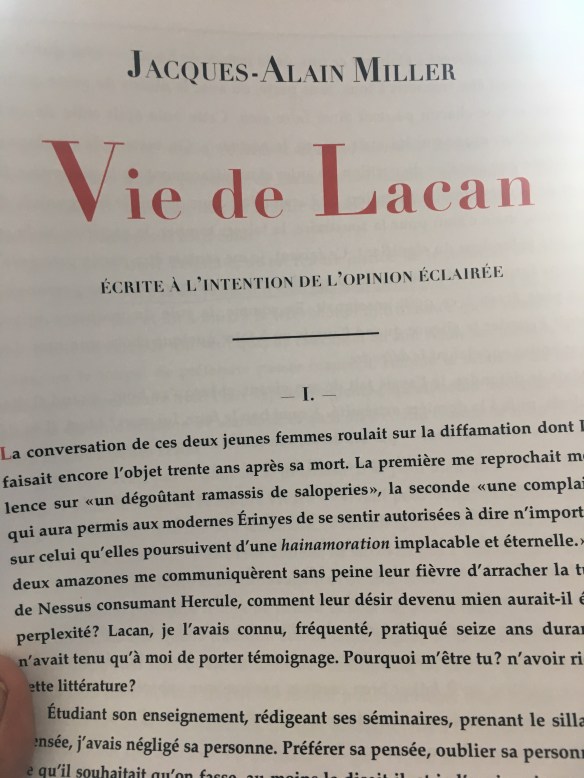
Vie de Lacan, mastodonte singular.

vie de lacan

Los rasgos “éticos” que le atribuye Miller a Lacan (en el sentido infrapolítico, esto es, desde una cierta voluntad de destrucción de la relación ético-política y hacia una “ética originaria” en el sentido del Heidegger de Carta sobre el humanismo–nada que ver con moralinas) pueden gustar o no, pueden ser resorte de identificación o de crítica, pero creo que conforman una figura de carácter superior a la ofrecida por Benjamin con su “carácter destructivo,” con la que sin embargo guardan relación.  Son:

-no un justo; nada de atormentarse por un deber de justicia.

-sin relación autobiográfica.

-sin relación servil.

-con prisa.

-con riesgo.

-siempre un poco tarde.

-siempre hasta el final.

-sin buenas intenciones.

-sin más allá de la muerte.

-sin magnanimidad.

-sin universalización (todos salvo yo).

-queriendo ser otro a pesar de la ley.

-en el me panta, contra lo que vale para todos.

-contra el orden del mundo.

-sin dejarse contar.

-sin interés en causas perdidas.

-sin optimismo

-sin idealismo.

-sin confianza en el prójimo.

-contando solo con la fuerza propia, la que sea.

-indemne a narcisos y al narciso propio.

-sabiendo hasta dónde ir demasiado lejos.

-auténtico, no faux-cul.

-siempre en el secreto.

PostScriptum:  Estos son los rasgos del “carácter destructivo” según Walter Benjamin (varios son incompatibles con el lacanismo, otros no tanto; otros coinciden plenamente):

1.  crea obligaciones profundas en otros.

2.  hacer sitio, despejar son sus necesidades definitorias.  Más fuertes que cualquier odio.

3.  La intuición del ser–el gran vínculo que abraza y unifica a lo que existe–tiene que ver con la reducción del mundo a su simplicidad radical, esto es, con su capacidad de ser destruido (y así ofrecer un resto).

4.  Siempre trabaja, pues debe anticiparse a la naturaleza–o destruye el carácter destructivo o destruye la naturaleza.  Así, urgencia, prisa.

5.  Funciona sin imágenes–no le interesa qué vaya a reemplazar lo destruido.  El espacio vacío es la imagen sin imagen.

6.  Evita la creación.  El creador precisa soledad, el destructor precisa en cambio testigos de su eficacia.

7.  Expuesto a la charla vacua, de la que no se le puede defender.

8.  Al destructor no le interesa ser comprendido.  Al contrario, provoca la incomprensión, y la tolera.

9.  El destructor lega situaciones, pues al hacerlas practicables las liquida.

10.  Tiene conciencia radical de historicidad.  Absoluta desconfianza en el curso de las cosas, y así disponibiilidad para entender que todo puede salir mal en cualquier momento.  Por lo tanto, absoluta confiabilidad.

11.  No cree en la permanencia.  Así, ve posibilidades por todas partes.  No reconoce obstáculos, sino caminos.  Pero entonces tiene que quitárselo todo de en medio, y está siempre en una encrucijada.  Reduce a escombro lo que existe no por amor del escombro sino por amor del camino que lleva más allá de él.

12.  Vive porque suicidarse no merece la pena.


Despeje y turbulencia.

Unknown

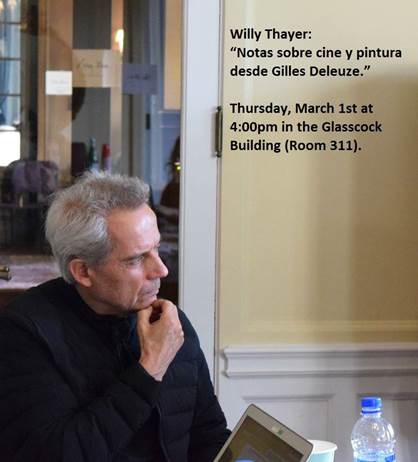
Esta nota no es más que una glosa, algo tonta o cruel, con un par de apostillas a algunos aspectos de la microentrevista sobre infrapolítica con Willy Thayer que puede encontrarse justo antes de esta entrada en el blog.   A la pregunta “¿a qué te suena infrapolítica?” Willy responde: la pregunta misma no es infrapolítica, la infrapolítica no pregunta y desde luego no pregunta eso, no pregunta el ¿qué es . . . ? que está escondido en la pregunta. Más bien la infrapolítica es una inclinación o una gravitación hacia el despeje, cuenta por lo tanto con, o busca, una experiencia de despeje, una experiencia antimilitante, pues el despeje despeja el objeto de cualquier militancia, de des-marcamiento desde la falta de suelo, la falta incluso de condiciones. Ese sería el rasgo infrapolítico, que la infrapolítica comparte con todas las escrituras memorables. Toda escritura memorable tiene que ver con esa experiencia del despeje previo en el abismo–y desde ahí uno va a cualquier parte (que merezca la pena). Pero desde ahí.

Bacon, por ejemplo, el pintor Bacon teoriza el despeje como condición de su pintura. Y esa es su relación con el pensamiento, o mejor: su modulación de pensamiento. La infrapolítica remite a una modulación del pensamiento que ya no pasa por poner, posicionar, exponer, colocar, mucho menos argumentar: se trata de despejar, y es así un pensamiento sustractivo porque busca una sustracción, busca operar una sustracción, hacia un abismo. [¿Es Lichtung la traducción de ese “despeje”? ¿Es el pensamiento memorable o infrapolítico una producción de Lichtung o una gravitación hacia el Lichtung?].

[Si la pregunta es la piedad del pensamiento, un pensamiento sin pregunta es un pensamiento despiadado.]   En cualquier caso, la “teoría” o el carácter de “teoría” en el trabajo infrapolítico pasa por todo eso.

La segunda pregunta remite a una conferencia dada por Willy Thayer la tarde anterior, en la que se refirió al carácter turbulento de la pintura de Bacon. Si esta última es en cada caso un despeje en turbulencia, entonces el despeje (¿el “claro”?) pone al mundo en turbulencia, mobiliza al mundo.   Clarear es poner en turbulencia.   La pregunta es “¿para qué?” Willy responde que “la turbulencia no pertenece a nada,” y así no tendría un para-qué–ese preguntar no merece interés. Pero aquí empiezan las dificultades.   ¿La turbulencia es una experiencia de goce, una experiencia autotélica?

[¿No es despiadado imaginar una infrapolítica que no descanse en el goce autotélico? Que busque también despejar ese goce, despejar el despeje y el goce del despeje, no porque quiera imitar la noesis noeseos, el pensar el pensar, sino porque piensa que el acceso a la cosa está también obturado por el goce.]

Otro comienzo.

download-2

Françoise Dastur nota en Heidegger et le pensée à venir, que, hasta que los Beiträge de 1936-38 comienzan a insistir en la necesidad de “otro comienzo” del pensamiento, un pasaje del pensamiento a otro lugar que es el lugar de EreignisEnteignis, apropiación-despropiación, el lugar del arresto de la historia del ser, del fin de las épocas, en la reserva de toda dispensa, de todo destino, y así el lugar de otra historialidad o de una historialidad otra cuyo alcance permanece, sin embargo, totalmente opaco, Heidegger solo había hablado de una “repetición destructiva” de la historia del pensamiento entendida como historia de la metafísica, es decir, como historia del olvido del ser y aun como historia del olvido del olvido del ser.

Esa “repetición destructiva” alcanza quizá, y contiene, las reflexiones de 1929 en “¿Qué es metafísica?” y “De la esencia del fundamento” sobre la relación profunda entre “metafísica” y naturaleza humana–el pensador entregado a la repetición destructiva de la historia del pensamiento busca ganar una relación “auténtica” con la metafísica, y consuma en ello su vocación existencial,   por oposición a la metafísica vulgar de los que permanecen en el olvido, y en el olvido del olvido, del ser, es decir, de los que no hacen de la “diferencia ontológica” el centro mismo de su meditación en repetición destructiva.  Este es el lugar del pensar caído.

Pero hacia mediados de los años treinta la noción de repetición destructiva, y su compañera la noción de diferencia ontológica como lugar de una ontología fundamental que recupere el sentido de la pregunta por el ser, se han mostrado insuficientes.   No inútiles, solo insuficientes. Este paso heideggeriano a algún otro lugar no ha sido registrado por la filosofía posterior–ni siquiera Derrida se hace cargo de ello.   Es verdad que Beiträge no se publica hasta 1989. La deconstrucción es un desarrollo de la repetición destructiva heideggeriana, pero en ningún caso se autoriza a sí misma como pensamiento de un comienzo otro.  En la tradición reciente este “comienzo otro” está por ser pensado, a no ser que sea considerado una mera locura de Heidegger–para mí, sin embargo, es la tarea de la infrapolítica, que no ignora ni pretende eludir sus dificultades ingentes.

No inútil pero insuficiente porque hay todavía, en el Heidegger de finales de los años veinte y principios de los treinta, una especie de “antropologismo trascendental” residual en el esfuerzo del pensador por rescatar del olvido la diferencia ontológica y crear así con ello un nuevo mundo, entregarse a una nueva producción de mundo desde un horizonte alternativo al de la agotada metafísica “vulgar.”   Por una parte, la tarea pendiente es reducir el antropologismo residual en la postulación existencial del pensar–la noción de que al ser humano le va siempre el ser en su pensamiento vincula excesivamente ser humano y ser, y puede formar la idea de un subjetivismo radical, más fuerte incluso que el subjetivismo cartesiano-hegeliano.   Por otra parte, y a la vez, se trata de radicalizar la postulación existencial del pensar.   Se podría decir que esta doble tarea es la que tiene fijada un tanto complicadamente la atención de buena parte del heideggerianismo norteamericano contemporáneo alrededor de la polémica Sheehan-Capobianco. Pienso, sin embargo, que esa polémica ha empezado a caer en criterios escolásticos poco productivos y sin mucho que ver con la urgencia del emplazamiento heideggeriano.  Hay que volver a enfrentarla como polémica desde los años posteriores a 1936-38, no desde versiones convencionales de la historia de la filosofía.

La frase heideggeriana según la cual era necesario abrirse a un “Verrückung in das Da-sein selbst,” un desplazamiento o despistamiento en el Da-sein mismo, indica esa urgencia: si ha de haber otro comienzo, es preciso abrir la herida traumática de la subjetividad, para poder poner fin a la pretensión de que los viejos modelos de pensamiento–el hegeliano, por ejemplo–puedan colaborar en algo en lugar de seguir siendo el inmenso obstáculo por apartar.

Ese desplazamiento o fisura traumática en el Da-sein no permite ya, excepto como síntoma y no como modo de curación, seguir entendiendo el problema en los viejos términos: digamos, realismo contra idealismo, un Heidegger que supuestamente entiende que hay un ser separado de los humanos que sin embargo no es Dios o un Heidegger que supuestamente entiende que no hay ser sin mortales que lo aguanten.   Tal contraposición es todavía, o de nuevo, una contraposición desde los términos de la metafísica “vulgar,” y oculta mucho más que desoculta.   Mejor sería en ese caso tomarse en serio la noción del dios divino o del último dios y pensar teio-lógicamente.

El descubrimiento de EreignisEnteignis cambia las cosas, ha cambiado ya las cosas. Si lo que el pensador en el fin de la epocalidad metafísica tiene por delante es la sumisión, modesta y pobre, confiada y terrible, al advenimiento de lo que desoculta el mundo en su retirada misma, en su ausencia más radical, que es la verdad desnuda de ese comienzo otro, la radicalidad existencial exigida–es lo que Reiner Schürmann, siguiendo a Meister Eckhart, llamaba “pensar imperativo,” pensar inevitable, pensar obligado, por oposición a un “pensar indicativo” que sería en parte un interminable pensar el pensar, que es la desviación académica más común en la tarea del pensamiento–ha entendido ya que hay una “singularización” pendiente que no es ajena a la instancia de natalidad, a sostener la natalidad en la finitud mortal.   La noción de autografía, que yo he usado a veces, apunta a esa inscripción singular en el silencio.

Pensar infrapolíticamente es pensar desde ese radical “despistamiento,” Verrückung, cuya función esencial es preparar la entrada en “otro comienzo,” y así en otro jouissance–un goce radicalmente singularizante, pero solo en él y por él es dable alcanzar una soledad afirmativa de lo que es común siempre en cada caso.  No sabemos qué puede haber al final de ese camino, pero es un camino necesario–James Osborn se ha referido a él como “transformativo,” y es esa dimensión de la transformación, en el habla, en la escritura, en el hábito, la que en ningún caso puede ser olvidada, como si pudiéramos seguir vistiendo de seda al mismo mono que ya no existe (excepto si existe todavía, en cuyo caso no ha habido transformación alguna)–la que empuja enigmáticamente.

La alternativa ya la conocemos, y así mejor es exponerse a otros peligros.


Notas a “De la esencia del fundamento” (1929), de Martin Heidegger.

download-1

En este segundo ensayo de 1928 sobre el desistimiento (Nichtung):

“La diferencia ontológica es el no entre ente y ser” (trad. Helena Cortés y Arturo Leyte, 109).   Una forma de desistimiento diferente a la del no de la nada, que es “el ser experimentado a partir de lo ente” (109).

La “trascendencia,” tal como fue definida en “¿Qué es metafísica?,” es el ámbito de discusión. [De un párrafo omitido en la edición de 1949: “¿En dónde reside la necesidad de la fundamentación? En el abismo (Ab-Grund) y en la ausencia de fundamento (Un-grund). ¿Y dónde está eso? En el ser-aquí” (112)].

En una de las versiones más simples de la diferencia óntico-ontológica: “La verdad de la proposición hunde sus raíces en una verdad más originaria (desocultamiento, das Unverborgene), esto es, en el carácter manifiesto antepredicativo de lo ente, que recibe el nombre de verdad óntica” (115). “Pero . . . ni siquiera dichos modos de conducirse serían capaces de abrir el acceso hasta lo ente en sí mismo si su modo de manifestar no estuviera ya siempre previamente iluminado y guiado por una comprensión del ser de lo ente . . . Es el desvelamiento del ser el que hace posible por primera vez el carácter manifiesto de lo ente: su evidencia. En su calidad de verdad del ser llamamos a este desvelamiento verdad ontológica” (115-16). “La verdad óntica y la verdad ontológica conciernen ambas, de manera diferente en cada caso, a lo ente en su ser y al ser de lo ente. Ambas se pertenecen mutuamente de forma esencial, por razón de su participación en la diferencia de ser y ente (diferencia ontológica)” (117).

El fundamento de la diferencia ontológica es la “trascendencia” del Dasein.

Aquí Heidegger añade una precisión esencial: “Si elegimos para ese ente que nosotros mismos somos y que entendemos como ‘Dasein’ el título de ‘sujeto,’ entonces la trascendencia designa la esencia del sujeto y es la estructura fundamental de la subjetividad. Pero no es que el sujeto exista previamente como ‘sujeto’ y después, si se da el caso, también se presenten objetos que tienen que ser trascendidos, sino que ser sujeto significa: ser ente en y como trascendencia” (120). Esta es para mí la precisión heideggeriana que abre el camino a la noción de “sujeto del inconsciente” en Lacan–un ‘sujeto’ que implica ya la destrucción de la noción cartesiano-hegeliana de sujeto y que se abre al estado de arrojado desde la experiencia radical, más o menos adormecida, de “desistimiento” (ver la entrada “Notas (de trabajo) a ¿Qué es la metafísica?” en este blog). Es también, por supuesto, la posibilidad misma de un pensar político post-hegeliano ( y así del pensar infrapolítico.) El “sujeto” heideggeriano que aquí se ventila es un sujeto “traspasado” [“Trascendencia” es traspasamiento, Überstieg” (120)] cuya característica es la “mismidad” arrojada: “En el traspasamiento el Dasein llega en primer lugar a ese ente que él es y llega a él en cuanto él ‘mismo.’ La trascendencia constituye la mismidad. Pero, nuevamente, nunca constituye solo y en primer lugar ésta, sino que el traspasamiento concierne siempre también simultáneamente a eso ente que el Dasein mismo no es. . . . Solo en el traspasamiento y mediante él se puede llegar a distinguir y decidir dentro de lo ente quién es, cómo es y qué no es un ‘Mismo'” (121). El “sujeto” heideggeriano es por lo tanto un sujeto bajo tacha, esto es, desistido y traspasado. Ambas condiciones, el desistimiento y el traspasamiento, definen desde cierta perspectiva el sujeto del inconsciente lacaniano, pero también indican claramente las condiciones desde las que podría pensarse el tipo de acercamiento proactivo a lo común que definimos como práctica política, de la que no es posible por supuesto excluir la práctica política fascista. El famoso y notorio “pensar sin sujeto” de Carta sobre el humanismo queda así matizado, pero también queda matizada la pretensión antiheideggeriana de que, fuera del nazismo colectivista, ninguna política es posible desde su pensamiento: resultará obvio que el fascismo no es de ninguna manera la única solución posible a lo que Heidegger plantea como mundanidad de la trascendencia.

Heidegger pasa a explicar el concepto de Ser y tiempo de “ser-en-el-mundo” a partir de la noción de que el mundo es la totalidad de lo ente. “La tesis de que a la esencia del Dasein en cuanto tal le pertenece el ser-en-el-mundo contiene todo el problema de la trascendencia” (123). Es aquí, desde el ser-en-el-mundo como sitio de habitamiento, donde Heidegger introduce preliminarmente ciertas consideraciones sobre la antropología filosófica de Kant–“antropología pragmática” que pertenece a alguien que comprende el juego del mundo y participa activamente en él. En ellas se indica que la comprensión del mundo es siempre necesariamente un “traspasamiento” hacia el mundo, y así una relación plena y plenamente activa con el mundo: “a partir del mundo el Dasein madura y se produce a modo de un Mismo, es decir, a modo de un ente al que se ha confiado el tener que ser. De lo que se trata en el ser de este ente es de su poder ser” (135).

Y no es trivial que a ese “traspasamiento” hacia el mundo Heidegger le de el nombre de “libertad.” “El traspasamiento hacia el mundo es la libertad misma” (140). “Pero aquí la libertad se manifiesta simultáneamente como lo que hace posible el vínculo y el carácter vinculante. La libertad es la única que puede lograr que reine, waltet, un mundo que se haga mundo, weltet, para el Dasein” (140).

No hay produccionismo aquí, ni Heidegger pretende alumbrar la idea de que el traspasamiento del mundo en la libertad del Dasein es un construccionismo. Se trata solo de insistir en que no hay otro fundamento de la acción que la diferencia ontológica, desde la que un Dasein desistido y traspasado immer schon vive en su temporalidad y existe bajo todos los posibles modos de existencia fáctica, incluyendo el de la explicitación de la facticidad misma–en el que se guarda la posibilidad política que es también la posibilidad filosófica o infrapolítica. No hay produccionismo ni constructivismo porque “trascendencia significa un proyecto de mundo tal que lo proyectante ya está también dominado y determinado en su ánimo por ese mismo ente al que traspasa” (142).

¿Por qué no insistir en la apelación radical por Heidegger a un principio de realidad que destruiría la contraposición arbitraria entre Ser y Real?   Pero es un principio de realidad cuya esencia es la libertad: “El acontecer de la trascendencia, en cuanto fundamentar, es el construirse de ese espacio en el que irrumpe el mantenerse fáctico en cada momento del Dasein fáctico en medio de lo ente en su totalidad” (146).

Heidegger concluye con un párrafo en cierta medida antológico, por desusado en su obra. Pero de él cabe concluir también lo que estaba en juego políticamente en el intento de enunciar la esencia del fundamento como libertad finita. Estamos en 1929, y no puede no escucharse un aire nietzscheano que iba a resultar ominoso, pero solo retrospectivamente: “Y, así, el hombre, que en cuanto transcendencia que existe se lanza hacia adelante en busca de posibilidades, es un ser de la distancia. Solo mediante lejanías originarias que él se construye en su trascendencia en relación con todo ente se acrecienta en él la auténtica proximidad a las cosas. Y sólo el poder escuchar en la distancia produce y hace madurar en el Dasein, en su calidad de Mismo, el despertar de la respuesta del otro Dasein compañero, con el que, al compartir el ser, puede olvidarse de su Yo para ganarse como auténtico Mismo” (149).


First Take on “What is Metaphysics?” by Martin Heidegger. By Gareth Williams.

Here’s a very preliminary impression of, and take on, “What is Metaphysics?”

Via the approach to the nothing, Heidegger ultimately unveils the “deconstruction” of God via a manifesto for the de-fetishization of the idols (God, Christ, philosophy, the common, the koinon, and, presumably, humanism) by attuning thinking to the originariness of the nothing. Heidegger does this by taking Nietzsche at his word (Twilight of the Idols and The Anti-Christ) and then taking on the question of concealment and unconcealment in relation to the two emergent modern sciences:  the Hegelian (and, as such, Marxist) legacy (the nothing-negative relation) and Freudian psychoanalysis (the nothing-uncanny relation), both of which are overturned, or de-naturalized, by the originary nature of the nothing, though, it must be said, Heidegger seems to be closer to Freud’s death drive than he is to the dialectic of negativity, even though he only ever says that Hegel is right, though the implication is that Hegel is right to the extent that he is more a sociologist of the ontic (a thinker of the world inverted) than he is a thinker of the question of metaphysics.  The essay offers a dismantling, or an attempt to dismantle, Hegelian negativity and its understanding of history/time, in conjunction therefore with Marxism as the science of historical understanding.

The question of science could perhaps be questioned now, as outdated, since if the definition of science is that of the concealment of the nothing via logic and “exactness”, or as the rejection of the nothing, then one would now have to take a serious look at the way in which astrophysics, for example, is indeed science confronting and striving to grasp the nothing. Though that would be too fast.  Of course, the Heideggerean response would be that it is science striving to instrumentalize the nothing, once again striving to camouflage the nothing itself.  It is no longer that science wants to know nothing of the nothing: in the contemporary world it wants to know absolutely everything, even about the nothing. Fundamental shift in the world/science relation in full blown techno-globalization?

As such, via the legacy of the positing of the subject-object relation (techne, science), can one encounter the nothing that is with us in our daily chatter (the problem of the unavoidability of the word “we”—the koinon– here appears to be fundamental) yet that is more originary:  “The nothing is the complete negation of the totality of beings” (in which case, the God of the Ten Commandments would be the nothing reconverted, into the word, as the merely negative; the sociological, as opposed to the “fundamental experience of the nothing”).

It is here that Heidegger begins to turn toward the ontic world of the inexact (perhaps the world of a certain zone of the affective, but at a distance from all will to power) that begins to emerge through words such as boredom, attunement, feeling, anxiety, and then the uncanny: in the shadow of the world of techne, in which the mathematical reigns supreme even as “mere exactness”, language both conceals and unconceals the silence of the hovering of the nothing in the everyday of speech. In this encounter, what is required is “the fundamental attunement of anxiety” (I would call this attunement poetry, art, music, thinking etc). It is here that we encounter Heidegger’s manifesto:  to “actively complete the transformation of the human being into the Da-sein that every instance of anxiety occasions in us, in order to get a grip on the nothing announced there as it makes itself known” (89); to give language to the presencing towards knowledge (“as it makes itself known”) of the nothing, attuned to the fact that “anxiety is no kind of grasping”.  To dwell, then, in the non-grasping of the nothing, that’s the only question.

It is this non-grasping of the nothing for thinking that keeps thinking open to the essence of the nothing:  nihilation (perhaps here, against Hegelian negativity, which is only every about grasping and instrumentalizing, Heidegger comes closer to the death drive), to the “unconcealed strangeness” of being-towards-death understood as the coming to presence of the uncanny, which “brings Da-sein for the first time before beings as such”.

It is here, in the nihiliation that anxiety is, that Heidegger utilizes the words “selfhood” (rather than subject) and “freedom” (rather than “emancipation”). It is also here that we can see the way his thinking would circumvent the philosophies of life (bios/zoe, the whole Italian tradition), turning toward an attunement to existence: “Must we not hover in this anxiety constantly in order to be able to exist at all”?

So what can be understood by “attunement”?  Heidegger notes that originary anxiety “only seldom springs, and we are snatched away and left hanging”. But neither is it exceptional. It is everywhere.  Attunement is the never-ending preparation for the snatching away (from logic, exactness, calculation, negativity); it is thinking dwelling in the hanging—the being held out in the nothing—that makes the human being a lieutenant of nothing” (dismantling, as such, of every humanism). Again, poetry would be the ground of concealed anxiety and the site of its unveiling simultaneity. Attunement would be the work of the work of art and of its thinking with a view to existence.

If the nothing is “the counterconcept to . . . God” then the nothing is not a mere secularization of God, but the destruction of God, and of the ontological difference itself; and the releasement into the nothing is a liberation from “those idols everyone has and to which they are wont to go cringing”. This is the turn toward the de-fetishization of, and the distance taken in thinking from, God, Christ, the common, Capitalism etc; in such a way as to be the lieutenant of the nothing, attuned to the nothing that compels (existence; being toward death, the experience of finitude etc). Heidegger says (without saying) that Nietzsche was spot on, but didn’t go far enough.

For all of the above “philosophy can never be measured by the standard of the idea of science”. And no university can control the savagery of attunement toward existence, toward the unconcealed strangeness of the nothing, though it can certainly silence it in the name of common sense, hegemony, exactness, calculation, means and ends etc.

Notas (de trabajo) a “¿Qué es metafísica?” (1929), de Martin Heidegger.

download

Lo que sigue es documento de trabajo, no resultado de nada. En todo caso el ensayo que estas notas comentan contiene una reflexión esencial para la infrapolítica, que es la idea de que la infrapolítica–el lugar práctico que la infrapolítica mienta–abre la posibilidad de libertad.

Que el que pregunta metafísicamente esté incluido en la pregunta–esta es la innovación heideggeriana: se pregunta solo siempre “desde la situación esencial del Dasein que pregunta” (traducción de Helena Cortés y Arturo Leyte, 93), sea eso explícito o no. Si no lo es, el coste es la ceguera. Así Heidegger es fiel a su intuición de 1922 (en un texto sobre Aristóteles), “la filosofía es la explicitación de la facticidad.”

[la infrapolítica toma como punto de partida esa guía: el preguntar, el pensar, está siempre remitido a la propia facticidad y ocurre desde ella.]

El desvío a propósito de las ciencias y su “nada”–creo que su interés contemporáneo reside sobre todo en que Heidegger muestra que esa “nada” que “el método científico” deja fuera puede tener otro nombre: el ser. La “nada” de la ciencia ocupa el espacio del “ser” en el pensar heideggeriano. La forma en que esto puede formularse más ajustadamente será dada más tarde.

El problema: si pensar es pensar sobre algo, la nada no es algo. Así pensar la nada se convierte en un problema. El ser no es tampoco “algo,” porque el ser no es un ente. Ese problema es el problema constitutivo del pensamiento heideggeriano, y su contribución a la destrucción de la metafísica.   Si no puede pensarse el ser, porque no es algo, ¿cómo relacionarse con la diferencia “óntico-ontológica,” que es la diferencia entre algo y “nada”? Es aquí que salta el hegelianismo y que en Heidegger empieza a pensarse “otro comienzo.”

“la nada es más originaria que el no y la negación”–porque el no y la negación no plantean ese problema en el límite de lo pensable.

“Negación de la totalidad de lo ente”–la totalidad de lo ente, entendida como la suma exhaustiva de todo ente. Eso es lo negado por la nada como condición de su presentación misma.

¿Cómo accedemos a la totalidad de lo ente? No es una cuestión de imaginación. Accedemos a ello mediante estados de ánimo. Uno es el aburrimiento (el aburrimiento del domingo por la tarde, dice Heidegger en otro lugar: el aburrimiento terminal, ante la totalidad de la vida, en general, no por una cosa o por otra, no porque esperamos y el tren no llega y no porque no tenemos nada que decir ni que escuchar en la maldita reunión del departamento, etc.). También la alegría ante la presencia de alguien (cuya presencia produce alegría: un amigo, un amor): esa alegría ilumina la totalidad de nuestro mundo, o del mundo en general.

Intrigante que Heidegger pase a decir que el “desvelar” del estado de ánimo es “el acontecimiento fundamental de nuestro ser-aquí” [el estado de ánimo que es cabalmente aquello que la infrapolítica precisa para ser, o aquello que la infrapolítica interroga]. Pero esos estados de ánimo no revelan la “nada” sino que solo iluminan la totalidad de lo ente. ¿Qué estado de ánimo niega esa totalidad o más bien permite entender su incomparecencia, su retirada, su reserva?  La angustia. En su radical Unheimlichkeit, que es experiencia de retirada, de reserva, de in-determinación. Nos angustiamos por “nada.”

“La nada no atrae hacia sí, sino que por esencia rechaza. Pero este rechazo de sí es, en cuanto tal, una forma de remitir a lo ente que naufraga en su totalidad, permitíendole así que escape. Este remitir que rechaza fuera de sí y empuja hacia la totalidad y remite a eso ente que escapa en la totalidad (que es la forma bajo la cual la nada acosa al Dasein en la angustia) es la esencia de la nada: el desistimiento” (101).  Desistimiento es “Die Nichtung.” Desistir: “nichten.” Desistimiento–no algo que hace el Dasein, sino algo que hace “la nada.” En ello el Dasein recibe, en el modo de su retirada, lo ente como tal.

La articulación aquí es crucial: el Dasein está inmerso en la nada, aunque también esté olvidado de su inmersión en general y por la mayor parte. Pero esa inmersión “originaria,” immer schon, siempre de antemano–sin ella, dice Heidegger, no habría ni mismidad ni libertad.

Heidegger está a punto de establecer la vinculación entre ser y nada, está a punto de dar “la respuesta a la pregunta” que formuló al principio del texto. La respuesta es:

“La nada no es el concepto contrario a lo ente, sino que pertenece originariamente al propio ser. En el ser de lo ente acontece el desistir que es la nada” (102).

En el desistimiento del ser (que es la nada) o en el desistimiento de la nada (que es el ser) experimentamos conmoción, como la de la angustia, o también: una “actuación hostil” contra mí mismo, un “desprecio implacable,” “el dolor del fracaso,” la prohibición, el abandono, “la amargura de la privación y la renuncia.”

En todo ello entendemos el carácter de arrojado del Dasein, que debe soportar o padecer.  Ese carácter de arrojado atraviesa completamente al Dasein, que debe vivir por tanto siempre en cada caso en una “angustia originaria” más o menos “adormecida.”   Con ello el Dasein se define como “lugarteniente de la nada” (105). Siempre y en cada momento, excepto que “tan finitos somos que precisamente no somos capaces de trasladarnos originariamente delante de la nada mediante una decisión y voluntad propias” (105) y así en general nuestra finitud nos adormece. Pero ese estatus–lugartenientes de la nada (adormecida)–: trascendencia.

En la trascendencia entendemos cómo la nada pertenece al ser de lo ente, y no es su negación (como habría pensado la tradición metafísica.)

“Ser y nada se pertenecen mutuamente, pero no porque desde el punto de vista del concepto hegeliano del pensar coincidan los dos en su indeterminación e inmediatez, sino porque el propio ser es finito en su esencia y sólo se manifiesta en la trascendencia de ese Dasein que se mantiene fuera, que se arroja a la nada” (106).

Que la filosofía sea la explicitación de la facticidad, esto es, la explicitación del estado de arrojado–eso implica, dado lo anterio, que “la filosofía solo se pone en marcha por medio de un salto particular de la propia existencia dentro de las posibilidades fundamentales del Dasein en su totalidad.   Para dicho salto lo decisivo es, por un lado, darle espacio a lo ente en su totalidad y, después, abandonarse a la nada, es decir, librarse de los ídolos que todos tenemos y en los que solemos evadirnos” (108).

[Es aquí que entendemos que la filosofía es uno de los nombres de la infrapolítica, igual que la infrapolítica es uno de los nombres de la filosofía.]


El sujeto del inconsciente y el problema de lo común


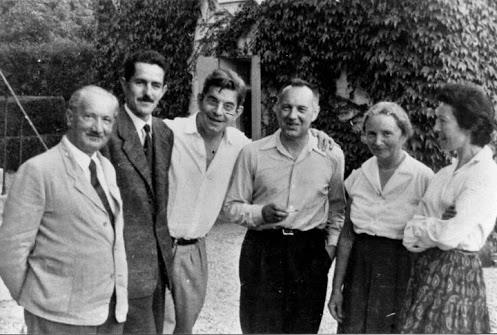
heidegger-axelos-lacan-et-al


El sujeto del inconsciente y el problema de lo común

Sergio Villalobos-Ruminott

Quiero compartir estas reflexiones preliminares y desordenadas, como una primera formulación relativa a la relevancia del pensamiento lacaniano-heideggeriano para el horizonte infrapolítico. Lo primero, por supuesto, es explicar que no me refiero ni al pensamiento lacaniano ni al heideggeriano concebidos al modo universitario, esto es, como bloques monumentales sobre los que habría que operar con una serie de protocolos hermenéuticos y con reglas más o menos establecidas. Por el contrario, en la conjunción Lacan-Heidegger (Lacan con Heidegger), intento, lejos de toda pretensión sintética, destacar el problema del sujeto y la existencia, como instancias cruciales en las que la reflexión infrapolítica comienza a mostrar su singularidad. A la vez, corresponde al sostenido trabajo de Jorge Alemán Lavigne el mérito de haber dado con la fórmula Lacan-Heidegger como locus reflexivo en que la cuestión del sujeto y de la existencia aparecen problematizadas. En este sentido, desde el punto de vista de la reflexión infrapolítica, el trabajo de Jorge Alemán resulta relevante no solo por haber producido una lectura política de Lacan, sino por haber producido una lectura lacaniana de la política.

Me detendré brevemente acá: Alemán ha producido una lectura política de Lacan en un sentido distinto, pero igualmente productivo, que la lectura realizada por los eslovenos, entre ellos, de manera central, Slavoj Zizek. La diferencia no radica solamente (aunque esto no es menor) en el hecho de que mientras los eslovenos apuntan a una re-interpretación iluminadora del pensamiento de Hegel, Alemán apunta a una problematización del sujeto hegeliano (cartesiano) y a Heidegger como un pensador afín a dicha tarea. La diferencia también se afinca en el hecho de que Alemán no se conforma con homologar el sujeto escindido lacaniano y el sujeto especulativo (fisurado) hegeliano, sino que insiste en poner en suspenso dicha homologación a partir de radicalizar la tesis lacaniana del sujeto del inconsciente como el sujeto de una política otra que la política del sujeto moderna.

Gracias a esta misma diferencia podríamos (siguiendo una inteligente observación de Gibrán Larrauri) distinguir entre el proyecto de Yannis Stavrakakis y, por supuesto, de Ernesto Laclau, que consiste, en este respecto, en darle al pensamiento lacaniano un lugar central en la formulación de una concepción de la política (de la hegemonía y del populismo), y el de Alemán, que como decíamos, no intenta solo politizar a Lacan sino lacanizar la política, de lo que se siguen importantes consecuencias, precisamente porque una política pensada desde Lacan ya no puede constituirse, soberanamente, desde sus presupuestos onto-teológicos y archeo-teleológicos habituales. En otras palabras, la sustitución del sujeto convencional de la política (el pueblo, la sociedad civil, la clase, la comunidad, el ego, el líder, etc.) por el sujeto del inconsciente como imposibilidad de sutura, inmediatamente altera la homologación, destacada por Heidegger, entre sujeto y voluntad de poder, que habría funcionado, vía afirmación y movilización total, o vía reducción antropomórfica del deseo, como motor de la política.

Si el sujeto del inconsciente aparece como una zona problemática y no como el depósito incólume de una determinada agencia transformativa, entonces ya no se podría apelar, ingenuamente, a las nociones capitales del imaginario radical moderno sin reintroducir las mismas paradojas despejadas por la interrogación de Alemán. Pero, por supuesto, el que ya no haya un sujeto maestro de la acción revolucionaria, una agencia encargada de la racionalidad final de la historia, no debe entenderse como una concesión al irracionalismo o al nihilismo, pues el nihilismo se muestra como pura afirmación irreflexiva, movilización de un deseo que ya no desea nada fuera de su propia afirmación soberana.

Alemán, por supuesto, avanza más allá de estas líneas esquemáticas, para entreverarse, a nivel tentativo o conjetural con las implicancias de esta convergencia (Lacan-Heidegger, Soledad común, Conjeturas sobre una izquierda lacaniana, etc.). De hecho, en el prólogo a su libro En la frontera: sujeto y capitalismo (2014) María Victoria Gimbel señala:


“Parecería que esta formulación lacaniana del sujeto llevaría a sostener, políticamente hablando, una especie de escepticismo lúcido, al poner una barrera infranqueable para la transformación social, que limitaría la práctica política solo a lograr mejorar dentro de lo posible. Pero Jorge Alemán critica esa forma de entender la política en términos de gestión y administración, insistiendo eso sí, de modo conjetural y sin garantía, en apostar todavía por hacer una lectura “radical” y en los márgenes del psicoanálisis para, desde ella, proponer una respuesta que comprometa a la izquierda en la construcción de algún tipo de pueblo aún sin nombre.” (15)


Este pueblo sin nombre, sin embargo, nos lleva de fondo al problema del sujeto del inconsciente y al problema mismo de la subjetividad que está a la base del pensamiento político convencional. Y esto no es del todo claro precisamente porque Alemán parece haber abierto una caja de pandora al incorporar el sujeto del inconsciente a su reflexión política, pues ese “imposible” sujeto pone en problemas su misma conformidad con el modelo traductivo-equivalencial de la hegemonía (á la Laclau). No olvidemos acá dos cosas: Alemán todavía intenta elaborar una crítica del capitalismo, pero esta crítica ya no puede ser realizada desde el repertorio conceptual a mano.

Por otro lado, al reparar en la tensión entre Lalengua (Lalangue) como la estructura misma de lo común, y el Sinthoma (Sinthome), como singularidad de la experiencia psíquica de ese común, como tensión propia de la soledad común, se hace imposible seguir sosteniendo el modelo de un programa o proyecto político colectivo, subjetivo, auto-transparente para los miembros ‘identificados’ con él, afectivamente o no. Es decir, ni partido, ni bando, ni programa, la lacanización de la política efectuada por Alemán desactiva en ésta su pretensión soberana, hegemónica, universalizante, equivalencial.

Pero este efecto post-hegemónico parece ser inesperado, pues se mantiene en el umbral de su pensamiento; un pensamiento que insiste en la política, aunque él mismo pareciera estar cada vez más advertido de que esa insistencia está abastecida por la misma voluntad de poder que reduce la existencia a una versión onto-teológica. En este sentido, habría que habitar en la tensión entre singularidad y lo común para poner en cuestión no solo el rendimiento traductivo-equivalencial y universalizante de Lalengua en el modelo de las cadenas hegemónicas (y su inexorable identificación con el “líder”, que resulta de la concreción empírica del llamado ‘significante vacío’), pues dicho modelo equivalencial traduce todo a un orden común del discurso, exiliando del rango hegemónico de audibilidad aquello que parece ser sintomático (Sinthoma) de una phoné sin sentido (sin logos), un ruido que es necesario mitigar o silenciar. Como si la post-hegemonía fuera un grito que la politicidad de Alemán todavía no logra escuchar.

Por otro lado, el común mismo ya no aparece encarnado ni en la figura de un pueblo nacional, ni en el modelo hegemónico de lo nacional-popular (que ya Osvaldo Lamborghini había faenado en sus banquetes literarios –El fiord). Se trata de un común sin comunidad, sin propiedad y sin atributos, de una experiencia del común en la convergencia, sin equivalencia, de una experiencia posible, nunca necesaria, en la que lo común es contingente en un sentido más radical que la contingencia, siempre sobre-determinada, de la teoría de la hegemonía. Y es aquí donde la caja de pandora abierta por Alemán nos entrega el demonio infrapolítico de una existencia marrana, contra-comunitaria, resistente a toda identificación, más allá de toda catexis libidinal con el amo, líder o sujeto supuesto saber. Pensar esa existencia marrana como desistencia desde el común atributivamente pensado, como el común identificado, es pensar una forma de la existencia no caída a la voluntad de poder.

Como señalaba al comienzo de estas notas, se trata de una primera reacción al importante trabajo de Jorge Alemán, que merece atención justo ahí donde nos permite seguir pensando más allá del sujeto de la política y de la política del sujeto, que parece ser el horizonte inescapable para la bondad política e intelectual contemporánea. Al pensar esa relación de des-identificación o de extimidad que el sujeto del inconsciente importa a la política, no puedo sino recordar una historia escuchada en un congreso reciente en México.1

Se trata de la historia de un joven doctor en historia de la medicina, brasileño, cuyos estudios de doctorado los realizó en Alemania, pero cuya motivación era muy anterior y, podríamos decir, ‘personal’. Ya desde sus primeros años en la universidad esté joven investigador y activista se había mostrado inclinado a estudiar el fenómeno de la lepra, de su tratamiento, y las formas en que la inmunología y el discurso médico en general se yuxtaponían con prácticas segregativas, represivas y reclusorias. No había llegado a estos temas por una sobredosis de Foucault, sino porque su abuelo había padecido de lepra. En Brasil, lugar donde esta historia tiene lugar, la lepra es una condena (no solo por el altísimo porcentaje de población contagiada), que marca no solo a quienes la padecen, sino que se ramifica y distribuye como un verdadero virus o carga genética, entre todos aquellos cercanos y relacionados con el o la enferma. El joven doctor no había conocido a su abuelo, quien se encontraba muerto. Pero si hubiese estado vivo tampoco lo hubiera conocido pues su abuelo había pasado los últimos 20 años de su vida ‘internado” en un leprosario.

El hecho de que su abuelo haya sido leproso se traducía en que su padre nunca había podido encontrar un trabajo permanente en su pueblo, y que su madre, con quien se casó ocultándole el secreto familiar, no lo perdonase hasta el día de hoy. Sin embargo, este joven doctor, inconforme y aventurado, decidió hacer sus primeros oficios de historiador investigando lo que para esa fecha eran las ruinas del leprosario donde había sido recluido su abuelo. Su intención por supuesto era la de producir una cura o un alivio para la ‘vergüenza’ familiar, restituirle al padre la dignidad de su doloroso secreto. Y lo hizo, simbólicamente, podríamos decir, al haberle dado rango de tesis universitaria a una investigación que nunca dejo de ser intima o familiar. Pues la familia construida en el secreto habitaba la región sin lengua de una extimidad en desasosiego.

Revisando los archivos del recinto, nuestro joven doctor descubrió muchas cosas aberrantes, entre ellas, que a los pacientes internados se les permitía rearmar sus vidas amorosas, entre ellos; que se les permitía reproducirse, pero que los hijos surgidos de esa unión eran rápidamente extirpados de la comunidad y mantenidos a una distancia segura. Descubrió también que su abuelo había tenido un hijo, su tío, y se dio a la tarea de encontrarlo. Pero pronto cesó su búsqueda al enterarse que los hijos eran extirpados desde el recinto, se les cambiaba el nombre, y solo volvían al leprosario dos veces al año, coincidiendo con una fiesta, pero sin poder ser identificados. Su abuelo había vivido sus últimos años y había muerto en la reclusión, lo que representa el otro secreto de la operación biopolítica de inmunidad, pero había tenido un hijo, del que fue privado, un hijo que su abuelo no se cansaba de buscar en los rostros inocentes de los niños que un par de veces al año eran permitidos como visitas entre los pacientes. Como si el anonimato de esos niños contuviera el secreto marrano de una imposible identificación individual. Todos los niños, o muchos de ellos, podrían ser ese hijo robado. Y la pasión de nuestro joven doctor, que abandonó su cómodo lugar universitario y se convirtió en un activista y crítico del tratamiento inmunitario y segregativo de la lepra, tampoco encontró ni encuentra sosiego. Hay un secreto más radical que el secreto del poder, sobre el que se constituye una posibilidad no resolutiva para el deseo, pulsión que no cierra y que no se clausura en la vana esperanza de una utopía común. Soledad común marrana como singularidad sin equivalencia, donde la falta no es un defecto antropológico, sino la condición misma de lo real.

  1. – Véase de Beatriz Miranda. Nuestra historia no es mentira. Vivir con lepra en Ecuador, Instituto 17, 2017.

Spain’s New Populist Left: An Impossible Hegemony.

IMG_6051

“The recent populist rise could perhaps be a desperate attempt to conceal, once again, or to turn one’s back on, the true depth of the conceptual abyss at the political level that accompanies the closure of metaphysics.  It may perhaps be suggested that the rise itself is the nihilist manifestation and actualization of will to power.  On the other hand deconstruction is not just conscious of such nihilism; it rather attempts to traverse it and to effectuate in the act of thinking a turn in a direction other than dominant nihilism”  (Gareth Williams, “¿Qué es el populismo?” 20).

Spain’s New Populist Left: An Impossible Hegemony.  Lecture at U of Michigan Center for European Studies, February 2018. (First Draft Version.) By Alberto Moreiras.

I am grateful to the Center for European Studies, my host, for this invitation.  Let me tell you briefly that, really, all I want to do here today is to gloss my epigraph, which comes from a recent yet unpublished text by Gareth Williams.  Let me read it to you.  But, in order to gloss it adequately, I will have to unpack it first or to show its context.   I am also anxious to tell you about a trend of thought I am only starting to explore, which is a sort of political Lacanianism of a non-Hegelian vein, Heideggerian is more like it, that is being articulated by Latin American scholars such as Jorge Alemán, Nora Merlin, Gibrán Larrauri, and others.  I think there is a lot of promise for political thought coming from that direction.

I will divide my remarks, which will be brief, into two parts.  The first part will focus on what I think are the main features of the present political situation in Spain and will suggest an analysis, almost a narratological analysis of possible open options for political development.  In Spain, that is.   But all through that first part I will keep a secret card hidden up my sleeve, which I will only play in the second part.  It is the card of what I have been calling posthegemony together with some of my friends, including Gareth Williams himself of course, and Sergio Villalobos, and a couple of other people in the audience, to rather little avail.

My posthegemony is the reason why I have subtitled this paper “An Impossible Hegemony.”   It is not that I do not believe in hegemony.  I think hegemony exists, I think societies are hegemonized by a dominant sector, I think some actors under some circumstances are able to challenge a given hegemonic situation and propose or even act upon hegemony from a counterhegemonic position that, in some cases, changes the coordinates of the situation.   I will not contest any of that.  What I would like to maintain, really (rats, I am already showing you my secret card), is that, if hegemony means domination through persuasion, if hegemony designates always and in every case a voluntary servitude towards the dominant, and if a hegemonic change signals a change of valence, from minus to plus, for non-hegemonic social groups, then hegemony is a rather banal political phenomenon that will solve nothing.  In other words, and insofar as politics has a particular dignity that should never be reduced to the servicing of the goods, to use the Lacanian expression, the real political problem starts after hegemony has been established, or even when it is still ambivalent, undecided, uncertain, in flux.  The political problem is always in every case a posthegemonic problem, since a change of hegemony by itself guarantees nothing: say, in the Spanish political situation today, blocked, paralyzed as it is, since the 2015 elections, an independentist hegemony in Catalonia would solve nothing in the same way a constitutionalist hegemony would solve nothing; a popular hegemony in Madrid would not by itself restitute equality against the casta hijackers or guarantee an effective redistribution of economic, social, and political resources.  In every case a lot more than the political implementation of hegemonic change through the application of a program is needed if the goal is to do something other than the servicing of the goods.

Hegemony is an inflated idea in its conventional use—yes, there is an unconventional use of it that I will comment on later—, and it is time to relegate it to its proper worth.  The left cannot afford to continue to think that taking power, that is, that constituting a hegemony led by it, leading hegemonic change, is all there is or should be to the political struggle.  Democracy is not best served by dreams of majority rule, which really is all the idea of hegemony, as traditionally understood, can offer.  To that extent, continuing with Jacques Lacan’s vocabulary, hegemony, as conventionally understood, is indistinguishable from capitalist discourse and its principle of general equivalence, which forecloses the subject’s enjoyment or throws it into a perverse enjoyment having to do with will-to-power and the technical accumulation of resources, or lack thereof.

Of course you may think that the proper end of politics has nothing to do with capitalist discourse or general equivalence; that those two concepts belong elsewhere, in philosophy perhaps, or in political psychoanalysis, but have nothing useful to contribute to everyday and even not so everyday political practice within liberal-democratic or parliamentarian systems.  We will see later that some economists think our major political problem today is social inequality, which can only be fixed with adequate redistribution, which is certainly a good form of servicing the goods.  But is that our major political problem, or is that problem only a symptom of a much vaster, deeper, certainly more hidden configuration of affairs, as Gareth Williams intimates?   I do not necessarily want to pontificate along those latter lines here, or to convince you of anything in particular.  My interest is much more modest.  I notice that the name of your series at the Center for European Studies is Conversation on Europe.  Perhaps my contribution could simply be to hint at the notion that a conversation on Europe today must transcend conventional political vocabulary and look for a discursive outside Europe seems to have lost (although some thinkers are trying to bring her, Europe, that is, back to her senses.)  Are European politics today totally caught up within capitalist discourse and the principle of general equivalence, to such an extent that even left populist options can do nothing but helplessly accommodate themselves to them, and repeat them?   This is the question for me: is contemporary populism yet another form of servicing the goods?  Is European populism, or Spain’s left populism, a new direction for politics or is it rather a terminal phenomenon testifying to political exhaustion at a civilizational level?  Can politics in fact survive, and challenge, capitalist discourse?  This seems to be the question Williams asks.

More on that later.  Let me now start with my Part One.

I.

Only last week the Center for Sociological Investigations, which is a semi-official organism in charge of running polls on political and social issues in Spain, published the results of the latest research on voting intentions.   As we are only concerned on this occasion with the populist left, I will spare you the general analysis and will only comment on the fact that Podemos, the left-populist party that broke into Spanish politics in January 2014, fell from second to fourth place, out of four places, within only one year, and in fact from first place to fourth place if we start the count from the Spring of 2104, when Podemos won the polls in the wake of enthusiastic expectation, until this winter of 2018.   Podemos seems to be registering a catastrophic loss of energy and popularity that has brought it from a genuine possibility of taking over the government of Spain and reaching the power of rule to what seems now to be stabilizing itself into a rather marginal political position, still very important for a national party, but a position that will doom it to be a perpetual sidekick, or a lonely and functional antagonist, since, at this point, nothing seems to indicate that any of the other three parties would want to seek a serious alliance with the Podemos leadership.

I am sure you have your own ideas, but for me this, even if predictable in hindsight, perhaps, is also very bad news.  And it is very bad news because we have a certain number of signs not just in Spain but in Europe in general, and also elsewhere, including the United States, although it all started in Latin America years ago, that the historical cycle of neoliberalism is probably coming to its demise and that a new politics for a new political and perhaps even economic epoch will have to be developed.   The harbinger of this situation beyond Latin America was of course the economic crisis of 2007 that hit Europe a little later, starting in 2008.  Ten years later the feeling of political exhaustion is still with us, or has increased.  And the traditional parties seem incapable of offering any kind of relief whatsoever, and certainly no democratic invention.  If populism does not offer it, then who will?   You may argue that populism has always been around, it is nothing new, and you would be right; but there is also a case to be made that this new populism, post-2008 and, in Spain, post-15M 2011, that is, a populism that rose in the wake of a substantive popular revolt that took the major squares of Spanish cities in 2011 by storm and terrified the political class, there is also a case to be made that this populism was the condition of possibility for a new democratic invention, that is, for a reinvention of Spanish democracy, for a new democratic promise.

And yet, now, just a few years into it, such new populism may have ceased to offer it, by reverting to the same old tired leftist attitudes that have not produced much success over the last thirty or forty years in Europe, and, more importantly, perhaps have not deserved any success.   We have to abandon the annoying idea that leftism is still good as some kind of bastion of essences that looks back to the early 20th century for its inspiration.  That historical moment is dead and gone.  Some of us thought only a few years ago that something else was clearly developing for the future.  Were we wrong?  Spain is only, in this sense, a particular case.  The political question goes beyond Spain and affects or may affect the entire West.

The political question, it seems to me, has a lot to do with what an important Spanish economist, Antón Costas, has called the establishment of a “new social contract.”   This means the old social contract has broken down and is no longer effective.  Politics runs the risk of evolving into civil war, which, in the case of Spain, has emerged as a phantom possibility, clearly radically symptomatic, in Cataluña; I am not suggesting that there could be civil war in Spain—I am rather saying there is one already, a low intensity one, non-lethal yet, bloodless yet, which only emphasizes the radical urgency of a situation for which we need to find anticipatory solutions before it becomes all too seriously too late.   And yet, so that you see the depth of the problem, the self-identified populist party, Podemos, and its conjunctural ally in Catalonia, En Comú, only received votes for 8 deputies out of 135 in the Catalan Parliament in the December 2017 elections.  Eight deputies out of 135 for the party who claimed to have a radical solution to the Catalan situation—not a good result, not a hopeful result. (It could and probably should be claimed that the pro-independence coalitions and parties are radically populist options, but they have offered nothing so far in terms of new democratic invention and have instead played a radically old Machiavellian and illiberal politics for the last five years: they also promise a paradise provided they become free from Spanish interference, but who is to believe them who is not already deluded by their enmity towards Spain, which is the only ascertainable element in the game?  Catalan populism, as it has been orchestrated by the Catalan government with full use of governance resources over the last several decades, is also, one should be clear about this, a populism from above, a populism of the dominant, in Ernesto Laclau’s characterization, no matter the relative popular support it may also gather.)

So, a new social contract: on what should it be premised?   That same economist, Costas, has insisted quite effectively that the problem in Spain is equality, that is, inequality, and the solution is redistribution.  As I have suggested, I do not think inequality and redistribution mark the beginning and the end of the problem, but let us play with this idea for a few minutes.  The breach of the old social contract—in Spain, the social contract known as the Regime of 1978, in reference to the constituent process that took place after Franco’s death; the idea being that the Regime of 1978 reached its exhaustion with the economic crisis of 2008 and is surviving on toxic fumes only—is a breach because it has elevated to an intolerable height the levels of economic inequality among Spanish citizens, it has created unemployment and poverty for many, precariousness for many more, and insecurity for yet many others even if the 15% richer has continued to flourish to unprecedented levels of wealth; it has devastated an entire generation and it has endangered, structurally endangered, the remnants of the social democratic welfare state the Regime of 78 attempted to put in place by reducing expectations that social security can be maintained at adequate levels in retirement pensions, unemployment subsidies, education financing, medical coverage.  A new social contract is needed, with or without a constituent process, but redistribution must be promised and implemented.   For Costas there is no doubt this must happen, so the question for him remains: who will do it, and how?   Let me suggest that Costas’ proposals are a minimal condition of political reconstitution: they are economic measures that must be decided and politically implemented, but they attempt no particular change at what we could call the ideological level of the social.   We could call Costas’s proposals something like a zero-degree structural adjustment, the creation of a new social contract based on redistribution: a technical measure or set of measures for which political energy and indeed political power must be found.   I think to that extent we should all agree with him.  Costas is recommending the best possible servicing of the goods—not that he is not worried about something more than redistribution.  The fear and insecurity, the anxiety he attributes to a population radically uncertain about their future prospects for life, given the ongoing thorough technification of the economy, is for him one of the most egregious issues—trans-class, also—in the current climate.

Costas identifies what he calls “the four types of social contract” that are currently competing, not just in Spain, rather in the entire West, so definitely also in Spain.  He says they are “the cosmopolitan [social contract], the right-populist, the left-populist, and the Europeanist liberal-social-democratic” (Final del desconcierto 33).   The “cosmopolitan” social contract is the neoliberal one, which for Costas is still contending, not yet completely out of steam, indeed apparently triumphant or still in power in many places.  It calls for, as you know, unrestricted globalization; an uneven European integration; free market; low taxes; no redistribution; and a reduction of state intervention (Costas, Final del desconcierto 314-15).   And yet this is the model that catastrophically collapsed in 2007 and brought on the largest financial and economic crisis to the West since 1929.  The solution to the problems created by the cosmopolitan social contract is not going to be found in more cosmopolitanism, it must rather be found somewhere else, it seems.

The Trump presidency in the United States incorporates features of this neoliberal social contract, but also features of right-populism, which would include antiglobalization and nationalism, identity politics, an illiberal democratic structure willing to sacrifice minority rights and willing to undo the separation of powers, and political authoritarianism, among other perhaps less defining features (Costas, Final del desconcierto 315).

Both of the previous models would have little interest in redistribution—they are models based on so-called trickle-down assumptions.  Against trickle-down, that is, in favor of redistribution, we have what Costas rather awkwardly calls “liberal social democracy,” characterized by a compensated globalization, a balanced European integration, a belief in free enterprise and the self-regulating virtues of the market and of economic competition; a personalized, that is, not based on identity-defined social groupings welfare state; and the development of the state in the direction of higher institutional density in order to secure the parameters for a stronger economic redistribution (Costas, Final del desconcierto 315-16).   But also against trickle-down we have the last of the social contract figures, namely, the left-populist one, which consists partially of not so attractive positions in the face of them, such as antiglobalization, a definite reluctance to trust the market, entrepreneurial competition, or private enterprise, interventionism at every level of the economy, high taxes and high public expenditure, even authoritarianism at all levels and a low institutional density, but all of this is to be radically compensated by a strong commitment to equality and a universal welfare state (Costas, Final del desconcierto 315).

The question, again, is: what social contract would you aim for, or how would you propose to get there?  Is it not the case that the liberal social-democratic social contract has had its chance already, in fact an extraordinary chance over the last three quarters of a century?  Can we trust a model that ran out of steam and yielded its terrain to neoliberalism and so-called cosmopolitan globalization?  Are there genuine second chances in history or in life?  Would we not be better off rejecting all failed historical solutions, including by the way the communist one that called for a total or quasi-total socialization of the means of production?  But, if so, then left-populism seems to be, perhaps not the final candidate, but at least the way to go, that is, the way to start going, let us start there, at least that way we can move on towards something new, a new invention, new developments, in the wake of social mobilization and democratic energy, that we could later correct if proven inadequate.  Let us move toward a new social contract for social and political redistribution, since only social and political redistribution will generate economic redistribution.  And let us do it through supporting, indeed, through constituting a left-populist option for power in Spain.  And that was the idea for Podemos and its supporters, starting in January 2014, when the party was first convoked.

We have been talking about four models, and I confess that my intention was to guide you towards the understanding that only the left-populist one should be left standing as a possibility, that is, unless we want to hold on to the old, to the pre-crisis situation, and go into a mood of political salvaging rather than one of democratic invention.  Or perhaps I am being too cruel to so-called liberal social democracy; the problem is, it is the old PSOE that would be in charge of implementing the liberal social-democratic new social contract, if they can find the newness of it; or perhaps it would be given to or gained by another new party, Ciudadanos, the winner–in the sense of the most voted party–in the December elections in Catalonia and the winner of all recent polls on voting intentions at a national level.  It is certainly not a solution that should be discarded, although my impression is that, as a solution, it is hardly seen even by the very people on whose shoulders the implementation would rest: the PSOE seems quite out of anything but their old routines, and Ciudadanos has only proposed vague liberal social-democratic enticements of too smooth and imprecise a kind.  The truth is, disappointing as the trip may have been, it has proved quite difficult to sustain political fascination for anything but Podemos over the last four years of Spanish political life.  I do not quite see how that could change.

Let us admit, then, that we are caught, in terms of producing a new social contract capable of a redistribution (economic, social, political) that would restitute equality, at least a measure of equality, between the left-populist and the liberal social-democratic option, persuaded by neither, skeptical about both, but at the same time certain that the solution, if there is to be one, will come from no other quarter.  So now I would like to propose that there are three main narratives that deal with precisely that situation of doubt and anxiety: we cannot trust them, and yet we must.  Not good.  Three narratives, that is, unless you would prefer to add to them and propose a serious denarrativization in the wake of the Catalan situation: it is possible that the Catalan separatists, together with whatever errors their antagonists may commit, may cause, in a not too far-off eventuality, the destruction of the Spanish state, which will certainly put an end both to the three narratives and even to the idea of a new social contract, as there will be other urgencies.   Although, to tell you the truth, there is another possible denarrativization from the left, which would be a fifth option: we could assume, we could think, we could advance the thought that the three narratives I am about to describe in a summary form are self-cancelling and will never result in a leftist exit to the situation at hand, will not result in the production of any new social contract whatsoever.   This is not a narrative, but what remains as default, in the absence of any narrative: the situation will stagnate into a political stasis, in the wake of the Catalan conflict and its promise of long duration; the Popular Party will keep its relative simple majority and will continue to govern Spain as they do; that is, Spain or whatever may be left of it for the foreseeable future.   This is a rather desperate option, as far as political life goes, that can only base its projections on an exit from politics altogether.   And yet . . . Is an exit from capitalist discourse not necessarily an exit from politics, or at least from epochal politics?

But let us not overrun ourselves.  Let us hold off on denarrativizations.  We still have those three positive narratives.  They are variations of the same function.  For the first one, we would have gone from the exhaustion of the old, Regime of 78 social contract to a populist eruption that is now in reflux and will continue to evolve and adjust until it finds its truth in a federal republicanism.   This is a narrative that calls for more institutionalization, for more democratic procedure, for an adequate redress to whatever excesses the populist mobilization may have promoted.  It hails and welcomes the populist rise but only in order to hope for its end, but from the inside, as it were.  In other words, it wants to break through to a non-populist formula from an initially populist configuration of the social.   There is an important segment in Podemos that seems to think this way.[i]

For the second one, we would have gone from the relative exhaustion of the political field given a structural economic crisis that had a powerful but not terminal impact to the hijacking of the popular field by a sort of Leninist populism that has now vanished to the fringes of political life, hence producing in its very wake the chance for a restitution of the social contract as a variation of the liberal social democracy that was the basis of the Regime of 78.  This narrative considers the negative impact of populism—the fear it has caused—as in fact salutary, and tends to think that the best populism is a past or dead populism, provided it has in fact taken place even if only phantasmatically.  It has cleared the air and created a new playing field.  This could in fact be, or would be, the general position of the Ciudadanos political party, but it is in no way limited to them only.   Segments of the PSOE are also invested in it, but again: not them only.

And the third narrative says that we have indeed moved from the collapse of neoliberal democracy to a populism that has not yet found its maturity but will—the solution will not come from a riptide of populism that clears the flotsam and the jetsam, as in the second narrative, and it will not be a growing out of it into popular democracy as federal republicanism, as in the first option; rather it can only be more populism, a new and better chain of equivalences that will hegemonically control the social towards the production not of a new social contract but rather of a permanent mobilization that will offer, for the first time since the early days of the Spanish Civil War, but now in conditions of peace, the return of popular democracy so long lost in Spain.

The first and the third of these narratives come from the Podemos ranks—certainly not from the same people in Podemos, rather from different factions within it.   The second comes from sectors of the older left, of the older social democracy, from people like Antón Costas himself, and from a large part of the intelligentsia and the Spanish establishment.   Which are certainly not grounds to dismiss it.   In any case, which narrative do you prefer?  Which narrative do you think adjusts better to the historical real and is less driven by ideology?  I think these questions are the questions that we should discuss, as they are the essential questions in today’s situation, certainly for Spain.  But this brings me to the second part of what I wanted to share with you today, and to invite you to discuss with me.  Bear with me for a few more minutes, I promise I won´t be long.


But I suspect that, in spite of what I already said at the beginning of my talk, and whatever you think of the three narratives, whether you favor more institutionalization or more mobilization and direct democracy linked to a passionate attachment to the leader, whether you favor the ongoing rule of populism or its role as a vanishing mediator for a better dispensation of the political, I suspect you are pretty much still stuck in hegemony discourse, whether you know it or not, and are still of the opinion that, hey, whatever your ideology is, at the end of the day political rule has to do with being on the side of hegemony, holding hegemonic power, that is, in every case, being on the side of the dominant, even if you have had to change the dominant and you are now occupying a position that never belonged to you until you managed to access it—through some successful counterhegemonic maneuvers of course.  Hegemony means power and power means hegemony, and no amount of theorization will change that fact, because a fact is a fact.  Right?   But what if we were to say that there may already be a problem at the core of that conventional understanding that could be expressed with the notion that either you go for hegemony or you go for power, but you cannot do both.  Yes, either hegemony or power, they are two different things.  Power is on the side of the social mass, on the side of the majority, on the side of capitalist discourse and its potent apparatus of control.  Hegemony, however, provided we change its conventional understanding, is in every case a leftist procedure for political invention, and a radical one at that.  Does that make sense?

As I said earlier,  my name for it is not hegemony, conventional or unconventional, but posthegemony.  Let me proceed with some care to make sure I do not lose you, which would be my fault.  I think it is a simple idea, but it is a bit counterintuitive.  Posthegemony is the supposition that, at the political level, the real problem starts once a given hegemony is constituted as power, once hegemony has abandoned its constituent force and has moved on to constitute a given configuration of rule, which happens in every case, which is unavoidable except when there is nothing but failure.  I could put it this way: posthegemony loves hegemonic failure, the failure of hegemony; posthegemony thrives through hegemonic practices insofar as they give rise to failure, but not insofar as they give rise to constituted power.   Put that way, it may already be clear to you that posthegemony would be a fairly happy party, under some conditions, to any of the three narratives proposed above.  Posthegemony cannot love populist hegemonic success, but it would be comfortable with hegemony’s failure as registered in options one and two, both of them understood as responses to failure, and it would be equally comfortable with an ongoing mobilization organized precisely through an impossibility of arrest, that is, through the very failure of stasis.

I must now make a quick reference—obviously to be developed: I promise it will not be so quick in the longer version of this paper—to some Lacanian thinkers whose work I have recently started to become familiar with.  I am talking in particular about Jorge Alemán and Nora Merlin, both of them from Argentina.[ii]  Both of them were close friends of Ernesto Laclau’s, and both of them take off from his work but, as Jorge Alemán puts it somewhere, “using Laclau against Laclau.”  The contender is the notion of hegemony.  I will admit—they have almost fully persuaded me—that Laclau’s notion of hegemony accepts a reading that is thoroughly non-conventional, that is, a reading that puts hegemony against the leader, hence also against the mass, against power, hence against accumulation, against equivalences understood along the lines of a principle of total exchangeability, and against the people as the subject of history.  I am not sure how effectively Alemán and Merlin deploy that new, revisionist notion of hegemony against the conventional one, or how much they rely—illegitimately, in my view—on the non-ambivalent, older rhetorical effect of a signifier that they themselves have made ambivalent.   But the fact is, their theory of hegemony revolutionizes, in my opinion, any contemporary thinking of politics.  From their oppositions—let us say, the people against the mass, hegemony against power, subjective destitution against capitalist subjectivity, and, finally, the Lacanian saint against the psychotic master of total jouissance—one can formulate a correction to populism that will guarantee, if nothing else, the latter’s impossible self-justification in the name of the power of the leader and everything that entails.

Alemán, and Merlin, make of an “emancipation from capital” the banner of their political position, hence moving well away from politics as servicing of the goods.  In Alemán’s words:

The power of capital is not hegemonic.  I am conscious this paradoxical proposal departs from the classic theorization of hegemony.  But hegemony in its logical articulation requires in the first place, at its very point of departure, heterogeneity, difference, an always-already failed subject and an always-already failed representation.  Different from the ruling homogenization in the order of capital, the political articulation of hegemony can only be instituted from the irreducible difference between the demands that institutions cannot satisfy, where their heterogeneity becomes ineliminable.  Hence the fragility and unstability of the equivalences that in a contingent manner can come together in a collective will.  The equivalences between the different demands never turn the space of hegemony into homogeneity.  This is a key distinction. (“Capitalismo” 3)

And it is key for me too.  For Alemán “without a hegemonic operation there is no popular field and there is only ‘mass psychology,’ that is, the voluntary servitude of mass individualism in the technical epoch” (“Capitalismo” 4).   Except that I would call such “hegemonic operation” a posthegemonic operation, to dissolve the ambiguity.

Finally, all I want to propose is that, were we to take a posthegemonic position vis-á-vis the three narratives presented above—remember, the federal-republicanist, the liberal social-democratic, and the popular-populist—there might be a reason for hope: a reason not to want to move into the desperate denarrativization of politics that would also mark a possible exit from capitalist discourse, but not one of a collective nature.

Alberto Moreiras

Texas A&M University


Works Cited

Alemán, Jorge. “Capitalismo y hegemonía: una distinción clave.”  http://www.eldiario.es/zonacritica/Capitalismo-hegemonia-distincion-clave_6_385721477.html

—. En la frontera.  Sujeto y capitalismo.  Conversaciones con María Victoria Gimbel.  Barcelona: Gedisa, 2014.

—.  Para una izquierda lacaniana.  Intervenciones y textos.  Buenos Aires: Grama, 2009.

—. Soledad: Común.  Buenos Aires: Capital intelectual, 2012.

Costas, Antón. El final del desconcierto.  Un nuevo contrato social para que España funcione.  Barcelona: Península, 2017.

Merlin, Nora.  Colonización de la subjetividad.  Buenos Aires: Letra viva, 2014.

—.  Populismo y psicoanálisis.  Barcelona: Letra viva, 2015.

Moreiras, Alberto.  https://infrapolitica.wordpress.com/2018/02/03/el-pensamiento-de-jorge-aleman/

Villacañas, José Luis.  El lento aprendizaje de Podemos.  Historia del presente.  Madrid: Catarata, 2017.

Williams, Gareth.  “¿Qué es el populismo?  Nosotros, ¿verdad?.”  Unpublished Typescript.


[i]   For what will probably become the classic formulation of this position see José Luis Villacañas, El lento aprendizaje.


[ii]   See https://infrapolitica.wordpress.com/2018/02/03/el-pensamiento-de-jorge-aleman/.  For Alemán, see Común, En la frontera, and Para una izquierda lacaniana among other books where he presents his radical version of Lacanian politics, from which we have a lot to learn.  For Merlin, see her two essential books, Populismo and Colonización.  I am aware of the summary treatment given to these two authors, and promise a more extensive one for the full version of this essay.