Notas de seminario sobre el pensamiento de Emanuele Coccia (VI FINAL). por Gerardo Muñoz


Llegamos a la última sesión en el cursillo sobre el pensamiento de Emanuele Coccia (pueden consultarse aquí las entradas sobre las sesiones previas: i, ii, iii, iv, v). En lugar de ofrecer un resumen quiero aprovechar esta última sesión para tematizar algunos de los problemas que quedaron abiertos, y, que constituyen ahora sí que un punto de debate tête-à-tête con el horizonte antifilosófico de Coccia. Quizás todo esto es muy prematuro de momento, porque, como dijo el propio Rodrigo, el pensamiento de Coccia se encuentra aun en proceso de cristalización. Es pensamiento incompleto. Esto no es solo una cuestión de “fase” de una obra, sino más bien de la propia naturaleza del pensamiento en tanto que pensamiento desobrado y ruinoso y abierto. Coccia está ahí, y sus errancias constituirán una de las más interesantes aventuras en los próximos años. Pero, al final de día, lo importante hoy es moverse, y ya con eso nos preparamos para que nos encuentre algo nuevo.

En las últimas sesiones se vino tematizando lo que yo propuse como la “cuestión del corte” al interior de la medialidad de toda imaginación descentrada. Creo que en esta sesión este problema quedó mucho más redondeado. Aquí habría que desplegar varios incisos.

A) la cuestión del corte nos vincula al problema del deseo, y el problema del deseo abre el diálogo con el psicoanálisis.

B) El corte nos abre a la separación entre mundo y vida, y entre el viviente y lo petrificado; esto es, lo que anteriormente llamamos la caducidad de las cosas como ángulo invisible en el trabajo de Coccia. Y esto remite al problema de la muerte.

C) El corte es relación con lo amoroso: ¿amamos todo con todo en una impronta cósmica como energía solar; o, más bien, es el amor lo que separa y discrimina entre la existencia y mis cosas cuando reparo en mi lugar en el mundo?

Obviamente que a mí me interesa defender esto último, en la medida en que no creo que podamos amar todo. Un amor así de absoluto me llevaría al precipicio. La energía amorosa del mundo no constituye la fuerza de individuación. Al final, creo que la obra de Coccia nos habilita a pensar seriamente sobre la relación entre amor y corte, o lo que quisiera llamar una física amorosa del corte. Por suerte, tenemos un texto del propio Emanuele Coccia sobre el tema titulado “La finalidad del amor” (trabajamos con una edición inglesa “End of Love”, 2012). Claro, sabemos que en inglés la noción de “end” es polisémica, ya que remite al “final” como algo concluido, pero también al “propósito” de una fuerza. Coccia navega esa ambigüedad. Es un texto demasiado corto, pero en él encontramos algo así como la signatura de una posible transfiguración del límite. O al menos, es el vórtice que a mi me interesa pensar contra una reducción de su obra en la tradición de la inmanencia, de la defensa del lujo, o en la restitución del panteismo. La “física del corte” establece una mínima distancia con estas improntas filosóficas. El corte estaría del lado de la anti-filosofía.

En “End of Love”, Coccia dice que el amor no es una cuestión del “origen’, sino del fin, ya siempre caída al “dios de la ruina”. Esto es, el amor no es la cupiditas espinosista de la inmanencia. Pero Coccia dice más: el amor es el resto de “una vida” después de la vida; y por eso es, siempre en cada caso, “muerte atravesada”. Esta postura, en efecto, ya no tiene que ver ni con el vitalismo ni con la finitud “eticisista” del “reconocimiento” ante el rostro de un otro. El “fin del amor” rompe contra eje inmanente del vitalismo, y pulveriza la trascendencia eticista de la “otredad”. Coccia dice que en la medida en que el amor se corta como imagen, cada cosa tiene su “vida póstuma” (Nachleben). Una vida póstuma que es fin de la subjetividad, que es siempre mala tonalidad de vivir una vida que pudiera ser otra; una vida sin singularidad y sin individuación. Cacciari en Dallo Steinhof (1980) buscaba tematizar algo similar cuando apostaba por las vidas oblicuas del 900 contra la ‘nueva transparencia’ de los cristales de la arquitectura decimonónica. Y, sin embargo, Coccia no piensa el amor como viaje interno del alma (tomista), sino como recorrido autopoiético de individuación. Por eso para mi el momento más importante de ese ensayo es el siguiente. Intento traducirlo al castellano:

“Y solo somos imágenes cuando somos capaces de producir el “esta” persona, pero nunca persona genérica. En efecto, quien alcance a completar su devenir-imagen; aquellos quienes pueden devolverse así mismos como imagen, dejan de ser humanos y así liberar del “encantamiento innombrable” que el “este” ya no refiere a cualquier otra cosa. Así, los individuos ya no solo especie ni tipo; sino singularidades sin un solo grano de humanidad. El amor puebla el mundo de vidas inhumanas, porque solo hay vidas ultra-humanas, o subhumanas, o en ruinas. La pura haceidad, el ser-este puro, el hoc-esse: este es el paraíso de nuestras imágenes que se construyen y se encarnan” (14).

Hay mucho que desplegar en este fragmento, aunque lo interesante y novedoso para mí es la manera en que Coccia coloca al amor como vórtice para organizar su pensamiento. El amor ya no es una afección del sujeto (vitalismo), ni es una fuerza cósmica, sino que es el sol negro de lo inhumano en el humano que, en su reverso, es la génesis con las verdades que encontramos. Me gustaría poner todo el énfasis en ese momento cuando Coccia habla de un “encantamiento innombrable” que ya no refiere a ninguna otra cosa sino a esa cosa que hemos encontrado. Ese es el acontecimiento del “esto” de la haceidad como corte. Y aquí Coccia muestra abiertamente una fragmentación del singular que despeja el hyle mens del politeísmo, pero que también toma distancia del amor entendido como pulsión de muerte en el deseo freudiano.

Rodrigo Karmy tiene razón cuando dice que la “cripta” o el “arcano” del psicoanálisis es la imaginación. ¿Qué quiere decir esto? Obviamente es mucho más que el hecho de que el “psicoanálisis” es una lengua privada e interna. Pero sabemos que si el inconsciente está “estructurado como lenguaje” (Lacan), entonces no es fácil reducir el psicoanálisis a un dispositivo pastoral (le agradezco a Alberto Moreiras un reciente intercambio sobre esto). ¿Dónde estaría la diferencia entre Coccia y el psicoanálisis? Para mí, se encontraría en el hecho de que el psicoanálisis sigue siendo una ciencia de la realidad; aún cuando la ciencia de la realidad fuese una ciencia de lo insondable o de lo “real” en la determinación del sujeto del inconsciente. ¿Qué supone esto? Que hay una dimensión que encarcela la imaginación a las mediaciones de lo real y lo simbólico. La revolución copernicana del descubrimiento de la “latencia” es también una ciencia del corte, en la medida en que fragmenta la posible deriva del “absolutismo de la realidad”. Esto es lo que pudiera responder el psicoanálisis. En este sentido, entonces, la física del corte en la estela cocciana sería un corte en segundo registro, donde la técnica aparece atravesada hacia otro uso. Pero aquí hay dificultades.

José Miguel Burgos Mazas desnudó el problema cuando dijo: “el operador central de Coccia es la Técnica”. La técnica es la mediación entre luz y vida en la exposición misma de la violencia del medio. ¿Pero qué es el amor en relación con la técnica? Creo que en esta pregunta abriríamos otro seminario, y obviamente que este no es el espacio ni el medio para responder a ella. Sin embargo, si acepto la tesis fuerte de que la técnica es el operador en Coccia, entonces el amor es el corte que la transfigura la obra del mundo, y que produce individuación. El amor, contra lo que se ha dicho de que es una fuerza “unitaria”, es una física del corte.

El amor ya no es unión de entes, sino, como dice el propio Coccia es tenor del “apocalipsis de un mundo que ha abdicado en su ruina hipnótica” (15). Y esa ruina hipnótica es siempre pasaje órfico, esto es, es develamiento entre la sombra de mis cosas y la cosa en sí. Porque, al final, nunca hay cosa en sí. Por eso la tesis fundamental aquí es la siguiente: el pensamiento que viene será un pensamiento del vestido. Un pensamiento “estilizado”. José Miguel Burgos controversialmente remató: el vestido, en la medida que es moda, impone una nueva jerarquía. Claro está, quien dice jerarquía, dice técnica. Desplegar todo esto requiere un proyecto sistemático sobre el horizonte de lo que Peterson llamó el problema de la “teología del vestir”. Por eso – y estas puede ser “malas noticias” para José Miguel – desde el vestido tampoco salimos del registro teológico, porque se pliega de otra manera. Un pensamiento del dobladillo.

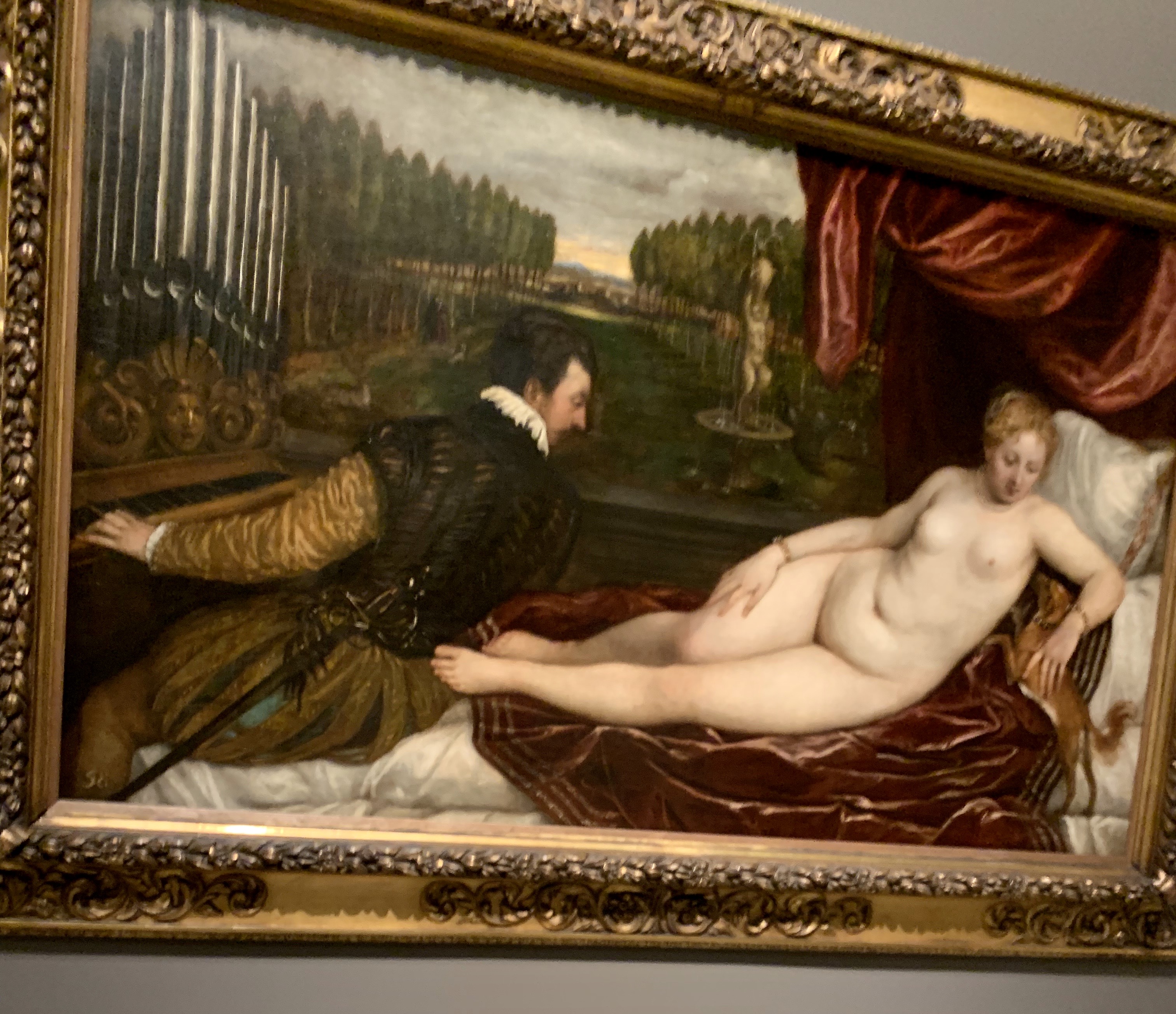
Y justo porque el vestido es una atopia entre cuerpo y su afuera, es ahí donde mora el ‘dios impenetrable’ de mi inclinación como amor que se da en cada corte del fin. Esto es lo que vemos en las últimas telas de Ticiano, como pueden ser “Venus con Cupido” (1555) o “La ninfa y el pastor” (1575), que para Giorgio Agamben, en Lo aperto (2002), denota un “otium” desobrado entre espirito y piel. Se corta en el momento de mayor proximidad. Y más importante aún, dice Agamben, esta es una “condición” que le devuelve lo “inaparente” [inapparenti] a la experiencia sin salvación. Y esta inaparencia, que yo ligaría fuertemente al paisaje irreductibilidad de lo mundano, es siempre denotación del afuera en la apariencia misma de las cosas.


*Imagen: “Venus con Cupido” (1955), de Ticiano. Museo Del Prado. De mi colección personal. 2019.
An epoch unmoved (III). by Gerardo Muñoz

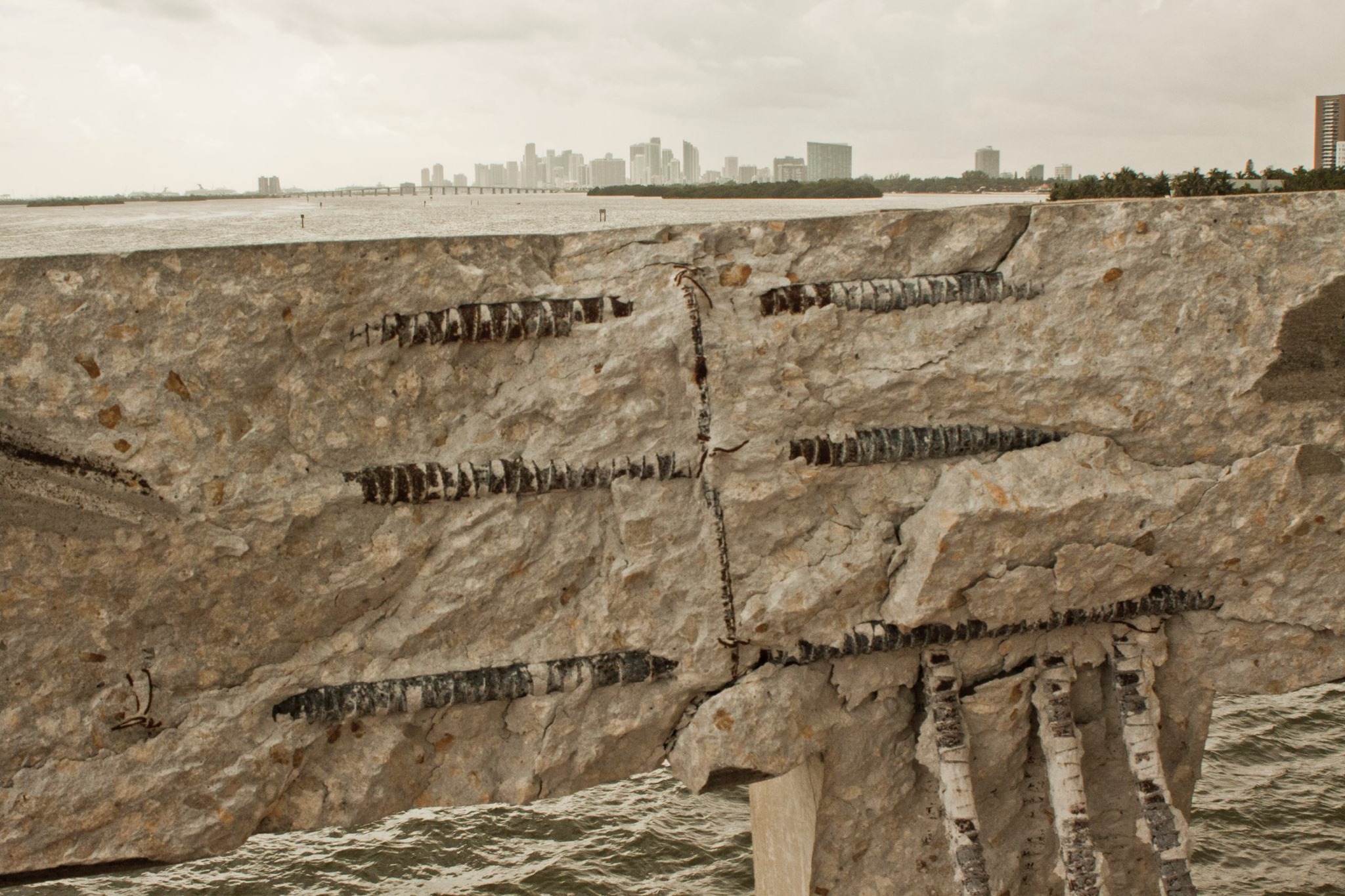
I find myself returning to Ramón Williams’ photograph “The Iceberg” (2013). It is a rather simple composition, but one that builds a strange and uncanny sense of place. It liberates a vista, but it cut through a solid structure that forecloses the horizon with a harsh juxtaposition. This rocky texture becomes one with the sea. Interior and exterior, forefront and background appear at a level of proximity that the movement of de-structuring assists in framing. Williams’ picture draws us towards a non-object: the very possibility of view. It is an experiment with a sense of surface that recalls another geological time; a sense that all too quickly recoils back to earth. It puts us near the matter of view. By liberating the eye, a clear sense of the world takes place.

Now, to be moved in an epoch of closure means that we narrow on the constraint. This is Williams’ challenge: the all too rocky surface bestows a sense of distance, and thus, an outside. This is no longer an abstraction of the medium or an effect of ‘theatricality’. Presumably, all of that is dissolved under the condition of the view. We are standing somewhere; not precisely in water, nor in the city. “The Iceberg” is a farewell to the metropolis at the moment in which desertion is no longer an aspiration but a taking place. There is no horizon and no time either leaving or coming. We are in a lapsus of inhabiting a fragment of the world. Here I experience the outside. Is not this what remains on the other side of the unmoved? I take this to be the question prompted by Williams’ picture.

I want this photograph to speak to me about desertion from the world unmoved. We can recall that Agamemnon uses a specific word to describe his conundrum: lipanous. Specifically, he asks: “How should I become a deserter (pōs liponaus genōmai)?” As it has been explained, the condition of lipanous is not just anyone, but a deserter from a ship. It is no longer how I can lead myself astray from the tasks of the heedless navigator, nor if I can pretend to be an ally in a ship possessed by a silent mutiny. The lipanous, on the contrary, moves beyond alliance and helpless dissensus towards a movement that experiences the clear. This means that the task of a deserter in thought is facilitated by the view. It is no longer language as an exteriority of things; it is how things become irreducible to the language in a decentered image without objects. Whereas in the city I can identify volumes; as a lipanous I am granted a new vision.

Here poetry assists us in a movement towards self-recension. Jana Prikyl writes in a wonderful verse: “Appian way, autobahn – those folks’ wildest dreams too were escape routes.” Obviously, these roads cannot longer prepare a flight. The Appian road and autobahn are civilizational tracks of a world now lost. This is at the heart of Williams’ craft: the course of de-civilization begins with lipanous at the level of the most apparent; not in the sea and most definitively not at ground level. Prikyl writes in the next verse: “with maybe a girl in evening dress waking onboard that takes vision.”

This little thought experiment doubles Williams’ phototactic concern by asking the following: how do we take a vision of a lighted world as a natural element for inclination? What ‘moves’ here is no longer the instantaneous stimulus of the waking to the vision. It is a via di uscita. But a vision of a particular kind, in which I am forced to be a deserter – chipped from the mast of the world into the melody with the true things (étuma).


*Image: Ramón Williams, “The Iceberg” (2013). 

Materialism Without Matter: Gramsci Notes. 15 May 2020. By Jaime Rodríguez Matos.


1.-image


Antonio Gramsci was born in 1891.  He died in 1937—at the age of 46.  I am two years younger than that today as I write these notes on the first section of the Cambridge University Press edition of his Pre-Prison Writings.  That is to say, I will make comments on texts dating from 1914 to 1918, most of them newspaper notes, written when he was between the ages of 23 and 27.  (I finished my dissertation at the age of 29, disowned it, and worked for ten more years on the manuscript which became my first book, hoping no one ever deems it necessary to go back to anything I wrote before then.  So I do not wish to do to a young Gramsci anything I wouldn’t want visited upon myself.)  I want to note some issues or problems that I found worthy of further thought and investigation.  That is, even as I find myself in agreement with many of the criticism raised in the previous blog entries here, what I want to set down, at the moment, are the ways in which I would image a possible, though difficult, tarrying with Gramsci.


I want to suggest a different way of looking at Gramsci’s unabashed endorsement of Idealism in these pages.  In fact, I want to suggest that this is the closest Gramsci got to the existential analytic of dasein—from which he distanced himself, at least according to the general undersatanding of Gramsci today, but which might yet make way for an infrapolitical Gramsci.


Going back to Marx, this would be “to understand that adopting the standpoint of the proletarians in a state of ‘permanent’ insurrection resulted not so much in putting an end to idealism, but in installing the materialism/idealism dilemma—the perennial

question of their difference—at the very heart of the theory of the proletariat and its privileged historical role” (Balibar 27).  I don’t wish to insist on any subject’s privileged role, though.  Only on the idea that in terms of the existential analytic of dasein Idealism has at least one priority: “If what the term idealism amounts to an understanding of the fact that being is never be explicable by beings, but is always already the ‘transcendental’ for every entity, then the sole correct possibility of a philosophical problematic lies in idealism” (Heidegger 200).  In Gramsci this played out in a very specific way. Allow me a digression before I turn to a comment on something that informs my way of looking at the present situation.


In “Socialism and Culture” (1916), Novalis appears as a way to clarify the “supreme problem of culture:” “that of taking charge of one’s transcendental self, of being at the same time oneself and the self of oneself” (8).  In order to know others, we must first be capable of understanding ourselves perfectly, claims Novalis/Gramsci.  Giambattista Vico is adduced to give this notion, to know thyself, a political slant in a gloss on Solon’s maxim: “Vico maintains that, with this phrase, Solon intended to provoke the plebeians, who  believed themselves to be bestial in origin, while the nobles were of divine origin, to reflect on themselves and recognize themselves as  being of the same human nature as the nobles, and therefore to claim  to be made equal with them in civil rights.  And he then identifies this … as the basis and the historical reason for the rise of democracies in antiquity” (8-9; italics in original).  At issue here is “the scope and the principles of a true understanding of the conception of culture, and of culture in its relation to socialism” (9).  Culture is not encyclopedic knowledge—which Gramsci saw as harmful.  We are back to Spirit/History: “Culture is … the organization, the disciplining of one’s inner self; the mastery of one’s personality; the attainment of a higher awareness, through which we can come to understand our value and place within history…” (9-10).  All of this spiritual striving, however, is not anything “spontaneous” or “beyond the control of our wills” (10).  That would be nature, unchangeable, within the realm of “ineluctable laws” (10). But we are, on the contrary, creatures “of spirit”—which, in this context, means “a creation of history, rather than nature” (10).  Yet what can we make of all of this if there is no perfectibility, if there is no “sense” and order leading toward the final raid/revolution?  Let us take a step back.  The supreme problem of culture is for all of us to be able to discern that there is no difference between those who have a putative divine line of descent and those who are mere animals.  Rather than put the emphasis on the distinction human/animal, or gods/animals, I want to underscore the way in which the human-animal is here also the knot between a materiality of the spirit and an eventual void piercing through the available knowledge.  We are spiritual-historical creatures to the extent that we can inhabit that void in knowledge that is our ongoing transformation as spirit-history.  Critique is another name for this ability to inhabit that hole in knowledge.  For Gramsci, however, all of this is still moored to the political hopes of a more coherent, logical, ordered and perfect world: “To know oneself means to be oneself, to be master of oneself, to assert one’s own identity, to emerge from chaos and become an agent of order, but of one’s own order, one’s own disciplined dedication to an ideal” (11).  One must know the misery that others have created for us, in order to be able to replace it with a civilization of our own (11).  If for Gramsci history-spirit is a chain of events leading to our liberation of prejudice and idolatry (12), then “civilization” itself must not become either a prejudice or a form of idolatry.  What is the chain of historical-spiritual events if it is not a drive toward the ideal, toward a telos, toward a more perfect order?  I put forward the following: it is the presentation of an abyssal experience that we have systematically refused to face, in which the systematicity in question has been the various ways we have projected a desired order of things.  Words like destiny, order, god, life, and so many others, have organized our collective ways of projecting that there is something covering over the that void.


Gramsci’s sense of that abyssal experience is also palpable.  In “History” (1916) we find both the abyssal experience and the way that “life” is called upon to lessen the anxiety that experience produces.  “Give up to life your every action, your every ounce of faith,” writes Gramsci (13).  But even that can leave you with the sense that “something is missing”: “You are in the world, but you do not know why you are here. You act, but you do not know why. You are conscious of voids in your life; you desire some justification of your being, of your actions; and it seems to you that human reasons alone do not suffice” (13).  “You are,” he adds: “like a man looking at the sky, who, as he moves further and further back through the space which science has mapped out for us, finds ever greater difficulties in his fantastic wanderings in the infinite until, arriving at the void, and incapable of conceiving of this absolute void, he unconsciously populates it with  divine beings, with supernatural entities, to co-ordinate the vertiginous, and yet logical movement of the universe” (13-14).  According to Gramsci, these are inferior manifestations of the self, “purely instinctive, mere uncontrolled impulses,” and religion is the way that most seek to deal with them (14).  In stark contrast stands “the force of life itself” (14).  One must historicize and draw out the unfolding of religious impulses, for once one can trace a phenomenon back to its origin it will have been overcome: “To make them an object of history is to recognize their emptiness” (14).  But note the key operation in this passage: the void in question has shifted place from the sensation of arriving at a place where the ground is lacking (over which a religious answer is projected as a way to cover it) toward the emptiness of the religious answer itself.  It is history-spirit that will offer “the explanation to our existence” (14).  History-spirit cannot be supernatural.  However, this materialist understanding yields all too quickly to a different kind of faith: “revelation. If something still remains inexplicable, that is due only to our cognitive deficiencies, to the still imperfect grasp of our intellect” (14).  The whole is knowable, even if do not yet know all of it.  The past will be with us no longer as our shadow, but illuminating the way to a better future.  Gramsci is not shy about this secularization of religious categories: “Our religion becomes … history.  Our faith becomes … man, and man’s will and his capacity for action” (14).


What emerges is a fight against two different kinds of knowledge.  On the one hand the encyclopedia of all the fact that contribute to the permanence of the ruling class power; and, on the other, the knowledge that emerges once proper cognition of the historical process is gained.  One jumps over the abyss that opens in the dissolution of the first—which includes not just the narratives that legitimize a certain ruling structure, but also all of the metaphysical certainties that were the diving dictate from on high—to land on the certainties of a capacity for constructing the better world.  Between the first and the second form of history-spirit lies the recuperation of all that had been occluded in the past.  All is now light: “a past which illuminates” (14).  It is important to add that this kind of history is “the richer history which is not written in the history books” (30).  This illuminating past is “the bond of solidarity,” “the bond of shared humanity”—“the light which millions of Italians see by, … which illuminates the world for them…” (30).


On a different front, I would like to not that today it is impossible to read these texts without feeling their historical distance.  They are intimately involved in the context of WWI and the Russian Revolution, and they orient themselves therein in a way that is difficult to abide with today.  Gramsci makes clear some of the things that would be unconscionable for us to assume today.  Consider the tangled web of consequences derived from the class struggle.  For us, it has become ever clearer that “the class in power” will never “assume its responsibilities,” will never “carry its premises through to their logical conclusions,” will never “submit to an examination of the way in which it has been preparing for the … present miserable state” (5).  But for Gramsci, such a reckoning was also the only way to restore “the dualism of the classes” (5).  That is, only in the recognition of this failure would the dualism of the classes become clear.  No one today would even imagine to make such a demand of the ruling class in earnest.  The ruling class today simply ploughs through with the construction of its narrative.  It accepts responsibility for naught.  Thus, today, we believe neither in destiny nor in dualisms.  Given Gramsci’s presuppositions, this would make it difficult to sustain a belief in “the passage of civilization from an imperfect form to a more perfect one” (5).  This is also our inability to believe in progress.  But I leave it at that.


Balibar, Étienne. The Philosophy of Marx. Trans. Chris Turner. London; New York: Verso, 2007.

Gramsci, Antonio. Pre-Prison Writings. Trans. Virginia Cox. Ed. Richard Bellamy. Cambridge; New York: Cambridge University Press, 1994.

Heidegger, Martin. Being and Time. 1927. Trans. Joan Stambaugh. Albany: State University of New York, 2010.

An epoch unmoved (II). by Gerardo Muñoz


The possibility to be ‘moved’ against the pitch of “malafede” solicits another symbolization. A “new founding” of the world for an opening of a destiny. In his beautiful The true life (2017), an essay for boys and girls, Alain Badiou writes that: “A thinking of departure, a true thinking of the ever-changing ocean of the world…an exact thinking because it is a nomadic one, a maritime thinking. May everyone be able to say: “I have seen the earth parceled out in vast spaces and my thought is not heedless of the navigator” (49).

Given the obvious maritime metaphor, it is evident that Badiou is suggesting that true life is only possible outside the party of cybernetics (kubernetics) and its half-sister ally, the party of hegemony. This plea for ‘exactitude’ is irreducible to what “I ought to do”; it is on the side of “how I do what I do” in a world disjointed from the whole. To exist outside the whole means that I cut through things. It also means that I have only one life.

The problem of what I am calling the epoch ‘unmoved’ raises the question of the genesis of the species. This is why the lives of boys and girls become crucial. The destruction of the time of youth (an unproductive time, not just a biological stage) announces the corruptio optimi of a world without experience. The world becomes only survival. I take this to be the vortex of the film The Killing of a sacred deer (Dir. Lanthimos, 2017). On the surface a rendition of the tragic legislation of Agamemnon, but more esoterically perhaps a commentary on the loss of inclination in world integrated into value and reproduction of life.

It is no coincidence that the two poles of contemporary life help frame the film: the correctional suburban life of order and civilized legibility (the end of community), on the one hand; and the practice of a surgeon (whose profession is to save “lives”), on the other. These two poles of world administration – the economic (oikonomia) pole and the medical pole (“human life”) – is the mechanism by which the world is reduced to a place, and experience to communication. Hence, when the tragic irrupts “normal time” of life, there is no more decision possible. Rather, there is only exchange, equilibrium, and ius talionis. The Killing of a sacred deer circumvents the nihilism of the epoch precisely in this way: there is no way out, so like Pacman we must go on.

Except for a sequence (into the 20:00-25:00 mins) where the fatherless Martin is sitting with the girls in the room, and they talk cigarettes, and looks, and armpit hair and music. Everything is purposely inconsequential, but this chatter is the only true void of every encounter. Then, they go out for a walk. A clear path meanders the two bodies with no purpose. Pasear is the activity that leads nowhere. Isn’t this what Badiou called a “thought that is not heedless of the navigator”? But how long could it last? In the film, not very much. As confirmed in the last sequence, ius talionis puts everything back in order and the child becomes future-time; an act of magic that has Reality as its theater.


*Imagen: “Lette versato” (2018), de Mónica Ferrando.


“Paisaje contra política: algunas consideraciones sobre Hölderlin”, intervención en la Academia de Santiago, 13 de mayo, 2020. por Gerardo Muñoz


 “The idea of the «terreau» recalls what Heidegger called the Earth as such; nobody has explored like Heidegger this dimension of a «landscape» beyond political division in his course on Hölderlin. But he had no Europe in his mind. – Flavio Cuniberto, correspondencia personal (diciembre de 2019)


En este breve trabajo quiero desplegar algunas consideraciones en torno a Hölderlin dentro del marco de nuestro encuentro, interrumpido hace unos meses a causa de la pandemia global en la que hoy seguimos inmersos. En realidad, no me interesa desarrollar un ejercicio filológico en torno al poeta alemán, sino más bien añadir algo sobre el problema de la “parábasis”, tema que se impuso en las últimas sesiones. Si la parodia nos convoca hoy, más allá de su inscripción retórica, es porque nos redirige a este problema. Como sabemos, la parábasis es el recurso de la suspensión de la representación hacia un éxodo de la experiencia. Y ese afuera prepara una relación con el mundo desde el paisaje. Como veremos mediante Hölderlin, paisaje y naturaleza son irreductibles, por lo que se anuncia desde ya una crítica a un posible giro telúrico como modalidad de comunidad política en la tierra. Establecer esta diferencia es el vórtice de mi intervención. En el poco tiempo que dispongo solo quiero intentar reaccionar ante dos improntas que agilizan el paisaje como problema: primero, vamos a elucidar la crítica del titanismo en Hölderlin; más específicamente, el titanismo como absolutización de la postura ante la crisis del nihilismo. Pero como veremos, el problema del titanismo en Hölderlin también supone una destrucción del privilegio del poeta como clarividente de la historia y de la lengua. Podemos decir que el pensamiento de Hölderlin en su mayor simpleza no es un problema de la “comunicación”, como se pensó en algún momento, sino de otra índole[i]. En segundo lugar, vamos a interrogar en qué medida lo que expresa hoy como “crisis de la comunidad política” es un sobrevenido de una pérdida del paisaje ligado a la organización territorial en las sociedades. En este sentido, parto de una atendible intuición del filósofo chileno Hugo Herrera en Octubre en Chile (2019). Permítanme citar el fragmento completo:

“La tierra es existencial en el más grave sentido de la expresión. Corto se queda aquí quien acota el asunto a los limites de una estricta biología. Sus alcances son de otro calado. Los humanos somos la tierra. Ella de se deja configurar, pero nos determina, no sólo materialmente, sino vital, cultural, espiritualmente, con su estética, sus fluidos, sus vibraciones. “El paisaje de Chile es paisaje psíquico y moral”, dice el poeta. Hay una verdad de la tierra, un descubrimiento inicial de la tierra, como escribía Knut Hamsun: unas “bendiciones de la tierra”. La tierra nunca es neutral, ella es orden de sentido. Nos da un sustento firme para asentar nuestras vidas; un suelo visible y estable sobre el que definir señas y direcciones, trazar caminos y límites, sobre el que deslindar el hogar y la ciudad…Además, y aquí la tierra se une a los otros elementos, ella es también lo bello y lo sublime, la amplitud y la hondura del paisaje.”[ii]

Herrera entiende la crisis política chilena – y que es co-sustancial con la que atraviesa Occidente – como expresión de una pérdida del sentido telúrico y del paisaje. Incluso, en una columna reciente Herrera ha hecho explícito el vínculo con Hölderlin[iii]. En parte, en este texto queremos establecer un diálogo con las tesis de Herrera.

En su reciente ensayo sobre la geopolítica europea, Strategie imperiali (Quodlibet, 2019), el pensador italiano Flavio Cuniberto concluye con una recomendación: más allá de la impronta imperial del hegemon alemán en el contexto europeo – y que ahora, a la luz de la pandemia que se ha intensificado en diagramaciones teológicas[iv] – Alemania es también la tradición que habilita la destrucción de todas las pretensiones titánicas movilizadas por la técnica. Esta es la primera lección de Hölderlin. Toda la obra de Hölderlin está atravesada por un intento de rebajar el titanismo compesatorio del paso abismal de la antigüedad a la modernidad. Este pasaje entre la antigüedad y la génesis moderna inaugura una crisis de distancia, que es también olvido de lo irreductible, y, por lo tanto, el triunfo de la estructuración onto-teológica de lo ilimitado de todas las cosas. Obviamente una manera más simple de decirlo es que la modernidad es otro nombre para el olvido de la “diferencia ontológica” en la cual deposita sus fuentes vitales[v]. Este olvido, sin embargo, no significa que la “diferencia ontológica” haya sido reprimida; al contrario, es más bien que la diferencia ontológica inscribe el vacío que dispensa la crisis de la transmisión de las formas en Occidente. Claro está, sobre este vacío se generan diversos tapones para mitigar lo irreductible. Hay dos estrategias de mediación. Primero, tenemos la compensación excéntrica de la división de poderes de los dos reinos. Y, en segundo lugar, asistimos al quiebre de esa aspiración moderna que es el titanismo como salida absoluta que, ante la imposibilidad de lo aórgico, se refugia en la conflagración de lo abstracto fuera del mundo de la vida.

Es ahí como podemos pensar el drama trágico de Empédocles, que es la manera en que Hölderlin busca “transfigurar” el horizonte sacrificial moderno. La figura de Empédocles, ese pensador presocrático arcaico, encarna el titanismo como destrucción poética al menos en dos sentidos. En primer lugar, Empédocles representa (en la lectura Hölderlin, no en la figura clásica) la catástrofe del genio poeta, cuya energía imaginativa podía devolverle al mundo el encantamiento desde la potencia de su artificio. El genio poeta, como supo ver muy bien Max Kommerell, era la punta de lanza de la fuerza de conducción, ya que esgrimía su voz como liderazgo capaz de anunciar destino[vi]. Esta postura solo podía llevar a la celebración de lo trágico como abismo del mal y sacrificio cargado de impotencia política. Como sabemos, este fue el ideal del grupo de Stefan George, donde el poeta no solo es Führer, sino también legislador, autorizado desde la acclamatio imperator signada por los olivos de Dante[vii]. Por esta razón es que la destitución del titanismo buscaba la eliminación del poeta carismático que ahora ganaba una “nueva objetividad” en el tiempo. Es lo que Hölderlin luego traducirá al conocido apotegma del “libre uso de lo propio (o de lo nacional)”. Esta objetividad ya no es propiamente política, sino más bien lo aórgico de lo vivo y lo muerto[viii]. Pero la crítica del titanismo es una crítica del poeta como contraposición al sujeto de la voluntad, y probablemente de la “libertad”, en la medida en que la condición de la libertad siempre fue la acción. No se nos escapa aquí una enmienda a la “edad de los poetas”, que Hölderlin lleva a la ruina en el pasaje de la figura del genio poético hacia una poetización de mundo. Como escribe en el poema “Titanes” (en traducción de Verónica Jaffé):

“Del abismo pues hemos

Comenzado y caminado

Cual león…

Pronto empero, como un perro, vagará

en el ardor de mi voz en las calles el jardín

Donde viven los seres humanos en Francia.

Fráncfort empero, según la figura, que es la estampa de la naturaleza,

[…] Eso quiere empero decir el destino.”[ix]


El recorrido al afuera del “jardín” (que no es una polis, ni una civitas), Hölderlin va abriéndose paso a la naturaleza y al sentido de la tierra donde el poeta ya no “decide”, sino que encuentra o se da en un encuentro con el mundo. En realidad, el paso lógico de la destrucción del poeta carismático (Empédocles) a los himnos pindáricos se da en este umbral como vía de “salida” que, como vio Andrea Zanzotto, le devuelve a la palabra una tonalidad existencial[x]. Encontrarse con el mundo, sin embargo, no solamente significa morar en la tierra, sino poetizar en el “relucir” (gleaming / das glänzen) de la naturaleza. Es aquí donde aparece el paisaje como lugar de lo que encontramos. Este “das glänzen”, como han dicho ya otros, se concatena como toda una constelación de palabras como “brillar”, “aparecer”, “resplandecer”, “hacer visible”, o “claro” que es la entrega a la exposición del paisaje[xi]. Por ejemplo, en el poema tardío “Si desde lejos”, nos dice Hölderlin: “de aquellos lugares que tan bien conocía: todas las bellezas de mi tierra que florecen en las costas bendecidas…aun se satisface con el recuerdo de días que alumbraban[xii]. O bien, en “El paseo”, una vez más:

“que bella luce para alguien

en la clara lejanía, la gran imagen del paisaje…

el encanto del paisaje”[xiii]

Sin embargo, ese encantamiento no es la fascinación meramente afectiva, sino, una revelación de otro orden. Esa revelación abre a la cuestión de la “divinidad transfigurada” o manchada, un acontecimiento mundano después de la fuga de los dioses y del cierre del mundo clásico. ¿Qué es ese brillo? En un comentario al poema “Otoño”, Heidegger nos dice que: “Y, sin embargo, el paisaje no es la naturaleza. El paisaje, recogido alrededor de seres humanos e inclinados hacia ellos, es lo que aparece como brillo inicial[xiv]. La imagen recogida alrededor del encantamiento es el trazo “divino” entre cielo y tierra. Pero este “trazo” no es una vuelta atrás a una medialidad metafísica, sino más bien un encuentro. Y es interesante que Heidegger lo refiere como un “Geschehen” o un “suceso”, esto es, lo que tiene lugar.  Obviamente que el Heidegger tardío está interesado en lo cuestión de una visibilidad que desiste de la objetualidad del mundo. Una visibilidad pasmada que en los seminarios de Zahringer llama una “fenomenología de lo inaparente”[xv]. Todo es muy complejo, en parte, porque el propio Heidegger no llegó a tematizar qué quería decir con lo inaparente, aunque sabemos que en esa zona aparece una transfiguración entre mundo y existencia que merece ser pensada. El brillo o das glänzen de Hölderlin asume aquí su condición primordial – una condición sin condición, ya que es pura exposición – que es experiencia siempre singular contra todas las reducciones del mundo en tierra y de la existencia en subjetividad.

En el ensayo muy tardío del 84 (“Zur Frage nach der Bestimmung der Sache des Denkens”) – por otra parte, un texto decisivo en la medida en que también ahí elaboraba la tesis sobre el dominio cibernético como nueva unificación de la ciencia como “fin de la filosofia” – Heidegger hace explícita la cuestión del “resplandecer” como problema de la “visibilidad” en Homero. Lo que “reluce”, nos dice Heidegger, es lo que presencia en sí. Y no es coincidencia que tanto Odiseo como Telémaco vean a una misma mujer como presencia divina; nunca “evidencia” de algo ni del recuerdo[xvi]. El resplandecer de la presencia de las cosas mismas carece de metaforicidad y se retira de las trampas fenomenológicas de la percepción. Desde aquí, me parece que estamos en mejores condiciones para entender el das glänzen como apertura al glamur de las cosas. Cuando decimos glamur queremos establecer una diferencia con el lujo. El lujo es condición antropológica de la génesis de la equivalencia moderna. Mientras que lujo invierte la luz en el intercambio de objetos; el glamur propio de la das glänzen es una distancia sin objeto. Este el espacio a-objetual del paisaje en su inaparencia. Y lo inaparente devela y depone en un mismo movimiento una proximidad experiencial que recorre el afuera de la ciudad, y, por lo tanto, de la política. El encuentro, en la medida en que lo entendamos como problema de diferencia ontología, establece un corte desde mi inclinación. Una vez más, esto queda claro en un poema tardío de Hölderlin, “Tierra natal”:


“percibiendo lo preferido

Pues siempre se atienen justo a lo más cercano…

[…]

Pero en el medio el cielo del canto.

Al lado empero, en la orilla de iracundos ancianos,

Es decir, de la decisión,

Pues las tres nos pertenecen.”[xvii]

La distancia del paisaje es siempre “lo más cercano”, porque es decisión de existencia en el mismo movimiento en que transfigura el nomos como “cielo del canto”. Solo así podemos entender lo que Hölderlin le escribe un poco enigmáticamente a su amigo León von Seckendorf: “mi único interés es la fábula como paz poética de la arquitectura del cielo[xviii]. ¿Puede existir tal cosa? ¿No es la arquitectura lo que se funda desde un territorio, lo que hace legible el mundo instaurando límites y particiones, y aquello que tala el bosque? Esta expresión, en toda su contradicción sugerente, es un recorte de la “fenomenología de lo inaparente” en la medida en que el paisaje no es lo que recoge las cosas en el mundo, sino lo que armoniza en el cielo en su espesor ex terram que ya no puede objetivar las cosas, puesto que en cada encuentro lo invisible se recoge en lo visible. La arquitectura del cielo es paisaje con mundo, pero sin tierra. De ahí que lo “nacional” solo pueda ser “uso” y no apropiación o cultivo. Si la teología moderna estableció una línea de cesura entre cielo y tierra (entre trascendencia e inmanencia), la mirada “aturdida” de Hölderlin se abre a la cuaternidad de un paisaje encantado en el cual se nos dan las condiciones de nuestras verdades[xix].

Por esta razón es que no podemos hablar de un simple paso a la modernidad convencional en Hölderlin, sino, de un paso atrás con respeto al encuadre mismo de objeto y sujeto que “taponea” el resto perdido de la experiencia. Al fin de cuentas, esta es la lección pindárica: no se busca el Todo universal, sino persistencia en la escisión que nos recoge el brillo de las cosas mismas en el paisaje[xx]. En este punto la lección sigue siendo particularmente actual: si la crisis que hoy atraviesa Occidente es una crisis de existencia en la organización de la metrópoli (un mundo reducido a las tribulaciones del despliegue cibernético), entonces al paisaje es la extática que puede ofrecernos la “simpleza de una imagen”, la cual es también la “imagen primitiva”, como dice Hölderlin en “El paseo”[xxi]. Como ha recordado un amigo recientemente, no es en absoluto coincidencia que el malestar de la ciudad, y por extensión la “explosión social”, apunte a una destrucción del paisaje como umbral de experiencia del afuera[xxii]. Pero el paisaje es irreductible al territorio y a la urbe. Así, la oposición moderna entre campo y ciudad deja de tener sentido. Pensar el paisaje, o atender a un pensamiento paisajístico, le devuelve el brillo a eso que encontramos en el mundo. Un brillo que es ya poetizar en medio de un cielo despejado.


Notas

[i] Dionys Mascolo escribe en En torno a un esfuerzo de memoria (1987): “La palabra “comunismo” le pertenece mas a Hölderlin que a Marx. Designa lo que se busca en todas las obras posibles del pensamiento, eso que todas ellas dejan escapar…” Pero este movimiento es hoy ya insuficiente desde la comunicación. Necesita un segundo escape.

[ii] Hugo Herrera. Octubre en Chile (2019). Version Kindle, 348.

[iii] Hugo Herrera. “La patria en el ocaso”, 10 de abril, capital: https://www.capital.cl/la-patria-en-el-ocaso/

[iv] Ver mi “Theologies of the coronavirus: a Catholic-Protestant showdown?”, April 2020: https://www.tillfallighet.org/tillfallighetsskrivande/theologies-of-the-coronavirus-a-catholic-protestant-showdownnbsp

[v] Sobre la crisis de la distancia y la pérdida de suelo en el tránsito hacia la modernidad, ver Felipe Martínez Marzoa, “Hacia la referencia a Grecia”, en Heidegger y su tiempo (1999).

[vi] Max Kommerell. Der Dichter als Führer in der deutschen Klassik (1982).

[vii] Ernst Kantorowicz. “The sovereignty of the artist: a note on legal maxims and Renaissance theories of art”, in Essays in honor of Erwin Panofsky (1961), Meiss ed., 267-279.

[viii] José Luis Villacañas. Narcisismo y objetividad: un ensayo sobre Hölderlin (Verbum, 1997), 194.

[ix] Verónica Jaffé. Friedrich Hölderlin: Cantos Hespéricos (La Laguna de Campona, 2016), 184-185.

[x] Andrea Zanzotto. “Con Hölderlin, una leggenda”, en Friedrich Hölderlin: Tutte le liriche (Mondadori, 2001), X-XXIV.

[xi] Richard Capobianco. “Heidegger on Hölderlin on “Nature’s Gleaming”, Existentia, Vol.XXII, 2012, 15-23.

[xii] Friedrich Hölderlin. “Si desde lejos…”, en Poesía completa (Ediciones 29, 1977), 447.

[xiii] Friedrich Hölderlin. “El paseo”, en Poesía completa (Ediciones 29, 1977), 451.

[xiv] Ver, Heinrich Wiegand Petzet, Encounter and dialogues with Martin Heidegger, 1929-1976 (University of Chicago Press, 1993), 127.

[xv] Martin Heidegger. “Seminar in Zähringen 1973”, en Four Seminars (Indiana University Press, 2003), 64-85.

[xvi] Martin Heidegger, “On the Question Concerning the Determination of the Matter for Thinking”, Epoché, Vol.14, Issue 2., Spring 2010, 213-223.

[xvii] Verónica Jaffé. Friedrich Hölderlin: Cantos Hespéricos (La Laguna de Campona, 2016), 169.

[xviii] Friedrich Hölderlin. Correspondencia completa (Hiperión, 1990), ed. Helena Cortes Gabaudan & Arturo Leyte, 561.

[xix] Friedrich Hölderlin. “Notes on the Antigone”, en Essays and Letters (Penguin Classics, 2009), 325-332.

[xx] Eulàlia Blay. Píndaro desde Hölderlin (La Oficina, 2018), 184.

[xxi] Friedrich Hölderlin. “El paseo”, en Poesía completa (Ediciones 29, 1977), 451.

[xxii] Esta es una tesis que comparto con mi amigo Ángel Octavio Álvarez Solís con quien he venido intercambiando sobre este tema.


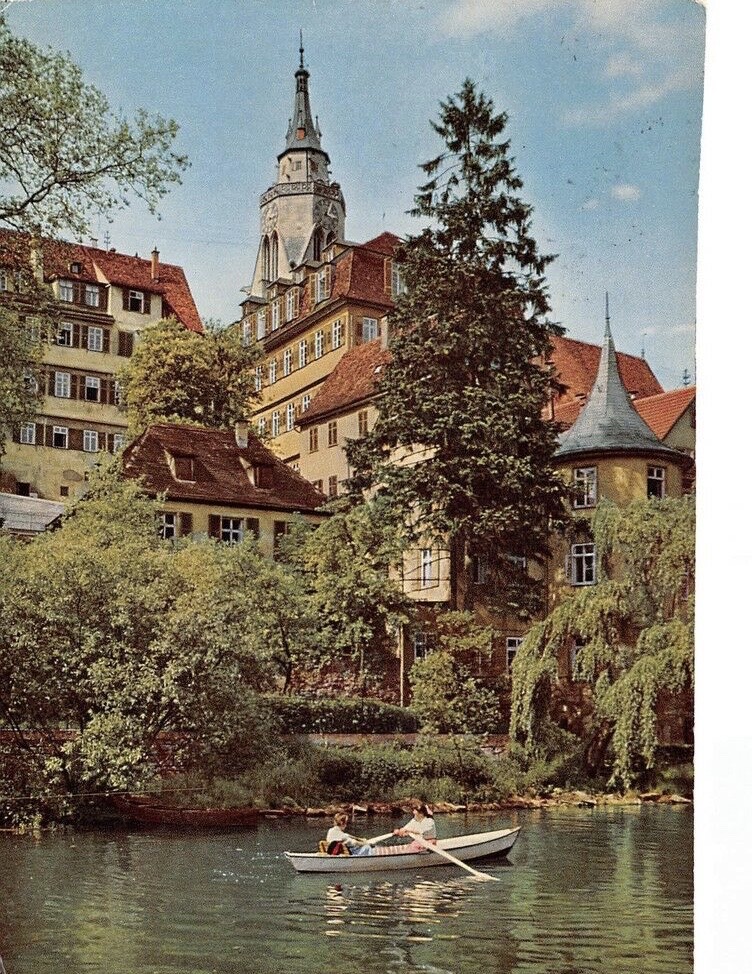
*imagen: “Hölderlintrum Tabingen”, postal de 1977.

Notes on Gramsci’s Pre-Prison Writings, 1-100

61vMT6P+QLL

Of biological organisms, bourgeois citizens, and ethical comrades

I found a lot to be scared about in these first 100 pages—as I’m sure others will have. The insistence on the organic character of social life, the biological metaphors about the communal body, the aggregating molecules escaping bourgeois society to form higher-level compounds, and so on and so forth, these are all metaphors worth thinking about, especially in these years, especially after identity politics has become a norm, and especially after the symmetrical backlash that politics has generated—the politics we, or rather people with a stronger stomach than mine, endure every day at 6:00 pm. We may discuss these scary metaphors, but I am not sure we would find a lot to say—I am not sure *I*, at least would find much to say beyond marveling at I once deemed necessary to fight them, at how I thought urgent to reject the hold they seemed to exert.

Of cocaine, moral fiber, and redemption

I find Gramsci’s reflection on cocaine more interesting—perhaps, because they may offer an alternative path through the organicist bric-à-brac that avoids falling off the cliffs of nostalgic reminiscences marking little more than age. There are two passages I have in mind, both from p. 71. Gramsci is commenting about the drug users in Turin and Bologna who will walk free since cocaine consumption is not a crime. They’ll walk away as they should, innocent as they are of actions that are the necessary consequence of bourgeois society, he claims:

“It is quite natural that this kind of putrid scum will be produced: people without ends, without morals, without history. […] Pure animality, the pleasures of the senses, the mechanical action of nerve and muscle. […] I am amazed that so *few* slip down the slope of destructive pleasures.”

The explicit dualism underwriting this statement is remarkable in itself, even though it is not completely clear at which level it is pitched. Ontological, à la Kojève? Or is it purely axiological, à la Kant? But perhaps even more interesting is that last phrase, “destructive pleasures.” (I wish I could find the Italian, btw, but this piece is not included in the publicly available selection of his writings). It is easy to let your eyes skim over a trite clause used and abused when talking of drugs. But let us think about it for a second. Are the pleasures destructive because it is cocaine that triggers them, or are they destructive because they are pleasant? It seems pretty obvious to me that the latter interpretation is much better, otherwise the previous line about pure animality would make no sense. And what is the remedy to these dangerous pleasures whose looming destruction should have felled many more than it did?

“Work is the only thing that confers moral impulses: it is the crucible in which the spiritual essences that can give a meaning to our lives are volatized” [1]

Really, Antonio? I would be tempted to gloss. Really, in 1918, right at the end of the most destructive war in the history of Europe, right in the middle of famine, poverty, and overall sorrow you are extolling redemption through work? Would not have been more courageous, more daring, more in tune with the spirit of the times whose necessary path we are claiming to follow to praise pleasure against work? Shouldn’t the revolution abolish work—and not just meaningless work, but work altogether, as even Marx claimed? (Not always and not very consistently, to tell the truth, but he still claimed it). Should not that be the promise, the great ideal that wold override the petty details of the misguided utopian thinkers?

What if the road across the swamp of the organic society would only go through pleasure—the pleasure of the senses and the mechanical action of nerves and muscle,” as it were? What if it is cocaine that may redeem us from work?

That is a question I think we will want to discuss, or at least keep in mind throughout this Gramscian journey we just started.

[1] The translation here makes little sense and the crucible metaphor, as written, goes obviously against Gramsci’s meaning. I think he must have written something like “l’essenza spirituale si cristallizza” o “si distilla.” It certainly does not evaporate…

On Taming and Domestication: Notes on Gramsci pre-prison writings pp.3-100 (By Maddalena Cerrato)

IMG_0466Just a few notes around three main interconnected points:

  • THE HISTORICAL CONJUNCTURE: WWI and Russian Revolution (1914-1919).

These pages are unquestionably marked by the particular historical conjecture to which they belong. Each article presents itself as a piece responding to a particular occasion, and pays its special tribute to its kairos. Yet, each time it seems as though Gramsci’s most urgent concern is taming the historical juncture in order to bring it back (in the form of exception) within the necessary movement of the supreme reason governing History. What called my attention is the fact the both the two main events that constitute the overarching kairos for many of (if not all) the interventions, that is, WWI and The Russian Revolution, appear in these pages mostly as (related )exceptions to that historical rationality of which the Italian proletariat should become aware in order to be able to accomplish its destiny of establishing a new order.

War is the origin of the chaos as is disrupts the “long process of intense critical activity, of new cultural insight and the spread of ideas”(10) that should proceed every revolution. War is what disrupts “the normal course of events,” i.e. “when events are repeated with a certain rhythm. When history is developing through a series of moments, each more complex than the last and richer in meaning and value, but nonetheless similar”(41). “War has modified the conditions of the normal environment for historical action, giving an importance to men’s collective will which it would not have under normal conditions” (45). Under these new conditions that the war brought about – which changed the face of the system of production-, the Russian Revolution is a necessary and welcomed historical anomaly. The Russian Revolution is a revolution against Karl Marx’s Capital (39), but “the revolutionaries will themselves create the conditions needed to realize their ideal fully and completely… in far less time than it would have taken a capitalist system” (42).

  • COLLECTIVE WILL  -> IDEA and CULTURE -PROPAGANDA-EDUCATION-DISCIPLINE:

Gramsci’s uneasiness with the anomaly of the war (so in a sense also with the Russian Revolution) seems to have to do with Gramsci’s “cultural” and educational concerns that frame his account for the collective revolutionary will. If on the one hand, the occurrences that exceed the normal course of events give an importance to men’s collective will which it would not have under normal conditions, need to be understood as exception to the order of things – which means that they also confirm the historical necessity and rationality of the normal course of events. On the other hand, in the normal course of events, men’s collective will needs to be raised and domesticated into a consensus to serve such an historical necessity.  Here, it’s where Gramsci’s particular understanding culture emerges as inherently entangled with discipline, propaganda, organization, and voluntary submission.

“Culture is quite different. It is the organization, the disciplining of one’s inner self; the mastery of one’s personality; the attainment of a higher awareness, through which we can come to understand our value and place within history,  our proper function in life, our rights and duties.”(9)

Culture so understood makes sure that the universal idea (Socialism) becomes the programmatic ideal around which a new social organism can unite and emerge as a well-developed self-aware historical subject. The socialist ideal (concrete universal) is the unifying factor that enables the establishment of those affective ties that constitute the collective will of the nation and enables it to become a fully developed historical subject acting through the consciousness of its universal aim. The creation and transformation of the multiplicity of individuals into a social organism that will be the agent of the new order implies “a long term task of educating and mentally priming its members” (37) to “guarantee the kind of immediate, effective, deep-rooted consensus which provide a solid foundations for action”(37). Only through this process of grass-root education:

“Man is coming to know himself, to know how much his individual will can be worth and how powerful it can become, if by bowing to necessity, by disciplining himself to obey necessity, it can come to dominate necessity itself, by identifying necessity with its own ends. Who is it who really know himself? Not man in. general, but the man the submits to the yoke of necessity.” (56)

“Will in a Marxist sense, means consciousness of ends”(57).

  • ORDER -> NATION-CLASS-STATE-PARTY SUTURE:

Finally, in these pages, Gramsci comes across as having settled the problematic National Question that dominated the Marxist debate at the beginning of the century.  The Historical dialectical necessity aims to the establishment of a higher order, that is the concrete universal of socialism. And such an order emerges as depending on the suture Nation-Class-State enacted through the party which is “a State in potential, which is gradually maturing.” The party “depends on the international only for its ultimate aim, and for the essential nature of its struggle, as struggle between classes” (4), but its immediate task is rather national. The party’s specific function and responsibility is to lead the nation to the its self-awareness… so to bring the “millions of individuals scattered throughout Italian territory, each leading his own life, each rooted in his own soil, knowing nothing of Italy…”(28) to form a social and political unity.

The constitution of the nation as collective will around the idea and the program of socialism is the task and the fulfillment of the party universal potential to become the State organizing the superior order that overcomes the chaos of capitalism and bourgeois competition.

Preliminary Reflections on Antonio Gramsci’s Pre-Prison Writings (p. 0-100) – Michael Portal

Preliminary Reflections on Antonio Gramsci’s Pre-Prison Writings (p. 0-100) – Michael Portal

Here are my preliminary thoughts and notes on the first 100 pages of Antonio Gramsci’s Pre-Prison Writings. My ignorance (in general, and of Gramsci in particular) means that I have, at the moment, little to contribute to our discussions. Still, I found the reading interesting and exciting – and I eagerly look forward to reading the reflections of others and learning from everyone in the coming days and months.

In my reading, I was struck by how Gramsci addressed the historical. Humanity, Gramsci suggests, is nothing but its history: “Man is primarily a creature of spirit – that is, a creation of history, rather than nature” (10). Elsewhere: “But society, like man himself, always remains an irreducible historical and ideal entity, which develops by continually contradicting itself and surpassing itself” (48). History exists to illuminate the world (we learn who we are as historical beings through our projects within history), but history does not predetermine our world: it is “a past which illuminates and does not overshadow us” (14).

Potentially in tension with this line, however, is Gramsci’s observation that we are intimately involved in crafting history (“History is a product of humanity”) and that history “is not a question of evolution, but of substitution of one thing for another: something which can only be done by a self-conscious and disciplined use of force” (78). For this, the Russian Revolution is exemplary: Russia is “where history is” because, in part, “the Russian Revolution had paid its dues to History” (95).

In the Italian context, as Gramsci hopes to demonstrate, history (or History?) means something particular. “Italian history,” he writes, is clearly distinct from “the history written in the history books” (30). Instead, “the greater, the richer history” remains unwritten and is present as a special “bond of solidarity” between the Italian people. Are these bonds contingent or eternal? Are they a “concrete universal”? (25)

What is interesting (or important) about these thoughts on history is how they allow us to rethink utopias and utopianism. For Gramsci, utopias are not ‘unreal’ in the traditional sense. Instead, they lack a history (they have “no foundation”) because they are founded “on an infinity of details, rather than a single moral principle” (20). History “in the true sense of the word” evades writing, of being restricted to some endless list of details (55). Merely recording information, producing encyclopedias, is not sufficient: “one will not be writing history” (56). Instead, we can (and must?) think of history as an event “entirely composed of practical activity (economic and moral).”

The turn towards practical activity might shed light on the supposed tension I isolated above – between our being both the products and producers of history. Practical activity, living daily life, sits bizarrely in historical writing. It does not contain high drama; it won’t sell books. But it is all that we have and are. Political mobility should, accordingly, be based on this (and our) reality.

Notas de seminario sobre el pensamiento de Emanuele Coccia (V). por Gerardo Muñoz

Seguimos con la cosmología de Coccia (entradas anteriores aquí: I, II, III, IV). Rodrigo lee un fragmento donde el filósofo dice que “lo más profundo son los astros”. Esta excentricidad complejiza el problema del sol. En efecto, ya no podemos hablar de “heliocentrismo”, sino de otro tipo de irradiación. Lo importante es que la mirada hacia los astros hace que el estar en la tierra sea siempre ex terram. Aquí hay una clara distancia con respeto al horizonte schmittiano. Le recuerdo al curso que el primer texto de Carl Schmitt fue un ensayo sobre la Aurora boreal de Theodor Däubler, el poeta expresionista católico tan caro para el arcano del jurista. Allí Schmitt le dará divisa poética al nomos de la tierra, tal y como luego haría con Konrad Weiß con el sentido escatológico de la historia. Hablar de un sentido telúrico, por lo tanto, se vincula a una reducción del sentido de mundo a la matriz del territorio. Aquí podemos tener una interesante discusión con el pensador político Hugo Herrera, quien ha desarrollado una interpretación sobre la crisis chilena como problema del territorio y del paisaje. La mirada excéntrica de la planta se ubica en a la atopia entre tierra y cielo.

Gonzalo Díaz Letelier hace una vinculación importante entre heliotropismo ex terram y la concepción de un universo sin centro. Aquí es reaparece Blanqui con La eternidad a través de los astros (1872). Para Blanqui la luz de los cuerpos cósmicos (estrellas, cometas, lunas, planetas) es una luz manchada. Por ejemplo, dice Blanqui: “…contemplar el teatro de sus grandes revoluciones, bajo el aspecto de una luz pálida, mezclada con puntos más luminosos. La luz es solo una mancha, por eso esta mancha es un pueblo de globos que resucitan…la materia no llegaría a disminuir ni a crecer ni en un átomo. Las estrellas solo son antorchas efímeras. Entonces, una vez apagadas, sino se vuelve a alumbrar, la noche y la muerte, en un tiempo dado, se hacen cargo del universo” (28-29). Si alguna vez se ha hablado dos herencias agambeneanas – una de derechas y otra de izquierdas – podemos decir que el blanquismo cosmológico es su zona de indeterminación.

Pero Blanqui afirma abiertamente el problema de la muerte astral. El universo está siempre lleno de “antorchas efímeras” porque para los astros “la noche es larga en la tumba” (28). En realidad, Coccia habla muy poco o casi nada de la muerte. Esto va al centro de su apuesta panteísta. Si todo es “vida”, entonces olvidamos la sombra que acecha como “afuera de la vida en la vida”, tal y como sugiere el pensador Mårten Björk. Si todo es “vida” entonces la maquinación biopolítica es fuerza absoluta de esa energía. Desde luego, el “todo es vida” de Coccia no es un vitalismo integrado a la comunidad humana. Por eso Coccia se distancia de la tradición de pensadores de la inmanencia como Gilles Deleuze o Michel Henry. Y, sin embargo, lo que sí podemos decir es que no hay cabida para una teogonía trágica en el mundo sensible de los medios. Como remarcó Gonzalo: no hay una retirada a lo Empédocles.

Como sabia Hölderlin, Empédocles era el representante de lo sacrificial de la irreductibilidad aórgica; mientras que para Coccia es trazado no es nunca trágico, sino más bien próximo al paradigma espinosista de la felicidad. El problema sigue siendo si, esa felicidad, después de la génesis moderna, mantiene o no un trazo de sombra negra que es ser-para-la-muerte. Incluso, con Blanqui podemos decir que la muerte no es un “acontecimiento” terrenal, sino también cósmico. Pensemos en el momento actual de nuestra civilización: ¿no es la muerte lo que se busca escamotear bajos diversos dispositivos de encantamiento? El encantamiento del afuera es el lujo. Pero ese lujo puede ser cegador si no encuentra una zona de sombras.

Aquí hay que ir muy lentamente. El encantamiento ex terram no puede ser “absoluto”, sino refractario. Pero en lo refractario afirmo “mis condiciones de verdad”, y es desde ahí que se produce un encuentro con las cosas del mundo. Hay que ver con mil ojos, decía Stevens. Pero solo para no ver mil cosas. Pero tengo para mi que lo importante se trata de establecer un corte entre el paisaje y mi experiencia. Incluso una deriva con lo no-vivido de la experiencia que es la muerte. Y no cualquier muerte: un pajarito muere, muere una flor y una planta, pero en el momento en que la muerte se singulariza como algo irreductible, entonces ya podemos hablar de un archê del entierro como trazo invertido del ser. De la misma manera que amamos aquellas cosas que hemos atravesado, no podemos decir que amamos a todo lo que muere. El amor depende del fantasma y no de la energía solar.

José Miguel Burgos Mazas abrió un punto de inflexión importante cuando dijo que justo aquí reaparece la teología. ¡Finalmente me concede algo! Claro, cierto tipo de teología – no la teología oficial de la Iglesia y de los curas y los sacerdotes – vinculada al afuera de la metafísica del sacrificio y del pastoreo de la persona. Hölderlin le llamó a esto la posibilidad de una “Iglesia invisible”, que era ya extra ecclasiam. El paso de Empédocles a los himnos pindáricos indica esta salida a lo abierto del paisaje como teología transfigurada y transfigurante. O sea, ya no hay dependencia de la “genealidad” del poeta como líder. En este sentido, el paso de la edad de los poetas a la poesis del mundo sigue siendo una transición inter-epocal importante. La poesis nos abre a naturaleza de la caducidad de las cosas.

Es cierto que, como sugirió Rodrigo Karmy, el problema de la biopolítica moderna es que instala el paradigma sacrificial del régimen de vida al punto de dejar fuera a la muerte como ‘accidente’. Que una época como la nuestra la muerte sean estadísticas o acumulación de cuerpos en un frigorífico da la medida de que la biopolítica, incluso en su mejor versión “positiva”, es siempre tanatopolítica. Una biopolítica de la muerte que es, en cada caso, expropiación de la muerte y nunca celebración. Como sabía el teólogo Iván Illich, esta distancia entre vida y muerte es lo que se viene abajo con la administración de mysterium iniquitatis de la Iglesia como control impositivo sobre las almas y la caridad. Rodrigo dice: la ausencia de “almas personales” es lo que el tomismo nunca le perdonará al averroísmo. La muerte se organiza como una oikonomia orientada a preservar una comunidad de salvación encarnada.

Quedaría pensar, con y más allá de Coccia, lo que en otro lugar el mismo Rodrigo ha llamado una apertura de “excarnación”, que para mi ya no sería “política”, sino del otro lado de la política, más allá de la vida y de la economía: la existencia en el mundo. Este pudiera ser un buen momento para un “paso atrás” y reconsiderar, contra toda reducción biopolítica, el bios orphikos, que antecede a la polis. El bios orphikos: el viaje como encuentro entre los vivos y los muertos; la posibilidad de una teología transfigurada desde el afuera de la civilización. Un afuera al que ya no hay que imaginar como un submundo, sino que está entre nosotros, en un zaguán o en una fiesta, o como en la bruma de Santa Mónica, en el umbral entre el paisaje y la piel.


*Imagen: Paisaje en Route 1, California, abril de 2018. Fotografía de mi colección personal. 

An epoch unmoved. by Gerardo Muñoz

We live in an epoch of odd reversals: that is, we live in an epoch of war, but there have not been as many pacifists as other times in history; we live in an epoch of “excellence”, but there has not been so much reproduction of the same; we live in an epoch of unbound expressionism and commotion, but only with the caveat that all the lines of sensation are contained within the prism of “my security”. Finally, we live in an epoch of “movements” (from the Tea Party to the Yellow Vests), however, everyone is more or less unmoved. The extensiveness of the movement of all things guards an originary “unmoved mover”.

In a 1953 essay “Il tempo della malafede”, Nicola Chiaromonte diagnosed our epoch not as one of disbelief, but rather as one of bad faith. According Chiaromonte: “Nihilism permeated not only intellectual groups but all of European society. This means that men began to feel that no believe was strong enough to withstand the pressure of faits accomplis. It is a very small step from this mood of doubt and distress to the grim conclusion that believes do not matter at all, and that in politics as in art, in art as in personal behavior, the only thing that counts is the will to act. With or without conviction he who acts is right. This is step point at which bad faith beings to set in and a preestablished ideology takes the place a freely formed conviction. The ersatz replaces the genuine.”

The destruction of the genuine or the conditions of the pursuit of our “truths” is what maximizes the regime of compensatory actions. And this is where we are today in the world. Back in the heyday of the Cold War, Chiaromonte had a solution to find an “exit route”. He writes at the end of his essay where he outlines the ingredients that we might consider: “A return to reality after mind and soul have been beclouded can only take place through disillusion and despair. Yet this suffering will remain sterile and the recovery of reason impossible unless a true conversion takes place. Conversion to what? First of all, to the immediacy of nature and experience, to contact with things one by one, and their primal disorder…”

The question for us (and for the species) is whether such a conversion can take place given the “unmoved” tone of the epoch. It seems obvious that this conversion can no longer happen at the level of language, ideas, rhetoric, justification, narratives, and even less political fides. The conversion is, each and every time, an opening of experience in which the things (not all Things, and most definitely not “every-thing”) attunes itself in a different way. Of course, most of the reactive and aggressive outbursts today are ways to block this process of “immediacy” in favor of the “security” of the unmoved position.

This is why the meeting of Wendy Rhoades and Rebecca Cantu in a recreational construction site is so moving (Billions, Season 4, episode 12). But it is moving not because it elicits some sort of aesthetic impulse on the viewers, but because of what Rebecca says to Wendy: “It is not a metaphor…it is going to feel absurd for a minute. I need you to fight that off and own the fact that you’re moving the earth”.

This is the sort of ecstatic movement that is needed today against the unmoved avowals of bad faith. Only this movement can open the “genuine”.


*Image: Wendy Rhoades and Rebecca Cantu at the construction site in upstate New York.  Billions, Season 4, episode 12, 2019.