First collective publication dedicated to infrapolitics: Transmodernity. Volume 5, Issue 1, 2015

Although the work is ongoing, the texts in this issue of Transmodernity reflect some of the questions and problems that the Infrapolitical Deconstruction Collective has engaged with in its first year of activity as a collective.

See link for access to essays by Alberto Moreiras, Maddalena Cerrato, Sergio Villalobos-Ruminott, Ronald Mendoza de Jesús, Ángel Octavio Álvarez Solís and Jaime Rodríguez Matos.

https://escholarship.org/uc/search?entity=ssha_transmodernity;volume=5;issue=1

¿A quién se dirige la poesía?* (Giorgio Agamben)

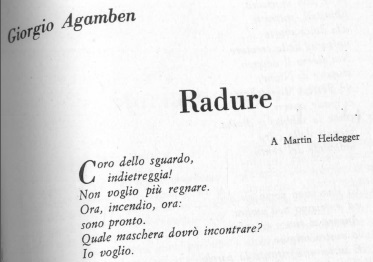
Agamben Radure 1967

(“Radure”, un temprano poema de Giorgio Agamben publicado en Tempo presente, N.12 (6), 1967.)

Traducción de Gerardo Muñoz & Pablo Domínguez Galbraith

¿A quién se dirige la poesía? Solo es posible responder esta pregunta si se entiende que el destinatario del poema no es una persona real sino una exigencia.

Una exigencia nunca coincide con las categorías modales con las que estamos familiarizados. El objeto de la exigencia no es ni necesario ni contingente, no es posible o imposible.

Se puede decir, en cambio, que una cosa ‘exige’ (‘exacts’) o demanda otra, cuando sucede que, si la primera cosa es, la otra también tiene que ser, sin que necesariamente la primera esté implicando lógicamente a la segunda o forzándola a existir en el ámbito de los hechos. Una exigencia es simplemente algo más allá de toda necesidad y toda posibilidad. Es similar a una promesa que solo puede ser cumplida por aquel que la recibe.

Benjamin escribió alguna vez que la vida del Príncipe Myshkin exige permanecer inolvidable, aun cuando todos la olviden. De la misma forma, el poema exige ser leído, aun cuando nadie lo lea.

Esto mismo puede expresarse diciendo que en la medida en que la poesía demanda ser leída, debe permanecer ilegible. Estrictamente hablando, no hay un lector de poesía.

Es esto quizás lo que Cesar Vallejo tenía en mente cuando, al definir la intención última y la dedicatoria de casi toda su poesía, no encontró otras palabras más que decir por el analfabeto a quien escribo. Es importante detenernos en la formulación aparentemente redundante “por el analfabeto a quien escribo”. Aquí “por” significa menos “para” que en “lugar de”; tal como Primo Levi dijo que él daba testimonio por –esto es, “en el lugar de”– aquellos llamados Muselmanner que, en la jerga de Auschwitz, nunca pudieron dar testimonio.

El verdadero destinatario de la poesía es aquel que no está habilitado para leerla. Pero esto también significa que el libro, que es destinado a quien nunca lo leerá –el iletrado– ha sido escrito por una mano que, en cierto sentido, no sabe leer y que es, por lo tanto, una mano iletrada. La poesía es aquello que regresa la escritura hacia el lugar de ilegibilidad de donde proviene, a donde ella sigue dirigiéndose.


[*Este ensayo fue publicado originalmente en la revista New Observations, N.130, 2015. Originalmente traducido al inglés por Daniel Heller-Roazen. Traducido al castellano específicamente para Infrapolitical-Deconstruction Collective. No reproducir sin incluir la fuente.]

Conversación incompleta con José Valero sobre La filosofía de El Capital de Marx, de Felipe Martínez Marzoa. (Alberto Moreiras)

Moreiras: Martínez Marzoa introduce la posibilidad de la infrapolítica al decir, en la página 138 de La filosofía de El Capital, que el produccionismo científico-técnico capitalista se enfrenta a “infinidad de microoperaciones humanas contingentes.” Es decir, en última instancia, es el concepto marxiano de Krisis el que impide la consolidación total de una conformación onto-teológica (o físico-matemática) del mundo, el que por lo tanto guarda la posibilidad de una ruptura, sólo imaginable ahí, del principio de equivalencia general. La “republica democratica” como Estado moderno, fundada sobre un sistema de garantias de igualdad entendida como sistema de derecho, es la contrapartida politica de la conformacion fisico-matematica del mundo. Por eso la infrapolitica no puede sino concebirse como el intento por suspender la hegemonia misma del Estado moderno incluso en su calidad de “republica democratica.” Esta operacion de suspenso infrapolitico tiene dos dimensiones centrales: la suspension de la legitimidad (weberiana) y la suspension de la hegemonia (gramsciana). Para mi esto es enteramente consistente con la postulacion de una democracia posthegemonica como la indicacion tanto de la necesidad de “destruccion” del Estado moderno como de una nueva potencial invencion de forma-Estado. Y la bomba: el proyecto socialista de Marx (léase comunista) supone un intento conservador de salvar la modernidad de lo moderno resolviendo sus contradicciones internas: “de las dos vías por las que puede cumplirse la finitud histórica, la ‘socialista’ es precisamente aquella que no es la ‘destrucción’ abstracta de la sociedad moderna, sino la asunción del patrimonio histórico que ella representa.”

Valero: Tal como yo lo veo lo que en ese párrafo Marzoa denomina “infinidad de microoperaciones humanas contingentes” no implicaría para el mismo Marzoa una ruptura con el principio de equivalencia general, sino que es sólo aquello cuyo quedar atrás es condición de posibilidad de que aparezca la estructura de la equivalencia general (ciencia moderna-sociedad civil). En efecto se refiere al trabajo real que no entra en el espacio de lo civil sino en la medida en que puede ser considerado trabajo abstracto, esto es, en la medida en que entra en relaciones de equivalencia. Así, en Marzoa esto define únicamente el límite que constituye la especificidad histórica de la sociedad moderna. Por otra parte si lo que la infrapolítica propone es un regreso a aquellas microoperaciones humanas contingentes, entonces estaría hablando de regresar a estructuras jerárquicas definidas naturalmente, cuando es justamente ese efecto de naturalización algo a lo cual la infrapolítica habría que oponerse.

Moreiras: Verdad que Martínez Marzoa no habla de infrapolítica ni nunca se le ocurrió hacerlo. Por eso yo digo que esas frases, es decir, ese punto preciso en su discusión, “introducen la posibilidad de,” si uno quiere pensar a partir de Marzoa, más que lo que dice Marzoa. Las microoperaciones humanas contingentes e infinitas no se llevarían a su término ni consumación incluso en el caso de una exitosa dictadura del proletariado que radicalizaría las posibilidades democráticas de la igualdad. Marzoa no habla de esto, sólo insiste en que, según él, Marx no autoriza ninguna especulación al respecto en términos de una sociedad futura. Para mí no es necesario hablar de regreso alguno, como si las microoperaciones humanas contingentes e infinitas sólo pudieran pertenecer a la “sociedad moderna” o a su figura. La “naturalización” está más bien del lado de pensar que la sociedad burguesa, en su giro revolucionario, pueda agotarlas. En el límite podría pensarse–esto lo dice Marzoa, para decir a continuación que él prefiere abstenerse de pensarlo–que la consumación revolucionaria de la república democrática como dictadura del proletariado sería la integración a la totalidad planificadora de todas esas “microoperaciones contingentes,” que en el capitalismo no encuentran funcionalidad sistémica y deben quedar desechadas o condenadas a su ruina. El socialismo sería en ese sentido “conservación revolucionaria” del sentido de la modernidad. Pero Marzoa comenta también que, una vez haya triunfado el socialismo, parece abrirse otra dimensión, el “comunismo” propiamente dicho, sobre el que Marx fue no sólo abiertamente vago sino también confuso. En fin, lo que queda es que el comunismo sería un cambio ontológico necesariamente, el comienzo posible de otra figura histórica de la que por lo tanto, al no tener su idea, no podemos hablar. Pero aquí se cuela, pienso yo, una filosofía de la historia encubierta en cuanto denegada, y es esa, la de Marx, la que está buscando reducir Marzoa. Infrapolítica se cuela por el agujero de sostener que las microoperaciones contingentes en cuanto tales, es decir, no en cuanto a su forma concreta sino en cuanto a su irreducibilidad a sistema, son el lugar en el que reside la posibilidad misma de enunciar la finitud radical de la sociedad moderna como figura, pero no en cuanto finitud diacrónica, sino en cuanto finitud sincrónica. Es decir, que son irreducibles también a la dictadura del proletariado, que son por lo tanto la reserva de la diferencia ontológica.

Valero: Mi intención era señalar que esa expresión apunta de algún modo a trabajo real que es lo que aparece ausente cuando el trabajo es social (y al cuál no se retorna por ejemplo en un tránsito revolucionario en la medida en que la revolución es un elemento más en el espacio de lo civil y no algo que lo supere) Eso conduce al “imperativo de la transparencia comunicacional” y que establecería las condiciones de la producción moderna. Entonces la cuestión para mí es cómo pensar la forma república (que para mí no es lo que Negri denomina forma estado) como conjuntos de operaciones contingentes cuando justamente en el momento de su génesis ideal está asociada a la planificación de la producción, es decir, a la socialización del trabajo.

Moreiras: Claro, exacto. Desde esta operación crítica de Marzoa el neocomunismo se desvanece como operación metafísica, es decir, queda marcado como operación consumadamente onto-teológica. Por eso esa forma-república no puede pensarse como realización positiva de un intelecto general!! Para mí pensarla, y por lo mismo criticar lo propuesto por Negri, etc., es el contenido específico, político, de la noción de posthegemonía.

Valero: La cuestión además es que la contrapartida de la ciencia moderna es, antes que el Estado Moderno, el espacio civil. Así, Estado o revolución no son superaciones del espacio civil (en el sentido de que el primero la integre y el segundo la destruya) sino movimientos diacrónicos dentro de una misma estructura que es lo civil. La forma-república excede y a la vez explica los intentos de establecer garantías en un espacio de equivalencia general que es lo civil. Así surgen aparatos de gestión de la fuerza como el Estado (y específicamente en su sentido moderno) La cuestión es que no da igual un estado que otro (aunque todos sean posibilidades de una estructura) porque no todos son capaces de ofrecer los mismos sistemas de garantías (por ejemplo hay estados que en nombre de unos derechos suspenden otros tantos) a la vez que ningún Estado satura la forma república (y los que lo hacen terminan en catástrofe) porque esta es una cuestión de iure y el estado es una cuestión de facto.

Moreiras: Cierto, pero, en la explicación de Marzoa, la dictadura del proletariado zanjaría, idealmente, esos desfases del Estado moderno consigo mismo. Creo que ahí estamos muy cerca de la noción de doble registro en el Espectros de Marx de Derrida. Lo cual nos lleva a preguntar si una forma-república trans-figurada, que es lo que tendría que pensar o concebir el segundo registro (aquí hay una fuerte diferencia entre Marzoa y Derrida) todavía podría contemplar conceptos como el de sociedad civil o incluso ciudadanía. Se me ocurre que aquí la idea de plasma, de Bruno Latour, que es parte de su crítica de lo social, podría ser interesante.

Seminar Notes on Felipe Martínez Marzoa, Heidegger y su tiempo (Madrid: Akal, 1999). (Alberto Moreiras)

First Note: Heidegger’s time=our time. The time of reading remains the time of writing.   This can be said of Heidegger’s work but not of Hegel’s or Nietzsche’s.   But it can be said on the basis of Heidegger’s own thought. It is Heidegger’s thought that reveals or unconceals a state of affairs—but this state of affairs is the state of affairs out there, in the world out there, with things themselves, with the thing as it is.   Heidegger’s thought is the unconcealment of a temporal state of affairs that is still ours.   The state of affairs is: our time, and Heidegger’s time, is the unlimited and unqualified, de-qualified time of being.   Heidegger’s thought is, on the one hand, the determination, in the sense of unconcealment, of a particular state of affairs with being (unlimited, de-qualified). On the other hand, the meditation on it: if so, what of it?   How do we relate to what relates to us fundamentally, how do we dwell in unlimited and dequalified time, how do we survive our belonging to it, if it is a matter of surviving, of not simply falling for it?   We assume that it is a matter of surviving it on the notion that time as unlimited and dequalified is historical, that is, that it has come to be, that it is not eternal and fixed—it therefore has an outside, there is an outside of the time that fundamentally determines our belonging.   Keeping the question open regarding such an outside—that is Heidegger`s thought, and there is, there would be nothing else to it but that.   It is a simple thing. If time is historical, there would be, and there would have been, another time . . . Being is the referent of that fundamental, and abyssal, frameless frame=the history of being is history as such.

[We could say: deconstruction is a working out of that state of affairs, essentially the thought that the state of affairs exceeds or subceeds the state of affairs, that there is always something that escapes. As to infrapolitics, it comes to the same: if, precisely, the time of unlimited and dequalified time is also the time in which, for the first time, one can say that everything is political, that everything is politics, if politics has now become one with the state of affairs of time as it is, if politics, at the time of the completion of metaphysics as the metaphysics of subjectivity, exhausts the horizon of time, and time exhausts the horizon of politics, then infrapolitics is only the simple claim that there is an excess, or sub-cess, that there is an outside to politics, an otherwise than political when politics is nothing but the implementation of unlimited and dequalified time. And that is a simple thought that, however, calls for a task: the task of an alternative understanding of the time of life. Perhaps infrapolitics, vis-à-vis Heidegger’s work or the task of deconstruction, is only its turn towards the thought of the time of life—which is not the time of work, and is not the time of the subject.]

(Note from Jorge Alvarez Yagüez: El tiempo del cumplimiento de la metafísica es el tiempo de la “techné”, no el de “polítiké”. Esta desaparece justamente por el recubrimiento de todo por aquella, la política se convierte en “gestión”, que es el modus técnico en la esfera en que se mueve. La extensión (e intensión) planetaria de lo técnico pone todo a disposición del sujeto, que al mismo tiempo adopta formas de relación consigo y con los otros de carácter técnico (estratégicas, calculísticas), su propia subjetividad, todo é, sensible y cognitivamente, es colonizado por aquello que coloniza. La forma que impone al mundo se le impone a sí. El momento de desaparición de lo político es paradójicamente el momento de su posible potenciación, toda vez que esa disponibilidad universal demanda una decisión compartida guiada por el interés de la polis, el de lo común. Y ahí entra la infrapolítica, en una doble tarea: 1) la de rescatar lo político sobre lo técnico; reivindicación de lo político 2) la de debilitar lo político mismo (este es su lado”infra”, en el sentido de inferiorizar, menoscabar) en la nedida en que este se asuma aun como forma del imperio de la subjetividad. Es posible que esto segundo no pueda ser cumplido sino dando lugar a una forma nueva ya no catalogable como “política” (ni siquiera en el sentido de la contraposición entre lo político y la política), pues esta no sea susceptible de superar su condición moderna. Y tal intento demanda otro manera de pensar, otro modo de pensamiento, que no puede ser sino, al mismo tiempo, otra forma de vida, y un modo en que pensamiento y acción (uso, inoperosità, praxis pura ??) vengan a fundirse.)

Second Note: There is a thing, or the thing, but we cannot be certain that we have access to it. There is the thing, it can always escape. By the same token, we may have access to it.   Let us bracket for the moment the thing that is only certain. Every other thing is also uncertain.   But it is a curious uncertainty, because of every thing we can say there is a possible certainty, even if we miss it.   In other words, there is a position of certainty for every thing in the context of everything else. This mote of dust is here (or it is not): if it is here, our certainty is correct. If it is not here, then we must revise our position regarding every thing else as well. (Hegel: the universe itself would be destroyed if a mote of dust in it could be destroyed: everything is interdependent.)   But this means, if we are properly certain of one thing, then we are properly certain of every thing else: we have access to the ens unicum, also called, the subiectum, the what of every thing.   The ens unicum, the subiectum, the what of everything, that thing of which things can be predicated (a cat is . . . an animal), opens the thought that the ens unicum is also the ens totum, the totality, the one-all.   This is metaphysics, but not any metaphysics. This notion of the thing, die Sache, re, to pragma, is itself historical. The thing as explained is modern metaphysics, certainly Hegel’s.

So the question is about the question. If the thing ends up in the one-all, this has to do with the nature of the fundamental question behind it.   We don’t ask about what we already know, we ask about what is somehow distant.

Modern metaphysics reveals itself as a distance from the thing which is at the same time a distance with the totality of things.   We ask about the thing because the thing has vanished or sunk, the ens unicum is distant, and so is the one-all.

But of course even here we find a difference between the type of distance to things that turns them all into an “indefinite, neutral, aconceptual, merely quantitative multiplicity”—this would already be the vulgar version of modern metaphysics, what would be ordinary or prephilosophical.   And the philosophical determination of the question of the being of beings in modernity. Both are certainly related, but there is a difference between them. If nothing else, this difference is the very alibi of modern metaphysics (and science, and politics, etc.): a disparaging reference to a vulgar understanding that does not rise to the level of a concept with which, otherwise, it is perfecty compatible (in a vulgar manner). [We need only point out to the difference between actually existing communism and its idea, or actually existing democracy and its idea, or actually existing religion and its idea, etc.]

So modern metaphysics is already the symptom of a loss, of an uprooting (“desarraigo o pérdida o desapego”) (we ask about what is no longer ours). But there is no turning back to the moment prior to it. The loss is all there is. Understanding that is assuming the distance, understanding the distance as loss, the loss as distance.   The one-all as unlimited continuum is loss. Every thing from now on would be an arbitrary, gratuitous cut in the continuum, every thing is just as good as any thing else—things are de-qualified [and general equivalence, which is the same thing as indifferent difference, reigns].

“La pérdida no es sino la propia comparecencia de aquello que se pierde; ello mismo acontece perdiéndose, su tener lugar es su escaparse,” “el zapato es en verdad zapato sólo mientras no es aquello de lo que se trata, es decir, mientras simplemente caminamos seguros.”

Being therefore means not just presence, but also and inseparably that which in presence has been left behind.

Third Note: We call that double sense “ontological difference.”   In a precise phenomenological sense: what is is ontic. The ontic prompts a question—the question makes us move towards . . . something that will not be found, because it is not itself ontic (and only ontic things can be found).   This is a tearing, a “desgarro.” There is this and there is the fact that this this is already a loss. When I say cat I kill the cat, when I say shoe I kill the shoe.

How can one, then, thematize the ontological difference without killing the ontological difference? [Is this not the fundamental question of what we are calling infrapolitics?]

Modern metaphysics has always already solved that question, appealing to the non-vulgar understanding of the being of beings as one-all, unlimited continuum, the absolute.   “La cuestión de cómo hay que entender y pensar para que se pueda estar en efecto reconociendo la exigencia de totalidad es, en este espacio, la peculiar versión de la diferencia ontológica; claro que no es la cuestión ontológica, pero precisamente por eso en cierta manera sí, porque no es la omisión estéril de esa cuestión, sino justamente la marca de ausencia de la misma, a saber, el que la cuestión del ser ya es expresamente sólo posible como cuestión de lo ente uno y total, el que la cuestión ontológica ha derivado en cuestión óntico-total . . . la cuestión óntico-total sólo es posible como derivación o marca de ausencia de la cuestión ontológica.”

There is therefore a peculiar mode of saying, of Saying, in modern metaphysics, just defined. But—is there an alternative Saying? Is there a Saying that could say the ontological difference without covering it over as the ontic-total vs. the particular thing?   There is always a “sense” of the questioning, and the question about that “sense” is the question about a particular kind of Saying.

Could the poet be the fellow who can Say the ontological difference without killing the ontological difference?

Fourth Note: But who is the poet? Is the poet just . . . the poet?   Or do we invert the definition and we talk about the thinker of ontological difference as the poet?   Poet= whoever can Say the difference, that is, say the difference without killing it. So, it is not in any case a matter of the poet being poetic and casually hitting, through her or his innate genius or poetic talent, whatever escapes the metaphysical taming, the withdrawal of Being as such in its articulation with its presencing.   We could even say that, as Willy put it in a recent comment, the last thing we need are poetic poets—they are just as bad as authentic authentics or musical musicians (they always end up whistling Bulgarian wedding tunes in any case, pachan pachan).   So perhaps we can say that there is a problem as to “the poet” in Heidegger, concretely regarding the question “what is a poet supposed to Say?” Because it is the Saying that makes the poet, not the other way around (this may not be so for right Heideggerianism, where a nationalist poet might qualify as the Namer of Being.)   Is Cecil Taylor a poet, in the Heideggerian sense?   Is Cezanne a poet in the Heideggerian sense?   Perhaps the answer is yes.   But then Lope de Vega may not be a poet, Espronceda may not be a poet, Neruda may not be a poet—mere amateurs.

Which brings us to Hölderlin.   Heidegger depends on Hölderlin in a way, says Martínez Marzoa, that cannot be limited to the dependence of a thinker on a poet.   Why? Because Hölderlin, who was a member of the Jena Circle, that is, a friend of Schelling and Hegel, understood something crucial (that very thing that Kant may also have understood but pulled away from, according to Kant and the Problem of Metaphysics)—it was so crucial that could and would have put German Transcendental Idealism on its head.   It has to do with the fact that the ens unicum, the interdependence of the thing with the one-all, the belonging of the thing to the unlimited continuum of timespace, means that the thing is subordinate to the one-all, that what truly is is the one-all, that a thing is only insofar as it is subsumed into the one-all.   The one-all is therefore the self-positing of everything, the subjectum of everything. And this is what German Idealism would have called the ego, I, the subject. The subject is the substance. This is the moment in modernity that begins the completion of metaphysics (Nietzsche will take one more step and so forth).   The self-positing of being as substance is the moment of maximum withdrawal of the ontological difference, the moment of the triumph of Being as Presence.   But, through the extreme absence of the question of the difference, the question of the difference returns as maximum presence, in the same way that only places from which even the ghosts have departed can be full of ghosts.

Hölderlin would have understood that, which is that in Hölderlin that drastically attracts Heidegger. But we don´t have the time to see how Hölderlin processes such an understanding through his poetry—except to say that it has something to do with Greece. Why?

Hölderlin understood, and stated, that in the apotheosic absolute self-positing of metaphysical modernity something “queda atrás,” is left behind, withdraws, and sinks into concealment.   Modernity refuses to understand that, and sees in its very refusal, in its “clearing of the ground,” a radical “absence of prejudice” which is consistent and compatible with the general indifferentiation of things into the unlimited continuum.   It is clear that the unlimited continuum is not historically new—it had been posited in the Hellenistic period. But, at that time, it was considered a state of affairs pertaining to the world of appearances, which could only be made consistent through theology (onto-theology). Modernity does away, in regards to the unlimited continuum, with the notion that things are inconsistent, that the world of appearances is only illusion. It posits its own understanding as final—prejudice-free empirical materialism, which of course does not preempt the belief in ontotheological spirit as well.

Another way of saying that: it is not the absence of the question of the ontological difference that identifies modernity, rather it is the fact that the absence has become principial, constitutive, grounding.   And this started with Hellenism, that is, after Aristotle. Aristotle is still a thinker for whom the ontological difference counted as a problem that had to be dealt with. Hellenism has already dealt with it, has already made its own solution “obvious,” and that dealing launches the history of modernity as the history of a forgetting.

So, Greece, and Greece also for Hölderlin and in Hölderlin’s work, is the historical name for the moment in which our history begins. How does it begin? Politically: “Que el juego que siempre se está jugando pretenda hacerse relevante él mismo, eso es lo que llamamos la pólis, no doctrinas acerca de la pólis, sino precisamente la pólis misma; y el que esa relevancia sea a la vez la pérdida podría decirse exponiendo cómo la pólis perece no por el ataque de los bárbaros, sino precisamente porque se sostiene.”

So Greece is the name of that historical beginning whose examination may help us remember the dual face of being, the ontological difference, also in or starting from, the political realm.   Why should we do this? Because our time, our modernity, our completion of the loss and the forgetting, our plight of having forgotten the plight itself, makes itself noted.   It is simple: if there is a problem you cannot solve, study the problem—historically.

Fifth Note: So who is the poet? And what is a poet? It just so happens those are not Greek notions, they are Hellenistic. In Greece proper we find no word for poets, or poem, or poetry.   What we have there is a notion of an excellent Saying.   And the Saying was excellent also in the sense that it was preeminent—not as it is the case with us, in which there is an objective, normative Saying, which is precisely not poetry.

So in Greece there is an excellent Saying that is excellent because it achieves relevance and preeminence.   In what sense?   In the sense of the ontological difference: “la excelencia del decir comporta . . . el que lo que lo que siempre ya queda atrás tienda a hacerse ello mismo relevante de alguna manera. . . . en el decir excelente, el decir, diciendo en todo caso las cosas, esta y aquella y la otra cosa, a la vez permanece especialmente enganchado en el decir mismo como tal.

The Saying of the poet is the saying of the ontological difference.   Excellent Saying says beings in reference to Being.

And was that not precisely what Dasein is supposed to accomplish as Dasein, that is, insofar as Dasein remains authentically as Dasein instead of letting itself be covered over by the inauthenticity of a false saying? If Dasein has it in itself to access Being, that is, to be responsible to the call of Being, if the voice of conscience, which calls to Being, is precisely the constant reminder of ontological difference as such, beyond the thrownness into the midst of beings, the Saying that corresponds to that is . . . Saying.

Can we get its possibility back from historical forgetting at the time of the full completion of metaphysical onto-theology as technology?

Sixth Note: The unlimited continuum is the unlimited continuity of the now—it is secondary (if it were not secondary, there could not be things, since a thing always implies a limit), it only operates on the (primary) absence of the question of sense (which is also the question of the ontological difference).

Dasein wonders about sense, because Dasein wonders about its own limit—being means limit. The affirmation of the limit is also at the same time the questioning of the unlimited continuum.   But Dasein’s limit is: death.   The anticipation of death is both the questioning of the unlimited continuum, the realization that it is secondary, and the priority of another temporality, a temporality that, as coming from the future, embeds the question of the ontological difference.   Time is already the ontological difference, and points to it. Time breaks time.

In the mood of the unlimited continuum, however, time does not break, it simply fails. Why? Because the one-all has no opposite, nothing is its opposite. And if the one-all confronts nothing, it does not take place. Nietzsche realized this. Hence his Doctrine of Eternal Return is his attempt—the last doctrine of metaphysics—to guard time from itself, that is, from its own failure—in the metaphysical mode, although inverted.

We talk about Hegel and Nietzsche, but the situation they reflect, the situation their thoughts reflect, is the general situation, that is, it also applies, for instance, to the State, and to everything else. Which means that the time of the end of metaphysics is also the time of the completion of the State, hence of the end of the State, the time of the end of ontotheological politics, etc.

But Heidegger has left few indications to take his thought into realms alternative to the philosophical tradition, particularly as regards the political sphere, civil society, and the like. And yet we can say: “la posición del Estado con respecto a la cuestión ontológica es la que hemos atribuido a la ciencia en sentido fuerte; por así decir: él es un problema ontológico, e incluso se basa en que haya quedado atrás la cuestión ontológica, pero no es él mismo ontología.”

The scientist, the statesman or politician, the poet—they eventuate truth in different ways.   The thinker is not the poet or the artist: if the latter two Say the truth, the thinker interprets it. The thinker is the hermeneutist, the reader.

But this means, for the thinker: the thinker can only read the unthought in the thought, that is, the thinker can only read what appears insofar as it is lost; what appears withdrawing, in withdrawal.   Everything else is, today, merely culture, and cultural industry.

[Understanding history, understanding the event of history—if this is all that is left, at the end of the pathway, for Heidegger in Martínez Marzoa’s interpretation, and if we claim Heidegger as an important guide towards infrapolitics, the question comes up: is infrapolitical reflection merely, and nothing but, a mere understanding of history, a mere dwelling in the errancy of history, a mere freeing of the hermeneutical relation? And yes is the only possible answer—which does not make it any easier.]

Deconstruction, not a good word. (Alberto Moreiras)

It should not be surprising that Jacques Derrida’s “Letter to a Japanese Friend,” dated 1983, has some connections to Martin Heidegger’s “A Dialogue on Language Between a Japanese and an Inquirer,” published in 1959.   Pablo Domínguez Galbraith said a few weeks ago that, in his opinion, Derrida in fact takes explicit distance from Heidegger in a few of his lines, when he says “I would not even dare to say, following a Heideggerian schema, that we are in an ‘epoch’ of being-in-deconstruction, of a being-in-deconstruction that would manifest or dissimulate itself at one and the same time in other ‘epochs.’   This thought of ‘epochs’ and especially that of a gathering of the destiny of being and of the unity of its destination or its dispersions . . . will never be very convincing” (4).   But distance is a form of relation.

What is at stake in the Derridean letter to his Japanese friend?   Apparently a definition of deconstruction, since it is the demand for a “schematic and preliminary reflection on the word ‘deconstruction’” that prompts it.   The definition will not come: “What deconstruction is not? Everything of course! What is deconstruction? Nothing of course!” (5).   Which leads Derrida to say that, therefore, deconstruction must not be a good word (“bon mot,” 5).   It can be or could have been “of service” (5) in the European languages “in a highly determined situation,” that is, historically speaking (5). But translation may have more to say, particularly as “translation is [not] a secondary and derived event in relation to an original language or text” (5).   Derrida then goes on to say that the Japanese translator, the “friend,” may be able to find a “more beautiful” word (5).   And, in his last lines, hints, merely, that translation, as a “writing of the other,” is of the order of the poem (5).   This is, then, the “positive” contribution of the letter, responding to the demand of the friend that Derrida’s reflection should “avoid, if possible, a negative determination of its [deconstruction’s] significations or connotations” (1).

But there is a little more, starting with the notion that, even in French, there is a shadowy (“somber,” 1) gap between the ostensible meaning of the word and its “usage itself, the reserves of the word” (1).   How did it come about? Derrida tells us that the word came to him by itself at the time of Of Grammatology, as he was trying to translate the Heideggerian “Destruktion or Abbau” (1), for an operation “bearing on the structure or traditional architecture of the fundamental concepts of ontology or Western metaphysics” (1). The models or regions of meaning provided by the archive of the French language were only models for it—and they in fact “have been behind a number of misunderstandings about the concept and word of ‘deconstruction’ because of the temptation to reduce it to these models” (1).   Against those models, Derrida invokes the “use value” of the term as he has been using it (1).

So, yes, at the time of structuralism, it seemed important to rehearse an “antistructuralist gesture” (2): “Structures were to be undone, decomposed, desedimented” (2). “But the undoing, decomposing, and desedimenting of structures, in a certain sense more historical than the structuralist movement it called into question, was not a negative operation. Rather than destroying, it was also necessary to understand how an ‘ensemble’ was constituted it and to reconstruct it to this end” (3).

The perceived negativity was hard to erase, particularly as one realized that deconstruction could not propose itself as an “analysis” (“the dismantling of a structure is not a regression toward a simple element, toward an indissoluble origin” [3]) or as a “critique:” “the instance of krinein or of krisis (decision, choice, judgment, discernment) is itself, as is all the apparatus of transcendental critique, one of the essential ‘themes’ or ‘objects’ of deconstruction” (3).   And the same can be said about “method” (3), which has the pleasant/unpleasant corollary that deconstruction, therefore, is not a methodology for reading and interpretation and can therefore not be “reappropriated and domesticated by academic institutions” (3).   Neither analysis nor critique nor method, it is also not an “act or an operation” (3), because there is something more passive about it than the passivity that is opposed to activity and because it does not return to an “individual or collective subject” (3). The most that can be said, therefore, is that deconstruction happens, there is deconstruction, ca se déconstruit, and the “se” “bears the whole enigma” (4).

If there is “that,” ca, then there is deconstruction. And that is one thing. But there is one other thing, and “all my essays are attempts to have it out with this formidable question” (4). This is the question of deconstruction’s timeliness or modernity or contemporaneity—and here is where Derrida introduces his “distance” from Heidegger.   Right after it there comes what I think is the single most important determination of the use value of “deconstruction” in this text: “It is therefore only a discourse or rather a writing that can make up for the incapacity of the word to be equal to a ‘thought’” (4). This is rather enigmatic, and Derrida does not elaborate on it at all. What is this “thought” that hover beyond the word?

So, let me suggest that the thought that there is a thought that hovers beyond the word organizes in this text the proper distance from the Heideggerian “Dialogue on Language.” Which is also very much a relation.

Let me attempt a few brief indications—I have to give up in advance on the pretense of doing justice to the later Heidegger’s text.   It is one of the texts where something like a cosmopolitical perspective insinuates itself in the Heideggerian oeuvre. And let me say it right out, but tentatively: Heidegger’s cosmopolitanism would here be organized around the notion that there is some incapacity of the word to be equal to a possible thought.

The Japanese visitor is a student of Count Shuzo Kuki’s, one of Heidegger’s Japanese students in the early 1920’s.   They rememorate the fact that many conversation with Kuki revolved around the Japanese word Iki. The word “incapacity” shows up in the second page. According to the Japanese, the encounter with European thinking has brought to light “a certain incapacity in [Japanese] language” (2).   Because Japanese would be deprived of a certain power to produce concepts.   The Inquirer is skeptical about the claim and refers to an inconspicuous “danger” that emerges through the very claim, but is left unspecified for the time being.   What is said is that the danger is embedded in the dialogue, on the basis of the fact that the near-impossibility of translation shows up in it, but also remains concealed. The Inquirer says, “I do not yet see whether what I am trying to think of as the nature of language is also adequate for the nature of the Eastasian language; whether in the end, which would also be the beginning, a nature of language can reach the thinking experience, a nature which would offer the assurance that European-Western saying and Eastasian saying will enter into dialogue such that in it there sings something that wells up from a single source” (8).   The question, the question that remains, is therefore whether a single thought can come into language, or whether language, in and through its very multiplicity, will remain incapable of reaching it.

Hermeneutics has everything to do with this, as defined: “the art of understanding rightly another man’s language” (11). The example of Iki comes up again. What is Iki? Can a non-Japanese grasp Iki through a European language?   Or is that word, and other words such as Ku and Iro, inevitably destined to be betrayed by the metaphysical structuration of the European language?   The danger is then that, in dialogue and through dialogue, the very possibility of saying “that of which we are speaking” be destroyed—and it is a danger that is only increased by what the Inquirer calls “the complete Europeanization of the earth and of man” (15).   Kurosawa’s Rashomon is now discussed as another example of dangerous translation, since, on the one hand, says the Japanese, Rashomon is a symptom of the fact that “regardless of what the aesthetic quality of a Japanese film may turn out to be, the mere fact that our world is set forth in the frame of a film forces that world into the sphere of what you call objectness. The photographic objectification is already a consequene of the ever wider outreach of Europeanization” (17), and on the other hand, there are in the film inconspicuous gestures that point in the direction of something other than Western.   But how can such gestures be discussed?

A brief discussion of gestures in No plays seems to take a step forward, as they are said to be a “gathering which originally unites within itself what we bear to it and what it bears to us” (19), in such a way that the gesture, “so gathered, bears itself to encounter emptiness in such a way that in and through it the mountains appear” (19).    But is this mention of emptiness not similar to what the Inquirer attempted to describe as “nothingness, that essential being which we attempt to add in our thinking, as the other, to all that is present and absent” (19)?   If so, this is a nothingness that a Japanese could never understand as “nihilistic” (19).   At this point in the conversation the notion of an “overcoming metaphysics” comes up to be described as neither a destruction nor a denial, but rather “an original appropriation” (20).

The danger of a dialogue, and the danger of language, is always to opt out of the concealed original appropriation, the concealed essence or nature of language.   How would the Japanese refer to language?   Is there a Japanese word that can express the appropriation of language, the ‘thought’ of language?   If so, as a word about essence, in terms of language, it would not refer to anything linguistic. Languate cannot represent language—and this is a limit where the danger conceals itself. Conceptual representation is not adequate to a manifestation of the nature of language—perhaps only gestures or “hints” will do. Perhaps only hinting at the nature of language is possible (24). Perhaps a word “is a hint, and not a sign in the sense of mere signification” (27).   And a hint of what?   The ontological difference, here called the “two-fold,” the “ambiguity of Being” as Being and beings, is perhaps already hinted at in the Japanese’s words: “And while I was translating, I often felt as though I were wandering back and forth between two different language realities, such that at moments a radiance shone on me which let me sense that the wellspring of reality from which those two fundamentally different languages arise was the same” (24).

Perhaps language, or a thoughtful reflection on language, can only aspire to produce tidings of that sameness—we may want to call it hermeneutics if we are to say that “language defines the hermeneutic relation” (30) as the relation of human nature to the two-fold.   “But the word ‘relation’ does want to say that man, in his very being, is in demand, is needed, that he, as the being he is, belongs within a needfulness which claims him” (32). This is the needfulness of the two-fold, which aims to be preserved. But can this needfulness be represented?   It can only be “used” (33). “The two-fold is not an object of mental representation, but is the sway of usage” (33).   Usage names the “originarily familiar,” which, the Japanese tells the Inquirer, “is what your thinking pursues” (33).

This “originarily familiar”—“our dialogues speaks historically precisely in its attempt to reflect on the nature of language” (34)–, would it not be what the Japanese must strive for? “Professor Tanabe,” says the Japanese, “often came back to a question you once put to him: why it was that we Japanese did not call back to mind the venerable beginnings of our own thinking, instead of chasing ever more greedily after the latest news in European philosophy” (37). The question can then be turned to the Inquirer regarding his own interest in the Greeks.   If the Japanese must turn to their venerable beginnings, says the Inquirer, “our thinking today is charged with the task to think what the Greeks have thought in an even more Greek manner” (39), which seems impossible, but has a plausible twist, or a twist of plausibility: it has to do with thinking the unthought of the Greeks, and “to see it so is in its own way Greek, and yet in respect of what it sees is no longer, is never again, Greek” (39).

The unthought of a thinking is the concealment of the two-fold, the non-appearance of appearance. “In the source of appearance, something comes towards man that hold the two-fold of presence and present beings” (40).   It is a “voice,” the “almost imperceptible promise announcing that we would be set free into the open” (41).   Heeding that voice implies a “transformation of thinking,” to be understood as “a passage . . . in which one site is left behind in favor of another . . . and that requires that the sites be placed in discussion. One site is metaphysics. And the other? We leave it without a name” (42).

Can we then speak of Iki not aesthetically, that is, metaphysically, but on the other trail?   Let us venture that Iki might be grace, or the gracious. Iki is a hint of the two-fold, “the message of the veiling that opens up” (44).

What about Koto ba, as the Japanese word for the non-linguistic essence of language? Is it also graciousness? Would there be a connection with the Sophoclean “charis,” which is also called “tiktousa—that which brings forward and forth” (46). As Dichten and tikton say the same, “graciousness is itself poetical, is itself what really makes poetry, the welling-up of the message of the two-fold’s unconcealment” (46).   Yes, there would be, as Koto ba refers to the “petals that stem” from “the happening of the lightening message of the graciousness that brings forth” (47).

We would now have to find a Western word that could match Koto ba, that could establish a relation and a dialogue with Koto ba. The word is Saying, as “let appear and let shine, but in the manner of hinting” (47), “the beginning of that path which takes us back out of merely metaphysical representations, to where we heed the hints of that message whose proper bearers we would want to become” (48).

But it is a beginning, and it still guards a danger. The danger is, Saying cannot be a word “about” language, because “speaking about language turns language almost inevitably into a concept” (50). Saying speaks from out of language not about language.   But this means, saying could only be a dialogue (51), a “saying correspondence” (52) in usage.

So that there can be dialogue.

Can there be?   Deconstruction may not be a good word for it. But it can be used. And it can be used in order to let the “se” of se déconstruit come into its own. That “se” is the mark of the two-fold, of ontological difference, of a transformation in favor of a passivity anterior to the difference between passivity and activity, an originary passivity that breaks, graciously, into poetical (or infrapolitical) dwelling. It is, in other words, a matter of translating, through dialogue, the untranslatable—historical thought, for the sake of cosmopolitical “appropriation.” Or, if the word “appropriation” “will never be very convincing,” perhaps we should stick to the more modest “transformation” as a mere passage to another site.

Nota a propósito del libro de Peter Trawny, Heidegger et l´antisémitisme, Seuil, Paris, 2014.

La tesis central del libro de Trawny es que en los Hefte el antisemitismo se inscribe en la Historia del ser. Tesis que yo diría no viene aquí sino a confirmarse, pues no es esta la primera vez que se nos ofrece. Es una interpretación conocida que en Heidegger lejos de haber un corte estricto respecto de sus querencias políticas de la experiencia del rectorado, lo que se da posteriormente es un elaborado trabajo de ocultamiento de esas posiciones siendo retomadas en un nivel de abstracción en que el judaísmo se convierte en la quintaesencia de lo que otras figuras ya expresaban. El americanismo, la democracia, el bolchevismo, el imperialismo, el nazismo, digamos, “desviado”, actores todos ellos, sonámbulos, del cumplimiento de la metafísica en su última etapa de la tecnología. Los judíos encarnan en estos Cuadernos la “racionalización y tecnificación”, “la maquinación”, el “desarraigo” (Entwurzelung, Bodenlosigkeit), la “ausencia de mundo”, “pérdida de la historia”, el “subjetivismo de los Tiempos Modernos”, en fin, todo aquello que significa la decadencia de una civilización, de Occidente; muy particularmente lo que impide al “pueblo” alemán, a su “raza”, realizar aquello a que está llamada: un “nuevo comienzo”. La depuración -el término “purificación” es muy frecuente en esos escritos- de ese elemento infectante es mero corolario. No se puede hacer frente a lo uno (maquinación) sin lo otro (depuración de los judíos).
Un pensamiento que sabe calar en este devenir civilizatorio ha de estar preparado para lo más terrible; en 1941 Heidegger anota que el proceso de superación puede exigir los más graves acontecimientos, un “último acto” en que se vea “la tierra estallar y la humanidad actual desaparecer”, lo que ante una mirada penetrante no será “una desgracia, sino la primera purificación del ser de su más profunda desfiguración por la predominancia del ente” (40) Lo que aparece en los Cuadernos, son las claves, por momentos tabernarias – con evocación inevitable del panfleto Los protocolos de los Sabios de Sión -, de esa ontoteología, las que emocionalmente, en su cotidianidad, harían entender la gran filosofía a los profanos, y que a la postre serviría de justificación a su autor.

Ni que decir tiene que con estos Cuadernos queda absolutamente demolida la tesis de un Heidegger no antisemita (Safranski), de un hombre que incluso en los momentos de mayor compromiso con el nazismo se distanciaba del antisemitismo vulgar de sus mamporreros colegas de partido; por momentos ni siquiera se puede hablar de una diferencia de estilo, pues lo que por un lado se disimula en la ontología se desvela en la expresión sincera de lo que puede escucharse a micrófono cerrado (“judería mundial”, “los judíos”, “judaidad”, “raza”, nómadas semitas…).
La raza judía aparece definida por una estar en el mundo, por una forma de pensamiento, tiene, se nos dice, un “don particularmente acentuado para el cálculo”- una expresión que apenas disimula el tópico del apego al dinero del semita; lo que era consignado por la época en que se quemaba la sinagoga de Friburgo, se hacían destrozos en el cementerio judío de la ciudad, y se deportaba a varios cientos al campo de Dachau. El “cálculo”, esta “racionalidad vacía” sería la forma de pensamiento que mejor conviene al omniabarcante imperio de la tecnificación del mundo, y que hace que las más graves decisiones que exige el futuro sean «inaccesibles a esta “raza”».
Justamente aquí, por sorprendente que pueda parecer a hermenéutas más finos, habría que hallar la razón última de por qué Husserl, aun a pesar de su valor, “no alcance de ningún modo el dominio de las decisiones esenciales”, y su fenomenología recaiga en la tradición, en el neokantismo y el hegelianismo formal, en el olvido de la cuestión del ser. El judaísmo es la ceguera del maestro, el calculismo vinculado al racionalismo de los judíos ha sido un límite insalvable para él. Pero el ataque a su maestro como tal, apenas importaba a Heidegger, pues en él se jugaba mucho más, no era una cuestión de personas: “El ataque funda un momento histórico para la decisión suprema entre el primado del ente y el fundamento de la verdad del ser” (52). La “decisión suprema” no se jugaba solo en el plano de la teoría, ciertamente. Es evidente que aquí de la decisión de que se trata es de la Entscheidung schmittiana. Al fin, la hostilidad entre los judíos y el pueblo alemán debe ser comprendida ontológicamente, como encarnando dos “principios raciales” opuestos, uno el del cálculo, el otro el del que está en las vías del pensamiento meditativo y es fiel a su suelo, a su tierra. ¿No era esto lo que, en definitiva, delimitaba la división amigo/enemigo? Heidegger extrae las consecuencias para el devenir de la Ontoteología de la concepción política schmittiana. Y no cabe duda de que la decisión puede implicar desagradables efectos; el más que cauto y extracomedido Trawny, es lo suficientemente ecuánime para afirmar cosas como esta: “no podrá excluirse nunca que pudiera tener por necesaria la violencia contra los judíos” (28).
Ahora aparece a otra luz aquel excusador “cuando un hombre piensa a lo grande se equivoca a lo grande”. El error no habría sido otro que dar crédito a una especie de nazismo inauténtico, el pensar, al ver, desde su ventana, al Führer pasar, que éste era la encarnación del Espíritu, del “nuevo comienzo”, ese que la filosofía heideggeriana, confundida una vez más con la marcha de la Historia, revelaba. Ya se sabe, Alemania sería la heredera de Grecia, solo su lengua como otrora la griega podían dar acogida al ser. “Solo el alemán puede poetizar y decir de nuevo el ser de manera original – solo él llegará a conquistar la esencia de la theôría y a crear finalmente la lógica” escribe en sus Cuadernos en 1938 (43). Ese era el gran mito, que él no tenía por tal, en el que todo cabía ser dispuesto. Según Trawny esta construcción es esencialmente lo que llevó a Heidegger al compromiso nazi (46)). Heidegger habría creído en un “nazismo espiritual”, que distinguía del “nacional-socialismo vulgar” – expresiones de los Cuadernos. Su equivocación fue creer que aquel empezaba a plasmarse; eran aquellos momentos en los que hablaba de “la verdad y grandeza internas de este movimiento” (Introducción a la metafísica). Más tarde, escaladas ya las alturas de la historia del ser, se daría cuenta de que el mismo nazismo no era sino una figura más en el complejo cumplimiento de la metafísica. ¿Habrá pues que esperar otro momento auroral? Heidegger no corrige, entonces, nada en lo esencial, no era aquel el movimiento esperado; ha sido un problema óptico; la gran decisión aun está por tomarse. ¿Con sus purificaciones?.
Todo se transmuta en categoría, perteneciente al devenir ontológico, y así adquiere otro cariz. Ante los signos de la derrota de la Guerra, el necesario “nuevo comienzo” será reinterpretado como caída, el momento trágico del proceso de salvación, parte necesaria del complejo Ereignis.
Y también aparece a otra luz, su silencio sobre Auschwitz. Habría que decir que no fue sino silencio en la “esfera pública”, que él, por otra parte, tan consecuentemente -tan anti-kantianamente-, despreciaba (recordemos aquello de “la dictadura de la publicidad”) pues por lo bajo rumiaba su justificación, “a lo grande”.
Entendiendo en claves de la historia del ser las luchas de la época, toda posición de asunción de responsabilidades aparecería como ejemplo de incomprensión, cuando no de antropomorfismo naif. ¡Qué se le va a hacer si el decurso del Ser en la historia es antisemita!. La marcha de las categorías sustrae a los hombres de toda carga moral individual. Mientras Heidegger podía restituir a Nietzsche al destino de la metafísica por mucho que le pesara al filósofo del martillo -no sin tomar de él acaso lo mejor que late en su propio pensamiento- sí podía simpatizar o sumarse pasionalmente a sus invectivas antisemitas, sirviéndose al tiempo del aristocratísimo situarse más allá de bien y de mal.

Como tantas veces en la historia de la interpretación, no cabe otro camino que leer a Heidegger en contra de sí mismo; pero también el de ser muy consciente de que una de las lecturas es la que él mismo hace de sí, nada es unívoco. Es muy posible que tras la categorías heideggerianas esté toda esta experiencia; que, por ejemplo, el “ser arrojado” del Dasein se entienda en claves de referido a una tierra concreta, a un suelo al que ha de serle fiel si no quiere caer en la inautenticidad… ; la mejor plasmación de esa categoría podría verla su autor en ciertos impulsos del movimiento nacional-socialista. Evidentemente de ese humus la categoría se distancia y transciende, lo que hace que otro pueda leerla al margen de él, y también de la plasmación que veía su autor, pero tampoco podrá negar la coherencia de este.
La infrapolítica ha de ser una contestación a la metapolítica como forma política que no se reconoce como tal al disimularse bajo la especie de ontología. La infra, mira desde abajo, es desconfiada y acecha al enano que mueve los hilos del muñeco.

(Nota: todos los términos entrecomillados y citas, salvo cuando se especifica otra cosa, son de Heidegger, pertenecen a los Cuadernos excepto la correspondiente, como se indica, a la Introducción a la Metafísica)

Fascist Historicality. (Alberto Moreiras)

The reference in the blog entry below to “there is no non-somnambulic hero of thought that can claim infrapolitical sovereignty” is a negative reference to #25 (“Historicality and Being) in Heidegger’s Contributions to Philosophy. (Of the Event.).  This paragraph seems to me a very clear and explicit articulation of the notion of inceptual thinking in Heidegger with fascism; henceforth, one of the passages that our project needs to counter.  Notice Heidegger’s thorough biopoliticization of politics, and then the claim of a totally other space for the masters.  And the masters are those who would make it possible for the political process of drastic uprooting for the sake of a new rootedness (a clear reference to the brutality of Nazi power, endorsed) to result in a proper thorough transformation of what he would in other places call “the essence of the human:”

“Historicality here grasped as one truth, the clearing-concealing of being as such.  Inceptual thinking as historical, i.e., as co-grounding history in compliant disposability.”

“Sovereignty over the masses who have become free (i.e., groundless and self-serving) must be erected and sustained with the shackles of ‘organization.’  In this way can what is thereby ‘organized’ grow back in its original ground, so that what is of the masses is not simply controlled but transformed?  Does this possibility have any prospects at all, given the increasing ‘artificiality’ of life, which facilitates and by itself organizes that ‘freedom’ of the masses, that arbitrary accessibility of everything for everyone?  No one, however, should undervalue resistance to the inexorable uprooting, calling a halt to it;  indeed, that is what must happen first. Yet would that guarantee the transformation of the uprootedness into a rootedness, and above all would the means necessary for such an action guarantee this transformation?”

“Still another sovereignty is needed here, one that is concealed and restrained and that for a long time will be sparse and quiet.  Here the future ones must be prepared, those who create in being itself new locations out of which a constancy in the strife of earth and world will eventuate again.”

“Both forms of sovereignty, though fundamentally different, must be willed and simultaneously affirmed by those who know.  Here at the same time is a truth in which the essence of beyng is surmised: in beyng there essentially occurs a fissure into the highest uniqueness and the flattest commonality.”   (I do not know–I do not have the German original–whether the word fissure is Riss.  If so, then it ain’t just a fissure, also a relation of sorts opens up, which would be a fascist one indeed. If it is Zerklüftung, then the question remains as to what Heidegger meant by fissure between “those who know” and the common ones in need of a new rootedness.)

IDC Genealogy and Projections. (Alberto Moreiras)

If the project of the Infrapolitical Deconstruction Collective has a common genealogy, and it must have it, although it is lived differently by every one of its members, we could probably find it in themes that have been developing since the late 1990s. They would be: the necessary destruction of the general cultural studies paradigm, a critique of the history of the left, including the so-called academic left, a dissatisfaction with dominant theoretical paradigms in the larger field of the humanities and in the smaller field of the Latin Americanist humanities, including subalternism, a critique of the neoliberal turn in the university as such, and, finally, a critique of so-called North American deconstruction.  I would myself propose that all of these negative or critical predispositions developed in the wake of a certain congenital marranismo, understood as the interesting side of the Hispanic intellectual and existential tradition.

And yet IDC means to insist on, and to continue to let itself be inflected by, a tradition of thought marked by the Heideggerian scheme concerning the history of being/end of metaphysics/end of epochal history/end of principial thought.   The former list of genealogical conditions should make it abundantly clear that it was never our intention to be in favor of any particular valorization (or de-valorization) of particular historico-cultural horizons or specific human profiles.  Indeed the notion of value, or any form of cultural value, was denounced by some of us as incompatible with a subalternist approach even at its most superficial.   Our marranismo had a few teeth, but not to chew on the exaltation or denigration of any form of human life: letting-be was our fundamental political position, from which every critique sprang.

The ongoing publication of Heidegger’s Black Notebooks makes it clearer than it ever has been–there is now no doubt that Heidegger was also an anti-Semite, and not just merely some sort of idealistic or deluded or merely opportunistic Nazi–that our project must also affirm a radical anti-Heideggerianism as well.   If the Heideggerian scheme on the history of being, which is very much a variation of the Hegelian one, hence it pertains to the history of thought as we know it, cannot be renounced tout court, and can only be engaged thoughtfully, the explicit, intentional undertones revealed by the Black Notebooks suggesting an “ontic” or “existentiell” plunge into both anti-Semitism and an overvaluation of “German” destiny in the preparation of the inceptual thought of the Other Beginning must be rejected not just in themselves, but also as master tropology for any kind of alternative cultural-historical valorization.   IDC must affirm the radical suspension of any cultural-historical valorization as principial thought, which, as principial thought, would always already be committed to hegemonic power and hegemonic accomplishment.

The Heideggerian thematics of the end of epochal history can only be referred by us to the end of the hegemonic/sacrificial structuration of history and historical life.  IDC articulates itself as a renunciation of power as principial force from an idea of an-archy whose foundations can be traced back to Heidegger as well, mediated by Emmanuel Levinas and Reiner Schürmann among others.

There is then a practical question in terms of how to read the Heideggerian text, which is at the same time the text of the end of metaphysics.   Given Heidegger`s own use of the tropology of “destruction,” it might not be appropriate to imagine our own reading of Heidegger as a practice of destruction (just as it would seem dubious to claim that one wants to undertake a deconstruction of Derridean deconstruction).   But “critique” seems to fall short as well.  We have been trying out the notion of “demetaphorization” in the wake of the recent publication of Derrida’s 1964 seminar on Heidegger and the Questions of History and Being.   We have used its corollary, “de-figuration.”  Catherine Malabou’s book on Heidegger (Le change Heidegger) also insists on a “third incision” in the Heideggerian wake having to do with desymbolization as a new practice or imagination of the real.   The object of all of this would be to arrest the very possibility of either of the two false exits from the Heideggerian schematic structuration: the rupture of the principle of general equivalence in favor of an alternative ontic or existentiell hierarchization; or the philosophico-artistic (or poetic) pretension that a refoundation or historial re-inauguration can be prepared by the thinkers or the poets, “the future ones” from Contributions to Philosophy.   IDC does not favorably hierarchize the labor of thinking or poetizing because it refuses to hierarchize values.  There is no non-somnambulic hero of thought that can claim infrapolitical sovereignty.   All of this forms one of the theoretical crossroads of our project.  We have tried to address it as the problematic of an infrapolitics of transfiguration or an infrapolitics of “vencimiento.”

Ni siquiera un manifiesto. (Alberto Moreiras)

La infrapolítica es, mínimamente, un campo de reflexión abierto a la indagación de condiciones y manifestaciones de experiencia en la época de la consumación de la estructuración ontoteológica de la modernidad.   Entendemos que la experiencia, la de todos y la de cada uno, está cruzada por la política, que la marca y determina y enmarca de forma fundamental e irreducible, pero postulamos que la determinación política no agota la experiencia. La experiencia excede o subcede la política, y puede por lo tanto ser tematizada y estudiada infrapolíticamente. Postulamos también que la política en la época de la consumación de la estructuración ontoteológica del mundo conocido no es un fenómeno naturalizable como dado por supuesto, sino que está él mismo sometido a condiciones históricas de manifestación.   La esencia de la política, podemos decir mimetizando a uno de nuestros pensadores de referencia, no es en sí política. Pero la infrapolítica no busca determinar filosóficamente cuál sea la esencia de la política, ni siquiera en sus dispensaciones contemporáneas. Su interés, hermenéutico, fenomenológico y deconstructivo, se da más bien en el intento de acotar la determinación política a favor de su exceso o suceso.   La infrapolítica es un campo de reflexión que indaga el suceso de la política en nuestro mundo.   En cuanto su-ceso, es decir, exceso que precede, campo experiencial no circunscribible ni agotable por determinación política alguna, la infrapolítica tiene dimensiones críticas—la infrapolítica piensa la política en la medida en que piensa su negación–, pero su ejercicio primario no es crítico (de la política) sino interpretativo.   La infrapolítica vive en una retirada de la política de la que no se nos oculta que incluye una intensa politicidad—pero es la politicidad impolítica que suspende y cuestiona toda politización aparente, y la coloca provisionalmente bajo el signo de su destrucción. Llamamos a la dimensión de politicidad impolítica de la infrapolítica posthegemonía, o democracia posthegemónica. La infrapolítica encuentra en la democracia posthegemónica, y en su praxis, que es la democratización posthegemónica, la interrupción suplementaria de su propia praxis subcedente.

Es claro en lo que antecede que este proyecto se sitúa en una tradición de pensamiento marcada por la obra de Martin Heidegger, a la que busca interpretar o reinterpretar en diálogo con sus continuadores históricos, de Reiner Schûrmann a Catherine Malabou, de Luce Irigaray a Felipe Martìnez Marzoa, de Jacques Derrida a Jean-Luc Nancy, de Giorgio Agamben a Roberto Esposito o Davide Tarizzo, e incluyendo a muchos otros. Pero también que la reflexiòn infrapolítica aspira a constituir un archivo de pensamiento más amplio y no contenible en la estela heideggeriana.   Nos interesa la práctica artítstica, la literatura, la ciencia y la religión en la misma medida en que también en esas prácticas se da reflexión y poetización de la encrucijada historial a la que remite el fin de la estructuración ontoteológica de la modernidad.   Nos interesa también el pisicoanálisis, que en ciertas de sus versiones puede entenderse como paradigmático de la práctica infrapolítica avant la lettre.   Y nos interesa el mundo de la vida cotidiana, con sus trazas de maquinación y cultura, de ética y moralismo, de historia y de desnarrativización perpleja.

Lo que proponemos es sólo derivada y subsidiariamente una práctica académica. Muchos de nosotros somos miembros de alguna universidad y tendemos a realizar nuestro trabajo en el contexto del aparato universitario.   Pero entendemos que la universidad está hoy sometida a condiciones de producción, en sí derivadas del acabamiento metafìsico de la modernidad, que son incompatibles con el futuro del proyecto infrapolítico. La infrapolítica es postuniversitaria y antiinstitucional en la medida en que busquemos su necesaria radicalización.   Se entiende como una modalidad de pensamiento salvaje, lo que Malabou llama la irrupción de lo fantástico en la filosofía, que nos desborda tanto como nos convoca, y nos destruye tanto como nos informa.

La infrapolítica no pide inscripción ni perdón. Se anuncia como voluntad de pensamiento al margen de canales establecidos y reconocibles, al margen de toda política cultural, al margen de toda recuperación biempensante. Tratará, por supuesto, de crear sus lugares, pero nuestra querencia es virtual y oscura, y nos atraen más los bares y las playas y los desiertos que las aulas, las salas de conferencia o los grandes hoteles convencionales. No insistimos en secreto alguno, pero sabemos que el pensamiento es siempre secreto.   No pedimos comunidad, no pedimos filiación, no pedimos siquiera comprensión alguna.   Nos manifestamos contracomunitarios y hostiles a toda formación de captura. Y apostamos a un largo plazo incalculable desde el cómputo servil del produccionismo excelentista.   Sabemos que sólo contamos con nuestro tiempo de vida, y que tal tiempo excede, y sucede, al tiempo de trabajo. Y esa es la cosa.

La presuposición del vencimiento y su consecuencia. Nota mimético-preliminar a Schürmann, Beistegui, Malabou, Sheehan, Leyte, Martínez Marzoa. (Alberto Moreiras)

El vencimiento de la estructura ontoteológica de la metafísica, si esa es la tarea de pensamiento asumida, pide un cambio en la dis-posición del pensamiento mismo, también de la escritura: una nueva Ge-Stell escritural. Contra la representación calculativa hacia una meditación recolectiva. Tal cambio sólo se hace posible en la época, presumiblemente la nuestra, de la consumación de la metafísica en el agotamiento de sus recursos metafóricos o foranómicos.   La metafísica hoy está ya de antemano desmetaforizada—de ahí que la desmetaforización imposible sea el nombre del peligro mismo del pensamiento otro (dado el riesgo de su contaminación saturante.)   Ese cambio—prepararlo, ejercitarlo (ex + arcare, exercitium, Ge-Stell de escritura), ejecutarlo—es actividad de pensamiento desde el fin de la historia que nos vive hacia otro comienzo posible, desde cierto fin del pensamiento hacia un pensamiento otro posible.   Pero no conocido. Tal esfuerzo, cuya necesidad no es cuestión de fe sino que se siente o no, por lo pronto, íntimamente, poéticamente, es ya un esfuerzo infrapolítico. La infrapolítica es el doble juego de destrucción o desestructuración crítica (desmetaforizante, en su peligro) del pensamiento tradicional, que constituye la hegemonía de Occidente, y del paso atrás o salto hacia una re-estructuración posthegemónica.   Pero esto último implica una mutación, un cambio en, dentro de, el cambio permanente que informa y estructura la tradición metafísica, un cambio otro que sólo puede ser entendido como salto fantástico. En cuanto fantástico no es locura sino que permanece como proyección orientativa. El motor del pensamiento infrapolítico es el fantasma de esa intimación. A ese fantasma hay por lo pronto acceso poético, o mejor, poetológico, en la medida en que se trata de una instancia que debe tematizarse (Ge-Stell de escritura) para ser. Dice Derrida en algún momento de La bestia y el soberano que de Paul Celan puede derivarse una política: quizá hay que añadir que esa política no es política, sino infrapolítica. La política, en cuanto a la vez necesariamente aprisionada en la esencia ontoteológica de la metafísica e instancia fáctica del manifestarse en cada caso de la voluntad de voluntad, en el fin epocal de la metafísica, debe también ser destruida, desestructurada, desmetaforizada.   Se trata de encontrar una relación libre con la política. La retirada de la política es su necesario retrazo. El nombre de ese paso atrás o salto hacia una sub-stancia destituyente puede ser, es, infrapolítica del vencimiento. Pero, si esto es un programa, la letra no está escrita. Pasa por la liquidación del fantasma, por su encarnación vital.