Respuesta (mínima) a Jordi Gracia sobre el asunto de la teoría entre los expatriados hispanistas.

images

(Sería bueno leer el texto de Jordi Gracia antes de proceder a leer el mío.  Aquí está:

Notas intempestivas sobre humanidades y universidad

Querido Jordi:

Lo primero es decirte que te agradezco incondicionalmente que te hayas ocupado de mi libro, cosa que no tienes ni tenías por qué hacer. Eso para mí es lo importante. Y no quiero que pienses que esta respuesta en forma de carta está motivada en ninguna posición defensiva por mi parte, ni que yo sea un tipo particularmente reacio a las críticas. No es eso. Es que tu reseña dice algunas cosas que son algo hirientes para un colectivo de gente que, mal que bien, me ha acompañado casi toda mi vida, que es en realidad ya mi gente, y es una gente que, en realidad, y en cuanto colectivo, recibe pocas satisfacciones formales–alguien debe hablar por ellos no para reinvindicarlos (no quiero hacerlo, no me interesa hacerlo, no soy un sentimental) sino para no acabar siendo cómplice de cierta injusticia. Y lo hago entre otras razones (y con brevedad para no dar la lata) porque entre mis defectos cuento la impaciencia–quizá debiera haber dejado que otros respondieran, o hacerlo yo pero para un periódico. Lo cierto es que, como diría Borges, tu texto, sin duda sin buscarlo, nos “anula o afantasma.” En fin, el formato de carta, espero, enfatizará la informalidad de esta respuesta mía, que solo quiere incidir en un par de aspectos de lo que dices, de ninguna manera cuestionar tu lectura de mi libro, sobre el que tienes perfecto derecho de decir lo que te parezca.

Ese grupo que me parece que hay que defender es el de los expatriados hispanos en Estados Unidos. Podríamos sin duda incluir a los expatriados hispanos en otros países, pero creo que la historia que se juega en Estados Unidos tiene ciertas especificidades que conviene tomar en cuenta. Y cuando digo hispanos incluyo en ello a los latinoamericanos, para abreviar, aunque quepa argumentar que los latinoamericanos no son solo hispanos, etc.   Y resulta que, si no me equivoco, esos expatriados hispanos son un buen porcentaje del campo profesional que se ocupa de todo lo relacionado con lo hispano en la universidad norteamericana–no tengo estadísticas fiables, no sé si existen, pero yo colocaría el porcentaje en un 70 por ciento, a ojo de buen cubero.

Esos tipos no son necesariamente todos marranos, no ocupan esa posición simbólica necesariamente, muchos no la desean o incluso la desprecian. Pero la realidad tiende a marranizarlos, incluso a dividirlos entre marranos y malsines (alguien decía hoy en el periódico que el malsín era el marrano que traicionaba a los marranos ante autoridades no marranas, algo así.)   Y así estamos. Hay un prestigio del “expat” cuando se trata de norteamericanos viviendo en París, pero no hay tanto prestigio cuando se trata del chileno que vive en Iowa o del español que vive en Carolina del Norte o en Texas. Y no porque en Estados Unidos los gringos no sean hospitalarios, sino porque el origen nacional tiende a dar igual por aquí y la divisoria es fundamentalmente racial y cultural. Y ahí es donde me gustaría hacer una primera puntualización, metiéndome por supuesto ya en aguas turbias.

El campo hispanista en Estados Unidos está sometido y ha estado siempre sometido a una discriminación racial-cultural sutil e inconfesa, pero sorda y fuertemente efectiva. Tan efectiva que ha relegado secularmente a los departamentos de español al lugar del último mono universitario. A esto se suman también deficiencias incontestables en la educación y en la calidad intelectual de la tradición crítica, pero estas últimas cosas se añaden a algo que las preexiste. No es así ahora o ayer–siempre lo ha sido. Y eso tiene efectos en lo real que aquí solo puedo empezar a indicar. Desde esas condiciones la lucha por la dignificación de un discurso intelectual hispanista capaz de trascender las fronteras nobles y respetables de la filología y de la crítica literaria en relación con el archivo en español se ha dado siempre en condiciones adversas y difíciles. Eso es lo que marraniza–uno vive en doble exclusión, no está ni en una parte ni en otra, porque no acepta esa subalternización sino que la rechaza, pero también porque no acepta vivir en el ghetto sin más, no quiere ser confinado, no quiere ser consignado al corral, mucho menos por la gallina al mando; y por detrás los pollos que sí han aceptado su posición en el corral, los que sí han aceptado su subordinación simbólica, ah, esos no perdonan.   Y hay que vivir en esa situación de inquerencia, desde ella, con los pocos amigos que uno va haciendo. Y esto va marcando la libertad intelectual, socavándola, haciendo sentir su precio de una manera que el profesor de alemán y la profesora de francés no llegan a conocer nunca. No es tan grave, uno siempre puede irse a comer ostras a Florida, pero para saber de qué hablo hay que haberlo vivido o vivirlo todos los días, y eso es lo que hacen esos expatriados con los que tu texto es, yo creo, poco generoso, aunque también creo que sin querer.

Entonces, primera puntualización, el problema en Estados Unidos no es teoría o crítica literaria, es quedarse en el ghetto o tratar de establecer un discurso capaz de hablar fuera del corral de la lengua, hablarle a otros, para sostener la igualdad, y no solo hablar de otros, por más respetable que sea esa opción (en todo caso no la mía, nunca lo fue.)   Ese es el reto que mi generación, que es la generación de la “teoría,” no tuvo más remedio que aceptar. En general, esa aceptación del reto se canalizó con excesiva facilidad hacia la política–muchos pensaron que hablar de política y ser muy político los legitimaba como interlocutores universales (dentro de la universidad norteamericana) sin darse cuenta de que eso acabó siendo también marca de caín y síntoma de procedencia cultural específica.   Algunos, sin embargo, y entre ellos estoy yo, quisimos darnos al intento de legitimar la reflexión desde nuestros departamentos de literatura, no por pretenciosos, sino porque nos parecía que eso era condición necesaria de una práctica intelectual no orientada a seguir en el ghetto crítico literario, comentando infinitamente y solo para colegas a otros escritores.   No nos interesaba, en realidad, hablar de otros, sino tratar de llegar a hablar por nosotros mismos. No buscábamos preservación de la herencia ni reparto de gloria literaria, sino innovación en el pensamiento. Eso queríamos. Y también librarnos del maldito racismo que nos ninguneaba, nos silenciaba, nos mortificaba, tantas veces también desde dentro, desde nuestros mismos departamentos. Sin duda es pretensión arrogante la de no aceptar un destino aparentemente corporativo, pero es la arrogancia que explica la expatriación en el mejor de los casos: buscar una libertad que, a pesar de todo, ofrecía la academia norteamericana de forma central en aquellos años. Por eso no es que yo haya sido un tonto (que lo fui, pero por otras razones) al tardar treinta años en darme cuenta de que la universidad no es amiga del pensamiento: es que la pelea para que lo fuera duró en mi caso treinta años. Quizá las cosas hayan cambiado para peor ahora. Quizá vuelvan a cambiar. Para mejor.

Pero ya entonces no te digo cuántas veces tuve que soportar que otros repitieran a mis espaldas “gallego, go home” o “gallego de mierda.”   El racismo se torna autorracismo también en la acusación de eurocentrismo cuando el atacado insiste en referirse al pensamiento europeo para tratar de decir algo. La pretensión de que un latinoamericano, por ejemplo, solo lo es auténticamente cuando habla desde ojos indígenas o afro-latinoamericanos, desde ojos y gafas no ya subalternistas sino subalternas, es francamente ridícula desde el punto de vista intelectual, lo sabemos, pero es también la marca de distinción de tantos de esos redentores contemporáneos del latinoamericanismo falsario. Y lo que justifica sus veleidades antiteóricas. Y eso es muy patético.

No te voy a disputar que haya mucha mala escritura supuestamente “teórica,” igual que supongo que tú no me disputarás que un alto porcentaje de la llamada crítica literaria es basurita prescindible. Malas prácticas profesionales–también en el terreno de las citas–se dan por todas partes, pero la regla hermenéutica siempre es elegir lo mejor de cada casa.   Y pienso que los mejores entre esos expatriados que son tan grande parte del hispanismo internacional son gente que no se fugó de sus carcelarios países, en los que muchos hubieran preferido seguir viviendo, para someterse a imperativos de servidumbre académica, sino que lo hicieron pensando en una libertad intelectual que sus países no les ofrecían.   No se fueron por cobardes y cabizbajos, no se fueron por muertos de hambre, y no se fueron como el que se va a una plantación de caucho, a joderse para ganar algo de pasta.   No los mejores. Y los hay. Y eso no está reconocido realmente en tu texto. Por eso quería puntualizar.

Una última cosa, no porque no haya más que decir, sino para dejar que otros quizá las digan: yo me largué de Duke porque Duke se había convertido, para mí, en un lugar pestilente. Lo único que perdí, y lo hice a conciencia, fue el dinero que Duke ponía a mi disposición con gran generosidad para hacer lo que me pareciera. El supuesto prestigio que perdí no es algo que yo valore en absoluto, y me parece más bien patético que la gente lo haga, sabiendo lo que sabemos.   Todas esas consideraciones sobre la pérdida de una hegemonía que nunca tuve, o no más que ahora, aunque quizá halagadoras para mí, aunque construyan una historia que alguien puede pensar semiheroica, son ociosas, en realidad, y mandan mala señal. Como lo hace, y me perdonas, Jordi, decir que la infrapolítica o la posthegemonía son retiradas del campo teórico y reconocimiento de la mayor gloria de no sé qué sencillez de habla en la que yo no creo ni creí nunca, pero en la que según tú ya todos los no-teóricos coincidíais desde siempre. !Me parece que lo que está en juego es bastante más complicado!  Sigamos hablándolo. No como conversación entre tú y yo, aunque también, sino que ojalá como conversación de campo que hay que tener y que llevamos décadas evitando por timidez insólita. O será por otra cosa.

Fuerte abrazo,

Alberto


New Recording 14, Voice Memos.

IMG_5896IMG_5896[5]

(This is the transcript of a recording from one of the sessions at the Transformative Thought Workshop, University of Michigan, September 2017. )

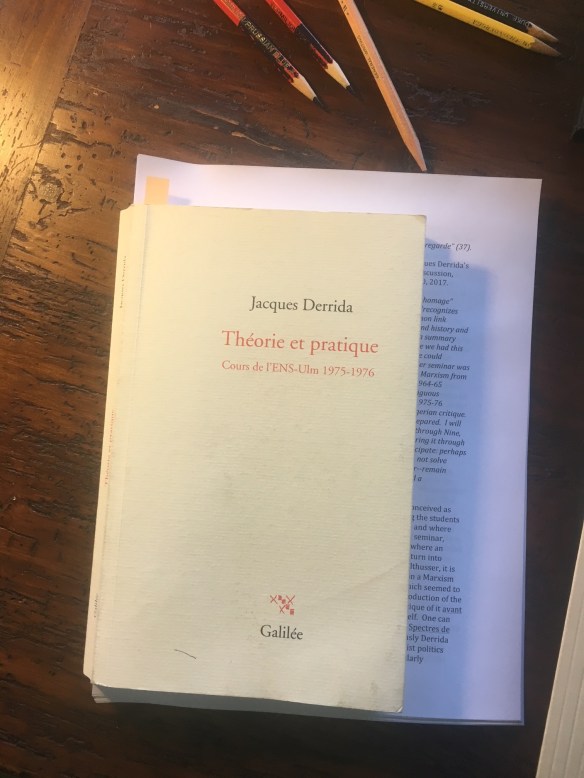
“En las primeras sesiones del seminario del 64-65 Derrida habla mucho de proximidad y distancia de una forma muy intrigante, provocativa. Es un tema que se anuncia y luego no se persigue, queda ahí instalado. Y claro, esto tiene que ver con la temática nietzscheana de que el abismo más estrecho es el más difícil de cruzar, lo que está más cerca es lo que está más lejos. Es también la temática de la diferencia ontológica, o de la difícil relación con la diferencia ontológica. Es la temática que consume la totalidad de la trayectoria heideggeriana y es la temática fundamental de la infrapolítica. Bueno, esto tiene una contrapartida en el seminario Théorie et pratique, un momento en el que, ya en las sesiones finales, cuando Derrida habla de lo que en francés llaman “l’incontournable,” lo inevitable, y se propone, Heidegger propone, dice Derrida, que pensar es tratar de acceder a aquello a lo que no se puede acceder pero que es inevitable, esto es, es buscar acceso a un inevitable que es inevitable pero cuyo acceso está vedado. Es inevitable pero no podemos saber lo que es. Esta es la tensión o la estructuración del pensamiento. Pensar es tender ojos claros hacia lo inevitable inaccesible. Entonces da unos ejemplos: la ciencia trata de relacionarse con la physis, pero no puede acceder a la physis, la ciencia nunca sabrá qué es la physis, el humano trata de relacionarse con Dasein pero no puede hacerlo se queda en lo humano, en lo inauténtico, etc., la “Historie” trata de relacionarse con la “Geschichte” pero no puede tampoco, igual que la gramática quiere relacionarse con la lengua, pero la gramática nunca toca la lengua, nunca tocará la lengua. La labor del pensamiento es esa tensión enferma, en cierto sentido, esa gran dificultad. Entonces, esa tensión en la estructuración, yo creo que es la que organiza la metáfora. Es la “purveyor of metaphors.” Esa distancia insalvable es la que organiza la actividad metafórica. La metáfora es al mismo tiempo una sustitución de la gran dificultad del pensamiento y una compensación por ella, y por lo mismo siempre en cada caso una trampa, una gran trampa. Una medicina que es veneno, eso es la metáfora en cada caso. Mi pregunta, o mi propuesta: la misma relación estructurante (o desestructurante) hay entre casa y ser. Es decir, la relación casa-ser es del mismo orden que la relacion humano-Dasein, o la relación Historie-Greschichte, o la relación gramática-lengua. La casa es metáfora, y en cuanto tal ni apropiada ni inapropiada, su uso tiene un sentido pragmático que puede servir o no servir según para qué, pero en la estructuración metafórica casa ocupa el lugar del ser: lo sustituye, lo compensa, lo “suplementa.” Es un término más pero que acaba englobándolos a todos y formando sistema. Esa es la propuesta. En esas páginas 58-60 del seminario del 64-65 en las que Derrida inesperadamente, y de forma contraria a lo que normalmente hace, elogia la metáfora de la casa. Creo que Derrida está moviéndose hacia la noción de que “casa” configura una solución metafórica al asunto de la diferencia ontológica, pero eso también implica: la relación con la diferencia ontológica es por lo tanto también una relación con la desmetaforización de la casa, con la destrucción de la metafórica de la casa o del habitar.  Eso también permite ver, esto le interesaba a Derrida, que “ser” es por lo tanto también metáfora.  No hay razón alguna para no invertir los términos–es cuestión de uso–y decir que es el ser lo que configura una solución metafórica al asunto de la diferencia ontológica, puesto que la diferencia ontológica es solo la traza de una diferencia que organiza la tensión del pensamiento, la diferencia misma entre estar y pensar.”


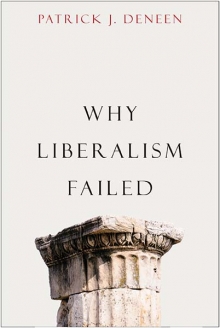
The triumph of res idiotica and communitarianism: on Patrick Deneen’s Why Liberalism Failed. By Gerardo Muñoz.

Patrick Deneen’s much-awaited book Why Liberalism Failed (Yale University Press, 2017) is a timely contribution that, in the wake of the Trump presidency, vehemently confirms the epochal crisis of political liberalism, the last standing modern ideology after the demise of state communism and short-lived fascist mass movements of the twentieth century. It is difficult to distinguish whether liberalism is still a viable horizon capable of giving shape to citizenship or if on the contrary, it endures as a residual form deprived of democratic legitimacy and popular sovereignty [1]. In fact, contemporary liberalism seems incapable of attending to social demands that would allow for self-renewal. In a slow course of self-abdication, which Carl Schmitt predicted during the Weimar Republic, liberalism has triumphed along the lines of a logical administration of identity and difference through depolitization that has mutated as a global war in the name of ‘Humanity’ [2]. The catastrophic prospect of liberalism is far from being a schmittian alimony of political exceptionalism. In fact, Mark Lilla in his recent The Once and Future Liberal (2017) claims, quite surprisingly, that the “liberal pedagogy of our time is actually a depolitizing force” [3]. What is at stake at the threshold of liberal politics is the irreducible gap between idealia and realia that stages a moment where old principles wane, no longer accounting for the material needs in our contemporary societies [4].

Deneen confronts the foundation of its idealia. Deneen’s hypothesis on the failure of liberalism does not follow either the track of betrayal or the path of abdication. Rather, Deneen claims that liberalism has failed precisely because it has remained “true to itself” (Deneen 30). In other words, liberalism has triumphed in its own failure, crusading towards liberation as a philosophy of history, while administrating and containing every exception as integral to its own governmentality. If modern liberalism throughout the nineteenth century (an expression of the Enlightenment revolutionary ethos) provided a political referent for self-government, the grounds for the rule of law, and the exercise of liberty against divine absolute powers (the medieval theology of the potentia absoluta dei); contemporary liberalism has found consolidation as a planetary homogeneous state that reintroduces a new absolutism that interrupts modern man’s self-affirmation against divine contingencies [5]. Since its genesis, liberalism was held by two main anthropological assumptions: individualism as the kernel for the foundation of negative liberty and the radical separation of the human from nature, both by way of an economic-political machine that liberates the individual at the same time that it expands the limits of the state. The rise of the securitarian state is the effective execution of this logic, by which politics centers on governing over the effects in a perpetual reproduction of its causes. These ontological premises are the underlying infrastructures of a two-headed apparatus that ensembles the state and the market in the name of the unrestrained conception of liberty. As Deneen argues: “…liberalism establishes a deep and profound connection; its ideal of liberty can be realized only through a powerful state. If the expansion of freedom is secured by law, then the opposite also holds true in practice: increasing freedom requires the expansion of law” (Deneen 49).

But the same holds true for the unlimited market forces that today we tend to associate with late-modern neo-liberal laissez-faire that presupposes the expansion of functional units of state planning as well as the conversion of the citizen as consumer. The duopoly of state-market in liberalism’s planetary triumph spreads the values of individual autonomy, even if this necessarily entails the expansion of surveillance techniques and the ever-increasing pattern of economic inequality within an infinite process of flexible accumulation and charity that maintain mere life. In this sense, globalization becomes less a form of cosmopolitan integration, and more the form of planetarization driven by the general principle of equivalence that metaphorizes events, things, and actions into an abstract process of calculability [6]. This new nomic spatialization, which for Deneen discloses the erosion of local communitarian forms of life as well as the capacity for national destiny, is the epochē of sovereignty as the kernel principle of liberalism. In other words, Liberalism’s sovereigntist traction was always-already exceptio through which the governance of the nomos is only possible as the effective proliferation and rule over its anomic excess.

The substantial difference with early forms of liberalism is that only in the wake of contemporary globalization and the post-industrial reorganization of labor, this exceptionalism  no longer functions as a supplement to the normative system, since it is what marks the subsumption of all spheres of action without reminder. In this scenario, liberalism is no longer a political ideology nor is it a horizon that orients a modern movement towards progress; its sole task is to control the imports of identity and difference within the social. One could say that liberalism is a technique for containing, in the way of a thwarted katechon, a society without limits. Paradoxically, liberalism, which once opposed sovereign dictatorship, now endorses a universality that cannot be transmitted, and a principle of democracy that has no people (populus).

In the subsequent chapters of Why Liberalism Failed, Deneen turns to liberalism’s imperial mission in four distinct social paradigms: culture, technology, the Liberal Arts in the university, and the rise of a new aristocracy. The commonality in each of these topoi is that in each and every one of these social forms, liberalism has produced the opposite of what it had intended. Of course, it did so, not by abandoning its core principles, but precisely by remaining faithful to them, while temporalizing the hegemony of the same as eternal. First, in the sphere of culture, Deneen argues that liberalism’s inclination towards an anticultural sentiment is consistent with multiculturalism as the “eviscerated and reduction of actual cultural variety to liberal homogeneity loosely dressed in easily discarded native garb” (Deneen 89). The culturalism promoted by liberalism is a process of deletion that knows only a fictive transmutation within the logic of ‘diversity’ and ‘inclusion’ that seeks to exhaust the cosmos of the singular. The price to be paid for policed inclusion of cultural differences into liberal anticultural norms, aside from leaving the economic accumulation untouched, is that it forces a form of consent that tailors the radically irreducible worldviews to standardized and procedural form of subjective recognition. Although Deneen does not articulate it in these terms, one could say that culturalism – which Deneen prefers to call liberalism anticulturalism-, amounts, in every instance, to a capture that supplies the maintenance of its hegemonic thrust.

Nowhere is this perceived with more force today than in liberal arts colleges and universities across the country, where from both ideological extremes, the Liberal Arts as a commitment to thinking and transmission of institutional knowledge is “now mostly dead on most campuses” (Deneen 113). From the side of the political conservative right, the way to confront the ongoing nihilism in the university, has been to completely abandon the liberal arts, pledging alliance to the regime of calculative valorization (the so called “STEMS” courses) on the basis of their attractive market demand. But the progressive left does not offer any better option, insisting by advancing the abstract “critical thinking” and one-sided ideological politization, it forgets that critique is always-already what feeds nihilism through the negative, which does little to confront the crisis in a democratic manner. The demise of the liberal arts in the contemporary university, depleted by the colonization of the dominance by principle of general equivalence, reduces the positionality of Liberal Arts to two forms of negations (critique and market) for hegemonic appropriation [7]. In one of the great moments of Why Liberalism Failed, Deneen declares that we are in fact moving slowly into the constitution of a res idiotica:

“The classical understanding of liberal arts as aimed at educating the free human being ids displaced by emphasis upon the arts of the private person. An education fitting for a res publica is replaced with an education suited for a res idiotica – in the Greek, a “private” and isolated person. The purported difference between left and right disappears as both concur that the sole legitimate end of education is the advance of power through the displacement of the liberal arts” (Deneen 112).

Liberalism idiotism is invariable, even when our conduct is within the frame of public exposition. One must understand this transformation not merely as a consequence of the external economic privation of the public university (although this adds to the decline of whatever legitimacy remains of the Liberal Arts), but more importantly as a privatization of the modes of the general intellect into a dogmatic and technical instrumentality that “can only show their worth by destroying the thing they studied” (Deneen 121). The movement of liberalization of higher education, both in terms of its economic indexes and flexible epistemic standardization, dispenses the increasing erosion of institutions, whose limits have now become indeterminate within the general mechanics of valorization. The res idiotica is the very exhaustion of the res publica within liberal technicality, where any form of impersonal commonality is replaced by the unlimited expansion of expressive subjectivism. In a total reversal of its own conditions of possibility, the outplay of the res idiotica is satisfied in detriment of any use of public reason and freedom, if by the latter we understand a commitment to the polis as a space in which the bios theoretikos was never something to be administered, but constructed every time [8]. The emergence of res idiotica coincides with the decline of politics as a force of democratization in the public use of reason.

In the economic sphere, the assault of the res publica entails the emergence of a new aristocracy, which as Deneen argues, was already latent in liberalism’s great ideologues’ (Locke, Mill, and Hayek) commitment to a ruling class formation and arbitrary economic distribution. For Deneen, one did not have to wait for Hayek’s experiments in active market liberalism to grasp that what J.S.Mill called “experiments of the living” as the promise of liberation from the social shackles, but only to consecrate an even more stealth system of domination between expert minorities rule and ordinary people. What remains of Liberalism in its material deployment is not much: a res idiotica that fails at constituting a public and civil society devoid of cives, and a state that expands the limits of administration in pursuit of freedom only to perpetuate an aristocratic class. In broad strokes, Deneen’s narrative about liberalism could be well said to be a story about how a “living body” (the People) became an absolute in absentia that only leave us with a practice of idolatry to a supreme and uncontested principle [9].

The idolatrous character of liberal principles is rendered optimal in recent theoretical claims against democracy, where the latter is seen as an obstacle for government rather than as the premise for the legitimacy of popular sovereignty. Hence, democracy is turned into a mechanical arrangement that includes whatever supports liberal assumptions and beliefs, and excludes all forms of life that it sees as a threat to its enterprise. In this way, liberalism today is a standing reserve that administers the proliferation of any expressive differential identities, while scaffolding an internal apparatus for self-reproduction. In one of the most eloquent passages of the book, Deneen evokes the anti-democratic shift of liberalism in the contemporary reflection:

“…the true genius of liberalism was subtly but persistently to shape and educate the citizens to equate “democracy” with the ideal of self-made and self-making individuals – expressive individualism – while accepting the patina of political democracy shrouding a power and distance government whose deeper legitimacy arises from enlarging the opportunity and experience of expressive individualism. As long as liberal democracy expands “the empire of liberty”, mainly in the form of expansive rights, power, and wealth, the actual absence of active democratic self-rule is not only an acceptable but a desired end”. Thus liberalism abandons the pervasive challenge of democracy as a regime requiring the cultivation of disciplined self-rule in favor of viewing the government as a separate if beneficent entity that supports limitless provision of material goods and untrammeled expansion of private identity” (Deneen 155-156).

The triumph of the res idiotica works in tandem with the expansion of the administrative state at the level of institutional reserve, and through the presidentialist charismatic populism in covering the void of an absent demos. These two cathetic instances of hegemonic closure maintain the democratic deficit that organizes the polis against any attempt at active dissent against the unlimited forms of commence and war that, according to Deneen, “have increasingly come to define the nation” (Deneen 172). At the very core of its innermost material practices, liberalism amounts to a technical-war machine that, in the name of a homogenous and uprooted ‘humanity’, liquidates the commitment to the res publica as the only political system that can uphold any form of consistent and durable endurance against the imbalanced domination of an unruly and anarchic power. If the political as a modern invention it is said to be a flight from the condition of servitude and slavish subordination, as Quentin Skinner has observed, we are in a position to claim that contemporary liberalism is as much a movement forward in unlimited freedom that articulates a regression to the form of dependence of the slave [10]. Once the singular is dependent on a power that he interiorizes as fully spectral and all encompassing, freedom amounts to a slave restraint over the potentiality of desiring and retreating. In the planetary stage governed by equivalence as the administration of cultural identity formation, the singular comes to occupy the position of the slave that, although is free to exercise his self-command in an unlimited region for self-recognition, any transgression of the normative regime is always-already anticipated by the securitarian apparatus. Politics, as we know it, has come to a close in the liberal paradigm.

Why Liberalism Failed does not shy away from offering a way out, a ‘what is to be done’ to the liberal dominium that puts in crisis the relations between thinking and action, imagination and political ideologies. For some contemporary thinkers (in particular, the post-Heideggerian tradition opened by the work of Reiner Schürmann and Giorgio Agamben) have endorsed a positivization of an-archy as a way for clearing the path beyond the saturation of apolitical liberalism [11]. But if we grant this speculative move, we forget that liberalism is an economy that governs the very excess of foundation that is already well within the anarchy principle. In other words, failure is not an exception or achievement or telos of liberal rationality; it is rather something like its irreducible latent force that gives semblance to the ‘actuality’ of the idolatrous principle. However, if liberalism is only semblance without material substance (barren from popular sovereignty), then it is no longer a constituted principle or archē. Anarchy is thus a false option, although it is not the option that Deneen subscribes. The question remains: what is to be done at the end of liberal politics that have brought to ruin the triad of action, freedom, and even citizenship?

Deneen’s wager is not an endorsement of a new and better theoretical articulation, but the affirmation of a community form that he associates with Tocquevillian ‘schoolhouse of democracy’ as well as with Wendell Berry’s practical communitarianism as a “rich and varied set of personal relations, a complex of practices and traditions drawn from a store of common memory and tradition, and a set go bonds forged between people and place that is not portable, mobile, fungible, or transferable” (Deneen 78). It is at this critical point in the conjuncture, where I see Deneen’s proposal as insufficient on grounds of both his own intellectual premises in his critique of liberalism, as well in relation to what the community form if understood as a locational and identitarian structure.

First, it is not very clear that community as understood here can do the work to retreat from liberal machination. The community form, assumed as a foreclosed and identitarian contained social form, can offer only a thetic instance of what liberalism promotes in its rule through management. The community as a countercultural reaction to liberalism’s promotion of identities leaves intact its own identitarian closure reduced to propriety and consensus [12]. Could one reconcile democracy with a communitarian horizon for a singular that opts for dissent against the communitarian majority? Probably not, because the horizon of communitarization, like that of liberalism, rests on the production of exclusion for anyone that chooses to retreat from the community. The fact that these questions are left unanswered by Deneen’s proposal is a sign the community form does not offer any substantial alternative to atomized identity. Rather, the community form only call to legitimacy is a set of metaphysical niceties such as ‘inheritance’, ‘location’, and ‘practicality’.

By subscribing to organic communitarianism, Deneen postulates a theoretical archē of the community that thrives on what it excludes in order to properly define and constrain itself. In other words, as conceived under the banner of “practical” (not ‘theoretical’) forms of life, the community form becomes an active self-reproductive logic that bars dissent before any threat from the outside. However, there is a second consideration when thinking about community form. Essentially, that it is not convincing that Deneen’s affirmation of the community can claim to be an exception to liberalism’s empire. By retorting that liberalism amounts to a “demolition that comes at the expense of these communities’ settled forms of life”, Deneen immunizes the community as an impolitical form that can be extracted from the logic of real subsumption (Deneen 143). In an ironic endgame, Deneen’s practical communitarianism as a ‘personalized and settled form of life’ recasts contemporary Marxist and current vice-president of Bolivia Alvaro Garcia Linera’s thinking of the community form as organic entelechy that accelerates use value against global transnational capitalism [12]. But whereas for the Bolivian thinker, the task amounts to an actualization of the community form in order to radically transform the state, in the case of Deneen’s proposal, the return to the communitarian patchwork amounts to the fantasy of a radical detachment from the administrative state and national popular structures. These two positions, although from opposing extremes of the ideological spectrum, do not provide an exit from the crisis of politics, but rather the full realization of politics as ongoing nihilism against the negative labor of liberalism. It would seem that the best that either the Left or the Right can offer today is a form of communitarianism.

If community form is always one of theological salvation – as a set of practices that would include care, humility, and modesty at the level of local communities (Deneen 191-192) – then this entails that communitarism works through a theological foundation of faith as the dissuasion of any possible instance of the profane interruption. As Elettra Stimilli has observed, the Christian community of salvation is always already consigns an unknown dimension of freedom, which reintroduces the dependence model of servitude [13]. The factical life of Christian community of faith can only be maintained as an ascetic practice for those that already within the parameters of its beliefs. In short, community form does not only leave unperturbed the functioning of the liberalism’s empire of liberty, and unfortunately can only provide the same broken idealia that fails to confront the interregnum that today names the fracture between theory and practice of the political.

Could it be, rather counter intuitively, that Patrick Deneen’s Why Liberalism Failed is actually an esoteric defense of liberalism? I would like to read the consequences of the book in that direction, by slightly displacing the question of liberalism to that of the anthropological genesis of modernity. This speaks to the book’s admirable tension between the triumphs of liberalism as a failure (or as always failing), while at the same time liberalism’s appeal to realize the admirable ideals that liberalism often only promised (Deneen 184). What if these aporias could allow us to rethink the Enlightenment as a project ‘to come’ that can guarantee open universal conditions for reform and in pursuit of modern man’s self-affirmative counter-communitarian, and institutional durability? What if the Enlightenment could desist on being a triumphalist account of humanist withdrawal, and instead be rendered as a project of radical deficiency, of the crisis of modern science, and the scope of singularity that can never amount to a metaphorization of the idea of liberty, but one that allows for the disturbance of myth (as well the theology) against transcendental action? [14]

The failed triumphalism of liberalism, and here I must agree with Deneen, was confined on its reducibility on subjectivation and subjectivity as an absolute anthropologism. This metaphysical anthropology, in fact, made the psychic life of the singular into identity reproduction between duty and guilt as the dual symptomology of becoming ‘subject’. Liberalism has been a compulsive and failed politics, not because of what it has not achieved by remaining all too faithful to its promises, but because it has substantially realized subjectivity as the uncontested hegemonic principle of the political. Against the servitude of liberalism’s imperial drive, and the communitarian countercultural obligations, the task remains to think the emergence of a universal, marrano, and non-subjective democratic enlightenment that could reinstate the res publica from within the ruins of the res idiotica, only if it is not already too late.

Notes

  1. The retraction of legitimacy in all political systems of the West has been argued by Giorgio Agamben in The Mystery of Evil: Benedict XVI and the End of Days (2017). Slightly in a different register, what I am arguing here is that the exhaustion of popular sovereignty in liberal hegemony, in part, is due to liberalism’s extreme distance, and at times even explicit rejection, from any transaction with the ‘popular’. At the same time, one could also claim that the emergence of populism in contemporary societies is a latent expression that seeks to ground popular mobilization to readdress the democratic deficit in technocratic governance.
  2. See La Guerra Globale (2002), by Carlo Galli.
  3. Mark Lilla. The Once and Future Liberal: After Identity Politics (2017). 137-138.
  4. The epigraph of Barbara Tuchman’s A Distant Mirror: The Calamitous 14th Century, we read: “When the gap between ideal and the real becomes too wide, the system breaks down. Legend and story have always reflected this in the Arthurian romances the Round Table is shattered from within. The sword is returned to the lake; the effort beings anew. Violent, destructive, greedy, fallible as he may be, man retains his vision or order and resumes his search”. The question is whether in the current interregnum the capacity for ‘myth’ can still provide a source to cope with the fissure between a desirable political horizon and a theoretical set of concepts capable of giving form to a new order.
  5. This is the argument for the legitimacy of modernity beyond the theological-political underpinnings in the wake of secularization advanced by Hans Blumenberg in The Legitimacy of the Modern Age (1985).
  6. Although the term general equivalent spans from Marx to Jean Luc Nancy to account for the logic of exchange, for an assessment of the question of equivalence as the logic of nihilistic measurement at a planetary scale, see “Infrapolitical Action The Truth of Democracy at the End of General Equivalence” (2016), by Alberto Moreiras at: https://quod.lib.umich.edu/p/pc/12322227.0009.004?view=text;rgn=main
  7. The insufficiency of hegemonic politics today has nothing to do with a partisan, theoretical, or ideological inclination. If we say that the theory of hegemony is no longer viable today, it is because it can only work as a collectivization of identity proliferation, whether in the form of the equivalent demand or in through the closure of the community form, failing to provide in either case for a demotic impersonal region. For the crisis of the modern university and the insufficiency of critique, see La crisis no moderna de la universidad moderna (1996), by Willy Thayer.
  8. As Arendt writes in her essay “What is Freedom?”: “The way of life chosen by the philosopher was understood in opposition to the bios theoretikos, the political way of life. Freedom, therefore, the very center of politics as the Greeks understood it, was an idea which almost by definition could not enter the framework of Greek philosophy”.
  9. I am thinking here of Adrian Vermeule’s important critique of the idolatrous conception of the separation of powers by legal liberalism in his most recent Law’s abnegation: from Law’s Empire to the administrative state (2017).
  10. Quentin Skinner. “A Genealogy of Liberty”, unpublished lecture read at Stanford University, October 2016.
  11. See, “On Constituting Oneself an Anarchistic Subject” (1986), by Reiner Schürmann.
  12. For an important assessment of the limits of the communitarian model, see “Consensus, Sensus Communis, Community” (2016), by Maddalena Cerrato, at https://quod.lib.umich.edu/p/pc/12322227.0010.005?view=text;rgn=main
  13. Elettra Stimilli. The Debt of the Living: Ascesis and Capitalism (2017). 9-10.
  14. This is the moment where Hans Blumenberg, who labeled himself as a disillusioned child of the Enlightenment, took maximum distance from the Kantian unlimited freedom as a necessary presupposition of reason: “However, the danger of using an absolute metaphorics for the idea of freedom can be discerned in Kant himself, and its grave, necessarily misleading consequences can be seen in the introduction of the conception of transcendental action. This makes it natural to regard as freedom anything that can be represented as a transcendental action of understanding”, in Shipwreck with spectator (1997), 101.

Presentación de “Marranismo e Inscripción, o el abandono de la conciencia desdichada”

A continuación copio la presentación que hice del libro de Alberto Moreiras, Marranismo e Inscripción, o el abandono de la conciencia desdichada, para un acto de mi departamento en el que se me pidió participar. Debido a los condicionantes del acto, la presentación que sigue es muy breve y no entra a comentar en profundidad muchas cuestiones del libro que merecen un tratamiento más pausado. Una de las cuestiones, y aprovecho esta ocasión para lanzar la pregunta, es acerca del estatuto (y, por tanto, validez) de las divisiones departamentales una vez rechazados los paradigmas culturalistas e identitarios y, por supuesto, los paradigmas filológico-nacionales de raigambre decimonónica. ¿Es, acaso, la lengua (o lenguas) lo que constituiría algo así como “el campo de los estudios hispánicos”? ¿O es, más bien, una apuesta teórica? Y si es tal, ¿no disolvería eso la pretendida -y generalmente inexistente- interdisciplinariedad en otras coordenadas, no ya en la universalidad de las humanidades sino en una singularidad teórica? En términos más concretos, ¿es el marrano un caso de los estudios hispánicos o una ruptura de los mismos? En caso segundo, Marranismo e Inscripción es un agujero hacia afuera dentro del campo mismo de estudios hispánicos… 


* * *


El libro de Alberto Moreiras, Marranismo e Inscripción, o el abandono de la conciencia desdichada, es un libro que plantea numerosos desafíos interpretativos para el lector, en particular para el lector del campo de los estudios hispánicos por la reflexión que contiene acerca de las últimas décadas del lationamericanismo. A lo largo de 9 capítulos, más introducción y epílogo, Marranismo e Inscripción es un libro que no se agota en una sola interpretación y que con cada nueva lectura va proporcionando líneas de fuga adicionales respecto de lo que el libro cuenta – y respecto de lo que calla. Evidentemente esto último depende de la interpretación de cada cual, y esa –la invitación a la interpretación y la teoría– es una de las virtudes del libro, razón por la que creo que una discusión en profundidad de este polémico pero también sereno libro podría beneficiar aproximaciones alternativas al campo de los estudios hispánicos y su relación con la teoría y el pensamiento contemporáneo.

Más allá de los elementos que a primera vista pueden parecer autobiográficos, el libro de Moreiras es una apuesta por entender la tarea del pensador como algo que no se limita a la práctica académica-universitaria contemporánea, sumida bajo una lógica corporativista y excluyente, en tanto que ésta está dirigida principalmente por criterios de beneficio económico, lo que Moreiras denomina, según una interpretación marxiana que conectaría con Felipe Martínez Marzoa y Jean-Luc Nancy, «la reducción al principio de equivalencia». La tarea del pensador, si se toma rigurosamente, apunta siempre a un afuera de la mismidad y el ensimismamiento universitario, lo que Moreiras llama «post-universidad» y que en términos más comunes podría denominarse sencillamente como «la existencia». Lo cual, de acuerdo con el libro, no resta ni un ápice que la profesión universitaria deba hacerse con el máximo rigor, aunque no pueda identificarse la labor académica con la tarea teórica o del pensamiento. Cito el libro: «Durante años pensé en mí mismo como alguien comprometido centralmente con el discurso universitario, con la institución universitaria. Hoy debo admitir que ya no -trato de hacer mi trabajo lo mejor posible, claro, pero algo ha cambiado. O seré yo el que cambió. Y entonces, para mí, ser un intelectual ha perdido ya su prestigio, el que una vez tuvo. Habrá otras maneras de serlo en las que el goce que uno quiso buscar pueda todavía darse. Hoy ese goce, en la universidad, solo es ya posible contrauniversitariamente» (16).

Precisamente el tono autográfico del libro se inscribe en la relación entre pensamiento y existencia, y se expone, en el doble sentido de declarar algo y de situar o situarse a la vista, en relación con todo un recorrido por la evolución de los estudios hispánicos y latinoamericanistas en las últimas décadas. Este recorrido señala varias rupturas y cambios en el campo profesional que van, en primer lugar, desde un paradigma de estudios muy dependiente de la filología tradicional y de la centralidad de la literatura, pasando por, en segundo lugar, la apertura del campo a los estudios culturales (y, nótese, que los estudios culturales parten de la, al menos, sospecha de que los estudios literarios eran estructuralmente elitistas y excluyentes). Hasta llegar, en tercer lugar y de un modo hasta cierto punto paralelo al segundo, a la creciente influencia de la teoría postestructuralista y la teoría feminista, provocando una inevitable e irrevocable transversalidad entre los estudios hispánicos y otros departamentos como los de lenguas romances e inglés, entre otros.

A partir de ese momento de cierta ebullición se va produciendo una constelación de distintos posicionamientos, postcoloniales, subalternos, neo-marxistas, decoloniales, y deconstructivos. Sin embargo, las expectativas que este contexto podrían generar pronto chocan con aspectos de la vida académica, tanto en su vertiente política como en su vertiente corporativa, lo que de un modo negativo señala el objeto real de Marranismo e inscripción. Más allá de luchas hegemónicas y de la tendencia a reducir la literatura a militancia política, surgen tres nociones claves en el libro: infrapolítica, posthegemonía y marranismo. Si los libros anteriores de Alberto Moreiras trataban polémicamente los paradigmas literarios y culturalistas, Marranismo e Inscripción levanta acta de estas polémicas y apunta en otra dirección completamente diferente. El nuevo libro de Moreiras condensa varias décadas de su carrera en los estudios hispánicos pero mientras hace ese recorrido se van perfilando otras figuras que rompen con los paradigmas establecidos. Por una parte, la figura del marrano. Pensar en el registro marrano es antes que nada una distancia respecto de todo identitarismo, sea político, sea cultural, lo que marca una relación con el archivo completamente diferente, en tanto que lo que enmarca el archivo no es una identidad previamente establecida sino la teoría y el pensamiento sobre una lengua.

Por otra parte, posthegemonía es una ruptura con las concepciones hegemónico-populistas de la política que pese a sus pretensiones acaban cayendo de un modo u otro en formas sociales y políticas ajenas a la democracia; posthegemonía sería, por tanto, un modo de pensar la democracia sin reducirla al juego político hegemónico-contrahegemónico ni a la reducción equivalencial economicista. Finalmente, frente la equiparación de cultura y literatura a alegoría nacional y militancia política, infrapolítica haría mención a una experiencia que pasa por debajo de las construcciones político-identitarias (en términos de Moreiras, una experiencia como sub-ceso) y refiere a aquello de la existencia que no se deja reducir a otra esfera, sea política, económica o cultural.

Para terminar esta presentación del libro, quiero terminar con una cita acerca de la figura que titula la obra, el marrano. «El marrano nunca quiere estar ahí donde lo ponen, de una manera o de otra, ni antes ni después de la acusación, y esa especie de rebeldía silenciosa o previa es quizá lo que ha provocado mayores problemas políticos para nosotros, el simple hecho de no querer o de no poder dejarse atrapar en las redes de la hegemonía a cualquier nivel supongo que resulta muy desconcertante y sospechoso y acaba por hacerse intolerable» (49). Ese simple no querer dejarse atrapar, marca «el fin de la conciencia desdichada» que define el subtítulo del libro y señala otras incursiones en el pensamiento que están por llegar y que Moreiras, y otros tantos, se disponen rigurosamente a acometer.

Notas crípticas sobre la conversación de Tijuana.

road2tijuanad

Informante bestial, informante diabólico, informante radical, que a su vez merece varias subcategorías. Mezclas de tipos en cada caso (por ejemplo, el que envía una carta anónima de denuncia falsaria puede incorporar los tres tipos, por ejemplo Marta Rovira diciendo mendazmente lo de “muertos en las calles” incorpora lo diabólico y lo radical y el análisis privilegia una u otra de las categorías, etc.).

Esos tipos contra el morador hiperfronterizo, el que vive en el secreto del desocultamiento, el marrano.

El hiperfronterizo entendido como el no-informante, es decir, el que vive en relación de sustracción respecto de la tipología del informante.

¿Qué es lo secreto, lo que regula la economía del informante? La “mismidad” del no-informante responde a la categoría (abiertamente presubjetiva) de “sujeto de la pulsión,” esto es, la pulsión de muerte en su singularidad máxima, o también,a aquello que en cada uno de nosotros se sustrae al Mitsein, al Mit- del Mitsein, contra Nancy, el lugar de la singularidad que ningún “cum” domestica.

La subversión del migrante marrano, el secreto del migrante, es el saber de la inexistencia del Gran Otro, el saber de la vacuidad de la fantasía social, y también, por lo tanto, el saber de la vacuidad de la teleología política.

El marrano en registro afirmativo apoya al estado contra la comunidad, y apoya la lucha del estado contra el estado de extracción. La batalla política de nuestro tiempo es la batalla del estado–único garante de la libertad posible–contra el estado de extracción–que organiza la servidumbre específica de nuestro tiempo–. Lo demás o es infrapolítica o es banal y está caduco.

El éxtasis del no-informante–del que se sustrae tendencialmente a toda tipología del informante–, su potencia de sobrevida y su oscura misión, son efectivamente lo que podríamos llamar o habría que llamar “aprender a callar.”

Aprender a callar es demanda de escucha, plantea demanda de escucha, pero solo porque es a la vez una sustracción radical a la escucha, un fin del análisis.

Hay un ejemplo histórico específico: el averroísmo popular de los siglos XII a XV en las comunidades judeo-moriscas de Tudela y León. Y había otras. No escribían, no dejaron más que traza de memoria.

Paz en Cataluña.

IMG_5673

Dicen que la paz social no es sino olvido o disimulación de un conflicto siempre latente, y que el conflicto es primario. Dicen que la política es siempre anestésica de un conflicto o de muchos conflictos que, desatados, resultarían en violencia mayor, violencia abierta. Dicen que, por lo tanto, la política efectiva, en cuanto gestión de conflictos, solo debe entenderse como violencia menor, violencia vivible.   El problema surge cuando dos entendimientos directamente enfrentados de la acción política–no la acción política en general, sino la acción política concreta–llegan a tomar preponderancia. En ese caso, que es el caso actual en España, las condiciones para la violencia mayor están dadas y son quizá imparables. No debemos engañarnos: el estado actual del conflicto en Cataluña es anuncio de violencia mayor. El estado actual del conflicto en Cataluña es sin duda, como algunos han querido que fuera, el fin, simbólico de momento pero pronto real, del llamado régimen del 78 y marca el inicio de una incierta etapa de inestabilidad que puede llevarse por delante no sólo a España como país, desde luego también a Cataluña, o antes a Cataluña que a la totalidad de España, sino también al proyecto de unificación europeo.   Cabe recordar el letrero que el protagonista de Bajo el volcán, de Malcolm Lowry, el cónsul Geoffrey Firmin, ve para su horror profundo en un parque mexicano al final de la novela: “¿Le gusta este jardín? Es suyo. Evite que sus hijos lo destruyan.”   Se está haciendo estúpidamente tarde en España para tal evitamiento, y me temo que el lunes 16 de octubre, es decir, pasado mañana, solo abrevie el plazo que resta hasta el principio de la catástrofe real.

¿En qué nombre? Pongamos que hubo en algún momento legitimidad incontestable a la demanda de mayor autogobierno y de ventajas fiscales para Cataluña. Pero lo que está en juego ya hace mucho que dejó de vincularse a esa legitimidad posible. La avidez pseudorrevolucionaria de algunos (pseudorrevolucionaria porque no sabrían qué hacer, no tendrían ni idea, con una revolución entre las manos) pretende que un triunfo resonante del nacionalismo independentista (supongo que la pretensión de un independentismo no nacionalista ya está revelada como el cuento que siempre fue) consumaría en el despliegue histórico-práctico una especie de paraíso terrestre en el noreste español o ex-español, mientras que otros se limitan a afirmar su creencia objetivamente supremacista de que basta con librarse ya de los “españoles” para lograr la virtud, y es todo lo que quieren: eso les basta. Otros piensan, solo o además, que el mal real en Cataluña es una presencia impuesta por los malos españoles que lo controlan todo, y así la sustracción de todo ello dejará males muy menores con los que se podrá lidiar con facilidad desde una supuestamente nueva hegemonía social.   La gran ventaja, quizá también para ellos mismos, y así para todos, sería, por supuesto, que, de darse la improbable independencia, por lo menos uno quedaría a salvo de tanta monserga insufrible, que ya no habría que escuchar más.  ¿Cabe pensar que todo esto sea no más que un gigantesco malentendido, que los catalanes estén simplemente reaccionando a un supuesto desamor del que quieren librarse ya, igual que los otros españoles reaccionarían por despecho ante el visible rechazo?   Hay gente que piensa eso.  Yo no estoy entre ellos.

Me he pasado en Cataluña, concretamente en Barcelona, más años de los que he pasado en ninguna parte de España con la excepción de Galicia, donde nací. Allí estudié mi licenciatura y allí tuve mis primeros trabajos asalariados.  Allí me enamoré para siempre.  Estuve empadronado en Barcelona hasta que mi larga residencia en el extranjero me obligó a reempadronarme en el consulado de turno. Allí voté mis primeras veces.  Y no he cesado de volver, casi todos los años, a Barcelona, y ha habido veranos pasados en la Costa Brava, con mi familia, con mi mujer y mis hijos, con mi padre que vino a estar con nosotros.   Tengo muertos en Cataluña.  El catalán es una de las lenguas habituales en mi casa.  Por lo tanto llevo a Cataluña en mí, muy dentro, y lo que está pasando me produce un fuerte desgarro que, por supuesto, no puedo ni comparar a lo que les estará pasando a tantos que viven todavía en Cataluña y que no han querido ser embaucados por lo que ha venido a llamarse el “relato” independentista.

Ahora bien, esto del “relato” es en sí una trampa. ¿De qué relato se habla? ¿Del relato que hace de Cataluña una región irredenta y sometida a un estado español nunca querido desde hace más de quinientos años? Para no meternos en complicaciones imposibles, prefiero acotar el “relato” a lo que se relata en cuanto a la opresión y daño hecho por España a la Cataluña posterior a 1978. Y ese, no tengo reparo en decirlo, es un relato mentiroso y embaucador, tramposo, mírese por donde se mire.   Hay una situación fáctica, que es un Estado cuyos supuestos básicos están determinados por la Constitución aceptada por todos desde la facticidad misma, y no había otra. Ese Estado ha sido abierta y consensuadamente organizado en torno a una amplia división de poderes, aunque inevitablemente habrá siempre mayores o menores demandas y resistencias según los partidos de turno.  Más allá del Estado, y de la legalidad que no puede saltarse pero que se ha saltado, en Cataluña ha sido siempre muy claro, desde luego desde los años setenta, si no antes, que la hegemonía social era catalana y catalanista, y que el poder social no dependía en manera o modo alguno del Estado español o de sus supuestos largos dedos o arteras costumbres. La pretensión de una España opresora de una Cataluña sufriente, fuera del juego político habitual en democracias liberales, no puede en verdad sostenerse en relación con los últimos cuarenta años, y de relatos quiliásticos y victimistas en relación con la totalidad de los tiempos estamos más que hartos.  Cuando Mas le dijo a Rajoy que se atuviera a las consecuencias de una negativa a ampliar ventajas fiscales para Cataluña, clara amenaza, todo fue ya cuestión de sumar agravios para embarcarnos a todos en un camino altamente peligroso.  El movimiento resuelto hacia la independencia lo inicia el Gobierno catalán, y por eso él es el principal responsable, al margen de que ha habido graves torpezas políticas por todos lados en los últimos cinco años.

Pasé en Cataluña mis años de estudio universitario, los años de la llamada transición, del 74 al 81. Siempre supe, en aquellos años, que mi posición social real (dejaré al margen a mis amigos y a mi familia política, naturalmente) era la de un forastero solo más o menos bienvenido, así me lo hicieron notar, por ejemplo, mis profesores universitarios, y que, para conseguir una vida plausible en la sociedad catalana, había que pagar un peaje que excedía el aprendizaje de la lengua.   El contraste con lo que podía sentirse en Madrid o quizá en cualquier otra región española (con la excepción del País Vasco, me dicen, aunque yo no tengo experiencia directa), más francamente hospitalarias en un sentido primario y sencillo, era notable, pero era un contraste que uno aceptaba.   Ya se sabía: Cataluña era Cataluña y Barcelona era Barcelona, y amarlas, amar su lengua, su cultura, su tierra y su mar, su gente, su cocina, era apañarse con todo lo demás, con la diferencia catalana, grande, interesante, divertida, que tampoco hacía la vida cotidiana tan incómoda, se aguantaba, era un poco raro, se notaba a veces, podía tener consecuencias no del todo simpáticas (cuando, por ejemplo, el nieto de un famoso pintor mallorquín le preguntó a un amigo mío en un bar, hablando de mí, a quien acababa de ser presentado, ¿quién es este xarnego de mierda?), pero uno ya sabía.   Y quizá haya fuertes razones históricas para que esto sea y haya sido así, más allá del franquismo y más allá de la sospecha de que cualquiera que viniese en esos años de plomo del oeste de Lleida o del sur de Tarragona hablando en castellano era potencialmente un peligro para la herencia ancestral.   No lo dudo ni las juzgo. Había una particularidad catalana fuerte con la que había que pechar sin mayores reproches si uno no quería por otra parte tener que renunciar a su propia particularidad.  Esa particularidad catalana hacía demandas, demandas que eran personales pero también sociales, y eran demandas más rotundas y distintas a las que podía sentir un forastero en Galicia o en Madrid o en Sevilla o en Asturias.  Daban la oportunidad de elegir, o incluso conminaban a elegir después de un cierto tiempo.   Y uno elegía, qué remedio, y eso marcaba vidas, y a lo mejor no pasaba nada o a lo mejor sí, y muchos encontraron su felicidad en ello. Y nadie era directamente responsable, la historia quizá, y me atrevo a pensar que era así no solo para mí sino para tantos como yo, para todos y cada uno de los que eligieron Barcelona como lugar de residencia temporal durante todos esos años–justamente esos años que ahora, inevitablemente, mueren.

(Y en Cataluña aquel capullo de los años setenta me pudo llamar xarnego, y a lo mejor todavía les pasa hoy a otros, o a los niños en los colegios, crece el odio y el desprecio o crece el resentimiento, crece la estupidez, pero los no catalanes en España son también responsables: cuántos catalanes no han sido insultados y humillados en los últimos años en los taxis, bares, hoteles cuando viajan por España, en cuanto catalanes, por serlo.  Quizá les pasó a los vascos en otro tiempo.  Esa mezquindad torpe y palurda, la del desprecio al otro por ser diferente, española o catalana, no puede perdonarse, ni en un lugar ni en otro, ni de unos ni de otros.  No sería fácil, imagino, saber si hay más desprecio por lo español castizo en Cataluña o en España por lo catalanista en estos momentos, pero conviene decir, escribiendo en español, que los catalanes no son los que más insultan, y que no vale, en estas cuestiones, tirar la piedra, esconder la mano y luego dolerse de lo que otros hacen como resultado.  En qué medida el independentismo sea consecuencia de un desprecio percibido es algo que nunca sabremos, pero no debemos dudar de que sea un factor importante sobre el que siempre se puede hacer algo positivo, renunciando a ese desprecio.)

No me preocupa tanto la muerte de una época–el pasado pasa. Y no prejuzgo el futuro. Lo que me preocupa es lo que veo como el muy difícil acomodo de tantos como yo, de tantos que, queriendo vivir en Cataluña como ciudadanos iguales, con plenos derechos, y dispuestos a aceptar o incluso adoptar en lo que se pudiera una diferencia catalana, por incómoda que resultase (había que hablar la lengua, claro, pero había también que aceptar hasta cierto punto un relato problemático e incierto, había que cumplir ritos, decir cosas o callar otras, o no hacerlo y asumir la condición permanente de forastero), en la misma medida en que no estábamos dispuestos a renunciar a la nuestra propia–yo quería seguir siendo gallego y español tan clara o tenuemente como ya lo era, faltaba más, cuando vivía en Barcelona, y nadie me convenció nunca de que tal pretensión fuera vergonzosa–, ahora ya no tendrán a qué carta quedarse, las cosas se han complicado, ya no podrán reconciliarse fácilmente con una situación que los excluye como los conciudadanos reales que habían creído ser; una situación que crea una divisoria ideológica explícita y quizás insalvable en la sociedad catalana, entre los catalanes de verdad y los que Forcadell llamó súbditos y otros llaman traidores, quizás latente por muchos años, pero ahora demasiado dolorosamente patente.  Y el problema para ellos está abierto, y no hace falta esperar a que se declare y triunfe o fracase la independencia.  Ahora hay que asentir o callar, callar o doblarse, para que la igualdad no se tambalee, para que no haya bronca, o largarse y no volver, o esperar a que todo cambie, y aguantar, y esa es mala cosa.  Lo que en principio no era más que un conflicto político acaba envenenando condiciones fácticas de existencia. Claro, tenía que ser así, quizás, pues al fin y al cabo la política no es más que la disimulación del conflicto, y cuando la política falla–en Cataluña ha fallado la política, catastróficamente, y ninguno de los mediocres que hoy están a su cargo, incluyendo al patético Pablo Iglesias, tiene la más remota idea de qué hacer al respecto–la infrapolítica entra en su verdad.

Ahí está mi problema. Personalmente creo en la necesidad de una Constitución vinculante y no soy partidario de pasársela por el forro cuando a uno le conviene, como han querido hacer el Gobierno catalán y sus aliados.   Sé dónde está mi lealtad política, a pesar de mi amor por Cataluña.   Pero, más allá de mi lealtad política, está la otra lealtad, esa lealtad vital o existencial que está hoy desgarrada. Y me duele pensar en tanta gente como yo que no podrá resolver este conflicto en sus propias vidas excepto quizá invocando pasiones tristes que no le van a hacer favor alguno a nadie.  Pero a tantos de los valientes indepes esto parece traerles sin cuidado. No sé si hay entre ellos algunos que todavía se preocupen, o si más bien lo buscan.

Si todos o casi todos los residentes de Cataluña apoyaran la independencia, no habría que pedirles razones.  La independencia sería razonable y legítima.  Pero no es el caso.  Y a esos que no la apoyan y que tienen no solo a la Constitución–la ley del Estado–sino también quinientos años de historia y tradición a sus espaldas–la mitad del electorado, la mitad o más, pero poco importaría que fuese la mitad o menos–, en última instancia no se les puede dejar solos.   Por mucho que nadie que piense eso quiera violencia alguna.  Esa es para mí la verdad de lo que pase el lunes.


Democracy without arcanum: philosophical anthropology and metaphorics after The Question of Being & History 1964 seminar. (Draft for “Transformative Thinking Workshop”, University of Michigan, September 2017). By Gerardo Muñoz


Jacques Derrida’s important early 1964 seminar on Martin Heidegger, The Question of Being and History (2016), is more than a mere exegetical reading of Being and Time. I think it is also wrong to think of the seminar as an attempt to promote a “Heideggerian paideia” of a philosophical master. From the first session, it becomes clear that Derrida is not interested in producing anything that could resemble what we think of as “critical theory”. Indeed, theories today could be thought-provoking novels and melodramas, and every time that one hears of ‘good theories in America’ it is most certainty because they are good novels. No stories, no masters. It should come to no surprise that Derrida says that the Heideggerian ‘destruction’ could never entail a refutation. The craft of refuting belongs to the sophistry of meaning made possible through exchange and measurement. It is not coincidence that the sophists were performers of rhetorical persuasion, a pragmatic practice that unified substitution, linguistics, and temporality in semblance of philosophical deployment [1].

This game of refutation is always potentiality hegemonic, since its capability for truth never leans towards a singular ex-position. It is rather in the metaphorics of discourse that the singular runs astray as truth of being. As a preliminary condition of his seminar, Derrida makes himself unsophistically clear: there will be no anti-philosophical sophistry, no refutation, and no university productive surplus. In fact, one of the challenges that reading this seminar poses today –especially as professors or students having some relation to the contemporary university world – is to be found in an unbounded desire to extract essential lessons for the ‘present’. But one must reject the journalistic temptation in the teacher’s lesson. Furthermore, today this difficulty cannot be entirely solved by favoring écriture, but rather by confronting the task of thinking outside the dispensation of the order of ‘philosophy’, ‘literature’, or ‘politics’ [2]. The seminar is an invitation to accept the integrity of thinking with no derivative systematic and telic program.

If this is true, then one must take Derrida very seriously when he contends that: “there are no Heideggerianism and no Heideggerian” (Derrida 223). This affirmation is not rebutting the construction of a philosophical school under the label ‘Heideggerianism’. Rather, it is preparing, in its place and deferral, another entrance that neutralizes the metaphorical dissimulation that subordinates the tragic dimension covered up by narrative production of originary sense. Throughout the sessions, Derrida stages the possibility of rendering visible the ways in which the metaphysical tradition has never ceased to sleepwalk over its principles in language. This condition of sleepwalking is not the story that metaphysics has produced in its ipseity; it is rather a secondary plot that keeps buried the conditions under which stories are told, transmitted, redrawn, and acknowledged in a process that binds ontology and history.

Hence, the texture of the onto-theological ground of the philosophical tradition is novelesque. Derrida tells us: “Telling stories,” in philosophy, is for Heidegger something much more profound that cannot be so easily denounced as doxography. The Novelesque from which we must awaken is philosophy itself as metaphysics and as onto-theology” (Derrida 26) Telling stories has been the pacifier for the infant misrecognition of metaphysics as the teleological movement of history. But there is no formal uniformity to the philosophical tradition. From Aristotle’s organon and Hegel’s philosophy of history, from Husserl’s empiricism and Descartes’ skeptical logos and Bergson’s duration, telling stories has produced what Derrida calls a state of immaturity, a permanent infantile stage of storytelling. This does not mean that adults are immune to storytelling, quite the contrary. One could argue that the Enlightenment’s call to an exit from immaturity was yet another variation of a sleepwalking night under the self-possession of logos in the name of an ultimate indivisible sovereignty. Let’s recall Kant’s “What is Enlightenment?”. If one submits to the courage to ‘use of one’s own reason’ then one must admit that no failure is possible, except as cowardice. This is why every fracture of the Kantian bodybuilder of reason needs to compensate with subjective guilty (‘only you are to blame for this failure’). Here we also are thrown into a story of modern capitalist subjectivity that necessarily needs to sublimate finitude as either economic guilt or political treason. Since there is no unifying form of infantile storytelling, a metaphoric combustion supplements the transaction of every epochal failure to radically confront the problem of history. The power of the metaphor works to alleviate and postpone the inquiry of the existential.

If metaphorics is the core problem in The Question of Being and History, it comes to a surprise that Derrida wouldn’t openly confront the strategic defense of storytelling pursued by the post-Heideggerian school of philosophical anthropology. Even more so, because Heidegger himself had seen in Max Scheler – who at times is seen as one of the “founding fathers” of philosophical anthropology –the strongest force of German philosophy during the first decades of the twentieth century [3]. But perhaps there is no mystery involved, and Heidegger’s ontological difference is nothing but a direct engagement to a philosophical anthropology’s recasting of a metaphysical and rhetorical humanism in the wake of biology and Weberian sociology of the separation of powers. Although this is not the place to reconstruct the strands of philosophical anthropology, I want to recap at least three movements to situate its program. First, one must recall its starting point in Max Scheler’s The Human Place in the Cosmos (1928), where a metaphysical humanity was thought as a dual substance between an external process of spiritualization and internal biological drive. Scheler’s hypothesis of the deficiency and excessive posture of the human will later become premises for Helmuth Plessner and Hans Blumenberg’s speculative projects of modern man’s self-affirmation against the risks of absolute contingency.

The driving force behind philosophical anthropology hinges on the idea that every singular human necessitates concealment from himself in so far he is deficient. For Plessner, speculative anthropology does not presuppose a subject, since man is first and foremost a homo absconditus that “never discovers himself complete in his actions [and] only has his shadow which precedes him and remains behind him” [4]. This deficient edge entails that man can only interact with reality through a partial and metaphorical mediation that fails to actualize an absolute inner-worldly history of salvation. As a non-absolute and fissured being, man can only relate through metaphors. Metaphorics for philosophical anthropology is thus a nonconceptual discharge of existence against the absolute or literalness of the objectivity of phenomena.

In fact, while Derrida was working on the 1964 seminar, another exponent of philosophical anthropology, Hans Blumenberg, had just written Paradigms for a metaphorology (1960), a collection of essays that attempted to rework the relation between history, metaphorics, and existence. Like Derrida, Blumenberg also departed from the crisis of phenomenology and metaphysical tradition in the wake of Heidegger’s radicalization of thinking beyond history and ontology in Being and Time. However, for Blumenberg, the question of being in philosophical reflection amounted to a dysfunctional mode of representation, since the essence of care would render impossible any form of delegation and incommensurable exchangeability [5]. If the question of Being presupposes an indeterminate structure of existence, then this could only mean that an absolute conceptualization could place philosophy as an index of poetics. The impossibility of substitution and delegation of singulars meant that it was philosophical anthropology’s task to explain man’s deficiency once immersed in reality as “always indirect, circumstantial, delayed, selective, and above all metaphorical” [6].  Because we cannot endure the absolutism of reality, man can affirm its existence only through rhetorical and symbolic forms that exceed empiricism and measurement into potential expectations. Metaphorics interrupts the absolute reality, while opening the singular vis-à-vis stories to the historical density of the concept.

Philosophical anthropology’s reaction to Being as care, is perhaps best explained in Blumenberg’s sardonic treatment of being as a “MacGuffin”, in which he refers to a dialogue that Hitchcock had made up between two men on a train [7]. So the story goes: one man asks about what is inside a package in the baggage rack, and the other answers, “Oh, that’s a McGuffin, it’s an apparatus for trapping lions in the Scottish Highlands”. But if there are no lions in the Scottish Highlands, what is exactly a McGuffin? The mystery of the McGuffin begins as soon as one reveals his name, keeping silence of its logic or procedure. The McGuffin must remain a mystery. For Blumenberg, Dasein shares a similar structure that enacts curiosity in order to avoid boredom. The enigma of the McGuffin resides in the suspension of storytelling or rhetorical mediation involved. This is quite the opposite way in which Derrida refers to the source of the enigmatic and enigmaticity in the constitutive of privilege of the present at the heart of every metaphysical epoch. In an important passage of the seventh sessions, Derrida writes:

“Enigmatic, then, is the discourse — and the enigma is always, as its name indicates in Greek, ainos, a discourse and even a story — on history at the moment that it really must speak about the past. Enigmatic is the discourse on the past, enigmatic is the past as origin of discourse, enigmatic is historicity as discursively. The time of the past in discourse and the past of time in ek-sistence are the enigma itself. They are not enigmas among others but the enigma of enigma, the enigmatic source of the enigma in general, enigmaticity” (Derrida 174).

This passage brings forth several difficulties. To the extent that we are to understand the destruction of temporality of presence as a fundamental point of inflection of the destruction of metaphysics in the seminar, enigmaticity points to an aporetic limit in which the past of tradition, the generality of inheritance and transmission become one with the origin of the present. This relation is fundamentally enigmatic because the temporality of presence appears as one of dissimulation. In other words, the enigma signals the movement of metaphysics’ sonambulism. Here one is able to see the preliminary movements of Derrida’s subsequent deconstruction of the presence of metaphysics from the structure of the trace. Derrida seems to suggest the enigma recalls the fact that we take for granted the temporality of the present as presence. In this crucial injunction we can approach the irreducible distinction between Blumenberg and the project of existential temporality of Being.

Whereas Blumenberg understood the enigmatic formalization of presence as a danger of the absolutism of reality that solicited the human engagement through compensatory metaphorics for self-affirmation; for Derrida the destruction of presence entails a factical suspension of all metaphors conferring to a temporality always already that lets existence be. This letting be, however, cannot be re-metaphorized, as Giorgio Agamben has recently undertaken in Use of Bodies (2014), to make it coincide with an ontological primacy of the political [8]. Derrida’s early seminar is an attempt to make the case that for this im-possible inherence of the philosophical tradition without first privileging philosophy (ontology) as arcana for thought. Here destruction of metaphysical ontology essentially encompasses a transformation for thinking politics as excess to every foundation that works against singular existence. In an important passage of the seminar, Derrida warns of the impossibility of derivative originary politics:

“Heidegger does not provide, and does not have to provide, an ethics or a politics. Insofar as he is analyzing the essence of the decision in the situation — the decisionality and being of the structure in general — he does not have to tell stories and say what must be done, in fact, here or there, in this or that situation” (Derrida 187).

So, within a general economy of de-metaphorization, there are no derivative politics or ethics from the destruction of philosophical storytelling. For Derrida, more importantly, this also means that one must be vigilant of the force of the negative: every destruction of principial (archē) temporality cannot deliver us with an an-archia as a reversal towards an ethics of a non-political essence.  This gesture would belong to what one could call the nomic and temporal acceleration of a historicist philosophy of salvation. This is also why Karl Lowith found gratification when Heidegger told him that he “agreed without reservation that his concept of ‘historicity’ was the basis of his political ‘engagement’” [9]. In this framing, “Heideggerian” historicity yields a non-political dismissal of ethics. But we are not going to subscribe anecdotal veracity in a game of refutation. In fact, in the opening of existential historicity a relation between politics and thought is the infrapolitical designation that marks the passage from historical ontic storytelling to existential de-narrativization. Infrapolitics could depart from the Heideggerian suggestion that ‘essence of the polis is non-political’, but it avoids interpretations of this stepback as a flight from politics [10].

I think that what Derrida already quite forcefully discloses in the 1964 seminar is an infrapolitical historicity that is necessarily followed by an affirmation of a quasi-concept of democracy. I emphasize “–quasi” since democracy cannot constitute either a thetic or hegemonic ground. Infrapolitics would come to trace the non-metaphoricity in the metaphorics between thought and politics as a retreat from the anxiety of an arcanum. The destruction of the enigma of the temporality of present as privilege of presence necessarily demands a suspension of every political arcanum. Carl Schmitt defines the arcanum as the political secret of the modern state sovereignty’s technology, as the phantasmatic essence of politicity [11]. Thus for Schmitt “every great politics belongs to an arcanum”, which secures order and communal subordination, providing legitimacy of a mythical drama that unfolds a theological shadow containing liberal endless dialogue. The enigma of the arcanum coincides with a notion of history as a mystery, since it is also a political theology of communal salvation. The well-known Pauline notion of katechon in Schmitt’s thought is a way to concretely dispense every political decision to an existential temporalization that must decide in the face of disintegration. Indeed, in schmittian terms, the drama of history stages the katechon against anarchos, in an effort to tame the prevalent liberal ethical anarchy dispensed by the technical structuration of modern nihilism. This is why Schmitt represents a hyperpolitical thinker that guards and protects the arcana of an originary authority. But infrapolitics cannot amount to a negation of the arcanum in the direction of anarchy. This is the second option that existential infrapolitics denies.

Derrida was very attentive to this second slip in his early essay on Levinas’ “Violence and Metaphysics” distinguishing between being and commandment: “Being itself commands nothing or no one. As Being is not the lord of the existent, its priority (ontic metaphor) is not an archia. The latter are therefore “politics” which can escape ethical violence only by economy: by battling violently against the violences of an-archy whose possibility in history, is still accomplice of archaism” [12]. In his commentary on this important negation of the anarchy principle, Moreiras objects to the eschatology of messianic peace that every an-archy proxies for political arcana. Thus, the negation of archaic politics as an an-archy of ontology is still supported by the archē. In this sense, infrapolitics is the term that seeks to reorient a radical detachment of anarchy as a secondary declination that displaces the co-belonging of politics and ethics, to the irreducible distance between politics and thought. In fact, what we see in those gestures that have paradoxically posited anarchy as first principle – from Reiner Schürmann to Miguel Abensour to most recently Agamben’s an-archical modal subject within an archeological history – is that are still subjected (hypokeimenon) and subject to the deployment and clousure of the command [13].

In place of an arcanum that subordinates existence to politics and an a-historical anarchy as form of an ethics, Derrida’s elaboration of historicity in the 1964 seminar yields an infrapolitics as a third turn that is neither an anti-politics nor an ethics of the singular encounter with the other. Infrapolitics could thus be thought as a third moment that thinks with and beyond Heidegger the notion of democracy as always deficient, always to come, and quasi-concept that is never fully political, nor entirely given to closure. Many years later, Derrida would link democracy and historicity in Rogues in that: “…the language of democracy has an essential historicity of democracy, of the concept and the lexicon of democracy (the only name of a regime, or quasi regime, open to its own historical transformation, to taking up its intrinsic plasticity and its interminable self-critical, one might even say its interminable analysis)” [14]. The fact that Derrida denotes an “essential historicity” to democracy is fundamental. Unlike the political arcanum or the eschatological somnambulism of conducted by an-archy, democracy watches over the historical absolutism lacking in the horizon of politics as last instance of thought.

Infrapolitics names a transformative thinking that cannot be integrated under the arcana of the One, and that consigns a democratic indifference. The fact that democracy can provide a non-anarchic relation with the coming of nihilism, announces that only “in principle it assumes the right to criticize everything publically, including the idea of democracy, its concept, its history, and its name” [15]. Underneath, the historicity of being puts to work a deficient relation of every singular with politics. This form of democratic reinvention of ‘essential historicity’ at a near distance, poses another challenge for thinking freedom as a permanent examination of the fictio legis inherited from the legal institutions. Democracy presupposes the promises to think historicity (Geschehen) as an undoing of the present into present as past of a future. This is the final displacement of historicity of the origin where no arcanum is subsumed within existential temporality. Derrida comes close to explicitly naming a democracy of unequal singulars, which Jean Luc Nancy has called the democratic truth beyond the categories of onto-theology storytelling:

“…one should not even say inequality but anequality, inequality presupposing a defect or a shortcoming with respect to a measure or a telos, to a common entelechy, to a measure of all things. The concept of anequality is the only one able to respect this originality, and the radicality of the difference of which Heidegger was always primarily concerned to remind us, an originary difference: that is, one not thinkable within the horizon of a simple and initial or final unity. So, an irreducible multiplicity of historicities.” (Derrida 208).

The assertion of a historial democracy unlocks every process of singularization where politics is irreducible neither to “heroic individuals nor communitarian resolution” (Derrida 198).  The end of political ontology destroys the operative process of dissimulation produced in every hegemonic phantasy.  Thus, a-metaphorical thinking is the infrapolitical turbulence within the theory of politics and the ontological void of the political. But can we truly say that this amounts to a rejection of ‘philosophical anthropology”? Philosophical anthropology cannot provide us with a politics as the telic organization of existence to sustain community or history. It cannot depart from an-archic metaphorics. So it must come to terms with the finitude that is prior to the deployment of deficiency and delegation.

This is the supplementation that any philosophical anthropology should address in every (im)possible metaphorics. I take this to be one of the possible guiding marks in Derrida’s only mention of ‘philosophical anthropology’ in the seminar: “Philosophical anthropology, necessary though it is, must lean on this analytic of Dasein and come after it if it wants to rest on a satisfactory philosophical base” (Derrida 56). This tracing out of the metaphor borders an existential temporality that can only announce a movement to an infrapolitical reflection at work in the majestic (presbeia) and insufficient composure of democracy.


Notes

  1. Boris Groys, The Communist Postscript. London: Verso, 2010.
  2. Alberto Moreiras has made an important distinction between first and second wave of deconstruction in order to distinguish deconstruction as a reflective practice from the history of its reception. More importantly, this distinction helps to differentiate between a residual textuality and a turn towards thinking politics as infrapolitics. For a discussion of this, see Marranismo e inscripción (Escolar y Mayo, 2016).
  3. Martin Heidegger. “In Memory of Max Scheler” (1928). Heidegger: The Man and the Thinker (ed. Thomas Sheehan). New York: Transaction Publishers, 2010.
  4. Helmuth Plessner. “De Homine Abscondito”. Social Research, Vol.36, No.4, 1969.
  5. Hans Blumenberg. “Prospects for a Theory of Nonconceptuality”. Shipwreck with Spectator: Paradigm of a Metaphor for Existence. Massachusetts: MIT, 1997. p.107
  6. Hans Blumenberg. “An anthropological approach to rhetoric”. After Philosophy: End or Transformation, MIT Press, 1987. p.439.
  7. Hans Blumenberg. “Being – A MacGuffin: how to preserve the desire to think”. Salmagundi, No.90-91, 1991, p.191-193.
  8. At the end of Use of Bodies (2016), for instance, Agamben writes: “And if being is only the being “under the ban” – which is to say, abandoned to iself of beings, then categories like “letting be”, by which Heidegger sought to escape from the ontological difference, also remain within the relation of the ban”. p.268.
  9. Karl Lowith. “My Last Meeting with Heidegger in Rome, 1936”. New German Critique, No.45, 1988. p.115-116.
  10. Barbara Cassin. “Greek and Romans: Paradigms of the Past in Arendt and Heidegger”, Sophistical Practice, 164-188.
  11. Carl Schmitt. Dictatorship. New York: Polity, 2013. p.16-20.
  12. Quoted in Alberto Moreiras’ “Infrapolitical Derrida”, forthcoming, 2017. p.141.
  13. The contradiction of the an-archic position in contemporary thought has also been treated by François Loiret in his “L’épuisement des archéologies.”. https://www.francoisloiret.com/single-post/2015/05/25/Lépuisement-des-archéologies “.
  14. Jacques Derrida. Rogues: Two essays on reason. Stanford University Press, 2005. p.25.
  15. Ibid., p.28.


Geschehen and (Hi-)Story-telling. Notes on Derrida “The question of History and Being.” (draft)

To speak of a question of being is, by the simple elocution of the word being, to determine it, to determine metaphorically the cipher of non-metaphor.  (224)

IMG_1206

Mimicking Derrida’s gesture, I can start by trying “in a quite preliminary way to justify in its literality the title” of these notes “Geschehen and (Hi-)Story-telling“– a title that I do not especially like but somehow imposed itself and resisted to all my attempts of revise it.

Following the pattern of the -terribly misleading-moralistic- dualistic interpretation of the Analytic of Dasein based on the opposition authentic/inauthentic, one might be tempted to read the conjunction in the title as an essential disjuncture between the two terms, which would be also the trench where philosophy should set its defense lines.  Heidegger himself would seem to encourage such an interpretation when at the beginning of Sein und Zeit he reproduces the classic gesture of dismissing story-telling quoting Plato’s Sophist:

The first philosophical step in understanding the problem of being consists in avoiding the muthon tina diegeisthai (keine Geschichte erzählen) in not “telling a story”, that is, not determining beings as beings by tracing them back in their origins to another being — as if being had the character of a possible being. (SuZ 5)

But story telling is nothing strange to philosophy. “’Telling stories,’ in philosophy, is for Heidegger – as Derrida clarifies – something much more profound and that cannot be so easily denounced as doxography. The Novelesque form which we must awaken is philosophy itself as metaphysics and as onto-theology.” (26) Story telling is any discourse about beings and the origin of beingness in terms of becoming. Any ontic history is already story-telling.  Metaphisics is story-telling and story-telling is always already onto-theology and humanism.

And this is because what is behind story-telling is the privilege accorded by philosophy to the present. The privilege of present is itself initially and for the most part what orients the Dasein in its everydayness. It is what marks the ordinary ontic understanding of time. It grew out of the inauthentic understanding of time rooted in Dasein inauthentic temporality, which stems directly from its authentic temporality. (§ 65) One could say that the absolute privileging of the present as the transcendental framework to understand the totality of being is the common ground for philosophy and Dasein’s ‘common sense’. Here, it is where subjectivity, community, as well as ontic history are grounded as such, and in their respective reciprocal implications. In this sense, in the transcendental structure of the Present is where all the main onto-theological closures take place.

First and foremost, it is the place of subjectivist closure. Through the privileging of the Present, life gains its continuity: life is understood in its Zusammenheit, as course, continuity, and concatenation of lived experience. And this way, the pure identity of the ego, the unity of the self, and the stability of the transcendental subject are guaranteed. This is the historical subject understood as being in history and subject to events. [Paraphrasing Heidegger’s chapter 72 of Sein und Zeit] This subject exists as the sum of the momentary realities of experiences that succeed each other and disappear in a succession gradually fill up a framework, an objectively present path. And – it is worth noticing – the framework is a narrative framework, and the objective presence of the present in the form of a path is made possible only narratively.

Second is the communitarian closure. Privileging the present is the very condition of community whose metaphysical structure mirrors the model of the subject. The presupposition of living in the same present is the transcendental condition of any community. But the present that the community shares is first and foremost the reality of Today where the past, meaning the “no longer objectively present,” manifests its effects as tradition. The community represents itself now as what has arisen from a collection of events that can be gathered into a teleological narrative that remitted the community to its destiny. In this sense, the same narrative condition, the same narrative framework is constitutive of the unity of the community in its continuity, meaning its Zusammenheit. The unity and the continuity of the destiny of a community is narratively produced.

The metaphysical closure of History is in general the closure of the within-time-ness of that which guaranties the continuity of the subject and the community. In this sense, the closure of History, is itself part of the mirroring of the continuity of the life of the subject in the continuity of the life of the community, and it presupposes the possibility of such a mirroring. On the one hand, the gathering of events into the unity of a narrative as common memory of the community is instrumental to the constitution of the community itself. The destination of the narrative is the community that transmits it and requires its transmission for the sake of its own reproduction. On the other hand, the unity of history as object of human consideration always assume the continuity-unity of subjectivity in any of its ethical-political collective forms.

One can say then, not only, that story-telling is itself grounded in the privilege of the present, and that it assumes such a threefold metaphysical closure as its transcendental condition, but also, that it is somehow always already serving it and (maybe) performatively confirming it. (Hi)story-telling is initially and for the most part telling about these closures. It shows the ultimate complicity of onto-theology and humanism at the very core of metaphysics.

So, what really is at stake in “stop telling stories,” is destroying “the privilege of the present” as the self-evidence of the ground for metaphysical closure, meaning for thinking Being as totality of beings. As Derrida puts it during “session six”:

It must be clearly understood that this absolute privileging of the Present and the Presence of the Present that Heidegger must destroy or shake up in order to recover the possibility of historicity cannot be destroyed by him the way one criticizes a contingent prejudice. It must be clearly understood that what he is going to solicit (I prefer this word to “destroy”: comment) in this privilege of the Present is the self-evidence, the assurance, the most total and most irreducible ground of the totality of metaphysics itself; it is philosophy itself. (138)

What is at stake in Heidegger’s classical gesture of dismissing story-telling and philosophical mythology, is the very possibility of posing the question of Being as such, which becomes possible only through an understanding of the temporality of Da-sein. It is a matter of understanding Da-sein’s authentic temporality, that is “Geschehen,” meaning “historicity as the constitution of the being of Da-sein, to show [I quote from SuZ] “that his being is not ‘temporal,’ because ‘it is in history,’ but because, on the contrary, it exists and can exist historically only because it is temporal in the ground of its being.” (345)  Heidegger’s resolution of stop telling-stories then has to do with the possibility of understanding Da-sein’s authentic temporality, which is at the same time the only possibility of understanding the privilege of the present as the irreducible ground of metaphysics and so, the only actual possibility of stop telling stories. However, understanding Da-sein’s authentic temporality means understanding that the inauthentic understanding of its being it is not an extrinsic threat to Dasein, but “a possibility and even an essential necessity inscribed in the very heart of its being.” (116) The Da of Dasein is the key to its historicity. There Dasein dwells in ecstatic ex-position to the historicity of being, and exists historically in its proximity to Being. Such a proximity is the proximity of language. The historicity of language is the historicity of being and is the historicity of Dasein. (see Derrida “language is the shelter of Being…and this shelter is historical” 59) In such a proximity, Dasein exists historically both authentically and inauthentically, or, better, first and for the most part inauthentically. Inauthenticity is a primordial possibility of Dasein’s Geschehen. Language itself is first and for the most part the language of metaphysics, its formal (predicative?) structures are reproducing the subjectivist closure, inherently privileging the present, and building ontic metaphors. Language is virtually always already story telling.  So, there is no originary truth of Being first, that language would be improperly covering up metaphorically through the rhetorical exercise of telling stories. Story-telling is the metaphoricity of language as such.

Now the thinking of the truth of being is to come but to come as what was always already buried. It follows that metaphor is the forgetting of the proper and originary meaning. Metaphor does not occur in language as a rhetorical procedure; it is the beginning of language, of which the thinking of being is however the buried origin. One does not begin with the originary; that’s the first word of the (hi)story.
This means in particular that there is no chance, that there will never be any chance for those who might think of metaphor as a disguise of thought or of the truth of being. There will never be any chance of undressing or stripping down this naked thinking of being which was never naked and never will be. The proper meaning whose movement metaphor tries to follow without ever reaching or seeing it, this proper meaning has never been said or thought and will never be said or thought as such. (62-63)

At this point, it becomes clear that there is no opposition, but rather an essential as well as conflictual relationship hiding in the title “Geschehen and Story-telling“. Is there any way out of story-telling? Can philosophy think without narration?

I would say that following Heidegger-with-Derrida, the actual only possible counterpoint of “story-telling” is not geschehen, but rather questioning, interrogating, inquiring. Not only because the interrogative form seems less affected by the metaphoricity of language than the predicative one; but because the ontic-ontological priority of Dasein – as “this being which we ourselves are”- comes from the very fact that this being “includes inquire among the possibilities of its being” (SuZ 6) This means that it is through this possibility of inquiring, even beyond the limits of its own language, that Dasein dwells in the proximity of being. In this sense, it is clear why it is not then an accident if the word question is the only word in the title of the course that Derrida did not tried to justify. As the conclusive remarks states:

The title of this course was, I recall: “Heidegger: The Question of Being and History.” You remember that I tried at the outset to justify each of the words of this title. Each of them, even the name Heidegger, has turned out to be metaphorical. There is one word, perhaps you remember, that I did not try to justify, and that was question. (225)

So, there is no way out of metaphoricity and story-telling. Thinking can only in the best scenario be an interrupted sequence of metaphors, a sequence of metaphors interrupted by the inquiring of metaphoricity of language as such. By interrupting the metaphoric movement of language, by interrupting the (hi)story-telling, thinking can try to interrupt the metaphysical closure.

If, then, using another metaphor, one calls vigilance this thinking destroying metaphor while knowing what it is doing […] So it is not a matter of substituting one metaphor for another, which is the very movement of language and history, but of thinking this movement as such, thinking metaphor in metaphorizing it as such, thinking the essence of metaphor (this is all Heidegger wants to do). (190)

Now to move toward the conclusions of this contribution, I would like to refer more directly all of this to infrapolitical thinking and its relation to something like an infrapolitical narrative. Infrapolitical thought is always already the gesture of de-metaphorization of metaphysical closure.  Thinking the infrapolitical dimension of existence has always to do with challenging the threefold metaphysical closure of subject-community-history and within it any ethical-political pretension of exhausting existence as such. In this sense, I would feel comfortable saying that what infrapolitical thought is trying to do is “to determine metaphorically the cipher of non-metaphor” (224), or that is the same, it is trying to think historicity, Geschehen, through the suspension of ethico-political (hi)story-telling.

My question is if there is a possibility of narrative (that we can provisionally call an infrapolitical non-narrative) that would determine narratively the cipher of the non-narrative, ie. the non-narrative cipher of infrapolitical existence.  Thinking cannot really escape a certain degree of metaphoricity, but only interrupting it, it can make visible the possibility of non-metaphoricity as coextensive to metaphorical language.  The possibility of the non-metaphor is given only in the language itself as the – still linguistic and still metaphoric-  gesture of crossing out the trace of metaphor.

Is there then a possible relation to story-telling able to cross the narrative closure? Is there a possible negative narrative that solicits the privilege of present, the unity and continuity, the Zusammenheit, the ipseity of life and community in order to let the infrapolitical dimension of existence be?

Because, if there is such a narrative, than it seems clear to me that it is the only one apt to build something like a democratic community. Only a community built on the ground of the impossibility of communitarian closure –both in terms of subjectivity and historicity – a community that thinks infrapolitically its own impossible Zusammenheit can be ‘something like a democratic community.’

The question is about a narrative able to make present (of course is still a narrative so the trace of the privilege of present cannot help but being there) the ecstatic temporality of existence, where the primacy of the projection toward the future, toward its potentiality as who is always already thrown in-the-world, which is a condition always already an a-synchronically shared with other Dasein that are indeed mitsein.


Notes on Sessions Six Through Nine of Jacques Derrida’s Théorie et pratique.

IMG_56111. Some perplexity regarding the abruptness of session nine, in particular because Derrida says, for the first time in the printed text, that all along the question has been this, what follows: and what follows are considerations on psychoanalysis, analytic theory, analytic practice, and analytic technique.   In the same way that Heidegger could bring the issue of technique to bear on the Marxist (and Althusserian) determination of theory/practice, in order to declare Marxism yet another instance of metaphysics and incapable therefore of accomplishing a true overflowing of philosophy, Derrida brings the issue of analytic technique to bear on psychoanalysis. The question is, is analytic technique a “modern technique” in the Heideggerian sense? That is, does the analytic technique belong to the epoch of modern technology?   Essentially, as determined perhaps, even if rather tenuously, in Session Eight, what is modern about the modern technique is that, in it, “Entbergen [unconceal] does not deploy itself any more as a ‘pro-duction’ (Her-vor-bringen) in the sense of poiesis . . . but rather as ‘Heraus-fordern,’ as a pro-vocation that tears away, requests, extracts violently with accumulation” (170).   Derrida fundamentally finishes his seminar raising the question whether the analytic technique has already taken decisive distance from modern technique, in spite of appearances.   But this question is strangely, uncannily, linked to another question which is not the same question, namely, the question of what we could call the save, or salvation.   Whether psychoanalysis, or even Marxism, or even Heideggerianism, by being re-traced to the ultimate question of the essence of technique, could in fact organize an einkehren, a return home or a homecoming, an orientation towards the homecoming understood relationally, that is, as a simply ever-more original unconcealment. Derrida cites Heidegger in his penultimate page against the menace that “returning to a more originary unconcealment and experiencing the call of a more primal truth be refused” (173).   This question of the save concludes the seminar.   It is, to my mind, the site of the counter-overflowing, but it is far from clear to me that Derrida has done anything but repeat the Heideggerian solution, not in that sense a third way, not a Derridean determination of what he could have found doomed, or metaphysically doomed, in Marxism yes, but also in Heideggerianism.   The issue is, therefore, whether a certain Heideggerianism can be called upon to save Marxism as well as to save psychoanalysis, or to save thought itself, from metaphysics, and to save Dasein from being refused an experience of truth not constrained to being as production.

2. That is, to me, what results from the questions to Heidegger that Derrida will indicate yet again in the seventh session (he had already raised them in session five): “Does Heidegger not reproduce, in the style of the questions he posits from the border of philosophy, philosophy, the relationship of philosophy to itself? . . . wanting to go through thought beyond metaphysics, would Heidegger not reproduce a ‘reactive’ research [understood as] a theoreticism that wants to reappropriate theoria against practicism, by returning to a ‘more originary’ or ‘more initial’ site?” (143).   The answer, to the obscure extent it is given, will have to do with whatever we think the answer to the question of analytic technique may be: is analytic technique also a reflective resetting of the endless search for an always-already where the ec-static temporality of Dasein exercises itself?   Is the endless search for an always-already, understood as the save, whether in terms of Gelassenheit (there is a meditation on Heideggerian Gelassenheit in session six) or in terms of exposure to whatever is more ancient as truth, aletheia as ever more initial unconcealment, not Derrida’s response to the question of theory-practice?

3. Besinnung (meditation) opens itself as a “passive praxis” (125) of transformation no longer productionist. It searches for what is unavoidable or unmissable within every system of production: “Physics cannot accede the unavoidable that is for it physis, since the objectivity of nature to which it relates is only one of the ways in which physis determines itself. In the same way, for psychiatry . . . the Dasein of man remains the unavoidable: ‘the Dasein, for which man as man ex-ists . . ., remains the unavoidable of psychiatry.’ In the same way, ‘history’ (Geschichte) remains the unavoidable for ‘history as theory’ (Historie). And for ‘philology,’ ‘grammar,’ ‘etymologie,’ the ‘comparative history of languages,’ ‘stylistics’ and ‘poetics’ what remains unavoidable is language” (128).   Besinnung opens towards the unavoidable in productive systems through a practice of the “tra-” (“en tra-jet de pensée” [129]) that links it to the exercise I call infrapolitics.

4. Perhaps the more enigmatic of Derrida’s proposals: for him, techné and praxis “are not separable in a modern concept of labor” (161). They were separable for Aristotle and for Heidegger. Heidegger’s entire critique of Marxism can be subsumed into the forced separation of technique and praxis which is the very condition of the subsumption of praxis into technique–Marxist practice is productionist.   This is what is intriguing: “You will say: but if Heidegger had returned labor to Aristotelian practice, the result would have been the same. Yes, but perhaps not if he had broken with the dissociation between techné and praxis operated by Aristotle and he had proposed to himself a new concept, a new organization, etc.” (162).   I find this hard to agree with, but perhaps it is what Derrida had in mind when, in session four, he spoke about the possibility that Marxism could be understood “so as to render account of metaphysics as technological humanism rather than to let itself be understood as such” (92).   The question for Marxism is a modulation of the question for psychoanalysis: are they something other than, and beyond, modern technique?   Could they be?  A positive answer could in fact move further than Heidegger did. Until we have it, we remain within the question. Is that comfortable enough?


The Counter-Overflowing.  A Commentary on (the First Half of) Jacques Derrida’s  Théorie et pratique.  Cours de l’ENS-Ulm 1975-76 (Paris: Galilée, 2017). Draft for Discussion,Transformative Thinking Workshop, U of Michigan, Sept 29-30, 2017.

IMG_5611

“Faut le faire/ca me regarde” (37).

(At two points in Théorie et pratique Derrida mentions the “ambiguous homage” Heidegger renders Marx in “Letter on Humanism” by saying that Marx “recognizes historicity in the essence of being” [106-07]. This seems to me the common link between the 1964-65 seminar on Heidegger and the question of being and history and the 1975-76 seminar I will be discussing. I will only have time to make a summary presentation of the later seminar, I am afraid, but I wanted to make sure we had this on the table for our discussion. On the basis of the 1975-76 seminar, one could hypothesize that Derrida’s interest in the question of history in the earlier seminar was already deeply inflected by a desire to take a critical position regarding Marxism from a certain Heideggerianism.   Except that it was Hegel, of course, in the 1964-65 seminar, who stood in for Marx and the Marxists. In any case, the “ambiguous homage” to Marxism Derrida takes on for himself is not decisive in the 1975-76 seminar, and it is for the most part limited to a repetition of the Heideggerian critique. Or is there more? Is there a third position? The question can only be prepared. I will not have the time to pursue it over the next half an hour in Sessions Six through Nine, although we can refer to them in discussion. I will limit myself to preparing it through an analysis of Sessions One through Five, although we may already anticipate: perhaps Sessions Six through Nine are only preparatory as well, perhaps they do not solve anything, do not settle anything. Can we–we ourselves, forty years later–remain within the confines and restraints of such a preparation? Or do we need a breakthrough? Some breakthrough, some new air?) 

One gets the impression at times that the 1975-76 seminar was not conceived as anything but a pedagogical enterprise–it really was a matter of letting the students know something that Derrida had established for himself long before, and where there wasn’t a lot of room for further discoveries.   This is no 1964-65 seminar, where a genuine Auseinandersetzung with Heidegger took place and where an astonishing blueprint for thinking that it would take Derrida years to turn into extensive writing was developed.   Here, in the 1975-76 seminar on Althusser, it is more a matter of recognizing the specificity of the Althusserian take on a Marxism that could not take flight from its roots in Hegelian productionism, which seemed to condemn it to endless variations on the metaphysical theme of the production of the subject or the subject as production, to examine the Heideggerian critique of it avant la lettre, and then to come to terms with the Heideggerian critique itself. One can perhaps argue that this seminar is at the genealogy of Derrida’s 1992 Spectres de Marx, but, I think, only in a very general and secondary sense. Obviously Derrida had thought enough about Marxism and the Marxists and about Marxist politics many times, like everyone in his generation, but he never was particularly interested. Yes, he was politically on the left, which meant he did not want necessarily to overdo the critique of his Marxist friends, including Althusser.   But he truly was not particularly interested. I think that does show in the 1975-76 seminar. The question is whether there is anything else that should excite us.

In my reading, the first session, playful in its use of the French expression “faut le faire,” can already barely hide an impatience with it, with the possibly arrogant demand that translates politically into possibly dangerous idiocy every time, but is nevertheless a staple of the Althusserian Marxists who were dominant in his Academic milieu and, at that time, possibly in Marxist milieus everywhere in the West.   In the seminar, it introduces the theory-practice opposition that will be the ostensible focus of the seminar.   Sessions Two through Five develop an analysis of it through the study of powerful inversions and counterinversions of the opposition in the work of Louis Althusser. But the analysis culminates, perhaps predictably, in the confrontation with Martin Heidegger’s notion of technology, on the basis of the 1947 “Letter on Humanism” and “Science and Reflection” and “The Question of Technology” (1953) in particular. Sessions Six through Nine are of uneven quality in the way they have come down to us, hard to read or at least hard to follow, but they are entirely consumed in a continuation of the reading of Heidegger’s essays on technology.   (I will not have the time to treat those in this paper, but perhaps in the discussion we can look at them to see whether something new in or for the Derridean approach emerges there.)

Il faut le faire: the opposition theory/practice calls for deconstruction. But we are not going to do it as a more or less standard complication and dismantling of what is oppositional in an oppositional logic. Instead, we will look at the specifically philosophical field where the opposition is today prominent. That is, at Marxism. Which always takes its point of departure in this respect from the eleventh of the “Theses on Feuerbach” that show up in Marx’s The German Ideology: “Philosophers have only variously interpreted the world, what matters is to change it.” Or: “The philosophers have only interpreted the world, in various ways; the point is to change it.” A priority of practice is announced, seems to be announced, or a certain priority of practice–let us change the world, interpreting it is a waste of time, or perhaps interpreting it in various ways is a waste of time. Perhaps, then, this priority of change no longer belongs to philosophy, leaves philosophy behind. Or, alternatively, perhaps this priority of practice is still a philosophical thesis, perhaps the first change is that there is a priority of a practico-theoretical engagement now, or practico-critical, that is, revolutionary philosophy, the new thing.

Derrida says that what matters to him is the following question: “does the last thesis mark the end of philosophy (which would have been contented with interpreting) or does it mark the end of the only philosophy that would have been contented with interpreting, so that what Marx calls forth is still a philosophy, but a practico-revolutionary philosophy, a world-transforming philosophy?” (28-29).   Derrida opts for the latter: taking Marxists at their word, following, for example, Antonio Gramsci and also Louis Althusser, he prefers to accept the notion that Marxist philosophy, that is, dialectical materialism, is still a philosophy and not something else: but a new, practico-revolutionary philosophy. (In this workshop named “Transformative Thinkingwe of course need to come to terms with what transformation might mean for us. There is a discourse on the “trans-” in Théorie et pratique I will not be able to comment on, or perhaps only later.   The crucial thing, it seems to me, is whether transformation is to be taken in the direction of production–one transforms the world through, say, manufacture, through production: is Transformative Thinking Productive Thinking? Or in the direction of an ecstatic trans- that takes us into a new–non-productive–relationship to ex-istence.)[1]

But the question itself–are we within philosophy or in excess of philosophy?–brings up the notion of a philosophical border. Derrida points out that an investigation into the genealogy of this border, in Althusser, will produce “different effects in terms of content, but structurally similar to a different genealogical perspective, namely, the Heideggerian-type text” (32-33).   This is the end of the first session in the seminar, and a certain ambiguity occurs here that should be underlined.   Derrida has just announced that he is going partially to interrogate “Althusser’s systematic trajectory” (32) and he has also said that Althusser’s trajectory will produce effects similar to the trajectory of texts of the Heideggerian type.   And then he says: “to its genealogical purpose, to its general type at least, we shall compare . . . a different purpose, a different perspectival take, a different interpretation . . . of the theory/practice couple” (33). The ambiguity that I want to underline: it is not clear to me whether Derrida is suggesting here that he is going to develop a third genealogical perspective, one to be compared to the Althusserian and to the Heideggerian one, or whether he is simply saying that he will in fact oppose a Heideggerian type of genealogical investigation to the Althusserian one.   In Sessions Six to Nine Derrida will attempt a reading of the Heideggerian texts on technology because those texts incorporate and develop Heidegger’s fundamental critique of Marxism.   Derrida presents that reading as a critical reading. But is the critique strong enough to offer a third position, an alternative reading? Or does the critique remain within a fundamental Heideggerian approach?

In the third session Derrida highlights Althusser’s interest, not so much in the 11th of the Theses on Feuerbach, but rather in the eighth, that is, “All social life is essentially practical. All mysteries which lead theory to mysticism find their rational solution in human practice and in the comprehension of this practice.” He has already commented on it in the previous session, showing how the notion of rationality in this eighth thesis solicits the apparent priority of the practical in the 11th thesis: if practice solves rational conundrums, then practice still has theoretical ends, practice still serves interpretative goals. It is unavoidable. The whole situation has to be taken on in the right way. Althusser, in fact, says that “there is only one step” between taking the 11th thesis too seriously and falling into a “theoretical pragmatism” (63).

This theoretical pragmatism is the other side of mystical theory. If a theory unrestrained by practice will go into the mystical, theoretical pragmatism is a practice without theory, which amounts to saying: “a practice in the horizon of philosophy’s death” (67). But Althusser’s project is not that. Well to the contrary, his interest in developing Marxist philosophy, or even his interest in turning Marxism into not just a philosophy but philosophy in general, cannot survive within the region of theoretical pragmatism. This is why he calls for “giving a bit of existence and theoretical consistence to Marxist philosophy” (69), where Derrida finds solid confirmation of the fact that Althusser, far from abandoning theory, seeks “a subordination of the philosophical in its totality to a theoretical instance or criterion” (70).   Here are Derrida’s words: “the Marxist philosophical construction must be theoretically consistent, in other words . . . the theoretical instance is the principal instance, the tribunal of last instance to judge the philosophical character of philosophy. The theoretical is no longer an aspect, a side, a determination of philosophy, but the reverse” (69). It does sound as if Marx’s eleventh thesis were completely out of luck.

Derrida salutes the Althusserian take by calling it “a singular and absolutely new displacement . . . in the history of philosophy” (71), because it adds to the traditional or fundamental gesture of regional subordination within a field of knowledge a different one: “This strongly classical gesture is strangely worked over, detoured, turned over, displaced . . . by another one” (71). The new gesture is of course precisely the subordination of the philosophical to the theoretical in the context of an epistemological break, a passage into science, which in itself relegates the totality of the theses on Feuerbach to the border of the break, on the bad side, the side that must be left behind or merely taken over as a historical residue (74).   The “dialectical circle” of Marxist philosophy is construed precisely through the radical theoreticism that confronts practical history as such, and that only Marxism can or could accomplish. Derrida quotes Althusser: “this theory that alone permits an authentic reading of Marx’s texts, a reading at the same time epistemological and historical, is in effect nothing but Marxist philosophy itself” (78).

Theoretical practice in Marxist philosophy is precisely the practical concept of conceptual production, that is, the dialectical determination of a new knowledge that was already previously there in a practical state: “this irreversibly marks the anteriority, the primordiality of practice over theory, of the practical state over the theoretical state, an overflowing anteriority since it announces that theory remains a development of practice, a kind of practice, theoretical practice insofar as it produces knowledges that were already there in the practical state” (83).

Derrida is particularly interested in the way in which a practical state is elaborated or belabored into a theoretical concept. There is a transformation, that is, a production, a manufacture. From matter to product: that is itself practice. Transformation is always production, and production is always human production. Derrida’s seminar reaches at this point its main critical articulation, in my opinion.   This Marxist discourse, says Derrida, “makes of practice (hence of transformative production, or human labor, or human technique) the essential determination of being, of that which is and of that which is to be thought; this discourse does not say ‘that which is essential is the primal matter’ or ‘the product,’ but, as Althusser reminds us, the ‘labor of transformation,’ the transforming production of human technique. From this point of view one understands, in its principle in any case, what Heidegger says of Marxism, and also the perspective he proposes, for example in ‘Letter on Humanism'” (89).

If Heidegger is right that metaphysics is the technical interpretation of truth, then clearly Althusser’s Marxism or Marxism tout court is a metaphysical enterprise. Marxism would be “a humanist metaphysics founded on a technological determination of being as production” (90). There is, Derrida says, another possibility, perhaps, that he, for the moment, will leave unattended, only registered, which is: “whether Marxism does not precisely come to think for the first time that which was involved in [certain] philosophemes (production, technique, humanity, labor, etc. and to articulate the possibilities of these philosophemes, so as to render account of metaphysics as technological humanism rather than to let itself be understood as such, and to render account no longer theoretically but rather through a practical, essential transformation, etc.” [91-92]. This is not, cannot be, an anticipation of the results of Specters, but it is perhaps what in 1975-76 Derrida thought it was possible for him to do. It seems to me the idea of what is possible in 1975-76 is more philosophically ambitious, from the perspective of Marxism, than what Derrida ended up doing, where quod erat demonstrandum is far from demonstrated, or even no attempt is offered.

Derrida had already quoted Heidegger in the fourth session to the effect that the emphasis on materialism in Marxist philosophy had little to do with matter vs. spirit and was much more interested in material labor, that is, in the essence of labor as the “self-organizing process of unconditioned production, that is, as the objectivation of the real by man, himself experienced as subjectivity” (Heidegger, quoted by Derrida 91). Now, in the fifth session, Derrida will refer to “the secular struggle between idealism and materialism” (103) as the crux of the Marxist redefinition of philosophy, which is also the determination of Marxist philosophy as philosophy tout court. Marxist philosophy, in the Althusserian sense, engaged as it is in the “dialectical circle,” may claim for itself a reciprocal overflowing of practice by theory and of theory by practice.   This dialectical circle is presumably the mechanism that allows Marxist philosophy to conceive of every philosophy that is not itself as merely idealist. If materialist philosophy must be understood restrictively as class struggle in theory, it is not because other philosophies are not very precisely also class struggle in theory, except that they are on the side of the wrong class, not on the materialist side of the proletariat.

So, Derrida, in this fifth session, announces that he wishes to interrogate the Marxist silence on Heidegger, as he has “no doubt that this non-reading hides the assured certainty that Heidegger is always already understood within ‘the secular struggle’ between idealism and materialism, and that he represents a variation, more or less subtle, unheard-of or overdetermined, of the possibilities of this struggle” (106).   In other words, Derrida wants to examine the Heideggerian critique of Marxism, notwithstanding what he now announces as a project that is not immediate, only eventual, which is “an eventually deconstructive reading of Heidegger and of the questions Heideggers posits to Marxism, on the subject of Marxism and on what Heidegger considers the sense of Marxism” (106). Again: was that the original idea for Specters of Marx? If so, we have to admit that things changed considerably. But is this “eventual deconstruction,” probably never done, of the Heideggerian critique of Marxism what Derrida considered essentially his own position on Marxism?   Can we read Specters of Marx from that perspective and find something there that would confirm this “third position”?

The question is important first because it refers back to the great question of the 1964-65 seminar, namely, whether Heidegger’s understanding of history or historicity marked an epochal break with the Hegelian, (hence also with the Marxist) idea; whether there is a radicality in Heidegger that the Althusserian radicality, still a metaphysical radicality, simply cannot measure up to.   Is Derrida still a thinker of Heideggerian radicality or does he claim for himself a third position? But the question is also important, second, because in my opinion the issue is not just a philological issue in Derridean criticism; rather, it constitutes still today an impasse for us that we must solve. And this is the reason why I wanted to bring these notes here for discussion: can we really thrive in the perplexity regarding whether the Heideggerian critique of Marxism is terminal, in the sense that it marks the need for a new and epochally post-Marxist determination of thinking?   Do we not have the means to decide whether Marxism can be rescued from it? Derrida’s ambiguity is a double ambiguity: he says to the Heideggerian critique something like “yes, but . . . ” “Yes, but . . . ” regarding the critique itself, that is one ambiguity developed in Sessions Six through Nine, not conclusively, though, but also “yes, but . . .” regarding Marxism, second ambiguity which Derrida talks about eventually resolving.   And that, perhaps he did. But we must come to some clarity ourselves. Perhaps the classical place of the ambiguity will become this 1975-76 seminar.   In my opinion, the ambiguity is overdetermined and it should be critiqued.   We need to break out of this epochal impasse which is really the contemporary form of the impasse of what some have called and will continue to call “left Heideggerianism.”   (I do not need to say, but I will, what some of you must have already thought, which is that infrapolitics is already an answer to the issue: but it must be specified.)

If Marxist philosophy postulated an overflowing of philosophy and of the history of philosophy, if Marxist philosophy posits a new philosophy which must be the philosophy, that is, philosophy, then Heidegger does the same: “because there is an enterprise of overflowing of Marxist discourse and its metaphysical space by Heidegger” (106). Derrida calls it: a “counter-overflowing” (106).  This Heideggerian counter-overflowing in the context of the history of philosophy, of the history of thought, is presumably what starts to be critically examined and determined in the sessions that follow session five, and which have come down to us in a less elaborate form than the previous ones, and with less than full clarity (the editors do not explain why, though.)

But is this counter-overflowing not the decisive site of contemporary thought?   Do not call it “left Heideggerianism.”   In the Heideggerian critique of metaphysical productionism the question of an epochal politics is involved, hence the question of the possible relation between politics and thought.   Is that not our question?

Still in the fifth session: “every being, as matter, appears as a relation of production between one subject and another, a humanity and a nature that are fundamentally identical. The ground is then nature as production, the unity of the totality of being as production, whatever the differentiations and the further determinations of this production” (109). The world is an unconditioned and self-organizing process because this production is “the last instance, the ultimate determination of being as nature put into work by human praxis” (109).

Still in the fifth session: “the essence of dialectical materialism cannot be understood without reference to the essence of technology” (109). This is a derivation or a corollary of the Heideggerian analysis of Marxism in “Letter on Humanism,” or even more: this is the Heideggerian fundamental thesis. Dialectical materialism, that is, Marxist philosophy, is a productionism thoroughly subservient to the metaphysical understanding of being and of the being of beings as production. Within this context, the opposition theory-praxis must be rethought all over again: theory is an effect of practice, indeed, a form of praxis, a form of technology as praxis. With this, the pretention of a Marxist philosophy to philosophy as such is contained. Within the Heideggerian machine, Marxist philosophy is nothing but an example–the most contemporary one, maybe–of the old philosophy of metaphysics, of old metaphysics as philosophy.

Towards the end of the session Derrida hints at the questions he will now orient against the Heideggerian text–and of course this is the moment when the possibility of a third position starts to be developed. There are, he says, two types of questions to be addressed to Heidegger here. The first type: is Heidegger’s counter-overflowing a real counteroverflowing, or is it still to be contained? In other words, how can one, or can one, ascertain the Heideggerian pretension to a real difference from metaphysics as a thinking of technique, as a productionism that is consummated in Marxist thinking through the notion that the being of beings is the being of production, which radically involves human subjectivity? The second question: if the Heideggerian critique of contemporary philosophy, in the form of Marxism, condemns it to being a follower of a certain reactive deviation from an origin, the follower of a conception of truth that obscures a more primal meaning that we must now recover, how is this return to the origin not simply another metaphysical ruse?   The two questions are really one question only, and they are well-known, they are in a sense the questions, or they are the question, Derrida always addresses to Heidegger, namely, is your pretension to a radical recovery of historicity as being, of being as historicity, anything but a pretension? Is it fake? Can we trust it?

(Second part of this, an analysis of sessions five to nine of the seminar, to follow. But there is no way we may have time to discuss everything now.)[2]


[1]  [Add note on Derrida’s “trans-“]

[2]   [Add notes on that, eventually finish paper]