A note on ‘class’. By Gerardo Muñoz.

I think that a discussion on class and exploitation brings important points for a fundamental disagreement. In so far as thought solicits perpetual interlocution, this exchange seems necessary and timely. Since I alluded in passing to Daniel Zamora’s article on exploitation in a previous note, I would like to recall the way in which he brings to bear the analytical stakes in pursuing the question of ‘exploitation’ against that of ‘inequality’. (Let’s leave for a moment the oppositional form of the debate, that is, between inequality and/or exploitation, which I do not think exhausts the discussion of work in any sense). Zamora writes at the very end of his article:

“Today, more than ever, the success or failure of the struggles to come depend on the capacity of political and class organization (e.g: unions) to draw attention to the socioeconomic stakes represented by the “surplus population”, and to convince the so-called “stable” working class that their fates are intertwined. Indeed, at the very dawn of the industrial era, Marx had already posited that a decisive stage in the development of the class struggle would be the moment when workers “discover that the degree of intensity of the competition among themselves depends wholly on the pressure of the relative surplus population” and thus on their being able to “organize a regular co-peration between employed and unemployed in order to destroy or to weaken the ruinous effects of this natural law of capitalist production on their class” [1].

I do not intend to gloss Zamora’s article, rather I want to use it to introduce at least two intertwined elements of analysis. First, I would agree with Zamora that exploitation has not disappeared from our contemporary world. On the contrary, everything is labour and everyone is exploited insofar as we are in the post-epochal stage dominated by the principle of general equivalence. What disappears is the semblance and unity of the very category of class as articulated in Marx’s thought. In the 1990s, this aporia underlying the “theory of the working class” was posed with immense clarity by the Chilean philosopher Willy Thayer as follows:

“Escasa la teoria porque esta ha caido en el territorio de la fenomenolidad. Lo que equivale a decir que el conflicto o la divison del trabajo entre teoria y fenomenolidad ya no rigen estrictamente mas. La efectividad ha subsumido esa posibilidad” [2].

So, the end of work does not mean the end of exploitation as such, but a turbulence between the categorial sphere and the phenomenal sphere. As Willy Thayer observed, the totalization of real subsumption of capital leaves only capitalism and gets rid off the potential for revolution (Thayer 139). So, if we only account for labor in the way that Zamora (or even Hatfield at the end of his book) seems to do, then, how can the role of finance, derivative models, the phenomenon of debt, and the pure means of speculative capital where nothing is produced except value itself be thought? It is general knowledge that for Marxism the model solicits a necessary mediation between money, commodity, and surplus value. However, in the ‘financial turn’, as Joseph Vogl discusses at length in his Specter of capital (Stanford 2013), work is reduced to mere re-production of value for value’s sake. For Vogl this is linked to bad faith and guilt. Today, it seems that the attractiveness of the category of class in the new the sociological revival of Marxism is solely discursive, since it cannot say anything about these transformations.

More important is the fact that, by retaining the category of class, the sociological critic secures his place as a vanguard of his time, leaving untouched the constitutive productionism at the heart of Marxian critique of capitalist labour. This is, after all, the philosophy of history working both against existence (wanting to “convince” specific subjects, whether in motley or unified social determination), while voicing a messianic promise for an emancipation to come. Of course, this does not mean that the idea of class could not be reworked as to grasp something else beyond Marx, as Andrea Cavalletti has demonstrated [3]. But the positive horizon that posits class against inequality does not do the work as an analytical tool to understand the global predicament. In fact, it seems to restitute as a sort of violence implicit in political drives.

When Zamora speaks of the “intention to convince the stable working class”, he reveals an old desire of the Left. (And it should not come as surprise that his book on Foucault and Neoliberalism comes endorsed by the Marxist sociologist Vivek Chibber). However, this is a legitimate political position, which actually exited last century under the name of guerrilla warfare. What is the guerrilla if not a process of subjectivization that pushes to link or “convince” the unemployed or the lumpen (whoever inhabits the outside of the “stable working class”) with class, or vice versa (those outside with the stable proletariat)?

It is very interesting that those who stand for full fleshed theory of such a strict political action do not push (at least explicitly) for guerrilla warfare. But it is the guerrilla form what seems to haunt the very horizon of thought that demands revolutionary alliance. Guerrilla is the unsaid of ‘obligatory’ class as a sort of universal military conscription or duty. Against voluntarism or this kind of brute force, the task is to imagine other ways of thinking labor as an exigency for our times. Infrapolitical exodus – exemplified by the sabbath (see Kelso 2016) – seems to me a space beyond this productionism and the recurring promise of emancipation of life through work.

.
Notes

1, Daniel Zamora. “When inequality replaces exploitation: the condition of surplus-populition under neoliberalism “. Non-site, Issue 10, September 2013.

2, Willy Thayer. “Tercer Espacio e ilimitacion capitalista” (1999). But also see his “Fin del trabajo intelectual”, in Fragmento repetido (ediciones/metales pesados, 2006)

3, Andrea Cavalletti. Clase: el despertar de la multitud. Buenos Aires: Adriana Hidalgo, 2013.

More on responding to Buttes. By Alberto Moreiras.

ventanas garajeThis comes from a thread below, following on Gerardo Muñoz’s “A Reply to Buttes.”  It is a reply to replies, so it will only be fully understood if the previous comments are read as well.  Or perhaps it won’t!
Of course Gerardo will speak for himself in terms of the issue of exploitation if he chooses. As for myself, I agree that exploitation exists, and in my opinion it is becoming more invasive than ever (although in some segments of western liberal-democratic societies, perhaps in other places as well, it may be less brutal than it has been in the past; but not less insidious). We do not need to accept a Marxian framework as THE framework (for me Marxism is still crucial for social and political analysis, but it is not the ultimate framework of my thinking, so I am a Marxist but not dominantly so–I could say a similar thing about Freudian and Lacanian thought), but it is simply not possible to deny the existence of exploitation at the very core of capitalism, which is our fundamental mode of production and pervades our lives. Infrapolitics projects itself in a world almost entirely hijacked by exploitation at an economic and social level, that is, at a political level.So in fact for me the attempt to take some distance from exploitation and not allowing it to define our lives is really at the very root of the thought of infrapolitics. From that perspective (I think I said this to Emilio Sauri in a previous discussion along similar lines) infrapolitics is always already a response to exploitation, and attempts a (precarious) subtraction from it to the extent that it is possible (again, the gap between lives exploited and infrapolitical lives, the punctum in that gap–the site of Borges’ “ancient innocence”). I think it is important to note here that does not mean that subtraction from exploitation is equivalent to sticking one’s head into the sand and pretending it does not exist. It is a subtraction with open eyes and even with a snake’s heart, as Nietzsche would put it. I make some remarks on the precariat in my first response–the point is that it is not a matter of adopting the precariat from academic thinking, as one adopts a cat, as one exerts a piety.  This has been an endemic problem in subaltern studies, postcolonial studies, and generally in Marxism. Thought must assume its own ceaselessly precarious condition through the undoing of the mystifying separation between theory and praxis. Infrapolitics is always already a praxis–but not in the militant Marxist sense, that is, not in its very separation of a theory from actions that would then need to be carried out laboriously–practice as always already representation, whatever the thesis on Feuerbach meant to say, defines the history of Marxism even today.  Let me just repeat my sense that there is a differend between us at the level of presuppositions, and that it is very difficult to look both for agreements or disagreements if the differend is not recognized as such. This is not the same as saying that you, for instance, insist on focusing on the pine trees whereas infrapolitics looks for everything else as well. Rather, the very perception of the “everything else” already goes through the recognition of the differend. At that level, I would say that “your” pine trees, from this side of the divide, are not the same as the pine trees we can see and deal with. In the same way, say, lust has different connotations for different ethical positions: a puritan sees lust where a libertine sees only desire, etc. When you think of exploitation, you are looking at an ultimate horizon from a productionist perspective that is consubstantial to Marxism. I think of exploitation in a way that recognizes productionism, the principle of general equivalence, and the reduction of the life-world to class struggle as in itself part of the system of exploitation organized by principial thought, of which capitalism is a symptom rather than a cause (and classical Marxism is also principial thought along Hegelian lines).  On values, I would think the object of desire is not to be conceived as a value. If it is, well, then, you are smack in the middle of idealism in a rather fallen sense. (After all, the notion of value in Western thought is a direct derivation of the Platonic theory of ideas.) Regarding actuality-potentiality, it may be that I have not thought the issue through, but in principle it is because I am rather reluctant to do it, since it is difficult for me to see how potentiality as discussed today for the most part is anything but a hypostasis of the modern theory of the subject, that is, of the Cartesian subject. I have not studied the issue in Aristotle, but again, I suspect Aristotle himself lays some traps for us (the tendency today is to read potentiality through variations on the Nietzschean will to power.)

Sobre Fuerzas de flaqueza. Nuevas gramáticas políticas (Madrid: Catarata, 2015), de Germán Cano. Por Alberto Moreiras.

13043317_1136468509706911_7583807030214232393_n

(Photo Stefano Franchi; my thanks for his permission to use it).

No pretendo hacer una reseña formal de Fuerzas de flaqueza, tan sólo redactar una nota parcial relacionada con un problema concreto en ese libro: la “opción hegemónica” en la política de Podemos, cuya justificación es a mi juicio su motor fundamental.   Quiero plantear un problema o una objeción que podría tener más peso del convencionalmente previsible, aunque no esté ahora en condiciones de desarrollarla adecuadamente. Mi intención es sólo indicarla. La objeción es: Ernesto Laclau, cuya teoría de la hegemonía es la decisiva en Cano y en Podemos, dice que la hegemonía es la forma misma de la política, y que no hay política sin hegemonía.   Aceptémoslo.  El intento de literalizar la forma de la política en su contenido es, sin embargo, un paso más, y parece estar abocado al culatazo, y particularmente hoy, en un tiempo histórico en el que no hay ya referentes naturales que permitan su secuestro efectivo a favor de una práctica hegemónica particular.  Si se me permite invocar aquí al Giorgio Agamben de El misterio del mal, cito: ““Si la crisis que nuestra sociedad cruza es tan profunda y grave, es porque no sólo coloca en cuestión la legalidad de las instituciones sino también su legitimidad; no sólo, como se repite con demasiada frecuencia, las reglas y modalidades del ejercicio del poder, sino también los principios mismos que lo fundan y lo legitiman” (6, edición italiana).

La carencia de legitimidad principial implica necesariamente una situación de poshegemonía que ningún voluntarismo puede paliar. Lo cierto es que cualquier opción hegemónica hoy es sólo el disfraz de una carencia de hegemonía estable—carencia de principios, carencia de arkhai o referentes últimos—que llevará a cualquier política que la niegue o la esconda (por ejemplo, negando la pluralidad de intereses que excederá cualquier posible cadena de equivalencias) a su ruina más pronto o más tarde, pero ineluctablemente.   Si la hegemonía es la lógica de la política, si toda articulación política es también una articulación hegemónica, se entiende la táctica hegemónica en política. Pero si el contenido de la política se pretende también hegemónico en su naturaleza misma, y atendiendo a la lógica laclauiana misma, la diferencia entre forma y contenido, entre significante y significado, entre plano literal y plano figural, condena a toda política hegemónica a su desastre. Es una falta de imaginación política no entender que la situación fáctica es hoy necesariamente poshegemónica, y que la política debe adaptarse al mundo, porque el mundo no se adaptará a la política.

Cuando Cano dice en su página 163 que “la cuestión de si el 15M constituye un movimiento social orientado a la hegemonía o poshegemónico es, en efecto, objeto de interés,” no cita en apoyo de la poshegemonía más fuente que un casual Paolo Virno sin precisar la cita, revelando en ello su propia concepción de la “opción” poshegemónica como “la idea de una multitud autopoiética entendida como una agrupación de singularidades ‘unidas’ en una relación de variación continua” (164).   Contra la multitud autopoiética, Cano opta por la opción hegemónica, a la que considera “la pista correcta” (164).   Dice, añadiendo nuevas precisiones: “La visión antipolítica del mundo desde la que hoy se ‘recoge’ con éxito la comprensible indignación popular no es el resultado de la estupidez o de la falsedad ideológica de unas masas necesitadas de ilustración sobre sus auténticos intereses, sino de la inoperancia e indolencia exquisitas que ha mostrado la izquierda tradicional desde hace tiempo a la hora de construir hegemonía social y mancharse con estas realidades psicosociales” (170-71); y la “dimensión horizontal de ‘autonomía,’ como resalta Ernesto Laclau, suele conducir, más tarde o más temprano, al agotamiento y la dispersión de los movimientos de protesta. De ahí la necesidad de complementarse con un movimiento orientado a la hegemonía” (171). La hegemonía–una hegemonía no simplemente procedimental, sino una hegemonía sustantiva–es claramente el horizonte intelectual de este libro, aunque la posibilidad poshegemónica aparezca indicada brevemente, y solo para ser rápidamente zanjada. Pero hay poshegemonías que no tienen nada que ver con las multitudes autopoiéticas, a las que en todo caso siempre exceden.

La obsesión más o menos táctica del texto tiene que ver con “el fracaso de la izquierda tradicional” (173), su tendencia a ser hoy poco más que un lecho de Procusto: “La articulación popular hoy pasa por no ajustar a la gente a la cama de la izquierda, sino por dejar el lecho en busca de los muchos que aún nos faltan en el camino de cambiar nuestra sociedad” (174).   Fuerzas de flaqueza es un libro astuto, pero escrito desde el partidismo, es un libro político, sin distancia: escrito desde dentro de Podemos, y no pretende otra cosa.  Lo que busca es por lo tanto justificar sin someter a examen una opción fundacional para el partido: “el proceso formativo de la lucha política como lucha hegemónica que ha impulsado Podemos desde el principio” 175).   Cano dice claramente que se trataba siempre de desbloquear una situación política congelada en un bipartidismo estéril, pero también de romper otro bloqueo, a saber, el impuesto por una izquierda anquilosada, “cada vez más encerrada en su alicorto posibilismo” (176), en confrontación ruinosa con unos movimientos sociales que no llegaban a encontrar camino propiamente político.

En ese contexto la opción hegemónica es presentada como la única posible, la única razonable. Cierto que en el capítulo segundo hay también una consideración crítica que rechaza, a partir de ciertas críticas de Alain Badiou, la llamada teoría de la multitud de Michael Hardt y Antonio Negri, sobre cierta presuposición, sólo a medias correcta, de que cualquier alternativa a la articulación política hegemónica tendría que pasar por alguna vinculación a esa teoría (que no es el caso). Incluso se entiende que la otra posibilidad latente, que tanto el 15M como la formación misma de Podemos como partido habrían evitado o al menos retrasado en España, la de un populismo de derechas, sería también una forma de opción hegemónica. La hegemonía es claramente el límite de la imaginación política de Cano o de Podemos.

No sabemos todavía—estamos a 15 de abril, y parece que habrá nuevas elecciones ante el fracaso en cuanto a la formación de gobierno después de las elecciones del 20 de diciembre de 2015—si la estrategia política seguida por Pablo Iglesias y su partido en las negociaciones que hoy por hoy han fracasado es coherente con las metas del partido, y coherente con la estrategia hegemónica misma. Sólo podrá darse una contestación positiva a esa incógnita si, en las próximas elecciones, Podemos crece y aumenta su número de votantes y diputados—de otra manera, la estrategia tendrá que reconocerse como un error de cuya gravedad tendremos que hacernos cargo en su momento.   La hegemonía, cuyas condiciones mínimas son la invocación de un antagonismo y la invocación de un significante vacío (vacío, no arbitrario) que suture una cadena de equivalencias, busca alianzas, no separación excepto de ese antagonismo que debe ser de antemano identificado como minoritario y vencible.   Cuando el antagonismo incluye más de la mitad de los presuntos votantes, sólo hay fallo hegemónico. Y catástrofe política, quizá pero no necesariamente remediable. Ahora bien, mi objeción primera supondría también que incluso la formación en alianza de un gobierno de coalición, con o sin la participación activa de Podemos, no hubiera hecho más que retrasar el problema para estos últimos. Y nos jugamos demasiado para no tratar de señalarlo.

Al comienzo del libro Cano discurre sobre lecturas posibles de la dialéctica del amo y del esclavo en Hegel, y se pronuncia en contra tanto de la lectura que promovería que el esclavo se esfuerce por tomar sin más el lugar del amo como de la lectura “estoica,” que llevaría al esclavo a imaginar un mundo sin opresión del amo, y a pretender vivir en él.   La única tercera opción imaginada es la que, en definitiva, puede lograrse a través de una cadena de equivalencias que incorpore y resignifique fragmentos del mundo del amo y fragmentos del mundo del esclavo—esta es la “guerra de posiciones” que marca el tiempo de la política y que acabará, Dios mediante, en la figura de un nuevo sujeto plebeyo que habrá no ya deconstruido, sino complicado la relación dialéctica entre amo y esclavo hasta el punto de confundirla terminalmente.   Esta es la primera presentación de lo que el libro llamará con cierta insistencia, y desde su título mismo, “nuevas gramáticas políticas.” David Soto Carrasco, en su reseña del libro, dice: “Frente a [las] pasiones tristes que encierran a los individuos en sí mismos, [Cano] nos propone una apuesta afirmativa que acepta la experiencia de la actualidad pero que no cae en fetiches heroicos ni tensiones idealistas. Este sería el momento propio de la irrupción plebeya, que extrae del malestar social, corporal y espacial nuevas gramáticas que aspiran a desplegar una experiencia inusitada de solidaridad. Con estas premisas se lanzó, a su modo de ver, la hipótesis Podemos.” Si los “fetiches heroicos” recogen una alusión a la vieja izquierda y las “tensiones idealistas” remiten a la desviación derechista o claramente fascista del populismo, la hegemonía plebeya es el único referente de las “nuevas gramáticas políticas” mencionadas con tanta insistencia.

¿Por qué llamarlas nuevas, sin embargo? La obra de Laclau da muchos ejemplos de articulación populista clásica en el siglo XX, atendiendo al tipo de gramática ahora invocada por Cano. ¿Qué es lo estrictamente nuevo en pretender la aplicación sistemática o literalización de la teoría de la hegemonía en Laclau (y Chantal Mouffe) a la situación política española? ¿Nuevo para España, quizás?   Y aun eso es discutible, en la medida en que el franquismo en cierto periodo o a partir de cierto periodo puede concebiblemente entenderse como aplicación de la gramática hegemónica laclauiana (y no es extraño, si tiene Laclau razón al decir que toda política es de cualquier manera siempre ya hegemónica, explícitamente o no).  En todo caso, si lo nuevo es la literalización hegemónica, la aplicación sustantiva de una mera lógica política, eso nuevo es lo que no va a servir, y conviene buscar otras opciones.

Hay política más allá de la hegemonía, la hegemonía es lógica de la política pero no consuma su horizonte. La hegemonía se instala en la política pero no la termina; cabría también decir que la hegemonía no es en ningún caso emancipadora, aunque pueda ser instrumental.   El fin de una hegemonía emancipadora es su disolución misma. Pero mi intento aquí es sólo marcar el problema, no indicar soluciones.   Las soluciones tendrán que salir del partido mismo, antes de que se haga tarde.


Cultivating the Breath to Build a Dwelling in Time: Rethinking Heschel’s Sabbath with Irigaray and Heidegger. By Julie Kelso.

(Pleased to publish here Julie Kelso’s recent paper with Julie’s permission.  She asks me to point out this is a first shot, really just a draft, and there is more to follow.)

My project concerns two principal questions. The first is this: how do we rest today, by which I mean retreat from the world in our wakeful hours (i.e. I’m not talking about sleep, though I love it!) when our waking lives largely seem to be describable as “harassed unrest,” to use Heidegger’s term from his lecture “Building Dwelling Thinking” for poor human being-in-the-world? [Do you feel this term “harassed unrest” adequately describes the bulk of your waking lives, including your waking times away from work? For Heidegger this is actually some kind of spacial trouble: do you feel yourself at home in the world if you live this way? When do you feel at home in the world?] Or, to put it another way, again drawing from Heidegger, though this time from another lecture from around the same time “The Question Concerning Technology”, do you feel yourself on “stand-by”, merely a resource to be ordered and extracted, a “standing reserve”, what today we can call life reduced entirely to biopolitical life? In other words, what can rest possibly mean if you feel yourself just one of the world’s resources…do you feel your restful times are akin to that of a battery on charge? {My thinking is very much indebted here, and throughout this paper, to Alberto Moreiras’ lovely paper on Harassed Unrest, never published.}

My second question is: why do we retreat from the world? For what purpose? In general, historically we can say that there are two reasons that have been given to us for why we rest. Either, we rest to rejuvenate ourselves so we can return to work refreshed (this is the Aristotelian position; Nicomachean Ethics X, 6)) or we work so we can rest (as we say in Australia, we live for the weekends). Essentially this is the Jewish model of rest about which I will speak today. Given what I’ve just said, though, I will argue in this paper that neither models are at all helpful. And yet, as I hope to explain to you, I am particularly interested in the recent call for a return of the Sabbath, though not for reasons of piety to a god in which I don’t believe.

The idea of a weekly rest day is, of course, in our culture, originally religious. The Sabbath (shabbath) was the day where one had to cease work in order to worship, but also in order to celebrate. We were ordered to rest by the God of the Hebrew Bible, and as the centuries unfolded this rest continued to take place in accordance with the rules of our religious institutions, Jewish and Christian. For Judaists, the Sabbath specifically involves two commandments: to remember (zachor) and to observe (shamor). The Sabbath is both a remembrance of the creation itself and of the escape from slavery in Egypt. But it is also an observance of a law prohibiting work. The type of work prohibited is said to be melachah, work that is creative or that seeks to control the environment, natural or otherwise. It involves the ceasing of any cultivation of the land or any building (derived from the rabbinic interpretation of Ex 31.13). [Interestingly, none of the biblical laws pertaining to the Sabbath include woman/wife among those who must rest from work. For example, Exodus 20:8-11 reads: “Remember to keep holy the day of the Sabbath. Six days you shall labour/serve (ta’abod; second person, masculine singular) and do all of your work. But the seventh day is the Sabbath of the Lord your God. Do not do any work, you, nor your son (ubinka), nor your daughter (ubitteka), your manservant (abdeka), nor your maidservant (waamateka), nor your livestock (ubehemteka), nor the stranger who is within your gates.” See also Deut. 5:13-14; Ex. 23:12, 31:13-17. In all of these laws we see a proprietary model of subjectivity and objectivity—the “your” being second, masculine, singular—consistent with patriarchal social organization. And yet, “your wife” (ishteka) is never included. This will be important for me, not for the obvious feminist reason (a wife’s work doesn’t even register as work) but because I want to take advantage of the fact that women (presumably of childrearing age) are strangely absented from this proprietary model of rest and are thus able to explore their/our own relationship to time, space and restfulness.]

According to the ancient Romans and Greeks the Jewish people were considered lazy because of their practice of the Sabbath, of resting from work one day each week. For example, in his Fourteenth Satire the Roman poet Juvenal (c67-c145 CE) states: “It’s the father that’s to blame, treating every seventh day/ As a day of idleness, separate from the rest of daily life” (105-106). Idleness was clearly considered unacceptable to Juvenal and other non-Jewish people in the ancient world. And today we live with a similar viewpoint dominating our lives: restfulness and leisure are the enemy of economic growth (which is, apparently, limitless) and as such have become severely eroded. What is left of this time of retreat from work, originally the Sabbath, is also now largely determined for us by others not in the interest of life itself, but capital. Non-work time is understood as necessary to ensure the workers return to work able to do their work better than they would without any rest. As such, we have returned to the position of Philo, who defended the Jewish practice of the Sabbath against the charge of idleness by claiming that its “object is rather to give man relaxation from continuous and unending toil and by refreshing their bodies with a regularly calculated system of remissions to send them out renewed to their old activities” (De Specialibus Legibus, II, 60). As the Jewish philosopher Abraham Joshua Heschel points out, however, this is an Aristotelian understanding of the need for rest (Philo being the representative voice for the Greek-speaking Jews of Alexandria), contrary to that of the biblical rendering:

To the biblical mind, however, labor is the means toward an end, and the Sabbath as a day of rest, as a day of abstaining from toil, is not for the purpose of recovering one’s lost strength and becoming fit for the forthcoming labor. The Sabbath is a day for the sake of life…The Sabbath is not for the weekdays; the weekdays are for the sake of the Sabbath. It is not an interlude but the climax of living…Labor is a craft, but perfect rest is an art. It is the result of an accord of body, mind and imagination…The seventh day is a palace in time which we build. It is made of soul, of joy and reticence. (Heschel 2005, 14-15)

In his much-loved book The Sabbath (1951/2005), Heschel famously argues that because Judaism is a religion of time rather than space, one that aims at “the sanctification of time” (Heschel 2005, 8), its teaching concerns how to live according to “holiness in time” (8). He characterizes the rituals of Judaism as the “architecture of time” (8) and the Sabbath as a cathedral (8) or “palace in time” (15).

Heschel wants us to refuse to dispense with what he considers to be the greatest gift from his God: the Sabbath, which he understands as “a realm of time where the goal is not to have but to be, not to own but to give, not to control but to share, not to subdue but to be in accord” (3).

These are beautiful words and since the publication of his book many Jewish and Christian scholars have continued to argue for the need for the Sabbath today as an antidote to the war on rest and leisure, as a way of countering the dehumanizing effects of late-capitalist demands on our time and energy. However, despite the frequent calls for the politics and economics of the Sabbath to be re-considered, most scholars envisage a return of the Sabbath in terms of piety, of reverence for the father-god of the Judaeo-Christian traditions, and his creation. As Benjamin J. Dueholm argues:

The ethos of the sabbath goes much deeper than an individual commitment to prioritize worship…It will take more than individual piety for us to avoid permanent exile from time’s palace. We will need a sabbath politics and a sabbath advocacy. We will need a commitment to life as its own rationale, its own form of wealth, its own glory. (Dueholm 2014, 25)

These too are beautiful words. However, I want to question the ability of the Sabbath as it has been conceived to achieve what Heschel, Dueholm and others claim as its possibility: the promotion and practice of a reverence for life. I shall argue that because the Sabbath has only been considered from a masculinist perspective, notably as a gift of rejuvenating spirit and rest from a creator father-god who dwells beyond the cosmos he created on his own, the Sabbath can only continue to serve the masculine subject and the promotion of his perceived well-being. I shall suggest that this promotion of his well-being is not in fact accomplishable because of the failure to consider the sancity of time and space from a woman’s perspective.

Luce Irigaray claims that in order to construct a world that honours and cultivates the life and living of two irreducibly sexuated subjects, man and woman, along with a respect for nature and especially the air required for life, we “must reconsider the whole problematic of space and time”(Irigaray 1993 ESD, 7). I suggest that the Sabbath is a valuable spatio-temporal concept in need of such a rethinking. Indeed, I shall argue, with the help Irigaray and (somewhat ironically) Heidegger, that the Sabbath needs to be recast as the sanctification of time and space for the promotion of “the two”, a time and space for man and woman each in their own way to cultivate their self-affection and their love for each other as irreducibly different and un-appropriable.

  1. Heschel’s “Palace in Time”

The rest of this paper is structured according to the three principal problems I have with Heschel:

  1. I have a problem with what Heschel seems to think about the realm of space and our way of relational being within it. “Man”, according to Heschel, is naturally preoccupied with the realm of space, which is also the world of things. In particular, “man” seeks to gain control of space and its things, possibly as a way of attempting to convince himself that time is not a problem for him, not a “slick treacherous monster with a jaw like a furnace, incinerating every moment of our lives”(5). Indeed, technical civilization is how “man” controls and conquers space, and it derives from his “desire…to subdue and manage the forces of nature” (3-4). The world of commerce, of building, of farming, of business, of education, of power, of the arts and crafts, etc., these pertain to the realm of space. For Heschel, this fascination with space and its splendor (“with the grandeur of things of space”) is simply part of being human. Because our minds interpret the world primarily via the senses, we have tended to privilege the “thinginess” (5) of the world, at the expense of the immaterial, which scares us. In fact, we have become almost completely beholden to the task of gaining control of space, at great cost not just to the world but to ourselves:

To gain control of the world of space is certainly one of our tasks. The danger begins when in gaining power in the realm of space we forfeit all aspirations in the realm of time…Life goes wrong when the control of space, the acquisition of things of space, becomes our sole concern. Nothing is more useful than power, nothing more frightful. We have often suffered degradation by poverty, now we are threatened with degradation through power. There is happiness in the love of labor, there is misery in the love of gain. Many hearts and pitchers are broken at the fountain of profit. Selling himself into slavery to things, man becomes a utensil that is broken at the fountain. (Heschel 2005, 3)

So, it is not that we must develop a new relationship with space and the things in it, including nature; we naturally seek to subdue and control them; he tells us this is “certainly one of our tasks”. Of course, this idea is actually biblical (Genesis 1:26) and we can and indeed today should reconsider this idea of space as the realm in which we dominate and subdue anything. We need to resist this language of control and work more towards the language of space as the realm of being-with. And for that, I shall argue, we need a conception of space and time as sanctified dwelling in the world (emplacement).

  1. Relatedly, the second problem I have is Heschel’s insistence that “the danger begins when in gaining power in the realm of space we forfeit all aspirations in the realm of time.” What does he mean by aspirations in time? He states:

Time is man’s greatest challenge. We all take place in a procession through its realm which never comes to an end but are unable to gain a foothold in it Its reality is apart and away from us. Space is exposed to our will; we may shape and change the things in space as we please. Time, however, is beyond our reach, beyond our power. It is both near and far, intrinsic to all experience and transcending all experience. It belongs exclusively to God. Time, then, is otherness, a mystery that hovers above all categories…We share time, we own space. Through my ownership of space, I am a rival of all other beings; through my living in time, I am a contemporary of all other beings. We pass through time, we occupy space. We easily succumb to the illusion that the world of space is for our sake, for man’s sake. In regard to time, we are immune to such illusion. (Heschel 2005, 99)

For Heschel, the problem is not that we understand space as something we bend and shape according to our will or that this is merely an illusion; the problem is that our conquering of space cannot solve our problem with time, and it is only with respect to time that we are immune to the illusion of control. The only way we can deal with the problem of time is through the combined conquering of space and the sanctification of time: “We must conquer space in order to sanctify time. All week long we are called upon to sanctify life through employing things of space. On the Sabbath it is given us to share in the holiness that is the heart of time” (Heschel 2005, 101). Do we really sanctify life by employing the things of space; are we sanctifying life by owning space and thus being “a rival of all other beings” (Heschel 2005, 99)? Heschel simply finds it unproblematic to think of the Sabbath as a day where we get to retreat from our task of conquering space, so that we can “share in the holiness that is the heart of time.” In fact, there is the suggestion that our dominion over the things of space is celebratory and the real problem is that we don’t know how to also celebrate time: “The meaning of the Sabbath is to celebrate time rather than space. Six days a week we live under the tyranny of things of space; on the Sabbath we try to become attuned to holiness in time” (Heschel 2005, 10).

The problem as I see it is that Heschel simply accepts that for six days a week we lives of “harassed unrest.” For Heschel, this is natural and unavoidable, and the Sabbath is our way to take respite from the demands of our spatial dwelling amongst things. But is this actually respite? For Heidegger, we need to attempt to move beyond such a perverse or sham mode of dwelling in the world, for the best we can do is long for rest. As Moreiras puts it:

If rest defines a temporal point in our private negotiation with the deprived space of our lives, the interruption of a spatial flux, the desperate reach for the oxygen of the night, then we could say that time is today nothing but the stasis of unrest. In dislocation, in disposition, we are disposed temporally into the avoidance of harassed unrest, and the avoidance of harassed unrest is the final disposition of our lives. We are all, as it were, turtles dreaming of the end of the race, wishing for the night, for final torpor.   The Roman historian Tacitus said of his compatriots once: “they created a wasteland. They called it peace.” We could say of our ourselves: “we dream of resting. We call it a life.”

  1. Returning to Heschel for my final point: Tellingly, there is also a, well, very familiar hierachicalised gendering of space and time happening in Heschel’s book. Again, Heschel argues that Judaism is a religion that shifted away from the idea of sacred space toward the idea of time as holy: “Holiness in space, in nature, was known in other religions. New in the teaching of Judaism was that the idea of holiness was gradually shifted from space to time, from the realm of nature to the realm of history, from things to events. The physical world became divested of any inherent sanctity…The quality of holiness in not in the grain of matter” (Heschel 2005, 79). We learn that matter is maternalised, and we can infer that maternal matter (our original dwelling place) belongs to the thinginess of the world, to matter not spirit: “We usually think that the earth is our mother, that time is money and profit our mate. The seventh day is a reminder that God is our father, that time is life and the spirit our mate” (Heschel 2005, 76). Furthermore, he spends two or three chapters discussing the ancient sages’ notion of the Sabbath as a bride and a queen and informs us that this is not a personification of the Sabbath, but “an exemplification of a divine attribute…it does not represent a substance but the presence of God, his relationship to man” (Heschel 2005, 60). At this point I realized that Heschel all along means man when he says man. In short, my problem is this: Putting aside the question of belief (which is unimportant for my study) I agree with Heschel’s insistence that we need to combat the theft of time and rest that seems almost to be the very nature of our being today. And consider these words: “Gallantly, ceaseless, quietly, man must fight for inner liberty. Inner liberty depends upon being exempt from domination of things as well as from domination of people…This is our constant problem—how to live with people and remain free, how to live with things and remain independent” (89). Well, indeed, but Heschel’s conception of the Sabbath as “a palace in time which we build” is a masculinist construction of the relationship between work and rest, space and time, immanence and transcendence. And it seems women simply have to follow the guidance of men like Heschel when it concerns the question of how and why we rest our weary bodies and minds, knowing however that we seem to be placed on the side of nature, not spirit. At best, we can just try to imitate men. But, following Irigaray, I refuse to do such a thing. I have a different body, I live in the world differently to a man. Why should I try and imitate something that cannot promote my well-being in the world, as mind-body-spirit?

In An Ethics of Sexual Difference, Irigaray, evoking Heidegger, states that each age has but one issue “to think through” (Irigaray 1993, 5). For Irigaray, this one issue of our time is sexual difference, a project with far reaching implications for other major issues of our time (racial, ecological, economic, political and social). If we think through sexual difference, understood as recognition of two irreducibly distinct sexuated subjects, man and woman, we will effect a change for the better in our world:

Sexual difference would constitute the horizon of worlds more fecund than any known to date – at least in the West – and without reducing fecundity to the reproduction of bodies and flesh. For loving partners this would be a fecundity of birth and regeneration, but also the production of a new age of thought, art, poetry, and language: the creation of a new poetics. (Irigaray 1993, 5)

This is currently impossible for us to imagine, but we must begin trying to think it anyway. Like Heidegger, Irigaray believes that thinking the very problem of dwelling as our distinctly human problem is how we begin to move towards proper dwelling in the world, and thus potentially changing our world. However, Irigaray chastises Heidegger for his “forgetting of air” and his obsession with the mystery of things, but also for his failure to recognise that different body types (of which there is at base two, man and woman) produce and need different houses of language. Part of her work over the last two decades has been about fairly practical approaches to moving us forward into what she believes could be a new epoch: the cultivation of the breath (remembering air) and silence, especially, as a means to becoming spiritual (which in her terms is to become properly human, as a woman, and as a man). Given that breathing is our first autonomous act, Irigaray believes that learning to breathe properly is akin to learning to live autonomously, which means learning to live without the need to appropriate others or things or cultures, which in her terms is nothing more than the continuation of placental living. The breath about which Irigaray speaks is thus not simply that which sustains our existence, operating only at the level of needs, but it is the breath that pertains to the spirit. There is vital breath and spiritual breath and we need them both to survive and flourish.

In order to become spiritual, it is necessary that we be able to transform the vital breath in such a way that it can attend to the promotion of ‘the heart, of thought, of speech and not only in the service of physiological survival’ (Irigaray 2005: 76).

As far as I am concerned, becoming spiritual signifies a transformation of our energy from merely vital energy to a more subtle energy at the service of breathing, loving, listening speaking and thinking (sic). This implies going from merely individual survival to the capacity of sharing with the other, and not only goods but breathing, love, words, thought. We thus find again the link with the other(s) but through a personal becoming, which otherwise runs the risk of being paralysed. When I speak of a spiritual virginity, I allude to the capability of gathering, keeping and transforming an energy of one’s own…(Irigaray 2008a, 104-105)

The term here, “virginity”, is no doubt confusing. Irigaray rethinks virginity as the cultivation of autonomy; wrt to women, it is akin to woman’s gathering together of herself, a feminine in-dwelling, her interiorization and nurturance of herself as a woman. This enables woman to remain faithful to her gender (or genre), understood as an horizon toward which she strives in the continuous process of ‘becoming woman’. In other words, Irigaray (2008: 88) uses the term ‘virginity’ to refer to a woman’s ‘capacity of reaching and keeping her own integrity’. In her work, this must begin with the cultivation of breathing such that vital breath is transformed to spiritual breath. Then we become capable of thinking in a way that promotes our human well-being:

After listening to the other and to the world – and not only the world built by us—we have to return home, to return to ourselves, within ourselves…Thinking is the time of turning back to the self. Thinking is the time of building one’s own home, in order to inhabit one’s self, to dwell within the self…Thinking has to secure the return to home, the dwelling within oneself for reposing, for a becoming of one’s own, for preparing future relations with the other, the world. (Irigaray 2008b, 234-235)

Returning to my two original questions:

How do I retreat from the world?: Through the cultivation of silence and breath so that my thinking, speaking, listening, breathing, loving are changed.

Why do I retreat from the world?: to build a home of my own as a woman, in internal-dwelling that enables me to dwell in the world properly as a woman, such that I can return to the world of others and things, especially natural things, without the need to dominate or appropriate them (people, things, cultures, etc). Most importantly, thinks Irigaray, men and women need to do this (each in their own way given their embodied difference) so that we can start to build a world together.

In other words, we need to rethink the Sabbath so as to promote an ethics of Sexuated Difference.

References:

Dueholm, B.J. 2014. “Sabbath Piety and Sabbath Politics: The War against Rest.” Christian Century November 26: 22-25.

Heschel, A.J. 2005 (1951). The Sabbath: Its Meaning for Modern Man. New York: Farrar, Straus and Giroux.

Irigaray, L. 1993. An Ethics of Sexual Difference. Trans. Carolyn Burke and Gillian C. Gill. Ithaca, New York: Cornell University Press.

Irigaray, L. 2005. Between East and West: From Singularity to Community. Trans. S. Pluháček. New Delhi: New Age Books.

Irigaray, L. 2008a. “A Feminine Figure in Christian Tradition: Conversation between Luce Irigaray, Margaret R. Miles and Laine M. Harrington.” In Conversations, 85-106. London and New York: Continuum.

Irigaray, L. 2008b. “Listening, Thinking, Teaching.” In Luce Irigaray: Teaching. Eds. L. Irigaray with M. Green, 231-240. London: Continuum.


A reply to Steve Buttes on infrapolitics. (Gerardo Muñoz)

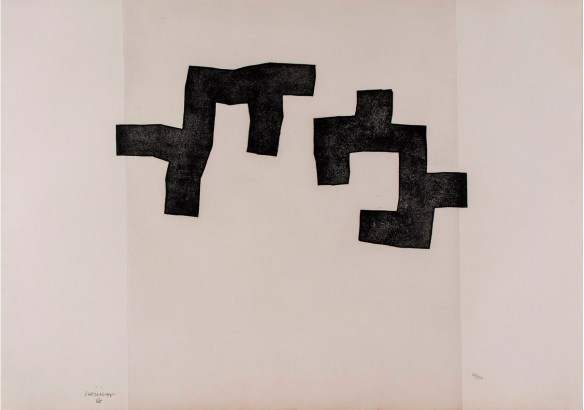
Chillida 1970

Steve Buttes’ “Some questions for infrapolitics” is an intelligent and generous effort that engages with several key problems at the heart of the ongoing collective project of ‘Infrapolitical Deconstruction’. Although, it begs to say that Moreiras’ works – from the early Interpretación y Diferencia (1991) to Línea de sombra (2006), have been central to thinking de-narrativization and the critique of metaphoricity, bringing these problems into new light from different registers (the literary, the cultural, and the political), I think it would be incorrect to frame the particular project of infrapolitics as a culmination of Moreiras’ own thought and itinerary. In this light, what I find of importance in Buttes’ intervention is the fact that he does not just hinge on a particular problem, but is able to juggle and render visible a series of common elements of the project that merge with his own research (1).

Indeed, it was unfortunate to have missed Prof. Buttes at the last formal meeting during the Harvard ACLA 2016 conference, but we could only hope that there will be another timely encounter for discussion. For what it is worth, I want to lay down a few commentaries on some issues raised by Buttes. My aim is not to correct or even less defend a programmatic way of infrapolitics, but perhaps to think about his recent inquiry as parallel with some of the problems that have been pertinent to my own intellectual reflection over the last two or so years. I hope this will serve as a reparatory outline for future discussions to come.

In a precise moment of his commentary, Buttes writes: “That which escapes regulation, visibilization through the metaphors chosen to organize the world—the unthought thought, that which “what was never [on the] radar” (“Some comments”), freedoms that remain beyond writing (Williams, The Mexican Exception), the unfinished manuscript (Cometa, “Non-finito”), averroist intellect (Muñoz “Esse extraneum”) and so on—always remains invisible, and as a consequence always emerges as something that looks like the thing it is: real life beyond calculation, beyond visibilization, beyond metaphoric capture. In other words, it is the image, as Dove has called it. This image, of course, is characterized by its invisibility, by its ability to be sensed but not seen, experienced but not known, used but not valued”.

I am entirely in disagreement that infrapolitics could be thought as invisibility in opposition to visibility, since that opposition itself remains caught in calculation that renders the operation of unconcealment and the existential analytic obsolete. The very idea of the averroist intellectual has nothing to do specifically with the image as such, but with metaxy (or metaxu as rendered by Weil’s anti-personalist Platonism). This is why life as pure means constitutes itself impersonally from the outside. Hence, to reduce the question of the image to a division of the senses (sight) or to the disciplinary arrangement made possible by modern art historical discourse (Fried et al) is interesting, but not relevant, at least not for averroism. It is true, however, that averroism is crucial for infrapolitics. To some extent averroism, like the existential analytic or marranismo, is an important referent for infrapolitical existence and posthegemonic democracy.

א In her important research on the saturated image, Camila Moreiras Vilaros has emphasized the transformative nature of images from a regime of the society of control to one of saturation and exposure. If the first still has a mode of coercion over bodies and subjects, the second one is hyperbolically without subject, substance, and extension. Exposure coincides fully with the image of the world in positionality. In this sense, infrapolitics fundamentally thinks not the invisible, but the invisible as already fully visible. To be marrano in the open means to dwell in the event of total exposure.

Weil, Esposito, Coccia, Agamben, or Moreiras are thinkers of this outside as metaxy, although do not particularly wish to install an “invisible iconology”, or “an icon of potentiality over actuality”. I am convinced that the question of iconology features centrally in Prof. Buttes’ research, but from my own understanding, infrapolitics cannot be separated from an actuality granted by a form of life or the second division of existence that renders inoperative the very distinction of actuality and potentiality. In fact, in recent months some of us have understood the importance of undertaking Heidegger’s influential seminar Aristotle Metaphysics 1-3: the actuality over force, as to cautiously rethink the difficulty of the Aristotelian category (actuality) that is at stake here. In terms of the icon, in my own research project I have thought of another relation with pictorial space that is not possessed by iconicity, which allows possible oikonomical arrangement and sacrament institution [2]. I would say that, indeed, landscape is important for infrapolitics, but far from rendering a dichotomy between the visible and the invisible, the expropriated and the appropriated, it seeks to think distance and dwelling.

א It was something like this that was at stake for Heidegger in one of his rare essays written as a general reflection on art, but specifically meant as a commentary on a Spanish sculptor that he very much admired: Eduardo Chillida. In Die Kunst und der Raum (1969), Heidegger writes: “Solange wir das Eigentümliche des Raumes nicht erfahren, bleibt auch die Rede von einem kunst-lyrischen raum dunkel. Die weise, wie der Raum das Kunstwerk durchwaltet, hangt vorerst im Un-bestimmten.” Before the pictorial space there is the question of space. How to account for the peculiarity of space? That was Heidegger’s question, since spacing meant to ‘erbringt’ (don) freedom and the life (wohnen) for da-sein.

The word “value” appears in different ways about seven or eight times in Buttes’ piece. I am not sure I can take up the different ways in which it appears, at times in opposition to use. However, it is clear that infrapolitics does not seek to value any ontic or ontological position, since it departs necessarily from a critique of the principle of general equivalence as the contemporary determination of nihilism (an argument made forcefully, I think, by Moreiras, Villalobos-Ruminott, & J. L. Nancy). Thus, it is inconsistent with infrapolitics to argue that “infrapolitics, creates […] a fetish—“a form of thinking the political that fetishizes the undoing of power as a value in itself”. Undoing power arrives at the non-subject or post-hegemony as democratic condition for social existence. But how is this “value” or instrumentalized for “value itself”? In some cases, Buttes seems to take value for ‘preference’. Infrapolitics does not make that decision for preference’s sake, but for understanding the non-correspondence between life and politics in thought.

א The question of value tied to the problem of ‘poverty’ and ‘exploitation’ is a register that infrapolitics does not take for granted. However, I am convinced that the pursuit of a new jargon of exploitation today is always in detriment of the possibility of understanding the existence of man otherwise. It is a very strange turn that some today on the Left– take Daniel Zamora, who fundamentally misinterprets Foucault’s work – keep insisting on the question about the necessity to reintroduce proletarian identity as determinate subject against diversity. It makes no sense to do this in a time like ours, where work and labor have completely disappeared. I prefer to discuss inclusive consumption (Valeriano) and uneven pattern of accumulation (Williams), not labor and exploitation.

In one of his footnotes, Buttes claims that “infrapolitics spans writers from Javier Marías, to Borges, to Lezama Lima to Cormac McCarthy to, as I note below, Ben Lener, and also, plausibly, Sergio Chejfec or Alberto Fuguet, then infrapolitics is the canon, it is the archive itself”. It is a surprising remark, but I understand that I might not fully understand its implications. Does it entail that infrapolitics is an archive of a particular style, or that it coincides merely with a work-for-the-archive? I agree with Moreiras that infrapolitics is a type of relation with the archive, and in fact, at the moment the collective is currently thinking through the archive in relation to the general historiography of the imperial Hispanist tradition [3]. Does this mean that infrapolitics is merely a relation with Hispanism and the Spanish letters? I am not convinced. I do think that there is intricate relation between writing and infrapolitics, but it could be extended and explored in other forms of art (painting, music, cinema, or even dance). Most of us work on writers such as Roa Bastos or Raul Ruiz, Lezama Lima or Oscar Martinez, Juan Rulfo or Roberto Bolaño; but these proper names are far from constituting an infrapolitical archive. There can never be an archival infrapolitics.

א In a recent intervention on the subject of infrapolitics, Michele Cometa suggested that infrapolitics was indeed the place to use literature as a thing for thought [4]. The modern invention of university disciplines and faculties, archives and practices such as “literary criticism” is a perversion of an an-archic space of unity where there is no differentiation between literature and thought, the image and life. One has to break away from the modernist fantasy that there is a ‘proper location’ for an object of studies. There are only relations of force constituted by tradition. This is why Dante at the dawn of Modernity, and later Leopardi during the bourgeoisie revolution, could see themselves as poets, thinkers, political theorists, and lovers. There was no separation.


Notes

*Image: Eduardo Chillida, drawing, 1970.

1. Buttes, Steve. “Some questions for infrapolitics”. https://infrapolitica.wordpress.com/2016/04/10/some-questions-for-infrapolitics-by-stephen-buttes/

2. Mondzain’s research is fundamental here, since her work on early Byzantine Church’s articulation of hegemony is intimately tied to the operation of iconology. See, Image, Icon, Economy: The Byzantine Origins of the Contemporary Imaginary. Stanford University Press, 2004.

3. Alberto Moreiras. “A response to Steve Buttes”. https://infrapolitica.wordpress.com/2016/04/11/a-response-to-steve-buttes-by-alberto-moreiras/

4. https://www.youtube.com/watch?v=U6ddjE_sL5w

A Response to Steve Buttes. By Alberto Moreiras

IMG_3918(I am prompted to make of this, which is a response to Steve’s post below, a separate entry here.)

Dear Steve,

I thank you for your interest and the work you have put into this, which is in itself flattering to the Collective.   While I only mean to give you a general response—I do not think I am the owner of infrapolitics, of course, or any kind of gatekeeper—I will also try to follow the thread of your discourse and will make comments as they appear relevant. It is not for me to pass any kind of judgment on the force of your analyses, since I am involved in them in ways too conflicted for me to take a step back.

Infrapolitics stands indeed in a paradoxical relationship to politics which may have something to do with religion—recently there has come up within the group the notion that marrano infrapolitics (which is a kind of assumed militancy, as opposed to infrapolitics as such, which simply happens) is a religion without religion–, but it does not however think of itself in any kind of ethical commitment to anything or anyone: neither to the poor nor to the rich. It is simply not a thinking of the ethical commitment. So the comparison with liberation theology or with any charity politics kind of breaks down in my opinion.   The subaltern relation in infrapolitics hits a different register, and it has to do with its very precise abandonment of social hegemony: it makes exodus of it, whatever the social hegemony happens to be (say, even if it is postsubalternist in Beverley’s parlance). This is not because infrapolitics, in its assumed or “militant” dimension, is antipolitical; it is rather because it affirms a directly posthegemonic politics: a demotic republicanism of equality based on the notion that nadie es más que nadie, which means: nobody occupies the site of representation, neither the rich, nor the poor. It is an-archic in that sense. It does not support the precariat, not directly (I mean, it may, if it comes to political choice, but the action that results from a political choice is no longer infrapolitics): it is itself precarious, and it lives in precarity. Joyfully.

Re the notion of “pequeño ajuste,” I think it is true this is a major theme. But perhaps not in the messianic (without messianism) way you describe it following Lerner, who himself takes it out of Agamben discussing Benjamin and Scholem. The “pequeño ajuste infrapolítico” involves a lot but, I would say, in a radical, strictly, thoroughly antimessianic way, way beyond any structure of the promise. It is precisely a step back from any kind of promise, and from the economy of the promise. We have talked about this frequently in terms of letting-be, and also more particularly in terms of the notion of Gelassenheit taken from Meister Eckhart, Heidegger, Schürmann.   My position is that, while there is ever a practice of Gelassenheit in infrapolitics, while infrapolitics lets-be and is a practice of letting-be, there can be no final letting-be, there can be no final Gelassenheit, since the human is forever trapped in the tragic condition between natality and mortality and all that it entails.   The gap between the practice of Gelassenheit and the impossibility of a final state of rest calls for that “pequeño ajuste” that might ground all aspects of existential infrapolitics—it also organizes, I would think, what I will call the politics of infrapolitics in the widest sense. Because it opens up the terrain of action. There is nothing peaceful about infrapolitics.

This would not have much to do with the Borgesian “imminence of a revelation as yet unproduced” in the sense in which you read it. The revelation is unproduced not because it remains invisible—the “production” of the revelation would never be its coming into visibility (the revelation remains unproduced). Infrapolitics does not search for, nor does it desire, the invisible. On the contrary, it is a radical concern with existence such as it is, which also means with desire such as it is.   It takes the structure of desire seriously, of course, which makes it take less seriously the notion that desire may have a goal that has to do either with traducing the invisible into the visible or, in a more Baudelairian (but also more perverse) way, with keeping the invisible invisible. It sees what it can, it desires what it must, and it lets it be. And it knows and acknowledges whatever pain or joy that brings along. To that extent I would make the claim that only infrapolitics is properly material, or materialist.

Re the saying and the said, or nature and the landscape, the reference here is to the ontico-ontological difference in the Heideggerian sense. I would also, myself, say, the Derridean sense, but there are differences in the group regarding Derrida’s use of the Heideggerian notion. For me infrapolitics is above all an exercise (exercitium, we take this word literally) in the region of the ontico-ontological difference, that is, in the difference between being and beings.

The punctum is also a crucial concept for me, as precisely the site of desire, redefined by infrapolitics as the crossing of the ontological difference in every case.   I should use this precise point in your paper to warn you that when I wrote Tercer espacio, or even Exhaustion of Difference, I was not yet thinking of infrapolitics. So for me the inferences are very interesting, but I am not ready to endorse them without going over them with a very fine comb.

My general impression, Steve, is that you come at infrapolitics with framings and enframings of your own and have not yet moved into the terrain where infrapolitics may become fertile: you are, if you will, still missing the “minor adjustment.” This is probably the reason why your questions at the end do not strike a chord in me—they are not my questions, which means I cannot provide answers for them, I am sorry.   But, as I said, I am not the gatekeeper, so you are very welcome in terms of doing your own theorizing and your own extrapolations. And I am not asking you to “take the step” or anything of the kind. If there is one thing infrapolitics abhors, it is any kind of pedagogy.

Let me only say one thing, though: there is extreme resistance to infrapolitics in the field, I rarely make “vague claims” regarding things I have patent experience of. And the sentence “infrapolitics is the canon, it is the archive itself” is, although flattering, since you can only formulate it out of a certain clear respect for the thing, is, I think, misleading. No, infrapolitics is a relation to the archive. A different and difficult one.

Thanks so very much again for having worried about it, written about it, and shared it so that we can discuss it.

Alberto


On the Alleged Dearth of Materials to Study the Issue. By Alberto Moreiras.

The last thing I want is to sound supercilious, and yet I have to say something.  Addressed, of course, against no one.  I  once told a friend of mine he seemed to be smoking too much marihuana on a daily basis, and that he should cool it down a bit.  He replied to me that yes, he regretted so much smoking, but only because it was smoking, not because it was marihuana.  Since I was a fairly heavy tobacco smoker at the time, the point hit home, and I never raised the issue again.  In terms of infrapolitics, the complaint is usually the opposite: we are told we never publish enough on it, thus leaving people who want to figure it out deprived and anxious.  This is very nice of them.  Yes, of course, we are not publishing enough, and we should publish a lot more.  But let us put things in perspective.  We always thought and said it was going to take about ten years for the infrapolitical project to reach some kind of tipping point or point of saturation, and we have only been at it two years.  So I think we are on the right track, even if people do complain rightly.  I remember going to a Hispanic Studies conference in the summer of 1987, there was a mysterious panel on deconstruction (mysterious because it was so out of character in a provincial Hispanic Studies conference–even though, after all, it was already 1987, and deconstruction had been kicking around the States for about, what, fifteen years or so).  But those professors, bless their souls, proceeded to read papers where they declared Bugs Bunny to be a paradigm of deconstruction among other things: “Bugs Bunny IS deconstruction.”  (That was the funniest, not the phoniest)  So, they could have said, if contested, that there was not enough clear writing on deconstruction for them to have been able to figure it out rightly, so they made do.  But it would not have worked, not really.   In other words, what I am trying to say is that the demand for more clarity, more precision, more dissemination, more encyclopedia articles, more definitions, and more examples is all well and good, but it is also an infinite demand whose tendential fulfillment will never satisfy anyone–by the time there were enough materials on deconstruction, deconstruction was deemed worthy of the dustbin of history.  It is now kind of back, but that is something else entirely.  My point:  at this time there are about a thousand pages worth of talk on infrapolitics in this blog alone.  We have published two special issues, and I count about twenty published essays on it, I think.  And of course we have been discussing the issues at many professional venues–from MLA and LASA to ACLA, to mention only the more visible ones.  I think that is enough to prompt an idea of what it is we are up to, for better or for worse.  But it does require work, as all good things do except perhaps taking a nap.  I do not, however, want to sound sarcastic at all: yes, we take the point, a lot more needs to be done, we have been lazy!!  And yet one wonders whether, within the present coordinates in the field, where people become thoroughly acculturated to just a handful of themes to which they call Latinamericanism (say, culture, identity, subalternity, politics: you mix those things up in some way, and you develop a perfectly proper professional position), there is an ear to hear what infrapolitics has to say.  My own answer is: probably not.  I regret this.  Perhaps the problem is not that people cannot see the forest for the trees.  The real problem is that we have educated our students to believe that all trees are nice pine trees.  But there are other trees out there, some of them beautiful, with obscure shapes that you will only recognize if you develop the sight for them.

Some Questions for Infrapolitics. By Stephen Buttes.

6593be21-8068-4b2b-8506-db9298e8228dI attended the 2016 ACLA at Harvard, but because my seminar overlapped with the afternoon session of the Línea de sombra seminar on Friday, I unfortunately had to leave the discussions before the conversations had really gotten under way and was unable to attend the Saturday session for the same reason. Such is our fate amid scheduling at large, important conferences like ACLA. But I should say that this was a disappointment for me because there is a great deal I find of interest in Línea de sombra, and I wish I would have had the opportunity to engage in the conversation fully since my own presentation modestly sought to dialogue with some of the claims made in the volume. What follows in my comments below was initially begun as a short response to Moreiras’ recent post “Some comments on the ACLA 2016 discussions,” but it has grown substantially as I started to write it two weeks ago. So, I apologize for the length and also if the comments I make were already addressed during the discussion.

One of the aspects I admire about Línea de sombra and especially his more recent work, such as the essay giving an overview of the infrapolitical project, published in Transmodernity last year, is the ways in which Moreiras continues his attempts to move past some of the limits of the project of subaltern studies. By acknowledging that we all are “subaltern or potentially subaltern in ways that would have been unimaginable only a generation or two ago” (“Some comments,” my emphasis, and more on that emphasis in a moment), he situates the infrapolitical project in a place to deal with one of the limits signaled but unresolved by John Beverley in Latinamericanism after 9/11:

“in the Haitian Revolution the slave-owning planter class became a subordinated group, in the sense that its own identity and interests were coercively negated—its plantations were confiscated, and many of the slave owners and their families and associates were killed and forced into exile. Does that mean that the former slave owners became ‘subaltern’? In a narrow sense, yes, if—to recall Guha’s definition—the subaltern is ‘a name for the general attribute of subordination. . . whether this is expressed in terms of class, caste, age, gender and office or in any other way,’ so that ‘in any other way’ could be understood as including having one’s slaves rebel and one’s plantations seized. But to insist on that point (rather than, for example, to characterize the former slave owners as counterrevolutionary émigrés) would seem to distort significantly the meaning and political valence of the idea of the subaltern” (Beverley, Latinamericanism After 9/11 112).

To think of these particular instances of dispossession as subalternization, Beverley notes, would be a corruption or “distortion” of the term, which for him, and for Ranajit Guha, as Javier Sanjinés has noted, sees “subalternity [as] a euphemism Gramsci used for the proletariat and peasantry” (88). For this reason Sanjinés expands the notion and “along with Beverley . . . [is] inclined to define [the subaltern] . . . as the poor in spirit mentioned in the Sermon on the Mount” (89). This links one version of subaltern studies and its transformation in discussions of the multitude and the marea rosada with Beverley’s account in in Subalternity and Representation (1999) of “subaltern studies as a secular version of the ‘preferential option for the poor’ of liberation theology” (Beverley, Subalternity and Representation 38). Indeed, like liberation theology’s preferential option for the poor, this version of subaltern studies possesses the “structure of the asymptotic curve: we can approximate in our work, personal relations, and political practice closer and closer the world of the subaltern, but we can never actually merge with it” (40). Subalternity can never come fully into view and so cannot be addressed in fullness, an affirmation, if followed to its end, leads to the conclusion that we can never actually eliminate poverty or make the poor and non-poor self same to each other: we can only ever approximate eliminating it. This is because, as Gustavo Gutiérrez puts it,

“poverty is an act of love and liberation. It has redemptive value. If the ultimate cause of human exploitation and alienation is selfishness, the deepest reason for voluntary poverty is love of neighbor. Christian poverty has meaning only as a commitment of solidarity with the poor, with those who suffer misery and injustice. The commitment is to witness to the evil which has resulted from sin and is a breach of communion. It is not a question of idealizing poverty, but rather of taking it on as it is—an evil—to protest against it and to struggle to abolish it . . . . It is poverty lived not for its own sake, but rather an authentic imitation of Christ; it is a poverty which means taking on the sinful human condition to liberate humankind from sin and all its consequences. (Gutiérrez 172, my emphasis)

Voluntary poverty, or “spiritual poverty” (the “poor in spirit”), is “an ability to receive, not a passive acceptance” of “the Lord” (171) and “above all total availability” (171) to that messianic witness.

Confusingly, this model of justice both requires poverty and also requires that no one actually be poor (that is, exploited or dispossessed). Poverty must always appear and be present because it is what produces the justice of the community: “[it is] not a question of erecting poverty as an ideal, but rather of seeing to it that there were no poor” (173). But poverty itself is “an act of love” (172) and indeed is the process by which the community can carry out the eschatological project set out by the Messiah and as a consequence cannot be eliminated. In other words, the poverty that appears in a truly just society—one that has eliminated exploitation—must be voluntary poverty, spiritual poverty: openness and incompleteness. But this category of poverty must necessarily be treated as if it were real, as if it were material poverty: “the meaning of the community of goods is clear: to eliminate poverty because of love of the poor person” (Gutiérrez 173). This is not love of the saint but love of the “marginated.” The poor must appear so that there can be no poor. In this sense, poverty can only ever be eliminated through something paralleling the painterly technique of trompe l’oeil. In this model of justice, the poor must appear as if they were exploited, and the community must believe that their poverty is a sin, but the poor must in actuality be voluntarily poor, be Christian witnesses employing an act of love. They must be an “an authentic imitation of Christ,” a trompe l’oeil representation of poverty: “being rich, [but appearing] poor,” material plenty appearing as lack, fullness and completeness as its opposite. We can only approximate closure so that closure is possible: the asymptotic curve.

This model, however, creates a difficult dilemma. Who, might we say, is choosing poverty of their own free will? How should we distinguish the person who loves their neighbor (voluntary Christian poverty as “an expression of love” (172)) from the one who is exploited by their neighbor (“material poverty” (171) as “a scandalous condition inimical to human dignity” (165))? Who is functioning as the necessary witness to justice and who is the victim of injustice? Who is “[living] . . . as an authentic imitation of Christ” (172) and can redeem the corrupted society and all the consequences of that corruption and who is victim of dispossession? How can we calculate these differences?

These questions, of course, make it perfectly reasonable to ask about what we should do with ruined oligarchs and white collar criminals and the flotsam and jetsam of the upper crust who are forced to work for a living after a crash or a revolution, and Beverley notes as much in the footnote that follows the passage I quote above: “[This] is not to say of course that elements of defeated classes, or of elite classes in decomposition, such as the petty nobility in the transition from feudalism to capitalism, could not migrate in class status terms to form part of the subaltern sectors of a given society” (141 n6). But it also makes Beverley’s demand that we distinguish who is voluntarily poor (the necessary witness) and who is not, who is a “counterrevolutionary émigré” and who is a victim of dispossession a difficult one to mesh with this earlier (and abandoned?) version of subaltern studies, which is why I suspect he makes the claim for a postsubalternist age and maintains little or no mention of Gutiérrez in the more recent book.

This dilemma is also where the infrapolitical intervention, as I modestly understand it, seems to fit, responding to the metaphysical and spiritual dilemma of voluntary poverty with an account of the marrano, with an account of those who do not quite fit into the regulated archives and structures of society, the remainders of projects of modernization: we are all potentially subaltern because the eschatologies of justice that structure society can always be captured. Línea de sombra, like liberation theology, views the possibility of the world in the poor, or, as it has more broadly been pointed out, in “all infrapolitical lives,” the “potentially subaltern,” those lives which cannot be properly political in existing modes of calculation and regulation. Might this share a genealogy with the “poor in spirit” that has “[a] relationship to the use or ownership of economic goods [that] is inescapable but secondary and partial” (Gutiérrez 171)? Perhaps, but unlike liberation theology, infrapolitics rejects communitarian forms of justice, championing unrepeatable forms of singularity, rejecting any mode of capture. The poor are the possibility of the world because they maintain an openness to the (denarrativized) world to come whatever it may be: the messianic structure without messianism.

This is a deeply compelling way to view the world, and it is for this reason that these points of view have been gaining so much attention and are being widely adopted in contemporary literature and culture, despite the vague claims of a field-wide resistance to the infrapolitical that Moreiras asserts in his recent post.[1] What is so attractive about the infrapolitical project is the notion of the “minor adjustment,” the notion that there is a “pequeño ajuste infrapolítico” that is hiding in plain sight and already in all of us, the notion that the liberation of the world and the solution to exploitation and domination will emerge through a minor change, the notion that the world to come is just the same as this world but a little different. This idea, of course, owes one portion of its genealogy to Walter Benjamin, and for this reason the “minor adjustment” has emerged as a popular idea in contemporary culture, present in a wide array of contexts and texts like Ben Lerner’s recent novel 10:04 (2014), which, through its engagement with Agamben’s The Coming Community, cites as its epigraph Benjamin’s famous anecdote discussing the Hassidim’s vision of the Messiah’s world to come, which like the infrapolitical claim, sees that future as just the same but a little different: “The Hassidim tell a story about the world to come that says everything there will be just as it is here. Just as our room is now, so it will be in the world to come; where our baby sleeps now, there too it will sleep in the other world. And the clothes we wear in this world, those too we will wear there. Everything will be as it is now, just a little different.”

An example of this dynamic appears about halfway through the novel (but really all throughout), when we meet a character named Noor, an Arab-American co-worker of the narrator-protagonist, to whom it is revealed that Nawaf, the Lebanese man she had been told was her father, and with whom she had always identified racially and ethnically, was, in fact, her adopted father, and that the identity of her biological father, a white man named Stephen, meant, in her view, that she had no claim to the Arabic-speaking world and Arab culture with which she had identified her entire life. This “minor adjustment” to her biography led her to begin “seeing [her] own body differently” (104), an invisible change that denies her “ownership” of a past (her own) that she feels she wrongfully claimed, even though nothing else about her lived experiences nor her beliefs about the Arabic world had changed: her world was the same but a little different. For example, when asked to speak about the Arab Spring at an Occupy protest, she felt she had no right to do so given this (invisible) revelation about her past, and she remained silent as a “new” member of a racially powerful group, as a “new” member of the group of imperialists who appropriate culture for their own ends.[2] And she compares this to a friend who felt wronged by his brother and who, in seeking to confront him, finally managed to tell his brother during a mundane cell phone conversation everything he’d been feeling for so many years. Towards the end of his cathartic airing of grievances, he realized, to his horror, that this deeply emotional experience—“a major event in his life” (107)—actually hadn’t taken place: the cell phone call had dropped before the brother could hear anything: “it happened but it didn’t happen” (107). And the brother, like Noor, must figure out how to live in this transformed world, which is really no different from the world before the transformation, in which major, life changing events happened but did not happen: they remain invisible to all except a singular witness. Their task is to prepare themselves to confront the transformations they recognize in the world. In these silences—Noor’s silent presence at Zucotti Park and the brother’s sudden absence from the cell phone call—we can hear an echo of the world Línea de sombra describes: “la posibilidad mesiánica del fin de la subalternidad en contraimperio es lo que no toma lugar, lo que está sujeto a un retraso infinito” (Moreiras 209). Infrapolitics is a constant preparation for “accounting for what was never on [the world’s] radar in the first place” (Moreiras, “Some comments”).

These infrapolitical intonations, of course, appear outside the literary realm as well, perhaps, I cautiously want to suggest, in Richard Thaler and Cass Sunstein’s now-famous book Nudge (2008). Using behavioral science, the book argues that through invisible modifications to the “architecture of choice” in both government and free markets policy makers and companies can significantly reshape the world. As an example of one of these “nudges” in “choice architecture,” Sunstein points to the mundane task of filling out forms for a driver’s license. Here, there is still a box to check relating to organ donation, but it is slightly modified: instead of opting in, one has to opt out. Instead of actively choosing to donate life-giving organs, instead of imagining one’s own heart in the body of another, instead of imagining ourselves become another—instead of thousands of dollars spent on marketing campaigns meant to mobilize this empathic or affective identification that would produce the necessary minor move of the pen or the mouse to choose yes— one has to negate, to actively choose not to donate life, to actively deny ourselves, which, through the transformation of the default option, through a shift in our immanent field of existence, has already been given to another. Here, the world is just the same—a box to check—but a little different: instead of choosing to give ourselves to another, we already have, but the choice remains: to give or not to give, movement and action are still possible. By making paternalism invisible—by modifying the “choice architecture” so that no one needs to decide on things about which they may or may not have beliefs, by making it so that no one need ask themselves if they have any beliefs at all, and by nudging and modifying habits by intervening with a modified default option—the invisible baseline around which society organizes itself transforms, and the “world reorganizes itself around you” as Lerner puts it time and again in his novel.

But as Sunstein points out in his more recent book Simpler: The Future of Government (2014), invisible paternalism—the invisible nudge in the restructuring of choice architecture—simply acknowledges the fact that most choices—indeed a good number of bad choices—are made because the truth of a situation—the clarity of the choices available—is distorted or obscured through existing modes of calculation. There are important aspects of all situations that remain invisible, and good governance must integrate, that is, must make these characteristics visible through the invisibility of the architecture of choice. A key example of this imperative is Sunstein’s description of the famous “invisible gorilla” experiment. Here subjects are asked to count how many times a basketball is passed between a group of players. In the middle of this, a person in a gorilla suit enters the scene and then leaves. Most subjects calculate the right number of passes, but they completely miss the gorilla. (The experiment is here: http://www.theinvisiblegorilla.com/videos.html). The gorilla is beyond calculation because it cannot be described in the number of passes: it is simply not on the radar of those participating in the experiment. It is precisely for this reason that the White House—seeing the power of incorporating into choice architecture the gorillas we are likely to miss, the benevolent paternalistic witness who sees the gorillas we cannot—has transformed the nudge into a properly political tool: the possibilities for a progressive politics are always based on what is beyond existing modes of calculation, what is open to infinite modification.[3]

It is clear that the nudge shares something with the infrapolitical “minor difference”: transforming the world not by force but rather through the minor adjustment, they both prepare the ground for the world to come. But their differences are also fairly obvious: while one is a form of messianism (or paternalism), the other maintains a messianic structure without messianism; while one is a mechanism of control, the other is a mode of freedom; while the former is unabashedly managerial, the latter stakes a claim to the pure possibility of politics and a truly just world; while the former emerges from the behavioral and social sciences, the latter emerges from philosophy and literary and cultural studies. But these differences, if I understand Moreiras’ most recent comments correctly, cannot be made to matter, for these are ultimately academic or “straightforwardly political” debates. What can count as evidence, modes of access to truth and the importance of choosing one mode of expression (a novel) over another (a graph, a survey, an algorithm, an experiment) are all part of modes of regulated knowledge production; choosing what information to make visible to consumers or lawmakers (“just the facts” or “an argued position”) are part of political debates. To focus our attention on any of these issues, that is, to focus on what is currently visible would be to miss the “gorillas in our midst,” which is what is truly important.

And it is from here where one of my points of disagreement with Moreiras begins to become clear. Because for Moreiras, these differences only matter artificially, can only appear to matter and in fact are a product of dominating, managerial claims to knowledge. To decide whether something is a novel and therefore engaging particular kinds of constraints and approaching a problem from a particular point of view, or to decide that something, on the other hand, is the product of a series of experiments misses the gorilla for the passes: the truth of the world is “out there” in “the world,” in life itself which cannot be completely known and can never be knowable through the micromanaged institutions of the university and government that seek to calculate how many times the ball was passed, what counts as the humanities and what counts as the social sciences and so on. As Moreiras points out in his reflections on the ACLA seminar:

there is no ivory tower. The university is no more than a symptomal torsion of the wider society.  Which is why infrapolitics must abandon its original roots in university discourse, exit disciplinary configurations, and break away from any attempt to surrender at the capture of thought through increasingly domesticated, indexed, regulated, venued, and analytically-ranked self-insertion. This is one of the reasons why infrapolitics claims a savage terrain of engagement, beyond fields: because it understands that battles internal to university politics are always already rigged, always already lost battles. Hence infrapolitics prefers to hide in the plain sight of the world at large, and reflect away from any regulated archive: the real struggle is out there, particularly if we manage to escape from the boredom that threatens us from the rear, and from the sides. (“Some comments,” my emphasis)

On the one hand, there is no autonomous university discourse: “there is no ivory tower.” The university is the “wider society,” the modes of thinking that populate the university are the modes of thinking that belong to the “world at large.” And so it follows that university politics—the disciplinary border wars, if you will— are politics that have already collapsed into the world at large. But if the university is already heteronomous—if there is no ivory tower—in what sense can we claim, as Moreiras does, that there are still “battles internal to university politics” (“Some comments,” my emphasis). If we take the infrapolitical claim seriously, that the “real struggle is out there,” we also must say that the real struggle is also “in here” given that the university is the world—there is no ivory tower—and the world the university. Indeed, if we are all “potentially subaltern,” if the point of infrapolitics is recognizing the ever-shifting minor difference or nudge that sends us careening one way or another, it would seem that the space of engagement would not really matter at all: all battles are already lost, all modes of thinking already corrupt, everything already managerial, everything already controlled. I suspect that it is for this reason that the infrapolitical seeks to escape the boredom of what Moreiras calls here “regulation,” and the futility of already existing, already managed modes of thought to focus instead on that which escapes (something always does, Jon Beasley-Murray tells us), that which remains invisible, that which is pure potential, that which is free of all constraints. Infrapolitics tells us to search continually for the “invisible gorilla,” an object that may never appear in “gorilla form,” that may only ever emerge as the Augenblick—the blink of an eye—(as Patrick Dove has termed it, following Jacques Derrida) or as the figure that brushes against us and comprises a “secret index” (as Kate Jenckes has termed it, following Walter Benjamin).

But this is to imagine that as long as it remains invisible, undetected and off the radar that it remains free of constraining choices—that it is pure potentiality, that it is unchosen—and we are guaranteed an escape from capture and a path to secure the liberation from eschatology: the Augenblick, the passing touch, all infrapolitical “immaterials” (for lack of a better word) create a usable potentiality. But these usable potentialities, as Ignacio Sánchez-Prado notes in his recent critique of Rancière and infrapolitics, creates what he calls a fetish—“a form of thinking the political that fetishizes the undoing of power as a value in itself” (“Limitations of the Sensible” 375)—and what I argue we can call an icon: “an object that matches (is just like) the sign itself” (Ghosh 66), but a little different.[4] Of course, the infrapolitical icon is not exactly an object—“It names the threshold of the visible—the closing of the eye is also the prelude to its opening—and, thus, cannot itself become a possible object of vision” (Dove, “Aesthetics, Politics, Event”)—but the threshold, a passage that functions in the way that icons do, a product of the desire to escape that motivates the infrapolitical reflection. That which escapes regulation, visibilization through the metaphors chosen to organize the world—the unthought thought, that which “what was never [on the] radar” (“Some comments”), freedoms that remain beyond writing (Williams, The Mexican Exception), the unfinished manuscript (Cometa, “Non-finito”), averroist intellect (Muñoz “Esse extraneum”) and so on—always remains invisible, and as a consequence always emerges as something that looks like the thing it is: real life beyond calculation, beyond visibilization, beyond metaphoric capture. In other words, it is the image, as Dove has called it. This image, of course, is characterized by its invisibility, by its ability to be sensed but not seen, experienced but not known, used but not valued. In other words, infrapolitical “immateriality” becomes iconic in its invisibility, in its immanent potentiality, through the fact that the “infrapolitical minor adjustment” looks something like the Borgesian revelation that doesn’t take place, or like, if I can be a little more concrete, “The Unending Gift” memorialized by Jorge Luis Borges in Elogio de la sombra (1969).

The “gift” that gives the poem its title is a landscape painting that the Argentine painter Jorge Larco promised to Borges before Larco’s death in 1967 and which Larco never completed. What we see in the gift Borges cherishes is not the thing itself—an iconic landscape fully realized in watercolor—but rather the promise of the painting and its escape from full realization: “si [el cuadro] estuviera allí, sería con el tiempo una cosa / más, una cosa, una de las vanidades de la casa; / ahora es ilimitada, incesante, capaz de cualquier forma y / cualquier color y no atada a ninguno” (984, my emphasis). This, of course, sounds quite a bit like a map of the invisible, savage, uncapturable terrain of the infrapolitical, almost literally evoking the Derridean promise, an icon that is usable but not interpretable.

And yet, as Borges points out, despite this escape from habit, despite the landscape’s full invisibilization and despite the guaranteed “imminence of a revelation that [will never] produce itself” given that Larco died before realizing the work and fulfilling his promise, the painting has already been captured by existence. “Existe de algún modo,” Borges tells us, and this “de algún modo,” this mode of existence is what makes possible the transposition of gods and men Borges imagines (parenthetically) in his poem: “Sólo los dioses pueden prometer porque son inmortales . . . También los hombres pueden prometer, porque en la promesa / hay algo inmortal” (984). These temporal landscapes are linked with eternal ones through the linguistic “de algún modo” that imparts its “algo inmortal,” but it is clear that we should not confuse the signified—“the unending gift” of the absent landscape painting, the immortality or eternity of Larco’s infinite promise, the imminence of the revelation that will not produce itself—for any particular signifier, which can arbitrarily be evoked by “cualquier forma y / culaquier color,” and perhaps “cualquier hombre” as repeated singularities in time: a messianic structure without messianism.

But, if I am reading this poem as the infrapolitical approach would ask, what also becomes clear is that all of these singularities do not escape an eschatology: all of them are incorporated into the gift, into the infinite, eternal whole that is the unending landscape painting, Larco’s promise or gesture: the gift that functions as a mode of passage, a metaphor of metaphor itself, or more simply as a gap between what Moreiras calls in “Mules and Snakes” the saying and the said. These unrepeatable singularities or intonations are incorporated into this absent or indeterminate whole but also can never be domesticated into yet one more of the “vanidades de la casa” because there is always a new gap, a new approach to glimpsing what Moreiras calls in his essay “Mules and Snakes” “a non-caputrable exteriority” (“Mules” 203). This gap that Moreiras describes in that 2005 essay, this gift that escapes capture and is “non-capturable” defines what I understand as a version of infrapolitics, a version that he does “not hesitate to call neobaroque” (224).

Following this logic, I want to suggest that an infrapolitical reading of the landscape painting produces an iconicity that parallels Baroque hagiographic imagery. As Lois Parkinson Zamora points out in The Inordinate Eye, Baroque hagiographic images are premised “upon the separation of the image from what [they represent]” and their ability to “point to invisible realities but . . . not to be mistaken for those realities” (Parkinson Zamora 172): they are a mode of passage to the world to come. As Parkinson Zamora demonstrates in her reading of Frida Kahlo’s repeated, visceral self-portraits that parallel the Baroque tradition of serial portraits of suffering martyrs and virgins, the Neobaroque replicates “the process of metonymic displacement typical of the Baroque” in which the “association accumulation, and diffusion” of repetitive but individualized portraits serve to make visible an “indeterminate or absent whole” (186-87) to which new portraits, new fragments and, following Moreiras, new intonations can continually be added. These (Neo)baroque icons always maintain certain characteristics. While in Baroque iconography it is the situation of the death of the saint, in infrapolitical iconography it is what is sensed in the “sacredness of man”: the echo, the glance, the might have been, the intonation, the Augenblick. This creates a dynamic relationship between artwork and beholder that is theatrical in nature, a potentiality that can be created again and again in and on one’s own body as Borges does, metonymically relating the singular to an “indeterminate or absent whole:” “Vivirá y crecerá como una música y estará conmigo hasta el fin.” And here we can hear an echo of the discussion of subalternity above: el fin = el retraso infinito; or the asymptotic curve Beverley evokes from liberation theology. An end that is not an end because it can (and must) always be recreated in the gap between the saying and the said, in the gaps between the interlocking illusions that produce the Neobaroque spaces of our “world theater.”

Seen as a Neobaroque icon of potentiality and passage, the infrapolitical does not avoid the eschatology that Moreiras seeks, because the recognition of immanence always requires a witness, a particular kind of viewer: the marrano, the unbelieving beholder, the remainder of modernity, the witness who refuses to (or cannot) count the passes and sees the “invisible gorilla” and “invisible mules” and “invisible snakes” and other members of the Baroque bestiary who will seminally enter the scene and require infinite minor adjustments that briefly integrates the beholder into and then releases him/her from the absent whole. The Neobaroque icon of potentiality, then,—the echoes, the breaths, the blinks, the invisible remainder or fallen fur or scales of the gorillas or mules or snakes that pass before our very eyes in the gap between the saying and the said—pairs with the trompe l’oeil logic of a secular liberation theology. While infrapolitics opts for the materials over the mediation, negating or denarrativizing the illusion, Beverley opts for the illusion that can escape the frame.[5] But both models remain squarely within Baroque modes of trompe l’oeil thought, requiring either believing or unbelieving beholders. In choosing image over metaphor, in choosing the invisible over the visible, in choosing the icon of potentiality over the icon of actuality, there is little ground from which the infrapolitical minor adjustment might escape the nudge noted above since the kinds of absent wholes into which the infrapolitical minor adjustment and the nudge are integrated cannot be distinguished without some recurrence to categories that pass through disciplinary and political debates, the world of the visible and the world of constraints, the world of calculating what was chosen and valued and what was not. Indeed, it is impossible to follow Borges in his valorization of Larco’s gift without recurrence to these same sorts of categories. In reducing lived experience to the singular category of potentiality and by iconizing what we cannot see, infrapolitics seems to valorize its own form of calculation: the accumulation of the unchosen, the piling up of non-commensurable possibilities. Making us all miners of life’s raw material, infrapolitics seems to value what appears unchosen and so unconstrained. But the moment it passes into active choice, into regulation, into visibility, into the representative, into the metaphor, into the aesthetic, it loses all value, loses potentiality and thus demands a return to a savage terrain. But what do we make of choices we have made, including the choice not to choose one non-commensurable option over another (e.g. choosing to visibilize lived experience through a novel instead of a painting or an experiment or a blog post or a government report or a street performance or a day at the park)? What to make of choosing one set of constraints and not choosing another?

A path out of this dilemma contrasts the infrapolitical of Borges’ account of Larco’s landscape painting with a Friedian one, one that acknowledges that particular kinds of choices have been made and one that seeks to explain the importance of making something other than simply another everyday object. It is notable that Borges highlights the fact that Larco’s painting is not “una cosa / más” [just another thing or object] that is placed in the world for him or by him. The promise is perceived by him but also transcends him (is eternal, has “algo inmortal”). It is possible to read here a radicalized antitheatrical demand paralleling that highlighted by Michael Fried in his reading of Barthes’ punctum and extended by Walter Benn Michaels in his recent book. One question that emerges from thinking through this possible reading, then, which marks the difference between the promise of the landscape painting and the promise of graphically represented statistics on organ donation, or, we might add here, poverty, is the extent to which infrapolitics shares its orientation with Barthes’ punctum as well.

In the beautiful and (for me) moving opening pages of the Exergo in Tercer espacio, Moreiras analyzes a personal photo that serves (as I understand it) as a “foundational allegory,” highlighting certain confluences between “el tercer espacio” and the punctum by way of the “baroque [barroco]” mirror that makes the reflection (in both its literal and critical senses) possible. Indeed, such a claim emerges in Moreiras’s extension of this photographic reading in his account of the photographed images of painted landscapes, or “pinturas campesinas” (Tercer 375), that appear in Cortázar’s “Apocalipsis de Solentiname.” Following Rosalind Krauss, Moreiras calls the “failed fetish” that is the photographic image of these landscape paintings “la opción antióptica” (377) that is an extension of Barthes’ punctum. Is this a demand for something antitheatrical, something that arrests us and holds us in our place because it appears as if it were not there for us, doesn’t quite fit into standardized modes of representation and in a flash or an instant captures us in a demand for contemplation of that which is structured beyond the habitual world created by or for us? And if so, how does that demand map onto the critique of visibilization, metaphorization and narrative fiction we’ve seen above?[6] The landscape paintings were made with a particular form of community and a particular end in mind as were the photographs of them: there is a critical mode of potentiality made available through each particular visualization, whether they be the painting, the photography, the fictional narrative or the essay of literary criticism. As Moreiras himself notes, “[el] efecto literario [de “Apocalipsis de Solentiname”] no puede ser asimilado automáticamente al tipo de eficacia lograble por el texto histórico, periodístico, científico-social o testimonial” (355). How does the “opción antióptica”—efecto literario? translation?—map onto the infrapolitical and dialogue with the antitheatrical account of the punctum? Does the infrapolitical assert a difference between the unassimilable “efecto literario” and the “eficacia científico-social”? How does this connect to the “savage terrain . . . beyond fields” demanded above?

To try to make my ultimate question a little clearer, I’ll end with one last landscape artist admired by Borges: the Swedish mystic Emmanuel Swedenborg. Swedenborg, as Borges notes in his 1978 lecture on Swedenborg, developed an account of the world to come—“el otro mundo” (196)—“un poco a la manera de los cabalistas” (196). Above all, Borges notes, “su visión de la inmortalidad personal . . . está basado en el libre albedrío” (196). Borges continues:

[En Swedenborg] los muertos [no] son condenados por un tribunal [que les dice que] merecen el cielo o el infierno . . . Nos dice [en cambio] que cuando un hombre muere no se da cuenta que ha muerto, ya que todo lo que le rodea es igual. Se encuentra en su casa, lo visitan sus amigos, recorre las calles de su ciudad, no piensa que ha muerto; pero luego empieza a notar algo. Empieza a notar algo que al principio lo alegra y que lo alarma después: todo en el otro mundo, es más vívido que este . . . . Hay más colores, hay más formas. Todo es más concreto, todo es más tangible que en este mundo . . . este mundo, comparado con el mundo que yo he visto en mis innumerables andanzas por los cielos y los infiernos, es como una sombra. Es como si nosotros viviéramos en la sombra (196).

Obviously there is something in this description of a world to come that is just the same but a little different that is shared with the account of the Hassdim’s world to come admired by Benjamin and connected with “pequño ajuste infrapolítico.” But it is also notable that the known world, the visible world is described by Swedenborg in Borges’ reading as “like a shadow,” precisely that which is valued by the infrapolitical approach. What we know and what we see, what we choose and our desired modes of expression, metaphors visibilized and calculated are, without our knowing it, open to change. In this model, there is no messiah that saves or condemns. Rather, it is a messianic structure without messianism: “hay una región intermedia, que es la región de los espíritus. En esa región están los hombres, están las almas de quienes han muerto, y conversan con ángeles y con demonios. Entonces llega ese momento que puede durar una semana, puede durar un mes, puede durar muchos años; no sabemos cuánto tiempo puede durar. En ese momento el hombre resuelve ser un demonio, o llegar a ser un demonio o un ángel” (197). As Borges notes, this would take place through lengthy “theological conversations” between angels and humans in Latin and would lead to decisions for self-condemnation or self-salvation “por la inteligencia, por la ética y por el ejercicio del arte” (199). In Swedenborg, that recognition takes place in Latin, but Moreiras’ recent reflections on Florencia Mallón’s work asks us to think about what those conversations might be like in Guaraní (likely much to the horror of the elder Borges in “El otro” who laments the loss of Latin in favor of Guaraní).

Given the parallels between infrapolitics and Borges’ account of a Swedenborgian world to come and the centrality of Borges to both, my question for the infrapolitical collective, then, is what role art and particularly literature might take in these accounts. Can the difference between the nudge and the “pequeño ajuste” be distinguished, and if so how? Does it dialogue with the reading of Cortázar in Tercer espacio? If so, is there a role for artistic visibilizations in infrapolitical projects? Are the terms “neobaroque” and “infrapolitical” synonyms for each other? Do the punctum and the “opción antóptica” come to bear on the infrapolitical project? Do these concepts dialogue with the concept of the antitheatrical, which shares a common space through the punctum? And finally, can poverty—which can be defined with Amartya Sen as the depravation of freedom to live the kind of life one has reason to value—be brought to an end given its central role in the open-ended eternities imagined by the processes of Neobaroque or infrapolitical iconization?[7]

The questions I have attempted to pose throughout this reflection serve as an effort to take seriously the critiques posed by infrapolitics, that is, the hidden forms of exploitation that emerge in developmentalist logic and that I understand as motivating these critiques. At the same time, I question the iconization of potentiality, possibility and invisibility and wonder if it is possible to move beyond Neobaroque modes of thought to create real possibilities for an end to certain specific modes of existence such as unchosen hunger and other aspects of poverty and to what extent art and particularly literature can (if it can) play a role in that process.


Notes

[1] If it is true that infrapolitics spans writers from Javier Marías, to Borges, to Lezama Lima to Cormac McCarthy to, as I note below, Ben Lener, and also, plausibly, Sergio Chejfec or Alberto Fuguet, then infrapolitics is the canon, it is the archive itself.


[2] Amartya Sen has an account of a transformation very much like this one that takes place in Tagore’s novel Gora. See Identity and Violence 38. For an account of the centrality of beliefs to Latinamericanism see Hatfield’s book.


[3] I include links to how these are being incorporated into aspects of governance through reports from White House committees and a short article giving an overview of them: https://www.whitehouse.gov/the-press-office/2015/09/15/executive-order-using-behavioral-science-insights-better-serve-american

https://www.whitehouse.gov/sites/default/files/microsites/ostp/sbst_2015_annual_report_final_9_14_15.pdf

http://www.politico.com/agenda/story/2015/10/obamas-effort-to-nudge-america-000276


[4] For an account of the icon that links its religious, commercial and fetishistic aspects, see O’Connor and Niebylski’s essay.


[5] See DiStefano and Sauri for a discussion of this: http://nonsite.org/article/making-it-visible


[6] I try to think through versions of these question in “Towards an Art of Landscapes and Loans”: http://nonsite.org/article/towards-an-art-of-landscapes-and-loans


[7] Shortly before citing a version of Moreiras’ demand to critique Latin Americanism, Enrique Dussel cites Axel Honneth’s “struggle for recognition,” which some have claimed has parallels Sen’s capabilities approach to poverty. See p. 343-44


Works Cited

Beasley-Murray, Jon. Posthegemony: Political Theory and Latin America. U Minnesota P: Minneapolis,

2010.

Beverley, John. Latinamericanism After 9/11. Duke UP: Durham and London, 2011.

—. Subalternity and Representation: Arguments in Cultural Theory. Duke UP: Durham and London, 1999.

Borges, Jorge Luis. “The Unending Gift.” Obras completas II. Emecé: Buenos Aires, 2007.

414.

—. “Emmanuel Swedenborg.” Obras completas IV. Emecé: Buenos Aires, 2005. 194-203.

Buttes, Stephen. “Towards and Art of Landscapes and Loans: Sergio Chejfec and the Politics of

Literary Form.” http://nonsite.org/article/towards-an-art-of-landscapes-and-loans

Cortázar, Julio. “Apocalipsis de Solentiname.” La autopista del sur y otros cuentos.

Penguin: New York, 1996. 283-89.

Cometa, Michelle. “Non-finito: Antonio Gramsci’s Infrapolitical Writing.” Infrapolitics Deconstruction

Collective 6 April 2016.

DiStefano, Eugenio and Emilio Sauri. “Making It Visible.”

Dove, Patrick. “Metaphor and Image in Borges’ ‘El Zahir’.” The Romanic Review 98.2-3 (2007): 169-

87.

—. “Aesthetics, Politics, Event: Borges’s ‘El fin,’ the Argentine Tradition and Death.” CR: The New

Centennial Review 14.1 (2014): 25-46.

Dussel, Enrique. “Philosophy of Liberation, the Postmodern Debate and Latin American Studies.”

Coloniality at Large: Latin America and the Postcolonial Debate. Ed. Mabel Moraña. Duke UP:

Durham and London, 2008.

Ghosh, Bishnupriya. Global Icons: Apertures to the Popular. Duke UP: Durham and London, 2011.

Jenckes, Kate. Reading Borges After Benjamin. SUNY P: Albany, 2007.

Fried, Michael. “Barthes’ Punctum.” Critical Inquiry 31 (2005): 539-74.

—. Why Photography Matters as Art as Never Before. Yale UP: New Haven, 2008.

Hatfield, Charles. The Limits of Identity: Politics and Poetics in Latin America. U Texas P: Austin 2015.

Gutiérrez, Gustavo. A Theology of Liberation: History, Politics and Salvation. Orbis, 1973.

Lerner, Ben. 10:04: A Novel. Faber and Faber: New York, 2014.

Michaels, Walter Benn. The Beauty of a Social Problem: Photography, Autonomy, Economy. U Chicago P:

Chicago and London, 2015.

—. “Neoliberal Aesthetics.” nonsite.org 1 (2011). http://nonsite.org/article/neoliberal-aesthetics-

fried-ranciere-and-the-form-of-the-photograph

Moreiras, Alberto. Línea de sombra: el no sujeto de lo político. Palinodia: Santiago, 2006.

—. “Mules and Snakes: On the Neobaroque Principle of De-Localization.” Ideologies of Hispanism. Ed.

Mabel Moraña. Vanderbilt UP: Nashville, 2005. 201-29.

—. “Some comments on the ACLA 2016 discussions.” Infrapolitical Deconstruction Collective 22 March

2016.

—. Tercer espacio: Literatura y duelo en América Latina. LOM: Santiago, 1999.

—. “Infrapolitics: the Project and its Politics. Allegory and Denarrativization.

A Note on Posthegemony.” Transmodernity 5.1 (2015): 9-35.

Muñoz, Gerardo. “Esse extraneum.” Infrapolitical Deconstruction Collective 31 March 2016.

O’Connor, Patrick and Dianna C. Niebylski. “Reflections on Iconicity, Celebrity and Cultural

Crossings.” Latin American Icons: Fame Across Borders. Vanderbilt UP: Nashville, 2014. 1-18.

Parkinson Zamora, Lois. The Inordinate Eye: New World Baroque in Latin American Fiction. U Chicago P:

Chicago and London, 2006.

Sánchez Prado, Ignacio M. “Limitations of the Sensible: Reading Rancière in Mexico’s Failed

Transition.” Parallax 20.4 (2015): 372-83.

Sanjinés C., Javier. Embers of the Past: Essays in Times of Decolonization. Duke UP:

Durham and London, 2013.

Sen, Amartya. Identity and Violence: The Illusion of Destiny. Norton & Co: New York and

London, 2006.

—. Development as Freedom. Knopf: New York, 1999.

Sunstein, Cass. Simpler: The Future of Government. Simon & Schuster: New York, 2014.

Thaler, Richard and Cass Sunstein. Nudge: Improving Decisions About Health, Wealth and Happiness.

Penguin: New York, 2008.

Williams, Gareth. The Mexican Exception: Sovereignty, Police, Democracy. Palgrave: New York, 2011.


Non-finito. Antonio Gramsci’s Infrapolitical Writing. By Michele Cometa.

th(Uncorrected, unrevised draft–do not quote without author’s permission)

Michele Cometa

Non finito. Gramsci’s infrapolitical writing

Texas A&M University, 5 april 2016

Frankly there is no past to regret. The empire that must be protected from barbarism has never existed; that is, it still doesn’t exist.

Italo Calvino

  1. I was always fascinated by the project of infrapolitics, although I’m not a philosopher of politics, nor a latinoamericanist, nor interested in (post-)colonial or subaltern studies. I look at infrapolitics with interest because infrapolitics – in the sense that I will discuss further – is the perfect candidate to understand the “gray zone” between literature and thought.

As an old and old fashioned historicist I’ve always appreciate when we – and I mean in this case both the old university intellectuals and the marranos – the «radical alternative to the modern theory of subject» (Villalobos-Runinott, 2015, p. 128) – try to establish an «archive of theoretical references» (Moreiras) to the «infrapolitical deconstruction». So I’ve looked with interest at the attempt to trace a genealogy of infrapolitics starting from my old “mystical” heroes, Reiner Schürmann or Simone Weil, and even more, studying the infrapolitical dimension of literature, to which Alberto Moreiras has dedicated his most brilliant essays.

As a literary scholar, I cannot take position in this paper on the wide ranging questions posed by infrapolitics: Can we think politics in a non-Roman way? Can we demetaphorize and deallegorizes power in order to rediscover the “sacredness of man” (Oscar del Barco)?, Can we escape the logic of equivalence? or Can we think – with Maria Zambrano – «the possibility of politics beyond subjectivity and beyond sovereignty? (Moreiras, 2009).

My thesis is that we can detect infrapolitics in the forms of writing, especially in literature, as in the case of Antonio Gramsci’s and Walter Benjamin’s unfinished works, an example of the never-ending attempt to «abandon subjectivity» (Heidegger, 1947).

I will try to sketch only a chapter of this “literary history” of infrapolitics working between the lines on the literary and the infrapolitical structure of Gramsci’s (and Benjamin’s) unfinished works.

Alberto Moreiras has shown the infrapolitical dimensions of many writers. His pages on Javier Marias’, Cormac McCarthy’s, Jorge Luis Borges and even Cervantes’ infrapolitics are a good way to detect infrapolitics in the folds of Western (and non-western) literature. But the most important contribution he gives to the infrapolitical meaning of literature is not about single novels or poems, but about genres. In a challenging essay on the genre of the thriller he states:

A thriller is always a political reaction to the suspension of ethics. A crime against a fellow human being is always a suspension of ethics… The ethico-political structuration of the thriller, we could say, turns the thriller into a special form or a special way of thinking the political: it is an ethical form for thinking the political that is also a political form for thinking the ethical. For this chiasmatic structure I will use the term “infrapolitical” (Moreiras, 2007, p. 150 ss.).

I think that the same can be said of Gramsci’s and Benjamin’s unfinished works. But we need to be precise and to study juxta propria principia the development of their attitude to the “non finito”, which is not the bare celebration of anarchy and bricolage, but the outcome of an existential fight and of a philosophical tactic that reveals new potentialities in Gramsci’s and Benjamin’s thought. We are aware, of course, that Gramsci’s and Benjamin’s thought can be considered as a part of the hegemonic and counter-hegemonic way of thinking, which is malgré tout a continuation of the onto-theology of politics. Nevertheless, if we look at the forms of Gramsci’s writing in prison or Benjamin’s writing in exile, at the development in their practice of writing, we will see a slow but inexorable development from a traditional way to speak about politics to a new form that takes the structure of an infrapolitical thinking. Infrapolitics is not only a way to act but also to write.


  1. To question the various “forms of writing” within cultural critique is one way to define the physiognomy of the speaker, as the statute of any cultural approach can be based only upon this fundamental issue: who is the speaker? From where does he or she speak? Whose voices – and how many – echo within that speech? These are the classical questions of Subaltern or Gender studies. But what about the forms of writing that can be considered a symptom of the transformation of the subjectivity of the subjects (subaltern and hegemonic)?

In this regard we are aided by several classical texts which provide a methodological framework of references for the forms of cultural critique. I am referring to Hayden White’s (1973) study on the “genres” of classical historiography, which has taught us to identify in the “literary form” the most profound substance of historical discourse, or to the analyses of Friedrich Kittler (2001) and Hartmut Böhme (2000), who have isolated in the novel (der kulturgeschichtliche Roman) the main form of late 19th century Kulturgeschichte; and, finally, to the physiognomy of the Kulturwissenschaftler proposed by Thomas Macho (1993) and Helmut Lethen (1995), who distinguish between two main forms of writing on culture: that of the “hunters” (Jäger) and that of the “collectors” (Sammler). The first group prefers the totalizing form, the comprehensive vision, the great fresco that can represent totality (Lamprecht, Burckhardt, Lukács); the second displays a passion for the detail, for the fragment, for the vivid aphorism destined to endless combinations, in short, a “tactic” – to borrow from De Certeau (1980) – that “mimics” its own object, surrounding and touching it, concerned more with a possible than with the real reference, concerned more with the process than the finished work.

This is the classical form of many great “unfinished” books on culture in the 20th century: Simmel’s, Benjamin’s, Warburg’s – and certainly Gramsci’s.

This paper does not seek to determine if Hayden White’s strict categorizations correspond to the forms of European cultural history of the 19th and 20th centuries or if it is justified to apply, for instance, the notion of Satura/Satira to the works of the Sammler, or if the precise method of the Satirico – that is, «to add gray to gray» in the belief that «the world has aged» (White, 1973) – is suitable for explaining complex forms of writing such as the romantic arabesque or the Deleuzian rhizome. The fact remains that this way of looking at cultural critique may explain some fundamental articulations of 20th century thought.


  1. I will concentrate on two exemplary case studies – two “forms” of cultural critique that still influence our cultural and philosophical research.  I am referring to Walter Benjamin’s Passagenwerk (The Arcade Project) and Antonio Gramsci’s Quaderni del carcere (Prison Notebooks) – stories and forms of writing that are interwoven in the time of danger.

Birgit Wagner (2001) – Romanist and Gramscian at the University of Vienna – put much emphasis on the “elective affinity” between authors who are still widely recognized as the innovators of international cultural studies and political thought. This applies to Benjamin – without whom there would be neither the Western Cultural Studies nor the German Kulturwissenschaften – as well as to Gramsci, whose reception in Subaltern Studies, (post-)colonial studies, and Latin-American studies has been crucial.

Certainly these two author are not alone in experimenting new forms of writing. Similar strategies are evident in Aby Warburg’s Atlas (1924 ss.) and, as Birgit Wagner reminds us, in Antonio Machado’s Juan de Mairena (1927), just to name a few. These are all forms of writing in the moment of danger. And this danger is constituted not only by political persecution, as for Benjamin and Gramsci, but by dramatic and catastrophic life events. These works certainly reflect a period of great social and psychological difficulties in the lives of the authors, while at the same time they represent the product of gifted individualities subjected to a strong stress.

I therefore will consider Gramsci’s condition in prison as a kind of existential premise to the development of his infrapolitical way of writing. I don’t need to discuss here that there are of course also infrapolitical conditions of subalternity that influence ways of life, writing and resisting. James C. Scott already in the first pages of his Domination and the Art of Resistance. Hidden Trascript has written:


My working assumption in organizing the book was that the most severe conditions of powerlessness and dependency would be diagnostic. Much of the evidence here, then, is drawn from studies of slavery, serfdom, and caste subordination on the premise that the relationship of discourse to power would be most sharply etched where the divergence between what I call the public transcript and the hidden transcripts was greatest. Where it seemed suggestive I have also brought in evidence from patriarchal domination, colonialism, racism, and even from total institutions such as jails and prisoner of war camps (Scott, 1990, p. X)


Gramsci in prison, Benjamin in exile are two candidates for the forms of resistence studied by Scott.

Nevertheless what hat we have called “infrapolitical condition” is only a part of the story. More importantly, this condition produces a slow but inexorable transformation and development in the character and in the form of writing of these authors. Although the costs of this development were too high – Gramsci’s illness and death and Benjamin’s suicide – what remains is a monument to infrapolitical thinking.


  1. Gramsci’s work in prison and Benjamin’s project in exile are an interplay of heterogeneous elements. They are actually heterologies in De Certeau’s words. By virtue of their complexity, however, these heterologies claim at first to give a comprehensive image of Baudelaire’s Paris in 19th century, and of Italian culture and social development in the 19th and 20th centuries. It goes without saying that these writings are anti-academic, or even extra-academic. Which is not a trivial matter in the context of their infrapolitical interpretation. They are also writings, which, in their conscious application of a precarious form, thematize and theorize that form, offering us a meta-reflection, a meta-discursive processing, whose power we can still discern.

We should not forget the paradox to which heterologies are exposed: as sciences of those who “have no voice”, these transcripts (translations) work as the «concealment of a loss» (De Certeau), as a product which replaces an «absent voice», the voice of the Self – or, better, of a wounded Self.

There is much to say about the specific heterological dimension of Gramsci’s and Benjamin’s research.

At times Gramsci, imagining his work’s destiny of remaining unfinished, seems to want to exorcize the risk of the “almanac.” For example, in Loose notes and jottings for a history of Italian intellectuals, he writes:

(1) Provisional character – like memoranda of these kinds of notes and jottings. (2) They may result in independent essays but not in a comprehensive organic work. (3) There can be no distinction yet between the main part of the exposition and the secondary elements, between what would end up being the “text” and what should be the “notes”. (4) These notes often consist of assertions that have not been verified, that may be called “rough first drafts”; after further study, some of them may be discarded, and it might even be the case that the opposite of what they assert will be shown to be true. (5) That said, one should not be put off by the enormity of the topic and its unclear boundaries; there is no intention to assemble a jumbled miscellany on intellectuals, an encyclopedic compilation aimed at filling all possible and imaginable “lacunae'” (Q, II 935; I 438 and II 1365; PN, III, p. 231).


In the Notebooks there are numerous passages about hermeneutic overinterpretation («Importuning the texts», Gramsci says), «making texts say more than they really do» (Quaderni, II, p. 838; PN III, p. 141). Gramsci, a skilled linguist, recognizes of course the value of philology, the passion for detail, and opposes it to sociology which is a science mainly interested in seeing the big picture. The Prison Notebooks involve a constant and profound struggle between concern for detail and the totalizing impulse of the social historian.

Thus a discussion gradually emerges on the details of the texts, on the relationship between text, footnotes, marginalia, commentary, and on the role of “rhapsodic memories” that is awaked by reading these notes in a prison. The physical form of the notes, with their inherent dispersion, conflicts at the beginning with Gramsci’s intense passion for «putting things in order», systematizing, and above all, recombining what has been written into new meanings. Not by chance both Gramsci and Benjamin are obsessed with the question of the material “support” for their writings. They search for an instrument that allows both dispersion and melting, deconstruction and construction. Gramsci is even insistent about the physical form of the notebooks. In a letter dated February 22th, 1932, to Tania Schucht, his sister-in-law, he wrote significantly:


As for the notes I have jotted down on Italian intellectuals, I really don’t know where to begin: they are scattered in a series of notebooks, mixed in with various other notes and I would first have to gather them all together so as to put them in order. This job is a big burden, because I am too often plagued by serious headaches that do not permit the necessary concentration: also from a practical point of view the task is laborious because of the restrictions under which I am forced to work. If you can, send me some notebooks but not like the ones you sent me a while ago which are cumbersome and too large: you should choose notebook of a normal format like those used in school at most forty to fifty, so that they are not inevitably transformed increasingly in jumbled miscellaneous tomes. I would like to have these small notebooks for the purpose of collating these notes, dividing them by subject, and so once and for all putting them in order. This will help me pass the time and will be useful to me personally in achieving a certain intellectual order (LC, II, p. 537; PL, II, p. 141).


Not unlike Walter Benjamin, who was living in exile in Paris sustained by the solidarity of a few friends, wrote to Gretel Adorno in 1934:


I have only one small, ridiculous favor to ask you, about the pages I’ve worked on for Passages. Since I’ve begun to gather the many pages of work that form the basis of the study, I’ve always used one size of paper, a notebook of plain, white MK letter paper. Now my supplies are used up and I would like very much that the full, accurate manuscript maintained the proper exterior form (PW, II, p. 1098).


As literary scholars know, these are not mere idiosyncrasies (which would be more than justified given the significant psychological and physical stress these writers were subjected to) but have to do with giving form and coherence to one’s own writing. At least at the beginning of their enterprises.

Notice how both Gramsci and Benjamin speak mainly of «putting in order», and show no natural inclination toward deconstructionist solutions, nor for the fragmentary form itself. In both cases their choice almost seems a surrender to the aphoristic form and they realized only in a later stage the necessity of combining their scattered notes; their option for the fragmentary form is the outcome of a long process of adaptation and suffering, and out of this necessity, they have made a virtue. They sublimated the constraints of practice in theory, a painstaking process that constitutes the purest intellectual contribute they have given.

Gramsci bears painful testimony of this in an moving letter to Tania from March 6th, 1933 in which he attempts to describe the «catastrophes of character» that a person encounters when subjected to the harsh world of prison, a radical transformation that initially reflects a sense of schizophrenia but is the prelude to an irreversible change. It is a long and moving letter that is worth to be quoted because it describes what we can call an infrapolitical condition:


Imagine a shipwreck and that a certain number of persons take refuge in a large boat to save themselves without knowing where, when, and after what vicissitudes they will actually be saved. Before the shipwreck, as is quite natural, not one of the future victims thought he would become…the victim of a shipwreck and therefore imagined even less that he would be driven to commit the acts that victims of shipwreck under certain conditions may commit, for example, the act of becoming…anthropophagous. Each one of them, if questioned point-blank about what he would do faced by the alternative of dying or becoming cannibalistic, would have answered in the utmost good faith that, given the alternative, he would certainly choose to die. The shipwreck occurs, the rush to the lifeboat etc. A few days later, when the food has given out, the idea of cannibalism present itself in a different light until a certain point, a certain number of those particular people become cannibalistic. But they are in reality the same people? Between the two moments, that in which the alternative presents itself as a purely theoretical hypothesis and that in which the alternative presents itself with all the force of immediate necessity, there has been a process of “molecular” transformation, rapid through it may have been, due to which the people of before no longer are the people of afterward, and one could no longer say except from the point of view of the state record office and the law (which on the other hand are respectable points of view that have their own importance) that they are the same people. Well, as I have told you, a similar change is taking place in me (cannibalism apart). The most serious thing is that in these case there is a split in the personality: one part of it observes the process, the other suffers it, but the observing part (as long as this part exists there is self-control and the possibility of recovery) sense the precariousness of its position, that is, it foresees that it will reach a point at which its function will disappear, that is, there will no longer be any self-control and the entire personality will be swallowed by a new “individual” who has impulses, initiatives, ways of thinking different from the previous stage. Well, I am in this situation (LC II, p. 692 ss.; LP II, p. 278 ss.).


Gramsci knows all to well the «institutional neurosis» that James C. Scott (2012, p. 79) considers the first step to resignation in a prison or to a new kind of resistence. Gramsci uses the metapher of a “shipwreck” (see Blumenberg) that forces people otherwise considered civilized and morally incorruptible to succumb to cannibalism. Gramsci maintains that the comparison is valid not only on the individual level but also on the political and social levels, as we can see in his “autobiographical note” from Notebook 15 (Q II, p. 1762).

It would not be difficult to find similar passages in Benjamin’s letters.

Certainly for Benjamin it was easier to move toward the fragmentary form, given his experiences with the avant-garde and the Jewish theology. Adorno urged him repeatedly to consider the necessity of renouncing once and for all to his «rhapsodic naiveité» (PW II, p. 1117; C, p. 255), but Benjamin only formally conforms himself to Adorno’s request.

With the combination of small unities of meaning in the collage/montage of quotations, Benjamin anticipates the chief form of modern hermeneutics, marked by a constructivist impulse, completely in line with the experiments of the avant-garde so dear to him, and with the constitutive complexities of the Jewish and Marxian exegesis. He begins to confront himself with the “garbage” that modernity accumulates on its path to the future. As a collector (Sammler) he knows that the sense of history emerges among the “rests” of the Modernity:

In the Arcade Project there is a monument to this vision. In the famous Notebook N (On the Theory of Knowledge, Theory of Progress) – another infrapolitical incunable – Benjamin delineates his theory of montage, which he in no way intends as a mere collection of quotations:


Method for this work: literary montage. I needn’t say anything. Merely to show. I shall purloin no valuables, appropriate no ingenious formulation. But the rags, the refuses, these I will not inventory – but allow, in the only way possible, to come into their own: by making use of them (N1a8; PW, II 574; AP, p. 460).


Not simply an almanac, but a «form of practical memory» (H1a2; PW, I 271; AP, p. 205), that unmasks the mythic compactness of history through a combination of heterogeneous parts. Benjamin speaks of «the dissolution of the “mythology” into the space of history» (N1 9; PW, I 571; AP, p. 458), thanks to the «practice of a collector» that consists in detaching the «object . . . from all of its original functions in order to enter into a closest conceivable relation to things of the same kind» (H1a2; PW, I 271; AP, p. 204). The relationship is evident with the practice of interpretation which Gramsci will introduce. The idea to “show” the contradictions of history is in line with the infrapolitical practice, especially the literary.


In his first prison years, everything still make reference to a planned and rational construct. In a letter to Tania from March 19, 1927 Gramsci writes:


In short, in keeping with a pre-established program, I would like to concentrate intensely and systematically on some subject that would absorbe and provide a center to my inner life. Up until now I’ve thought of four subjects (LC I, 55; LP, I, p. 83).


For those four subjects – a study of the formation of public spirit, comparative linguistics, Pirandello’s theater, and serial novel and popular taste in literature – Gramsci underlines their «homogeneity» (LC I, p. 57; LP, p. 84), even though he recognizes, some weeks later in a letter to Tania of May, 23th, the complexity and impossibility of a proper study:


I believe that real study is impossible to me for many reasons, not only psychological, but also technical; it is very difficult for me to become completely absorbed in a train of thought or subject and delve into it alone, as one does when one studies seriously, so as to grasp all possible relationships and connect them harmoniously (LC I, p. 87; LP, I, p. 112).


Two years later when Gramsci is permitted to write in his cell (February, 9th, 1929), he is still searching for a “plan” to put «all my thoughts in order» (LC II, p. 236; PL I, p. 246). In April of that same year he already understands that writing in these conditions means trying to «squeeze blood from a stone», although a political prisoner must submit to the discipline of «knowing how to take notes (if given the permission to write)» (LC I, p. 254; PN I, p. 262):


Many prisoner underestimate the prison library. Of course prison libraries in general are a jumble: the book have been gathered at random, from donation by charitable organizations that receive warehouse remainders from publishers, or from book left behind by released prisoners… Nevertheless I believe that a political prisoner must squeeze blood even from a stone… Every book, especially if it is a history book, can be useful to read. In any small unimportant book one can find something useful… especially if one is in our situation and the time can not be measured with the normal yardstick (LC I, p. 254; LP I, p. 262 ss.).


Gramsci had been warned about the risks of this «squeezing blood from a turnip» – as we say in Italian – and his unconditioned passion for detail. This is illustrated in an anecdote included in a letter to Giulia, his wife, dated December 30th, 1929: «To reconstruct a megatherium or a mastodon from a tiny bone was Cuvier’s special gift, but it may also happen that from a piece of a mouse’s tail on might reconstruct a sea serpent» (I, p. 302). The anecdote also appears in the Prison Notebooks (Q I, p. 22; PN I, p. 116). Joseph Buttigieg bases his introduction to the American edition of the Notebooks on this anecdote (PN I, p. 42).


  1. After these general statements on the crisis of the form and of the life, I would like to stress four qualities of Gramsci’s and Benjamin’s writing attitudes, using the infrapolitical vocabulary: the anti-academic instance, the demetaphorization and denarrativization of thinking, the autobiography as exposure, and what I would call the virtuality of Non-finito.


The anti-academic instance In August, 3th, 1931 Gramsci admit, in a letter to Tatiana Schlucht, that he has «no longer a real program for study and of course this was bound to happen» (LC II; p. 441; PL II, p. 51). This is not simply a psychological problem, a passing depression. Gramsci feels that his background as an academic linguist has begun to be a burden: «You must keep in mind that the habit of a rigorous philological discipline that I acquired during my university studies has given me perhaps an excessive supply of methodological scruples» (LC II, p. 442; PL I, p. 52). At the same time, his physical conditions worsen. Not even new notebooks seem to bring relief.

Some days ago Alberto Moreiras has written in the Infrapolitical Decostruction Colletive’s blog:


Which is why infrapolitics must abandon its original roots in university discourse, exit disciplinary configurations, and break away from any attempt to surrender at the capture of thought through increasingly domesticated, indexed, regulated, venued, and analytically-ranked self-insertion. This is one of the reasons why infrapolitics claims a savage terrain of engagement, beyond fields: because it understands that battles internal to university politics are always already rigged, always already lost battles.


In a sort of autobiographical projection onto Marx reported in many notebooks (4 and 16), Gramsci brings up the issue of his intellectual legacy after his death, and reveals a greater flexibility regarding the linguistic disciplines he studied at the university. He begins to give greater importance to the relationship between the text itself and the notes, between the work and its hidden genealogy.

In the theoretical testament contained in Notebook 16, the Quistioni di metodo Gramsci clearly points out the theoretical necessity of considering the whole production of an author: published writings, works published by others, scattered notes and incomplete writings, unpublished fragments, letters, even the «discards that is to say … partial doctrines and theories for which the thinker may have had certain sympathy, at certain times, even to the extent of having accepted them provisionally» (Q III, p. 1775 ss.; SW, p. 383).

He recommends always caution, discretion and apparently speaks of Marx and Engels, the fathers of the philosophy of praxis. But it’s clear that he is considering the destiny of his notebooks too. And the necessity to study in any case the «birth of a conception of the world which has never been systematically expounded by its founder (and one furthermore whose essential coherence is to be sought not in each individual writing or series of writings but in the whole development of the multiform intellectual work in which the elements of the conception are implicit» (Q III, p. 1775; SW 382). He is proposing to «reconstruct the process of intellectual development» considering the “gaps” just as significant as what is selected and highlighted, because they transmit that «heroic furor» which stimulates more controversial thoughts. Those who undertake the interpretation of these gaps need to keep an eye toward the biography of the author and the «rhythm of thought as it develops» (Q III, p. 1776; SW, p. 383; Baratta, 2003, p. 91).

Coherently, Gramsci never misses the chance to underscore the “provisional” nature of his own notes (Q I, p. 438; PN II, p. 158). Nonetheless he inevitably begins to reflect on the “disposition” of the notes as an part of the semantics of the text, on the meaning of the “structure” of the text, and even of the meaning of the gaps between texts:


Some criteria for “literary” judgment. A work may be valuable 1) because it expounds a new discovery that advances a determined scientific activity. But absolute “originality” itself is not the only valuable thing. It can happen that 2) the facts and arguments already noted were chosen and organized according to an order, a connection, a criteria that was more suitable and probing than the previous ones. The structure (the economy, the order) of a scientific work may itself be “original”. 3) the facts and arguments already noted could have given place to “new” considerations, albeit subordinated, but still important (Q III, p. 2191. My italics).


Therefore the “form” works as a part of the semantics. Giorgio Baratta has written: «We find ourselves confronted with a work whose ‘investigative method’ and ‘expository method’ do not – as yet – appear to be separated from each other. We have the results of the research within the research, not after, like distilled sediment» (Baratta, 2003, p. 83). While the full awareness of this “formal” necessity comes very slowly, Gramsci pays more attention to clarify the structure of his own cultural research and often in the Notebooks he offers meta-discursive reflections that underscores their «provisional nature». Recurring considerations in the Notebooks culminate in a clear theorization regarding the method and the form of Bucharin’s Popular Essay:


Does a general method exist, and if it does exist, is it anything more than a philosophy? … It is necessary to establish that every research has its own determined method and constructs its own determined science and that the method was developed and elaborated together with the development and the elaboration of that determined research and science, and is at one with them. Believing that one is advancing scientific research by applying a method chosen because it has given good results in another shared field is a strange blunder that has little to do with science (Q II, p. 1404).


And more generally:


The ambiguity surrounding the terms “science” and “scientific” stems from the fact that they have acquired their meaning from one particular segment of the whole range of fields of human knowledge, specifically, from the natural and physical sciences. The description “Scientific” was applied to any method that resembled the method of inquiry and research of the natural sciences, which had become the sciences par excellence, the fetish sciences. There are no such things as sciences par excellence, nor is there any such thing as a method par excellence, a “method in itselff”. Each type of scientific research creates a method that is suitable to it, creates its own logic, which is general and universal only in its “conformity with the end”. The most generic and universal methodology is nothing other than formal or mathematical logic, that is, the ensemhle of those abstract mechanisms of thought that have been discovered over time, clarified, and refined in the course of the history of philosophy and culture. (Q II, 826; PN III, p. 131).


Gramsci’s arguments against the «fetish sciences» and «Esperanto philosophers» (Q II 1466) and «volapuk scientists» (Q II, p. 855; PN III, p. 157 ss.) are well known, not to mention his criticisms of the system at every price:


If a particular doctrine has not yet reached this “classical” phase of its development, every effort to put it in the form of a manual is bound to fail; its logical systemization will be mere façade. It will be just like the Popular Manual: a mechanical juxtaposition of disparate elements that remain inexorably isolated and disjoined. Why, then, not pose the question in its correct historical and theoretical terms and be content with publishing a book in which each essential problem of the doctrine is treated in a monographic way? That would be more serious and more “scientific”. But there are those who believe that science must absolutely mean “system”, and therefore they construct all kinds of systems that have only the mechanical outward appearance of a system (Q II, p. 1424; SW, p. 434).


A kind of self-gratification, as you can see.

Gramsci and Benjamin had to content theirselves with a collection of fragments, offering those who came after them an open work, a kind of fermenta cognitionis. But they made a virtue out of necessity. Gramsci, for instance, recognized soon the aphoristic dimension of the “philosophy of praxis” already clear to Marx – a necessary form when combining the universal and the particular into an infrapolitical practice. Even the philosophy of praxis – the axis of Gramsci’s thought – is presented as a «science of particular facts». In Notebook 11 he writes:


One must however be clear about this: the philosophy of praxis was born in the form of aphorisms and practical criteria for the purely accidental reason that i founder dedicated his intellectual forces to other problems, particularly economic (which he treated in systematic form); but these practical criteria and these aphorisms implicit an entire conception of the world, a philosophy (Q II 1432; SW, p. 426).


The philosophy of praxis imposes, in fact, an experience of the textual sources that is far less positivistic. Gramsci applies this idea even to the founder of the philosophy of praxis, whose practice cannot be explained with an analysis of its sources alone, «all this experience of Hegelianism, Feuerbachianism and French materialism» (Q II, p. 1437; SW, p. 396), but starting from the same creative gaps that Marx produces among his own sources.

Significantly Gramsci insists on the notion of “plagarism” – offering literary examples as when he talks about the “plagarism” of Bruno and D’Annunzio (Q II, p. 1435) – affirming that the philosophy of praxis consists in making a creative use of the sources, and even of plagiarism. It is that Umfunktionierung of the sources that in another context the Marxist Brecht and the Marxist Benjamin wanted to see applied to the artistic strategies of the avant-garde. It is that very creative appropriation of the sources that Gramsci is constrained to turn to a new concept of philology which doesn’t respect the sources anymore but betray them: what we would call today the never-ending work of demetaphorization.

As Alberto Moreiras has pointed out:


The infrapolitics of any politics is permanent demetaphorization. And in that always ongoing process of demetaphorization, which is, among other things, time, and, among other things, what exceeds any will to control, and, among other things, accident and catastrophe, but which can also be freedom and jouissance, or an opening for pleasure – it is here where, I would say, the possibility of invention, which is also the possibility of revolt, of subtraction, of restitution and even, why not, of vengeance is kept, even if it is in and through the retreat, the permanent retreat, of that very possibility (Moreiras, 2015, p. 146).


Following Gramsci, this has to do with deconstructing, through practice, the «history of terminologies and metaphors» (II 1473), according to a perspective that in the 20th century will culminate in the great tradition of the Begriffsgeschichte and Metaphorologie and continues now with the demetaphorizing and deallegorizing practices of infrapolitics.

It is worth quoting some essential passages from Gramsci. In the Prison Notebooks we read passages like these:


The study of the linguistic-cultural origins of a metaphor used to indicate a concept or relationship recently discovered can help to better understand the same concept insofar as it is brought back to the historically determined cultural context that gave rise to it, as it is useful to determine the limit of the metaphor itself which in turn inhibits it from materializing and mechanizing itself (Q II, p. 1474).


The whole of language is a continuous process of metaphor, and the history of semantics is an aspect of the history of culture; language is at the same time a living thing and a museum of fossils of life and civilisations. When I use the word “disaster” no one can accuse me of believing in astrology, and when I say “by Jove !” no one can assume that I a m a worshipper of pagan divinities. These expressions are however a proof that modem civilisation is also a development of paganism and astrology… The question of the relationship between language and metaphor is far from simple. Language, moreover, is always metaphorical. If perhaps it cannot quite be said that all discourse is metaphorical in respect of the thing or material and sensible object referred to (or the abstract concept) so as not to widen the concept of metaphor excessively, it can however be said that present language is metaphorical with respect to the meanings and the ideological content which the words used had in preceding periods of civilisation (Q II, p. 1438; SW, p. 450).


It is no coincidence that Gramsci insists on the “metaphorical” differences between the two founders of the philosophy of praxis, Marx and Engels. The passion for linguistics keeps interest alive for new metaphors, new words, new “nomenclatures”. And the question of nomenclatures gives rise to the question of the translatability of metaphors (Q II, p. 1470; Baratta, 2003, p. 201).

Provisionality, mimicry, productivity of the details, demetaphorization. These are the axes of Gramsci’s and Benjamin’s cultural analysis.


Autobiography as self-exposure Speaking of Marx in the already quoted Quistioni di metodo, Gramsci proposes a «reconstruction of the author’s biography, not only as regards his practical activity, but also and above all as regards his intellectual activity» (Q III, p. 1776; SW, p. 383) and places at the center of this reconstruction not a naïve biographical interpretation, not the specific contextualization of the speaker claimed by Cultural Studies, but the excess of a biography (or autography), whose interpretive practices in the real life carries as much weight as the formulation of theories:


Infrapolitics understands – writes Moreiras – that there is a region of existence, of existence in common, for which the political relation, although it is far from exhausting it, is determining in every case, but it also tries to understand that that political relation, as a region, is not exhaustive, does not consume or map out the space of human existence (Moreiras, 2015, p. 149).


Or better:


La autografía, entendida como inversión de la propia vida en escritura, depende siempre de un registro heterográfico; es decir, de cómo la autoescritura no es más que un modo particular de apertura a la demanda de otro, o del otro (Moreiras, 1999, p. 195).


This intrusion of the author’s personality no longer frightens Gramsci. In a section of Notebook 15 he begins to take into consideration written forms that diverge from the objectivity of the essay form, such as the autobiographical ones. In the rubric entitled Past and Present, Gramsci proposes to extrapolate «a series of notes that are like Guicciardini’s Ricordi politici»:


The Ricordi are memories insofar as they summarize not so much autobiographical events in the strict sense (though those are not lacking) as much as civil and moral “experiences” (moral more in the ethical-political sense) closely connected to life and its events, considered in their universal or national value. In many ways, such a written form can be more useful than autobiographies in the strict sense, particularly if they refer to vital processes that are characterized by a continuous attempt to overcome an old-fashioned way of life and thinking, like that of a Sardinian at the beginning of the 20th century, in order to find a way of life and thinking that was no longer “small town” but national and even more than national (in fact, national for just this reason) insofar as he was attempting to insert himself into a way of life and thinking that was European (Q III, p. 1776).


An explicit autobiographical reference. But even more important than Gramsci’s self-awareness of his own geographical and cultural location, is the counsciousness of what in his life exceeds the politician and the thinker. There is always a link, in what Gramsci writes in his notebooks and his letters, between his suffering, the ethical meaning of this pain and the biographical excess which cannot be comprehended by the normal law of logics and ethics, as in the example of cannibalism. His awareness of the autobiographical form (Baratta, 2003; Anglani, 2007) put Gramsci’s self-explanation (or self-exposure as Moreiras would say) at the center of a strategy which is not a form of subjectivation, of the kind which Subaltern studies or Gender studies have introduced into the cultural debate. On the contrary it is the Leidensgeschichte, the passion of a Sardinian who tries to overcome his personal and political catastrophes. Accordingly to Moreiras we can say that the Prison Notebooks and of course the Letters from Prison express:


The need for antimoralist revelation, for a self-exposure without calculation – it is not yet ethical, and it certainly has nothing to do with politics. It is something else and points to a realm of practical reason that can hardly be captured by the division of the latter into ethics and politics. Is it a rhetorical need? It conditions all rhetoric. It is perhaps from the incalculable abyss of this need that there can be something like an infrapolitical position, which is in itself neither properly ethical nor properly political, but which nevertheless abhors moralist betrayal… And is it not, finally, the only reason why there should be literature? (Moreiras, 2007, 175).


Benjamin too, working on the Arcade Project, permit the irruption of his biographical condition in the most important methodological pages of the N convolute, the already quoted fragments on the «theory of knowledge»:


These notes devoted to the Paris arcades were begun under an open sky of cloudless blue that arched above the foliage; and yet – owing to the millions of leaves that were visited by the fresh breeze of diligence, the stertorous breath of the researcher, the storm of youthful zeal, and the idle wind of curiosity – they’ve been covered with the dust of centuries. For the painted sky of summer that looks down from the arcades in the reading room of the Bibliothèque National has spread out over them its dreamy, unlit ceiling (PW, p. 972; AP, p. 458)

The ability to endure fragmentation, the precariousness and the revocability of one’s own collection, the mimicry of the tactic, the autobiographical instance as an instrument of knowledge… are qualities that infrapolitics has incorporated and exalted. They are the conditio sine qua non of cultural resistance.

The tactics laid out in a “moment of danger” (as in the case of Benjamin and Gramsci) show themselves to be more adapt to the complexity of modern life.


  1. Whatever has caused the need for these writings – prison, exile, disease – what matters to us is the virtue, or the theoretical power of these forms.

This kind of writing recalls a far more crucial question for those involved in infrapolitical thinking, forcing him/her to reflect on what Otto Friedrich Bollnow (1976) calls the Unvollendete, Nicht-zu-Vollendende, or the bedrock on which the unfinished works stand.

We must become accustomed to considering the Unfinished as the stage ex-negativo of the Finished, as the specific location of all the potential of the completed, and – at the same time – as a form of writing in which the death has the last word, whose semantics is indeed determined by the death. In a sense, this form of writing is an anticipatory game with respect to death. Conversely, the unfinished work is the affirmation of a temporality that doesn’t belong to the author, but, actually, to Nature, in the final instance to Death itself.

From the Unfinished emerges a sort of Naturgeschichte of the creative process and of the work itself. On the positive side: the Unfinished helps us to overlook the telos during the praxis, or, in infrapolitical terms, to escape the teleology of the Wille zur Macht of the Subjects. In fact, it is through the Unfinished that these interrupted roads, these Holzwege, become relevant, along with dead ends, mazes, missed opportunities: all figures of praxis.

Basically the theme of the Unfinished brings us back to De Certeau’s heterology, and to a reflection on the «absent of history». For De Certeau, history is in fact a «work on limits», always a narrative which limits from within the text the outside of the text, which, in turn, is exactly what matters most:


The story implies a relationship with the other as far as absence is concerned, but a particular kind of absence, which in the vernacular, “has passed”. What, then, is the status of this discourse that let the Other to speak? How does this heterology – which is the story of the Other logos – function? (De Certeau, 1973, p.   ).


All infrapolitical studies must be, in this sense, heterologous, in particular because they are conscious of their partiality, impermanence, of their fragmented structure. The meaning, in these writings, in these stories, is exactly elsewhere, in what is limited by the text but retreats from the speakable, is the “garbage” which is – as Italo Calvino explains in his microstory La poubelle agréée and John Scanlan in his challenging study on “garbage” (2003) – the conditio sine qua non of social value, since «differentiation is the foundation of culture». Taking out garbage is a ritual of metropolitan purification and a form of delimitation of the Self:


What matters – Calvino writes in this infrapolitical story – is that through this daily gesture I confirm the need to separate myself from a part of what was once mine, the slough or chrysalis or squeezed lemon of living, so that its substance might remain, so that tomorrow I can identify completely (without residues) with what I am and have. Only by throwing something away can I be sure that something of myself has not yet been thrown away and perhaps need not be thrown away now or in the future (Calvino, 1994, III, p. 65; RSG, p. 103).


«Rubbish as autobiography» (Calvino, 1995, III, p. 79; RSG, p. 125), Calvino clearly concludes.

  1. To return to our authors, Antonio Gramsci and Walter Benjamin: we can see now in this relation – in this “family resemblance” in the words of Wittgenstein – something more than a contingent and historically determined fact.

Obviously we must pay attention not to fall into the trap of a pure analogical thinking: between Benjamin’s Arcade Project and Gramsci’s Notebooks there are substantial differences both in their intentions and in the form of writing itself.

Nevertheless, if we examine the textuality of their unfinished works, which are the results of a long struggle with themselves and within themselves, we may see many affinities. We can only list them in conclusion:


1) the meta-reflections on the relationship between text-notes-comments-fragment-unpublished works-letters etc.;

2) the attention to the detail;

3) the (Baroque) accumulation as a form that preserves energies on one side; on the other the dispersion as auto(bio)graphy (Moreiras, 1999);

4) the acceptance of the aphoristic dimension as a “philosophy of praxis”;

5) the practice of the semantic Umfunktionierung of phenomena: in fact the same practices can be “loaded” in different, if not opposite, ways (e.g., Warburg’s reflections on polarization, inversion and decay as the basic structures of cultural semiosis) (Didi-Huberman, 2002):

6) the demetaphorization and deallegorization of the onto-theologic or political discourse;

7) the retreat of the Subject and the practice of Self-exposure, not excluding emotions and affects (many Gramsci’s and Benjamin’s letter can be read as a sublime variation on emotions, as we have seen); and Gramsci tried to thematize “affects” and “feelings” in the political praxis. When Jon Beasly-Murray and Alberto Moreiras propose that «Gramsci’s notion of the relation between subaltern and hegemon also now demand revision in the light of subaltern affect» (2001, p. 3), could find an answer in Gramsci’s Notebooks when he uses even a traitor of the socialist cause like Henri De Man to promote the affective turn of Marxism:


The passage from knowing to understanding to feeling and vice versa from feeling to understanding to knowing… The error of the intellectual consists in believing that one can know without understanding and, above all, without feeling or being impassioned… One cannot make history-politics without passion, that is, without being emotionally tied to the people, without feeling the rudimentary passions of the people… Only if the relationship between intellectual and people-masses, between the leaders and the led, between the rulers and the ruled is based on an organic attachment in which impassioned sentiment becomes understanding and hence knowledge (not mechanically but in a living manner) only then is the relationship one of representation, and only then does one get an exchange of individual elements… (Q II, p. 451 ss.; PN II, p. 173 ss.)


8) last but not least: the logic of the non-finito, which is a way to move towards the «obscure ground», a way of «pensar il fondo oscuro» (Zambrano) «that in the end constitutes what calls for thinking and what need thought» (Moreiras, 2010, p. 187).

To achieve this, it is necessary to perform as a Sammler, that is – to quote a wonderful expression by Thomas Macho – not to abandon the «rhapsodic naiveté» (PW, I 1117; C, p.     215) – as Adorno has argued against Benjamin – to make speak, with Gramsci, those «disasters of character» (LC II, p. 692 and Q III 1762), which make the research innovative, that «squeezing blood from a stone» (LC I, p. 254; PN I, p. 262) which characterizes writing in the moment of danger.

To achive this, one must develop a mimetic and contextual strategy (Q II, p. 1404) that render the methods foldable and adherent to their subject matter; one must believe in infrapolitics, rather than in an eternally valid method; and obviously one has to be not afraid of contamination between non-academic, apperently incompatible fields of knowledge.

In a poignant letter to his son Delio in 1936, some month before is death, Gramsci gives the sense of this vision, which is more in tune with the tenderness and the affect of a father than with the philosopher’s pen:


Dearest Delio, I have received your letter, but you don’t tell me anything about your health, whether you feel strong, whether can study well, whether you tire easily. I see with pleasure that your intellectual life is very varied: the classics and The Three Little Pigs etc. You must not think that I say this as a joke: I really believe that is a wonderful thing to take interest in the three piglets and then read a beautiful poem by Pushkin; your mother will be able to tell you that I too used to be like this to some extent (LC, II 77; PL, II, p. 356).


Pushkin and the Three Little Pigs: is this not the «irruption of the fantastic in philosophy» (Catherine Malabou) that Moreiras considers the pre-condition of infrapolitical thinking? Is the affect shown by Gramsci not that kind of feeling that make «the questions of subalternity (more) concrete» (Beasley, Moreiras, 2001, p. 2)? Is this not the “non-method” of infrapolitics which, in Moreiras words: «is neither an analytic tool nor a form of critique, neither a method nor an act or an operation, … infrapolitics happens, always and everywhere, and its happening beckons to us and seems to call for a transformation of the gaze, for some kind of passage to some strange and unthematizable otherwise of politics which is also, it must be, an otherwise than politics» (Moreiras, 2015, p. 12)?

Pushkin and the Three Little Pigs: not by chance, classical, canonic literature and pop culture. From these forms of writing in the moment of danger, infrapolitics has much to learn.


Works quoted


Anglani, Bartolo. Solitudine di Gramsci. Politica e poetica del carcere, Roma, Donzelli, 2007.

Baratta, Giorgio. Le rose e i quaderni. Il pensiero dialogico di Antonio Gramsci. Carocci: Roma, 2003.

Beasley-Murray, Jon, Moreiras, Alberto, Subalternity and Affect, in «Angelaki», 6.1 (2001), pp. 1-4.

Benjamin, Walter. Das Passagenwerk. Frankfurt a.M., Suhrkamp, 1982; The Arcade Project, translated by Howard Eiland and Kevin MacLaughlin, The Belknap Press of Harvard University Press, Cambridge (Mass.) et al, 1999 (PW).

Benjamin Walter, The Correspondence, translated by Manfred R. Jacobson and Evelyn M.Jacobson, The University Press of Chicago, 1994.

Bollnow, Otto F., Vom Unvollendeten, Nicht-zu-Vollendende, Kant-Studien, 67.3 (1976): 480-491.

Boostels, Bruno, Politics, Infrapolitics, and the Impolitical. Notes on the Thought of Roberto Esposito and Alberto Moreiras, in CR: The New Centennial Review 10:2 (2010): 205-238.

Buttigieg, Joseph A, Introduction, in Gramsci, Antonio. Prison Notebooks. New York: Columbia University Press, 1991, vol. I, pp. 1-64.

Calvino, Italo, La poubelle agréée, in Romanzi e racconti, Milano: Mondadori, 1994, vol. III, pp. 59-79; The Road to San Giovanni, transl. by T. Park, Pantheon Books, New York, 1993, pp. 91-126.

De Certeau, Michel. L’Absent de l’histoire, Paris, Mame 1973.

Didi-Huberman, George. L’image survivante. Histoire de l’art et temps des fantômes selon Aby Warburg. Paris: Éditions de Minuit, 2002.

Gramsci, Antonio. Lettere dal carcere 1926-1930, Palermo, Sellerio, 1996; Letters from Prison, edited by Frank Rosengarten, translated by Raymond Rosenthal, Columbia UP. New York, 1994 (LC).

Gramsci, Antonio, Quaderni del carcere. Critical edition by the Gramsci Institute, ed. V. Gerratana, Turin, Einaudi, 2001; Prison Notebooks, Edited with Introduction by Joseph A. Buttgieg, translated by Joseph A. Buttgieg and Antonio Callari, Columbia UP, New York 1992 ss. (PN)

Gramsci, Antonio, Selection from the Prison Notebooks, edited and tranlated by Quintin Hoare and Geoffrey Nowell Smith, International Publishers New York, 1971 (SW).

Levinson, Brett, Feeling, the Subaltern and the Organic Intellectual, in «Angelaki», 6.1 (2001), pp. 65-73.

Macho, Thomas H., Jager und Sammler in der Wissenschaft, in Freitag, 6 (1993).

Moreiras, Alberto, The Villain at the Center: Infrapolitical Borges, in CLCWeb: Comparative Literature and Culture, West Lafayette: Purdue UP, 2004, pp. 131-148.

Moreiras, Alberto, Line of Shadow: Metaphysics in Counter-Empire, in «Rethinking Marxism», 13.3-4 (2001), pp. 216-26.

Moreiras, Alberto, A Conversation with Alberto Moreiras Regarding the Notion of Infrapolitics, (Alejandra Castillo, Jorge Alvarez Yágüez, Maddalena Cerrato, Sam Steinberg, Angel Antonio Alvarez Solís). Transmodernity 5.1 (2015), pp. 142-58.

Moreiras, Alberto, Infrapolitics and the Thriller. A Prolegomenon to Every Possible Form of Antimoralist Literary Criticism. On Héctor Aguilar Camin’s La Guerra de Galio and Morir en el Golfo, in Erin Graff Zivin (ed.), The Ethics of Latin American Literary Criticism. Reading Otherwise, New York, Palgrave MacMillan, 2007. 147-179.

Moreiras, Alberto, Infrapolitics and Inmaterial Reflection, in «Polygraph», 15-16 (2004), pp. 33-46.

Moreiras, Alberto, The Exhaustion of Difference. The Politics of Latin American Cultural Studies, Durham: Duke University Press, 2001.

Moreiras, Alberto, Tercer espacio: Duelo y literatura en América Latina, Santiago, Arcis-LOM, 1999.

Moreiras, Alberto (ed.), Infrapolítica y posthegemonía, Debats 128 (2015).

Moreiras, Alberto, Línea de sombra. El no sujeto de lo político, Santiago de Chile, Palinodia, 2006.

Moreiras, Alberto, Infrapolitical Literature. Hispanism and the Border, in «The New Centennial Review», 10.2 (2010), pp. 183-204.

Moreiras, Alberto, Infrapolitics: the Project and Its Politics. Allegory and Denarrativization. A Note on Posthegemony, in «Transmodernity», 5.1 (2015), pp. 9-35.

Moreiras, Alberto, The Last God: Maria Zambrano’s Life Without Texture, in Carsten Strathausen (ed.), Leftist Ontologies, Minneapolis, U of Minnesota P, 2009, pp. 170-184.

Scanlan, John. On Garbage, London, Reaktion Books, 2003.

Scott, James C., Weapons of the Weak: Everyday Forms of Peasant Resistance. New Haven: Yale UP, 1985.

Scott, James C., Domination and the Arts of Resistance: Hidden Transcripts. New Haven: Yale UP, 1990.

Scott, James C., Two Cheers for Anarchism, The Princeton Universuty Press, 2012.

Villalobos-Runinott, Sergio, En qué se reconoce el pensamiento? Poshegemonia e infrapolitica en la època de la realizacion de la metafisica, in «Debats», 2015, pp. 41-52

Wagner, Birgit, Denken (und Screiben) in Netzwerken: Antonio Gramsci, Walter Benjamin und Antonio Machado, in U. Göttlich, L. Mikos, R. Winter. Die Werkzeugliste der Cultural Studies. Prespektiven, Anschlusse und Interventionen. Bielefeld: Transkript, 2001, pp. 223-42.

White, Hayden. Metahistory. The Historical Imagination in Ninteenth-Century Europe. Baltimore: Johns Hopkins UP, 1973.