
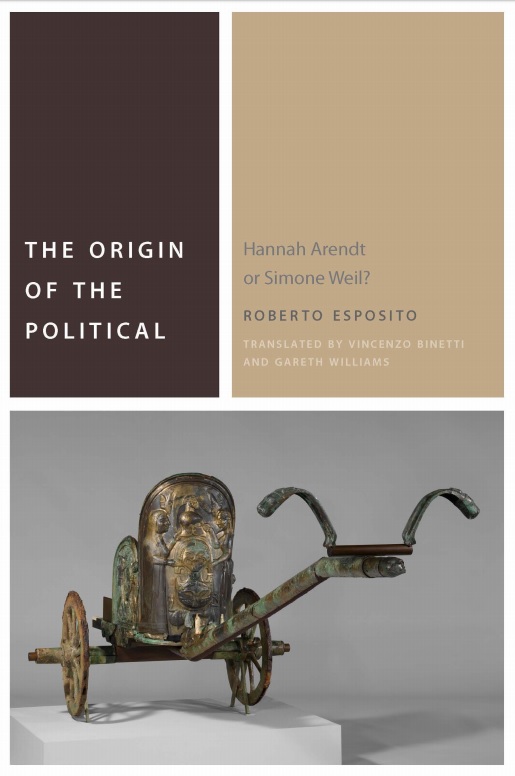
Ius imperii: on Roberto Esposito’s The Origin of the Political: Hannah Arendt or Simone Weil? By Gerardo Muñoz.

Vicenzo Binetti and Gareth Williams’ translation of Roberto Esposito’s The Origin of the Political: Hannah Arendt or Simone Weil? (Fordham U Press, 2017) fills an important gap in the Italian thinker’s philosophical trajectory, connecting the early works on the impolitical (Categorie dell’impolitico, Nove pensieri) to the latest elaborations on negative community and the impersonal (Terza persona, Due, Da Fuori). Origins is also an important meditation on the problem of thought, and Esposito admits that had he written this work today, he would have dwelled more on this question central to his own philosophical project up to Da Fouri and the turn to “Italian Thought” (pensiero vivente). Nevertheless, The Origin of the Political is a unique contribution that crowns a systematic effort in mapping the rare misencounter and esoteric exchange between two great Jewish thinkers of the twentieth century: Hannah Arendt and Simone Weil.

In a sequence of thirteen sections, Esposito dwells on the question of the origin of the political in light of western decline into nihilism, empire, and modern totalitarianism. He is not interested in writing a comparative essay, and this book could not be further from that end. Rather, Arendt and Weil are situated face to face in what Esposito calls a “reciprocal complication”, in which two bodies of work can illuminate, complement, and swerve from instances of the said and unsaid (Esposito 2). Albeit their dissimilar intellectual physiognomies and genealogical tracks, which Esposito puts to rest at times, the underlying question at stake is laid out clearly at the beginning. Mainly, the question about the arcanum or principle of the political:

“Does totalitarianism have a tradition, or is it born of destruction? How deep are its roots? Does it go back two decades, two centuries, or two millennia? And ultimately: is it internal or external to the sphere of politics and power? Is it born from lack or from excess? It is on this threshold that the two response, in quite clear-cut fashion diverge.” (Esposito 4).

Whereas for Arendt the causes and even the texture of the political is extraneous from the totalitarian experience that took place in the war theaters of the central Europe, Weil’s response solicits a frontal interrogation of the ruinous catering of the political, going back at least to the Roman Empire. But Esposito does not want to exploit differences between the Weil and Arendt too soon. In the first sections of Origins he brings them to common grounds. First, Esposito notes how important Homer’s Iliad was to both Arendt and Weil in terms of the question of “origins”. In fact, the Iliad does not only represent a ‘before of history’, a poem that cannot be reduced to the narrative of the event; it is also an artifact that allows for truth. Esposito writes: “It is precisely the defense of truth through the name of Homer that most intimately binds our authors” (Esposito 8). Whereas totalitarianism emerges once politics is only a legislative instrument for seeking ends, truth for the an-archic Homeric poem praises both accounts; that of the victor and the defeated. Thus, any an-archic (beyond or before origin or command) is always, necessarily, a history of the defeated, which remains a demand in the order of memory. This is what Arendt’s admires and defends in “Truth and Politics” regarding the Homerian telling of both Hector and Achilles. But it’s also what Weil in her pre-Christian intuitions accepts as the survival of the Greek beginning in the commencement of Christianity without mimesis. To recollect truth in history beyond arcana (origins and commanding force) is to take distance from the force of philosophy of history, and its salvific messianic reversals. This is far from the negation of history; it is the radicalization and the durability of the historical, which Esposito frames with a cue from Broch:

“How can something conceived in terms of a caesura lay the foundations for something enduring? How can one derive the fullness of Grund from the emptiness of Abgrund? How to stabilize and institute freedom when it is born literally from the “abyss of nothingness” This is the question that returns with increasing intensity in Arendt’s essay on revolution…However, revolution cannot be an inaugural caesura and constitutio libertatis simultaneously” (Esposito 17-18).

This explains, perhaps only implicitly (Esposito does not say so openly), Arendt’s convicted defense of the American Founders over the Jacobinism of the French Revolution, which has only been an achievement in history due to the enduring progressive force of living constitutionalism. Esposito does not take up the fact that, Weil also responded critically to the Jacobin rule in her influential “Note sur la suppression générale des partis politiques” (1940). Esposito does claim, however, that any historical an-archy, insofar as it remains incomplete and evolving, must not resolve itself in genesis or redemptive messianism of the “now-time” [1]. This clearing allows for a passage through the origin that brings to bear the proximity of war to politics, which for Arendt delimits the antinomy of polemos and polis, as well as the difference between power and violence elaborated in her book On Violence.

Esposito lays down three different levels of Arendt’s positing of the origin of the political: a first one predicated on the space of the polis for the action of the citizen (polis becoming a theater); a second one, in which the agon is manifested without death; and a third, a Romanization of the Greek physis into auctoritas. For Arendt, Rome becomes a sort of retroactive payment for what was lost and destroyed. It is an after Troy in order to experience “beginning as (re)commencement” (Esposito 31). Rome is the possibility of another polis after the incineration, a tropology for amnesty within the historical development of stasis or social strife. Once again, the hermeneutics of memory over forgetting is placed above a philosophy of history that absolutizes the valence of the political. But it is in this conjuncture where Weil’s thought announces itself as an interruptive force in Arendt’s ontological conversation of the polis.

Esposito immediately tells us that for Weil the “origin” of the political does not run astray due to accumulation of historical catastrophe. According to Weil, the Fall is already original in the sense of being grounded in the event of creation (Esposito 36). Here Weil’s neoplatonic Christianity carries the weight. Weil posits an understanding of contradiction in Christian Trinitarian thought, although unlike the Carl Schmitt of Roman Catholicism and Political Form (1923), she does not substantialize this split through the reciprocity of its division into decision in the name of legitimate order. Weil, as it is well known, affirms a moment of creation grounded in its own abnegation. This revolves in the concept of de-creation that Esposito defines as: “a presence that proposes itself in the modality of absence, as a yes to the other expressed by the negation of self in an act fully coincident with its own renunciation” (Esposito 39). Conceptually consistent with Eckhart’s kenosis and later in modernity with Schelling’s philosophy of revelation, decreation is the Weil’s stamp of unoriginary foundation.

At stake here is the question of impersonal life, which in different ways, Italian thinkers as diverse as Giorgio Agamben, Elettra Stimilli, Davide Tarizzo, or Roberto Esposito himself have articulated in multiple ways in a debate that has come to us under the label of biopolitics. To the extent that decreation is an an-archy of this neoplatonic theology, Weil remains a thinker of the non-subject or of the trace of the finite that is irreducible to any modality of the political [2]. At this point, Esposito exposes the problem of force. Without fully embarking on a phenomenology of the concept in Weil’s reading of the Iliad, Esposito notes that force has the character of a total encompassing sensation that strips life unto death, belonging to no one, and viciously bypassing all limits. Here Weil cuts away from Arendt’s agonistic impulse of the polis.

The maximum distance with Arendt also emerges at this point: whereas Arendt conceived the Iliad of glory and claritas, for Weil it is “a nocturnal canto of mortality, finitude, and human misery” (Esposito 52). The uncontained force, the true and central protagonist of Homer’s epic, unfolds a negative community that Esposito calls, after Jan Patočka, a community “of the front”. Although Weil’s utmost divergence from Arendt becomes effective in the question of Roman politicity, which for her amounts to a juridical idolatry and a theologico-political glorification, as well as a prelude for the modern totalitarian experiment. In a key moment of this treatment of Weil’s critique of Roman law, Esposito writes:

“But what is even more significant for Weil’s arguments, and this is in contrast to Arendt, is that Roman law – ius, whose intrinsic nexus with iubeo drags the entire semantic frame of iustitia far from the terrain of the Greek dikē – is annexed to the violent sphere of domination. While the latter alludes to the sovereign measure that subsides parts according to their just proportion, the Roman iustum always belongs to he ho stands higher in respect to others who for this very reason are judged to be inferior, or, in the literal sense of the expression, “looked down upon”. This is the principle of a “seeing” that in the roman action of war is always bound to “vanquishing”…” (Esposito 56).

For Weil, Rome was representative of imperium and ius that subordinated the transcendence of its uncontested rule above citizenship equality, such as it existed in the Greek polis through isonomia. Devoid of citizenship, the Roman ius imperii is necessarily a dependent on slavery. Esposito notes that Weil’s anti-roman sense is more consistent with Heidegger’s critique of the falsum of the Roman pax as well as with Elias Canneti’s understanding of roman perpetual war, than with the Romantic anti-roman verdict. In its decadence, Roman politics as based on fallare opens up Christian pastoral power in a long continuum that later reproduces the basis for supreme hegemony. At the same time, Rome never truly stands for war, since it negates by declining conflictivity to peace in the name of domination. That is why for Weil the greatest discovery of the Greeks was to abide by strife as the mother of all things, while realizing its destructive nature. This makes Weil, as Esposito is aware, a figure of ignition, and a “combative thinker”. There is a sense in which the imagination of warring also colors Weil’s reading of Love in Plato’s Symposium, which positively informs her deconstruction of Roman ius.

But is this enough to leave imperial legislative domination? Should one accept Love as contained in war, as a form of warring and as a sword? (Esposito 72). The question that emerges at the very end of the Origins is whether Love can be at the center of a elaboration of a third dimension of the political, traversing both Weil and Arendt’s thought, and establishing perhaps a new principle for politics. It is to this end that Esposito argues: “…justice – love and thought, the thought of love – requires that what appears to others be sacrificed to what is, even if it remains obscured, misunderstood, or despaired (and this is precisely what Weil’s hero also proposes)” (Esposito 77).

Esposito writes just a few pages before that perhaps only Antigone succeeded in facing this differend, but only at the highest possible cost of destruction. It is at this crossroads where we find the last attempt to reconnect Weil and Arendt. However, love (eros) stops short of being a legislative antinomy and premise for a politics of non-domination beyond sacrifice or the payment with one’s own life. One should recall that Arendt’s doctoral work on Saint Augustine and love sheds light on Weil’s pursuit of love in facticity of war [3]. And if love always retains a sacrificial and Christological trace, then it entails that at any moment the condition of eros could dispense towards the very falsum that it seeks to undue. Could there be a politics predicated on love as an origin, capable of obstructing imperial renewal?

This is the question that Esposito’s book elicits, but that it also leaves unanswered. While it is surprising that the question of ‘the friend’ goes without mention in The Origins of the Political – the last twist in the book is on the figure of the hero or the antihero – it begs to ask to what extent friendship, not love, becomes the “deviation of the political” into an post-hegemonic region irreducible to the negation of war? This region is not possible to subsume in the impersonal reversal of the lover, the enemy or the neighbor. Perhaps the “He” that Esposito analyzes in Kafka at the very end of the book cannot be properly placed as an amorous figure, since the friend always arrives, quite unexpectedly, at the game of life. We abide to this intimate encounter beyond ethical and the political maximization. Moreover, we care for him, even when we do not love him. It is the friend, in fact, a figure that finds itself in a hospitable region, in a city like Venice so admired by Weil, where “he can rest when he is exhausted” (Esposito 78). This is a region no longer ruled by imperial politics, nor by its exacerbated modern perpetuity.


Notes

  1. The target here is messianism as represented mainly by Walter Benjamin and other representatives of salvific philosophies. Esposito notes that Hannah Arendt was critical of Walter Benjamin’s messianism in her “Gnoseological Foreword” of Benjamin’s Origin of German Tragic Drama. For a devastating critique of messianism and philosophy of history as a dual machine of political theologies, see Jaime Rodriguez Matos’ Writing of the Formless: José Lezama Lima and the End of Time (Fordham U Press, 2016).
  2. For the non-subject, see Alberto Moreiras’ contribution to the debate of the political in his Línea de sombra: el no-sujeto de lo político (Palinodia, 2006).
  3. Giorgio Agamben makes the claim that love in Heidegger, as informed by Arendt’s early work on St. Augustine, stands for facticity. See his “The Passion of Facticity”, in Potentialities: Collected Essays in Philosophy (Stanford U Press, 1999). 185-205.
Sephardics Readings List: An Intersection between latinx/hispanic/jewish studies

a. Western intellectual and cultural history since 1600. This examination includes basic
issues in the philosophy of religion, theory and method in the study of religion, and
contemporary critical theory. The purpose of the exam is to situate the field of Religion and Culture in its historical and intellectual context.

This list is designed to include canonical works in the broader field of Religious Studies as it relates to my topic such as Machiavelli’s The Prince, Cervante’s Don Quixote, Spinoza’s Theological-Political Treatise; and also to include non-canonical primary sources wich are nevertheless important to the development of the ‘West,’ works like the diary of Ursula de Jesus and the proto-novel Lazarillo de Tormes as well as the broader picaresque literary genre that so subtly influenced posthegemonic rebellion of an internal (–marrano–) kind. The representatives of the canon as well as those chosen to represent a noncanonical kind of canon are designed both to challenge the supremacy of canon as a concept and to point to the role of Spanish imperial culture as being an important, if not fundamental, element in even conceiving a phrase such as ‘Wesern intellectual and cultural history since 1600″. Spanish history, particularly as it pertains to the whirlwinds of posthegemonic stirs, desires, and manifestations along the margins of the Empire, involves an incredible transformation on the world stage. I will follow Professor DeGuzman’s observations and posit that the West as such positions itself historically as being other than Spanish, that modernity is other than Spanish, that freedom (as in the case of the ‘Free Cities’ that developed in the early modern period, such as Sale, or even Amsterdam or London, ports that were in the new zones of global trade outside of Spanish Imperial hegemony) was increasingly defined in reaction/accommodation to the professed Spanish imperial ideal. Professor Cassen’s Italian Spy is indicative of yet another possible ‘posthegemonic’ reaction to the Imperial claim on religious conformity–as are characters like Samuel Palache, Abraham Miguel Cardozo, Baruch Spinoza, and many others.  I plan to have an eye on these macro historico-cultural turns that were taking place in different places within the matrix of the Spanish/Portuguese Imperial zone but also on marranism’s (destabilizing, reinvigorating) force and influence on what we now call ‘Western’ thought.

b. Area of specialization. This examination focuses on major scholarly literature specific to the student’s specific field of study.

This list is focused on the historiography of the converso/new christian/marrano narrative, with a nod at the different streams of understanding the converso phenomenon both within and without the Iberian peninsula. This is an exploration of the development of a new Sephardic community that would come to understand itself in many different ways in different locations, but, and particularly in seventeenth-century Amsterdam and throughout the Atlantic zones, began to articulate a sense of nationhood that included fellow kinsmen then living or having lived in Spanish lands (‘the lands of idolatry’) as Catholics, even for generations. This trajectory will follow the work of Bodian, Yovel, Perez, Netanyahu, Nirenberg, Jonathan Israel, and many others.

c. Cultural theory. This examination focuses on methodological and theoretical issues in an area of cultural theory relevant to the student’s scholarly work, such as literary theory, cultural studies, ethnographic theory, postcolonial studies, or gender theory.

This list is designed as a ‘Jewish Studies’ list, but with an emphasis on the history of the ‘heretical.’ I follow Gershom Sholem and more recent scholars like David Halperin and Benjamin Lazier and try to show that heresy is an integral–if not fundamental–to the movement of (Jewish) history.  I also highlight different ways that the Inquisition was instrumental in creating precisely what it feared most. We can see this in Wachtel’s recent Marrano Labyrinths in which he details conversations had between Inquisitorial prisoners (who were recorded by fellow inmate spies) where we witness a ‘return’ to Judaism as a result of a life lived at the at times ruthless mercy of Inquisitorial bureaucracy. At the same time, following scholars like Rawlings or Kamen, the Spanish Inquisition was a modernizing institution and became a model for non-Spanish elites to not only reject the “inquisition” at a rhetorical level (as an illiberal and primitive institution to be abhorred) but also adopt its innovations and efficiencies, its claim on biopolitics, the right to a trial, access to international databases, adherences to procedure, global institutional cooperation, and, to remain topical, an early apparatus of the modern deep state.

d. Dissertation examination. This exam covers historical and critical literature specific to the student’s area of dissertation research.

This list is a focus on the cultural and political phenomena of ‘Philosephardism’ which I explore as part of a Spanish postcolonial nostalgia that became marginally widespread after the territorial losses of 1898 that marked the end of Spanish colonialism in the ‘New World.’ At the same time, philosephardism was concurrent with growing nationalisms that took on many forms, among them a kind of re-colonialism that would invert certain traditional (crusader) norms by claiming loyal ‘Moors’ and Spanish Jews and enlisting them in a new project of ‘hispanidad’ that supposedly could usher in a new and better era. Broader European notions of progress inflected these ideas and they played out in Spanish (re)colonial thinking in various and particular ways. This included King Alfonso XIII’s love affair with chemical weapons which he used unabashedly in the Rift Wars, setting the stage for the first mass aerial bombardments of civilian populations in Europe during the colonial-reconquest of peninsular Spain from the supposed dangers of Communism during the Spanish Civil War. The proto-fascist Spanish right revitalized and reinvigorated the narrative of 1492, reconquest, los reyes catolicos, etc; but interestingly the ideology differed both with more traditional conservatism and its counterparts of in the modern right in northern Europe. ‘Southern’ proto-fascism made room for thinking about an orientalism that allowed for Jews to re-enter the bodypolitic of Spanish nationhood on the one hand, while on the other both rejecting and internalizing the ‘Moor’ as the noble, potentially civilized, but still tainted savage other. Sebastian Balfour’s Deadly Embrace is crucial for talking about these so-called African wars, while Isabel Rohr’s Philosephardism and the Spanish Right, and Stanley Pain’s several biographies and histories of Franco and the run-up to the Spanish Civil War are necessary historiographies as well. The writings, works, thoughts and lives of individuals central to disseminating philosephardism in the late nineteenth and early twentieth centuries are necessary, people like Angel Pulido and Ernesto Gimenez; and then represented should be examples of philosephardism in the contemporary literary world–like Munoz’ Sefarad or Eran Torbiner’s recent documentary Madrid before Hanifa; as well a brief rumination on Spain’s current philospehardic law to extend citizenship to exiles of 1492.

Comentario a un testimonio. Por Alberto Moreiras.

http://www.revistatransas.com/category/dossier-la-frontera-mexico-ee-uu-desplazamientos-contenciones-agencias-movilizaciones/th

Si pudiéramos intentar algo así como una fenomenología del informante —es decir, establecer una tipología imposible: ¿cómo son los informantes, a qué mecanismos responden, qué buscan en lo que hacen, qué satisfacción libidinal obtienen de su labor?—, creo que Me decían mexicano frijolero sería el lugar en donde buscar los rasgos primarios de un informante en grado cero.  Así, a Roberto Rangel le correspondería el honor atroz de configurar el tipo más extremo del informante: el que informa contra su voluntad, contra su vida, contra su satisfacción libidinal, contra lo que quiera que pueda entenderse como su felicidad; un informante esclavo, que actúa solo siguiendo un imperativo deconstituyente. A Rangel le dicen: “Informa, es tu ley, firmaste un contrato, no tienes opción, y si no lo hicieras despanzurraríamos a tus novias, mataríamos a tus hijos, y luego nos desharíamos de ti”.  Rangel no tiene vida, aunque la busca: se la han robado.  Sabe que sirve a canallas, sabe que el sistema que le rodea sirve también a esos canallas, no tiene recurso alguno, y el milagro es siempre el milagro de una supervivencia precaria, en la cárcel, cincuenta y siete años por un asesinato inventado, cincuenta y siete años falsos, porque Rangel no cuenta, no sirve, no es, o es solo carne de cañón, y a esa gente se la condena solo porque sí, ninguna otra cosa sería consistente, ni la verdad ni la justicia pueden entrar en el procedimiento.  Solo el escarnio.

Porque hay escarnio sádico por parte del policía que lo maneja como informante y lo convierte en su servidor sexual y lo humilla y degrada en cada visita, el policía que lo llama “mexicano frijolero” en el momento de la violación y que le hace comer carne escupida en el suelo porque no otra cosa merecen los mexicanos frijoleros que creen que pueden venir a Estados Unidos a comer carne.  Son ellos mismos carne, carne usable sexualmente o económicamente, pero por fuera de eso son nada, no son nada, son nada. Son solo transcripciones, objetos para el despliegue de una psicosis predatoria que cuenta, por otro lado, con la cobertura oficial, estatal, con todo el cuerpo de policía, con todo el aparato estatal.  Roberto Rangel cae en una máquina de triturar cuerpos y espíritus y ya no saldrá nunca; paradójicamente, solo la cárcel trae cierta medida de tranquilidad, la posibilidad de aprender a leer, de aprender a escribir, de dar un testimonio que nadie creerá nunca, que será siempre considerado ficción y puesto a la distancia de la ficción porque nadie puede dar crédito a su verdad sin entrar en la noche sicótica: no es solo el policía Rivas o la María de Inmigración, sino todos los demás agentes que deben descreer cualquier palabra de Rangel, el abogado, el fiscal, el juez, nadie puede atenerse a la verdad simple, al mero testimonio, pero qué testimonio, todos piensan que hay mentira, que no puede ser, pero es justo a través de ese no poder ser, a través de su improbabilidad misma. Es la noche psicótica. En ella Rangel escucha “you are a bitch, nothing but a bitch, I will make you my bitch, you will become a bitch, I will give you your proper existence as a bitch, your being must match your worth, your name is the name of a bitch, proper name, mexicano frijolero, suck my cock o despanzurro a tu hijo”.

Hay que preguntarse cómo se desvincularía el Presidente Trump de esta situación. Cuando le dice a Peña Nieto pay for the wall, pay for my wall, you must, or you will suffer the consequences, no tienes opción, y si no lo hicieras despanzurraré a tus hijos, mataré a tus novias, I will make you my bitch, you already are my bitch, ¿no está el Presidente Trump introduciendo la noche psicótica en la política internacional? Para su propia catexis libidinal, para su propia descarga, así son los hombres, como Rivas, el detective de Fresno que tiene la confianza de su gente, de la DEA, de la Highway Patrol, del fiscal del distrito, de los abogados, de los jueces, o la compra. Al fin y al cabo, el mismo Rivas tiene acceso a toda la cocaína del mundo, y así al dinero, para eso le sirven sus informantes.

Hay otros informantes.  Está por ejemplo el Butcher’s Boy, el protagonista de The Informant, de Thomas Perry, que informa a una empleada del Departamento de Justicia porque esa información sirve a su propio interés, a su propio cálculo, a su frío plan de venganza, o no es venganza, solo precaución, esos tipos mejor que estén en la cárcel o muertos. Él es un asesino, pero no puede matarlos a todos, son muchos, y así se ayuda a sí mismo, en cuanto asesino, como informante, por cálculo: informante radical, como lo que decía Kant del mal radical, el mal que se hace por cálculo, por oportunismo, aunque el otro lo merezca. Pero no es el mal diabólico del informante en grado cero, del informante que es, no agente, sino paciente del mal diabólico, una vez cruza la frontera.  Pero ahora habrá un muro.

Y luego está el otro informante, el informante serio, profesional, el informante que informa por deber, el informante que acepta una vida de riesgo y traición, de infinita distancia, porque hay una ley que hacer cumplir, una ley que cumplir, y hacerse informante es afirmar la libertad, es ser libre, aunque uno está solo cumpliendo leyes, haciendo que la ley se cumpla, cooperando en ello, no importa el precio: el informante moral, o informante en grado pleno, por ejemplo, el Robert Manzur de The Infiltrator. La tipología del informante coincide con el análisis kantiano, gran cosa, hay mal trivial, y luego hay mal radical y hay mal diabólico, y hay libertad moral, y no hay más.

Pero es una tipología precaria. El informante, como todos, solo quiere que algún ángel vuelva a su vida, como Tobías, que perdió a su ángel y pasó el resto de su vida, hasta los ciento diecisiete años, añorándolo, pidiendo su retorno. No es posible vivir sin ángel, o la única manera de hacerlo es vivir en la nostalgia del ángel. No habría hospitalidad sin tal nostalgia, la nostalgia del ángel es condición de hospitalidad. El informante informa en nostalgia de ángel. El informante pide hospitalidad, requiere hospitalidad, y a veces la da, pero solo para recuperarla. Para el pobre Rangel, el ángel es quizá el hijo que no conoce, al que no conocerá nunca, la segunda hija de la otra novia que también pierde, los hijos que vienen y se van, y de los que no se puede asegurar retorno alguno, ya no, no así, y sin embargo, si así no, ¿entonces cómo? Rangel pide cruzar la frontera, pide volver después de su deportación, cosa humanitaria, tiene un hijo, quiere ser recibido por su hijo, y cae en las manos de una policía que parecía trivial pero es diabólica, y así, sin papeles, sin letras, atado solo por la amenaza de muerte general, no es ya más que esclavo, pronto adicto a su esclavitud misma, informante que ya no informa, porque informar requiere una distancia ahora perdida. Y ya no hay distancia, a menos que la letra del testimonio mismo pueda organizarse como distancia, a menos que una verdad sea en última instancia expresable, aunque nadie pueda creerla. A menos que pueda entrar el ángel en la carta.

An explanation for ‘deconstructing the administrative state’. By Gerardo Muñoz.

A few weeks ago at CPAC (Conservative Political Action Conference), when Steve Bannon, Donald J. Trump’s White House chief strategist, laid out the principle of “the deconstruction of the administrative state” as one of the immediate objectives of the Trump administration, there followed a storm of commentaries. For academics in the humanities, it was a perfect setting to mock ‘deconstruction’, and assert the un-political character of this so called “theoretical trend” in the academia, easily linking Derrida with Bannon’s strategic plan.

Just to cite one of many examples, French writer Alain Mabanckou twitted: “Steve Bannon, le mentor de Trump parle de “deconstruction” du povuir de Washington. Deconstrution? Srait-il un lecteur de Derrida?”. Many more followed on social media and in academic groups. These witty remarks were, of course, written under the sign of irony, which is certainly a central stimmung of our time. But irony is also one of the most serious genres to discuss a serious affair, of which I would like to briefly contemplate. Of course, my intention is not to defend Derrida, or even worse, to prove that Bannon has not read Derrida. I am sure that Bannon has not read Derrida, and even if he has heard of him, or someone told him a few things about deconstruction as a critical strategy of contemporary thought, this is irrelevant.

Bannon’s usage of deconstruction of the administrative state is correct, although in another sense. For one thing, deconstructing the administrate state is a technical term used in sociology and political science analysis as it relates to the fiscal state. In his new book Democracy against Domination (2017), Sebeel Rahman discusses the deconstructive force of computative fiscal logic over institutional structures and governmental regulatory bureaucracy [1]. In a good portion of the literature, whenever the notion of deconstruction of the administrative state is used, it refers directly to the dismantling of the fiscal regulatory apparatus (see Norris 2000). Whereas it might, at first sight, seem that Bannon is misinformed or just downright clownish, he is deeply versed in the specific discipline that he wants to target; mainly, political science of the welfare state as it has been discussed from the New Deal onwards.

One could press this point even further: the idea that Bannon wants to ‘deconstruct the administrative state’ does not merely amount to ‘more neoliberalism’ as cultural critics seem to reduce the problem. This is part of the truth, but not the whole truth. The attempt to attack the administrative state entails a serious assault on the rule of law, since as the most intelligent constitutionalists have recently noted, the administrative state is today the legal structure that has supplanted legitimacy over the deficit of presidentialism of the executive branch. Adrian Vermuele (2016) makes it clear that the administrative state is the law’s greatest triumph after the weakening of the separation of powers. This ultimately entails, that perhaps Bannon is well aware that it is not enough to destroy a democratic society from the standpoint of a sovereign executive, since it must be done from the very place where the rule of law resides, and this is where the administrative state plays a fundamental role. Bannon’s deconstructive gesture goes to the heart of the rule of law, which we have already started seeing as a check mechanism to Trump’s rampant executive unilateralism. Hence, the rumor that says that Bannon is a Leninst should be taken very seriously: Leninism seeks the destruction of the state and rule of law in order to create a dictatorship of the proletariat, which is Bannon’s civilizational response to globalization [2]. Bannon is a full-fleshed anti-institutionalist who admires not only Lenin, but also the decade of the thirties that he has called “exciting”.

At this point, it is perhaps almost unnecessary to say that Derrida’s deconstruction has little do with Bannon’s loaded attack on institutions of the welfare state. However, what is important is to note that Bannon’s articulation of deconstruction is inequivalent to Derrida, and a comparison becomes only possible if one subscribes to a transparent conceptual reservoir of the linguistic turn in order to abuse it. Thus, whenever a linguistic component is emphasized as hyperbolic of intellectual thought, the latter is suspended to favor an easy advantage in tandem with anti-politics.

Derrida emphasized that deconstruction was a condition of democracy, and that democracy could not take place without deconstruction. Democracy is really not a political concept in Derrida’s thought. It is not reducible to a tradition of “intellectual history”, and not even to the primal causation of life as predicated in the political. Such was, for Derrida, the exemplary nature of Mandela [3]. But to the extent that it solicits unconditional hospitality, it alters the alterity of the singular that is never reducible to political finality. This coming of friendship or non-enmity is another way of thinking through an infrapolitical existence. It is this demotic existence beyond the political what Bannon wants to destroy and obstruct in a move that is both fully ultra-political and non-political.

Notes

  1. K. Sebeel Rahman. Democracy against Domination. Manhattan: Oxford University Press, 2016.
  2. “Steve Bannon, Trump’s top guy, told me he was ‘A Leninst’ who wants to ‘destroy the State’. http://www.thedailybeast.com/articles/2016/08/22/steve-bannon-trump-s-top-guy-told-me-he-was-a-leninist.html
  3. Jacques Derrida. The Politics of Friendship. London: Verso, 2005. P.102-106. “Admiration of Nelson Mandela, or The Laws of Reflection”, Law & Literature, Vol.26, 2014.

Comentario a un libro de Monedero. Por Alberto Moreiras.

IMG_5199En el final del libro de Juan Carlos Monedero, Curso urgente de política para gente decente (2013), hay como tres páginas de listas de cosas que uno quiere disfrutar, y que aparecen en nuestra vida, si tenemos ojos y oídos para ello, como los fulgores en lo oscuro de Georges Didi-Huberman. El lema es “hacer política como si nos fuera en ello la vida.” Esto es, hacer política, viene a decir, para que la vida no sea políticamente agotable, hacer política para ganar algo otro que la política–y esto es lo específicamente definible como de izquierdas (la política de derechas busca en realidad lo mismo, dice Monedero, pero desde el miedo y no desde la esperanza, a partir del privilegio de algunos contra el privilegio de todos; y el miedo impone su precio). Si esto es así, si esto lo entiende todo el mundo, si en el fondo es verdad que ningún panorama de izquierdas puede construirse hoy sin la negación del mundo político y de la relación con la existencia que hemos heredado (“Si los problemas de nuestras sociedades son la mercantilización de cada rincón de nuestra existencia, la precariedad de nuestras condiciones de trabajo y de vida, la desconexión del entorno y de los otros, la privatización de la existencia y la competitividad como la racionalidad de la época, un programa político alternativo se arma, precisamente, con todas esas cosas que niegan esas lógicas”), ¿por qué entonces tanta resistencia y tanta mala fe cuando se habla de infrapolítica? (No de Monedero, por cierto, del que no sé si ha oído la expresión, sino más cercanamente.) La infrapolítica es el horizonte necesario del logro en política (contra el éxito derechista)–cuando el mundo se abre a algo otro que el conflicto y la división. Ninguna política sirve cuyo resultado no sea una expansión radical del ejercicio infrapolítico. Por lo mismo, una infrapolítica sin política no puede darse–solo cabe radicalizar la demanda política hacia un espacio no hegemonizado, hacia un espacio libre, que es el espacio infrapolítico. Pero esto será llamado, no ya desde la ignorancia, sino desde la terquedad resentida, conservadurismo eurocéntrico, anti-identitarismo, fascismo, pendejismo, o giro lingüístico. La ceguera es voluntaria y es también profundamente desilusionante–porque en ese rechazo ciego entre los que pueden oír y no oyen ni quieren oír se sintomatiza una radical falta de compromiso político con todo lo que importa, se sintomatiza solo el oportunismo de los ventrílocuos. ¿No es hora ya de mandar a paseo a esa falsa izquierda gesticulante? ¿Quién querría vivir en su mundo?

Infrapolitics. Bibliography in Progress. Draft. Prepared March 2017. By Alberto Moreiras

th-1(First Attempt–Incomplete and with Format Problems. Work in Progress. Additions or corrections can be proposed in Comments, and they will be incorporated.)
Alvarez Yagüez, Jorge. “Límites y potencia de dos categorías políticas: infrapolítica e impolítica.” Política Común 6 (2014)
—“Hegemonía, cultura y política.” En Poshegemonía. El final de un paradigma de la filosofía política en América Latina. Rodrigo Castro Orellana ed. Madrid, Biblioteca Nueva, 2015, pp. 67-92
—“Crisis epocal. La política en el límite”, Debats 3 (2015): 9-28
–“De la crítica de dos conceptos políticos: sujeto y acción”, Política Común 10 (2016)
–“Infrapolítica.” Enciclopedia Iberoamericana de filosofía, (forthcoming)

Baker, Peter. “(Post)Hegemony: Reflections on the Politics of the Present.” Política Común. 9. [Online]. <http://quod.lib.umich.edu/p/pc/&gt; 2017.

— “Hacia una crítica del terror: Inquisición y marranismo. Terror social y pensamiento.” ed. José Luis Villacañas. Madrid: Biblioteca Nueva [2017]

Cerrato, Maddalena. “Consensus, Sensus Communis, Community.” Politica Común, 10(2016).

—“Alberto Moreiras: desde la aporía auto/hetero-gráfica hacia posthegemonía e infrapolítica.” Papel Máquina, Santiago-Chile: Palinodia, 2016.

—-“Infrapolitics and Shibumi. Infrapolitical Practice between and beyond Metaphisical Closure and End of History” Transmodernity. 5.1 (2015): 79-103.

Moreiras, Alberto. Marranismo e inscripción, o el abandono de la conciencia desdichada. Madrid: Escolar y Mayo, 2016.

—. Línea de sombra. El no sujeto de lo político. Santiago de Chile: Palinodia, 2006. [English publication under contract with Duke University Press. Revised and Expanded Edition to be published in 2017-18.]

—. “Approssimazioni all’infrapolitica.” Maddalena Cerrato transl. Naples: Paparo [2017]

—“Piel de lobo. Ensayos de posthegemonía e infrapolítica.” Madrid: Biblioteca Nueva [2017]

—. “The Parergon for Parergonal Critique. On David R. Castillo and William Egginton’s Medialogies. Reading Reality in the Age of Inflationary Media. Brad Nelson ed. Hispanic Issues Online [2017].

—. “Cercanía contra comunidad: la errancia y el ojo de más.” In Pléyade [Santiago de Chile, 2017].

—. “Hacia una república marrana. Conversación entre Alberto Moreiras y José Luis Villacañas sobre Teología política imperial y comunidad de salvación cristiana, de José Luis Villacañas.” To be published in a volume of review-essays on said book. Madrid [2017]

—. “Idolatría e infrapolítica. Comentario a Teología política imperial y comunidad de salvación cristiana, de José Luis Villacañas.” To be published in a volume of review-essays on the book in the title. Madrid [2017]

—. “Against the Conspiracy. Revisiting Life’s Vertigo. On Roberto Esposito’s Terza persona and Da fuori. Una filosofia per l’Europa.” In Antonio Calcagno and Inna Viriasova eds. The Thought of Roberto Esposito. State University of New York Press [2017]

—. “The Ontic Determination of Politics Beyond Empiricism in Early Derrida.” Erin Graff Zivin ed. The Marrano Specter. Derrida and Hispanism. Fordham UP [2017].

—. “A Negation of the Anarchy Principle.” Política común [2017].

—. “Memory Heroics. Ethos Daimon.” Special Issue on Allegory edited by Jacques Lezra and Tara Mendiola. Yearbook of Comparative Literature [2017]

—. “Tres tesis sobre populismo y política. Hacia un populismo marrano.” Alfonso Galindo ed. Title to be decided. Madrid [2017]

—. “Distancia infrapolítica. Nota sobre el concepto de distancia en Felipe Martínez Marzoa.” En Arturo Leyte ed., La historia y la nada. En torno a Felipe Martínez Marzoa. Madrid: La oficina de arte y ediciones [2017].

—. “La diéresis del pensamiento como tonalidad patética: Nota sobre pensamiento/crítica en Willy Thayer, apoyada en Jacques Derrida y en Martin Heidegger y en Juan Benet.” Papel màquina [2017]

—. “La religión marrana y el secreto literario.” Angel Octavio Alvarez Solís ed. (Title to Be Decided). Mexico: Iberoamericana [2016]

—. “Derrida infrapolítico.” Pablo Lazo Briones ed. Etica y política. Mexico: Universidad Iberoamericana [2016].

—. “The Turn of Deconstruction.” Volume edited by Juan Poblete on LASA Culture and Power Panels, May 2014. Routledge [2017]

—. “Sobre populismo y política. Hacia un populismo marrano.” Política común 10 (2016): 1-15.

—. “Hispanism and the Border: On Infrapolitical Literature.” In Wilfried Raussert ed., The Routledge Companion to Inter-American Studies. London: Routledge, 2017. 197-206.

—. “La universidad es solo intemperie. Entrevista de Ivan Pinto a Alberto Moreiras.” El desconcierto (Santiago de Chile), May 4, 2016. 1-8. (Interview [I])

—. “Conversación en torno a Infrapolítica.” Interview. Questions from Alejandra Castillo, Jorge Alvarez Yagüez, Maddalena Cerrato, Sam Steinberg, Angel Antonio Alvarez Solís. Papel máquina (2016). (I)

—. “Infrapolítica—el proyecto.” Papel máquina 10 (2016): 55-66. (Refereed article [RA)

—. “Infrapolitical Action: The Truth of Democracy at the End of General Equivalence.” Davide Tarizzo ed. Política común 9 (2016). DOI: http://dx.doi.org/10.3998/pc.12322227.0009.004 (RA)

—. “Posthegemonía, o más allá del principio del placer.” In Rodrigo Castro Orellana ed., Poshegemonía. El final de un paradigma de la filosofía política en América Latina. Madrid: Biblioteca Nueva, 2015. 125-46. (Book Chapter [BC])

—. “A Conversation with Alberto Moreiras Regarding the Notion of Infrapolitics.” (Alejandra Castillo, Jorge Alvarez Yágüez, Maddalena Cerrato, Sam Steinberg, Angel Antonio Alvarez Solís). Transmodernity 5.1 (2015): 142-58. (I)

—. “Infrapolítica y política de la infrapolítica.” Debats 128 (2015): 53-73. (RA)

—. “Introducción: Infrapolítica y posthegemonía. (Anhkibasie).” Debats 128 (2015): 6-8. (RA)

—. “Infrapolitics: the Project and Its Politics. Allegory and Denarrativization. A Note on Posthegemony.” Transmodernity 5.1 (2015): 9-35. (RA)

—. “Pasión de hospitalidad, pasión hospitalaria: relación encubierta. Comentario a “Después del euro. La Europa de la hospitalidad.” Res publica [2014] (RA)

—. “Das Schwindelgefuehl des Lebens. Roberto Esposito Terza persona.” Vittoria Borsó ed. Wissen und Leben. Wissen für das Leben. Herausforderungen einer affirmativen Biopolitik. Bielefeld: transcript, 2014. 115-39. (BC)

—. “Mi vida en Z. Ficción teórica. (De un profesor español en una universidad de Estados Unidos.)” http://www.fronterad.com/?q=mi-vida-en-z-ficcion-teorica-profesor-espanol-en-universidad-estados-unidos (Non-Refereed Article [NRA)

—. “Horacio Castellanos Moya and the Question of Cynicism.” Nonsite [2014]: 1-22. (Electronic publication.) (RA)

—. “Posthegemonía, o más allá del principio del placer.” Alter/nativas 1 (2013): 1-22.

—. “Keynes y el Katechon.” Anales de historia de la filosofia [Madrid] 30.1 (2013): 157-68.

—. “A Beggaring Description: The Republican Secret in Yo el Supremo, Together With Some Considerations on Symbolic Production and Radical Evil.” Journal of Latin American Cultural Studies 22.1 (2013): 71-87.

—. “The Fatality of (My) Subalternism: A Response to John Beverley.” New Centennial Review 12.2 (2012): 217-46.

—. “¿Puedo madrugarme a un narco? Posiciones críticas en LASA.” http://www.fronterad.com/?q=node/5697; Cuadernos de literatura 17.33 (junio 2013): 76-89.

—. “Common Political Democracy: The Marrano Register.” In Henry Sussman ed., Impasses of the Post-Global. Theory in the Era of Climate Change. Vol. 2. University of Michigan Libraries. http://www.openhumanitiespress.org, 2012. 175-193.

—. “Cujusdam negri & scabiosi Brasiliani. Las malas visitas. Ranciere y Derrida.” Cadernos de Estudos Culturais (Sao Paulo) 3.5 (2011): 9-25; Res publica 26.14 (2011): 29-46.

Muñoz, Gerardo. “Infrapolitica en tiempos posnacionales”. Review of Pablo Hupert’s El estado posnacional. Revista Consideraciones, Agosto 2014.

___. “Soberanía, acumulación, infrapolitica: intercambio con Sergio Villalobos-Ruminott”. Lobo Suelto, April 2015.

__. “Cinco hipótesis sobre Reiner Schürmann y el fin de la política principial”. Ficción de la razón, Marzo 2016.

___. “Writing in the Interregnum”. berfrois, June, 2016.

___. “Beyond Identity and the State. Introduction to dossier The End of the Latin American Progressive Cycle”. Alternautas, Vol. 3.1, July 2016.

___. “Epoca posuniversitaria e institución”. Universidad Posible. Raul Rodriguez Ed, 2016. Forthcoming. Print.

___.Infrapolitics, state, writing in Yo el Supremo”. Dissidences: Hispanic Journal of Theory and Criticism. Vol.13, Fall 2017. Forthcoming.

___. “Hegemon: communal form and total mobilization in Latin America”. Revista demarcaciones, 2017. Forthcoming.

___. “Poshegemonía, principios, y estado de derecho”. Pensamiento al margen, 2017.

___. “Interregnum and worldliness”. Review of Sergio Villalobos-Ruminott’s Heterografías de la violencia (La Cebra, 2016). Política Común, Vol.11. Forthcoming.

Rodríguez Matos, Jaime. “After the Ruin of Thinking: From Locationalism to Infrapolitics.” Transmodernity: Journal of Peripheral Cultural Production of the Luso-Hispanic World 5.1 (2015): 1-8. Print.
____. “De lo que agujerea lo Real: Lacan, crítico de la (pos)hegemonía.” Debats 128.3 (2015): 29-40. Print.
____. “Del no-tiempo de la incertidumbre en Juan Luis Martínez.” Martínez Total. Eds. Biggs, Braulio Fernández and Marcelo Rioseco. Santiago: Editorial Universitaria, 2016. 191-207. Print.
____. “Introduction. After the Ruin of Thinking: From Locationalism to Infrapolitics.” TRANSMODERNITY: Journal of Peripheral Cultural Production of the Luso-Hispanic World 5.1 (2015): 1-8. Print.
____. “Nihilism and the Deconstruction of Time: Notes toward Infrapolitics.” TRANSMODERNITY: Journal of Peripheral Cultural Production of the Luso-Hispanic World 5.1 (2015): 36-51. Print.
____. “Notas sobre nihilismo: Lalo y el pensamiento en las consecuencias de Occidente.” Asedios a las textualidades de Eduardo Lalo. Ed. Sotomayor, Aurea María. Córdoba: Corregidor, forthcoming. Print.
____. Writing of the Formless: José Lezama Lima and the End of Time. New York: Fordham University Press, 2017. Print

Villalobos, Sergio. La desarticulación (Soberanías en suspenso 2). Forthcoming, 2018.
—. Heterografías de la violencia. Historia Nihilismo Destrucción. Buenos Aires, La Cebra, 2016.

—. “Palabra quebrada. Glosas en torno al fragmento escatológico-político de Guadalupe Santa Cruz.” Revista Iberoamericana, forthcoming 2017.
—. “Transferencia y articulación: la política de la retórica como economía del deseo.” Revista Pléyade, 16, Diciembre 2015: 69-92.
—. “El poema de la Universidad: nihilismo e infrapolítica.” TRANSMODERNITY: Journal of Peripheral Cultural Production of the Luso-Hispanic World, 5.1, 2015.
—. “¿En qué se reconoce el pensamiento” Infrapolítica y posthegemonía en la época de la realización de la metafísica.” Debats, 128, 2015: 41-52.
—. “Oscar del Barco- la crítica del marxismo como técnica liberacionista.” Papel Máquina 9, Agosto 2015: 133-153.
—. “Para una política sin excepciones: el legado de Derrida.” Revista Caja Muda 7 (2014).
— “La deconstrucción, esa bestia soberana.” Derridasur, Pasto Colombia. Forthcoming 2017

—. “Equivalencia neoliberal e interrupción nómica: El conflicto de las facultades como contrato social.” La universidad posible. Santiago de Chile: Universidad Metropolitana de Ciencias de la Educación. Forthcoming 2017
—. “Dispositivo: historia e inmanencia.” Biopolítica y gubernamentalidad. Grupo de estudios de la guberanamentalidad, Universidad de Chile. Forthcoming2017
—. “Democracy and Development in the Latin American Pink Tide.” Alternautas/Journal of the University of Westminster, n 3, June-July, 2016.
—. “La anarquía como fin de la metafísica. Notas sobre Reiner Schürmann.” Machina et Subversio Machinae: 2016.

—. “Soberanía, imaginación y potencia del pensamiento. Un intercambio entre Rodrigo Karmy, Carlos Casanova y Gonzalo Díaz Letelier y Sergio Villalobos-Ruminott.” Demarcaciones. Revista latinoamericana de estudios althusserianos, 2015.
—. “Soberanía, acumulación, infrapolítica. Una entrevista a Sergio Villalobos-Ruminott.” Por Gerardo Muñoz y Pablo Domínguez Galbraith. Lobo suelto (14 de abril: 2015):
—. “La marea rosada latinoamericana: entre democracia y desarrollismo. Panoramas, University of Pittsburgh, 2014.

4 de marzo 2017

Unity is Tyranny. by Alejandro Moreiras

Derrida: “The ‘tower of Babel’ does not merely figure the irreducible multiplicity of tongues; it exhibits an incompletion, the impossibility of finishing, of totalizing, or saturating, of completing something on the order of edification, architectural construction, system and architectonics.”

And Yeshayahu Leibovitz explains that the Tower of Babel narrative shows God’s mercy in dispersing man to create difference: “In a world that is of one language and a common speech, man is a complete slave because there is no greater tyranny than to have unity forced on people.”

In the biblical text, the people say, “Come, let us build ourselves a city, with a tower that reaches to the heavens, so that we may make a name for ourselves.”

A tower leading to the heavens, to the gate of the gods, made of brick instead of stone, was the first hegemonic project, a progressive one, technologically advanced, meta-physical, rational, categorical, pursued in the name of recognition, for having a name, to finally reach the divide between the cosmos and the heavens.
But the people fail, they do not reach their liminal threshold, their border, their door, their wall. The gods scatter them because, “If as one people speaking the same language they have begun to do this, then nothing they plan to do will be impossible for them. Let us go down and confuse their language so they will not understand each other.”
A reminder from Derrida, which is self-evident in Hebrew, is that here ‘confusion’ is used metonymically for ‘babel’; Babel is at once The Gate of God and The Great Confusion.
What happens next is perhaps unexpected: once dispersed the people stop building, and the Tower is left deconstructed. But nevertheless, the seekers find what they sought–identity. But it was not unified, nay, it never could be, there could only be identities; infinite, like the cosmos. They desired the names of the gods for themselves; but a name, it turns out, does not make way for a new hegemony. It makes way for infrapolitics.
The builders of the Tower, the nameseekers, wanted a collective recognition, one that erased distinction and watered the desert between the divine and the profane. They wanted, as a group, an identity that signaled accomplishment, completion, power, conquest, totality.
Deserted the Tower eventually crumbled. But for a time it remained, half-built and forgotten, not destroyed by the godhead but abandoned by the people.
The heavens remained out of reach, as always, and the people gained language, a confused and fluid tool of division and independence. With language and name people no longer understand one another. Bewildered they continue, divinely confused and unfinished, living with the rubble, and the story goes on.
The project of the Tower of Babel, to bind the heavens and the earth, to pursue utopia, to wish for the eschaton, to desire a return, to want a postmessianism, is an exercise of hegemonic fantasy.
The scatter is necessary. The confusion is babel–the doorway to god, the name of the gods as well as gods’ name for us; and our names for each other.
Cacophony is the order of the political. A pluralist and diverse mess where tyranny can not live, where the polis is relegated and delegated by chaos, a fermenting chaos that births life and moves it.
I’ll close with Benjamin’s divine violence, a violence not based in law but that exists in spite of; a violence that liberates from the harmful violence of order and universalism; one that undermines the implicit horrors of a social contract; a violence that obliterates the terranean impulse to reach for the stars.

Esa gente del mal. Por Alberto Moreiras.

th

Estaba yo esperando a que los estudiantes me entregaran su midterm, y mientras tanto leyendo un libro sobre Jean-Pierre Melville, y justo después de enterarme de que Melville había dicho en una entrevista “I often say—which isn’t true—that I have always been rejected by the profession. Actually, it is I who have always rejected the profession,” empezó un pequeño bombardeo de mensajes por el teléfono. Todos contaban lo mismo: en una retransmisión en directo por facebook de la presentación de un libro (mejor no decir cuál para poder omitir nombres sin hacer malabarismos; además, el libro es un libro importante y su autor, que no tiene que ver con lo que sigue, es amigo), alguien había dicho, con cierta saña en el tono y en el timbre, poco después de referirse al “mal,” y haciendo gala de una voluntad de escritura que sale de las tripas, que se manifiesta siempre como escritura “contra,” que hay por ahí un grupo, “la gente de Moreiras,” que se ocupa de pensar “el giro lingüístico” contra la identidad, lo cual debe ser mala cosa o cosa de bandidos, y retuerce un poco las tripas, y uno, claro, debe escribir contra ella. El contexto dejaba claro que tal observación, que podía por supuesto estar condicionada por la dispepsia crónica o algún dolor de oídos, era una observación no solo crítica, sino tambien deslegitimante. Que provocó risitas de esas de caja en una audiencia previamente empaquetada y bien predispuesta.

Dejemos aparte lo de decir que la infrapolítica es pensamiento del giro lingüístico, cuando se trata más bien de un intento de todo lo contrario (aun así, desde luego yo asumo íntegra la herencia del postestructuralismo). Lo digo porque supongo que cuando se habla de la “gente de Moreiras” se alude al trabajo que se viene haciendo más o menos colectivamente bajo la noción de infrapolítica. Es extraordinario que a un intento de elevar la discusión académica en castellano a un nivel filosóficamente solvente—hablo de “intento” y hablo de “elevar” con plena conciencia de las dos palabras—haya que responder con el ataque y la descalificación, no con la lectura, con el estudio, con la crítica rigurosa y real, o simplemente sabiendo de qué se habla. Desde luego nunca con la invitación a una conversación seria y sostenida. Pero estamos acostumbrados ya de mucho tiempo a tales hazañas del latinoamericanismo.

Lo que realmente me interesa decir es que la única “gente de Moreiras” que existe en este mundo, si es que existe, es el grupo de estudiantes que trabaja conmigo en sus tesis doctorales en Texas A&M—que son Andy Lantz, Michela Russo, Belén Castañón Moreschi, Guillermo García Ureña, José Valero, y David Yagüe. Lo demás son fantasías desinformadas. Infrapolítica no forma grupo, no forma pueblo, no forma banda, no forma gente, sino que forma proyecto, y la gente interesada en ello no es gente “de” nadie ni tiene por qué serlo. Así, el que quiera discutir, conversar, hablar, para manifestar su desacuerdo o su perverso amor, su antipatía o molestia, debería ser capaz de nombrar a su antagonista sin implicar a un montón de estudiantes y colegas a los que puede acabar yéndole mucho profesionalmente en ese tipo de descalificaciones que solo circulan como rumor y viento hostil.  Quizás esto sea todo lo que haya que decir.

O, al margen de eso, conviene insistir también en ese otro asunto que se pierde casi siempre, que va de suyo, que nadie mienta porque es como mentar la soga en casa del ahorcado: la gente habla de oídas, sin leeer, sin estudiar, sin enterarse, sin tomar en cuenta más argumentos que los que cazan al vuelo en algún post de facebook o en alguna ponencia de LASA. Es absurdo, a estas alturas, decir que hay una gente, “la gente de Moreiras,” que piensa el giro lingüístico contra la identidad, y que eso está realmente muy mal, muy cerca del mal—¿mal vulgar, mal radical, mal diabólico? Qué aburrimiento. La infrapolítica no tiene absolutamente nada que ver con nada de eso. Por más que, efectivamente, la infrapolítica esté muy lejos de ser o de querer ser un pensamiento de la identidad. No tiene ni ganas de ello.

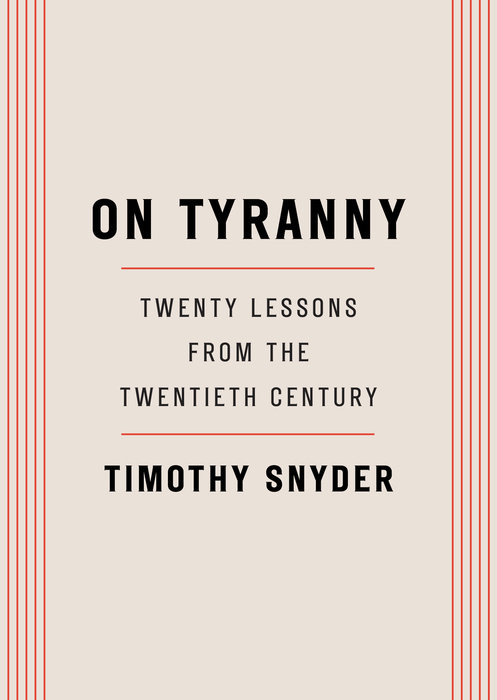
Retreating from the Politics of Eternity: on Timothy Snyder’s On Tyranny: Twenty Lessons from the Twentieth Century. By Gerardo Muñoz.

snyder-on-tyrannyWe often cite James Madison’s acute observation from Federalist 10: “Enlightened statesmen will not always be at the helm”. Timothy Snyder’s On Tyranny: Twenty Lessons from the Twentieth Century (2017), is written keeping this political conviction in sight, so indispensable to the democratic aspiration of the framers more than two centuries ago. Snyder, however, is no messenger of good news. In line with those that have taken seriously the rise of presidentalism, and the expansive politization of the executive branch in recent decades, Snyder is making the case for a timely warning against a potential threat for tyranny in the wake of Donald J. Trump victory at the end of last year.

On Tyranny is informed by Snyder’s expertise and research as a historian of Eastern Europe and the Holocaust, which have resulted in landmark contributions such as Bloodlands: Europe between Hitler and Stalin (2012), and Black Earth: The Holocaust as History and Warning (2015). In both of these books, Snyder has shown quite convincingly, how the erosion of institutions and the rule of law, due to both communist and fascist planning and dismantling over the control of the eastern region, paved the way for absolute anarchy and systematic destruction that made the Holocaust a juridical and political reality. Snyder does not mean to say, by way of an easy equivalence, that Trumpism amounts to a repetition of this historical period. Rather, On Tyranny is a precise warning on two levels: on one hand, it is a plea to rethink the necessity of institutions in the times of the rise of what Arthur Schlesinger Jr. called the imperial presidency; and secondly, to learn as much as we can from History, particularly from the historical evidence that confirms that every republic has always combated and affirmed itself against a latent imperial drift. Snyder’s thesis, presumably informed from a historiographical position, also suggests a political anthropology. In other words, the battle against an empire solicits an abandonment of the voluntary servitude that only feeds the incremental force of reaction. Our present shall not be indifferent to this.

After the 2016 election what is really at stake is whether the Federalist warning against the rise of factions is enough to contain an unprecedented alignment of vertical hegemonic power. There have been scholars, such as constitutional lawyer Eric Posner in The Executive Unbounded (2013), who have said farewell to Madisonian democracy in light of the exceptional upsurge of the executive branch [1]. On Tyranny does not go this far, but it is obvious that its purpose is not to engage in the aporias and intricate developments of constitutional law in order to render feasible an argument in favor of a retreat from hegemonic politics. Non-hegemonic politics always entail breaking the spell of a given set of coordinates that have produced an impasse. Snyder provides an array of historical examples: Rosa Parks in 1955 or Winston Churchill in the darkest moment when Hitler materializes his territorial expansion. It is in these perilous moments that the retreat from hegemonic politics does not mean renouncing political action. It means, first and foremost, abandoning the hyper-political consistency that defines the eternity and enmity of the political. But I do not want to get ahead of myself while briefing Snyder’s book. Havel, Parks, Churchill, Arendt, these are names that metonymically index Snyder’s plea for a politics of vocation in a time when rhinoceros are roaming through the landscape. The reference here is, of course, Ionesco’s well-known 1959 play Rhinoceros, which Snyder introduces when discussing the submission to politics of untruth:

“Ionesco’s aim was to help us see just how bizarre propaganda actually is, but how normal it seems to those who yield to it. By using the absurd image of the rhinoceros, Ionesco was trying to shock people into noticing the strangles of what was actually happening. The Rhinoceri are roaming through our neurological savannahs….And now, as then, many people confused faith in a hugely flawed leader with the truth about the world we all share. Post-truth is pre-fascism” (Snyder 70-71).

The rhinoceros are the political converts, which are always one step too close to the work of hegemony and its delirious power. It is then entirely consistent that Snyder also makes the claim for the protection of a new sense of privacy (sic) that could contain the boundaries between oikos (private) and the polis (public) against the drift towards totalitarianism (Snyder 88). Tyrannical politics is also a politics without secrets. It does not necessarily emanate from this position that a new egotist sense of privacy will act as a modality in an existence that is now beyond risk, guarding its own skin from the wild beasts. Snyder recognizes that there is no politics without factions, as Madison would have also said. Hence, there is no real politics without a minimal corporeal investment (Snyder 83-85).

But we have moved away from the level of hegemonic thirst for domination, conceiving a relation with politics that is not exhausted in the singular existence. Or put in different terms, only in existence could a politics of lesser domination be allowed to emerge against the threat of factions. Politics should not be oriented towards the end of the administration of life, which always amounts to a biopolitics. A republicanist politics is the orgazanition of public and social life that prevents both, the intensification and nullification of life in the polis.

What becomes troublesome, as Snyder makes clear, is that the administration of politics is today justified under the name of terror. In fact, Snyder states: “Modern tyranny is terror management” (Snyder 103). This is, indeed, an actualization of the schmittian withholding of the state of exception now normalized at the heart of democratic systems. Hence, the new danger is not just juridical, although it is also that. Snyder presses on the fact that current governments and parties – from Putin’s Russia to Le Pen’s Front National to Trump’s populist rallies in Florida or North Carolina – are borrowing props and gestures from the 1930s, a decade that Steve Bannon has labeled “exciting”. It is no surprise to anyone that we are currently living in times justified by exception in the name of the “crisis”. It is this time of excitement that provides a grammar of historical teleology and inevitability, and further, of judgment. However, the passage from inevitability to something darker is what Snyder calls the politics of eternity, which is really the core of his book, and the sign under which neo-fascism abides:

“…the politics of eternity performs a masquerade of history, though a different one. It is concerned with the past, but in a self-absorbed way, freed from with any real concern with facts….Eternity politicians bring us the past as a vast misty courtyard of illegible monuments to national victimhood, all of them equally distant from the present.” (Snyder 121).

If there is no real concern with facts, it is because all politics of untruth are politics to cover the Real, or what Jaime Rodriguez Matos has recently called the formless thing [2]. And for Snyder, national populists of the far right are eternity politicians providing a form that at the end of the day is just sending signs of smoke (Snyder 122). What is being covered is the void that leads to a point of no return: mainly, that there is no “greatest moment to return to”, since it is impossible to resurrect Empire. This inevitable untruth provides illusory grounds to radical right rhetoric in Europe. Although, we must infer that this is also the moment where Trump appears in its maximum existential danger to us.

It is uncertain if the institutions of the West will withstand this immanent threat. Although it is in this conjuncture that the rule of law becomes as central as ever before, and to discard it, is perhaps one of the greatest acts of moral decrepitude. It is here where we awake from the sleepwalking of eternal politics, as we are confronted with the historical sense that gives us the phantasmatic company of those who have perished, and that have suffered more than us (Snyder 125). It is in this affirmation, we agree with Snyder, that we find a substantial push against all tyrannies.


Notes

  1. Eric Posner & Adrian Vermeule. The Executive Unbound: After the Madisonian Republic. Oxford: Oxford University Press, 2013.
  2. Jaime Rodriguez Matos. “Politics, Trace, Ethics: Disciplinary Delirium—On Trump and Consequences”. Paper Read at USC Conference, November, 2016. https://infrapolitica.wordpress.com/2016/11/14/politics-trace-ethics-disciplinary-delirium-on-trump-and-consequences/

Infrareligion in the abyss: on Jaime Rodriguez Matos’ Writing of the Formless: José Lezama Lima and the End of Time. By Gerardo Muñoz.

writing-of-the-formless_2017Jaime Rodriguez Matos’ Writing of the Formless: José Lezama Lima and the End of Time (Fordham U Press, 2016) is an ambitious and truly mesmerizing mediation on the Cuban poet José Lezama Lima in light of contemporary theoretical debates concerning the status of the political in the wake of Modernity’s decline into nihilism. Rodriguez Matos’ sophisticated intervention attempts to accomplish several objectives at once, and in this sense, the book does not pretend to be an exegetical or philological contribution to scholarly debates on the poet. Rather, in the book, Lezama is taken as a poet-thinker of the informe, whose main import into Western history of writing and thought is that of a ‘writing of the formless’ (Rodriguez Matos 171). In its totality, the whole book is a groundwork for such a claim, and it works through a series of tropologies, figures, and debates that extend from Lezama’s specific cultural Cuban context and its readers, to a set of wider debates pertinent to Left-Heideggerianism, political theology, or the event (although by no means, is the complex set of debates reducible to these three philosophical indexes).

If one were to describe the project in its most far-reaching ends, Writing of the Formless is important yet for another reason: by handling several topologies of Lezama Lima’s oeuvre, we are offered an in-depth analysis of the intricate conceptual wager in infrapolitics, or in infrapolitical-deconstruction, which as Rodriguez Matos suggests, is the provenance of Lezama Lima’s contribution as a critical task. The book is divided in two parts. In the first one, four chapters grid an explication of the problem of time, as well as that of the formless, revolution, and nihilism. In the second, Rodriguez Matos engages in an innovative reading of different zones in Lezama Lima that evidence the destruction of principial politics, and the opening towards an (infra)politics of the void. In this review, I can hardly do justice to a book that I truly consider a masterwork of contemporary thought. In my opinion, this monograph comes as close as it gets to being flawless in establishing conceptual premises and argumentative deployment. In what follows I will map some provocative elements of his exposition, in hope that it will be a starting point for a discussion with those critically engaging Latin America, the political, and the stakes of thought in our time.

The point of departure of Writing of the Formless is the temporal question (in Latin America, although it is not localized here as a site of privilege) of Modernity, which is registered as a Janus face machine: on one end, the linear time of Hegel’s philosophy of history; and on the other, the teleological time of the messianic redemption and reservoir to many salvific political theologies. Early in the book, Rodriguez Matos sets up to establish the conditions that guide the development of his task:

“But it now it seems that in fact modernity, and not any possible redemption or liberation from its political and economic deadlocks, is itself a mixed temporality that is constantly battling between a circular and a linear time – a linear time of alienation and a circulation teleological time of redemption. The two need to be taken together, even in the very (im)possibility of such a synthesis. And this would mean that modernity is no longer the other of the revolutionary interruption of empty chronological time; rather, these are two sides of a single coin” (Rodriguez Matos 33).

By way of this dual apparatus of time, it becomes clear that linear time represents the time of alienation, where the eternal return marks its radical detachment only to become the engine of the theological messianic interruption. The two temporalities that frame Modernity, according to Rodriguez Matos, are a policing force, as well as “a residual effect or the symptom of the emergence of order itself” (Rodriguez Matos 22). And it is this formal legislation that synthesizes a duality that veil, in a variety of effective techniques, the formless of any foundation. Throughout the book the formless has different dispositions, such as the “intemporal”, “time of the absence of time”, or Lezama’s own “muerte del tiempo”. These all play key strategic functions and deconstructive relays. It might be the case, at least implicitly, that Rodriguez Matos knows that the history of metaphysics to cover up the void is, at the same time, the narrative produced by its apparatuses. What is important, however, is that by allocating these two times, Rodriguez Matos is able to set up what was otherwise obstructed: mainly, the time of void, which falls right beneath all principial politics, always in retreat and outside legitimizing messianic and developmental policity of Western modernity that governs both the time of the One and that of the multiple. Lezama is the figure that mobilizes a drift away from these two modalities:

“…beyond the politization of politics, and beyond the image of time as synthetic operation, what remains is the possibility of thinking with the poet beyond the current apparatus of academic-imperial) knowledge and all of its returns” (Rodriguez 25).

One would not exaggerate much in concluding that Lezama Lima as a thinker of the informe becomes the necessary antidote and hospitable dispensary against the philological exercises of the traditional belleletrism, but also of decolonial and neocommunist designs that, although attempting at the surface to break-away with imperial semblances, end up carrying the guise of principial politics as the highest flagpole for self-legitimation.

The reading of the informe allows us to move beyond the temporal dichotomy between revolution and conservation, messianic originalism (such as that of catholic, later convert post-socialist official poet Cintio Vitier), and the multiplicity of historical time (such as that endorsed by Rafael Rojas, Cuba’s most sophisticated neo-republican intellectual historian). It must be noted, however, that many other intellectuals and thinkers are tested on this basis. The common ground shared by diverse thinkers such as Rafael Rojas, Ernesto Laclau, Cintio Vitier, Walter Benjamin, Bruno Bosteels, Alain Badiou, and those that subscribe to post-foundationalism becomes clear: mainly, the assumption that the crisis of nihilism of temporality can be amended by always providing an adjustment for the abyss. In this way, Rodriguez Matos offers a frontal critique of any claim instantiated in hegemonic phantasms: “Our task remains to think time in all its radical complexity – that is, to think time as something other than a solution” (Rodriguez Matos 44). Writing of the Formless stands up to this deliverance.

There are many important elements that come forth in this argumentation, one of them being that the covering of the formless, or the lack of foundation, is usually articulated through a master and masterable political theology. It is not just Rodriguez Matos who arrives at this conclusion, but also Bruno Bosteels by way of observing the inscription of Christianity in many of contemporary thinkers of the Left. In a passage cited by Rodriguez Matos from Marx and Freud in Latin America, we read: “All these thinkers [Badiou, Negri, Zizek], in fact, remain deeply entangled in the political theology of Christianity – unable to illustrate the militant subject except through the figure of the saint” (Rodriguez Matos 44). It is even more perplexing then, that Bosteels’ own solution to this problem ends up being just more political theology by way of Leon Rozitchner’s reading of Saint Augustine, and merely exchanging the category of the saint for that of the militant subject, even though this is already part of the history of alienation of Christianity [1]. But the reason for this might be, as Rodriguez Matos thematizes a few pages later, that any predicament for politization as supreme value today needs to ascertain some sort of militant subject of the event in order to guarantee a consensus on “contemporaneity”, and in this way avoids what the present is or what it actually stands for (Rodriguez Matos 109).

The chapters 2 (“Sovereignties, Poetic, and Otherwise) and three (“The Mixed Times of the Revolution”) attend to how the question of time was conceived within the Cuban Revolution. This framing, one must first note, already dislocates the grounds of the discussion centered on the sovereign or the caudillo, a fetish so dear to both revolutionary and liberal imaginations when confronting the ‘Latinamericanist object’. Hence, in chapter two, Rodriguez Matos advances a demolishing reading of the temporality of foquismo, although not on the grounds that one could have imagined. From a historiographical standpoint, it is common to agree on the fact that that both Guevara and Debray’s formulations have little substance in historical experience, since they are theoretical fictions that develop to master a non-repeatable event (the Cuban Revolution), which was far from being successful solely because of the foco guerrillero in the first place. But this is not Rodriguez Matos’ critique. The argument is set up to make the claim that the Revolution, in order to become flesh and conceive the unity and sameness with the people, theory must be first discarded (Rodriguez Matos 60). Rather mysteriously, in foquismo it is the people that ‘act’, while Guevara becomes its narratological supplement. This is the inversion of the Leninist principle that alleged that in order for a revolution to materialize it needs a good theory beforehand.

Guevara, in Rodriguez Matos, takes the role of the anti-Lenin. In fact, in a strange way, Che appears as a sort of naturalist-philosopher: “…what Guevara is after is the same time that was at issue in Marti: the idealism of the Revolution has to become a force of nature, sprouting in the wind without being cultivated…in all its originary ontological stability, phusis) and the people, without the transubstantiation of the idea into flesh yielding intimate unity, and without this force of nature forging revolutionary ideology…this passage would be nothing but the declaration of one individual from Argentina who has recently landed in a foreign land…” (Rodriguez Matos 60). Guevara is a hopeless romantic, who recaps the Romantic ideal of the fragmented temporality in the pedagogical poem, only that for him the impolitical people are in a “time out of joint”. This is why they must also become a New Man. The catastrophe of foquismo, is thus not merely at the level of a massive historical evidence, but an afterfact of a metaphysics that is already one step away from thinking the void, while formalizing it through a dialectical moment. Rodriguez Matos stages the central problem, just after having glossed Guevara’s revolutionary thought:

“For the metaphysics in question already relies heavily on the form in which it makes multiple small narratives. For the metaphysics in question already relieves heavily on the form in which it makes multiple temporalities appears together. That is, modernity is fundamentally and internally committed to the constant confrontation of disparate forms of time. Instead, I suggest taking a closer look at the time of lost time, the time of the void, and what might happen when it is not filled in but, rather, allowed to resonate in all its formlessness.” (Rodriguez Matos 61).

How should we understand this echo? The turn to Celan and Heidegger’s immersion in noise and the ontological difference validates immediately any vacillation in the answer, since what is at stake is ultimately to think not the “standstill of all time” of the messianic force, but our being in time understood as our most basic and intimate relation that we have with time (Rodriguez Matos 70). It is only this absent time of the formless that will be one of majesty, capable of undoing sovereign authority and its governability over the singular.

The third chapter moves against the belief that Lezama Lima can be grasped in interested disputes regarding his intellectual provenance, political ideology, or assumed Catholicism (origenismo). This is an arduous task, but Rodriguez Matos makes it look easy through a threefold operation. First, Lezama is moved beyond the antinomies of secularization and aesthetics, placed in the proper site of the religion of the formless (we will come back to this). Secondly, Rodriguez Matos confronts Lezama’s own interpretation of the Revolution as parusia or Second Coming, which coincides perfectly with Guevara’s own model of the “ways things are” that folds revolutionary Cuba into globalization due an ingrained total administrate apparatus over life (Rodriguez Matos 93).

This entails that revolutions, if we take the Cuban experience as metonymic of the phenomenon, are always already biopolitical experiences, even though Rodriguez Matos does not frame it in such terms. Third, by understanding the ‘mixed’ temporality of communism and revolutionary politics as convergent with the temporality of capitalism, we come to understand that the second is always on reserve in the backdrop of the state and its institutions (Rodriguez Matos 96-97). In sum, the superposition of revolutionary times with the time of capital is here shown, once again, to be two sides of the same dual narrative of modernity that turns away from the abyss at the heart of politics. This complicates many, if not all, of the assumptions that Cuban transitologists have disputed with very futile outcomes, in my opinion, in the last decade.

Finally, the fourth chapter “Nihilism: Politics as the Highest Value” rightly places the question of nihilism at the center. This is a return to the question of political theologies discussed above. Whereas many of the thinkers on both sides, republicanist and communist alike, take up the question of nihilism, the result, according to Rodriguez Matos, is that it is presented as a fight against those that think the problem of nihilism. Thus, the “banality of nihilism must be dismissed or critiqued” (Rodriguez Matos 104). The operation rests on the fact that the question of being must be avoided at all costs. And this is achieved in at least two main forms: discarding nihilism by proposing a “multiplicity of times” (Rojas), or by proposing a “living philology” (Vitier, Bosteels) that would be able to restitute a truth of a text of the past to give proper political ground (Rodriguez Matos 115). Now the tables are turned, and those that seek to cover the void, as if that were an option, appear as agents of a true nihilistic force.

The second part of the book titled “Writing the Formless,” provides a roaming through Lezama’s conceptualization of the void against politico-theological closure, arriving at the unthought sites of the ontological difference after Heidegger and deconstruction, and moving into infrapolitics. This is an exemplary section in the sense that Rodriguez Matos warns that he is in no position to offer a transhistorical formal theory of Lezama’s writing, and in this way he calmly avoids the universitarian-Master demand for a totalizing expertise of lezamianos. This operation is undertaken not for the sake of confrontation against Lezama specialists, but rather due to a more modest motive: it is not the point that drives Writing of the Formless. Anyone to counter argue on this level is rather to sidestep its most important contribution of this book. Finally, Rodriguez Matos lays out what is at stake, which is tailored as a question that by far exceeds Lezama Lima as a single corpus:

“Ultimately what is at issue whether there is a difference between those texts of the Western tradition that forget the question of being and those whose starting point is the challenge and the difficulty that the question poses, the challenge and the resistance involved in dealing with the ground that is and is not there in its absence. What is at stake is whether or not it is possible to imagine a writing and a thought that do not simply fall silent in order to guarantee the continuity of the narrative of legitimacy and sovereign authority in the poem or in politics – but the link between these two is also at issue here. That is, whether or not it is possible for posthegemonic infrapolitics to be something other than the trace of politics” (Rodriguez Matos 136).

What immediately follows is a series of closely knit constellations of the writing of the formless as absent time in Lezama, which I can only register here without much commentary: Lezama’s own critique of T.S. Eliot’s notion of the difficult, a critique of Garcia Marruz’s reading of the aposiopesis as rhetoric’s hegemonic property, Lezama’s understanding of Aristotelian metaphoricity; Lezama’s philosophy of an atopical One, and finally Rodriguez Matos’ own conceptual position of Lezama as an infrareligious and infrapolitical figure that pushes politico-theological legislation of principles to their very limit into a ‘nonsynthesizable reminder’ [sic] (Rodriguez Matos 154). Further, Lezama’s vitalist response to the Platonist pros hen, unlike the immanentist modern reversal, concludes in a Platonist affirmation instead of an overcoming of Platonism (Rodriguez Matos 139). Rodriguez Matos intelligently resolves this bizarre multiplicity vis-à-vis a parallel reading of Paul Claudel, who rejects aposteriori knowledge in exchange for the cognizant objectification of God before the sovereignty of the Poet. Although I am left thinking about the status of Neo-Platonism as it relates to the discussion of Christian Trinitarian thought [2].

But Rodriguez Matos goes further, and the Lezama that emerges from this destructive multi-level procedure is one that resists alleogrization, taking cue from Alberto Moreiras’ pioneering reading in Tercer Espacio (1999), as well as a privileged and secured position of a profane materialism over the question of form. And it is also in this very instance where Rodriguez Matos opens up to a complicated debate, which although unresolved, is the most striking and illuminating kernel of his book. In short: does ‘the roaming of the formless’ [sic] in Lezama offer something other than a trace of politics? I want to suggest, from my first reading of what is certainly a complex conversation, that this remains unresolved in Writing of the Formless. Let’s consider a key moment at the end of the book:

“For part of what I am calling attention to is the fact the staging of the formless in Lezama involves a thematization and an awareness of what should only be there as trace. This awareness goes beyond a more familiar claim regarding the self-deconstruction of discourses of their own accord – this is, after all, also what the trace is supposed to underscore. I would like to read this excess of awareness as a radicalization of deconstruction” (Rodriguez Matos 176).

This radicalization will entail leaving behind the moment of ecriture, which characterized the first wave of deconstruction in literary fixation and textual playfulness. Infrapolitics will be, programmatically speaking, post-deconstruction, or what Moreiras has recently called a second turn towards instituted deconstruction [3]. But the question remains: is infrapolitics then, a trace of politics? It is an unresolved question, but perhaps the most important one. Rodriguez Matos leaves us a clue at the very end of the book. When discussing the baroque – and let’s not lose sight of the fact of how late the question arrives, which is a merit and not a pitfall – Rodriguez Matos cites a letter of Lezama to Carlos Meneses: “I think that by now the baroque has begun to give off a stench” (Rodriguez Matos 181). The Baroque has come become an exchangeable token for the Boom, the last stage of identitarian transaction. But it is more than this: the baroque can no longer account for the informe at the heart of the image and rhythm.

Let’s probe this further. If the baroque is now exhausted, it is because all politics of the frame are insufficient to cope with the formless. The primacy of the critique of political economy today, for example, remains just one of its last formal avatars. But one could also respond to Rodriguez Matos’ final invitation, and say that while the aesthetic program of the baroque is demolished or turned into ashes, perhaps a trace of it remains in posthegemonic politics. To the extent that we understand the baroque as a political of self-affirmation against Imperium beyond hegemony, the baroque necessarily entails a republicanist politics [4].

In other words, while the infrareligious trace depends on the abyss, posthegemonic politics of republicanism sprouts from the baroque in early modernity against any imperial and counter-imperial conversions. Rodriguez Matos interchangeably speaks of infrapolitics and posthegemony throughout the book, therefore this nuance could be taken as a radicalization of the second term in line with the disclosure regarding the baroque. Post-deconstructive infrapolitics remains open. But if Lezama’s legacy is waged on having confronted the formless abyss of the absent time; perhaps, the author of Dador can also reemerge as a political thinker and existential representative not of Paradise, but of the secret Republic. This will entail a republicanism that, in each and every single time, does not longer participate in the eternal arcanum.


.

.

Notes

  1. This does not mean that St. Augustine cannot be read against the myth of political theology. Such is the task that José Luis Villacañas has accomplished in his Teología Political Imperial: una genealogía de la division de poderes (Trotta, 2016). In my view, Rozitchner’s La Cosa y la Cruz (1997) is a flagrant misreading of Augustinian anti-political-theology in exchange for a superficial materialist affective analysis. Although I do not have space to discuss this at length, I must note that Rodriguez Matos’ discussion of contemporary materialisms is also a timely warning about the easy exists that the so-called “materialisms” offer today as an effective transaction in contemporary thought. For his discussion of materialism see, pgs. 104-108.
  1. The question of Neo-Platonism is a fascinating story by itself, which speaks about the multiple in the One. Pierre Hadot studied its influenced in debates of early Trinitarian thought in his work of Marius Victorinus; recherches sur sa vie et ses œuvres (Paris: Etudes augustiniennes, 1971). Now, it seems that Lezama Lima himself was not foreign to Plotinus and Neoplatonism, which he linked it to the emergence of the modern poem. In fact, while reading Writing of the Formless, I revisited my copy of Lezama Lima’s unpublished notes in La Posibilidad Infinita: Archivo de José Lezama Lima, ed. Iván González Cruz (Verbum Editorial 2000). It was interesting to find that in “Oscura vencida”, a fragment from 1958, Lezama writes: “Si unimos a Guido Cavalcanti, March, Maurice Sceve, John Donne, en lo que puede ser motejados de oscuros, con distintos grados de densidad, precisamos que sus lectores, puede ser los más distinguidos cortesanos, o estudiantes que versifican cuando la hija del tabernero inaugura unos zarbillos…Con una apresurada lectura de la Metafísica de Aristóteles, sobre todo su genial concepto del tiempo que pasa a Hegel (sic) y a Heidegger; con cuatro diálogos platónicos, donde desde luego no faltara el Parménides. Con algunas añadiduras de Plotino sobre la sustancia y el uno…ya está el afanoso de la voluptuosos métrica en placentera potencialidad para saborear una canción medieval, un soneto del renacimiento florentino, o una ingenua aglomeración escolástica que se quiere sensibilizar, o una súmala de saber infantil, regida por un pulso que no se abandonó a la plácida oficiosa…” (252). This does not necessarily dodge Rodriguez Matos’ discussion of Claudel, but complicates it, since the trinity also merges at different points throughout the book. My question is whether any discussion of Trinitarian co-substantialism is still embedded in metaphysical structuration as potentia absoluta, or if Lezama’s informe is a Parthian attack against this influential model of absolute potentiality by turning it into a monstrous infrareligion. At stake here is also the issue of ‘reversibility’ that is obliquely exposed at the end of the book (Rodriguez Matos 189).
  1. See Alberto Moreiras, “Comentario a Glas, de Jacques Derrida”. https://infrapolitica.wordpress.com/2017/01/13/comentario-a-glas-de-jacques-derrida-notas-para-la-presentacion-de-la-nueva-traduccion-espanola-clamor-publicada-en-madrid-la-oficina-2016-y-hecha-por-muchos-autores-con-copyright-de-cristina/
  1. The question of the republicanist politics, Imperium, and the baroque is studied in detailed in Ángel Octavio Álvarez Solis’ La República de la Melancolía: Politica y Subjetividad en el Barroco (La Cebra, 2015).