
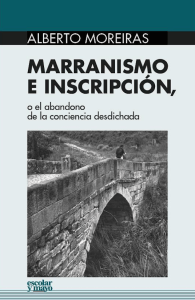
Ascesis universitatis: sobre Marranismo e Inscripción, de Alberto Moreiras. Por Gerardo Muñoz.

marranismo-inscripcion-moreirasMarranismo e Inscripción, o el abandono de la conciencia desdichada (Escolar & Mayo, 2016), el nuevo libro de Alberto Moreiras, es un compendio reflexivo sobre al estado teórico-político del campo latinoamericanista durante los últimos quince o veinte años. A lo largo de nueve capítulos, más una introducción y un epílogo, Moreiras traza en constelación una cartografía de numerosas posiciones de la teorización latinoamericana, sin dejar de inscribirse a sí mismo como actor dentro de una epocalidad que pudiéramos llamar ‘universitaria’, y cuyo último momento de reflujo fue el ‘subalternismo’. Además de bosquejar un mapa de posiciones académicas (postsubalternistas, neomarxistas, decoloniales, o deconstruccionistas), el libro también alienta una hermenéutica existencial que se hace cargo de lo que le acontece a la vida, y en su especificidad a la “vida académica”. Y los lectores podrán comprobar que lo que acontece no siempre es bueno. Marranismo e Inscripción explicita muy tempranamente en la introducción un tipo de denegación que configura el vórtice de este ejercicio autográfico: “…durante años pensé en mí mismo como alguien comprometido centralmente con el discurso universitario, como la institución universitaria. Hoy debo admitir que ya no – trato de hacer mi trabajo lo mejor posible, claro, pero algo ha cambiado. O seré yo el que cambió. Y entonces, para mí, ser un intelectual ha perdido ya su prestigio, el que una vez tuvo. Habrá quizás otras maneras de serlo en las que el goce que uno quiso buscar pueda todavía darse. Hoy ese goce, en la universidad, solo es ya posible contrauniversitariamente.” (Moreiras 16).

La tesis a la que invita Marranismo es la de abandonar la crítica universitaria (y la conciencia desdichada es un producto de la creencia en el prestigio de la labor crítica) en al menos dos formulaciones principales. Por un lado, la función de la crítica como apéndice tutelar del saber universitario entregado a su tecnicidad reproductiva. Y en segundo término, tal vez menos vulgar aunque no menos importante, el abandono de la crítica como operación efectiva y suplente de la crisis interna de la universidad. El ejercicio autográfico marcaría una modalidad de éxodo de la suma total de la razón universitaria hacia lo que se asume como una estrategia hermenéutica que implica necesariamente la indagación de una situación concreta que da el paso imposible ‘del sujeto al predicado’ [1]. Pero el paso imposible del marrano solo dice su verdad no como persuasión interesada de un sujeto, sino como hermenéutica inscrita en cada situación irreducible al tiempo del saber. En el ejercicio hermenéutico, el marrano deshace íntegramente la incorporación metafórica, sin ofrecer a cambio una paideia ejemplar, un relato alternativo, o recursos para el relevo generacional. Es cierto, hay un llamado a cuidarse ante un peligro que acecha, aunque esto es distinto a decir que el libro está escrito desde una situación de peligro. En realidad, el tono del libro es de serenidad.

En un momento del libro, Moreiras escribe: “…el próximo expatriado potencial que lea esto debe saber a qué atenerse, y protegerse en lo que pueda” (Moreiras 18). La pregunta que surge en el corazón de Marranismo es si acaso la universidad contemporánea está en condiciones de ofrecer un mínimo principio de autoconservación de la vida del pensamiento; o si por el contrario, la universidad es solo posible como pliegue contrauniversitario post-crítico, léase poshegemónico, para seguir pensando en tiempos intempestivos, atravesados por el ascenso de nuevos fascismos, y entregado a la indiferenciación técnica del saber en el seno de la institución. O dicho con Moreiras: ¿habrá posibilidad de ‘mantenerse en pie’ en los próximos años? Y si hay posibilidad de hacerlo, ¿no es una forma de contribuir a mantener en reserva el general intellect en función de una ecuación humanista? (ej.: más saber + más estudiantes = más progreso; pudiera ejemplificar lo que queremos decir). Todo esto en momentos, dicho y aparte, en donde la lingüística aplicada o la pedagogía derrotan en rendimiento a la ya poco digna tarea del pensar. Y si es así, la universidad contemporánea no estaría en condiciones de ofrecer más que humanismo compensatorio, donde el pensador solo puede disfrazarse de civil servant de la acumulación espiritual de la Humanidad. Desde luego que no hay curas ni bálsamos para dar con una salida a lo que Moreiras se refiere como un futuro “incierto e indecible abierto a cualquier coyuntura, incluyendo la de su terminación” (Moreiras 57). Pero tal vez hayan formas más felices que otras de entrar en relación con el nihilismo universitario en sus varias manifestaciones opresivas.

Por eso es que me gustaría invitar a leer Marranismo e Inscripción como una contestación a las formas sofísticas dentro y fuera del campo académico, exacerbadas en el momento actual del agotamiento de la universidad en el interregno. Y como sabemos, el interregno no es más que la imposibilidad de hacer legible el pensamiento en el momento del fundamentalismo económico. Pero es también la diferenciación cultural substituta como se ha demostrado con la hermandad entre multiculturalismo identitario y neoliberalismo. En el interregno el sofismo no solo crece y se alimenta, sino que dada la caída de toda legitimidad, la mentira solo puede asomarse como performance desnudo de la no verdad, puesto que ha agotado su efecto de persuasión posible, su validez efectiva, y cualquier ápice de razón. La tecnificación del pensamiento a través del marco equivalencial de la teoría supone la codificación del sofismo como valorización sin necesidad de apelar a la razón.

Por ejemplo, el éxito universitario de la decolonialidad, ¿no es la victoria de la irracionalidad como valor? A la decolonialidad no le hace falta ni le importa la razón – que para los llamados pensadores decoloniales es ya de antemano contaminación ‘eurocéntrica’ o ‘ego-política colonial’ – sino la afirmación nómica de un absolutismo cultural y propietario. La irracionalidad prometeica de las finanzas en el momento de la subvención real converge con un neomedievalismo crítico, y de este modo las piedades y doxologías retornan como figuras luminosas de un saber que parece haber saldado sus cuentas con la Historia. La anomia de la universidad contemporánea es principalmente una crisis de legitimidad, entendida como fin de su efecto de auto-convencimiento y ejercicio del pensar singular. Y así, no es sorprendente que la irracionalidad brille, triunfe, y cobre un peso irrefutable en las medidas tecnocráticas que regulan las Humanities.

La irracionalidad comparece a la tecnificación donde todo se ventila de antemano. Pensemos, por ejemplo, en la jerigonzas concurridas como ‘¿cuál es tu marco teórico?’ o ‘¿desde donde hablas?’ ‘¿cuál es tu archivo?’. Estas indagaciones solo pueden entenderse como formas de una máquina inquisitorial que la universidad alberga como principio de autoridad ante la caída medular de su legitimidad. Sería coherente pensar, entonces, que si estamos ante una máquina confesional, solo la mentira puede ofrecer salvación o posibilidad de ‘mantenerse en pie’ sin tocar fondo, o sin que le vuelen a uno la cabeza. Justo es esto lo que esgrime en En defensa del populismo (2016) el filósofo español Carlos Fernández Liria, quien sugiere que ante la consumación de la mentira en el campo político contemporáneo, no hay verdad que esté condiciones de legibilidad, ni de escucha, ni de generar efecto alguno ante un macizo ideológico impenetrable. La única posibilidad es expresar una contramentira. ¿Pero es ésta la única forma de contestación? Podemos ‘testear’ esta pregunta en un momento decisivo del libro, y que aparece condensado en la forma de un chiste. Valdría la pena reproducir el pasaje:

“La sospecha de no ser lo suficientemente correctos en política, con todo el misterio terrorífico que esa determinación tiene en la academia norteamericana, pesó siempre sobre nuestras cabezas como una grave espada de Damocles, y todavía pesa, y no importa lo que digamos o hagamos, porque estas cosas, como todo el mundo sabe, se solucionan a nivel de sospecha y rumor y susurro malicioso. O incluso: es una cuestión de olor u honor, como el cristiano nuevo perfectamente devoto que no puede evitar caer en manos de la Cruz Verde porque todo el mundo sabe que su piel no reluce con la grasa prestada de la sobrasada. O, en palabras de algún fiscal federal asistente en la nueva serie de televisión Billions, «Si alguien dice que Charlie se folló a una cabra, aunque la cabra diga que no, Charlie se va a la tumba como Charlie el Follacabras» (225-26).

Lo que he llamado la forma sofística de la retórica contemporánea transforma a todos en Follacabras, en miembros potenciales de algún siniestro grupúsculo de Follacabras, y no importa la verdad que salga de la boca de la cabra (si es que la cabra habla), o del propio Charlie, puesto que una vez que la marca de Caín reluce sobre el pellejo de la frente, ya estamos automáticamente condenados a participar de una exposición que nos arroja al juego de cazadores y cazados. Este ha sido siempre el campo de batalla de la hegemonía, y que hoy se vuelve sistemático desde su inscripción en la equivalencialidad general. Esto es, no hay quien se escape a su lógica. Es más, no hay quien no sea, a la vez, una excepción sacrificable a esta lógica.

Pero habría otra opción: los Follacabras o los condenados pudieran también rechazar el sofismo y sus afligidas metáforas, aceptando la verdad como ascesis, esto es, como ejercicio en éxodo de todo juego hegemónico efectivo. Es lo que parece estar pidiendo Moreiras en Marranismo e Inscripción, y eso es ya bastante, y nos obliga a repensar la cacería como único juego posible. Y es el ascesis donde pensamiento y vida entran en una zona de indeterminación, y desde donde la verdad puede comparecer como alternativa al yoga acrobático que ofrece la universidad contemporánea, ya sea en su forma inquisitiva que obliga a la mentira, o en su produccionismo metabólico desplegado en el consenso, o en la politización, o en las buenas intenciones. Fue Iván Illich quien notó que el ascenso de la crítica académica monástica, y cuya secularización es la sospecha hermenéutica, coincidió con la declinación del ejercicio ascético del singular [2]. Y esto tiene sentido, puesto que la función crítica solo puede apelar a una radicalidad en expansión, siempre y cuando se retraiga de pensar la facticidad que supone la irreversibilidad del capitalismo. No es casual que Moreiras hacia el final del libro, y en réplica a una pregunta de Ángel O. Álvarez Solís, recurra al arcano del ascesis, como abandono del juego hegemónico de las mentira, y que dibujo los contornos de una vida sin principio:

“La palabra «ejercicio» puede servir si la entendemos etimológicamente, desde ex + arcare, desenterrar lo oculto, des-secretar. Digamos entonces, todo lo provisionalmente que quieras, que la infrapolítica es una forma de ejercicio en ese sentido –busca éxodo con respecto de la relación ético-política técnica, busca su destrucción desecretante, para liberar una práctica existencial otra. Yo no tendría inconveniente en usar para esto una expresión que he usado en algún otro lugar, la de «moralismo salvaje». La infrapolítica, en su condición reflexiva, es un ejercicio de moralismo salvaje, anti-político y anti-ético, porque quiere éxodo con respecto de la prisión subjetiva que constituye una relación ético-política impuesta ideológicamente sobre nosotros como consecuencia del humanismo metafísico. Sí, ese paso atrás salvaje con respecto de la relación ético-política es an-árquico, porque no se somete a principio.” (Moreiras 208).

La ascesis dice la verdad en la medida en que siempre atraviesa una hermenéutica existencial, y da un ‘paso atrás’ que renuncia a las determinaciones fundamentales de la subjetividad. El ejercicio tiene como objetivo el cuidado ante previsibilidad del síntoma. Si la ascesis es contrauniversitaria, lo es no en función anti-universitaria, sino por su instancia necesariamente atópica, ejercida como expatriación y desvinculación de todo sentido de propiedad y pertenencia comunitaria. Para el marrano no hay pasos aun por dar, sino solo un paso atrás, que es siempre el paso imposible al interior del tiempo de la morada. Esto supone abandonar el fantasma hegemónico del campo académico como avatar del pensamiento. Se piensa siempre en otro-lado. Es este también el sentido, de otra manera incomprensible, desde el cual podemos entender el intercambio epistolar entre Celan y Bachmann: “No recuerdo haber salido nunca de Egipto, sin embargo celebraré esta fiesta en Inglaterra” [3].

Ese paso atrás es el de la posibilidad imposible para seguir adelante desde un pensamiento que renuncia a la presbeia para ser radicalmente amonoteísta. ¿Podemos acaso imaginar una universidad en Egipto? Solo esta sería una universidad post-deconstructiva. Marranismo e Inscripción invita a este éxodo como única posibilidad de mantenernos en pie, y de echar adelante. Y hoy, ya no perdemos nada con intentarlo.

*Position Paper read at book workshop “Los Malos Pasos” (on Alberto Moreiras’ Marranismo e Inscripción), held at the University of Pennsylvania, January 6, 2017.

Notas

  1. Arturo Leyte. El paso imposible. Mexico D.F: Plaza y Valdés, 2013. p.24-53.
  2. Iván Illich. “Ascesis”. (Manuscript, dated 1989).
  3. Paul Celan & Ingeborg Bachmann. Tiempo del corazón: Correspondencia. Buenos Aires: Fondo de Cultura Economica, 2012.

Mortal Communities Between Facticity and Existence. Draft Paper for MLA 2017. By Alberto Moreiras.

mtpsccqI only have twelve minutes, as you know, and I would like to use them to present an idea of community to you that in my opinion dissolves the general problem community has always presented to political thought, and which I will sum up by claiming that community is, can be, the most antipolitical of all political concepts.   In recent times it has been pretended that community could configure an anti-liberal or non-liberal basic concept for a new politics, the possibility of a democratic overcoming of liberal individualism. But things are not so easy, and we are now running the risk of a disavowed, but thorougly liberal, counterconcept of individualism camouflaged as a thinking of community.   The problem is that such a concept of community cannot fail to be authoritarian through its very suppression of politics—we were discussing this yesterday in a session on the current crisis of the Podemos political party in Spain.

As you can see, I am already rushing through very difficult things, but I ask you to bear with me.   I thought of presenting this to you through Jan Patocka’s Heretical Essays in the Philosophy of History (Patocka was a Czech philosopher who died at the hands of the police after being tortured as a dissident in 1977 Czechoslovakia), which I would then supplement with Walter Brogan’s 2002 essay “The Community of Those Who Are Going to Die.” I think there is a common reference in both to Martin Heidegger’s early definition of philosophy, in the 1922 essay entitled “Phenomenological Interpretations with Respect to Aristotle: Indication of the Hermeneutical Situation.” Let me start with the latter, that is, with those aspects of the latter that will help me advance as quickly as possible.   But I have to tell you I will not get to the explanation of Patocka’s uncanny notion of community—that will have to wait for an expansion of this text. Let me simply, as a placeholder, offer you a provocative quotation from his text. Patocka says: “The solidarity of the shaken is built up in persecution and uncertainty: that is its front line, quiet, without fanfare or sensation even there where this aspect of the ruling Force seeks to seize it. It does not fear being unpopular but rather seeks it out and calls out quietly, wordlessly. Humankind will not attain peace by devoting and surrendering itself to the criteria of everydayness and of its promises. All who betray this solidarity must realize that they are sustaining war and are the parasites on the sidelines who live off the blood of others” (135).

Now, I am sorry, because this will be somewhat tough conceptually, but I must explain some basic things about the very young Heidegger’s existential analytics, which he was already attempting to develop in a confrontation with Husserlian phenomenology that, as you know, forever altered the map of philosophy.   Here, in 1922, Heidegger is concerned, at the request of some university authorities, with explaining what he understood as the “hermeneutical situation” (358), defined as “the understanding appropriation of the past” (358).   But he finds that a preliminary clarification is in order—for Heidegger, the hermeneutical situation always springs necessarily from factical life.   This means that we cannot step outside our own skin and borrow the facticity of the past, of any past. Rather, “factical life is in such a way that in the concrete temporalizing of its Being it is concerned about its Being, even when it avoids itself” (359).   In other words, “factical Dasein is what it is always only as its own, and not as the general Dasein of some universal humanity, concern for which can only be an illusory task. The critique of history is always only the critique of the present” (360). This notion of factical Dasein—and there is no other Dasein than the factical one, while at the same time Dasein can and must take up its own facticity every time—is crucial to what I am trying to think. I will come around at the end of this presentation to linking facticity and existence to capitalism and anticapitalism, in order to give these remarks some concrete bearing in the political world as such.

This critique of the present which is also historical critique, or the historical critique which is also a critique of the present, respond to a caring which is the fundamental anthropological relationship to the world. This caring has a complicated structure: “there is alive in the movement of caring an inclination of caring towards the world as the tendency towards absorption in the world, a tendency towards a letting-oneself-be-taken-along by the world” (363).   Heidegger describes this tendency as the inclination of factical life towards falling, “the innermost fate which life factically bears” (364).   Falling is tempting, comforting, and alienating, and it cannot be cultivated away.   At the same time, falling is only a tendency of factical Dasein, and Dasein is not to be understood as simply its own falling. Falling is just what Heidegger calls the “averageness” of Dasein. But Heidegger detects in factical life, that is, within factical life and not in some other region of existence, what he calls a “counter-movement” (366).   If Dasein is always concerned about its Being, then such a concern is the site of the counter-movement to falling. “The Being of life in itself, which is accessible within facticity itself, is of such a kind that it becomes visible and reachable only by way of the detour through the counter-movement against falling care. This counter-movement, as life’s worrying about not becoming lost, is the way in which the possible and apprehended authentic Being of life temporalizes itself” (366).   “Authentic” Being only means, one’s own Being, in such a way that there is also authentic facticity: “The very idea of facticity implies that only authentic facticity—understood in the literal sense of the word: one’s own facticity—that is, the facticity of one’s own time and generation, is the genuine object of research” (369).

The counter-movement, that detour of facticity whose momentum is really the encounter with authentic facticity, is called “Existenz.” Existenz, says Heidegger, “becomes understandable in itself through the making questionable of facticity, that is, in the concrete destruction of facticity with respect to its motives for movement, with respect to its directions, and with respect to its deliberate availabilities” (366).   But then Existenz is a counter-movement against life’s tendency towards falling.   Let me finish this inadequate and all-too-rushed explanation of what is in fact Heidegger’s first attempt at developing an existential analytic by pointing out that, in this explanation, Heidegger finds the possibility of a “fundamentally atheistic” philosophy (367) which is to be defined as “the explicit interpretation of factical life” (369).

In other words, there is a practice of Dasein, a practice of the human being, which has to do with finding itself in a confrontation with its own falling—a critical destruction of the falling must take place, since, without it, the human being could never find, could never experience, its very own facticity, and would be blind and remain blind to its own conditions of existence. Negation—critical negation—takes primacy over position, Heidegger says, since without the labor of negation fallenness would, in every case, prevail.   The labor of critical negation is, therefore, “the explicit interpretation of factical life,” and the very name of philosophy, without which there would be no access to history, including one’s own history. This is all I need from Heidegger’s essay. Let me now move to Walter Brogan’s explication.

Brogan takes his point of departure in a double critique of what we could call the transcendentalist and the immanentist approaches to the existential analytic, as represented, respectively, by Jacques Taminiaux and by Hubert Dreyfus. For Brogan, both Taminiaux and Dreyfus, although in opposing ways, fail to see that there is no “dichotomy between existence and facticity” in Heidegger (238).   If there were a dichotomy, then the preference for existence could be fairly accused of a transcendentalism, and the preference for facticity could be fairly accused of a pragmatism.

According to this second reading, the pragmatist, Brogan says, “one understands being-with-others only in terms of specific factical ways of being thrown together. The concept of community that inevitably grows out of this is based on my being the same as the others I encounter; in other words, it is a community based on the they-self, a community based on actualized, concrete relations in which Da-sein finds itself and to which it gives itself over. It is a community that remains bound by an economy of exchange. The tendency to allow oneself to be defined by what is outside oneself is at the heart of the modern concept of community, the community of those who are the same” (240). We cannot emphasize this enough: the modern concept of community, in Brogan’s determination, is a community of equivalents, based on or ruled over by a principle of general equivalence, where everybody is communally interchangeable or interchangeably communal.   If we go towards the transcendentalist reading, and privilege existence to the exclusion of facticity, then community would be impossible, because equivalence could never obtain. In this particular case, the social would have to be established by principle, in the form of a law or the law. “The nonrelational character of Da-sein’s existential being makes any notion of community implausible . . . A community of radically subjective beings can only be established from outside, by a principle of universal law and divine authority” (241).

But in Heidegger’s account philosophy is fundamentally atheistic because it rejects all theological biases—both the transcendentalist one and the pragmatist one, which would have us believe we are all interchangeable on equal terms, as objects or things, and we were thus created. Brogan’s proposal is for an “existential community” of “differing beings” (242; 241), a “mortal community” of sovereign beings, linked by their anticipatory knowledge of their radical limit, finitude, death, the ultimate non-equivalent, he says (243; 245), where sovereignty, in a certain and precise sense, can only be ever prepared for the sake of an “other history.” Brogan quotes from Heidegger’s Contributions to Philosophy: “Da-sein is the crisis between the first beginning (the whole history of metaphysics) and the other beginning” (244).   But of course there is no other beginning: it is a notion that can only affirm itself from the perspective of the counter-movement to historical facticity, against the principle of equivalence and the hijacking of every possibility of sovereign existence. Our facticity is in every case our own death, which liberates us into an existential temporalizing away from fallenness as fate. If community can break away from fallen facticity and can engage in a countermovement towards freedom, then community can be retrieved for democratic political thought. But not otherwise.

So imagine that the relationship between facticity and existence that Heidegger presents can be taken over to an understanding of the intimate or extimate relationship between capitalism and anticapitalism, to the very extent that capitalism is our historical facticity and anticapitalism a form of factical resistance to it.[i] Anticapitalism could then only be understood as a countermovement. We could create existential exceptions to capitalism in education, family life, or professional life without necessarily waiting for a complete overcoming of capitalism that will never arrive but also without claiming an antipolitical exodus from historical life.   Anticapitalist existence would be concrete destruction, concrete factical destruction, political destruction, but a form of political destruction that we could also define as infrapolitical to the extent that it would not be looking for any new construction but would remain radically attuned to whatever is under every possible construction: a destructive movement at the time of total subsumption into general equivalence, the practice of a solidarity of the shaken that can, no doubt, claim for itself the totality of existential practice. There is, after all, nothing beyond infrapolitical destruction, just as there is nothing beyond factical life.

Alberto Moreiras

Texas A&M University

Works Cited

Brogan, Walter. “The Community of Those Who Are Going to Die.” In Francois Rafful and David Pettigrew, Heidegger and Practical Philosophy. Albany, New York: State University of New York Press, 2002. 237-247.

Heidegger, Martin. “Phenomenological Interpretations with Respect to Aristotle: Indication of the Hermeneutical Situation.” Michael Baur transl. Man and World 25 (1992): 355-93.

Patocka, Jan. Heretical Essays in the Philosophy of History. Erazim Kohak transl. James Dodd ed. Chicago: Open Court, 1996.

Villacañas, José Luis. “Todos somos anticapitalistas.” http://www.levante-emv.com/opinion/2016/12/20/anticapitalistas/1506439.html

[i] I owe these thoughts to José Luis Villacañas’s “Todos somos anticapitalistas,” Levante, December 20, 2016.

[1] I owe these thoughts to José Luis Villacañas’s “Todos somos anticapitalistas,” Levante, December 20, 2016.

The Populist Debate in Spain After 20-D. Draft Paper for MLA 2017. By Alberto Moreiras.

th-1

I think the clear and distinct crisis that has seized Podemos over the last few weeks makes it necessary for us to reflect on it, in anticipation of the Vistalegre 2 process that will take place in February. Vistalegre 2 could become a make or break moment for Podemos even if it does not solve anything. But there is a way for situations that apparently do not solve anything to become decisive in the medium term. Political passions are running high. And yet one gets the feeling that, if the different actors were to hold back for reasons of restraint, in order to save face, or to save the party from itself, then nothing real will be accomplished.   Things would only have been deferred for a later reckoning. I think it is this later reckoning that should be the reference for us.

I do not pretend to have any clues other than what I read in the press or in the internal party debates—I do not live in Spain, so I do not even have normal or easy access to tv and radio programs where so much of the more relevant political discussion today actually takes place.   So the following remarks are only my own initial contribution to the discussion that may happen—in the understanding that there are many factors we cannot provide a proper account for: it is too early. I will not claim any particular authority as a potential theorist, for example. I am simply observing events, although I can only do it as an interested spectator, hence, from my own perspective.

But let me start off by venturing the gut feeling that I do not think Vistalegre 2 will really solve anything even if it does seem to do so—the situation is now rather too vertiginous, too confusing, and there is little doubt that most of its actors will probably adjust their positions but only on grounds of prudence and political effectiveness, that is, tactically or rhetorically.   It is probably too early for political truth, or for a political truth that will damage the party, perhaps terminally. We will see those calculations taking place during the Vistalegre meetings, and of course things will happen, but in my opinion whatever happens will not be decisive—it will just open another stage. My hope is that in the medium term this crisis will prove to be a positive one, and that it will consolidate Podemos as a serious political party with a clear shot at becoming a preferential option for government.   But that is only a hope, and I am not at all sure it will come to safe harbor. The stakes are very high. Yes, this is a dangerous moment, a defining moment, but I think the definition will not happen instantly. Vistalegre will only be a factor in the story, even if it has significant, even scandalous political repercussions. Or even if it doesn’t.

Let me suggest two possibilities that are equally fraught with danger for the future: in one possibility, Iglesias wins and he continues to be the leader on the votes of faithful followers plus a number of people that decide it is important to keep Iglesias’s leadership in place because Iglesias’s leadership brought the party to its present situation and it would be too risky to do without him.   If the number of people in the second category becomes too significantly high, this would be a hollow victory, a damaged victory. Iglesias would continue to be the leader of a party where a significant number of people do not believe in his leadership, no longer do, but are willing to sacrifice their thought for the sake of political unity and a dream of effectiveness.

In the second possibility that potentially significant sector of people whose preference takes them elsewhere decide to act on their position. They shift their votes to Errejón, for instance. Iglesias loses and the party pretty much splits down the middle. Errejón becomes the new leader, and he is asked to become the new secretary general.   The pablista faction becomes disgruntled, they are resentful of the new leader and their followers, they talk about betrayal, a yielding to obscure regime forces, a Bourbonic restoration, a swerve to the right. It will be a matter of time before the party splits. Podemos will effectively have lost its chance as an alternative for government, and the political scene will change considerably.

As I sit down to write these six or seven pages, I read two press items. One of them, in El País, is a report of certain recent declarations by Miguel Urbán, the leader of the Anticapitalista faction or family, which, as we know, has about 10% of the votes within the Podemos general membership. Urbán claims to be incensed at what he calls the “soap opera” between Iglesias and Errejón, a rift, he says, ridiculous in nature, similar to what may go on in a “school yard,” a merely whimsical “power struggle” which is causing great “disaffection and disappointment” among the voters and the militants.   Urbán says he could not care less whether Iglesias and Errejón get along with each other, that that is not important. He thinks the discussion must become “political,” implying that what is going on is anything but political. This is what interested me in the press item: the pretension that the conflict between Iglesias and Errejón, or between pablistas and errejonistas, is anything but political, because it is merely about party power and party control.

As it happens, at the end of that report on Urbán El País adds an unsigned editorial note referring to an opinion piece by Juan Carlos Monedero in 20 minutos. The opinion piece is titled “If Iglesias falls, Podemos falls (and you get fucked).”   What is surprising is Monedero’s analysis, or rather the lack of it. He claims that, behind the dispute between Iglesias and Errejón, we have a regime or system conspiracy: “the impenitent attempt of the system to finish Podemos in any way or manner.” One imagines this is presented as one of those opinions that are true or as one of those truths that disguise themselves as opinion, because Monedero offers no explanation. He simply states his case and then says: “Fortunately, grandma Teresa came by and told everybody to shut up.”

Both Urbán and Monedero could probably be said to be closer to Iglesias than they are close to Errejón.   It is noteworthy: both of them claim that the errejonistas either have no political position or have a position that is only political by default, as they are toys and tools of undoubtedly political forces that manipulate them. Their politics is a form of antipolitics.   They are merely seeking power. They are or would be playing a politics of antipolitics in their expressed opposition to the present party leadership.   The only possible politics, therefore, is a politics of party unity, a politics of community, a politics of faithful allegiance and fierce support of the leader that has already brought them to a kind of collective power, and that it is only through it that proper politics can then open up. It is only through the reaffirmed and unconditional unity, against the regime, against all kinds of external enemies (any internal enemy is immediately a toy of the outside: any internal enemy is by definition an external enemy), that Podemos can revert to proper politics and discuss, in Urbán’s terms, “evictions, the banking rescue, illegitimate debt, basic rent, or human rights.” Grandma Teresa would have made that clear. Who is Grandma Teresa?

Monedero is of course referring to a character Iglesias brought up in a rather perplexing document, a “Letter from Pablo Iglesias to Teresa and to all the people of Podemos” sent by Iglesias to the membership on December 28, 2016.   The first part of the document refers to a video sent through Whatsapp from Teresa Torres, a 76-year-old-woman that Iglesias immediately calls “Podemos’ Grandma.”   In the video Mrs. Torres scolds Pablo for the “trouble” they are having and reproaches them: “No estáis todos a una como en Fuente Ovejuna” (“You are not all together like they were in Fuente Ovejuna”). Mrs. Torres then adds that “sabemos que eres el que tiene que estar. Pero es que, si no te ayudan los demás y empieza a tirar cada uno por su lado, eso es una jaula de grillos” (“we know you are the person that must be there [that is, the leader]. But if the others do not help you and everybody goes his or her own way, that is a cricket cage [a madhouse]”) Iglesias then confesses that “[se ha] quedado hecho polvo” (“[he] was crushed”) by Teresa’s message and felt forced to write a letter to the general membership asking for forgiveness. The letter is based on the refrain “forgive me for making you suffer this shame,” a sentence that is repeated four times in order then to make the point that “your dignity and the dignity of this project are above any political position.”   Let me retain two things from this letter: the idea that it would be, somehow, better to be “todos a una como en Fuente Ovejuna,” and the idea that the dignity of a political party should be above any political position. It is Iglesias himself, here, who invokes an excess from politics, something that should be beyond politics, beyond political conflict: dignity, the dignity of the party. And one gets the sense that, here, the beyond-politics is the very goal of politics: community, unity, consensus, unconditional acceptance of the leadership.

It is starting to look to me as if the iglesistas are coalescing around the notion that community is superior to politics in a very specific sense: any politics that attacks unity, the internal unity of the party, is immediately disqualified as antipolitical. Politics, then, can by definition only be conceived as community-building, anti-politics is, however, community-shattering. Discussing evictions, the basic rent, and human rights is community-building, but discussing Iglesias’ leadership is community-shattering.   The party’s dignity is not compatible with a public discussion of internal structures of power—an open discussion of internal administration, in other words, to the extent that it questions present leadership, or the practices of present leadership, is inimical to fuenteovejunismo, and fuenteovejunismo is the coalescing glue and the very goal of political development.

It might be time to appeal to some other conception of politics, and of political success: a politics that abandons any kind of fuenteovejunismo as a founding principle. This will require a fundamental revision of hegemony theory, and the very dubious extension of hegemony theory into the personality cult of the leader, which has many times been referred to as “hyperleadership” or “mediatic leadership.” From an overly inflated notion of the importance of leadership we can only move towards a hyperinflation of the importance of community, which is, in itself, the true antipolitical notion. In my opinion, the future of Podemos hinges on this, perhaps not so much in the short run, to the extent I doubt Vistalegre could have a frank and open discussion on these issues, but certainly in the medium and long terms.

Comentario a “Todos somos anticapitalistas,” de José Luis Villacañas. Por Alberto Moreiras.

http://www.levante-emv.com/opinion/2016/12/20/anticapitalistas/1506439.html

Uno de los argumentos fuertes de José Luis Villacañas en su reciente artículo de Levante, “Todos somos anticapitalistas,” copiado arriba, es que el anticapitalismo real no puede confundirse con una toma retórica de posición meramente “política,” que nos condena a la deyección de apostar fácticamente por lo que él llama el capitalismo arcaico y desdichado, el capitalismo nacional–recordemos que así acabaron todos los “marxismos realmente existentes.” Más bien entre capitalismo y anticapitalismo se da una suerte de estructura íntima o éxtima como la que se da entre los conceptos de facticidad y existencia en el Heidegger temprano. Así, el anticapitalismo es solo entendible y practicable como contramovimiento. Por eso José Luis recomendaba la actividad de crear espacios anticapitalistas a partir de prácticas existenciales como la educación o la vida familiar. Esta es la práctica de contramovimiento–no hay una trascendencia anticapitalista contra el pragmatismo capitalista, tampoco una trascendencia capitalista contra el pragmatismo anticapitalista, sino que el anticapitalismo solo puede ejercerse como contramovimiento, igual que la Existenz no puede prescindir de la vida fáctica que la sostiene. Es curioso que Heidegger entienda, históricamente, el contramovimiento de vida hacia existencia como “desvío” (umwegig), es decir, como un salirse del camino marcado por la inercia de la historia hacia otra cosa. En algún momento se refiere a ello como “lo más difícil.” “Existenz se hace entendible en sí misma en el hacer cuestionable la facticidad, esto es, en la destrucción concreta de la facticidad respecto a sus motivos para moverse, sus direcciones, sus disponibilidades relativas” (“Phenomelogical Interpretations with Respect to Aristotle,” 366).  Ese movimiento de destrucción–es la destrucción la que abre el camino a la Existenz–, y destrucción concreta, es decir, en cada momento ocupada en su mismo (des)hacer, que es un (des)hacer que construye un desvío, una errancia en sí misma orientada, pero orientada sin fin, o más bien orientada por la muerte como ya-no-más, en la que se juega todo, es la infrapolítica. Es obvio que la infrapolítica en ese sentido es siempre ya política–el movimiento de destrucción de lo fáctico no puede entenderse bajo ningún otro término–pero no es sin más política, porque no atiende como tal a ninguna nueva construcción sino que se abre radicalmente a lo que está debajo de toda construcción posible. Es decir, la infrapolítica no es sustantivable–como tampoco lo es el anticapitalismo, solo entendible como contramovimiento destructivo en el momento de subsunción total en la equivalencia. En ese sentido la infrapolítica es sin duda hermenéutica fenomenológica, y no podría ser otra cosa. En cuanto tal, sin duda también puede reclamar la totalidad de la práctica vital-existencial como su ámbito. Nada queda fuera de la destrucción infrapolítica.

1988: This is not a Review, it is a Call to All to Read “The Heidelberg Conference.”

Jaime Rodríguez Matos

[I do not post this as the general view of anyone doing work on infrpolitics, but as a personal engagement with perhaps the most intimate tradition linked to the emergence of infrapolitics.  It remains for those engaged in this work to point out to what extent infrapolitics is not simply a restatement of the French reading of Heidegger.  For my part, only after there is a concept of post-hegemonic infrapolitics can one begin to think through the political determination of the groundless calling, just as it is only after there is a concept of infrapolitical post-hegemony that it becomes possible to think thought the responsibility of deconstruction without ceding an inch on the philosophical insights that deconstruction has bequeathed us.  In the final analysis, however, the issue here is not whether infrapolitics is a novel endeavor regarding deconstruction (I believe it is simply a more radical continuation, even if this has to be done in tandem with deconstrunists such as they exist today and are academically sanctioned as such), but whether we are or are not better equipped to deal with the possible fascism that Trump and others incarnate today.]

  1. Are we more prepared today than we were in 1988 to deal with the possible resurgence of fascism? Almost thirty years on, there are some significant differences.  On the Left: it is no longer the case that Marxism is in retreat.  The word Socialism has gotten a new wind, even in the USA.  Elsewhere, leftist populisms have appeared (and perhaps also disappeared).  And in academia, a new breed of political theorists, wearing their radicalism on their sleeves, has found support from prestigious research institutions.  On the Center: it is no longer the case that the discourse of the rights of man and multicultural political correctness holds unquestioned power.  It is also no longer the case that the neoliberal agenda that underwrote much of what passed for such things goes without saying.  Hillary Clintons’ failure to secure the presidential seat gives one pause when considering the fate of neoliberalism, even as it is absolutely not a rupture with its most basic structures that we are attending to.  On the Right: a resurgence of a vitriol and violence imagined to be things of the past has left many in a state of deep shock.  The Right defined by a sort of cultural conservatism has given way to a Right of coded and not so coded racism, sexism, homophobia, and all around hate for all things not low or middle brow.  The attack on intellectual life, and education in general, has had profound effects on all facets of higher education, to the point where it is no longer even possible to discern the logic behind decisions made under the false pretense of efficiency and excellence.
  2. In 1988 Alain Badiou published Being and Event. He was, then, a virtually unknown professor (at least on a world-wide scale) with links to a Maoist French militancy.  Today he is undoubtedly one of the central master thinkers of our time.  In that book, and in its more accessible follow-up, Manifesto for Philosophy, Badiou made the case that it was in part due to the influence of Heidegger-inflected thought that the world had lost its way, or more precisely, that the left had lost its way, or, even more to the point, that philosophy had gone awry in so far as it was linked to politics.  The diagnosis had its appeal.  (Slavoj Zizek made a good part of his career on this one claim.)  It is perhaps hard to remember the complete rejection that first greeted this stance.  It was, then, almost a provocation to speak in the name of universality.  At least, one had to assume that doing it would lead directly, and very fast, to accusations of Eurocentrism.  Conjuncturally, however, it was a very astute way of framing things.  The naïve all over the world soon found themselves saying: “finally!, someone is here to legitimize my inability to actually delve seriously into deconstruction, poststructuralism, Being and Time, Spivak’s footnotes, the whole issue of the undecidability of the to-come that nevertheless is a step that has to be taken so that there can be something like my responsibility,” and so on and so forth.  Badiou’s Being and Event went on to go largely unread, or even dismissed as his own fall into the complacency of the Heideggerian deconstruction of metaphysics.  His “philosophy for militants” turned out to be the real draw.  Be that as it may, one thing is absolutely clear today: to claim that the world (any world, even Putin’s under the influence of Dugin) is somehow dominated by Heidegger-inflected thought is a claim that only the question-begging, straw-man-building, preachers-to-the-choir can entertain seriously.  In any case, even if we go back to the situation such as it was in 1988, it turns out that things were more complicated than they seemed from the point of view of (former) Maoists doing academic high theory in order to re-commence Marxism.
  3. In France (and one could say in Europe in general, even if most of the information was already known to anyone who cared enough), the publication of Victor Farias’ book on Heidegger’s ties to Nazism dominated 1988 from the start. And Heidegger inflected-thought, or more generally, the “thought of 1968” in France, was under attack from the simplifying world of media culture for allegedly not having denounced forcefully, or clearly, or loudly enough, Heidegger’s disgraceful involvement with the Nazi party.  The recent publication of the Heidelberg conference, which saw Jacques Derrida and Philippe Lacoue-Labarthe, together with Hans-George Gadamer, in a visit to Germany, gives us a clear glimpse of the complexity of the issue at hand.  For, in a world that was supposedly at the beck-and-call of deconstruction what emerges is the picture of an establishment that was only too glad to breath in relief at the opportunity of finally dispensing with the difficulty of Heidegger’s questions, and of the reading that some of his most committed French readers had endeavored to put forth since the 1960’s.  It became clear in 1988 that, because of the apparent novelty of Farias’ findings and the mediatic reaction to it, the surprise in question what not simply the result of an uninformed layman who happened to be a journalist, but that the journalists were following in the footsteps of an academic and supposedly informed audience who had taken it upon themselves to simply ignore the work that had been done regarding Heidegger and his ties to Nazism—a work that not only readily accepted the difficulty of assuming his political error, but which also brought to light an even more radical difficulty regarding the possibility of thinking Nazism precisely by reading Heidegger against the grain of this error.  In 1988 Derrida concluded that the Farias’ affair ultimately exposed not anything related to a novel and deal-breaking link between Heidegger and Nazism, for all of it was already known, but the complicity between a hegemonic neoliberal media apparatus and a university which ignored the same information only because the way it was framed, up until Farias’ book, was not only more difficult, but also put in question some of the most cherished assumptions that underwrote the social contract that it sought to uphold.  Derrida: “there is a certain field where one finds united the hegemony of the university, the powers at work in the university, and a structural hegemony of intellectual power that finds expression in the press.  An analysis, and not only a sociological analysis, should be applied to the articulation of these two domains.  It is there that the responsibilities of everyone are called” (77, emphasis in original).
  4. Once again I ask, how are we better prepared today to deal with a possible reincarnation fascism?
  5. In 1988 what was clear was that the political ideology that was supposed to have made fascism impossible was itself very weak. (And no one would seriously question this claim today: for what is at issue is not a strong political stance but the discourse of human rights, the ethics of respect for the other, and the weak claim that capitalist-democracy is the only way to safeguard freedom.)  This weakness was due to the fact that it relied on some of the very same concept that fascism took as essential to its discourse.  Now, it is true that the phrase “the political ideology that was supposed to have made fascism impossible” is still a very vague formulation.  Yet, it remains, for some, a fact that we do have certain positions that, if it were the case that fascism triumphed, would have to assume responsibility regarding the failure to have stopped it.  It is in this regard that Zizek states (citing Benjamin) that every fascism is a failed revolution (152).  [Zizek’s own endorsement of Trump complicates matters somewhat, as it entails that, for him, Trumpism is not yet, or not quite, a fascism, but an acceleration of world history so that contradictions fall into a place where it becomes visible (quicker) what needs to be done (in all its Leninists overtones).  The very idea of a possible acceleration of history should be critiqued, as it entails a very questionable teleological matrix.]
  6. Derrida, 1988, once more: “a certain disquiet, at this point even a certain fear, on the side of the tradition of this discourse—a fear regarding its own fragility and regarding a potential for questioning that is stronger in Heidegger’s work than in many others …” (21).
  7. And further: “… the discourse that dominates European institutions is no longer capable of holding up, and those who put forth this discourse know this in an obscure way. You know that one of the violences to which the people who pose this kind of question are exposed … is that when one says that ethics, that the way that we define ethics today is shaking on its lack of foundation, or when we say that we no longer know very well what it means to be responsible, the violence to which we are exposed is that one says to us: so you are putting forth a discourse that is immoral, an irresponsible discourse!  I maintain, on the contrary, that deconstruction today [early 1988] … is of course not an abdication of responsibility; it is … the most difficult responsibility that I can take.  And to trust in traditional categories of responsibility seems to me today to be, precisely, irresponsible” (24).
  8. And yet, the definition of responsibility cannot be a theoretical act (49). The issue here is not a theoretical voluntarism or decisionism.  Oddly enough, the Marxist and the deconstructionist find common ground on this front.
  9. Deconstruction, in 1988, and in spite of the university ignoring its work almost entirely, had spent a long while looking closely at those concepts that were supposed to have prevented the holocaust. And it had come across the evidence that subjectivity, intention, good will, etc., were not only not sufficient when it came to putting a stop to what from our present point of view is an absolute horror, but that these concepts were also, as it turns out, in complicity with that which they were supposed to have prevented.  Derrida, 1988: “… it is not because deconstruction deconstructs a received concept of responsibility that it is irresponsible.  On the contrary: I believe it is an exercise of responsibility to remain vigilant before the inherited concepts of responsibility.  And it is a fact that the … metaphysical concept of responsibility, such as it was formed throughout the history of philosophy, notably in its Kantian moment, as it was inscribed in the rights of man, in the democratic axiomatic, in Western morality and politics, that these concepts, European concepts, did not prevent Nazism.  And even that, very often, Nazism, Nazi discourse, used the very axiomatic that one opposes to it….  There was, in discourses, in people’s heads, something for which the theoretical concept and the form of injunction of that responsibility were not sufficient. …  [W]hat gives us all a bad conscience today … is that this concept of responsibility is not sufficient.  That all the categories it implies, that of the subject, of intention, of good will, are not sufficient” (50-51).
  10. In contrast to an explanation of Nazism that would place the blame on a “natural” inclination toward conformism—thus exculpating and inscribing Nazism as the natural unfolding of the human thing (see Gadamer’s comments in the appendix, pp.79-80)—Derrida and Lacoue-Labarthe attempt a more Heideggerian response to the issue of responsibility and of a responsibility to Nazism. This is the singular contribution of the French, and their reading of Heidegger in so far as it assumes that there was a Nazi commitment on the part of the great thinker.  In what follows I do not intend to give a learned account of it, or to even pay tribute to those who have already understood this.  I simply take the opportunity to alert the reader to the opportunity presented by the transcription of the Heidelberg conference to get a glimpse of the far-reaching consequences that reading Heidegger against the grain can have for us today, thirty years on.  (Though it also goes without saying that taking heed of the work of those who have been careful not to ignore all of this must become part of what we acknowledge as our responsibility.)
  11. Derrida sketches what is at stake by way of the issue of the “question of the question.” As he explains it, for some time Heidegger thought the question as piety (Frömmigkeit)—as beyond science and philosophy.  This piety beyond metaphysics went together with the motif of the quest, of a search for principles or an investigation into first causes of foundations (66).  This piety is later (in Unterwegs sur Sprache) linked, in reference to the Greeks, to the fact of being “already docile; docile means he who listens, who is obedient. … questioning is already a listening—a listening to but also of or from the other.  I do not have the initiative, even of the question, even in this piety of thought that is the question” (67).  Before the question, logically and chronologically, before it, there is an acquiescence (Zusage): “this consent to die Sprache without which there would not even be a question” (67).  The issue becomes how to deal with die Sprache: “this attunement to die Sprache—which one cannot translate … neither by ‘language [langue]’, nor by ‘speech [parole]’” (67).
  12. It would be a question of moving too fast if one were to say that die Sprache was language as the house of being. One has said yes even before questioning—but to what?  To whom? This question mark undermines the authority of the question itself.  And this opens another path to access responsibility.
  13. This is the decisive step. Derrida, 1988: “Heidegger spoke all the time about responsibility, responding to the call of being: there would be no responsibility if there were not, already, the call of being that is not the call of someone, of a god ….  I am, even before responding in terms of moral conscience, I am accountable, responsible for a call that comes to me, I know not from where.  It is not God; it is not another consciousness or conscience.  I am imputable.  Dasein is a responsible being, that is, a being that must respond to a call that already constitutes it.  But from that moment, which is the moment of Sein und Zeit and of the years that followed it, under the authority of the question, at the moment of the Zusage, there is already a displacement of the motif of responsibility. …  I am responsible before even knowing for what, or before whom.  It remains for me to know to what, to whom the Zusage will be determined.  It is there that the political risk of the Zusage is very serious.  …  [I]t is one thing, then, to recognize in this yes an absolutely originary responsibility, which I cannot escape, and it is another thing then to determine to what and to whom I say yes when … I accept being responsible for this or that, before this or that instance of authority.  It is there that the matter is determined politically: between the Zusage in general and then the acquiescence to this or that juridico-political instance for this or that act….  There is a step, and this step is the step of what we call ‘juridico-political,’ which is at once ineluctable and undecidable: because it is necessary to traverse the moment of undecidability.  …  There is no possible responsibility that does not undergo the ordeal of this undecidability, and of this impossibility.  I believe that an action, a discourse, a behavior that does not traverse this ordeal of the undecidable, with all the double binds, all the conflicts …, is simply the tranquil unfolding of a program….  The program can be Nazi, democratic, or something else … but if one does not traverse this terrifying ordeal of undecidability, there is no responsibility” (67-69).
  14. Aware of the complexity of the point, Lacoue-Labarthe explains: “[Heidegger] was conscious of the leap he was making between, let’s say, something like the call of being and the leap it was necessary to take in order to become committed” (69).
  15. The example of Heidegger is an extreme one. His work opens the way to think the ungrounding of his own political error; but this is only possible by reading him in a certain way (which is the singular achievement of, principally, Derrida, Nancy, Lacoue-Labarthe).  Heidegger opens the way toward thinking the originary call (of politics), which is not yet political.   When his commitment to the Nazi party is used as a name for the political as radical evil, it is adduced in order to side step or leave unthought the secondary status of the political determination of the call.  The yes is not originarily a yes to God or to a necessary authority.  It is a yes to we-do-not-know-what.  And this not-knowing is nothing less than the ungrounding of the political determination that follows.  This ungrounding is the very possibility of responsibility, for responsibility is only possible if we are able to step back in order to assume that there is no absolute authority that demands obedience in order to assign the call (of politics) to the juridico-political instance of this or that apparatus, whether it is the Nazi apparatus or any other political formation.  Heidegger’s yes is only secondarily a yes to Hitler, and this is not to say that there could have been a primary or primordial yes to a “right” form of politics, but to illuminate that every political determination is always secondary, and can therefore never be absolute.  That is, the militant, or the philosophy for militants, whether it is Heidegger or Badiou’s, can never know if its political determination of the calling, in this or that instance of authority, is the right one.  Responsibility, means, then, not justifying why one is right, but assuming, not that one could be wrong, but that no absolute necessity has ordained that any one particular determination is right.
  16. Are we more prepared today than we were in 1988 to deal with the possible resurgence of fascism? Not at all.  If anything, we are in a more precarious position.  Today what we are witness to, as a possible stop gap to fascism, is the reemergence of a radical militancy that wants nothing more than to declare and “demonstrate” its political determination as the right one.  To the extent that this oppositional force is the only stop gap we have at our disposal against the forces available to figures like Trump, it seems unlikely that we will be able to witness a revolution capable of preventing a new form of fascism.  It remains to us, up to all of us, to interrupt the irresponsibility that enables the efficacy of all the forms of fascist discourse.  This includes our own fascist will to political correctness.
  17. Now, what this entire exposition also exposes is that there has been a recent massive response to a political call, which only by means of an irresponsible denegation of the unnecessary assignation to the juridico-political conservative, and even reactionary, determination, is able to image that what is at issue at the present time has something to do with the plight of the white and rural working class. The populist, or the hegemonic, way to master this circumstance has been traditionally assigned to the role of managing equivalential chains of signification.  Yet, what the gap between call and determination points to is that this choice could have more to do with unacknowledged and ignored ways of being in the world than with the effects of neoliberalism on middle class America.  This does not only point toward unacknowledged visceral racism, it also entails thinking through the rejection of politics that typically lies at the heart of conservative populist movements.  (The recent desire to extricate Trumpism from populism is a wild herring effect of our current nihilist era.)  The rejection of politics should not be met with more politics, even less with morally upright politics.  The people, even according to the old Marxist axiom, have reason.  Even if for the wrong reason.  They have reason in intuiting, in heeding the call of being, which claims abeyance regarding politics as the totalizing discourse of our era.


Books cited

Badiou, Alain. L’Être et l’événement. Paris: Seuil, 1988. Print.

____. Manifeste pour la philosophie. L’Ordre philosophique. Paris: Seuil, 1989. Print.

Derrida, Jacques, Hans-Georg Gadamer, and Philippe Lacoue-Labarthe. Heidegger, Philosophy, and Politics: The Heidelberg Conference. Trans. Fort, Jeff. New York: Fordham University Press, 2016. Print.

Farias, Victor. Heidegger and Nazism. Trans. Burrell, Paul. Philadelphia: Temple University Press, 1991. Print.

____. Heidegger et le nazisme. Paris: Verdier, 1988. Print.

Žižek, Slavoj. Living in the End Times. New York; London: Verso, 2011. Print.

El relato del bastón torcido: sobre En defensa del populismo de Carlos Fernández Liria. Por Gerardo Muñoz.

fernandez-liria-popEn defensa el populismo (Catarata, 2016), del pensador Carlos Fernández Liria, es un libro espinoso que busca instalarse con vehemencia al interior del debate en torno a la política española de los últimos años. Por supuesto, es también un libro abiertamente comprometido con el ascenso de Podemos, y su líder Pablo Iglesias, y sobra decir que su defensa de la ‘centralidad del tablero’ no se presta a equívocos. En efecto, en el prólogo del libro, Luis Alegre Zahonero celebra que Fernández Liria brinde su apoyo a la disputa por los nombres del enemigo, y que recupere para la izquierda nociones como democracia, ciudadano, derechos, o institución en línea con la obra elemental populista: la construcción de un pueblo. El punto de partida de Fernández Liria es volver sobre la textura del lenguaje, y desde ahí colonizar su gramática hasta efectuar un ‘nuevo sentido común’. Aunque Fernández Liria sitúa el problema en un arco de larga duración: al menos desde Platón y Sócrates, el lenguaje siempre ha obedecido al habla en el lenguaje del otro, léase del poderoso, y solo así ha sido capaz de generar escucha.
Según Liria ésta sería la lección decisiva de algunos diálogos socráticos, pero también de los sofistas, en la medida en que ambos discursos lo que se juega no es la verdad, sino su recursividad efectiva. Entonces, de la misma manera que Platón o los sofistas habrían derrumbado la verdad de los poetas, para Liria hoy no hacemos nada en decir verdades a orejas que no lograrían escucharla, puesto que son orejas que están blindadas a la verdad. Por lo tanto, es fundamental jugársela dentro de los límites impuestos por el falsum colectivo si es que se quiere llegar a un mínimo de veracidad. Pero, ¿qué nos dice esto del populismo? En una primera instancia que el discurso populista no depende de una aclamación de la verdad, y todo esfuerzo por desplegarlo en realidad terminaría atropellándose contra el blindaje que el ‘macizo ideológico’ (sic) de la mentira ha superpuesto en su economía general del sentido. El populismo tiene que entrar necesariamente a jugar el juego del sofismo. En un momento significativo para el argumento de Fernández Liria, éste recurre al relato leninista del bastón torcido que conviene citar íntegramente:

“Althusser recurría siempre a una cita de Lenin que hablaba de que para enderezar un bastón torcido no se podía sencillamente mojar la madera y atarla a una guía rectar, porque al soltar la guía el bastón quedaría menos torcido, pero seguiría torcido. Para enderezarlo, es preciso que la guía esté torcida en sentido contrario. Una idea falsa no se puede combatir sencillamente diciendo la verdad, hace falta otra idea falsa de signo contrario para que la verdad tenga alguna oportunidad. Una mentira se corrige diciendo la verdad. Pero en este mundo las ideas están impregnadas de una materialidad que pesa como el plomo, llevan adherido verdaderos sistemas de pasiones y afectos autorreferenciales y tautológicos…En esos casos, mover del sitio una mentira se parece a la tarea de intentar arrastrar un iceberg remando en una pirgua. Si hay que hacerlo es, por el contrario, para que verdad tenga alguna oportunidad en este mundo” (Fernández Liria 37-38).

Estaríamos ahora en condiciones de señalar la segunda dimensión del populismo que maneja Fernández Liria; a saber, que el populismo sería el mejor de los artificios posibles para el rendimiento de la política en un mundo de dilatada mitomanía. Y es esto lo único a lo que el populismo puede aspirar en su inserción social. Aunque según Liria es lo que debe aspirar toda política en tiempos de fin civilizatorio (sic) a causa del ascenso del principio general de equivalencia. No hay más fuera de esto (Fernández Liria 221). No se nos escapa en el fragmento citado anteriormente una cierta traslación leibniziana, donde el gesto de hipostasiar la imaginación política a una combinatoria lingüística es compensatorio de la crisis general de la política misma. Y tampoco es casual que Fernández Liria glose algunas fichas especulativas de Crítica de la Razón Política de Regis Debray, para dar cuenta cómo la maximización de la globalización, así como los experimentos por consolidar el socialismo real durante el pasado siglo, terminaron generando arcaísmos políticos y una perdurable proliferación de mitologías a contrapelo de la racionalidad moderna. De ahí que, si la política moderna de la secularización estuvo siempre caída hacia el nihilismo, entonces no queda otra opción que sostener cierta dosis de religiosidad edificante para retener cierta ‘calderilla antropológica’ (sic) contra el perpetuo ‘desnivel prometeico’ de la maquinación neoliberal. En estos trámites de compensación, la opción es solo una:

“Hace falta un populismo de izquierdas que, consiente de la necesidad de pertenencia tribal del ser humano, conocedor de que el mundo político tiene sus propios resortes y sabedor de que no se puede eliminar la superstición, sino, todo lo más, contribuir a su civilización, sea capaz de enderezar las energías populares a favor de instituciones republicanas” (Fernández Liria 159).

De esta manera, los capítulos “Razón y Cristianismo” y el epílogo “Progreso y Populismo”, apuestan a un registro mítico del populismo como interface o suplemento arcaico capaz de sostener lo mejor del Republicanismo, su ideal institucional, y estado de derecho. Estamos muy lejos, o casi en la posición contrapuesta a la invitación de José Luis Villacañas explicitada en Populismo (Huerta Grande, 2015), a la cual Liria alude, pero tan solo para subordinarla a su lógica principial de populismo. El sustento que alienta la teoría de Liria remite explícitamente a la lógica de hegemonía como vehículo monoestático para alcanzar y finalmente conquistar el llamado ‘sentido común’. Escribe Liria: “El mayor error que podría cometer un populismo de izquierdas sería renunciar a la defensa de esta objetividad republicana. Es más, esta defensa de la objetividad república es más bien lo único que puede convertir al populismo en un populismo de izquierdas” (Fernández Liria 109).

Si para Liria el populismo es más cercano a la Ilustración que al jacobinismo, no es porque tenga como referente último la legitimidad institucional y los derechos del hombre, sino porque el vaciamiento de estos principios hoy hace posible que el populismo les dispute el campo semántico a categorías de peso en la tradición. A diferencia de Villacañas, para quien el republicanismo pudiera aflorar como posibilidad poshegemónica y breakthrough del impasse del ‘momento populista’; en la defensa del populismo de Fernández Liria, el republicanismo y la institución son significantes y estructuras que permiten hipostasiar el pensamiento en nombre del sentido común en tanto hegemonía. En otras palabras, mientras que la deriva republicana de Villacañas busca pensar la política democrática para tiempos de interregno, el llamado ‘populismo-republicano’ de Liria funciona a la palestra de extender el presupuesto schmittiano de la enemistad. Este es, al fin y al cabo, la pieza última de la ‘defensa populista’, por la cual a pesar de todas las piruetas por distanciarse de Laclau – y que quizás implícitamente es uno de los flancos de un tipo de discursividad que ‘no convence’ en tiempos poshegemónica para Liria – reaparece acoplada sobre los mismos términos. De hecho, Liria no cambia nada de la matriz de la hegemonía entendida como reducción culturalista enchufada a la voluntad de poder. Veamos:

“…la hegemonía se ejerce, fundamentalmente, apropiándose de lo que solemos llamar el “sentido común”. Es allí, en el sentido común de la población, donde se produce la secreta mutación de los intereses particulares en intereses generales de la colectividad. Es por lo que los marxistas repitieron tanto eso de la ideología de una sociedad era siempre la ideología de la clase dominante…Es ahí donde se disputa lo que podríamos llamar “la ficción de una voluntad general”. Así pues, la lucha política es, ante todo, una lucha por la hegemonía, una lucha, por tanto, por instalarse en el sentido común de la población de manera que los propios intereses hagan pasar por los intereses de la voluntad general” (Fernández Liria 51-52).

El llamado a más hegemonía, a pesar de su apelación a la Ilustración o a la posibilidad republicana, desafortunadamente termina siendo una variante más del voluntarismo político propio del cierre onto-teológico, donde la estructuración del contrato social y la factura culturalista terminan por agotar las opciones de otra política. Y así, lo que solicita Fernández Liria, al igual que la que ha venido pidiendo Alan Badiou, es desde un principio una política para convencidos, o para militantes, o para quienes quieran creerse ‘el cuento’ [1]. Pero es también aquí donde el juego sofista entra en aprietos, puesto que, si la subsunción real del capital genera la más densa mitología del consumo y la publicidad, ¿qué puede hacer la hegemonía, sino fracasar ante ello, o bien ofrecer un contra-mito siempre limitado o insuficiente? O simplemente arribista, acotado a la ‘coyuntura’ sin más. Sin duda, la apuesta por un contra-mito tampoco es novedosa, y no habría muchas diferencias a la solución de Carl Schmitt en su conocido ensayo sobre la instrumentalización del mito en el nacional-socialismo contra la neutralización ejercida desde la ‘habladuría’ parlamentaria [2].

Pero estos fueron esfuerzos por una totalización de la política que se ha arruinado en nuestros tiempos, y sin embargo es la condición mínima para que Liria pueda echar a andar la fuerza apropiativa de la hegemonía como motor de conflicto, y de existencia en común durante tiempos de crisis. En cualquier caso, Liria no logra avanzar más allá del esquematismo constitutivo entre Ilustración y crisis que encuadra el gran relato de la soberanía popular desde la revolución francesa, y del cual la teoría de la hegemonía tendría que hacerse cargo de manera más delicada. De otra manera los sofismos antropológicos serán mellados por el tiempo efectivo del capital sin muchos reparos por las fantasías equivalenciales diagramadas sobre las lenguas comunicacionales.

Pero Liria no hace concesiones, y hacia el final del libro sentencia: “En todo caso, un auténtico cosmopolitismo no podrá jamás suprimir algo así como el Estado nación. Siempre seremos seres humanos y naceremos por ‘el coño de nuestra madre, aprenderemos a hablar en algo así como la familia y tendremos una identidad personal y tribal que tendrá que ser gestionada políticamente” (Fernández Liria 236). La pregunta que tendríamos que hacerle a la ‘defensa del populismo’ de Liria es si acaso, su ‘nuevo’ ‘populismo-republicano’ podría ser algo más que una tribulación antropológica entregada al pastoreo gubernamental, una contra-hegemonía de la dominación desde una metapolítica del pueblo. Y si así es, el relato del ‘bastón torcido’ es una teoría de ‘bandazos’, como le ha llamado recientemente Villacañas, ya que no puede convencer ni atraer a nadie en tiempos poshegemónicos [3]. Liria exige que mantengamos la vista fija sobre el listón de madera mientras el abismo que desfonda la política sigue su curso por debajo. El bastón, entonces, es principalmente un fetiche y la exigencia una plegaria.

¿Pero no sería hora de arrojar el bastón? Luego de la lectura de En defensa del populismo queda muy claro que hegemonía como suelo que agota la política es el principio ineludible del sentido común. Y es esa la razón por lo que Luis Alegre tilda de “pensadores perezosos o cobardes” a quienes se afanaban por inventar ‘cosas mejores’ (sic), esto es, cualquier cosa que no sea hegemonía (Fernández Liria 13). O bien pueda Liria exhibir a aquellos que, en lugar de ofrecer sus vidas a la teología de la liberación, “estaban intentado descifrar a Derrida o dándole vueltas y vueltas al insondable misterio que ellos llamaban el dilema del prisionero” (Fernández Liria 149). Aunque quizás la inventiva de ese hombre perezoso y poshistórico, tal y como lo pensaba Alexandre Kojeve, sea la que menos rebusque en los basureros intelectuales de la izquierda. Ese perezoso hombre poshegemónico, es cierto, no ofrece proezas salvíficas o descalificaciones altisonantes, pero tal vez remitiría a un tiempo de democracia más allá de fábulas antropológicas que hoy solo pueden sucumbir a la indiferencia generalizada, o bien a rechineos para espabilar solo a unos cuantos.


Notas

  1. Es lo que propone Badiou con su noción de “nueva gran ficción” en “Politics as a nonexpressive dialectics”, en Philosophy for Militants (Verso, 2012).
  2. Carl Schmitt. “La teoría política del mito” (1923). Carl Schmitt: Teólogo de la Política (Orestes Aguilar, ed., 2001).
  3. José Luis Villacañas. “Podemos, la hora decisiva”. http://www.levante-emv.com/opinion/2016/12/13/hora-decisiva/1503555.html

Open Letter on Freedom of Expression in the Academic Field//Carta abierta sobre la libertad de expresión en el campo académico.

thRecent egregious instances of unprofessional behavior that must remain unexplicit for the sake of third parties motivate this open letter. The signatories wish to reject exclusionary practices—happening with increasing frequency–against scholars interested in the theoretical field of infrapolitics, many of them affiliated to departments of Spanish and Latin American Studies in US universities. Ranging from denying researchers the right to share their work with interested colleagues (blocking invitations, blocking participation in professional conferences), through passive and active censorship of research agendas, to active discrimination in the job market, these practices are most often exerted upon graduate students and junior faculty–the most vulnerable members in our profession. Those of us who are old enough to remember previous moments in the life of the field, for instance, early days of deconstruction, or subaltern studies, or feminism, or queer studies, are also experienced enough to know that the damage that this kind of attitude does to intellectual practice in general is insidious. Freedom of expression is threatened at its core by the setting of limits of discourse one must not transgress. The consequence of such behavior is far from only affecting specifically marked scholars every now and then. More importantly, it has internal institutional effects as it produces and performs ideological subordination that should be abhorrent to common university folk in the name of plain decency and the dignity of thought. And, not least, it hurts careers, or keeps them from taking off without compliance. To be sure, no one is obliged to invite anyone at all to engage in a conversation, but there is a line that should not be crossed, and that is the line of the explicit ban of trends of thought from certain institutional spaces because they are deemed dangerous to a professional discourse that must apparently be policed by privileged self-appointed guardians. We are calling for basic respect for diversity and freedom of thought, and we are denouncing the sinister effects of intellectual repression. In the middle of a political transition whose bearing upon university life is to be feared, at a time in which lists of inconvenient professors are being prepared by the radical right, those of us signing this letter wish to express our rejection of craven institutional censorship based on what to us is only hatred of experimentation and innovation in thought. We welcome disagreement and critical engagement, not the imposition of ideological compliance. By their very nature, these events tend to happen in relative secrecy and impunity, and publicly explicit resistance to the undermining of freedom of expression in our general field of Spanish and Latin American Studies is perhaps rare. We fear this letter will not be enough, but we are prepared to continue in our efforts.
Ciertos casos recientes de conducta profesional señaladamente impropia, que quedan sin explicitarse para proteger a terceras personas, motivan la escritura de esta carta abierta. Los firmantes deseamos denunciar prácticas excluyentes—que suceden con frecuencia creciente—contra estudiosos interesados en el campo teórico de la infrapolítica, muchos de ellos afiliados a departamentos de estudios hispánicos y latinoamericanos en universidades norteamericanas. Estas prácticas, que van desde negar a investigadores el derecho a compartir su trabajo con colegas interesados (bloqueando invitaciones, bloqueando participación en conferencias profesionales), a la censura tanto pasiva como activa de programas de investigación, hasta la discriminación activa en el mercado profesional, se ejercen particularmente sobre estudiantes graduados y el profesorado joven—los grupos más vulnerables de la profesión. Algunos de los mayores entre nosotros, que recordamos momentos anteriores en la vida del campo, por ejemplo, los días tempranos de la deconstrucción o de los estudios subalternos, del feminismo o de los estudios queer, tenemos también suficiente experiencia para saber que el daño que este tipo de actitud causa en la práctica intelectual en general es insidioso. La libertad de expresión se ve amenazada en su mismo seno al establecerse límites del discurso que uno jamás debe transgredir. Las consecuencias de tal asecho no sólo afectan de vez en cuando a investigadores específicamente marcados. Aún peor, tal conducta tiene efectos institucionales internos, pues produce y desempeña una subordinación ideológica que la gente normal de la universidad debería aborrecer en nombre de la decencia y de la dignidad del pensamiento. Y además daña carreras profesionales, o impide que puedan siquiera empezar si no se doblan. Por supuesto que nadie está obligado a invitar a nadie, ni a debatir o conversar con nadie, pero existe una línea que no se debe cruzar, y es la línea de la prohibición explícita del acceso a ciertos espacios institucionales de tendencias de pensamiento que se consideran peligrosas para un discurso profesional que aparentemente debe ser vigilado por guardianes autodesignados en situación de decidir. Exigimos respeto básico por la libertad y diversidad de pensamiento y denunciamos los efectos siniestros de la represión intelectual. Justo en un momento de transición política cuyas consecuencias sobre la vida universitaria pueden ser temibles, cuando empieza a haber listas de profesores indeseables preparadas por la extrema derecha, nosotros los firmantes queremos expresar nuestro rechazo a la cobarde censura institucional basada en lo que nos parece odio por la innovación y experimentación en el pensamiento. Por supuesto que invitamos la disputa y el debate crítico, pero no la imposición de obediencia ideológica. Por su naturaleza misma, este tipo de situaciones tienden a suceder en el relativo secreto y en la impunidad, y la resistencia pública y explícita al quiebre de la libertad de expresión en nuestro campo de estudios hispánicos y latinoamericanos tiende a ser escasa. Tememos que esta carta no sea suficiente, pero estamos preparados para continuar nuestros esfuerzos.

Signed by/Firmado por:

Angel Octavio Alvarez Solis, Jorge Alvarez Yágüez, Peter Baker, Matías Bascuñán, Jon Beasley-Murray, Belén Castañón Moreschi, Maddalena Cerrato, Pablo Domínguez Galbraith, Marco Dorfsman, Patrick Dove, Guillermo García Ureña, Humberto Jose Gonzalez Nuñez, John Kraniauskas, Gaëlle Le Calvez, Juan Leal, Brett S. Levinson, Arturo Leyte, Benjamín Mayer Foulkes, Ronald Mendoza-de Jesús, Alberto Moreiras, Camila Moreiras, Cristina Moreiras, Gerardo Muñoz, Sara Nadal-Melsió, Carolina A. Navarrete González, César Pérez, Juan Carlos Quintero-Herencia, Lindsey Reuben, Carlos Rodríguez, Jaime Rodríguez Matos, Michela Russo, Willy Thayer, Djurdja Trajkovic, José Valero, Teresa M. Vilarós-Soler, José Luis Villacañas Berlanga, Sergio Villalobos-Ruminott, Gareth Williams.

Inside the Industry of the Senses: on Carlos Casanova’s Estética y Producción en Karl Marx. (Gerardo Muñoz)

casanova-marxCarlos Casanova’s short book Estética y Producción en Karl Marx (ediciones metales pesados, 2016), a condensed version of his important and much longer doctoral thesis, advances a thorough examination of Marx’s thought, and unambiguously offers new ways for thinking the author of Das Kapital and beyond. Although the title could raise false expectations of yet another volume on ‘Marxism and Aesthetics’, or, more specifically, a hermeneutical reconstruction of a lost ‘aesthetics’ in Marx, these are neither the concerns nor aims of Casanova’s book. Instead, he does not hesitate to claim that there are no aesthetics in Marx’s thought derivative from German theories of romantic idealism, conceptions of the beautiful, or the faculty of judgment in the Kantian theory of the subject and critique.

Forcefully, Casanova situates his intervention apart from two well-known strands of thought: those that have sought to extract an aesthetics in Marx (of which Rose’s classic Marx’s lost aesthetic is perhaps a paradigmatic example), and those who have wanted to produce ‘a Marxist’ social theory for art (Lukacs and Eagleton, but also De Duve or Jameson). Casanova argues that Marx’s aesthetic can be located in a modality of thinking through an anthropological conception of man and the human (although, as we will see, perhaps ‘anthropogenic event’ is more accurate, than the claim for an anthropology). The anthropogenic event in the early Marx of the Manuscripts of 1844 is closely examined in light of the concept of praxis displacing the problem to the economy of potentiality and actuality inherited from the Aristotelean tradition. According to Casanova, this informs Marx’s concept of “exteriorization” understood as the capacity of use in the human. In Casanova’s conceptualization ‘use’ refers to potentiality, and not to a compensatory measurement of ‘value’, as it appears, for instance, in Bolivar Echevarria’s culturalist reading of the status of accumulation in Marxist theory. Challenging the Althusserian structuralism, which authorized the reduction of a heterogeneous corpus into two phases relative to the epistemological break; Casanova suggests that the early Marx inhabits the threshold of thinking the potentiality of Humanism as always producing the disruption of the apparatus of property and the person. What is at stake in Marx is an ‘industry of the senses’ in the constitution of the singular. Hence, Casanova writes early in the book:

“Vale decir: lo que hay en Marx es un pensamiento del limite, no del fin del humanismo, sino de un pensamiento de lo humano que consiste en un pasaje al límite del humanismo donde este se vera menos suprimido que suspenso, desfondo en su “raíz”. Digamos que, utilizan una expresión de Esposito y de Nancy, lo que hay en el pensamiento de Marx es más bien una “división/interrupción” del mito del humanismo” (Casanova 16).

Marx’s ‘aesthetic industry’ crashes the humanist onto-theological machine, which opens the inoperativity of man’s praxis as irreducible to the concrete and abstract extraction of value and production. This displacement pushes Marx away from the humanist machine of universality or particularity as the two poles of a locational dispute of the “subject”. Further, what follows from this claim, are two ways of liberating Marx from the constraints of the Marxist principial tradition and the opposition ‘structuralism vs. the subject’ towards a new use of man’s praxis. In the first part of the book, Casanova takes up the inoperativity of Marx’s humanism (“Humanismo del hombre sin obra”), and in the second section (“Tecnologías de la producción”), the analysis shifts towards a polemical scrutiny of the question of technê against the theorizations of telecratic instrumentality, but also from the phenomenological interpretations that have understood Marx’s thought as the consummation of the epochal technological enframing. Of course, Casanova’s book, and his own reflection on Marx, is situated in the wake of a reconsideration of the technology of the sensible, that allows him to read Marx beyond the humanist onto-theology as a messianic principle that propels the Hegelian philosophy of history as stasis for mastering the logic of revolution.

Casanova’s Marx is an-archic or aprincipial in Reiner Schürmann’s sense, as it avoids the substantialization of a ‘marxist politics’ to assert a stable ground for action over thinking. The Marx endowed in Estética y Producción is also an-anarchic in yet another sense: it offers no productive horizon of philosophical knowability as a new vanguard of intelligence, a technology of critique, or even a practice of restitution. Casanova makes no concessions to epochal nihilism, and there is no attempt in crafting Marx as an archē for militant hegemony or the invariant procedure of truth. His intervention is situated at the crossroads between Agamben’s archeology of potentiality, J.L. Nancy’s deconstruction, and more esoterically, a Chilean critical constellation, which includes, although is not limited to Pablo Oyarzun’s Anestética del ready-made (2000), Miguel Valderrama’s La aparición paulatina de la desaparición del arte (2008), Federico Galende’s Modos de Producción (2011), and Willy Thayer’s Tecnologías de la crítica (2010). This list could go on, and although none of these names are directly confronted, it would be interesting to read his intervention as a radical conceptual abandonment of the “aesthetic” in this specific cultural field.

In the first section “Humanismo del hombre sin obra”, Casanova complicates the early Marx of the Manuscripts by suggesting that the notion of the “generic being” takes place in a double-bind as part of the historicity of the human’s sensible organs that are both conditions and products of a “sensible activity” of the exteriorization of abilities. If both idealism and alienation are the forgetting of the material forms of production, Casanova is quick to underline that it is not just a mere extraction and division from a point of view of ‘functional socialization’, in terms of Alfred Sohn Rethel (although this is not explicitly thematized in the book), but an activity that is the very ‘mediality’ of life as the potentiality in which man can exercise a direct and unmediated relation with nature. In a crucial passage, Casanova writes:

“Los órganos humanos son las capacidades desarrolladas, esto es, el poder ser actual de los individuos al igual que los medios o instrumentos a través de los cuales esas mismas facultades se ejercen. Al mismo tiempo, ellos son los productos, el mundo objetivo del trabajo de toda una historia pasada: son los sentidos de una actividad productiva, entendida como “la relación historia real de la naturaleza (el “mundo sensible”) con el hombre. Son, en suma, los órganos de la industria del hombre” (Casanova 31).

What capitalism stages in the figure of the proletariat, as a result, is a series of divisions that obfuscate the taking place of a praxis constitutive of the industry of man; that is, of the life of the generic without work. In this intersection, Casanova is very much dependent on the Aristotelian’s definition of man’s essence as an-argos, or without work [1]. Hence, Marx’s “real humanism” entails necessary praxis of the industry of the senses, which capitalist humanism divides and codifies in terms of exploitation, alienation, rule of law, and private property. However, and more importantly for Casanova, is the privatization of the sensible transformed into an aesthetic apparatus that governs over life (Casanova 44-45).

The modes of production are in this way already a semblance and reduction of the overflowing of the senses in the praxis of man, which necessarily posits poesis as what cannot amount to work through the unlimited process of accumulation. The labor of the proletarian, understood as the industry of the generic being, enacts an undefined potentiality, in which action and thought, singularity and commonality, sensing and reason, collapse in a heterochronic plane of immanence with no remainder.

The becoming of man corresponds to the becoming of the world beyond the principle of equivalence as the structural circuit through which global spatialization of capital replaces the possibility of ‘earth’. Marx’s humanism without work is situated against this ruinous and fallen world confined to the logic of exchange and appropriation. The proletariat stands here less than a subject for and in history, as the site where an excess to productivity and equivalence is latent as a multiplicity of singular potentialities: “Ya no hay nada que apropiar mas que lo inapropiable – el libro uso de común de las fuerzas de producción – de una apropiación no capitalizable, es decir, excesiva respecto del marco económico politico de productividad, por ende no mensurable de acuerdo a la medida del valor, es decir, no gobernable bajo el principio o ley universal de la equivalencialidad” (Casanova 53).

To appropriate the inappropriable is the stamp of Marx’s industry of the forms of life as the turn towards what is an excess to equivalence. But Casanova’s Marx as the thinker of the inappropriable cannot escape the function of appropriation in the event of a modality of work, which constitutes, perhaps to the very end, the aporia’s of Marx’s thinking [2]. The function of positive appropriation of force in Marx is still tied to “esta producción multiforme del globo entero” (Schöpfungen der Menschen)” (Casanova 52).

Casanova forces Marx to say that a relation always implies the production with its own potentiality. But is not appropriation of production haunted by the unproductivity that is deposed in every praxis? That is, only because praxis is use, there is no longer an appropriation of wealth, which remains on the side of vitalism as a productive entelechy disposable for work. However, Casanova affirms that Marx’s communism was perhaps the first (sic) in taking into account how labor and property are economic categories of policing and subjecting the organization of life. In fact, all subjectivization is already a movement capture of immanence as a regime of equivalence in both the apparatus of modern sovereignty and in the capitalist form of exchange of the commodity. Marx’s communism is thus not a movement that trends towards the transformation of the actual state of things, but a deposition of a self-relation of one’s potentiality.

The mediality exposed in humanism without work is juxtaposed and analytically enlarged in the second part of the book when thinking the question of technology as originary technê, which Casanova also calls ‘co-constitutive’ of the generic being. Challenging Kostas Axelos’ standard reading of Marx as an epochal product of the complete exposure of the age of technology, he polemically advances a production of technology that is never reduced to instrumentalization, nor to the clarity of the concept in philosophy as a secondary tier of appropriation. Following Nancy, Marx’s thought is registered as one of finitude, as it opens to the mundane and profane dimension of the material conditions of sensibility:

“Un pensamiento de las condiciones denominadas “materiales” de existe es un pensamiento que necesariamente vincula, como cuestión ineludible la deconstrucción de la metafísica de la presencia con la pregunta por la condición material, económica, y social de los hombres. Un pensamiento así es, por otra parte, un pensamiento que se piensa en “la ausencia de presencia como imposibilidad de clausura del sentido o de acabada presentación de un sentido en verdad” (Casanova, 79).
Marx’s critique of political economy appears as a translation of his critique of religion as the deconstruction of the onto-theology of capital and the subject as coterminous with the principle of general equivalence. Equivalence is what renders abstract the industry of sense, capturing every singularity in a regimen of equality in exchange value and the commodity form. As such, the technology of capital equivalence is what separates and articulates for “work” the co-constitutive modal ontology of originary technê. More importantly, the originary technê allows for the emergence of politics in Marx that Casanova does not shy away to call “politics of presence” (política de la presencia) as the force that un-works the labour apparatus of labour. But, even in its appropriative force, is not production what thrusts the ‘absolute movement’ towards non-work?

Casanova is aware of this aporia when at the very end of his book he asks: “¿Continúan siendo las fuerzas en este movimiento metamórfico, fuerzas dispuestas dentro del marco de la productividad? ¿Siguen siendo las fuerzas del hombre fuerza de trabajo, o más bien, se transforman en fuerzas humanas en cuanto tales…” (Casanova, 118)? Could the limit of Marx’s thought be inscribed in the way in which concrete industriousness in the essence of man, only dispenses what is proper and productive in the anthropogenic event? Why is the status of “force” in the becoming of the sensible of the singular?

At the very end of the seminar Heidegger: The Question of Being and History (U Chicago, 2016), Jacques Derrida posits the existential analytic as what precedes anthropogenic event based on labor and its force of the negative [3]. But this is only the Hegelian telling of the ‘story’. Casanova grapples to make Marx a thinker of the originary technê in a metamorphic movement that brings to a zone of indistinction thought and action, whose appropriation is always that of the excess of the proper. Could this entail that communism in Marx rejects the notion of “equipementality” (verlässlichkeit) for a program of emancipation in the movement of appropriation of work? If so, then the labor of stasis at the heart of the sensible industry fails at being formalized into a ‘politics of presence’.

What opens up is an infra-political relation, a necessary fissure within any articulation of the common in the event of appropriation. In repositioning Marx to the improper site of desouvrament and the ungovernable, Casanova stops short of offering a Marxist ‘politics’. But perhaps no such thing is needed: the task of freedom is to abandon any metaphoricity as a new nomos of the senses. Bresson captured this freedom in a remark on Cezanne: “Equality of all things. Cezanne painted with the same eye, a fruit dish, his son, and Mt. Sainte-Victoroire” [4]. The ‘grandeur of Marx’ resides in that the sensible machine is never ontology of art; in the same way that hegemony never constitutes a phenomenology of the political. At the heart of Marx’s industry there lays, always and necessarily, a life without “work”, something other than politics.


Notes

1. This pertains to the passage from Aristotle’s Nicomachean Ethics (1098 a7) in which the philosopher argues that the musician has a particular function that defines his work, but the human to the extent that he is human, is born without work.

2. This is what Agamben detects in Use of Bodies (Stanford University, 2016), as the insufficiency of Marx’s oeuvre in terms of the fixity to the modes of production: “One-sidedly focused on the analysis of forms of production, Marx neglected the analysis of the forms of inoperativity, and this lack is certainly at the bottom of some of the aporias of his thought, in particular as concerns the definition of human activity in the classless society. From this perspective, a phenomenology of forms of life and of inoperativity that proceeded in step with an analysis of the corresponding forms of production would be essential. In inoperativity, the classless society is already present in capitalist society, just as, according to Benjamin, shards of messianic time are present in history in possibly infamous and risible forms.” 94.

3. Jacques Derrida. Heidegger: The Question of Being & History (U Chicago, 2016), p.194-96.

4. Robert Bresson. Notes On The Cinematographer. New York: NYRB, 2016.

Politics, Trace, Ethics: Disciplinary Delirium—On Trump and Consequences

“Politics, Trace, Ethics: Disciplinary  Delirium—On Trump and Consequences”

Jaime Rodríguez Matos

CSU, Fresno

(Paper read at the conference “Latin America in Theory/Theory in Latin America” held at USC, Los Angeles, CA, Nov. 11 & 12)


The first part of my title is meant as a reference to the kind of thought that maintains that it is not possible to neatly separate politics from ethics.  The trace of the ethical in the political and the trace of the political in any radical ethics…. This is a difficult proposition, which I would like to frame today, at least on a first approach, by way of the recent election result that has given us Donald Trump as president-elect of the United States.  I currently teach at an institution where Mexican and Mexican-American students represent a large sector of the student population.  When we went back to our various classrooms on November 9th, there was a palpable sense of dread and mourning.  At least for myself, that day represents the most vivid experience of something like an exposure unto death, an exposure to nakedness, destitution, passivity, and pure vulnerability—to the face of the other as the very mortality of the other, of the absolutely other, piercing, as Levinas put it, “what merely shows itself,” piercing through “what remains the ‘individual genus’” (174 & 167).[1]  When Levinas writes of this kind of exposure in his late work the limits of language are tested at every turn.  For what is at issue here is the singular beyond equivalency, the singular before and beyond the synthetic function of consciousness and re-presentation, the singular before or beyond or not yet under the unity of transcendental apperception—a noema without noesis, an exposure to time as “the deformation of the most formal form there is—the unity of the I think” (176).  This breach of intentionality—in which there is a relationship to the other not of the sort that reduces the other to the thought of the identical as one’s own, thus reducing one’s other to the same—is ethical to the extent that it must remain prior to knowledge.  Which means that as soon as I transform this exposure into a datum that means something within the architecture of a political “what is to be done?” I am no longer dealing with a formless time, still completely historical, but before or beyond intentionality.  I would then be dealing with the presence of the present as the temporality of the graspable and its promise of something solid, material.  Now, this materiality is the only thing that seems to be of value to many of our fellow radical thinkers, who are, quite correctly, concerned with the very political question of what to do now that the entire world of many of my students at Fresno State seems to be on the border of a catastrophe wrought in the name of “making America great again.”  This political, too political, first response would forget all too quickly the fundamental experience of singularity without equivalence, which is ultimately, as Levinas, himself puts it, an experience of love, by running away with its bit of knowledge, its bit of ground on which to found its: “what needs to be done is ….!”  If I could put it in these terms, at the risk of simplifying and doing some concretizing of my own, the less political edge of the ethics of singularity without equivalence would present us with a radical complication in our current climate.  For when I walk out of the classroom where I was in the company of my frightened students I immediately come across a young man wearing cowboy boots, Wrangler jeans, and a red baseball cap which orders everyone who reads the white letters on its front to Make America Great Again.  And there it was again, piercing through what shows itself, the face of the other, an alterity without noesis, the vulnerability and nakedness of the other.

As James Hatley has observed (35-36),[2] in Otherwise Than Being (101) Levinas elaborates on a scene of persecution in which he must fear not only for the possibility of a violent act of his own against the other, but also fear for the other’s plans for violence against him.  This fear is not simply a fear for oneself.  Rather: “My very persecution by the other is revealed to be my call to responsibility for the other.  The mere fact … that I have become a victim does not save me from responsibility.”  It is here that Levinas writes of an ethical delirium:

In ethical delirium … No matter how great the other’s assault against me might be …  Not the other’s assault upon me but my vulnerability to him or her is the issue.  My ethical delirium for the other does not cancel out my attentiveness to him or her … but intensifies it beyond any possible recall. (36)

Delirium is, one again, an attempt to explode or exceed the reduction of the other to the same in conscious representation.  What would the politics of this exposure be?  I would propose that whatever politics can be derived from this experience of singularity without equivalence would only be a deformed politics, and I don’t mean that as a bad thing but in the same sense that Levinas writes of a deformed time that is no longer the vision of the presence of the present in knowledge.

Now I believe that this is not simply something that we can learn from Levinas and apply as a ready-made solution to our problems.  For Levinas, this deformed time is also the address of a commandment or an order that is the voice of god, it is the fall of god into meaning.  Again, the thrust of this formulation is to move beyond the idea of meaning as presence or its reducibility to presence.  And Levinas emphasizes this double edge when he insists that this formless temporality is, and has always been, time as the good-bye of theology, while at the same time being the to-God of theology (à-Dieu).  I find this appearance of god consistent with everything Levinas sets out.  I think this is the inescapable conclusion if we follow the path of ethics.  But this is also why I find ethics problematic.  I fear that in this god, even if it is a deformed god, remains the all-too-palpable possibility of a political translation of theology: it is the most minimal, and perhaps for this reason the most effective, safeguarding of the becoming necessary of contingent authority, and authority figures.

The problem opens a different question.  For it would be possible to claim that if we do away with this figure, then we are immediately in the realm of a politicity that remains ensnared in the all-too-political framework of tragedy, where cutting the head of the leader is the central future of that form.  The most vivid theoretical work in this regard, to my mind, is Roberto Esposito’s conclusion to Categories of the Impolitical.[3]  There, in relation to Bataille’s acephalism and the image of Numancia, he points out to what extent Bataille’s writing elides the political and the impolitical:

the impolitical, pushed to its extreme, where what is in evidence is its own acephalism, the cutting of its own head, finds once again a political configuration, it recognizes (or it imagines) a point that is originarily prior to the ‘rupture’ with politics.  This point remains rigorously unrepresentable, but that unrepresentability can itself be represented, in its radical absence from the modalities of presence, but nevertheless represented. (308)

Which results in the perhaps contradictory fact that the impolitical becomes political at the exact moment in which one recognizes that there is something that remains before or outside of the political.

Though it is not the path I want to follow as I conclude, it would be possible to track in some of the literature of the 20th century attempts to think through this problem which eschew both the tragic as horizon for politics and the absolute commandment of ethics while insisting on the singular without equivalent that Levinas has done so much to make thinkable in our time.  Celan, Lezama Lima, Alejandra Pizarnik, among others, would be important reference points.  In that configuration, the issue concerns the relationship between the words of the poem and the deformation of the Muses, who ultimately are interrupted just as intentionality is interrupted in Levinas texts, without the loss of the singularly inequivalent.  But that is not the path that interests me today, as we are gathered here in Los Angeles at a time when people are out on the streets and the sound of police helicopters hovers over our heads.

I would like to return to the situation at hand now that Trump is the president elect.  And to the question of what kind of politicity, if that is the appropriate word here, would obtain if we allow the deformed time of singularity without equivalence to be heard as we think together in this difficult time.  Furthermore, I want to ask you to allow me to shift from the praxis of the militant to our own praxis as people who think and write about what is happening in our contemporary historical situation.  A praxis that is on the same plane as the actions of any militant, for our work can no longer simply be imagined to stand somewhere outside of time.

My feeling is that some of the difficulties that arise today do not only affect and compromise words like ethics, politics, subjectivity, and so forth, but that they also unground the frameworks in which we attempt to make them intelligible.  Latin Americanism is just one of those frameworks.  And whatever politicity can emerge from these ruins must begin by reimagining not only what we understand by politics, but also the function of knowledge when it is exposed to (the) singularity without equivalence (of the other).  It will not come as a surprise for most of you here today, that it is my opinion that the kind of thought that takes it upon itself to work through these problems goes by the name of infrapolitics.  But rather than say anything more about infrapolitics per se, I want to close by turning to the notion of psychoanalytic delirium and point out to what extent the style of that thought can be illuminating in what seems like a very dark post-Trump night.  That is, its style or its way of falling into meaning might be of help not because of any doctrine of the subject or of subjectivity, which might seem to be antithetical to what I have been outlining so far by way of Levinas, but because of what it can teach us, perhaps, as academics struggling with the relationship of knowledge and the exposure to the singular without equivalence.

For Jacques-Alain Miller, whom I cite here without the slightest need to presuppose his dominion over the exegesis of psychonalaisis, the formation of the unconscious is “the signifying alienation ([in which] the signifier represents the subject for another signifier) and sometimes, when a signifier calls upon another, it is produced for the subject as a lapse, through which it appears that he himself has produced it” (12).[4]  The difficult question, or the matter for psychoanalytic debate, is how to take this point of departure into account when differentiating between the formation of the unconscious (in neurosis) and the claim regarding elementary phenomena (in psychosis), while maintaining that these elementary phenomena are not simply a form of organisism.  How to reconcile something like an elementary phenomenon while rejecting organisism?  Miller proposes that there is an elementary phenomenon, but it is not quite certain what it is, much less that it is the address of god to us.  The elementary phenomenon represents a “we don’t know what” for someone else.  Elementary phenomenon, S1, represents an unknown X for someone, for the subject.  “In the formation of the unconscious, signifier links with signifier and the subject emerges as the effect of this link.  … the subject is not aware of this procedure: the signifiers link up among themselves and the subject is a little relegated to the background, as we see in the [case of a] lapse” (12).  And delirium is nothing but the address of this elementary phenomenon or sign, which represents an X for the subject.  Something comes to be taken as addressed to me, this tells me something, it speaks to me (19).  Thus the mysterious perplexity that the intuitive phenomenon produces—an intuitive phenomenon to which we add the delirious intuition implied.  There is here a supplement: the production of meaning.

For the analyst, “it” speaks to him.  The first evidence, the elementary phenomenon, the signifier alone, no one knows what it signifies.  It is only when another signifier appears (S2) that the signification of S1 emerges (22).  My students crying on November 9th, or the Trump supporter walking around campus with his celebratory gear, remain a “sinthomic” or formless thing that is yet outside of the symbolic fabric until I begin to assign them places like oppressor and victim, and the like.  Yet, they are not only both equally deserving of our responsibility to them, but are also responsible one for the other. Only when we instrumentalize in each case their singularity, reducing them to the sameness of our representations, bringing them into the light of conscious attention, do these individuals become the elementary phenomenon that authorize us to say: see, that is the thing that allows me to claim that politics speaks through my academic mouth, that is the ground on which I find the authority to say what needs to be done.  Yet what is happening here is the mistaking of “reality” for the constitution of delirium.  What if meaning comes from delirium in every case?  Delirium as equivalent to S2.  Which is to say that delirium would have an inextricable relation to knowledge.  Knowledge as delirium (22).

I do not mean to be simplistic or dogmatic one way or the other.  Nothing against knowledge, just as there is a new valuation of delirium.  Nothing against the delirium that makes knowledge possible, even as there is no rehabilitation of knowledge as a form of certainty.  For knowledge as delirium is exactly what undoes the certainty of the political or ethical materialist, he or she who thinks that somehow everything has been made clear and neatly tied to Reality.  We are reminded by the most devoted of Lacan’s students that

Lacan invites us to be a little psychotic, a little more perplexed.  He invites us to read things without understanding them and he helps us with his style that produces perplexity.  He teaches us not to efface the moment of perplexity, not to run away with our S2, our knowledge, supported by our phantasm, in order to decipher and affirm that we have no difficulty and that we understand what is happening.  To try not to understand what is happening is a discipline. (24)

Can this be the beginning of a deformed politics, a politics that is no longer the creation of hegemony, of the all too-quick answer regarding “what is to be done”?  To reject the pose of he or she who understands without perplexity?  The risk of running away too quickly with our bit of knowledge, with our S2, with the little plot of ground on which to stand and grandstand, is that we simply could mistake our phantasm for Reality.  Let us not demand of ourselves, or of others, or of the other in us—let us not demand write and think so that I can understand without perplexity!

[1]           E. Levinas. Entre nous: On Thinking-of-the-Other. Trans. Michael B. Smith and Barbara Harshav. New York: Columbia University Press, 1998, pp. 174, 167.

[2]           James Hatley. “Beyond Outrage: The Delirium of Responsibility in Levinas Scene of Persecution.” In Addressing Levinas. Eds. Eric Sean Nelson, Antje Kapust, Kent Still.  Evanston, Illinois: Northwestern UP, 2005, pp. 34-51.

[3]           Roberto Esposito. Categorías de lo impolítico. Trans. Roberto Raschella.  Buenos Aires: Katz Editores, 2006

[4]           J-A Miller. “The Invention of Delirium.” Lacanian Ink 34 (Fall 2009): pp. 6-27.