
Sobre Populismo, de José Luis Villacañas (Madrid: La Huerta Grande, 2015). Por Alberto Moreiras.


Me alegra seguir el ejemplo de Gerardo Muñoz y escribir unas palabras de reconocimiento al importante libro de José Luis Villacañas sobre populismo.   Como Gerardo ya ha hecho (ver más abajo en el blog) un análisis temático del libro, eso me permite a mí aprovecharme de su trabajo y concentrarme sólo en algunos puntos especiales.   Debo decir de entrada, para preparar mi propia reflexión, que, a pesar de que la elegancia intelectual y personal de José Luis le lleva en las primeras páginas a resaltar la complejidad práctico-teórica del populismo, y así su dignidad intelectual, como opción política para el presente, su ensayo es, a mi juicio, una demolición sistemática y total del fenómeno, sin concesiones de ninguna clase. Cada uno tiene sus preferencias personales, pero hay que notar que es difícil, tras la lectura, sustraerse a la idea de que el populismo es política para idiotas.   Y todavía más difícil encontrar formas de articular un desacuerdo con tan severo dictamen.

Villacañas escribe su libro en un momento especialmente grave de la política española, cruzada, como él mismo expone, por un desgaste de carácter fundamental en tres niveles—crisis económica, crisis institucional y crisis de representación política—que amenaza con convertirse en crisis orgánica (“Un paso en falso, solo uno, y desde luego los éxitos históricos de la España contemporánea pueden verse comprometidos” [122]). No hace falta ser un lince para entender que el libro no se postula sólo como un acto académico ni meramente reflexivo, sino que tiene una intencionalidad política de primer orden, y quizá dominante. Pero el libro lo escribe no un cascarrabias del 78 sino alguien que ha apoyado en los últimos tiempos frecuente, grande y entusiastamente la posible renovación política española representada por Podemos.   Muchos se rascarán el cácumen con perplejidad: ¿cómo este hombre se permite tan fieros denuestos contra el populismo si sus simpatías políticas están con el partido de Pablo Iglesias?   ¿No es cierto acaso que la mayor parte de los defensores académicos de la línea política de Podemos lo hacen precisamente desde el populismo, desde posiciones pro-populistas, desde posiciones que apoyan sin renuencia alguna a los máximos teóricos del populismo, en el mejor de los casos a los buenos, como Ernesto Laclau y Chantal Mouffe, y a su escuela, y en otros casos también a los mediocres, que son los tantos citados y recitados en los artículos que uno va leyendo sobre la llamada “latinoamericanización” de la Europa del Sur (¡pero no es eso!), las decolonialidades pendientes en España (tampoco), los poderes duales, y las virtudes infinitas del comunitarismo universal, para no hablar de los identitarismos endémicos que son como el cola-cao de la joven izquierda descerebrada (y descerebrada históricamente, no vayan a pensar que este es un insulto caprichoso y trivial, por razones que Villacañas expone y analiza persuasivamente en su libro)?

Pero, cabalmente, esa es la intencionalidad política real de su libro: a favor de una renovación radical de la política española, a favor de una sucesión política efectiva, y sin embargo en guardia contra lo que en esa renovación y sucesión puede convertirse en catastrófico, puesto que no hay garantía de que no vaya a ser así. Hay que leer, por ejemplo, con cuidado el siguiente párrafo: “Las demandas de las mareas sociales en defensa de la educación, de la sanidad, de las mujeres, de los homosexuales, de los ecologistas, de los dependientes, de los desahuciados, de los afectados por la hepatitis, todas eran demandas sectoriales. No fueron equivalenciales. Tenían detrás colectivos de profesionales, intereses parciales, no reclamos populistas. Es verdad que había un denominador común: los unía un gobierno que se empeñaba en una agenda torpe e inviable, que desconocía la realidad social de un país que deseaba ofrecer a minorías instaladas en estilos e ideas muy atrasadas respecto a las clases medias españolas. Pero todas esas demandas no forjaron un reclamo populista. Todavía estaban guiadas por una aspiración moderna de dotarse de instituciones eficaces, públicas, funcionales, solidarias. Se veía todo el esquema neoliberal más bien como una regresión que conectaba con los profundos estados carenciales de las instituciones predemocráticas españolas” (118).

El uso dominante del imperfecto en la cita, sin duda escogido e intencionado, comunica implícitamente el temor de que ya no sea así, de que las demandas sectoriales del 15-M hayan evolucionado hoy, en manos del partido que se autodenomina su consecuencia política crucial, y de su máximo líder, hacia demandas equivalenciales características de un populismo en construcción, dedicado a la formación hegemónica y dedicado a la toma del poder por la vía más rápida posible.   Si, como dice Bécquer Seguín en “Podemos and Its Critics” (Radical Philosophy 193 [2015]), Podemos es hoy un partido cuyo horizonte ideológico está repartido entre un neo-gramscianismo y un neo-leninismo, pero ambos vaciados de su sentido marxista y renovados en el sentido de una retorización dominantemente populista, la preocupación transparente en Villacañas es la de reforzar, dentro de tal partido, las tendencias abiertamente ni neo-gramscianas ni neo-leninistas.   La opción favorecida por Villacañas es en realidad una opción presente en Podemos, en alguno de sus máximos dirigentes, y es todavía incierta su materialización efectiva: el republicanismo democrático, él mismo de vieja raigambre y que incluye desde luego a Karl Marx si no precisamente al marxismo histórico entre sus defensores.

Me permito un ejemplo entre tantos que, en su ambigüedad, justifica la alarma y la crítica. En el artículo publicado ayer por Pablo Iglesias en El País, que conviene entender como un esfuerzo mediático por deshacer cierta torpeza retórica cometida en el faux pas de su primera propuesta de un gobierno de coalición a Pedro Sánchez, “El gobierno del cambio” (26 de enero, 2016), dice Iglesias: “Sabemos . . . que la mejor vacuna contra la traición, las filtraciones falsas y el doble juego es hacer a los ciudadanos testigos de lo que se dice y se hace. Por eso hemos invitado a Sánchez a un diálogo público y abierto a la ciudadanía, sin perjuicio de las reuniones que deban tenerse. En las reuniones se fija el texto de los acuerdos que después deben hacerse públicos, pero en los diálogos públicos se contrastan propuestas y argumentos.” Así que las conversaciones políticas ya no son, según Iglesias, conversaciones, sino que asumen más bien la forma de gritos en el mercado, y esos gritos son los que salvan al lenguaje de caer arteramente bajo la traición y el doble juego. No creo que haya que darle a estas frases un papel demasiado ejemplar, en la misma medida en que son frases defensivas, pero tampoco hay que desoírlas: la espectacularización de la política, y del lenguaje político, es un rasgo tan ampliamente populista como abiertamente antirrepublicano.   Estamos, en principio, servidos.  “Nadie está en condiciones de saber cuáles serán los frutos de las políticas educativas, culturales, familiares y económicas que se han impulsado en los cuarenta primeros años de nuestra práctica democrática española ni los retos que podrá encarar la sociedad que el régimen democrático nacional-liberal español ha configurado. Pero ya es una mala señal que no tengamos garantía alguna de que un correcto republicanismo cívico pueda ganar la partida al cortocircuito de alianzas que el neoliberalismo teje con el populismo” (114). ¿Cómo es esto último?

Como el liberalismo, el populismo no reconoce contenidos vinculantes y es por lo tanto abiertamente contracomunitario. El populismo ha asumido desde ya su punto de partida nihilista, o nihílico en la palabra de Felipe Martínez Marzoa. El populismo no parte de contenidos sustanciales ni afirma la esencialidad de ningún pueblo.   El populismo, más bien, se esfuerza permanentemente por construir un pueblo, por construir una noción de comunidad, y por rechazar por lo tanto la herencia nihílica a favor de su conjuración afectiva.   Así, desde una situación de partida que comparte con el liberalismo, el populismo se ofrece como su precisa o imprecisa alternativa. El libro se concentra en definir apretadamente los rasgos fundamentales de la posición populista desde su mejor formulación teórica, que es la elaborada por Ernesto Laclau en La razón populista. Los rasgos mínimos que detecta Villacañas, y que permiten por lo tanto una definición inicialmente apropiada de populismo, pueden resumirse en la siguiente cita: “el pueblo es una comunidad construida mediante una operación hegemónica basada en el conflicto, que diferencia en el seno de una unidad nacional o estatal entre amigos/enemigos como salida a la anomia política y fundación de un nuevo orden” (22). Los rasgos fundamentales son pues no sólo los definidos por Yannis Stavrakakis y su grupo de Salónica: la creación de un antagonismo y la invocación tendencialmente inclusiva de un “nosotros;” sino que en Villacañas incluyen un tercer rasgo, a saber, la intención de construcción comunitaria en recurso hegemónico fundacional: “esto significa que el populismo trata de transformar la sociedad de masas en comunidad políticamente operativa. Su problema es cómo hacerlo” (36).

La voluntad de creación comunitaria, en recurso hegemónico por lo demás, significa que el populismo se articula como movilización permanente. “Es un proceso en movimiento,” dice Villacañas. El populismo es movilización, y en cuanto movilización es también movilización post-crisis: una vez arruinadas las bases operativas de algún sistema social, el populismo se instala en el vacío, como respuesta a él, y moviliza lo social a favor de una invención retórica: Villacañas cita a Laclau, “La construcción política del pueblo es esencialmente catacrética” (43), se instala en el lugar de un vacío. “Se trata de crear instituciones nuevas mediante un poder constituyente nuevo” (64).   Para ello, el populismo necesita de otra función estructural que es para Villacañas sine qua non: la función del líder carismático, soporte afectivo de los procesos de identificación libidinal sin los cuales no podría consolidarse construcción retórica alguna. El líder es el representante sustancial, es decir, la encarnación simbólica de las demandas equivalenciales. Pero es un líder peculiar, pues su función consiste sólo en representar, y no en cumplir, tales demandas.   Villacañas es rotundo: “El líder populista no atiende demandas insatisfechas, lo que Weber llamaba ‘intereses materiales de las masas.’   Eso haría del líder populista un constructor institucional, lo que llevaría a una disolución de la formación populista” (73-74).   Con ello, el fin político del populismo lo predispone (o lo apresta) a una movilización permanente, incesante, ajena a cualquier normalización. Y esta es en el fondo la condena a mi parecer más dañina de la efectividad política del populismo en Villacañas: “lo decisivo es que el populismo asume como principal objetivo el mantener las condiciones de posibilidad de las que brotó” (79); “En lugar de usar el poder para superar la crisis y recomponer la atención a demandas parciales, usa el poder para perpetuar la crisis institucional, generando en la formación del pueblo el muro de contención del desorden que él mismo ayuda a mantener” (83).   Pero esto significa que la desmovilización populista es necesariamente traición, y así en rigor que no puede darse la desmovilización populista. El populismo es un movimiento que no aspira a su cumplimiento, o más bien un movimiento cuyo cumplimiento es su misma permanencia efectiva como movimiento.   Y es esto lo que lo hace política para idiotas (agitados).

No necesariamente de idiotas, claro, sino para idiotas. El papel del líder—por lo tanto, también de aquellos que amparan al líder en cuanto líder, la intelligentsia del partido que es en todo populismo soberana–es entender demasiado bien que no hay ya diferenciación institucional posible, que no hay por lo tanto complejidades sectoriales que abastecer. El papel del líder es buscar, en todo momento, la reducción y simplificación de la política a mecanismos de identificación imaginaria, que sostengan el deseo comunitario: “Todo lo que el populismo dice de la trama equivalencial tiene como supuesto el abandono de la tarea de singularización que suponemos prometida por la existencia de la inteligencia en nosotros” (94). ¿Cómo habríamos llegado a tal cosa, y llamarlo renovación?   Villacañas dedica algunas de sus mejores páginas a explicitar por qué el populismo es consecuencia directa de la devastación orgánica a la que el neoliberalismo somete lo social: “Cuanto más triunfe el neoliberalismo como régimen social, más probabilidades tiene el populismo de triunfar como régimen político” (99).   Si ambos son espejos mutuos, el populismo se convierte en una amenaza perpetua, de carácter siempre reactivo, a la sociedad neoliberal que facilita su alza.

La esperanza de que el republicanismo democrático se imponga en España contra la tentación populista—ya algo más que tentación en Cataluña—no queda enunciada más que como esperanza en este libro.   No es este un libro optimista, aunque los que conocen la labor periodística de Villacañas no habrán dejado de percibir un optimismo real en sus artículos. Aquí, sin embargo, la denuncia del populismo, como posibilidad no ya implícita en el curso de los tiempos, sino semiconsumada o en ciernes de hacerlo (no hay que pensar sólo en el todavía indeciso Podemos, sino en tantos otros de los fenómenos criptopopulistas que se desatan todos los días en las periferias y márgenes de la política real en casi todos los ámbitos de la contestación política en España) encuentra su colofón en la siguiente frase: “Si bien la crisis española no es todavía orgánica, podría serlo. Y el populismo tiene puesta su mirada en este horizonte” (119). El populismo emerge en este libro como una maldición contingente, pero se trata de una contingencia frente a la que no es dado hacer mucho en el corto plazo.   Sólo esperar que no se cumpla del todo, o, en todo caso, y esa puede ser la tarea política real de la generación presente, luchar por su desmovilización efectiva.   Me pregunto si el republicanismo en España no capitalizará su verdadera promesa en el “día después” de alguna pesadilla populista generalizada de la que quizá sea ya demasiado tarde para librarse.
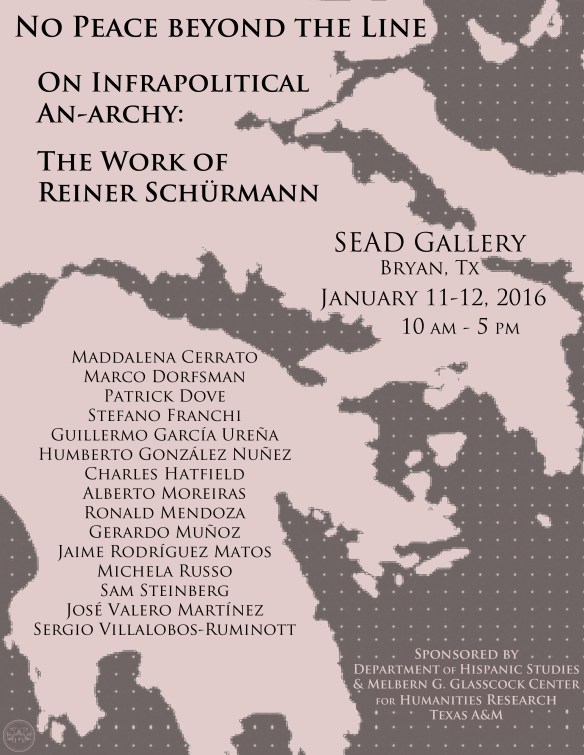


Preliminary Remarks for “No Peace Beyond the Line. On Infrapolitical An-archy: The Work of Reiner Schürmann.” A Workshop. January 11-12 2016, Texas A&M. By Alberto Moreiras

Workshop. Infrapolitical anarchy“Only a wrenching of thinking allows one to pass from the “time” that is concerned with epochal thinking to originary time, which is Ereignis—to agonistic, polemical freeings. So, it is not as an a priori that temporal discordance fissures the referential positings around which epochs have built their hegemonic concordances” (Schürmann, Broken Hegemonies 598)

Preliminary Remarks for “No Peace Beyond the Line. On Infrapolitical An-archy: The Work of Reiner Schürmann.” A Workshop. January 11-12 2016, Texas A&M.

For a little less than two years now we have been pursuing or unfolding or developing or whatever it is one does with these things a research or thinking project based on our professional histories and orientations as mostly Latinamericanist or Hispanist literary and cultural scholars but not limited to them. The project revolves for the moment around two master terms, namely, “infrapolitics” and “posthegemony.”   Those are terms that come from a reflection dating back to the late 1990’s and early 2000’s in our professional field, but which were neglected after 2003 or so for reasons that there would be no need to explain at the moment but that have to do with a certain collapse of the spirit for collective work, which became pervasive at least in the sector of the professional field interested in theoretical work beyond merely so-called political commitment.

We named the project in its new instantiation Infrapolitical Deconstruction, where by “deconstruction” we ought to understand not just Derrideanism but also the Heideggerian deconstruction (Abbau) of the history of thought in the West, whose practice and continuation have come to characterize the so-called Heideggerian left. Infrapolitics names a space of thought and existence that subtends political life while not being alien to it, or, if you want, subtends social life while not being reducible to it.   Posthegemony, the absent third term, refers—politically, insofar as it is an explicitly political term—to the Machiavellian dictum according to which “the rich like to dominate, the poor do not like to be dominated,” and takes a position against both sides of the Machiavellian phrase (posthegemony is not only a refusal of domination—it is also a recognition that domination happens in myriad ways and that political conflict is primary and unavoidable.)

We named the resulting group the Infrapolitical Deconstruction Collective. We conduct most of our activity through the web, in social networks, with occasional meetings such as this one, sometimes taking advantage of large professional gatherings such as LASA or ACLA, sometimes simply using whatever resources are available to us in the diminished scenario of the contemporary university.   The group also meets with others, for instance through the Seminario Crítico Político Transnacional summer meetings in Spain.   We were initially small, about fifteen people or so. Over the last year and a half, a little more, the group grew to a membership of about ninety, but the core of it is still small and will conceivably continue to remain small. Some of the core members are here today, and I greatly appreciate that and thank them for it. This is an important event in the little history of our group, and let me take this moment as an opportunity to thank all the participants and also the Hispanic Studies Department at Texas A&M and the Glasscock Center for Humanities Research for sponsoring the meeting.

Reiner Schürmann was a German Dominican priest born in 1941 in Amsterdam, during the occupation, who decided to hang his monkish attire and think and teach philosophy in the US (most of the time at the New School for Social Research in New York) until he died, prematurely and all too early, of AIDS, in 1993, at fifty two years of age.   During his lifetime he published, in addition to a number of essays in journals, two important books, translated into English as Wandering Joy. Meister Eckhart’s Mystical Philosophy (1972, translation 2001), and Heidegger on Being and Acting: From Principles to Anarchy (1982, translation 1987).   Although those books were certainly discussed through the 1980’s (my own dissertation, written in 1986-87, deals with Schürmann’s book on Heidegger), it is probably fair to say that Schürmann’s greatness as a thinker was definitively established with the posthumous publication of Broken Hegemonies (1996, translation 2003), although it took a few years for this very difficult masterwork to make it into relative public awareness—one can conceivably say the issue is still in progress, so this workshop is also a contribution to it.   Schürmann’s work is, generally speaking, an “Auseinanderdersetzung” with Heidegger, whom Schürmann considered to be the most decisive thinker of the 20th century.   He combines his own brand of Heideggerian deconstruction of the history of Western thought and a certain sustained take on politics and political life after the exhaustion of the political categories of modernity, where Schürmann joins from his own original perspective other thinkers that are also of interest to us, such as Simone Weil and Hannah Arendt, María Zambrano, Derrida, Luce Irigaray, Jean-Luc Nancy, Massimo Cacciari, Giorgio Agamben, Carlo Galli, and Roberto Esposito among others.   We thought that thematizing his work, forcing us all to establish a direct relationship with it, would help us establish bridges between the German, French, Italian, and North American moments of reflection and proceed on our own course, connected of course to the Spanish archive, through a sustained critical meditation on historical metaphysics, which we hold essential for our own endeavors regarding both infrapolitics and posthegemony.   But, since Schürmann’s “retrospective” Heideggerianism bridges Continental traditions of thought and North American reflection at the height of the theory moment in the US universities in the late 1980’s and early 1990’s, I suppose the question is fair as to what it is that should take a group of mostly Latinamericanist literary scholars by academic adscription to have chosen to focus on Schürmann’s work. The reason of course is honorable: some of us think he can help us think through both what is instituting and new and also what is ancient and continuous in both posthegemony and infrapolitics.   We are under no illusions that we are saying or would like to say the same things Schürmann did say, but we think it is imperative for us to take his thought on board.   In that sense, Schürmann is one more powerful element of our archive, and we learn from him.

There is of course by now a solid tradition of both Heideggerianism and Derrideanism in the United States going back in the first case perhaps to William J. Richardson’s classic work, Heidegger: From Phenomenology to Thought (1974), and in the second case to the aftermath of the 1966 Johns Hopkins Conference where Derrida presented his essay on “The Ends of Man.”   I think it is safe and proper to say that most of us are friendly towards but at the same time quite alien to those communities of thought, whose fundamental questions are not necessarily ours, and which have offered us no interlocution so far.   We are celebrating this workshop in English, to a certain extent against our better instincts, and aim to publish results in English as well, as a way of intervening in those discussions, no matter how modestly. That is not because we aim to intervene in some other discussions, so that we cannot be bothered with the North American one. Actually, what is at stake here is something else, probably a bit unusual, a bit weird perhaps, looking at it from the outside and from a perspective that ignores the real dynamics of life in the US university, perhaps even unclassifiable: we want to wake up from our own dogmatic slumber and to push thought to whatever extremes we can muster given our resources, in all modesty but also with a certain confidence and a certain resoluteness which we will no longer give up.   We aim to be as free and uncompromising in our attempt at reflection as possible, and we will not allow the professional field, the pressures, said and unsaid, from the civil servants of the institution, the endemic hostility to unpredetermined thought that structurally pervades the disciplinary and unequal configuration of the contemporary university, to circumscribe our thinking and make it conform to ready-made boxes.   I can say, speaking for myself now, that I did not start my career thinking those thoughts, but I do now. In one of his essays Schürmann analyses, in a fairly devastating manner, the US philosophical establishment up to the 1980’s. We could do a similar analysis, which would have to be equally devastating, concerning the fields of theoretical reflection in the humanities in the 2000’s and the 2010’s. The object of such an analysis would necessarily be, not to prepare an exodus, rather to determine its deeper necessity for the sake of institutionally-unrestrained thought. Thinking is hard enough from internal obstacles even to whatever can be attained in terms of personal freedom.   This is the time to give up, to the extent we can, on external obstacles as well. To that precise measure we claim that the university also belongs to us.

If infrapolitical deconstruction can be wagered upon as a project with properly instituting potential—something that will require a few years to unfold and establish, if we are persistent enough–, our intention is not to do the instituting within the framework of the current disciplinary distribution of knowledge in the university. Schürmann joked that in the philosophical field of the 1980’s one could only say whatever one’s colleagues would allow him or her to say. Well, as already stated, we are not interested in letting ourselves be constrained by the good will of our well-intentioned field colleagues (“oh, whatever you write is just too difficult,” “oh, whatever you write is just so presumptuous,” “oh, whatever you write has nothing to do with our field,” “oh, whatever you write is an imitation,” “oh, whatever you write should be illegal”) in their roles, not necessarily secundary, as discourse police and upholders of the laws of language.   Even if, as a result of that fateful positioning, against the grain, we end up saying nothing and falling into silence, as many of us have already done at several points in our careers, that decision—which is not supplementary, it is not an add-on, but is rather essential to the posthegemonic and infrapolitical aspects of the project, one must do what one thinks—is both founding and irreducible, as well as the direct consequence of a state of affairs which we know is not directly challengeable, or not directly challengeable by us. So we go along to get along, but we claim an exception, and it is called Infrapolitical Deconstruction. As a wager for and an attempt at free thinking, free from as many constraints as possible, it simply claims its own space, nothing else. It wishes to infringe upon no one’s terrritory, as if it were theirs, and it makes no claims on anybody else’s desire, as if it were not always already the other’s desire. This is not necessarily easy, as we all know or must learn. There is a certain risk, there is a certain adventurous danger attached to this journey that we will not deny all the while preferring to avoid its disagreable character and consequences. We will see, as we are not blind.   But we are not in the business of properly disciplined work in the conventional sense. Which makes us all, structurally, in the university, our home, marrano thinkers: our procedure is marrano, our reception is that accorded to marranos, our thematics are marrano thematics as well. It is no wonder, then, that projects on the marrano difference and a multi-volume collection of essays on literary marranismo in the Hispanic archive are on our immediate agenda for the next few years.

What we are doing now is still preparatory, inchoate, a beginning. We are patiently establishing an archive of theoretical references, and we thought Schürmann’s work deserves to be one of them. Hence the importance of this meeting for us, perhaps a merely private or semisecret importance, a marrano importance, which at the same time takes advantage of and attempts to cover over an institutional void, a hole at the center of the contemporary university, of humanities discourse in the university, the experience of which may have become our generational (this time, it does not matter that there are several generations of scholars in the group: the time for reflection is now, not tomorrow, not yesterday) destiny as Latinamericanist thinkers working in the United States outside mainstream parameters—which today means, on the positive side, political parameters very narrowly conceived, and on the negative side not even that.

We have planned this meeting not as a final discussion of Schürmann’s work, rather as a first discussion.   All of us have been reading his work in the past few weeks or months, and I can tell you, speaking for myself, I am already missing a second reading of Broken Hegemonies, which seems to me an inexhaustible book that immediately calls for a rereading of all of its texts under study.   We will present position papers meant to propose some ideas for discussion, and it on the basis of the discussion, I imagine, that we will then go back home and start writing in earnest.   We will also take this opportunity to make a series of short interviews on infrapolitics with our outside guests, since we have them here.

Since I have counted myself out of reading my own position paper, as I did not want to take up too much time, let me finish these preliminary remarks by suggesting, through a quick succession of bullet points, what it is that Schürmann provokes and challenges us to continue to think in connection with infrapolitics and posthegemony.

  1. The notion of hegemonic fantasm, to which he opposes, in the last pages of Broken Hegemonies, the notion of “posthegemonic ultimates.”
  2. The notion of anarchy as a political position at the end of principial politics, which would for me stand in need of reformulation as infrapolitical anarchy.
  3. The general schematics of his understanding of the relation between time and history, event and clearing.   Schürmann seems at times to move forward to the claim of a certain extrahistoricality of being, in order to avoid the accusation or the categorization of his thought as “historicist.”   But I think we should re-evaluate that, through the renunciation of the radical transcendentality of what gives.   To that extent, I would argue that infrapolitics, as infrapolitics, holds on to the priority of the existential analytic, expanded and revised, reformulated vis-à-vis the relevant sections of Heidegger’s Being and Time, but still a thought anchored in singular existence, not on the priority of radical heteronomy.
  4. In his book on Eckhart, and throughout the rest of his work, Schürmann upholds the notion of an “imperative mode of thinking,” as opposed to an “indicative mode.”   What commands in thought is not a principle, rather the very need for singularization, which cannot be thought outside the parallel instance of “natality.”   The conjunction of natality and mortality cannot however avoid a certain priority of the “singularization to come,” similar to the sway of the Heideggrian No (and against the double Derridean Yes).   If infrapolitics accepts its own status as a thought of the singularization to come, and if it is true that infrapolitics results “from the dissociation from any figure of the commons” and commits us to the acceptance of the “tragic condition,” “the fateful fissuring of being,” then infrapolitics must search for a tonality of inscription of life in thought and thought in life. Infrapolitics is the search for an imperative style that commands no one but submits to its own command, which is the heterononous command of freedom.Workshop. Infrapolitical anarchy.jpg

I invite discussion. As always, I do not presume I speak in anybody’s name but mine, if that.


No Peace Beyond the Line. On a Footnote by Schürmann. By Alberto Moreiras

thThe complicated conjunction between “principle” and “anarchy” is motivated on the alleged or suspected fact that the so-called “hypothesis of metaphysical closure,” and the consequent loss of any recourse to principles or principial thought, do not immediately condemn us to an a-principial world, since, on the “transitional” line, at the line but not beyond the line, we can only think, our language can only offer us to think, the lack of a recourse to principles through the painful enunciation of the principle of anarchy, the principle of non-principles. This is not a trivial affair. If, as Reiner Schürmann establishes at the end of Broken Hegemonies, a hybristic insistence on the maintenance of principles as constant presence equals something like (non-ethical, non-moral, but nevertheless overwhelming) evil, the principle of anarchy might also be considered historial evil—is it not after all a reluctant recourse to principles in the last instance? A desperate clinging to the principle—an irremediable and yet bogus extension of its presence—under the ruse of anarchy?   How are we to negotiate the ultimate catastrophe assailing the hypothesis of closure?

I do not mean to answer that question. Let me only point out a curious circumstance. Emmanuel Lévinas, whose work could be considered committed to the awakening of goodness in his sense, published Autrement qu’Ëtre in 1974. His Chapter 4 opens with a section on “Principle and Anarchy” (Otherwise Than Being, 99-102). It could be expected that any posterior attempt at dealing with the “and” in Lévinas´ phrase would refer back to that work and those pages. And yet Schürmann’s Le principe de l’anarchie. Heidegger et la question de l’agir (1982) devotes only one footnote to Lévinas (in the English translation, page 346, on the difference between originary and original Parmenidism), and, let us say, half of another one, whose main thrust is a sharp critique of Derrida: “Among the company of writers, notably in France, who today herald the Nietzschean discovery that the origin as one was a fiction, there are those who espouse the multiple origin with jubilation, and this is apparently the case with Deleuze. There are others who barely conceal their regret over the loss of the One, and this may indeed be the case with Derrida. It suffices to listen to him express his debt to Lévinas: ‘I relate this concept of trace to what is at the center of the latest work of Emmanuel Lévinas,’ Jacques Derrida, Of Grammatology, p. 70. The article by Emmanuel Lévinas to which he refers announces in its very title—‘La trace de l’autre,’ the Other’s trace—how far Derrida has traveled from his mentor. For Derrida, the discovery that the ‘trace’ does not refer back to an Other whose trace it would be, is like a bad awakening: ‘arch-violence, loss of the proper, of absolute proximity, of self-presence, in truth the loss of what has never taken place, of a self-presence which has never been given but only dreamed of,’ ibid., p. 112” (Schürmann, Heidegger on Being and Acting, n. 44, 321-22). As you have just seen, there is no mention of Lévinas’s take on “principle” “and” “anarchy.”   Unless we take the implied, indirect critique to Lévinas’ notion of the trace as referring to an Other understood as neighbor, always already nostalgic of the pure presence of the One, as a terminal disagreement at the level of conceptualization.   But the footnote does not really warrant it.   So we can only hypothesize.

For Lévinas “consciousness” does not exhaust the horizon of being and should not be, against modernity, considered the being of beings. Or perhaps it can, but then the positing of a me-ontological region, beyond being, certainly beyond consciousness, becomes obligatory.   Within that structure, “principle” is very much on the side of consciousness: in fact, subjectivity is the principle. “Being a theme, being intelligible or open, possessing oneself, losing itself and finding itself out of an ideal principle, an arché, in its thematic exposition, being thus carries on its affair of being. The detour of ideality [Lévinas has just said that ‘even an empirical, individual being is broached across the ideality of logos,’ 99] leads to coinciding with oneself, that is, to certainty, which remains the guide and guarantee of the whole spiritual adventure of being. But this is why this adventure is no adventure. It is never dangerous: it is self-possession, sovereignty, arché” (99). If there were to be an “spirituality” beyond “the philosophical tradition of the West,” it would have to be found beyond consciousness, that is, beyond always already archic being.   It would be the place of “anarchy.” Of a dangerous and adventurous anarchy.

Anarchy is a persecution and an obsession. “The subject is affected without the source of the affection becoming a theme of representation” (101); “Anarchy is persecution. Obsession is a persecution where the persecution does not make up the content of a consciousness gone mad; it designates the form in which the ego is affected, a form which is a defecting from consciousness. This inversion of consciousness is no doubt a passivity—but it is a passivity beneath all passivity” (101).   Far from being a hypertrophy of consciousness, it hits us as irremediable and always unwelcome trouble. It comes from outside. It is not domesticable, tamable, it admits of no reduction to arché. It is an absolute passion: “This passion is absolute in that it takes hold without any a priori” (102). Do we want it? But the question is only a question posited to consciousness, to the archic.   Beyond consciousness we cannot resist it.

What is it? Lévinas calls it “a relationship with a singularity” (100).   It therefore irrupts from a “proximity” we cannot organize or measure, and it is a proximity beneath all distances (“it cannot be reduced to any modality of distance or geometrical contiguity,” 100-01). It is the “trace:” “This way of passing, disturbing the present without allowing itself to be invested by the arché of consciousness, striating with its furrows the clarity of the ostensible, is what we have called a trace” (100).

Is this commensurate to Schürmann’s thought of the principle of anarchy?   Does it come under the indirect critique of his footnote? Yes, without a doubt, it is “arch-violence, loss of the proper, of absolute proximity, of self-presence, in truth the loss of what has never taken place, of a self-presence which has never been given but only dreamed of.” Schürmann’s critique may hint at the notion that any surprise in this regard would be always naïve or feigned. It is true that Lévinas makes it dependent on the encounter with the other as neighbor (“What concretely corresponds to this description is my relationship with my neighbor,” 100).   This is what Derrida is said to depart from, and what Schürmann seems to take for granted as correct. The irruption of anarchy should not for him, any more than for Derrida, be reduced to an encounter with human otherness, even if the encounter with human otherness could trigger it every time, or some times, also as a persecution and also as an obsession. In Lévinas the persecutory obsession of relational anarchy does not seem to be triggered by unspecified being—it is always a relationship with a singularity that does it. But, leaving Lévinas’ ultimate position aside, there is something else in Schürmann’s gesture of (non)citation that should be questioned.

Schürmann seems to naturalize the persecutory aspect of me-ontological anarchy by positing (displeased) surprise at Derrida’s feigned surprise and celebrating Deleuze’s jubilation in the face of it.   As if there were nothing particularly painful in being thrown over to an anarchic relation.   As if, therefore, the resources of subjectivity—the subjectivity of the thinker—were or could be enough to keep the dangerous adventure of anarchy at bay, under control. But, if so, the principle of anarchy emerges, plainly, as principle, and principle of consciousness.   Anarchy runs the risk of becoming yet another form of mastery.   At the transitional time, posited as such by the hypothesis of metaphysical closure, metaphysics still runs the show as consolation and consolidation.   But this may not be good enough.   It is not exposure but counterexposure.


Poiein Kata Phusin. On Reiner Schürmann. By Alberto Moreiras

At the end of Heidegger on Being and Acting: From Principles to Anarchy (286-89), Reiner Schürmann explicates four “Consequences for the Direction of Life.”   This is to comment on some punctual sites in the explanation with no pretense of exhaustivity but with a view to establishing their possible productivity for infrapolitical thinking.

  1. Schürmann mentions a “heuristic” function in Being and Time’s concentration on “everyday activities” in view of the need to establish a “fundamental ontology.” But “there is another priority of praxis in Heidegger, which appears as early as in Being and Time and which remains operative throughout all of his work: to retrieve the being question from the point of view of time, a certain way of life is required. To understand authentic temporality, it is necessary to ‘exist authentically;’ to think being as letting phenomena be, one must oneself ‘let all things be;’ to follow the play without why of presencing, it is necessary ‘to live without why.’ Here the priority of praxis is no longer heuristic . . . According to the mainstream of the metaphysical tradition, acting follows being; for Heidegger, on the other hand, a particular kind of acting appears as the condition for understanding being as time. Here praxis determines thinking. In writings subsequent to Being and Time, it is suggested that this praxis is necessarily of a political nature” (287)

This second (non-heuristic) priority of praxis is fundamental to the infrapolitical constellation, which emphasizes it and names it “existential.”   A praxis of existence—not a politics, not an ethics, certainly not a disciplinarization or institutionalization of existence—opens the way to infrapolitical reflection to the very same extent infrapolitical thought cannot be premised on anything but a specific relation to existence.   Whether Heidegger himself indicated the possible political relevance of this existential understanding of praxis is probably irrelevant for infrapolitics, but it may not be irrelevant regarding the fundamental thrust of Schürmann’s interpretation.   There is, in the attribution to the late Heidegger of a (reluctantly) “anarchic” political drift, an assumption I would not share: that changes in thinking, in order to be relevant, are necessarily epochal (even if, at a certain point, under the hypothesis of the closure of metaphysics, their epochal stance would mark, according to Schürmann, the end of epochality, the end of epochal history), and, as epochal, they reach and affect and shape and force the compliance of the totality of the political collectivity as such.   For Schürmann “anarchy,” on his terms, is not the singular choice of a thinker but rather the offspring of the contemporary economy of presencing with which the (contemporary) thinker should comply.   Anarchy would be a “nomos” at the end of principial (metaphysical) epochs. “The nomos or injunction always and everywhere determines the oikos, the abode of man” (235). There is a certain ultimate incoherence in claiming both that thinking presupposes a particular exercitium that belongs to the thinker’s singular existence and that thinking only lives through attunement with a nomic or temporal presencing that affects everyone.

  1. “Being can be understood as time only through its difference from history. The investigation into the concrete epochs and their regulation is what binds the later Heidegger’s phenomenology to experience. Since this is, however, not an individual’s experience, the issue of phenomenology proves to be political in a broad sense. An economy of presence is the way in which, for a given age, the totality of what becomes phenomenal arranges itself in mutual relations. Any economy is therefore necessarily public” (287)

The politicality of epochs has to do with the fact that epochs force an order of the visible (things, words, actions) into an order of domination. Principial epochs guarantee the domination of the principle as hegemonic domination (at the time of modernity subjectivism dominates hegemonically, and so forth, and it dominates all orders of existence: politically as well as philosophically or artistically, etc.)   But Schürmann’s distinction between history and time prepares his affirmation of an end of epochal history that opens the visibility of presencing as non-domination. At the end of the cycle of principial epochality, where we hypothetically are (this is the closure of metaphysics), the thinker can move or prepare the way for anarchy as non-domination. But the politicality of the thinker is then either prophetic or it has the character of a historical vanguard.   In both cases it appears as messianic, as it incorporates and enables a promise (the “early” correspondence of the thinker, as response to an unconcealing presencing, is a commitment to and an announcement of a general dispensation to come).   Infrapolitics prefers to consider posthegemony as the deconstruction of all political legitimation, including the preparatory, anticipatory, or transitional legitimation of a purported, posthistorical economy of presencing of universal reach. Infrapolitics gives up on preparatory thinking as it refuses the distinction between history and time.

  1. “The hypothesis of closure results from the reduplication ‘will to will’ substituting itself for the difference ‘being and entities.’ Enframing, then, is not like any other principle. It is transcendence abolished. Total mechanization and administration are only the most striking features of this abolition and reduplication, of this loss of every epochal principle; a loss that, as Heidegger suggests, is happening before our eyes” (288).

For Schürmann technology would be “the age without a beyond” (285) that terminates the epochal cycle, the history of being.   He claims that, at the end of the epochs, “originary time” resurfaces into a presencing no longer to be understood as the constant presence of the metaphysical dispensation.   Responding to originary time—the worlding of the world, the thinging of the thing—is what the thinker today prepares: “to think is to follow the event of presencing, without recourse to principial representations” (286). But the withering away of epochs needs not be thought as the welcoming of an unepochal dispensation, about which we know nothing and we experience nothing others may not have also known and experienced in any of the previous transitional times. Infrapolitics is an intraepochal affirmation of “simple dwelling” in the here and now, not a “step into the blue” (284) at the abyssal end of the history of being.

  1. “Poein kata phusin . . . Thinking is essentially compliant with the flux of coming-to-presence, with constellations that form and undo themselves. To think is to follow the event of appropriation, to follow phuein” (289).

Schürmann proposes two master terms for such a compliance: non-attachment and releasement, both taken from Heidegger in specific reference to Meister Eckhart. There is certainly a difference between submitting to ordering principles and “acting according to presencing,” in compliance with the worlding of the world and the thinging of the thing.   But who guarantees the public, collective, universal compliance with the second under the guise of the (transitional) principle that there are no principles?   A second-order hegemony, in this case presumably guaranteed by the thinkers and the poets to come, is no better than the pedestrian economy of the principle.   Infrapolitics prefers the suspension of compliance, not out of any fundamental suspicion towards the mysterious dispensations of the fourfold, rather out of a fundamental suspicion of its interpreters.   Letting-be is infrapolitically to be thought as existential releasement for the sake of a radical attachment to the free singularity of existence.

Imperative Self-Defense. By Alberto Moreiras

Living in Texas I am routinely exposed to the national passion here—self-defense and home defense, not just as a response to possible merely personal crime but also (perhaps more importantly even) now in connection with terrorism: newspaper and magazine articles, and the like.  There is something self-defense theorists call, taking it from the military, “situational awareness,” which has to do with paying attention to your “bubble,” they call it, essentially a perimeter of about fifty feet from where you are.  They recommend always to be on “yellow alert,” that is, always attentive to your environment and scouting any possible threat.

Now, I wonder whether and to what extent situational awareness can be thought of in Heideggerian “existential analytic” terms: is it authentic or inauthentic behavior?  Most of my Facebook friends would immediately say:  “Inauthentic!!”  I guess it could go both ways, like anything can, but, given the fact that self-defense is such an atavistic aspect of one’s personal relation to his or her own death, what I find of particular interest is the possible (plausible?) connection of self-defense, manifested in a passion for situational awareness, that is, for a guarding attentiveness, to authentic behavior. I only need to establish its possibility. But it may be contested.  I would welcome the discussion.

In Country Path Conversations Heidegger establishes a distinction between warten and erwarten. He privileges the first, as something like a waiting uncontaminated by its object, a destinal or historical awaiting.  But I think the decision for “waiting,” where waiting has no specific object, applies to precisely meditative reflection, in other words, it has to do with a particular capacity of the human—an opening to the clearing where things and world can be let be.  It cannot and would not rule out other capacities, particularly in the context of the existential analytic.  The sticking point is, letting-be also applies to one’s own life.  Or, as the self-defense theorists will tell you, to our loved ones against an external threat.   So there is no “das Man” necessarily here (although there could be, say, if one is mimicking the gestures of self-defense, trying to imitate buddies, trying to be cool or tough, and so forth), at the limit (which is where I want to think it), there is precisely “jemeinigkeit” to zero degree, we could say—self-defense could also be about protecting our inmost possibility for being.  So situational awareness, which of course in itself pretty much incorporates finitude and a deep involvement with temporality and death, could in fact be an essential, enabling part of existential “authenticity” in its more radical sense, which is the confrontation with one’s own death.   Again, it could also be mere bs.  But it is not that necessarily. The question here is whether self-defense is a mere matter of a subjective appropriation of one’s own life or whether it itself opens up to, indeed, whether it conditions, a meditative change in existence in view and full experience of the world and its worlding.   Self-defense is immediately and for the most part our only path towards letting things be, after all. Without self-defense we are all broken.    Mortality means ongoing and radical self-defense.

The question arises, is the “waiting,” as defined above, the condition of possibility of authentic care, of authentic existence, or is it the other way around?  Is it the defense of—that is, the insistence in–authentic existence that opens up, for the first time every time, the possibility of a “waiting for no object,” that is, of a different (non-subjective, non-calculative, non-representational) attunement to existence? If self-defense is irreducible, then it seems to me infrapolitics is irreducible.

Heidegger said many times that the existential analytic was the basis for everything that came later.  Perhaps in a modified form, but I am not sure the modification hits this particular spot.  There is an imperative dimension in it: you must strive for authenticity, and authenticity is always radically self-defense. Which of course happens at a level other than the level of the subject—at the level of “a life” individuated or singularized temporally in the Dasein we each are.

Heidegger discussed many times what he called “fundamental attunement”—this starts in Being and Time (actually, before) and goes on through the middle period and all the writings surrounding Contributions up to and through the Hölderlin lectures.  In Contributions it is said that the fundamental attunement of our historical period, no longer the modern one, is terror (Erschrecken, I think).   And it is the case that we can only think historically starting from the fundamental attunement of our epoch  (this is in itself very controversial, but I think this is Heidegger’s position).   If so, then terror—which is primarily terror in front of the abandonment of being—is irreducible, but also the very site of “das Rettende.”  In other words, terror is also the trace and the hint of the divinities, the sending of being, and a condition of Ereignis, worlding, thinging, and so forth.  (On this see Andrew J. Mitchell, “Heidegger and Terrorism.”)

If terror is the essential existentiell for our time, then self-defense is (could be, authentically) an enabling characteristic of our capacity to listen to being, or for an openness to the clearing. As death—finitude—is a radical condition of life, ongoing, not just at its terminus, which is what makes Heidegger something entirely other than a biopolitical thinker, self-defense is also a defense of one’s own ongoing death, a defense of temporalizing, of the temporalizing of a life, any life, starting with what is closer by, more intimate.

Of course we do not have to equate self-defense to what the Texan theorists reduce it to—policing the perimeter. There are other possibilities. But—does this work at all?  Or am I overly influenced by newspapers and magazine articles?


A Note on Gabriela Basterra’s The Subject of Freedom. Kant, Levinas (New York: Fordham UP, 2015). By Alberto Moreiras

9780823265145_21

This note does not measure up to a review, and it does not intend to. I simply want to point something out, controversial as it may be. The Subject of Freedom takes its initial bearings on an intricate examination of several antinomies of reason as presented by Kant in the first Critique and goes through Kant´s practical philosophy (essentially through the second Critique and Religion Within the Limits of Reason Alone, although there are references to other texts) into some key issues in Levinas’ later thought as represented by Otherwise Than Being.   The discussion includes the debunking of some influential positions on Kant´s ethics, such as Dieter Heinrich´s.   Basterra is interested in showing how Kant´s critical categories must be subjected to the scrutiny of a post-structuralist understanding of reason as essentially connected to language rather than to the forms of spatio-temporal intuition.

The significance of Basterra’s book is the critical double turn that consists in presenting Emmanuel Levinas’ thought as a philosophy of freedom in the Kantian sense, and, conversely, Kantian thought as a philosophy of auto-heteronomy. The implications of this double move for political thought are significant: essentially, but still rather superficially, The Subject of Freedom gives us a chance to understand the Kantian-Levinasian subject of the political as a non-liberal if still republican subject, and consequently gives us the chance to revise our notions of democratic republicanism through an alternative understanding of ethico-political subjectivity. This is revisionist in terms of the dominant traditions in political philosophy that have linked Kantian republicanism with a mostly liberal, or perhaps liberal by default, conception of both subjectivity and the political.

But there is a more daring task for interpretation. Once through Basterra’s analyses, and thanks to them, it is legitimate to wonder whether Kantianism is as securely established in autonomous subjectivity as it has been presumed.  Or whether Kantianism, in its ethico-political articulation, opens necessarily onto a radical critique of subjectivity—this would be a stumble, a scandal in Kant’s path, or in the path of Kantianism, hence of modern philosophy.   And, conversely, it also becomes legitimate to wonder whether the path of freedom does not necessarily go through a renunciation of the liberal notion of the subject, which is of course also the modern one.   Not that a new image of the subject needs to be formed as a consequence—rather, another game opens up, which goes through the difficult terrain of wondering whether there is, after all, a subject of freedom, as opposed to a freedom beyond the subject.


On Charles Hatfield’s The Limits of Identity. Politics and Poetics in Latin America (Austin: U of Texas P, 2015). By Alberto Moreiras

hatfield

This is an important book that, in its understated and unassuming rhetoric, actually establishes a generational challenge of fundamental importance to the totality of Latin Americanist discourse in the humanities. Beyond that, it subverts the very basis of Latin American cultural self-understanding since at least José Martí´s “Nuestra América.”

Hatfield organizes his book on the basis of four chapters, with a short Introduction and an equally short Coda, although both of the latter are significant.   The chapters cover four master concepts, namely, Culture, Beliefs, Meaning, and Memory.   Through them Hatfield offers a relentless critique of the Latin Americanist cultural tradition and its bearing on the present. He also makes a historical argument, hence a genealogical analysis of how the apparent truisms of the present came to be what they are.   His theoretical sources are to be found in a soft North American pragmatism, fundamentally indebted to the work of Walter Benn Michaels and Stanley Fish in particular.   It is a politically committed book whose urgency derives from the fact that, as the book establishes, contemporary literary-cultural reflection, or at least its mainstream, has lost its bearings and fails to realize that, contrary to its own claims, it will have no impact on “correcting the region´s most grievous injustices.”

The Introduction presents an idea of universalism as neither a belief nor an ideology, but as an irreducible dimension of any truth statement as such. It is because truth claims assert themselves as universally valid that there can (and should) be disagreement.   If truth could be taken to be always and in every case particularist, that is, only valid for a given location or site of enunciation, then the very notion of disagreement would become useless and incomprehensible. For instance, the very opposition to racism, sexism, or colonialism that a certain number of Latin Americanist thinkers, if not most, would consider their own privilege or obligation against Eurocentric impositions, Hatfield shows, is already universalist, and it would be considerably weakened if we were to claim that it is only the result of the particularism of their victims.   In other words, it is not because of “our” particular identity but because of a belief in the universal wrongness of racism that we can successfully and persuasively oppose racism.

So that universalism already commits us from the moment we have beliefs. Universalism is therefore not a particular form of ideology, much less a Eurocentric one, but rather a constitutive and irreducible dimension of everyday speech that cannot be disavowed without a cost. The cost is the reduction of thinking to an identitarian program–we, in other words, would not endorse a truth because we believe in it, only because it is ours or we have come to be persuaded that it is. The consequence is nefarious: “to invoke identity as the reason for a belief in a disagreement is to actually end the disagreement by refuting the universality that enables it” (“refuting” does not seem the right word here, as there is no refutation at play: “refusing” seems more like it).

It just happens to be the case that Latinamericanism in general has been throughout its history essentially preoccupied with “preserving, no matter in how contradictory or tense a manner, an idea of Latin America as the repository of a cultural difference that would resist assimilation by Eurocentric modernity.” The way this has been done–the rhetoric that sustains the concern for cultural difference–has followed patterns of anti-universalism that could only lead to identitarian dead ends. “Latin Americanism´s crucial work involves converting what is true or false into what is yours and mine.”   The net result of this, in practical terms, is not a resounding denunciation of cultural oppression, or even a brave refusal of racism, but rather the trap of proposing a “liberationist” discourse that “implicates itself in many of the same discourses that it sought to repudiate.”   When Doctor Francisco Laprida, in Jorge Luis Borges´s “Poema conjetural,” experiences a “secret joy” at the moment of his violent death, the complications of Sarmiento´s inaugural discourse on “civilization versus barbarism” are rendered moot: “liberation” is for Laprida, as for so many Latin Americanists, a mere return to atavistic identification with a tellurian force and a more than dubious authenticity, from which nothing but disaster can ensue.

If “Laprida´s demise at the hands of gauchos is, in a sense, the fulfillment of what Latin Americanist thinking ever since José Martí´s ‘Nuestra América’ has desired,” Chapter 1 offers an analysis of “Nuestra América” whose main thrust is the recognition that Martí´s discourse, “far from offering a post-racial vision,” “reinstates the concept of race that it repudiates” at a cultural not biological level.   It also happens to be a reinstatement that has become functional to the neoliberal regime of rule, which thrives on cultural difference as a substitute for economic equality.   Given Martí´s status as a cultural hero, this chapter is bound to be controversial if not fiercely polemical, and it is of course part of the merits of this book that Hatfield is courageous enough to risk the cost of debunking civilizational figures.

Chapter 2 deals with yet another cultic intellectual presence over the last century, namely, José Enrique Rodó, whose Ariel has been described as “the most important Latin American essay.” In Ariel Rodó inverts Sarmiento´s dichotomy and claims that Latin America, far from being the site of an impotent failure of civilization, should emerge as the true repository of spirit–the culmination, not the limit place, of Western civilization.   But Rodó does this through a reaffirmation of “nuestroamericanismo,” that is, through the repeated assertion, which organizes the core of his essay, that a pursuit of identitarian strategies counts as the highest example of thought, and the only one available to Latin Americans.   Hatfield complements his analysis of Rodó with the analysis of a book that would seem to be its direct antagonist, namely, Rodolfo Kusch´s Indigenous and Popular Thinking in América, to the extent that, if Rodó´s target audience is the Latin American liberal-criollo class, Kusch places his civilizational bet on a recovery of indigenous cosmovisions. But Hatfield persuasively shows that Kusch shares with Rodó “the idea that the only arguments that we can make for or against beliefs are that they are ours–or not.”   An understated aspect of this chapter happens to reside in the fact that today the field of Latin American studies could be easily defined as the combat between “arielistas” and “decolonials,” which is still a combat between Rodó and Kusch, were it not for the marginal if persistent existence of a number of dissidents (Hatfield himself, for instance).   One of the arguments that Hatfield deploys with devastating effect is that this kind of thought is circular and therefore vicious: “Seminal thinking is the thinking to which Kusch wants to return and simultaneously the theory that makes available that return.”   And he shows that the contradictions internal to current-day proposals for a return to indigenous thinking have a terrible price, if it all comes down to “lining up your philosophy with your skin:” “all of this in no way means that it is impossible or intrinsically contradictory to make a case for indigenous thinking, or any mode of thinking. It means only making a choice between the commitment to indigenous thinking on the one hand, and difference on the other.”

Chapter 3 opens up the frame of reference and avoids the concentration of the analysis into one master figure, like Martí or Rodó. In this chapter Hatfield goes through a number of more contemporary critics and writers in order to show the pervasiveness of the nuestroamericanist ideology in the present. He starts with a masterful reading of Borges´ “Pierre Menard: Author of Don Quixote,” examines a number of critical takes on it, seeks to establish its correspondence with pragmatic conclusions, and moves on to deploy those conclusions in the context of the work of people such as Roberto Fernández Retamar, Ricardo Kalimán, Octavio Paz, and Doris Sommer.   Through all of it Hatfield argues that identitarianism must recognize an impossible resistance in the literary text, which may point us in the direction of a denunciation of literature as insufficient for the political tasks it is expected to perform.   But it can equally point in the direction of literature “as a site of disagreement, rather than of difference, and in so doing” show that “literature gives us a model for a better politics.”

Chapter 4, on “Memory,” is one of the most original and brilliant in the book.   Taking its departure from the disturbing thought that neoliberalism has already managed to enthrone cultural difference and has hence deprived the contestatory dimension of mainstream Latinamericanism of any conceivable ground, it moves on to an analysis (again, understated and unassuming, but very powerful) of the critical constellation associated with “politics of memory.”   In other words, this chapter analyses “the shift away from culture and towards history and memory as the cathected objects for Latin American identitarian thinking.”   But history and memory are not the same thing: if history refers to knowledge, memory refers to experience. The thought that we could rehearse the memory of experiences we have not had is at the core of memory thinking over the last two generations of Latin Americanism.   And it is a deeply limiting thought, because the project of turning history into memory cannot be distinguished from the project of turning knowledge into identity.   Hatfield makes a historical argument that goes back to the 1960´s and the beginnings of testimonial writing in Latin America, through the rise of oral history as epistemic practice in the 1980s, through José Rabasa´s radically nihilistic account of the Acteal massacre in the 1990s (“truth and falsity do not matter for Rabasa, because the idea of truth makes identity irrelevant”), and into the curious conflation of apparently irreconcilable subjectivist thought in contemporary critique (Beatriz Sarlo and John Beverley are the examples in this section).   But Eduardo Galeano, Gustavo Verdesio, Diana Taylor, and Raymond L. Williams are also gently brought to task, together with Carmen Boullosa.   All of these authors are of course only examples of a widespread metonymy in the field.   It is part of the elegance of the book´s rhetoric that the author lets the reader draw her own conclusions as to the general state of the field, including the position taken by some of the more popular or well-known critics that are barely mentioned and not frontally analyzed.

The Coda on New Latin Americanism is essentially an analysis of John Beverley´s recent Latin Americanism After 9-11.   Hatfield presents the thought that, on Beverley´s own premises, if the neoliberal market has brought about “a play of differences that is not subject, in principle, to the dialectic of master and slave,” then the current predicament “equals a game-over on two counts for Latin Americanism itself. First, if ideologies of Latin Americanism at heart have always been about cultural dehierarchization, which is just another way of saying identitarian anti-universalism, then the recognition of cultural dehierarchization´s hegemony leaves it without anything to do. Second, the fact that Latin Americanism´s project of cultural dehierarchization was achieved by and in neoliberalism poses the question of whether that project ever–but especially now–counts as a progressive form of political resistance to capitalism.”   This is the fundamental impasse today, and of course Hatfield shows that Beverley´s counterproposal does not work: “Beverley´s new Latin Americanism, boiled down, is almost like a definition of the old one,” which is quite unfortunate.   There is a lot of genuinely new work to do, and it can change the game, but only if the playing field, Hatfield suggests, is rebuilt from scratch.


On Professional Bliss. By Alberto Moreiras

So many constant misunderstandings eventually come to our ears one no longer knows the battles one wants to fight—surely not the battles we have not sought, whose result is indifferent in the best of cases?   Yes, this group (not the blog, but the group the blog is connected to) is composed mainly of people who are not professional philosophers, whatever that means, and mainly of people from the academic disciplines of Hispanic Studies, which is for many a double problem (first, we are said to speak out of line, as whatever we say has “nothing to do with our language and tradition,” whatever that means, which makes us incomprehensible; second, we are said to speak as mere impostors and amateurs, because we have no proper legitimation—say, through the Heidegger-Gesellschaft or the Derridean establishment, one would suppose, or through philosophy departments perhaps?)   And yet we are trying to develop a path of thought, which takes many years, particularly against such obstacles, depressing. And that is rarely granted. Much less helped. We do not complain (we like marranismo, and dis-inheritance is part of what we do), but at some point—now, for instance—this must be registered.

Infrapolitics is to be understood, genealogically, as a repetition of the Heideggerian adventure in the destruction of metaphysical thought (which of course Derrida took up and continued). It seems to me we can date the notion of infrapolitical legacy, in the restricted but nevertheless immediate way that concerns Heidegger, to the moment, in the 1920 lecture course on Phenomenology of Intuition and Expression, in which he says: “Philosophy has the task of preserving the facticity of life and strengthening the facticity of Dasein.” This is of course the precise moment that Agamben takes up–quoting, through Foucault, some other, later text–at the beginning of Homo Sacer, and that marks the beginning of what he conceives of as his own project in biopolitics. Essentially, if philosophy, or thought, which is in itself a particular way of factical life, must make it its business to understand that which it is a part of, then two main possibilities ensue: one of them has been called biopolitics. But the essential problem with biopolitics is that its horizon is and cannot not be politics. The other one is infrapolitical, which includes politics but is not constrained by politics. I suppose this is difficult to understand, or to accept, for many? But we only claim to want to do what we can.

So yes, there are many of us by now but we are on our own (like in the old joke about Galicians lost in the desert), provided we keep it up (otherwise, not even that). It is hard to know why–surely we have not historically militated in favor of isolation and silence? And yet that is what we usually get, insofar as we speak up. But never mind: the real thing, if it ever was, is no longer in these battles that we cannot win precisely because they are battles we have not sought and do not want to fight. What seems much more sensible is to persist, to persevere, and the writing will have to speak for us by itself eventually and in the future, if that is important.


Postscriptum a Tiempo universitario y deseo. Por Alberto Moreiras

Se me pregunta qué es o cómo se define “lo que no tengas más remedio” que escribir, o enseñar, o servir.   Depende de la situación en cada caso. Para un profesor asistente que busca continuidad en su empleo “no tener más remedio” que terminar un libro y empezar la publicación de materiales para un segundo libro es condición de su salud laboral, con la que no vamos a interferir.   Lo demás debería en cada caso depender del estómago y de sus señales—no hay que escribir para producir cháchara que no le sirve a nadie para nada, hay que escribir porque pesan las palabras de las que hay que librarse, y sólo por eso. Ahí es cuando el “no tener más remedio” coincide con el deseo. Y los habrá que escriban mucho y los habrá que escriban poco, o quienes no tengan prisa porque la prisa mata, y específicamente mata no ya el pensamiento sino su misma posibilidad.   Pero vaya usted a decírselo a su comité de evaluación, a quien en general le importa sólo la publicación cuantitativa, y que estructuralmente no sabe ya qué es la cháchara.

En cuanto a la enseñanza uno enseña sólo lo que sabe y a veces se sabe poco. Pero enseñar—que nunca es otra cosa que dejar aprender–lo que uno sabe, en su pobreza misma, es todo lo que deberíamos hacer para no inundar las cabezas de los estudiantes de tontería. Enseñar lo que no se sabe es malo para todos—para el enseñante y para el enseñado, porque lo que no se sabe no puede dejarse aprender. Claro, a veces dejar aprender lo que se sabe, algo que uno mismo aprendió, puede llevar años.   Pero nuestra profesión, en su ritmo cada vez más condicionado a lo que se presume “gustable,” traiciona toda enseñanza en nombre de una pedagogía barata e instrumentalizada por razones hoy ya explícitamente meretricias.   Sin vergüenza alguna.

Y en cuanto al “servicio,” ¿a quién servimos? Sí, los comités son necesarios para llevar adelante el departamento.   Pero es “servicio,” por ejemplo, y de la peor especie, orientar nuestro tiempo universitario a buscar bequitas (no otra cosa es accesible en humanidades, o muy raramente) y premios, señal de supuesta “excelencia,” queriendo la recompensa de la palmadita en la espalda por habernos esforzado en adaptar nuestro deseo y por lo tanto nuestro ser, y nuestro estar, a las demandas con frecuencia inanes de esos grupos anónimos designados por la administración cuya función es aplicar en cada caso el criterio raso de una “excelencia” que no es más que conformidad a las normas corporativas en la mayoría de los casos.   Lo cual no quita para que ningún trabajo no excelente deba hacerse (nada peor que el que busca la “excelencia” convencional y aun encima lo hace mal.)   En fin, lo “estrictamente necesario” en el servicio tiene que ver con la lealtad a la idea de la universidad que todos deberíamos entender, y justamente con ninguna otra cosa.

Un viejo profesor mío, Bernard Dauenhauer, decía que hay libros que son meras colecciones de páginas y libros que son otra cosa, en los que hay algún favor o gracia, y que en la universidad norteamericana—supongo que en todas—la noción de libro está falseada desde el principio por la noción de publicación urgente, enemiga de la gracia. Que uno se puede pasar la vida escribiendo sin llegar nunca a un libro, y que así son las cosas, aunque por el camino se publiquen muchos “libros.”   Y que por lo tanto hay dos clases de escritores, dos clases de intelectuales: aquellos que entienden que el libro se espera y aquellos que entienden que el libro se produce.   “Libro” aquí significa otra cosa que libro como mero producto editorial, por cierto, al menos en la imaginación de mi profesor.   Y tiene todavía menos que ver con su “éxito” o “impacto” público. La universidad nunca tuvo ese valor como valor, y deberia volver a olvidarlo.