An explanation for ‘deconstructing the administrative state’. By Gerardo Muñoz.

A few weeks ago at CPAC (Conservative Political Action Conference), when Steve Bannon, Donald J. Trump’s White House chief strategist, laid out the principle of “the deconstruction of the administrative state” as one of the immediate objectives of the Trump administration, there followed a storm of commentaries. For academics in the humanities, it was a perfect setting to mock ‘deconstruction’, and assert the un-political character of this so called “theoretical trend” in the academia, easily linking Derrida with Bannon’s strategic plan.

Just to cite one of many examples, French writer Alain Mabanckou twitted: “Steve Bannon, le mentor de Trump parle de “deconstruction” du povuir de Washington. Deconstrution? Srait-il un lecteur de Derrida?”. Many more followed on social media and in academic groups. These witty remarks were, of course, written under the sign of irony, which is certainly a central stimmung of our time. But irony is also one of the most serious genres to discuss a serious affair, of which I would like to briefly contemplate. Of course, my intention is not to defend Derrida, or even worse, to prove that Bannon has not read Derrida. I am sure that Bannon has not read Derrida, and even if he has heard of him, or someone told him a few things about deconstruction as a critical strategy of contemporary thought, this is irrelevant.

Bannon’s usage of deconstruction of the administrative state is correct, although in another sense. For one thing, deconstructing the administrate state is a technical term used in sociology and political science analysis as it relates to the fiscal state. In his new book Democracy against Domination (2017), Sebeel Rahman discusses the deconstructive force of computative fiscal logic over institutional structures and governmental regulatory bureaucracy [1]. In a good portion of the literature, whenever the notion of deconstruction of the administrative state is used, it refers directly to the dismantling of the fiscal regulatory apparatus (see Norris 2000). Whereas it might, at first sight, seem that Bannon is misinformed or just downright clownish, he is deeply versed in the specific discipline that he wants to target; mainly, political science of the welfare state as it has been discussed from the New Deal onwards.

One could press this point even further: the idea that Bannon wants to ‘deconstruct the administrative state’ does not merely amount to ‘more neoliberalism’ as cultural critics seem to reduce the problem. This is part of the truth, but not the whole truth. The attempt to attack the administrative state entails a serious assault on the rule of law, since as the most intelligent constitutionalists have recently noted, the administrative state is today the legal structure that has supplanted legitimacy over the deficit of presidentialism of the executive branch. Adrian Vermuele (2016) makes it clear that the administrative state is the law’s greatest triumph after the weakening of the separation of powers. This ultimately entails, that perhaps Bannon is well aware that it is not enough to destroy a democratic society from the standpoint of a sovereign executive, since it must be done from the very place where the rule of law resides, and this is where the administrative state plays a fundamental role. Bannon’s deconstructive gesture goes to the heart of the rule of law, which we have already started seeing as a check mechanism to Trump’s rampant executive unilateralism. Hence, the rumor that says that Bannon is a Leninst should be taken very seriously: Leninism seeks the destruction of the state and rule of law in order to create a dictatorship of the proletariat, which is Bannon’s civilizational response to globalization [2]. Bannon is a full-fleshed anti-institutionalist who admires not only Lenin, but also the decade of the thirties that he has called “exciting”.

At this point, it is perhaps almost unnecessary to say that Derrida’s deconstruction has little do with Bannon’s loaded attack on institutions of the welfare state. However, what is important is to note that Bannon’s articulation of deconstruction is inequivalent to Derrida, and a comparison becomes only possible if one subscribes to a transparent conceptual reservoir of the linguistic turn in order to abuse it. Thus, whenever a linguistic component is emphasized as hyperbolic of intellectual thought, the latter is suspended to favor an easy advantage in tandem with anti-politics.

Derrida emphasized that deconstruction was a condition of democracy, and that democracy could not take place without deconstruction. Democracy is really not a political concept in Derrida’s thought. It is not reducible to a tradition of “intellectual history”, and not even to the primal causation of life as predicated in the political. Such was, for Derrida, the exemplary nature of Mandela [3]. But to the extent that it solicits unconditional hospitality, it alters the alterity of the singular that is never reducible to political finality. This coming of friendship or non-enmity is another way of thinking through an infrapolitical existence. It is this demotic existence beyond the political what Bannon wants to destroy and obstruct in a move that is both fully ultra-political and non-political.

Notes

  1. K. Sebeel Rahman. Democracy against Domination. Manhattan: Oxford University Press, 2016.
  2. “Steve Bannon, Trump’s top guy, told me he was ‘A Leninst’ who wants to ‘destroy the State’. http://www.thedailybeast.com/articles/2016/08/22/steve-bannon-trump-s-top-guy-told-me-he-was-a-leninist.html
  3. Jacques Derrida. The Politics of Friendship. London: Verso, 2005. P.102-106. “Admiration of Nelson Mandela, or The Laws of Reflection”, Law & Literature, Vol.26, 2014.

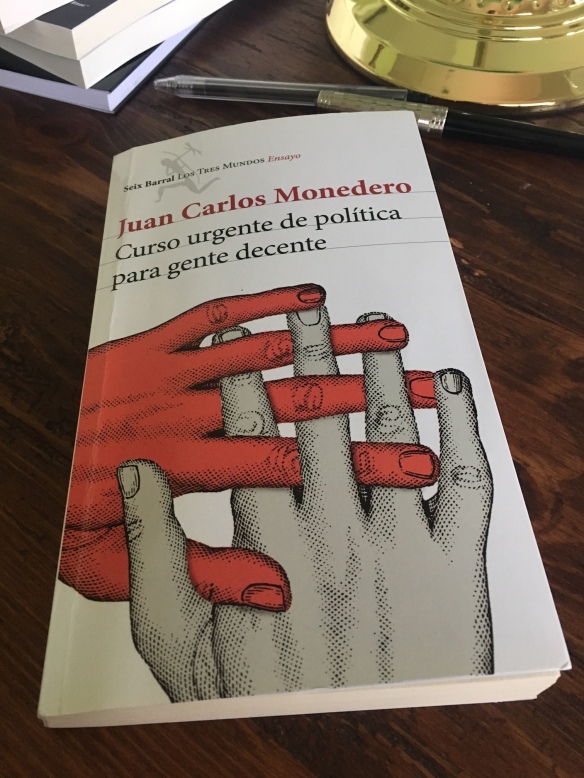
Comentario a un libro de Monedero. Por Alberto Moreiras.

IMG_5199En el final del libro de Juan Carlos Monedero, Curso urgente de política para gente decente (2013), hay como tres páginas de listas de cosas que uno quiere disfrutar, y que aparecen en nuestra vida, si tenemos ojos y oídos para ello, como los fulgores en lo oscuro de Georges Didi-Huberman. El lema es “hacer política como si nos fuera en ello la vida.” Esto es, hacer política, viene a decir, para que la vida no sea políticamente agotable, hacer política para ganar algo otro que la política–y esto es lo específicamente definible como de izquierdas (la política de derechas busca en realidad lo mismo, dice Monedero, pero desde el miedo y no desde la esperanza, a partir del privilegio de algunos contra el privilegio de todos; y el miedo impone su precio). Si esto es así, si esto lo entiende todo el mundo, si en el fondo es verdad que ningún panorama de izquierdas puede construirse hoy sin la negación del mundo político y de la relación con la existencia que hemos heredado (“Si los problemas de nuestras sociedades son la mercantilización de cada rincón de nuestra existencia, la precariedad de nuestras condiciones de trabajo y de vida, la desconexión del entorno y de los otros, la privatización de la existencia y la competitividad como la racionalidad de la época, un programa político alternativo se arma, precisamente, con todas esas cosas que niegan esas lógicas”), ¿por qué entonces tanta resistencia y tanta mala fe cuando se habla de infrapolítica? (No de Monedero, por cierto, del que no sé si ha oído la expresión, sino más cercanamente.) La infrapolítica es el horizonte necesario del logro en política (contra el éxito derechista)–cuando el mundo se abre a algo otro que el conflicto y la división. Ninguna política sirve cuyo resultado no sea una expansión radical del ejercicio infrapolítico. Por lo mismo, una infrapolítica sin política no puede darse–solo cabe radicalizar la demanda política hacia un espacio no hegemonizado, hacia un espacio libre, que es el espacio infrapolítico. Pero esto será llamado, no ya desde la ignorancia, sino desde la terquedad resentida, conservadurismo eurocéntrico, anti-identitarismo, fascismo, pendejismo, o giro lingüístico. La ceguera es voluntaria y es también profundamente desilusionante–porque en ese rechazo ciego entre los que pueden oír y no oyen ni quieren oír se sintomatiza una radical falta de compromiso político con todo lo que importa, se sintomatiza solo el oportunismo de los ventrílocuos. ¿No es hora ya de mandar a paseo a esa falsa izquierda gesticulante? ¿Quién querría vivir en su mundo?

Infrapolitics. Bibliography in Progress. Draft. Prepared March 2017. By Alberto Moreiras

th-1(First Attempt–Incomplete and with Format Problems. Work in Progress. Additions or corrections can be proposed in Comments, and they will be incorporated.)

Alvarez Yagüez, Jorge. “Límites y potencia de dos categorías políticas: infrapolítica e impolítica.” Política Común 6 (2014)
—“Hegemonía, cultura y política.” En Poshegemonía. El final de un paradigma de la filosofía política en América Latina. Rodrigo Castro Orellana ed. Madrid, Biblioteca Nueva, 2015, pp. 67-92
—“Crisis epocal. La política en el límite”, Debats 3 (2015): 9-28
–“De la crítica de dos conceptos políticos: sujeto y acción”, Política Común 10 (2016)
–“Infrapolítica.” Enciclopedia Iberoamericana de filosofía, (forthcoming)

Baker, Peter. “(Post)Hegemony: Reflections on the Politics of the Present.” Política Común. 9. [Online]. <http://quod.lib.umich.edu/p/pc/&gt; 2017.

— “Hacia una crítica del terror: Inquisición y marranismo. Terror social y pensamiento.” ed. José Luis Villacañas. Madrid: Biblioteca Nueva [2017]

Cerrato, Maddalena. “Consensus, Sensus Communis, Community.” Politica Común, 10(2016).

—“Alberto Moreiras: desde la aporía auto/hetero-gráfica hacia posthegemonía e infrapolítica.” Papel Máquina, Santiago-Chile: Palinodia, 2016.

—-“Infrapolitics and Shibumi. Infrapolitical Practice between and beyond Metaphisical Closure and End of History” Transmodernity. 5.1 (2015): 79-103.

Moreiras, Alberto. Marranismo e inscripción, o el abandono de la conciencia desdichada. Madrid: Escolar y Mayo, 2016.

—. Línea de sombra. El no sujeto de lo político. Santiago de Chile: Palinodia, 2006. [English publication under contract with Duke University Press. Revised and Expanded Edition to be published in 2017-18.]

—. “Approssimazioni all’infrapolitica.” Maddalena Cerrato transl. Naples: Paparo [2017]

—“Piel de lobo. Ensayos de posthegemonía e infrapolítica.” Madrid: Biblioteca Nueva [2017]

—. “The Parergon for Parergonal Critique. On David R. Castillo and William Egginton’s Medialogies. Reading Reality in the Age of Inflationary Media. Brad Nelson ed. Hispanic Issues Online [2017].

—. “Cercanía contra comunidad: la errancia y el ojo de más.” In Pléyade [Santiago de Chile, 2017].

—. “Hacia una república marrana. Conversación entre Alberto Moreiras y José Luis Villacañas sobre Teología política imperial y comunidad de salvación cristiana, de José Luis Villacañas.” To be published in a volume of review-essays on said book. Madrid [2017]

—. “Idolatría e infrapolítica. Comentario a Teología política imperial y comunidad de salvación cristiana, de José Luis Villacañas.” To be published in a volume of review-essays on the book in the title. Madrid [2017]

—. “Against the Conspiracy. Revisiting Life’s Vertigo. On Roberto Esposito’s Terza persona and Da fuori. Una filosofia per l’Europa.” In Antonio Calcagno and Inna Viriasova eds. The Thought of Roberto Esposito. State University of New York Press [2017]

—. “The Ontic Determination of Politics Beyond Empiricism in Early Derrida.” Erin Graff Zivin ed. The Marrano Specter. Derrida and Hispanism. Fordham UP [2017].

—. “A Negation of the Anarchy Principle.” Política común [2017].

—. “Memory Heroics. Ethos Daimon.” Special Issue on Allegory edited by Jacques Lezra and Tara Mendiola. Yearbook of Comparative Literature [2017]

—. “Tres tesis sobre populismo y política. Hacia un populismo marrano.” Alfonso Galindo ed. Title to be decided. Madrid [2017]

—. “Distancia infrapolítica. Nota sobre el concepto de distancia en Felipe Martínez Marzoa.” En Arturo Leyte ed., La historia y la nada. En torno a Felipe Martínez Marzoa. Madrid: La oficina de arte y ediciones [2017].

—. “La diéresis del pensamiento como tonalidad patética: Nota sobre pensamiento/crítica en Willy Thayer, apoyada en Jacques Derrida y en Martin Heidegger y en Juan Benet.” Papel màquina [2017]

—. “La religión marrana y el secreto literario.” Angel Octavio Alvarez Solís ed. (Title to Be Decided). Mexico: Iberoamericana [2016]

—. “Derrida infrapolítico.” Pablo Lazo Briones ed. Etica y política. Mexico: Universidad Iberoamericana [2016].

—. “The Turn of Deconstruction.” Volume edited by Juan Poblete on LASA Culture and Power Panels, May 2014. Routledge [2017]

—. “Sobre populismo y política. Hacia un populismo marrano.” Política común 10 (2016): 1-15.

—. “Hispanism and the Border: On Infrapolitical Literature.” In Wilfried Raussert ed., The Routledge Companion to Inter-American Studies. London: Routledge, 2017. 197-206.

—. “La universidad es solo intemperie. Entrevista de Ivan Pinto a Alberto Moreiras.” El desconcierto (Santiago de Chile), May 4, 2016. 1-8. (Interview [I])

—. “Conversación en torno a Infrapolítica.” Interview. Questions from Alejandra Castillo, Jorge Alvarez Yagüez, Maddalena Cerrato, Sam Steinberg, Angel Antonio Alvarez Solís. Papel máquina (2016). (I)

—. “Infrapolítica—el proyecto.” Papel máquina 10 (2016): 55-66. (Refereed article [RA)

—. “Infrapolitical Action: The Truth of Democracy at the End of General Equivalence.” Davide Tarizzo ed. Política común 9 (2016). DOI: http://dx.doi.org/10.3998/pc.12322227.0009.004 (RA)

—. “Posthegemonía, o más allá del principio del placer.” In Rodrigo Castro Orellana ed., Poshegemonía. El final de un paradigma de la filosofía política en América Latina. Madrid: Biblioteca Nueva, 2015. 125-46. (Book Chapter [BC])

—. “A Conversation with Alberto Moreiras Regarding the Notion of Infrapolitics.” (Alejandra Castillo, Jorge Alvarez Yágüez, Maddalena Cerrato, Sam Steinberg, Angel Antonio Alvarez Solís). Transmodernity 5.1 (2015): 142-58. (I)

—. “Infrapolítica y política de la infrapolítica.” Debats 128 (2015): 53-73. (RA)

—. “Introducción: Infrapolítica y posthegemonía. (Anhkibasie).” Debats 128 (2015): 6-8. (RA)

—. “Infrapolitics: the Project and Its Politics. Allegory and Denarrativization. A Note on Posthegemony.” Transmodernity 5.1 (2015): 9-35. (RA)

—. “Pasión de hospitalidad, pasión hospitalaria: relación encubierta. Comentario a “Después del euro. La Europa de la hospitalidad.” Res publica [2014] (RA)

—. “Das Schwindelgefuehl des Lebens. Roberto Esposito Terza persona.” Vittoria Borsó ed. Wissen und Leben. Wissen für das Leben. Herausforderungen einer affirmativen Biopolitik. Bielefeld: transcript, 2014. 115-39. (BC)

—. “Mi vida en Z. Ficción teórica. (De un profesor español en una universidad de Estados Unidos.)” http://www.fronterad.com/?q=mi-vida-en-z-ficcion-teorica-profesor-espanol-en-universidad-estados-unidos (Non-Refereed Article [NRA)

—. “Horacio Castellanos Moya and the Question of Cynicism.” Nonsite [2014]: 1-22. (Electronic publication.) (RA)

—. “Posthegemonía, o más allá del principio del placer.” Alter/nativas 1 (2013): 1-22.

—. “Keynes y el Katechon.” Anales de historia de la filosofia [Madrid] 30.1 (2013): 157-68.

—. “A Beggaring Description: The Republican Secret in Yo el Supremo, Together With Some Considerations on Symbolic Production and Radical Evil.” Journal of Latin American Cultural Studies 22.1 (2013): 71-87.

—. “The Fatality of (My) Subalternism: A Response to John Beverley.” New Centennial Review 12.2 (2012): 217-46.

—. “¿Puedo madrugarme a un narco? Posiciones críticas en LASA.” http://www.fronterad.com/?q=node/5697; Cuadernos de literatura 17.33 (junio 2013): 76-89.

—. “Common Political Democracy: The Marrano Register.” In Henry Sussman ed., Impasses of the Post-Global. Theory in the Era of Climate Change. Vol. 2. University of Michigan Libraries. http://www.openhumanitiespress.org, 2012. 175-193.

—. “Cujusdam negri & scabiosi Brasiliani. Las malas visitas. Ranciere y Derrida.” Cadernos de Estudos Culturais (Sao Paulo) 3.5 (2011): 9-25; Res publica 26.14 (2011): 29-46.

Muñoz, Gerardo. “Infrapolitica en tiempos posnacionales”. Review of Pablo Hupert’s El estado posnacional. Revista Consideraciones, Agosto 2014.

___. “Soberanía, acumulación, infrapolitica: intercambio con Sergio Villalobos-Ruminott”. Lobo Suelto, April 2015.

__. “Cinco hipótesis sobre Reiner Schürmann y el fin de la política principial”. Ficción de la razón, Marzo 2016.

___. “Writing in the Interregnum”. berfrois, June, 2016.

___. “Beyond Identity and the State. Introduction to dossier The End of the Latin American Progressive Cycle”. Alternautas, Vol. 3.1, July 2016.

___. “Epoca posuniversitaria e institución”. Universidad Posible. Raul Rodriguez Ed, 2016. Forthcoming. Print.

___.Infrapolitics, state, writing in Yo el Supremo”. Dissidences: Hispanic Journal of Theory and Criticism. Vol.13, Fall 2017. Forthcoming.

___. “Hegemon: communal form and total mobilization in Latin America”. Revista demarcaciones, 2017. Forthcoming.

___. “Poshegemonía, principios, y estado de derecho”. Pensamiento al margen, 2017.

___. “Interregnum and worldliness”. Review of Sergio Villalobos-Ruminott’s Heterografías de la violencia (La Cebra, 2016). Política Común, Vol.11. Forthcoming.

Rodríguez Matos, Jaime. “After the Ruin of Thinking: From Locationalism to Infrapolitics.” Transmodernity: Journal of Peripheral Cultural Production of the Luso-Hispanic World 5.1 (2015): 1-8. Print.
____. “De lo que agujerea lo Real: Lacan, crítico de la (pos)hegemonía.” Debats 128.3 (2015): 29-40. Print.
____. “Del no-tiempo de la incertidumbre en Juan Luis Martínez.” Martínez Total. Eds. Biggs, Braulio Fernández and Marcelo Rioseco. Santiago: Editorial Universitaria, 2016. 191-207. Print.
____. “Introduction. After the Ruin of Thinking: From Locationalism to Infrapolitics.” TRANSMODERNITY: Journal of Peripheral Cultural Production of the Luso-Hispanic World 5.1 (2015): 1-8. Print.
____. “Nihilism and the Deconstruction of Time: Notes toward Infrapolitics.” TRANSMODERNITY: Journal of Peripheral Cultural Production of the Luso-Hispanic World 5.1 (2015): 36-51. Print.
____. “Notas sobre nihilismo: Lalo y el pensamiento en las consecuencias de Occidente.” Asedios a las textualidades de Eduardo Lalo. Ed. Sotomayor, Aurea María. Córdoba: Corregidor, forthcoming. Print.
____. Writing of the Formless: José Lezama Lima and the End of Time. New York: Fordham University Press, 2017. Print

Villalobos, Sergio. La desarticulación (Soberanías en suspenso 2). Forthcoming, 2018.
—. Heterografías de la violencia. Historia Nihilismo Destrucción. Buenos Aires, La Cebra, 2016.

—. “Palabra quebrada. Glosas en torno al fragmento escatológico-político de Guadalupe Santa Cruz.” Revista Iberoamericana, forthcoming 2017.
—. “Transferencia y articulación: la política de la retórica como economía del deseo.” Revista Pléyade, 16, Diciembre 2015: 69-92.
—. “El poema de la Universidad: nihilismo e infrapolítica.” TRANSMODERNITY: Journal of Peripheral Cultural Production of the Luso-Hispanic World, 5.1, 2015.
—. “¿En qué se reconoce el pensamiento” Infrapolítica y posthegemonía en la época de la realización de la metafísica.” Debats, 128, 2015: 41-52.
—. “Oscar del Barco- la crítica del marxismo como técnica liberacionista.” Papel Máquina 9, Agosto 2015: 133-153.
—. “Para una política sin excepciones: el legado de Derrida.” Revista Caja Muda 7 (2014).
— “La deconstrucción, esa bestia soberana.” Derridasur, Pasto Colombia. Forthcoming 2017

—. “Equivalencia neoliberal e interrupción nómica: El conflicto de las facultades como contrato social.” La universidad posible. Santiago de Chile: Universidad Metropolitana de Ciencias de la Educación. Forthcoming 2017
—. “Dispositivo: historia e inmanencia.” Biopolítica y gubernamentalidad. Grupo de estudios de la guberanamentalidad, Universidad de Chile. Forthcoming2017
—. “Democracy and Development in the Latin American Pink Tide.” Alternautas/Journal of the University of Westminster, n 3, June-July, 2016.
—. “La anarquía como fin de la metafísica. Notas sobre Reiner Schürmann.” Machina et Subversio Machinae: 2016.

—. “Soberanía, imaginación y potencia del pensamiento. Un intercambio entre Rodrigo Karmy, Carlos Casanova y Gonzalo Díaz Letelier y Sergio Villalobos-Ruminott.” Demarcaciones. Revista latinoamericana de estudios althusserianos, 2015.
—. “Soberanía, acumulación, infrapolítica. Una entrevista a Sergio Villalobos-Ruminott.” Por Gerardo Muñoz y Pablo Domínguez Galbraith. Lobo suelto (14 de abril: 2015):
—. “La marea rosada latinoamericana: entre democracia y desarrollismo. Panoramas, University of Pittsburgh, 2014.

4 de marzo 2017

Unity is Tyranny. by Alejandro Moreiras

Derrida: “The ‘tower of Babel’ does not merely figure the irreducible multiplicity of tongues; it exhibits an incompletion, the impossibility of finishing, of totalizing, or saturating, of completing something on the order of edification, architectural construction, system and architectonics.”

And Yeshayahu Leibovitz explains that the Tower of Babel narrative shows God’s mercy in dispersing man to create difference: “In a world that is of one language and a common speech, man is a complete slave because there is no greater tyranny than to have unity forced on people.”

In the biblical text, the people say, “Come, let us build ourselves a city, with a tower that reaches to the heavens, so that we may make a name for ourselves.”

A tower leading to the heavens, to the gate of the gods, made of brick instead of stone, was the first hegemonic project, a progressive one, technologically advanced, meta-physical, rational, categorical, pursued in the name of recognition, for having a name, to finally reach the divide between the cosmos and the heavens.
But the people fail, they do not reach their liminal threshold, their border, their door, their wall. The gods scatter them because, “If as one people speaking the same language they have begun to do this, then nothing they plan to do will be impossible for them. Let us go down and confuse their language so they will not understand each other.”
A reminder from Derrida, which is self-evident in Hebrew, is that here ‘confusion’ is used metonymically for ‘babel’; Babel is at once The Gate of God and The Great Confusion.
What happens next is perhaps unexpected: once dispersed the people stop building, and the Tower is left deconstructed. But nevertheless, the seekers find what they sought–identity. But it was not unified, nay, it never could be, there could only be identities; infinite, like the cosmos. They desired the names of the gods for themselves; but a name, it turns out, does not make way for a new hegemony. It makes way for infrapolitics.
The builders of the Tower, the nameseekers, wanted a collective recognition, one that erased distinction and watered the desert between the divine and the profane. They wanted, as a group, an identity that signaled accomplishment, completion, power, conquest, totality.
Deserted the Tower eventually crumbled. But for a time it remained, half-built and forgotten, not destroyed by the godhead but abandoned by the people.
The heavens remained out of reach, as always, and the people gained language, a confused and fluid tool of division and independence. With language and name people no longer understand one another. Bewildered they continue, divinely confused and unfinished, living with the rubble, and the story goes on.
The project of the Tower of Babel, to bind the heavens and the earth, to pursue utopia, to wish for the eschaton, to desire a return, to want a postmessianism, is an exercise of hegemonic fantasy.
The scatter is necessary. The confusion is babel–the doorway to god, the name of the gods as well as gods’ name for us; and our names for each other.
Cacophony is the order of the political. A pluralist and diverse mess where tyranny can not live, where the polis is relegated and delegated by chaos, a fermenting chaos that births life and moves it.
I’ll close with Benjamin’s divine violence, a violence not based in law but that exists in spite of; a violence that liberates from the harmful violence of order and universalism; one that undermines the implicit horrors of a social contract; a violence that obliterates the terranean impulse to reach for the stars.

Esa gente del mal. Por Alberto Moreiras.

th

Estaba yo esperando a que los estudiantes me entregaran su midterm, y mientras tanto leyendo un libro sobre Jean-Pierre Melville, y justo después de enterarme de que Melville había dicho en una entrevista “I often say—which isn’t true—that I have always been rejected by the profession. Actually, it is I who have always rejected the profession,” empezó un pequeño bombardeo de mensajes por el teléfono. Todos contaban lo mismo: en una retransmisión en directo por facebook de la presentación de un libro (mejor no decir cuál para poder omitir nombres sin hacer malabarismos; además, el libro es un libro importante y su autor, que no tiene que ver con lo que sigue, es amigo), alguien había dicho, con cierta saña en el tono y en el timbre, poco después de referirse al “mal,” y haciendo gala de una voluntad de escritura que sale de las tripas, que se manifiesta siempre como escritura “contra,” que hay por ahí un grupo, “la gente de Moreiras,” que se ocupa de pensar “el giro lingüístico” contra la identidad, lo cual debe ser mala cosa o cosa de bandidos, y retuerce un poco las tripas, y uno, claro, debe escribir contra ella. El contexto dejaba claro que tal observación, que podía por supuesto estar condicionada por la dispepsia crónica o algún dolor de oídos, era una observación no solo crítica, sino tambien deslegitimante. Que provocó risitas de esas de caja en una audiencia previamente empaquetada y bien predispuesta.

Dejemos aparte lo de decir que la infrapolítica es pensamiento del giro lingüístico, cuando se trata más bien de un intento de todo lo contrario (aun así, desde luego yo asumo íntegra la herencia del postestructuralismo). Lo digo porque supongo que cuando se habla de la “gente de Moreiras” se alude al trabajo que se viene haciendo más o menos colectivamente bajo la noción de infrapolítica. Es extraordinario que a un intento de elevar la discusión académica en castellano a un nivel filosóficamente solvente—hablo de “intento” y hablo de “elevar” con plena conciencia de las dos palabras—haya que responder con el ataque y la descalificación, no con la lectura, con el estudio, con la crítica rigurosa y real, o simplemente sabiendo de qué se habla. Desde luego nunca con la invitación a una conversación seria y sostenida. Pero estamos acostumbrados ya de mucho tiempo a tales hazañas del latinoamericanismo.

Lo que realmente me interesa decir es que la única “gente de Moreiras” que existe en este mundo, si es que existe, es el grupo de estudiantes que trabaja conmigo en sus tesis doctorales en Texas A&M—que son Andy Lantz, Michela Russo, Belén Castañón Moreschi, Guillermo García Ureña, José Valero, y David Yagüe. Lo demás son fantasías desinformadas. Infrapolítica no forma grupo, no forma pueblo, no forma banda, no forma gente, sino que forma proyecto, y la gente interesada en ello no es gente “de” nadie ni tiene por qué serlo. Así, el que quiera discutir, conversar, hablar, para manifestar su desacuerdo o su perverso amor, su antipatía o molestia, debería ser capaz de nombrar a su antagonista sin implicar a un montón de estudiantes y colegas a los que puede acabar yéndole mucho profesionalmente en ese tipo de descalificaciones que solo circulan como rumor y viento hostil.  Quizás esto sea todo lo que haya que decir.

O, al margen de eso, conviene insistir también en ese otro asunto que se pierde casi siempre, que va de suyo, que nadie mienta porque es como mentar la soga en casa del ahorcado: la gente habla de oídas, sin leeer, sin estudiar, sin enterarse, sin tomar en cuenta más argumentos que los que cazan al vuelo en algún post de facebook o en alguna ponencia de LASA. Es absurdo, a estas alturas, decir que hay una gente, “la gente de Moreiras,” que piensa el giro lingüístico contra la identidad, y que eso está realmente muy mal, muy cerca del mal—¿mal vulgar, mal radical, mal diabólico? Qué aburrimiento. La infrapolítica no tiene absolutamente nada que ver con nada de eso. Por más que, efectivamente, la infrapolítica esté muy lejos de ser o de querer ser un pensamiento de la identidad. No tiene ni ganas de ello.

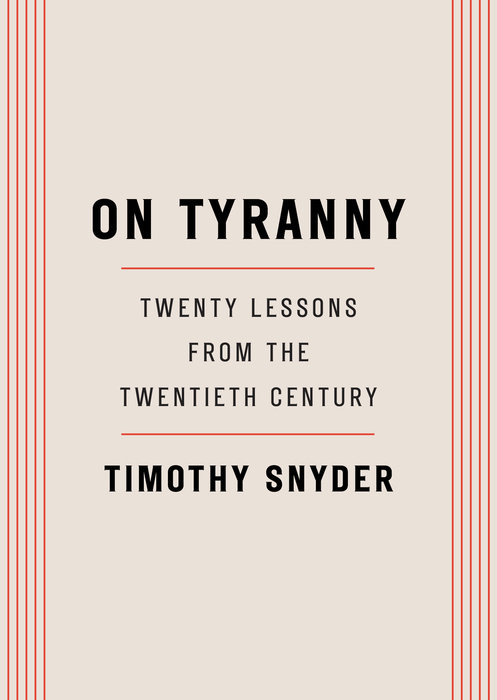
Retreating from the Politics of Eternity: on Timothy Snyder’s On Tyranny: Twenty Lessons from the Twentieth Century. By Gerardo Muñoz.

snyder-on-tyrannyWe often cite James Madison’s acute observation from Federalist 10: “Enlightened statesmen will not always be at the helm”. Timothy Snyder’s On Tyranny: Twenty Lessons from the Twentieth Century (2017), is written keeping this political conviction in sight, so indispensable to the democratic aspiration of the framers more than two centuries ago. Snyder, however, is no messenger of good news. In line with those that have taken seriously the rise of presidentalism, and the expansive politization of the executive branch in recent decades, Snyder is making the case for a timely warning against a potential threat for tyranny in the wake of Donald J. Trump victory at the end of last year.

On Tyranny is informed by Snyder’s expertise and research as a historian of Eastern Europe and the Holocaust, which have resulted in landmark contributions such as Bloodlands: Europe between Hitler and Stalin (2012), and Black Earth: The Holocaust as History and Warning (2015). In both of these books, Snyder has shown quite convincingly, how the erosion of institutions and the rule of law, due to both communist and fascist planning and dismantling over the control of the eastern region, paved the way for absolute anarchy and systematic destruction that made the Holocaust a juridical and political reality. Snyder does not mean to say, by way of an easy equivalence, that Trumpism amounts to a repetition of this historical period. Rather, On Tyranny is a precise warning on two levels: on one hand, it is a plea to rethink the necessity of institutions in the times of the rise of what Arthur Schlesinger Jr. called the imperial presidency; and secondly, to learn as much as we can from History, particularly from the historical evidence that confirms that every republic has always combated and affirmed itself against a latent imperial drift. Snyder’s thesis, presumably informed from a historiographical position, also suggests a political anthropology. In other words, the battle against an empire solicits an abandonment of the voluntary servitude that only feeds the incremental force of reaction. Our present shall not be indifferent to this.

After the 2016 election what is really at stake is whether the Federalist warning against the rise of factions is enough to contain an unprecedented alignment of vertical hegemonic power. There have been scholars, such as constitutional lawyer Eric Posner in The Executive Unbounded (2013), who have said farewell to Madisonian democracy in light of the exceptional upsurge of the executive branch [1]. On Tyranny does not go this far, but it is obvious that its purpose is not to engage in the aporias and intricate developments of constitutional law in order to render feasible an argument in favor of a retreat from hegemonic politics. Non-hegemonic politics always entail breaking the spell of a given set of coordinates that have produced an impasse. Snyder provides an array of historical examples: Rosa Parks in 1955 or Winston Churchill in the darkest moment when Hitler materializes his territorial expansion. It is in these perilous moments that the retreat from hegemonic politics does not mean renouncing political action. It means, first and foremost, abandoning the hyper-political consistency that defines the eternity and enmity of the political. But I do not want to get ahead of myself while briefing Snyder’s book. Havel, Parks, Churchill, Arendt, these are names that metonymically index Snyder’s plea for a politics of vocation in a time when rhinoceros are roaming through the landscape. The reference here is, of course, Ionesco’s well-known 1959 play Rhinoceros, which Snyder introduces when discussing the submission to politics of untruth:

“Ionesco’s aim was to help us see just how bizarre propaganda actually is, but how normal it seems to those who yield to it. By using the absurd image of the rhinoceros, Ionesco was trying to shock people into noticing the strangles of what was actually happening. The Rhinoceri are roaming through our neurological savannahs….And now, as then, many people confused faith in a hugely flawed leader with the truth about the world we all share. Post-truth is pre-fascism” (Snyder 70-71).

The rhinoceros are the political converts, which are always one step too close to the work of hegemony and its delirious power. It is then entirely consistent that Snyder also makes the claim for the protection of a new sense of privacy (sic) that could contain the boundaries between oikos (private) and the polis (public) against the drift towards totalitarianism (Snyder 88). Tyrannical politics is also a politics without secrets. It does not necessarily emanate from this position that a new egotist sense of privacy will act as a modality in an existence that is now beyond risk, guarding its own skin from the wild beasts. Snyder recognizes that there is no politics without factions, as Madison would have also said. Hence, there is no real politics without a minimal corporeal investment (Snyder 83-85).

But we have moved away from the level of hegemonic thirst for domination, conceiving a relation with politics that is not exhausted in the singular existence. Or put in different terms, only in existence could a politics of lesser domination be allowed to emerge against the threat of factions. Politics should not be oriented towards the end of the administration of life, which always amounts to a biopolitics. A republicanist politics is the orgazanition of public and social life that prevents both, the intensification and nullification of life in the polis.

What becomes troublesome, as Snyder makes clear, is that the administration of politics is today justified under the name of terror. In fact, Snyder states: “Modern tyranny is terror management” (Snyder 103). This is, indeed, an actualization of the schmittian withholding of the state of exception now normalized at the heart of democratic systems. Hence, the new danger is not just juridical, although it is also that. Snyder presses on the fact that current governments and parties – from Putin’s Russia to Le Pen’s Front National to Trump’s populist rallies in Florida or North Carolina – are borrowing props and gestures from the 1930s, a decade that Steve Bannon has labeled “exciting”. It is no surprise to anyone that we are currently living in times justified by exception in the name of the “crisis”. It is this time of excitement that provides a grammar of historical teleology and inevitability, and further, of judgment. However, the passage from inevitability to something darker is what Snyder calls the politics of eternity, which is really the core of his book, and the sign under which neo-fascism abides:

“…the politics of eternity performs a masquerade of history, though a different one. It is concerned with the past, but in a self-absorbed way, freed from with any real concern with facts….Eternity politicians bring us the past as a vast misty courtyard of illegible monuments to national victimhood, all of them equally distant from the present.” (Snyder 121).

If there is no real concern with facts, it is because all politics of untruth are politics to cover the Real, or what Jaime Rodriguez Matos has recently called the formless thing [2]. And for Snyder, national populists of the far right are eternity politicians providing a form that at the end of the day is just sending signs of smoke (Snyder 122). What is being covered is the void that leads to a point of no return: mainly, that there is no “greatest moment to return to”, since it is impossible to resurrect Empire. This inevitable untruth provides illusory grounds to radical right rhetoric in Europe. Although, we must infer that this is also the moment where Trump appears in its maximum existential danger to us.

It is uncertain if the institutions of the West will withstand this immanent threat. Although it is in this conjuncture that the rule of law becomes as central as ever before, and to discard it, is perhaps one of the greatest acts of moral decrepitude. It is here where we awake from the sleepwalking of eternal politics, as we are confronted with the historical sense that gives us the phantasmatic company of those who have perished, and that have suffered more than us (Snyder 125). It is in this affirmation, we agree with Snyder, that we find a substantial push against all tyrannies.


Notes

  1. Eric Posner & Adrian Vermeule. The Executive Unbound: After the Madisonian Republic. Oxford: Oxford University Press, 2013.
  2. Jaime Rodriguez Matos. “Politics, Trace, Ethics: Disciplinary Delirium—On Trump and Consequences”. Paper Read at USC Conference, November, 2016. https://infrapolitica.wordpress.com/2016/11/14/politics-trace-ethics-disciplinary-delirium-on-trump-and-consequences/