A Question on “Infrapolitical Action.” (Rubria Rocha de Luna)

In “Infrapolitical Action,” posted below in the blog, it is stated that Lacan considers that men can never completely understand the law. This lack of knowledge or stupidity is part of being human; proof of this is neurosis. The impossibility of knowing the law is caused by censorship which, in Freudian terms, would be an instance of the super-ego. Sovereignty passes through the same process, since it also “belongs in the domain of the unknown.”  Is sovereignty to be associated to the Freudian “navel of the dream,” which nevertheless, as “the point where the relation of the subject to the symbolic surfaces,” is the very name of being (“what I call being is that last word,” says Lacan in Ethics [105])? It is in that very sense that sovereignty is apotropaic and katechontic: either we uphold sovereignty through our very unbelief in it, through our very lack of understanding and rejection of it, or we lose our head, which is cut off” (Infrapolitical Action).  Can anything else be contemplated?

For Nancy, 1968 is the year when the structure of democracy and its subject were about to change. Nancy considered that “European democracies at the time were democracies without demos,” and an epochal crisis is felt concerning the subject of the political. Then the notion of subject changed its meaning: “Nancy critiques modern democracy as having been always occupied by a notion of a subject with mastery in terms of “representations, volitions, and decisions’” (25): “the subject . . . presupposed by a self-producing and autotelic being-for-itself, subject of its own presuppositions and of its own anticipations . . . whether individual or collective, was now overwhelmed by events” (24). Nancy, for the post-1968 period, that is, for the present, “proposes a democracy without a figure” and the “return of the originary moment when the city forfeits the formative-figurative principle in the renunciation of the common as general equivalence”. (Infrapolitical action)

According to this, is the demos that is lacking in 1968, the site of the infrapolitical? How could we understand Nancy’s subject after 1968? Does this subject follow the same structure proposed by Lacan? If so, how does the infrapolitical work within that structure?

Leviatán sin pueblo: sobre Leviathans Ratsel, de Giorgio Agamben. Por Gerardo Muñoz.

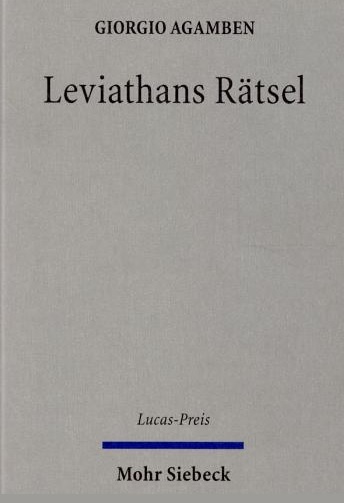
Leviathans Ratsel Agamben 2014En la nota que sigue quiero detenerme en una reciente lectura de Giorgio Agamben sobre el Leviathan (1651) de Thomas Hobbes y elucidar algunas de sus tesis. Leída como ponencia en el marco de la ceremonia Dr. Leopold Lucas-Prieses 2013 en Tübingen, y publicada ahora bajo en edición bilingüe como Leviathans Ratsel (Mohr Siebeck, 2014), el filósofo italiano ofrece lo que pudiéramos llamar, de forma preliminar, una lectura sintomática de la escatología, cuyo propósito es nada más ni nada menos que la deconstrucción interna del pensamiento sobre el Estado Moderno que ha dominado la teoría política durante los últimos tres siglos. Si el Leviatán ha gravitado como figura categorial fundamental en el pensamiento clásico sobre el Estado – de Carl Schmitt a Quentin Skinner, de Leo Strauss a Eric Nelson – la tarea consiste, nos dice Agamben, de poner a examen de una vez por todas a la figura del “gran dios mortal” a la luz de su propia escatología esotérica.

En buena medida esta conferencia radicaliza el argumento del Carl Schmitt de El Leviatán en la teoría del Estado de Thomas Hobbes (1938) quien sostenía, revisando su propia teoría en torno a la soberanía en Teología Política, que la crisis de legitimidad de la modernidad y su caída hacia la nihilización del mundo ya se encontraba en la disposición maquinista del Estado hobbesiano. En otras palabras, la posterior desintegración estatal tenía sus fisuras en la debilidad apotropaica de un viejo símbolo. A diferencia del autor de Romanticismo Político, Agamben no busca rehabilitar al Leviatán como forma katechonica de la gran política estatal, sino más bien insinuar su estatuto extenuado, cuya aporía solo es posible de captar en la medida en que podamos comprender el misterio que Hobbes inscribió en ese emblema marítimo. El gesto de lectura de Agamben también busca distanciarse de las teorías del contrato social, desde las cuales Leviatán es convencionalmente desarmado como el representante del “Pueblo” o la Commonwealth en un proceso invariante entre el poder constituido y el poder constituyente.

La clave la encontramos, en primer lugar, en el plano pictórico. Se trata de entender la lógica óptica que organiza espacialmente el conocido grabado que Abraham Bosse hiciera para la portada del libro de Hobbes, y que muestra al gigante Leviatán compuesto de pequeños hombrecillos mientras se asoma detrás de una montaña de un pueblo inhóspito. El Soberano flota en el mar (por su propia condición anfibia), mientras que el espacio de la ciudad se encuentra despojado de ciudadanos. Esta sería, en primer lugar, el momento aporético de la soberanía: el devenir del Soberano aparece situado en el espacio anómico (donde la tierra termina) cuyo cuerpo ahora encarna un “Pueblo” que ha dejado de ser multitud.

Y desde una lectura de De Cive, Agamben explica que el concepto fundamental de “cuerpo político” solo puede entenderse en la medida en que la multitud nunca coincide con el soberano, y es precisamente por esto que la multitud es capaz de sobrevivir como remanente existencial (tal vez como “forma-de-vida”) una vez que el “Pueblo” se inscribe el no-lugar de la “persona artificial”  del Soberano. Como argumenta Agamben:

“Es un lugar común decir que en Hobbes la multitud no tiene ningún sentido político y tiene que desaparecer para que el Estado pueda comenzar a existir. Pero si nuestra lectura de esta paradoja es correcta, y el pueblo se constituye de una multitud desunida, entonces la multitud no solo antecede al soberano, sino que en forma de multitud dispersa continua existiendo posteriormente. Lo que desaparece es el pueblo que ha migrado a la persona soberana, y si bien gobierna la ciudad, le es imposible morar en ella. La multitud no tiene ningún sentido político, sino que es el elemento impolítico cuya exclusión funda la ciudad solo para que la multitud habite un mundo en ausencia de pueblo que se ha desaparecido para integrar el cuerpo del soberano (Agamben 32) [1].

Así, la multitud signa la inoperancia de la concreción teológica-política del Soberano en tanto pueblo. Incluso, podríamos decir que a diferencia de Antonio Negri y Jon Beasley-Murray, la multitud que aparece en Hobbes no es propiamente la de un poder constituyente como agente transformador de la historia en vías de constitución, sino como remanente sin Pueblo y sin principio. Esto es, como esa katargesis, concepto que Agamben estudia en la epístola a romanos de San Pablo, incapaz de coincidir con el Pueblo ni restituirse como principio nómico [2].

La multitud solo recoge en su existencia un habitar permanente de mundo vacío, sin pueblo y sin arche. Emerge aquí un Hobbes emparentado con el Maquiavelo del comienzo aleatorio y sin origen avanzado por Althusser. Por lo que toda condición de democracia – y esta sería una formulación de la lección hobbesiana que nos refiere la lectura de Agamben y que se abre en el interior de nuestra discusión – se sitúa en una zona de indeterminación del “sin principios”, o bien en perpetua ademy que signa el fin categórico del pueblo, y por lo tanto de toda articulación hegemónica.

Pero volvamos a la figura mítica del Leviatán. Lo que para Schmitt representaba (dentro de su invariable visión antisemita de la Historia) el despedazamiento final entre Leviatán y Behemot al cual los judíos solo contemplaban a distancia, para Agamben desoculta una óptica escatológica que irrumpe todo principio estatal como garante katechontico de la historia. Lo que introduce Hobbes con Leviatán es la potencia misma de una política profana, a saber, una política sin fundamento o condición de restitución del acontecimiento transcendental de la Historia.

Su única promesa es la destitución del espacio de la excepcionalidad como regulación efectiva del derecho soberano. Si para Schmitt la anomia estaba irremediablemente asociada con la figura del Anticristo tal y como se concibe en la Epístola de Juan, con el escatón se abre otro espacio impolítico que ha sido olvidado completamente por la arquitectónica de la Iglesia y del Estado, si bien estas dos figuras de la contención política occidental pueden inscribir su huella.

Lo que sugiero es que del mismo modo en que el tratado El misterio del mal: Benedicto XVI y el fin de los tiempos anuncia una temporalidad escatológica desintegradora de la historicidad katechonica para la Iglesia; en Leviathans Ratsel Agamben lleva a cabo una destrucción de la temporalidad restrictiva de la política estatal hacia la apertura de una impolítica profana. Ambos gestos llevan la suma total de la teología-política a su ruina conceptual y al fin de su productividad epistémica. Pero habría que matizar, sin olvidar el final del ensayo que retoma al Benjamin del “Fragmento Teológico-Político”, que el eskhaton no busca poner al katechon de cabeza frente a la historicidad, sino que indica el éxodo a un espacio infinitesimal como naturaleza del fragmento en el devenir de una impolítica de la destitución (Agamben, 58) [3].

La propuesta de Agamben es, en este sentido, una invitación para releer a Hobbes a contrapelo, incluso contra el propio pensamiento que recorre el proyecto de homo sacer. Si en Il potere sovrano e la nuda vita (1995) aparece el Hobbes de la mutación del cuerpo hacia la muerte como parte de la invención contractual ‘protección a cambio de obediencia’, en esta nueva lectura el excedente de la fuerza inherente a la forma Estado hace que el “momento hobbesiano” recoja internamente su propia desintegración hacia una forma destituyente y profana, cuyo signo escatológico solo puede afirmar una opción no-nihilista del habitar sin Historia. En cambio, si en Lo abierto un manuscrito hebreo de la Biblioteca Ambrosiana ilustraba el banquete mesiánico donde el rostro de lo humano se ha vuelto indistinguible del animal, el cefálico Leviatán se prepara para el momento en donde el Reino solo puede volver irreducible la relación entre cuerpo y representación, entre vida y anomia en un panteísmo inmanente que solo Spinoza pudo conceptualizar hacia los comienzos de la Modernidad.

Si la arquitectónica política de la Modernidad yace en ruinas en nuestro tiempo, la propuesta que parece querer avanzar Agamben agiliza la investigación de la forma Estado que, lejos de operar como katechon y como representación del Pueblo, busca reconciliarse con su marca escatológica en la fractura que marca el tiempo del fin.

Notas

  1. Giorgio Agamben. Leviathans Ratsel. Mohr Siebeck, 2014. La traducción al castellano es mía.
  2. Jon Beasley-Murray. Posthegemony: Political Theory and Latin America. University of Minessota Press, 2010. p.XII-XV.
  3. Giorgio Agamben. “What is destituent power?” (Society & Space, 2014). Pienso en especifico en el momento en que Agamben posiciona su propuesta de la teoría destituyente frente a varios de los programas críticos de la política en la segunda mitad del siglo veinte: “It is this destituent potentiality that both the anarchist tradition and 20th century thought sought to define without actually ever succeeding. The destruction of tradition by Heidegger, the deconstruction of the archē, and the fracturing of the hegemonies by Schurmann, and what, on the trail of Foucault, I have called “philosophical archeology” – they are all pertinent, but insufficient, attempts to return to an historical a priori to destitute it…(….). The destitution of power and its works is an arduous task, because is first of all and only in a form-of-life that it can be carried out”.

Sobre la nota de Gerardo y las citas de Antonio. (Alberto Moreiras)

Gracias, Gerardo, magnífica nota, y gracias, Antonio, por copiarnos esos fragmentos de Gadamer. Creo que es quizás el momento de plantearse el enigma que supone el relativamente reciente texto de Agamben sobre la dimisión del Papa Benedicto. Igual que Schmitt y Althusser y Galli, Agamben constata el fin de toda legitimidad en las categorías de la política contemporánea, que es donde empieza su nota Gerardo en torno a Maquiavelo (también Maquiavelo habría dicho que “todo poder es necesariamente ilegítimo”). Gadamer supone que el irónico Schmitt pudo denunciar la carencia última de legitimidad de lo político a favor de una filosofía de la historia católica, que sin embargo nunca propuso afirmativamente (solo como genealogía denegada en el origen de la política moderna). Lo que hace Agamben es, a propósito del Papa Benedicto, restituir la filosofía católica de la historia. Que, obviamente, sería la única forma en la que Agamben puede pensar se podría combatir el nihilismo a tumba abierta de la ilegitimidad presente. La evolución de Althusser es más complicada, pues en él lo que está en juego es casi el procedimiento opuesto: él empieza por el abrazo dogmáticamente férreo a una filosofía de la historia, coincidente no ya con la tradición católica, pero tampoco con el marxismo originario, sino más bien con la escatología del Partido cuya filiación es clásicamente estalinista, para ir “subterráneamente” abjurando de ella hasta el punto de hacer de su obra una obra a leer sintomalmente, pues no puede hacerse coherente en lo relativo a principios. Entonces, la destrucción de la política en Althusser no se hace a partir de una alusión, implícita (Schmitt) o explícita (Agamben), a una filosofía de la historia de carácter religioso (con respecto de la cual el marxismo althusseriano sería una clásica secularización), sino que se hace ya como invivibilidad de la filosofía de la historia, como insoportabilidad de toda filosofía de la historia. Esa insoportabilidad arroja de sí un aroma de locura, como sabemos. Lo que queda es una destrucción conceptual abierta y un camino sin trayecto–el materialismo aleatorio obviamente no hace sino anunciar ese camino abierto pero no seguido, quizá no seguible. Cuando nosotros decimos que hoy la política debe pensarse infrapolíticamente o correr el riesgo de no poder pensarse nos referimos a esa constelación de problemas o situaciones. Pero también proponemos, implícitamente, que la reflexión infrapolítica ni apunta a la reconstitución fantasmática o irónica de filosofía alguna de la historia, ni apunta a la locura del eautontimoroumenos, la incoherencia que solo puede rescatarse de sí misma sintomalmente. Busca otra cosa.

‘Un pobre diablo’: Schmitt sobre Maquiavelo. (Gerardo Muñoz)

En el libro Lo sguardo di Giano: Saggi su Carl Schmitt, de próxima aparición al inglés y desglosado minuciosamente hace ya varias semanas por Alberto Moreiras, Carlo Galli analiza con lucidez las diferencias entre Carl Schmitt y el autor de Il Principe. Es curioso, como hace notar Galli, que un autor que se pudiera equiparar rápidamente con el llamado “realismo político” figure con tan poca frecuencia en la obra de Schmitt, y lo que es más, termine por generar un llamativo silencio a lo largo de la obra producida tras la segunda guerra mundial; es decir, aquella que asociamos con el viraje de los discursos de la soberanía y el katechon hacia la indagación global del nomos de la tierra y las formas de preservar el ius publicum europaeum. En efecto, tal y como sugiere Galli, en Schmitt habrían dos Maquiavelo paralelos, lo cual supone desde ya lo que pudiéramos llamar la “aporía maquiavélica” en el pensamiento schmittiano.

En primer lugar, un temprano Schmitt vincularía a Maquiavelo a un pontífice de la “tecnificación de la política”, y así uno de los responsables del devenir moderno de la política como actividad íntegramente inmanente (al igual que Spinoza). Como ideológico de los fines políticos, la instrumentalización de la religión del florentino le parece a Schmitt consagrar el vaciamiento mismo de la legitimidad de lo moderno, y en tanto tal, la raíz de la perseverancia del nihilismo como forma de la historicidad epocal que culminaba en el pensamiento de Nietzsche (Galli hace notar, sin abundar mucho en el nexo, la manera en que Maquiavelo aparece repetidamente homologado a Nietzsche). Maquiavelo se ubica en una exterioridad de toda teología política desde el momento en que ésta se asume como artificio de la hegemonía. Al decir de Galli:

“Schmitt lee El Príncipe como un tratado acerca de las dificultades que encuentra el “Príncipe nuevo”, una vez terminada la continuidad de la tradición monárquica, para gobernar en una situación ilegitima. …Por lo tanto Schmitt encuentra en Maquiavelo a un pensador que ha comprendido la crisis epocal que da origen a la modernidad, haciendo de todo poder un poder necesariamente ilegitimo”.

El otro Maquiavelo le ofrece a Schmitt un reverso de aquel signado por la técnica del fundamento político de mando en el vacío de la legitimidad. Es así donde, a partir de los treinta, Schmitt modifica su lectura hacia un Maquiavelo, a la manera del Althusser de la “ausencia determinada”, ahora abierto a lo político como contingencia y a la potestas directa que incide en la apertura situacional más allá de la armadura legalista de normas genéricas erigidas por el derecho positivista. Leído desde El concepto de lo político, Galli propone que el Schmitt de “La era de la política integral” (conferencia leída en la Roma de 1936), y del previo opúsculo “Macchiaveli” (1927) publicado en el Kolnishe Zeitung, reconstruye al pensador renacentista como uno de los precursores de la figura del Estado como aparato katechontico de la Modernidad, capaz de dar forma (gestalt) al nihilismo moderno impulsado ya sea por la crisis de la legitimidad tras la destrucción del complexio oppositorum de la autoridad papal, así como por el triunfo economicista del liberalismo europeo.

Lo que está en juego entonces para Schmitt (como autoridad ante el conflicto), así como para Althusser (para repensar la lucha de clases en tanto el desarrollo desigual y combinado), no es solo la relación Maquiavelo-Modernidad, sino Maquiavelo como la posibilidad de repensar al Estado como dispositivo que, internamente, fuera capaz de mediar entre el sistema categorial moderno y la concreción de lo político como lugar de arbitraje del conflicto. En este sentido, no es casual que Galli cite a Schmitt y recuerde que para el autor de Romanticismo Político “Maquiavelo era un pobre diablo” (ein armer Teufel); expresión no del todo feliz si recordamos, siguiendo a Heinrich Meier (The Lesson of Carl Schmitt) y más recientemente a José Luis Villacañas*, que justamente el último Schmitt de Glossarium, explicaba la aparición de Hitler como figuración del diablo en el intento de dar-forma (Gestalt) a lo político. Así, Maquiavelo significó para Schmitt el representante límite, me gustaría sugerir, de la substancialización de la política que siempre lleva consigo la traza de su destrucción. Como en el póstumo Machiavel et nous de Louis Althusser, aunque por otras muy distintas vías, la lectura de Schmitt sobre Maquiavelo vía Galli dan cuenta de la necesidad de transformar la política hacia otra parte luego de su caída en el origen mismo del republicanismo renacentista en que se quiere pasar a la unificación bajo el arche (la Monarquía).

Tras la publicación del ensayo sobre el tropo del Leviatán en Hobbes, Schmitt vuelve a su posición originaria en torno a Maquiavelo, puesto que ya ni la idea de Estado Total (tesis que le habría traído problemas con los propios ideólogos del Nacional Socialismo) resulta convincente como katechon de lo moderno. Más allá del “concepto de lo político”, Maquiavelo prescindía de un concepto jurídico de la soberanía, y por lo tanto de la excepción decisionista, lo cual ahora parecía mucho menos útil que la máquina inoperante y mortal (el Leviatán) desde la cual Hobbes intentó responder a las aporías de la legitimidad moderna polarizadas entre soberanía y biopolitica, entre autoridad y obediencia voluntaria (auctoritas non veritas facit legem). Aparece así, nos dice Galli, un “Maquiavelo demasiado humano” incapaz de haber imaginado la insuficiencia de la máquina-Estado (Hobbes) a partir del diseño de la “política como energía” (virtud).

Sin querer homologarlas, ni mucho menos pretender establecer una equivalencia mutua, el descubrimiento de la insuficiencia de Maquiavelo para Schmitt tiene resonancias con el reverso de otras de sus importantes lecturas, ya aludidas, durante la segunda mitad del siglo veinte: me refiero, a aquella llevada a cabo por Althusser, quien reconstruye un Maquiavelo de la práctica teórica concreta, expuesto al momento aleatorio, cuyo vacío signa el momento inicial de la forma política sin principios.

Por lo que el regreso a Maquiavelo, en ambos, explicita la destrucción de una cierta política de la afirmación, y el comienzo de un pensamiento “infrapolítico” y situacional donde la pregunta por los comienzos deviene inherente al interregno contemporáneo ya marcado no solo por las transformaciones fácticas de la política internacional, sino por el derrumbe abismal de sus matrices categoriales. Maquiavelo es ahí el síntoma de una promesa a encarar el nihilismo que se abre como sombra de lo moderno.

Nota:

*José Luis Villacañas estudia la relación entre la concepción del genio y la forma (gestalt) en Schmitt en una reciente intervención “Carl Schmitt: una autocrítica”, leída en el marco de la conferencia “Literatura / Posthegemonia / Infrapolitica”, Universidad Complutense, 16-18 de Junio, 2014.

A Minor Provocation. (Alberto Moreiras)

We are familiar with the old Gramscian division of the intellectual field between organic and traditional intellectuals.   Deleuze and Foucault have their own divisions.   Althusser, in Machiavel et nous, proposes his own: he talks about the litterateurs, whose mission is presumably the interpretation of a given state of ideology, the ideologists, whose mission is the reproduction of the system, and the political thinkers proper, whose mission is of course the transformation of the world.   The reference to the thesis on Feuerbach on transformation as the task of materialist philosophy was crucial for Althusser, as we know, and the proper content of his notion of epistemic break.   So, within that classification, what about infrapolitical thinkers?   Neither interpretation nor reproduction nor transformation—or rather, all of them, necessarily, but not as thematic for the endeavor.   Infrapolitics is inhabitation, and the infrapolitical thinker is a thinker of inhabitation.   We are far from the aesthetics of existence, or the ethics of existence, or the politics of existence, or the ideology of existence—or rather, those are all factors, but not thematic. We want to reflect on the conditions of existent dwelling on earth—no less, no more. This does not close off reading, it opens it to possibilities the critical tradition has mostly left aside. Overwhelmed with distraction as it has been.   Our contention: given that sad state of affairs, the infrapolitical thinker also dreams of a determinate absence, of an empty space one would hope to fill some day.

Althusser’s Machiavelli, 2. (Alberto Moreiras)

First of all, do take a look at Jon Beasley-Murray’s previous blog on Althusser’s Machiavelli: http://posthegemony.wordpress.com/2013/02/13/machiavelli-and-us/.  What follows, and what antecedes in my previous post, are just an elaboration of it.

In “La récurrence du vide chez Louis Althusser,” another essay published as an appendix to the book edition in French of Machiavel et nous, Francois Matheron quotes a private communication from Althusser to some of his friends: “It so happens we have a certain number of definite means that we are the only ones to have. It just happens that, as a function of this transitory privilege, we are the only ones that can occupy, and that occupy, an empty space: the space of Marxist-Leninist theory, and more particularly the place of Marxist-Leninist philosophy” (224-25).   It is an intriguing text, where Althusser is saying “we are here, we might as well use it.”   Or even: “we are here. We must use it. If not us, then who?” Which means that the space Althusser and his friends occupy is the mere occasion to launch the possibility of a beginning, of a political beginning.   The occasion binds the political agent to the very extent that the political agent is only an agent seeking an occasion. It is a structural place, in the sense that it is a particular site within the general structure, but it is more than anything a conjunctural place.   From which to make a leap, were it the case that Fortune helped.   In the meantime, one is not in politics, but preparing for politics. Preparing the necessary virtue. Thinking under the conjuncture. Waiting in active waiting.

This means, a political objective must be in place, which we need to understand under the figure of “determinate absence” (Machiavel 137).   It is not there, or rather, it is there but under the form of a void that must be filled.   And it will only be filled if an encounter were to happen that cannot be anticipated, only desired.   A political act is always an absolute beginning because its event is aleatory.

Althusser and his friends are therefore preparing themselves to take on the role of the New Prince, which they understand can only happen from within the Party.   The Party is seen as a necessary part of the conjuncture, as a necessary part of political virtue, but also as a necessary part of historical Fortune. In the name of a political objective, which is no longer, for Althusser and his friends, the constitution of a lasting national State, but rather the constitution of the state of communism. This complicates the notion of “determinate absence.” For Machiavelli, the determinate absence could only be filled by the absolute solitude of the New Prince.   But the absolute solitude of the Prince can hardly be translated to the solitude of the Party.   There is no solitude to the Party, witness Althusser’s own words to his friends.

Althusser has of course denied that Machiavelli must be understood as a democratic republican, and even more so that he has any secret or esoteric intentions.   Everything is out in the open if one cares to understand The Prince in the context of the Discourses.   What is at stake is the creation of a new political space, a lasting national Italian space, without tyranny, with laws that can protect the people. Against whom? Not just against foreign agents, but particularly against the grossi, the dominant class.   The dominant class is characterized by its desire to command, by its desire to oppress. The small people, the people as such, only care about their own safety. Freedom is for them freedom from oppression.   If the Prince must on occasion act as a scoundrel, well, it can be forgiven if it is done for the sake of a lasting national constitution without tyranny.   But it won’t be forgiven if it results in tyranny.

The solitude of the Prince is then compensated, at a second or later moment, by the Prince becoming the people.   This is the politics of the day-after, in other words, not the politics of the act of political irruption, not the politics of the aleatory encounter that might enable a change in the coordinates of the situation, even an impossible change (a change that only becomes possible after it happens, but could not have been predicted).   One supposes the Party must follow a similar course, since the Party is the new Prince. The Party must become the people, even if only after power has been taken, that is, starting the day after. This might be the task prospectively self-assigned to Marxist-Leninist philosophy and his agents, Althusser and his friends.  Discussing this, still allegorically, still in the name of an exegesis of Machiavelli´s work, is presumably the object of the last extant chapter in Machiavel et nous (which we know was left unfinished).

It has to do with the development of the Marxist State apparatus, and Althusser’s first interest is then showing the similarity between Machiavelli’s take and the Marxist one. For Althusser, Machiavelli would already be signaling in the direction of Gramsci’s definition of the state, “une hégémonie (consentement) bardée de coercition (force)” (147). Beasley-Murray is right, in his blog entry mentioned above, that what follows is a fundamental endorsement of hegemony theory through the analysis of the Machiavellian popular army, the function of base ideologies (religion) and secondary ideologies, and particularly of the Prince as state individual.

And it is in the analysis of the latter that a curious contradiction comes up. The Prince must “become the people,” but it turns out to be a fake becoming.   The Prince is before all, through his or her very virtue, a master of what Kant would have called radical evil, that is, a master at making political appearances look like righteous behavior. It is always a matter of fooling the people, then, either with the truth, that is, by conforming to the ideology that supports the state (religion, laws), or with a falsity meant to appear as a truth. That is, even the Prince’s righteous behavior appears as a form of deceit, once it is accepted that the capability of becoming evil is also proper to the Prince. Because the people, il volgo, want to be content, the Prince must do everything he or she can to keep them ideologically content—and this is of course the limit of the hegemonic model Althusser establishes Machiavelli proposes, and Althusser seems to sanction.   “Parmi tous les tromperies possibles, il en est une qui intéresse le Prince: la tromperie par excellence, celle qui présente aux hommes l’apparence mëme en laquelle ils croient, qu’ils se reconnaissent, oú ils se reconnaissent, disons oú leur idéologies se reconnaït en eux, celle des lois morales et religieuses” (169).

The fakely-becoming-people of the Prince is never addressed as such except as a political necessity.   But it marks a gap, or a “vide,” to use one of Althusser’s favorite words, in the very conception of politics proposed. Politics takes absolute priority, for the sake of its end, true (Althusser has argued earlier that the prevalence of the end makes Machiavelli´s theory anything but a form of pragmatism: “only results count, but it is only the end that judges the results that count” [161]), except that the end, politically speaking, is the necessary becoming people of the Prince, which is barred through the essential falsity of the Prince’s political action. When we transpose this situation to the actions of the Party, either before or after it takes power, we can see how unsatisfactory the theory becomes.   Just as unsatisfactory as the history we know.   If, as Althusser puts it, the Prince looks, not for the love, but for the “friendship” of the people (172), even as State individual, then the friendship gained in the political game remains a function not just of consent and coercion, but of duped concern sustained in the violence of the constant ruse (in addition to coercion based on force).   Bad friendship, which may be all hegemony can offer at best. Althusser calls it “ideological politics” (173).

It is clear that Althusser’s text does not manage to resolve the tension between politics as aleatory encounter, as the virtuous ability to seize the unforeseeable conjuncture and to keep itself within the rigor of the unforeseeable, and the hegemonic politics of the day-after, which are no longer aleatory politics, but a politics determined to gain and accumulate at the cost of perfectly foreseeable and presumably systematically organized state duping.   Critics have become accustomed to accepting something like two Althussers that can find no common ground. Beasley-Murray associates posthegemony to the Althusser of the encounter, to the extent that the notion of the aleatory encounter as master trope of political action excludes and must even denounce hegemonic procedures of constitution.

But does infrapolitics figure here?  Clearly, Althusser’s intent, whether it is the first or the other Althusser, is to theorize the political as such.   That it is an insufficient and broken theorization (and I do recommend Francois Matheron’s “’Des problèmes qu’il faudra bien appeler d’un autre nom et peut-ëtre politique’”), that politics ends up offering a disappointing result, may point the way towards the need for infrapolitical reflection.   So far we can only see it in the definition of il volgo as those who do not have the desire to command and opress but would rather be left alone in their everyday life, would rather reject the false friendship of the Prince who prides herself or himself in her or his capability for evil and ruses.

If we may understand infrapolitics as the region of historical facticity, the factical opening of historical space, that is, of spatial temporality for a life, for any life, infrapolitical reflection is first of all a destruction of political inconsistency, which ceaselessly hijacks both time and space (it is not only that, as Marx puts it in the Grundrisse, all economy is an economy of time, but all politics are equally a politics of time). It is as a destroyer of political inconsistency, which may be politics’ only consistency, that Althusser’s essay on Machiavelli may be claimed to be part of the infrapolitical archive.   When it comes to infrapolitics, perhaps the people will decide that they have better things to do than to prepare for politics, than to wait in active waiting for an event of beginning.   Perhaps, after all, thinking under the conjuncture may enable us to dismiss the conjuncture, and to look for something else.

Marginal Note. (Alberto Moreiras)

Infrapolitics is not a spatial metaphor for history any more than posthegemony is a temporal metaphor for political space. I am not sure supplementary conceptuality–something that would perhaps help us understand more and better, but also something that might retrospectively have become premature, in the absence of proper clarification of what is already on the table–is so necessary at this point (although why not?  We’ll take the risk.)   What we really need is a proper and nonreductive understanding of what is at stake through the very word infrapolitics. Over the last two months, in this blog, an attempt at mapping a territory of engagement has taken place that is still ongoing. But doing it in the blog, and in the context of an ongoing seminar that follows a proposed reading list, has very serious limitations. Those very limitations might be backlashing now. They are fostering potential misunderstandings that might derail the conversation (although I understand that there would be no conversation without misunderstandings).  But they could become misunderstandings leading nowhere.  This is presumably nobody’s fault but my own, although I attribute it to the medium.   No doubt a more formal proposal regarding the understanding of infrapolitics that we have been developing is necessary, and no doubt it will come at some point.   For now, we are simply on the way, which is all we can do.  

Althusser’s Machiavelli, 1. (Alberto Moreiras)

The French edition of Machiavelli and Us incorporates an article by Matheron, whose subtitle is “Althusser et l’insituabilité de la politique,” and which I hope I can comment on over the next couple of days, that throws some doubts as to Louis Althusser’s very understanding of politics.   Politics became a curious undecidable for him, particularly in his later years, and against the background of the fetishization of the plenitude of the Party as the subject of history.

It is not therefore surprising that Machiavelli and Us, which is a text Matheron himself dates between 1971-72 and 1986, should incorporate some hesitations on politics as such.

So, on the one hand, it is clear that Althusser thinks political tasks are “assigned by history” (58), and that, to that extent, Machiavelli should have dreamed of the creation of a national State, even if necessarily under a New Prince, since national States under New Princes were already in successful existence in France or Spain; it is also clearly consistent with Althusser’s ostensible goals that the national State would have been imagined by Machiavelli from the perspective of the people, not the Prince; and it is equally consistent that Machiavelli be presented as a thinker of the conjuncture, not the structure, to the point of claiming that all the theoretical work in Machiavelli´s writings is clearly subordinate to the task of thinking the concrete situation, that is, the conjuncture, but not in the form of a thinking of the conjuncture, about the conjuncture, rather in the form of a thinking under the conjuncture, within the conjuncture.

The conjuncture is not invented by men—it is given by history, no matter how aleatorily.   The political task attached to the conjuncture is therefore also given by history, and it sets obligations for everyone defined by everyone’s position in the class struggle.   Althusser seems to move in this first chapter towards stating that it is the instance of political practice within an aleatory conjuncture, nevertheless binding as such, that determines theoretical needs, hence, that prompts thought towards concrete politics, at least for those who are thinkers of or with the people, that is, not litterateurs or ideologists of the ruling class.   Such would have been the case for Machiavelli, who, in Antonio Gramsci’s words, “made himself people” in The Prince.

What I find particularly interesting in this first chapter, however, is the possibility that a certain “thinking under the conjuncture” could move towards infrapolitics as such.     This may seem surprising. Machiavelli, everybody says, wants the emergence of an Italian national state ruled by a New Prince.   Hegel thought so, Gramsci thought so.   What is the point, then, of making sure everybody understands such a New Prince was going to be a despotic scoundrel?   As Althusser puts it, Machiavelli “avows their unavowable procedures and puts their secret practices in the public square” (72).   “La vérité du Prince apparaït alors pour ce qu’elle est: une ruse prodigieuse, celle de la non-ruse, une dissimulation prodigieuse, celle de la non-dissimulation: le grand filet de la ‘verité effective’ tendu en plein ciel où les Princes vont venir se prendre tout seuls” (72).

Rousseau attributed Machiavelli a “secret intention” and Diderot, the likely author of the Encyclopédie article on Machiavelli, thinks Machiavelli actually told his readers: “if you ever accept a master, he will be such as I have painted him, voilá the ferocious beast you will be abandoning yourselves to” (73).

If one accepts the hypothesis of the esoteric Machiavelli, I suppose one has a choice: to think that Machiavelli was a democratic republican whose understanding of history was radically committed to anti-despotic politics, and that he denounced avant la lettre the bad lesson of the national State under an absolute ruler; or, indeed, that he was not only a democratic republican, but was one always already captured by a radical foresight concerning the misfortune of politics as such.   For this latter Machiavelli, there was no anti-despotic politics, only the possibility of “the void of a distance taken” (41), which is what we could call his infrapolitical turn.

It is not my intention to claim that Machiavelli was “the first thinker of infrapolitics” or any such thing. I am interested, rather, in following some of the more hidden nuances in Althusser’s understanding of the political-historical—precisely those that seem to subvert his good-boy stances.  To be continued.

Sitze’s Introduction to Galli’s Janus Gaze on Schmitt. (Alberto Moreiras)

I think Adam Sitze`s introduction, which I post here with his permission (the book will be published by Duke UP, but it will take quite a few months), is a tour de force in terms of accounting for and critiquing sixty or seventy years of reception of Carl Schmitt´s work in Anglophone countries.  In the process, Sitze gives us one of the best rationales I have ever seen as to why it is still necessary to read strong thinkers even if contaminated by their connections to the Nazi regime. What goes for Schmitt could go for Heidegger as well, or for Jünger.

But Sitze also provides a summary introduction to Galli’s position vis-à-vis Schmitt well beyond the book under study.   This is extraordinarily useful for English-language readers and the scholarly community in general, particularly because Galli`s position is strongly revisionist not just in terms of Schmittiana but also regarding the status of political theory today.   One of the things that comes to mind, for instance, reading Sitze reading Galli reading Schmitt, is whether such an influential thinker as Giorgio Agamben, himself strongly influenced by the German theorist, would agree.   My impression is, he would not, which opens the field to a fascinating engagement with the importance of Schmitt’s work for contemporary discussions.

Sitze’s explanations regarding the founding conflict in Schmitt`s work on political modernity rank among the best I have seen, not simply in terms of Schmitt’s exegesis, but also because they enable us to understand what it is that is meant when a number of political philosophers and cultural critics today expound upon the terminal crisis in the architectonics of modern political thought, which is no longer useful except residually.   Sitze retroactively connects such a crisis to the thought of community in the Middle Ages, that is, the Catholic community as manifested in the Corpus Mysticum, and establishes how the break away from Christian complexio opppositorum set modern political thought helplessly on its way to accomplished nihilism.

Carl Schmitt, An Improper Name