‘Chasing the hare with the ox, swimming against the swelling tide’: Towards a Posthegemonic Institutionality. (Gerardo Muñoz)

*(Paper read at the workshop “Left Behind: The Ends of Latin America’s Left Turns”, held at Simon Fraser University, December 5, 2016. Organized by Jon Beasley-Murray.)

In an important moment of Alberto Moreiras’ new book Marranismo e inscripción (2016) we read: “La sospecha de no ser lo suficiente correctos en política, con todo el misterio terrífico que esa determinación tiene en la academia [norteamericana], pesó siempre sobren nuestras cabezas como una grave espada de Damocles y todavía pesa…” (Moreiras 125). It might be a good ocassion to say upfront that the waning of the progressive cycle in Latin America will most likely revive old affective demands and well-known pieties that the Left never affords to give up. Someone will be blamed for the broken plates, and the burden of those “left behind”. But this moment should be seized to think not what ‘politics’ should or must do (in Latin America and beyond), but rather how to think politics in what already is taking place. Or to question if perhaps the political today amounts to nothing more than what Arnaut Daniel said of the poet: “[He] chases the hare with the ox, swims against the swelling tide”. Can the paralysis of politics be something other than hunting or resistance?

As this 2016 comes to a close, we have witnessed a series of drawbacks in the political landscape of Latin America: from the outcome of the referendum in Bolivia to the electoral victory of Mauricio Macri’s PRO in Argentina, not to speak of Dilma Rousseff parliamentary impeachment in Brazil. There has been other lesser-known events, although no less disturbing, such as Roxana Pey’s arbitrary dismissal as First President of Universidad de Aysén by the current Chilean Minister of Culture after proposing a debt free and non-corporate public education. The sense of ‘exhaustion’ is at the thicket of the progressive cycle and has only deepened in the last two years, although this prognosis is more than just a motto of ‘ultra-leftistism’. Recently, high profile figures of the so-called Pink Tide governments have also voiced a sense of political stagnation and defunct space to reignite the original rhythm that took place at the turn of the century.

Just about a week ago, in a conversation that took place at Columbia University between philosopher Étienne Balibar and Vice-President of Bolivia Alvaro Garcia Linera, the latter stated that we are now in turbulent times where no horizon is in clear sight. It might be true that the unsettling remark might have partly been influenced in the wake of Fidel Castro’s death as the symptom of Latin American Left’ symbolic orphanhood, although Castro died far from leaving a relevant political legacy. I think many will agree that the guerrilla warfare, the Partido Único, or the concept of ‘struggle’ plays no role in the future of the Latin American Lefts. Yet such announcement from the Vice-President of the Bolivian Plurinational State seems to put to a halt the deep political conviction for transformation that he himself theorized in a wide range of orienting categories such as ‘creative contradictions’, ‘planetary ayllu’, or ‘communist horizon’.

The deficiency of a visible political vista means that we are in times of interregnum; a time when the modern epochality is left behind and a new one that has yet to materialize. The interregnum describes an extraneous temporality that fissures the antinomies of architectonics of modern politics – autorictas and potestas, constituent and constituted power, legitimacy and legality – carrying the very economy between thought and action in a threshold of indeterminacy. At the closure of epochality we are obliged to rethink once again the limits of the Latinamericanist conditions of reflection in light of the contemporary transformation of the space or object of knowledge that we call Latin America. A few years ago, John Beverley made an attempt to propose a new paradigm in his Latinamericanism after 9/11 (2011) under the preliminary notion of post-subalternism, which he defined as an alliance between subaltern and the new progressive State:

“The question of Latinamericanism is, ultimately, a question of the identity of the Latin American state…I would like to suggest here an alternative that is post-subaltenrist, ‘post’ in the sense that it displaces the subaltenrist paradigm but is also a consequence of that paradigm in that it involves rethinking the nature of the state and of the national popular from the perspectives opened by subaltern studies. …This possibility has a double dimension: how can the state itself be radicalized and modified as a consequence of bringing into it demands, values, experiences from the popular subaltern sectors, and how, in turn, from the state, can society can be remade in a more redistributive, egalitarian, culturally diverse way (how hegemony might be constructed from the state, in other words). (Beverley 110-116)”.

The post-subalternist option largely depends on the temporalization of the State-people alliance, which leaves pressing questions relative to State form and patterns of accumulation untouched, or any excess that disrupts the culturalist consensus at the heart of every hegemonic articulation. The problem that arises from this specific conceptual design is that with the rise of the New Rights, which continue to operate on the basis of the expansion of social inclusion through consumption, the hegemony of a ‘non-State that acts as a State’ (another way through which Beverley defines postsubalternism), will be set to accomplish two simultaneous tasks: on the one hand, contain and polish the heterogeneity or savage dimension of ‘the people’ into the metaphoricity of national-popular representation; while on the other, reducing the State’s structures and institutions to the management of geopolitical processes and rent distribution. In a rather counterintuitive way, the post-sulbanternist option reenacts the decionism from the instrumentalization of the state as the exception to post-sovereign capital in the name of the people.

At the same time, facticity is now fully post-subalternist, but for the opposite reasons as those imagined by Beverley: hegemony’s de-hiearchization and economic administration convergences with the neoliberal general equivalent as real subsumption of capital renders hegemonic politics obsolete for substantial change. Ultimately, post-subalternist alliance curbs posthegemonic temporal intrusion, which forces a relentless displacement of its object of identification to disregard the constitutive tragic repetition of the fissure in its closure.

Post-subalternism is an attempt to reawake the specter of hegemony from the ruins of the political: from the inside it stands politics of subjectivization by the State, and from the outside, as a metapolitical form of order (katechon) to detain internal social explosion (Williams 61).

In recent years the post-subalternist paradigm has been somewhat displaced by what I have called elsewhere a ‘communal or communitarian turn’ (Muñoz 2016). Raquel Gutierrez Aguilar, a key thinker of communal horizontalism and also the author of the influential book Los ritmos de Pachakuti: Movilización y levantamiento indígena-popular en Bolivia (2008), at the end of last year conjured a radical turn towards the “communal” as the site for a new political program. In a more urgent tone, Huascar Salazar Lohman in Se han adueñado del proceso de lucha (2015) defines the position as following:

“Lo relevante es afirmar que la transformación heterogénea y multiforme que emerge de los entramados comunitarios implica la capacidad de dar forma a su reproducción de la vida social, trastocando, trans-formando o reformando la propia forma de la dominación…La manera en que los entramados comunitarios enfrentan al capital es a partir de vetos que permiten conservar, establecer, o restablecer relaciones sociales para reproducción la vida. En este sentido, el telos o el horizonte de deseo que media la lucha comunitaria es el despliegue de su propia forma de reproducir la vida, es decir, ampliar su capacidad de formación” (Salazar Lohman 35).

For both Gutierrez Aguilar and Salazar Lohman, the communitarian horizon requires breaking away from the dichotomy of civil society and State in order to relocate the temporal vitality of an autonomous re-production of life and the re-appropriation of that which the state has expropriated from communal property. However, if the communitarian form is not determined a priori by domination and capital, why is the emancipatory potential of the communitarianism emphasized solely on the basis of re-appropriation of what is valorized in the State? Salazar Huascar himself provides the answer to us when alluding to Bolivar Echevarria’s reconceptualization of the notion of use-value as yielding something like an inner exception within the logic of exchange. Communitarism, then, re-translates use-value as locational propriety.

Ironically, this is not very different from Álvaro Garcia Linera’s own attempt to “restore the communal (ayllu), against the logics of subsumption, through a re-functioning of culture and democracy and the recent juridical-political attempting to contain the ‘cunning of capital’ as it imposes its logics through its others…” (Kraniauskas 48). Although it seems the polar opposite of Huascar’s position, Garcia Linera’s instrumentalization of the communitarian through use-value mediates an indianization of the subject of social emancipation in the ‘community form’” (Kraniauskas 48). In fact, communitarianism ends up offering yet another exceptional particularism legitimized by the normative assumption of propriety and properness via-a-vis collective decision-making ( as ‘participacion directa y obligatoria’), and an alternative biopolitics of the ‘reproduction of life’ (reproducción de la vida). Communitarianism as a locational politics of resistance is already contained in the State’s shadow of community use-value, which is inverted on behalf of communitarian decisionism.

A similar paradox is at the heart of Diego Sztulwark and Veronica Gago’s essay that expands the temporality of the ‘end’ of the Latin American progressive cycle from below. On the one hand, they note that neoliberalism runs parallel to constituting a governmentality from above, and is also “inextricably linked to popular consumption, apparatuses of indebtness, and new forms of violence” as two dynamics that permute and sustain one another” from below (Gago & Sztulwark 610). While discerning the spectral dimension of contemporary flexible capital, they immediately move on to claim that it is on this plane where new counter-powers are transformed, modes of weaving together a resistance and a set of practical actions for political efficacy… (Gago & Sztulwark 612). However, counter-hegemonic subjective vitalism is already captured by the plasticity of financial subjectivization. Thus, this new vitalism framed solely as resistance only lifts political imagination to the domain of stasis or civil war already taking place in the territories, in which the struggle for subsistence takes the form of a neo-Francicanism eschatology (minimal relation to propriety) immanent to the financial subaltern bodies.

I would like to suggest that the two reflexive options sketched above, that of a post-subaltern state and the particular communitarian horizon, coincide in fashioning a politics of resistance after the closure of hegemonic principles. At the same time, the failure of hegemonic theory in the region is in this sense neither accidental nor limited to the temporalization of the so-called progressive cycle, since it also characteristic of the phenomenology of the originary fissure in the State form over the last two hundred years.

Hegemony or hegemon as an ultimate ontology of the political constitutes itself as a phantasm, which following Reiner Schürmann, denies the tragic dimension of the singular, translating norms and legislating laws in the name of its own sovereign principle. A phantasm is hegemonic when an entire culture relies on it as if it provided that in the name of which one speaks and acts. Such a chief-represented (hêgemôn) is at work upon the unspeakable singular classifying, inscribing, and distributing proper and commonality (Schürmann 22). In this sense, communitarianism and state hegemony are not just contending procedures of political decisionism, but more importantly, the two poles of a same structure waged on life as ultimate referent.

This is why, according to Schürmann, there is a “kind of joy of violent submission to it. Perhaps the intoxication they wish for us, or that we wish for ourselves through them” (Schürmann 29). To the extent that is waged on life, there has always been hegemony, although only as a phantasmatic economy to flatten and systematically erase the time of the tragic, whenever it appears to interrupt and ascend into the political principle. This is the time of the singular that is neither reducible to a subject in the eventfulness of history (a movement, a people or a multitude), nor a cultural schematization of identity and difference.

The challenge for thought is necessarily post-hegemonic, which I define as the potentiality for institutionalization of the tragic (singularity) in the anomic epoch of neoliberal administration. It is no coincide that both communitarian and hegemonic options define themselves against institutions, and they both respond to the moment of crisis of political epochality. A reformulation of an institutional form can mediate the ever-present pendulum movement that oscillates from neoliberal deregulation to the populist anti-institutionalism and back. But it so happens that populism does not posses a theory of institutionality, therefore is in no condition of providing a strategy to cope with the movement of the pendulum (Villacañas 2016). Since populism is always a decision on a concrete existential situation, it always remains attached to the perpetuity of the state of crisis as a decision made on and for life (understood in the Greek sense of krisis as judgment). As such, populism is the temporality of expropriation, and its process of abstractation into finite demands coincides with the money form (general equivalent) that structures the contemporary financial body of the living.

In the introduction to their edited volume Left Turns (2010), Beasley-Murray & Cameron & Herschberg noted that “if the Latin American states are to survive their current crisis of legitimacy they then need to be better funded, more efficient, and more reflexive of public preferences…the entire political class confronts the challenge of refunding the Latin American State” (Cameron & Herschberg 6). This was the promise and the stakes .Since then, the Latin American Progressive Cycle’s extreme presidencialism led to the withering of institutionalization making it easier for an accelerated restructuring of the State’s institutions by the New Rights technocrats. As the populist interpellation between friend and enemy evaporates in each political cycle, the price to be paid is life as thetic communitarian identity formation or as counter-hegemonic biopolitical vitalism. Constitutional scholar Bruce Ackerman alerts in his The Decline and Fall of the American Republic (2010) that the expansion of the powers of the ‘most dangerous branch’ (executive) effectively prepares the ground for an ominous neoliberal anti-institutionalization. This is what lurks in United States’ political future after the President-elect Donald Trump, and more generally, what haunts the spatial configuration of every western state’s void of legitimacy.

A posthegemonic institutionality for post-hegemonic times seeks the thinking of another relation with the political that is not reducible to the principle of a hegemonic phantasm as the oblivion of its own excess to equivalence. But perhaps more importantly here is how to think a posthegemonic institutional form that that would break away from the indeterminate concrescence of law as always already short-handed for internal exceptionality in order to redirect and put in motion the temporality of development. Thus, a posthegemonic institutionality will thrive to move beyond a notion of interruption or an insurrectionary moment dispensed in the phantasm of hegemony.

How can we imagine a form of life instituted not only in its irreducibility to the movement of vital ‘rhythm’, but in the arrival of the day after, when the last lights have gone off, after everyone has returned home, and mobilization gives way to demobilization? In his book on the Spartacist uprising, Furio Jesi says that the ‘decisive day of freedom’ is that which takes place the day after tomorrow, in which the time of living is not exhausted in life or death (Jesi 134). The crucial distinction here is a temporal one: living against life or death.

To institutionalize not life in the frame of biopolitics or communitarism, constituent power as passage to constituted power, but a destituent time of the living. The day after tomorrow is posthegemonic demobilization as distance from political ontology and its conversion into metapolitical community. Only by institutionalizing the temporality of an improper singularity could something like an inequivalent and ungraspable form of democracy and radical freedom could be conceived as the new truth in and beyond politics.

Bibliography

Ackerman, Bruce. The Decline and Fall of the American Republic. Boston: Harvard University Press, 2010.

Beverley, John. Latinamericanism after 9/11. Durham: Duke University Press, 2011.

Cameron, Maxwell & Herschberg, Eric. Latin America’s Left Turns: Politics, Policies, and Trajectories of Change. Boulder: Reinner Publishers, 2010.

Gago Verónica & Sztulwark Diego. “The Temporality of Social Struggle at the End of the “Progressive” Cycle” in Latin America”. SAQ, 115:3, July 2016.

Kraniauskas, John. “Universalizing the ayllu”. Radical Philosophy, 192, July-August, 2015.

Moreiras, Alberto. Marranismo e inscripción. Madrid: Escolar & Mayo, 2016.

Muñoz Gerardo (ed.). “The End of the Latin American Progressive Cycle” (dossier). Alternautas (3.1, July 2016). http://las.sites.olt.ubc.ca/files/2016/11/Alternautas_End-of-Progressive-Cycle-Dossier-2016.pdf

Salazar Lohman, Huascar. “Se Han adueñado del proceso de lucha”: horizonte comunitario-populares en tensión y la reconstitución de la dominación en la Bolivia del MAS. La Paz: autodeterminación, 2015.

Schürmann, Reiner. Broken Hegemonies. Bloomington: Indiana University Press, 2003.

Villacañas, José Luis. Populismo. Madrid: La Huerta Grande, 2015.

.
Williams, Gareth. “Los límites de la hegemonía”. Poshegemonía: el final de un paradigma de la filosofía política en América Latina (Castro Orellana, ed.). Madrid: Biblioteca Nueva, 2015.

Life During Wartime: Eleven Theses on Infrapolitics

RACAL

“Life During Wartime: Infrapolitics and Posthegemony”
(with a coda of eleven theses on infrapolitics)

Presented at the III Seminario Crítico-Político Transnacional
“Pensamiento y terror social: El archivo hispano”
Cuenca, Spain
July, 2016

Why stay in college? Why go to night school?
Gonna be different this time.
Can’t write a letter, can’t send a postcard.
I can’t write nothing at all.
–The Talking Heads

In what is no doubt the most famous theorist of war’s most famous claim, Carl Von Clausewitz tells us that “war has its root in a political object.” He goes on: “War is a mere continuation of politics by other means. [. . .] War is not merely a political act, but a real political instrument, a continuation of political commerce, a carrying out of the same by other means” (119). There is, then, for Clausewitz an essential continuity between war and politics; they share the same rationality and ends. And this notion has in turn led many to think of politics, reciprocally, as a form of warfare. The German theorist Carl Schmitt, for instance, defines politics in suitably martial terms as a clash between “friend” and “enemy”: “The specific political distinction to which political actions and motives can be reduced is that between friend and enemy” (The Concept of the Political 26). Moreover, this invocation of the term “enemy” is scarcely metaphorical. Schmitt argues that “an enemy exists only when, at least potentially, one fighting collectivity of people confronts a similar collectivity” (28), and he further qualifies the particular type of enmity involved in political disagreement in terms of classical theories of warfare: the political enemy is a “public enemy,” that is a hostis, as opposed to a “private enemy.” He quotes a Latin lexicon to make his point: “A public enemy (hostis) is one with whom we are at war publicly. [. . .] A private enemy is a person who hates us, whereas a public enemy is a person who fights against us” (29).

Likewise, the Italian Marxist Antonio Gramsci also calls upon the language of warfare to describe political activity, which he classifies in terms of the “war of manoeuvre” by which a political party bids for influence among the institutions of so-called civil society, and the “war of movement” when it is in a position to seek power directly from the state. Indeed, the notion of an essential continuity between armed violence and civil dispute informs Gramsci’s fundamental conception of “hegemony,” which characterizes politics in terms of a combination of coercion and consent, the attempt to win or secure power alternately by means of force or persuasion. War is politics, politics is war: the basic goals and rationale are the same, we are told. It is just the means that are different.

Keep reading… (PDF document)

eleven theses on infrapolitics

  1. Infrapolitics is not against politics. It is not apolitical, still less antipolitical.
  2. There is no politics without infrapolitics.
  3. It is only by considering infrapolitics that we can better demarcate the terrain of the political per se, understand it, and take it seriously.
  4. The interface between the infrapolitical and the political cannot be conceived simply in terms of capture.
  5. Only a fully developed theory of posthegemony can account properly for the relationship between infrapolitics and politics.
  6. Infrapolitics corresponds to the virtual, and so to habitus and unqualified affect.
  7. The constitution (and dissolution) of the political always involves civil war.
  8. Biopolitics is the name for the colonization of the infrapolitical realm by political forces, and so the generalization of civil war.
  9. But neither politics nor biopolitics have any predetermined valence; biopolitics might also be imagined to be the colonization of the political by the infrapolitical.
  10. None of these terms–politics, infrapolitics, biopolitics, posthegemony–can have any normative dimension.
  11. Hitherto, philosophers have only sought to change the world in various ways. The point, however, is to interpret it.

Interregnum and worldliness: on Sergio Villalobos-Ruminott’s Heterografías de la violencia. (Gerardo Muñoz)

Heterografias de la violencia 2016Sergio Villalobos-Ruminott’s Heterografías de la violencia: historia nihilismo destrucción (La Cebra, 2016) is, at first sight, an assorted compilation of fifteen programmatic essays. Mostly written during the last decade or so, these texts attend to a wide range of theoretical specificities, such as the baroque and performative violence, imperial reason and contemporary literature, sovereign-exception law and flexible capitalist accumulation. It is to Villalobos’ merit that none of these issues are restituted to academic knowledge production or leveled out as a selection of “hot topics” within the neoliberal marketplace. As in his prior Soberanías en suspenso: imaginación y violencia en América Latina (La Cebra, 2013), what is at stake, far from erecting the edifice of a ‘critical theory’ aspiring to fix the limits of reflection – as postulated in “sovereignty” “nihilism” or “destruction” – is the composition of a constellation that circumnavigates the vortex of the general horizon of the philosophy of history and the university machine.

In some way, Heterografías is auxiliary to Soberanías en suspenso, but not in the parasitical sense of amending or filling previous generalities. This new collection pushes thought beyond the specificity of the insular ‘Chilean scene’, providing for the indeterminacy of the logic of sovereignty as the arcanum of both interruption and continuity of the philosophy of the history of capital in Latin America. This is not to say that in Soberanías en suspenso the ‘local Chilean scene’ operated self-referentially as the archive for the reassertion of a cultural investigation. In the prior book, the Chilean scene is understood as a paradigm, in the sense of a singular relation to the singular, which Heterografías converts into a topical ensemble that interrogates the displacements, variations, and narratives of principial Latinamericanist reason from both nomic and anomic spatial formations.

Heterografías resists positing a new metaphorization of history, as well as yet another ‘political theory’ for what Latinamericanists identify as the object of “Latin America”. Although Villalobos does not thematize it as such, his book is full-fleshed post-Latinamericanist, and the reason is not just because it moves and weaves through the Schmitt-Kojeve debate on geopolitics and colonialism to the politics of the baroque and Catholic imperial katechon; from Latin American literature (Borges, Lamborghini, Perlongher) to debates on memory and indexing (Richard, Didi-Huberman, Segato). It is post-latinamericanist because it challenges the university praxis that administers, organizes, and provides for a linguistic transculturation to a post-katechontic ground that is today insufficient except as onto-theology and reproduction of cliché.

On the other hand, one also appreciates Villalobos’ minimal gesture of displacement of Latinamericanism not as a mere abandonment of the Latinamericanist object – which amounts to another exception, another distance with the object of desire, or its mere dis-placement – but as an otherwise relation that is not regulated by what Moreiras has called the ‘pleasure principle’ at the heart of hegemonic investment of the Latinamericanist intellectual [1]. A post-Latinamericanism, thus is necessarily posthegemonic to the extent that:

“…no se trata de elaborar una ‘mejor crítica’ de lo real ni de desenmascarar el carácter ideológico de un programa en competencia, sino de debilitar la misma lógica “fundamental” que estructura el discurso moderno universitario…. desistir del nihilismo en nombre de un pensamiento que no puede ser reducido a un principio hegemónico de producción de verdad y de saber. La post-hegemonía de la que estamos hablando, no es solo una teoría regional destinada a evidenciar los presupuestos de la teoría política contemporánea, sino también la posibilidad de establecer una relación no hegemónica entre pensamiento y realidad. Ubicarnos en esa posibilidad es abandonar el discurso de la crítica de la denuncia y particular de una práctica de pensamiento advertida de las fisuras y trizaduras que arruinan a la hegemonía como principio articulador del sentido y del mundo” (Villalobos 36).

What is offered to radical “destruction” is the principle of sovereignty that, as Villalobos painstakingly labors to display, is always already an-archic and indetermined. If according to Reiner Schürmann, the principle (archē) is what structures and accounts for the ground of presencing in any given epochality; Villalobos bears witness to the an-archic instance of every form of apparatus (literature, geopolitics, the national-popular, ethnicity, war, neoliberalism, etc.) that seeks to ground itself through principial formation, as both origin and commandment. In this way, the ‘history of metaphysics’ is not taken here as a teleo-phenomenological compression reducible to the very hyperbolic presencing of mere principles, but as a folding process that transforms the critique of metaphysics to that of its apparatuses. This has radically consequences, since it is no longer a debate about the university regime of knowledge production, or about the co-belonging between the destruction of metaphysics and the metaphysics of destruction, but rather: “…como concebir el carácter moderna y prosaico de las prácticas históricas, ya no investidas con un secreto transcendental, sino que constituidas como aperiódica radical de de-sujeción” (Villalobos 136).

The gesture does not wish to open a second order of exteriority to thought (whether geopolitically or subject-oriented), but a practice of the “non-subject” within the interregnum that lends itself to the radical historicity beyond the historicism of its apparatuses. The interregnum highlights the radical dislocation between philosophy and history, disinhibiting the categorial determinations that attest to its in-determinacy (Villalobos 145). By putting emphasis on the indeterminate character of violence, Villalobos is also indicating the flexibility and modality of effective law in every specific historical instance [2]. Thus, to amend the anomic status of the interregnum is always already to fall a step forward into nihilism and its epochal structuration of the given conditions. This is the instinct of all hegemonic principial incorporation as a pastoral or geopolitical formation. Heterografías consistently points to the folds that open to a potential constellation of singulars as an otherwise of experience de-contained from the duopoly philosophy-history and the cunning of capital (Kraniauskas).

As such, Heterografías advances the destruction of three transversal lines that feed the apparatuses of the philosophy of the history of capital in the interregnum: sovereignty, war, and accumulation. It is not the case that these lines have their own autonomy, historical foundation, or even ‘substance’. Rather, these folds that act as an assemble that partition and make up what I am willing to call the Latinamericanist exception in its metamorphosized transformations that aggregate knowledge, practices, and discourses. To dwell otherwise on the interregnum entails precisely to ‘free the lines’, as Deleuze & Guattari’s proposed in A Thousand Plateaus, crisscrossing the modalities of war (in times of peace or what Villalobos calls pax Americana); sovereignty (as still rendered in the katechontic determination of the State and fictive ethnicity); and accumulation (as an always ‘ongoing appropriation and expropriation’ from modernization processes to neoliberalist dispossession).

The scene of the interregnum as traversed by the flexible pattern of accumulation (Williams 2002) is a baroque scene. Not so much ‘baroque’ in the literary or even pragmatic sense that seeks to provide agency to subaltern informal workers in the Latin-American peripheries, but as a modal process that counteract the dynamic of sovereignty while re-inseminating a heterogeneous (heterographic) processes of violence at the heart of the common political experience [3]. The baroque also dramatizes the fissure of finitude that could put a halt to the sovereign exception. To this end, the critical gesture during times of interregnum is to abandon first principle of action, whether as purely conservationist katechon, or as immanentization of the eschatology. Villalobos calls for a third option, which is infrapolitical relation with the worldliness and the mundane freed from exclusion-inclusion logic. In an important moment in his essay on Kojeve and the geopolitical philosophy of history, Villalobos writes:

“Faltaría pensar la no-relación entre el ni-amigo-ni-enemigo, lo neutro blanchotiano, que se des-inscribe del horizonte sacrificial de la tradición política occidental, esto es, de una cierta tradición política asociada con el principio de razón, con la comunidad y la amistad, como decía Derrida, o del sujeto, como dice Alberto Moreiras, apuntando a una dimisión no afiliativa ni fraternal, no principial ni fundacional, sino infrapolítica” (Villalobos 92).

Infrapolitical relation is given as a promise that retains freedom of life during the time of the interregnum against all apparatuses of capture and conversion (it is no by accident that the marrano figure appears a few times through the book in decisive ways). How can one participate in conflict without necessarily open to war? How could one instantiate exchange without reproducing the principle of equivalence? How could there be a relation between literature and politics beyond representation and the productionist aesthetic institution and the literary canon? The potential to render thought otherwise, profanes every articulation of the apparatus allowing for a political exigency in the interregnum: an infra-political relation with the political, which brings back democracy to its post-hegemonic site. It is in this sense that Heterografías it is not a book disconnected from the “political practices” or what the althusserians call the material “conjuncture”. On the contrary, the task is achieved through a reflexive gesture that attends to every singular determination of the ‘ongoing accumulation’ that exceed the libidinal and memorialist investments in Marxian locational archives [4].

The purpose is to avoid a calculable relation with the conjuncture as always already shorthanded for hegemony, will to power, ‘movement of movements’, subjection, etc.; as to de-capture the radical historicity no longer ingrained in History’s metaphoricity. This is why Borges, the a-metaphorical thinker, disseminates Heterografías at various key moments juxtaposing politics and imagination and undoing the master-theory for political movements that always speak in the name of ’emancipation’. (The fall of Brodie in Borges’ short-story is the absolute comic negation of the Pauline’s militant conversion at Antioch).

As already specified in Soberanías, the threshold of imagination becomes the task for intra-epochal (interregnum) experience. Imagination, of course, does not point to an anthropological faculty of humanity, the prevalence of a sensible component over reason as in Kant, or a new intellect that as post-universitarian is able to secure a new site for prestige. Imagination is a preparatory relay for a turbulent de-formation of the apparatuses in to a common universality of singulars. Villalobos does not deliver a general theory of imagination, since imagination is already what we do as a form of dwelling, in the course of every form of life. I would like to un-translate Heterografías in these terms not because imagination remains the unsaid in every practice of destitution as what always escapes identity, equivalency, or the friend-enemy relation. But then, is imagination the outside of nihilism?

Imagination accounts for the heterographic processes that are flattened out by the master concepts that capture and dispense principial thought. In this sense, imagination is not reducible to the institution of literature or culture, but inscribes a singular relation with language; the possibility of speaking in the name of that which lacks its proper name [5]. The fact that today everyone speaks in the name of something it is the most visible asymptotic of the fall into technical nihilism. On the contrary, imagination is always the potentiality to speak for a minor people that interfere with the grammar of grand politics. In the last chapter “Crítica de la accumulation”, the site of imagination is the necessary metaxy for an otherwise politics of contemporary Latin America:

“En última instancia, se trata de pensar los límites históricos de la imaginación política latinoamericana, misma que necesita trascender la nostálgica identificación con una política reivindicativa y radicalizar su vocación popular en una suerte de populismo salvaje, que no se orienta heliotrópicamente a la conquista del poder del Estado, para una vez allí, disciplinar a las masas. Un populismo sin Pueblo, pero con muchos pueblos, heterogéneos y contradictorios, con una énfasis insobornable en los antagonismos y no en las alianzas, en las figuraciones catacréticas y disyuntivas…En suma, un populismo post-hegemonico…” (Villalobos 228).

The political mediation insofar as it is post-hegemonic ceases to dominate in the principial totality where life and the social, as based on fictive identity, coincide or collapse unto each other. This post-hegemonic populism cannot be said to be one at odds with institutions, or merely just cultural or charismatic supplement. Villalobos seems to be opening here the question of a distinctive form of law that would require imagination, not heterographic violence; attentiveness to singularity, and not another politics of the subject. How could one think a law that exceeds the citizen and the exception? Is it not isonomy – as the principle of the integral movement towards citizenship – what hinders and captures political life over its heterographic excess? Could one imagine a law that is consistent with democracy as the self-rule of a minor people, of a people without history, a savage people, inhabiting the true state of exception?

The answers to these questions are not to be found in Heterografías de la violencia. Villalobos-Ruminott has made a striking effort to sketch a set of common objectives, tasks, nuances, exigencies, and considerations for the possibility of critical thought (in the deleuzian sense) against the grain of interregnum’s anomie. The task is immense, even when its transparent language is deceiving: to open a fissure of worldliness (mundanidad) in preparation for a savage democracy to come; enabling the conditions for a way of thinking that is not oblivious to the production of violence within the ongoing accumulation that unfolds and whitewashes the present.


Notes

  1. Alberto Moreiras. “Poshegemonía, o más allá del principio del placer“. Poshegemonía: el final de un paradigma de la filosofía política en América Latina. Madrid: Biblioteca Nueva, 2015.
  1. It is in the quasi-concept ‘effective operation of law’, where Villalobos comes nearest  to Yan Thomas’ studies on the juridical flexibility of law. See his Les opérations du droit (EHESS, 2011).
  1. I am thinking here of Veronica Gago’s recent book La razón neoliberal: economías barrocas y pragmatica popular (Tinta Limón, 2015) which seeks to render a micropolitical form of neoliberalism from below deploying the concept of ‘baroque’ to ‘express’ its emancipatory and empowering dynamic in the informal sector. For Villalobos, on the contrary, informal economy is not an exception to the visible form of accumulation, but its flexible difference in the age of an-archic capital. The baroque is not a given instance for “emancipation” or “subjective agency”, but where sovereignty becomes dramatized in its most extreme degree: “Es decir, necesitamos pensar el barroco como una problematización de la filosofia de la historia del capital, con una interrupción que trastoca la especialización del atemporalidad propia de la metafísica moderna y más específicamente, de su correlato, política, la versión liberal-contractualista del orden y del progreso social” (78).
  1. “Diría que hay, al menos, dos formas de confrontar este problema; por un lado, la posibilidad de repensar el marxismo, Marx y sus diversas apropiaciones, según su historia, sus filologías y tradiciones, para determinar la “verdadera” imagen de Marx, hacerle justicia a su corpus, exonerarlo de los excesos de la tradición y traerlo al presente según una nueva actualidad. Por otro lado, sin renunciar a un horizonte materialista y aleatorio, la posibilidad de elaborar una crítica de la acumulación….” (215).
  1. Giorgio Agamben. “In nome di che?” Il fuoco e il racconto. Rome: nottetempo, 2014.

Podemos, ¿en nombre de qué? Transversalidad y Democracia. (Gerardo Muñoz)

En el artículo “Una patada en la mesa”, publicado el pasado 17 de Mayo, el pensador David Soto Carrasco pone sobre la mesa dos estrategias fundamentales para acercarnos sobre lo que viene acechando a la política española (aunque para los que estamos interesados en pensar la política más allá de un caso nacional, España es solamente un paradigma de la tarea central para el pensamiento político). Primero, Soto señala, contra los críticos convencionales tanto de la derecha como de la izquierda, que el nuevo acuerdo entre Podemos-Izquierda Unida no es una radicalización ultraizquierdista de la nueva fuerza política de Pablo Iglesias. Y segundo, sugiere que el nuevo acuerdo tampoco es un “acto de resistencia” en el sentido de una mera filiación para mantenerse a flote en la escena de la política nacional.

Soto Carrasco nos dice que se trata de un acto político de madurez que convoca a la ciudadanía española a través de una táctica de transversalidad. La alianza con Izquierda Unida, de esta manera, no estaría implicada en arribismo hegemónico, sino en nuevas posibilidades para “dibujar líneas de campo” y enunciar otras posiciones por fuera del belicismo gramsciano (guerra de posiciones). Soto Carrasco le llama a esto “sentido común”, pero le pudiéramos llamar democracia radical, o bien lo que en otra parte he llamado, siguiendo a José Luis Villacañas, deriva republicana. Conviene citar ese momento importante del artículo de Soto Carrasco:

“En política, la iniciativa depende fundamentalmente de la capacidad de enunciar tu posición, la posición del adversario pero también de definir el terreno de juego. Si se quiere ganar el partido, no solo basta con jugar bien, sino que hay que dibujar las líneas del campo. Dicho con otras palabras si se quiere ganar el cambio hay que recuperar la capacidad de nombrar las cosas y redefinir las prioridades. Generalmente esto lo hacemos a través de lo que llamamos sentido común. Para ello, la izquierda (como significante) ya no es determinante” [1].

El hecho que los partidos políticos y sus particiones ideológicas tradicionales estén de capa caída hacia el abismo que habitamos, es algo que no se le escapa ni al más desorientado viviente. Contra el abismo, el sentido común supone colocar al centro del quehacer de la política las exigencias de una nueva mayoría. Pero esa gran mayoría, en la medida en que es una exigencia, no puede constituirse como identidad, ni como pueblo, ni como representación constituida. La gran política no puede radicarse exclusivamente como restitución de la ficción popular bajo el principio de hegemonía.

En los últimos días he vuelto sobre uno de los ensayos de Il fuoco e il racconto (Nottetempo 2014) de Giorgio Agamben, donde el pensador italiano argumenta que justamente de lo que carecemos hoy es de “hablar en nombre de algo” en cuanto habla sin identidad y sin lugar [2]. La política (o el populismo) habla hoy en nombre de la hegemonía; como el neoliberalismo lo hace en nombre de la técnica y de las ganancias del mercado, o la universidad en nombre de la productividad y los saberes de “campos”. Hablar desde el mercado, la universidad, o el gobierno no son sino un mismo dispositivo de dominación, pero eso aun no es hablar en nombre de algo. Agamben piensa, en cambio, en un habla abierta a la impotencia del otro, de un resto que no se subjetiviza, de un pueblo que no se expone, y de una lengua que no llegaremos a entender. El mayor error de la teoría de la hegemonía es abastecer el enunciado del ‘nombre’ con fueros que buscan armonizar (en el mejor de los casos) y administrar el tiempo de la vida en política.

Por eso tiene razón José Luis Villacañas cuando dice que el populismo es política para idiotas (Agamben dice lo mismo, sin variar mucho la fórmula, que hoy solo los imbéciles pueden hablar con propiedad). Podríamos entender – y esta sería una de las preguntas que se derivan del artículo de Soto Carrasco – el dar nombre, ¿desde ya como función política que abandona la hegemonía, y que contiene en su interior el rastro poshegemónico? ¿No es ese “sentido común” siempre ya “sentido común” de la democracia en tanto toma distancia de la hegemonía como producción de ademia? Si la democracia es hoy ilegítima es porque sigue dirigiendo las fuerzas de acción propositiva hacia la clausura del significante “Pueblo” en nombre de un “poder constituido”.

En este sentido estoy de acuerdo con Moreiras cuando dice que la poshegemonía “nombra” la posibilidad de cualquier posible invención política en nuestro tiempo [3]. Es una brecha del pensamiento. Lo que siempre “nombramos” nunca habita en la palabra, en el concepto, o en prefijo, sino en la posibilidad entre nosotros y la potencia de imaginación para construir algo nuevo. Y eso es lo que pareciera constituir el olvido de los que permanecen enchufados a la política de la hegemonía, o la hegemonía como siempre reducible de una manera u otra a la política.

Soto Carrasco propone una transversalidad entendida como “principio político y nueva cultura política”. Y esto, nos dice, es lo decisivo para un nuevo rumbo y renovación de la política. La transversalidad es momento y estrategia de invención de las propias condiciones de la política real, y por eso necesariamente se escapa al orden de la hegemonía o del doblez en “Pueblo”. ¿Qué tipo de transversalidad? ¿Y cómo hacerlo sin volver a dibujar un mapa de alianzas políticas y sus digramacionoes de poder, siempre en detrimento del orden institucional y de la división de poderes? Fue esto lo que en buena medida limitó y finalmente llevó a la ruina y agotamiento la capacidad de ascenso del progresismo en América Latina durante este último ciclo histórico de luchas más reciente [4]. La transversalidad no puede ser alianza meramente con fines electoralistas o populistas de un lado u otro péndulo del poder.

A la transversalidad habría que superponerla con su suplemento: una segmentariedad inconmensurable, poshegemónica, y anti-carismática. Como lo ha notado recientemente José Luis Villacañas, quizás varíen las formas en que aparezca el lenguaje: “Es posible que lo que yo llamo republicanismo no sea sino la mirada de un senior de aquello que para alguien jóvenes es populismo…” [5]. Pero si las palabras y los términos fluctúan (siempre son otros para los otros), lo único que queda es la pregunta: ¿en nombre de qué?

Más allá de la palabra o el concepto, la política que viene tendría que estar en condición de hablar-se en nombre del fin de la hegemonía y la identidad. Solo así sus nombres del presente podrían ser democracia poshegemónica, populismo, comunismo del hombre solo, transversalidad, institucionalismo republicano, o división de poderes…


Notas

  1. David Soto Carrasco. “Una patada al tablero”. http://www.eldiario.es/murcia/murcia_y_aparte/patada-tablero_6_516958335.html
  1. Giorgio Agamben. Il fuoco e il racconto. Nottetempo, 2014.
  1. Alberto Moreiras. “Comentario a ‘una patada al tablero’, de David Soto Carrasco. https://infrapolitica.wordpress.com/2016/05/18/comentario-a-una-patada-al-tablero-de-david-soto-carrasco-por-alberto-moreiras/
  1. Ver, “Dossier: The End of the Progressive Cycle in Latin America” (ed. Gerardo Muñoz, Alternautas Journal, n.13, 2016). Ver en particular la contribución de Salvador Schavelzon sobre las alianzas en Brazil, “The end of the progressive narrative in Latin America”. http://www.alternautas.net/blog?tag=Dossier
  1. José Luis Villacañas. “En La Morada”: “Es posible que lo que yo llamo republicanismo no sea sino la mirada propia de un senior de aquello que para alguien más joven es populismo. La res publica también provoca afectos, como el pueblo, aunque puede que los míos sean ya más tibios por viejos. Su gusto por las masas es contrario a mi gusto por la soledad. Yo hablo en términos de legitimidad y ellos de hegemonía; yo de construcción social de la singularidad de sujeto, y ellos de construcción comunitaria; yo de reforma constitucional, y ellos de conquistas irreversibles; yo de carisma antiautoritario, y ellos de intelectual orgánico. En suma, yo hablo de Weber y ellos de Gramsci, dos gigantes europeos. Es posible que una misma praxis política permita más de una descripción. Es posible que todavía tengamos que seguir debatiendo cuestiones como la de la fortaleza del poder ejecutivo, algo central hacia el final del debate. En realidad yo no soy partidario de debilitarlo, sino que sólo veo un ejecutivo fuerte en el seno de una división de poderes fuerte.” http://www.levante-emv.com/opinion/2016/05/17/morada/1418686.html

Is communitarianism a substitute for State-University discourse? (Gerardo Muñoz)

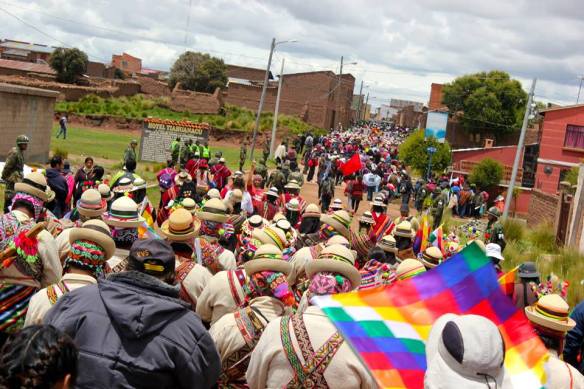
Julian Velez Bolivia 2015

As we witness the exhaustion of the Latin American progressive cycle, it is obvious that new demands emerge for thought. What began more than ten years ago in Venezuela, Ecuador, and a little later in Argentina and Bolivia, has now come to a full close. Concretely, this signifies a halt in the processes of democratization in the region. It also entails the need to think new categories, demand imagination to other possible configurations, and abandon principles that have been subsumed into the ‘duopoly’ of market-State formulation [1].

If the last decade was characterized by democratization through consumption, this could well mean that the Latin American plebs will now consume less, will party only part-time under surveillance, and will have to reimagine themselves otherwise (even if it is around a Coca-Cola late at night in the villa). The runfla lives (the lives of the marginalized, of the popular sectors, the villeros, etc.) will have to regain the time of life, which is the time of the commons in consumption.

Out of the many concepts that circulated in the ‘Universidad Posible’ Conference (generously organized by Willy Thayer & Raul Rodriguez Freire) that took place in Santiago (April 18-21) it was that of ‘the commons’ which had intellectual political purchase to ‘invert’ and transform the waning of progressive political structuration, now in the hands of right-wing administrative governmentality. But the idea or concept of ‘commons’ was in itself ambivalent: on one hand, the ‘idea of the commons’  (it is always an idealistic affirmation) thrives on the general horizon of resistance from below, but on the other, it necessarily feeds off the crystallization of the crisis of hegemonic articulation.

This resonated in the phrase that Eduardo Rinesi repeated throughout the four days of the conference: ‘let us not forget that something has happened all these years in Latin America’ (“recordemos que algo ha venido pasando en América Latina”). On one hand, this introduced the experience of someone implicated in a progressive State apparatus, but on the other, this was also an implicit response to those who called for radical suspension of university epochality [2].

But what is that that has happened (in Latin America)? In any case, what happened must remained silenced, and merely evoked. The event cannot be given its proper weight, its semantic density, and its full hermeneutic dis-closure. Perhaps, because what has happened is democratization, but also (now) the crisis of democratization. In other words: in the time of the ruin of hegemony proper, there is a decline and trans-formation into its other, the shadow of post-hegemony as translated and incorporated against the time of democracy. Hegemony flows back as time past to avoid its spectral present.

More importantly, that ‘that which has happened’ provides for political verisimilitude that guarantees specificity of location, which is also a guarantee of the political. But in its closure, it also unveils a temporality of the past. A past that cannot assume the present, and when it tries to do so, it renders a telic result of what has already taken place. In this variation of university discourse, thought is incorporated into the prison of consequential necessity of time. It has happened, but it must remain outside of the now. If according to a maxim of the Russian poet Joseph Brodsky, the prison is maximum time with minimum space; university discourse is maximum past with minimum present. In the carceral reflection on the university in time of crisis, thought itself enters prison with no possibility for parol.

It is at this point where the communitarian option emerges from below as co-substantial with the crisis of democracy. In fact, its demand appears as its supplement that affirms time present of horizontal an-institutionalization with the ‘something has happened’ of partial (interrupted) democratic life. Communitarism becomes a safety-vowel to recast hegemony form from below in the crisis of hegemony form. Thus, communitarianism is a necessary supplement of hegemony to keep its ground intact.

It is in this double movement – between hegemony of the effectual past and the localization of the movement in the present – where something like a crisis of university discourse could be located in the Latin American intellectual reflection when confronted with the inevitable sinking progressive cycle in the region. This movement is full stasis in a double sense: it provides balance and form to principal (intellectual) reflection, and it also guards the conflict between fracture of institutional hegemony and immanentization of hegemony translated into community.

Can the Latin American crisis assume the form of a political plebeization to save itself? What is the time for a plebeization of the university? This was the question posed by Oscar A. Cabezas against reflexive modalities of political closure or the substantialization of the political (as stasis) into thinking the present [2]. Plebeization becomes a possible horizon when it demands the integration of the unity of conflict. But the turn to a communitarian unity of intellect must first posit political struggle as a primary antagonism of the friend-enemy divide, as Luis Tapia forcefully argues [3]. In fact, this is the argumentative core in Tapia’s Universidad y Pluriverso (2014), an inverse but affirmative schmittianism.

Plebeization (a term that interestingly Tapia himself does not deploy) organizes the time of the ‘future’ as a way to govern the present, in the name of forgetting the singular. Or is plebeiazation an invisible remainder of what is always taking place? Or is it a dirty eschatology for post-katechontic times? In both cases, the ‘something has happened’ and the ‘immanentization of the ultimate struggle’ amount to a dual machine of a particular historical fabric that, in the face of the fissures the political, is unable to see the open.


Notes

*Image: Popular procesion after Tiwanaku, by Maria Alejandra Escalante & Julian Velez, 2015. (Do not reproduce without their permission).

.

  1. The duopoly of State and market was thematized by Gareth Williams following Brett Levinson’s Market and Thought: Meditations on the Political and Biopolitical (Fordham, 2004).
  2. Moreiras referred the a-positional ‘ex-universitatis’, Villalobos-Ruminott a suspension of the principle of equivalence, whereas I called for a ‘postunivesity form beyond community’. Rodrigo Karmy’s averroism against ‘epistemic personhood’ was also consistent with these positions. These were all rehearsals for an infra-university, as Williams called it.
  3. Oscar A. Cabezas. “Los intelectuales y la universidad norteamericana”. (Paper read at Universidad Posible Conference, 2016).
  4. Luis Tapia’s Universidad y Pluriverso (2014). The reference to Schmitt’s concept of the political is thematized explicitly in Tapia’s essay.

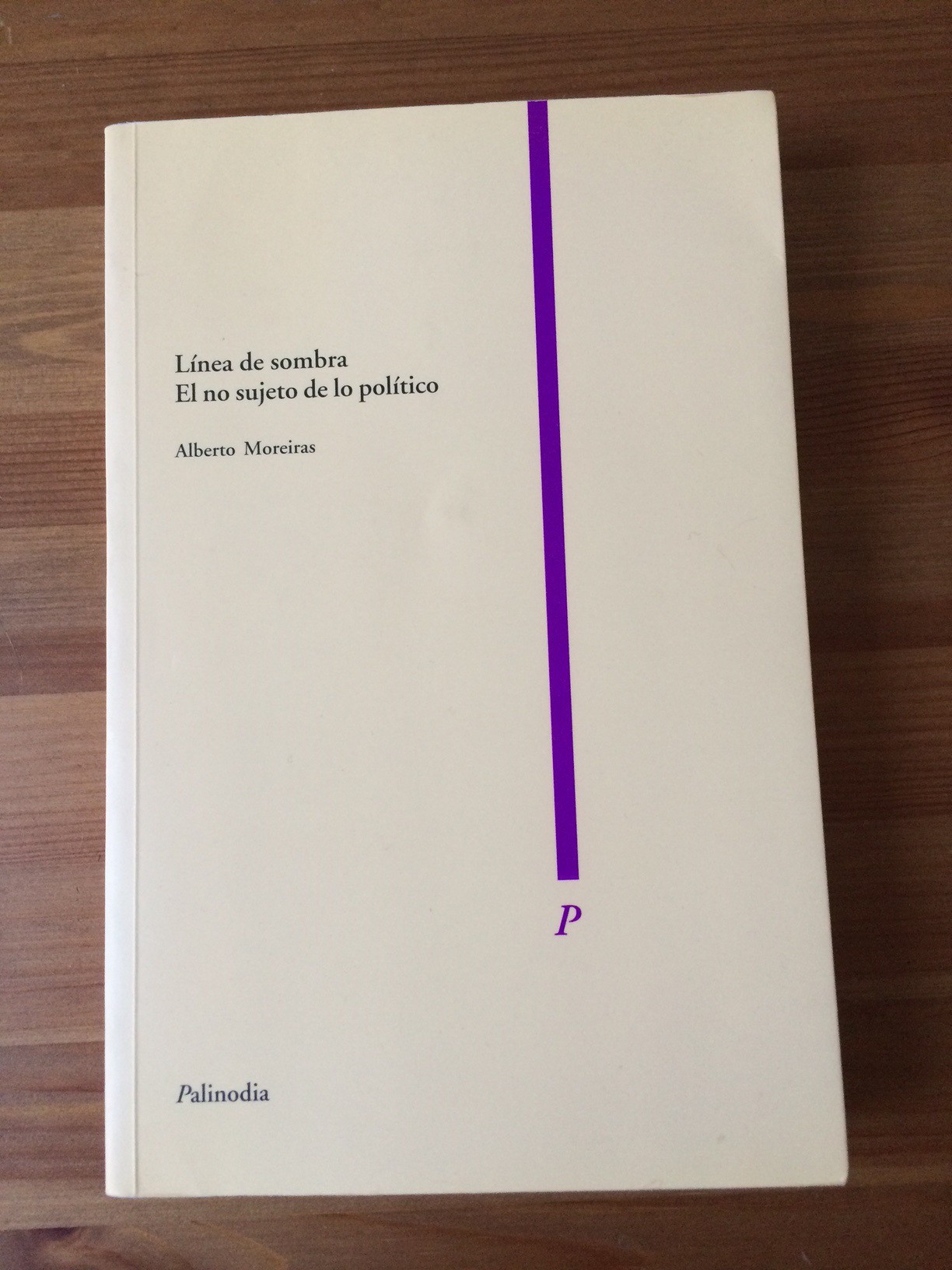
Línea de sombra ten years after: introductory remarks | ACLA 2016 Harvard University. (Gerardo Muñoz & Sergio Villalobos-Ruminott)

linea de sombra

Ten years have passed since the publication of Línea de sombra: el no-sujeto de lo político (Palinodia, 2006). It seems that this seminar received neither the most appropriate of titles, nor the most desirable one. At the end of the day, others are the ones that live by anniversaries, ephemerides, and revivals. In a way, to commemorate is a convoluted and dangerous move that recaps the jacobinist principle ‘down with the King, long live the principle!’

Something radically other is at stake here, or so we wish to propose. To the extent that something is ‘actual’ is so because it allows conditions for thinking and thought; that is, conditions of doing in thought. Then, of course, there are activities and activities. As Lyotard observed, there are some activities that do not really transform anything, since ‘to do’ is no a simple operation (Lyotard 111). So much is needed for this encounter to happen – and the purpose of this encounter with many friends here is Línea de sombra ten years after. This was Alberto’s fourth major book – after Interpretacion y diferencia (1992), Tercer espacio (1999), and The Exhaustion of Difference (2001), and that is without counting his early La escritura política de José Hierro (1987). Línea, we should not forget it, was published in Chile in 2006, under turbulent circumstances. We are referring here of course to Alberto’s exodus to Aberdeen, and in a way his “exile” from the enterprise of Latinamericanism. The drift to suspend the categorial structure of the Latinamericanist reflection was already underway in Tercer espacio and Exhaustion, books that radically altered the total sum of reflections on and about Latin America, in the literary and the cultural levels, and whose consequences were felt, though we are not too sure that they have been fully pursued and taken to its outermost transgressive limits. As Alberto has repeated often, the issues on the end of the 1990s and the beginning of the 2000s are still among us, but we have yet been able to deal with them radically, which means, to deal with them without just reproducing the constitutive limited structures and categorical systems that have informed Latinamericanism and Hispanism at large through the twentieth-century.

In this sense, Línea de sombra is an unfinished intervention. In part because it did not produce many interlocutors and readers when published, or perhaps because it was taken (and it is understood as such still today) as a book that transgressed the ‘Latinamericanist reason’, opening itself to a region of thought that was in itself undisciplined, savage, and for the same reason, considered an outlaw intervention (and we should keep in mind this tension between thinking and law). It does not matter. But what really does matter is that we consider the silences around Alberto’s intervention not as a personal affair, but as a particular effect of a certain disposition of hierarchies and prestige within the contemporary university. As if Línea (and the other books) were dammed from the beginning due to the constitutive limitation of Hispanism and due to the lack of interest in theoretical approaches coming form Latinamericanism, a field that was usually identified with the exoticism of political conundrums and the curiosities coming out of Third World countries.

Of course, the reverse side of this underprivileged condition of Spanish language for intellectual reflection is that it (re)produces reactive effects. For example, the decolonial option demands a constant revision of the privilege that Spanish has had in the process of representing Latin American realities. However, the paradox arises when this decolonial turn limits itself to the glorification of native languages as if they carry with them a more authentic access to the real, without questioning the self-limitation that both, Latinoamericanist criollo scholars and decolonial ones, show in restricting themselves to the same ethnographic task, avoiding not an explicit politics of identification, but avoiding the most urgent and radical politics of thinking. This politics of thinking doesn’t belong to disciplines and doesn’t follow University structruration. This is what we call infrapolitics.

In fact, we recently called this self-imposed limitation in Latinamericanism ‘late criollismo’ in relation to the last manifestations (political practices and historical forms of imagination) of a particular tradition of thought that, reactively, is confronting the dark side of modernity and globalization with a dubious re-territorialization of affects, practices and politics: from neo-indigenism to neo-communitarianism to literary New Rights, from neo-progressism to neo-developmentalism and neo-extractivism.

On the other hand, we should not forget it, Spanish was an imperial language, and the current (rhetoric of) privilege for ‘Spanish’ is also at the heart of the neoliberal university. In fact, it is what allows the expansion of the language programs, and by consequence, the expansion of ‘adjunct professors’ and ‘part-time post-PhD students’ that carry departmental duties. An exponential process of subalternization that professors that defend far-away subalterns always seem to forget. One might say, the psychotic decolonial affect is possible by the foreclosure of a minimal distance in favor of the maximization of their subjective drive, in a process of identification that is also a process of libidinal investment and insemination.

Línea de sombra appeared in this context, but we do not think it wants to take part on either the side of defending the underdog or assuming a counter-hegemonic capitulation of Spanish as the master language or even the variations of Spanish as a sort of a new pluralism against Iberian hegemony. Línea renounces what Derrida calls in an essay of Rogues the ‘presbeia kai dunamei’, which is roughly translated as ‘majesty and power’, but it also renounces to the privilege of the predecessor or forbear, the one that commands, the archē (Derrida 138). Alberto’s text is a call for releasement of such a demand as principle of reason into a different relation with thought – now we think it is fair to say that that relation is always an infrapolitical relation – positing the archē of the political parallel to the category of the subject. In the introduction Alberto lays the question:

“El subjetivismo en política es siempre excluyente, siempre particularista, incluso allí donde el sujeto se postula como sujeto comunitario, e incluso ahí donde el sujeto se autopostula como representante de lo universal…el límite de la universalidad en política es siempre lo inhumano. ¿Y el no sujeto? ¿Es inhumano? Pero el no-sujeto no amenaza: solo está, y no excepcionalmente, sino siempre y por todas partes, no como el inconsciente sino como sombra del inconsciente, como, por lo tanto, lo más cercano, y por ello, en cuanto que más cercano, al mismo tiempo como lo ineludible y como lo que más elude” (Moreiras 12-13).

So, el no sujeto is an excess of the political subject, an incalculable and unmanageable rest, since the non-subject of the political just is, without a why. Just like the counter-communitarianism cannot constitute a principial determination, the non-subject does not wish to do so either. Indeed, Línea de sombra unfolds a complex instantiation against every nomic determination that guarantees the truth of the idea or the concept. But the non-subject haunts its violence, its transgression. Following our recent encounter with Schürmann’s work, we can say it confronts the latent forgetting of the tragic condition of being.

Indeed, the political has rarely been thought against the grain of its nomic and decionist principles, and Línea de sombra was (and still is) an invitation to do so. Our impression is that it is a book that does not want to teach or master anything, but thematizes something that has always been already there, even if some prefer to sublimate it into the principle of satisfaction. The price to be paid for that is quite high. Hence the desire to move thought elsewhere: indifferent to legacy, proper name, inheritance, masters, and subjects.

We propose, then, to think collectively these days around the promise, the offer, and the gift of this book, but not necessarily to place it in a central canonical position. Rather we intend to open its questions to interrogate our own historical occasion.


Notes

Alberto Moreiras. Línea de sombra: el no-sujeto de lo político. Santiago de Chile: Palinodia, 2006.

Jacques Derrida. Rogues: two essays on reason. Stanford University Press, 2005.

Jean François Lyotard. Why Philosophize? Polity, 2013.

*Image by Camila Moreiras, 2016.

Movement and Sacrifice: On Samuel Steinberg’s Photopoetics at Tlatelolco, Afterimages of Mexico 1968. (Gerardo Muñoz)

Photopoetics SamSamuel Steinberg’s Photopoetics at Tlatelolco, Afterimages of Mexico 68 (U Texas Press, 2016) is a timely contribution to the field of Mexican Studies. It posits itself as a sort of culmination of that field, and we would not exaggerate to say by saying that it is an archive of an archive that thrives to undo ‘Mexicanist ideology’ towards a different opening. Steinberg powerfully states at the end Photopoetics: “Mexicanism, in turn, is the name of the ideology that regulated the dutiful carrying-out of the relation between art and the people that the Mexican state organized until Tlatelolco…According to this procedure, one can constantly make art speak the name of Mexico as its truth, as the discontinuous thought, the spirit that haunts and must be revealed by thought” (182). This is a strong and devastating assertion that should also be strategically posited in whatever remains of ‘area studies’ structuration as institutional inertia as well as against its dominance over knowledge production of Latin America within the contemporary university. Photopoetics’ boldness lays precisely in this intersection within archive and reflection, between cultural inscription and disciplinary containment in the wake of the Tlatelolco massacre during the Mexican 68. This ‘event’ is symptomatic of the hegemonic haunting of principial Mexicanist reflection and of its multivalance inscription that continuously translates and archives itself as ‘defeat’ (37).

But Photopoetics is more than a book about the co-belonging between photography and literature, the image and life. Rather this very relation, and the limits thereof, is what is tested and taken to the edge in the different folding case studies that make up the book – from Monsivais to Poniawtoska, from Paz and Volpi to contemporary artist Francis Alÿs. The name of that operation depends largely on ‘photography’ as a medium but is not entirely reducible to it. Indeed, photopoetics is the term that establishes a transversal relation with the archival 68 without necessarily being a master trope that seeks to subordinate the archive to “photographic studies” or the “visual culture” discipline (in the W.J. T. Mitchell line or otherwise). The ‘photopoetic’ is not even a concept, but rather a dispositif that varies according to the object in question, allowing for a phenomenology of the onto-photographic effect on the Real and process of encrypting the event as event, as well as the indexical repetition of the archive (25-28).  

This has potent consequences for an analytical comprehension of the political, which fundamentally entails the displacement of hegemonic structuration (not only for ‘Mexicanism’ or the ‘global 68’). Indeed, for Steinberg, hegemony is the consignation of an archive, if by the latter we understand the reduction and principial limitation of the political to calculation (27). It is thus not surprisingly that Steinberg situates his own reflection within a post-hegemonic horizon primarily defined as the destruction of the differend between theory and practice (and throughout the book there is critical engagement with Moreiras, Williams, Yúdice, and Beasley-Murray) (8). This is the unsaid ‘althusserianist’ wager in Steinberg’s book, which is, at the same time, consistent with a politics beyond the subject and a defiant a-principial thought. There are two major and unexpected figures that support this general horizon: José Revueltas and Francis Alÿs. In fact, the book opens with Revueltas and closes with Alÿs; a double movement that although not fully developed, is preparatory for an atopic ground in relation to a post-Mexicanist horizon of reflection, a new form of thought, and a democratic (and communist?) promise.

The first two chapters – “Archive and Event” and “Postponed Images” – situate the general economy of the book, that is, the relation between archive and event and archive as the hegemonic force proper to the 68. The hegemonic phantasm is that of situating the 68 as a sacrificial horizon of history against what should be read as the contingent and democratic student movement that remains encrypted or translated into a reiterated and diversified figures of closure (victims, heroes, the people, or melodrama). Understood in a rancierean key, Steinberg’s post-hegemonic articulation rests principally on the contingent heteronomy of the movement:

“…What we call 1968: “an unforeseeable coming of the other, of a heteronomy; “the event of what or who comes” as incalculable exposure to that other and to the event that is other. […]. No: it is “the event of what or who comes”, that change encounter in which ‘students are confused with workers”, and in which the peasants are also present – absent from where they properly should be. Unconditionally”. (44).

It is not just that the archival event orders them into a grammar of visibility, but also the fact that it translates it (them: the students, or what is to come) into a principle. This is what in “Postponed images” Steinberg sees in Monsivais’ popular melodrama and “national unity” that reinserts “mexicanidad” within the general analytical economy. In a similar way, although folded, this is what is analyzed in the chapter on testimonio (“Testimonio and the future without excision”) taking Elena Poniatowska’s famous La noche de Tlatelolco as interchangeably positing the sacrificial structuration of history vis-à-vis civil society. La noche de Tlatelolco tames the democratic dis-order of the movement into one of the “People” within a broad ‘collective memory’ of the nation (112). We are not too far here from a ‘fictive ethnicity’ grounded in testimonio and its politics of truth. Again, an indexical photopoeticology is what guarantees – in Monsivais’ melodrama as well in Poniatowska’s civil society deposition – the encryption of 68 and its ‘afterlife’.

“Exorcinema” and “Literary restorations” are secondary moments of the 68 archival fantasies and unusual atopics for carrying out the lasting effect of this event. “Exorcinema” takes up films, such as Fons’ Rojo Amanecer and Raygadas’ Silent Light as resurrections of the photopoetic act, but it also has strong declinations that spill over Chris Marker monumental Grim without a cat (1967-77), as well as other figures of Mexican cinema. In “Literary Restoration”, the transition is folded from the ‘spirit of revolutionary sixties’ to the ‘neoliberal age of restoration’. Restoration here is not deployed lightly. Following Badiou, the staging of restoration announces an impasse in the face of historical nihilism, but also makes evident the fascination with the ‘past’ as melancholic repetition and restitution. In this sense, the work of Jorge Volpi centrally figures itself as the symptom of neoliberal restoration, and more specifically his pedagogic novel El fin de la locura (Seix Barral, 2003) sketches something like a narratological aleph of the sixties, revolving around “French theory”, Fidel Castro, psychoanalysis, the “Padilla Case”, and revolutionary ethos. This is an ‘after the fact’ historical novel that condenses – meant for a middlebrow public – major events of the leftist politization and heroic drives. Against Volpi’s own authorial intentions, however, Steinberg concludes that Volpi’s narrative halts at complete politization (hegemony) making possible an infrapolitical register. This is not to say that Volpi is an infrapolitical writer himself. There is no doubt that Volpi’s literary program – the Crack Manifesto, his novels, also his journalism – amount to literary nihilism in the wake of Mexico’s turn towards neoliberalism after NAFTA trilateral economic adjustments. Steinberg pushes for what I would call an infrapolitical interruption in Volpi as a secondary effect of what hegemony and counter-hegemonic literary depolitization cannot hold itself up to.

The last chapter, “An-archaeologies of 1968”, is the fleeing territory from the Mexican archive, and it does so with the help of contemporary artist Francis Alÿs. In this chapter, there are at least two major problems at stake for Steinberg: on one hand is the question of the de-territorialization of the Mexicanist disciplinary (and disciplined) boundaries of knowledge formation, and on the other, the possibility of rendering inoperative any ideal of emancipation (and resistance) based on history, subject, and work (192-93). The relational aesthetics piece “When faith moves mountains” is taken as a precarious negative community that exceeds national borders, as well as any possibility of subjectivation for the Mexican being. Alÿs is resistant to the resistance of Mexicanism. While this is true, perhaps some readers are left desiring further confrontation but this time not against the Mexican archive, but on the grounds of what I would call the transnational circuit of global contemporary art. Bourriaud and Claire Bishop’s theories on relational aesthetics make an entry into the discussion, but I am tempted to say that both of these critics, in different ways, are fully committed to hegemony theory, or at least to hegemony for contemporary art relations to the political, whether in consensual or antagonistic terms [1].

I am not arguing here that Steinberg endorses either Bourriaud’s or Bishop’s assessments or “contemporary art”, but that the an-archeology releasement opens to a critical assessment of the very machinistic operation of contemporary art in its very economical precocity, autonomous circulation, and so called “democratic inclusion” of extended practices and subjects. In this sense the problem of “faith” (189-91), is also about “the faith” of contemporary art: the “pistis” (credit) that in the aura of participation and immateriality ends up repeatedly bounded within a logic of exchange value through the practice of documentation.

Photopoetics at Tlatelolco inaugurates a post-sacrificial reflection on Mexican culture and its conditions of possibility. Making no concessions to ideological or locational authorities, Steinberg calls for a post-hegemonic desire that affirms the real movement of thought that is the concrete potentiality of politics beyond principles and idle chatter.


Notes

  1. I am thinking here of Nicolas Bourriaud’s Relational Aesthetics (Les Presses du Réel, 1998) on the side of consensual political practice, and the article “Antagonism and Relational Aesthetics “ (October, Fall 2004), by Claire Bishop on the side of antagonism.

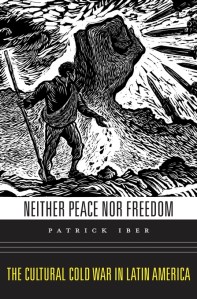
Ironic gramscianism: on Patrick Iber’s Neither Peace nor Freedom: the Cultural Cold War in Latin America. (Gerardo Muñoz)


Iber Peace Freedom 2015Patrick Iber’s Neither Peace nor Freedom: The Cultural Cold War in Latin America (Harvard Press, 2015) is a very much-welcomed piece of historiographical investigation on Hemispheric Cold War in the Americas, and I think it is not just circumscribed within conventional historiography, since it also speaks to us as Latinamercanists, that is, some of us not precisely invested in writing history of Latin America. Its publication coincides with other recent books that reexamine the “culture battles” during the Latin American Cold War, such as Jean Franco’s Cruel Modernity (Duke, 2014) Mabel Moraña’s Arguedas/Vargas Llosa (Iberoamericana, 2014), or Rafael Rojas’ Fighting over Fidel (Princeton, 2015). Neither Peace nor Freedom studies the Cold War structuration in the region as a long durè process– spanning from the late twenties (take the assassination of Julio Antonio Mella in Mexico) to Sandinismo and the Marea Rosada or Leftist progressive governments that began with Hugo Chavez’s 1999 election. The Cold War took place in a climate of political and cultural conflictivity that the historian is not hesitant to call a “civil war”: “…the work of political and intellectual currents whose existence predate the Cold War, and whose sources lay in what might be described as the international Left’s civil war. The arrival of the Cold War meant that the Left’s internal conflicts would be inscribed onto superpower competition, and thus that struggles for justice around the world would be refracted through imperial interests of the United States and the USSR. In Latin America, that would leave the Left with almost no viable options for pursuing its aims without compromising them” (3).
The event of the Cold War in Latin America was in this sense a long and costly civil war overdetermined by a dual structuration. However, as Patrick Iber’s studies moves on to argue, this structuration didn’t always lead to political or cultural closure on either side. This duality had multiple replications throughout the book: there was the World Peace Council (WPC) and the Congress for Cultural Freedom (CCF), Casa de las Americas and Mundo Nuevo, along with the principles of “peace” (promoted by the geopolitical interests of the Soviet Union) and that of “freedom” (promoted by anti-communist and largely financed by the CIA). Of course, every reader could input their favorite artist, intellectual, or country for either side. It might be superfluous to say that Neither Peace nor Freedom maps a heterogeneous and conflicting history of the Cold War in the Americas (as opposed to being a “Latin American narrative” that only “happened to them” so engrained in the common position of anti-imperialist mapping. Some of us, not all, associate this second with John Beverley’s work and in particular with his Latinamericanism after 9/11).

But perhaps less obvious is the fact that Iber’s commitment to historical writing has abandoned a model of political militancy to generate an otherwise relation with the cultural Cold War archive. I want to expand on this point. At the center of Iber’s argument is that this dual structuration – whether you were anti-communist or anti-anti-communist – encompassed both a technology of liberation and a position in favor of occasional oppression (149). If this is in fact what ‘contained’ the logic of the Cold War, then one can see that Iber’s own position as a historian is consistent with not being on the side of ‘liberation’ or of ‘oppression’. To affirm this, either side would have to hold on to some principle of imperialism. These are the stakes in Patrick’s own book, and I am bringing up this point as to allow for a reexamination of the “dual structure” of the Cold War epoch in light of our present. I think there is something to this. If Patrick is neither on the side of “peace” or “freedom”, ‘liberation’ or ‘oppression’, ‘Latin American anti-imperialism’ or ‘neo-conservative domination’, what is his ground? Where is he standing?

I think there is commitment in Neither Peace nor Freedom, but only in so far as it uncovers another space beyond ideology. This dislocation is the excess of the cold war duopoly. One of the places in which one could start discussing this space, is where Iber argues the following, which can be found at the very end of the introduction of his book:

“Each camp would accuse the others of corruption and operating in the service of foreign empire. But it was not so much an issue of corruption as of the inscription of intellectuals’ preexisting campaigns onto Cold War. The evidence from Latin America suggests that the Cultural Cold War is best understood within a framework of “ironic gramscianism” – the pursuit of cultural hegemony through a combination of coercion and consent, incorporating many agendas. But the consequences were so varied that cultural fronts produced nearly as many ironies as they did movement in the direction that their patrons hoped…And the experience of Lain America’s Left during the Cold War was less a betrayal of democracy than a true paucity of options” (18).

This notion of “ironic gramscianism” – that also makes an important come back at the very end of the book- remains an underdeveloped quasi-concept making it even more suggestive for understanding the endgame of the cultural Cold War [1]. To finish, I want just to elaborate on two aspects that seem latent in this fragment of Iber’s text, and I take them to be hyperbolic of some of the strong claims laid out. First, “ironic gramscianism” seem to be understood by Iber as the contamination by way of the effects of hegemony. Hegemony here is taken as producing not just ‘other effects’ than those desired or intended, but more importantly, perverse effects. As I understand it – not just explicitly in this fragment, but more implicitly in Iber’s study cases– ironic gramscianism breaks the very closure and suture logic of hegemonic articulation, opening itself to an excess that it cannot contain ideologically. That explains why there were “many ironies counter to the direction that the patrons hoped”.

Iber seriously puts hegemony theory in crisis. As we know, hegemony theory is not just a theory, but also inevitably the principial political theory of and about modern Latin America State form. I do not know to what extent hegemony theory can come back unscathed as a viable political option (another example: to what extent the valence of Estado Integral as Estado Aparente in Álvaro Garcia Linera not an ‘irony’ in a deep sense?) [2]. If gramscianism is always ironic, this means that gramscianism does the work in the negative (the “cunning of imperialist reason”), and this negative is the limit of what is no longer “tolerable” in history (think dictatorship, or forms of oppression) (244). If Gramsci (consent and coercion) is always a machine that generates other effects, then it cannot but be ironic. A fundamental consequence here is that hegemony theory does not produce democracy (it cannot do this labor). It is my impression that it is not just a matter of perception, but that gramscianism (hegemony) is irony tout court. Is the ‘irony’ constitutive of hegemony not the very excess and ruin of itself as shown consistently through the Cold War disjunction?

Secondly, I want to raise the question of democracy that lies at the heart of Iber’s intervention. Fundamentally, the question about the Cold War is also a genitive question about democracy in the region: why has there always been a demise and impossibility of democracy? Why the condemnation, the open repudiation across intellectual groups and politico-cultural ideologies? I don’t think that this is something that Iber takes up in his book, nor should we demand an answer from it. In my view, Patrick Iber makes a modest plea: democracy (or let’s call it republicanist democracy) was impossible because there were no options that allowed for such a drift. It is here where I want to open another question for Patrick – as well as for our debate more generally– and this is: what about populism in the Cold War? The national popular State (Peronism, Cardenismo, Varguismo) with all its limitations and authoritarian drives has been the closest to true democratic experiment in the region. Early castrismo, for instance, is in a sense-liquidated populism [3]. Perhaps populism is what the negative does not let be in time. My point is not that populism is something like a “Latin American destiny”. What I wonder is if populism is not what could allow for a republicanist drift (as I suggested recently reading Jose Luis Villacañas’ Populismo) as to establish long lasting democratic institutionalization, perhaps for the first time in the region’s history since the independences of 1810.

I realize that this a highly speculative question, since with the demise of what some of us are calling the “exhaustion of the Latin America political progressive cycle”, populism is not even a viable option. What is worse, the neo-populisms from the Right are neither desirable nor consistent with a democratic opening. The Marea Rosada was a fundamental moment of the Latin American Leftist democratic desire, but not for the reasons proposed by Beverley (geopolitical inversion or State-subaltern alliance), but rather because of the implementation of a certain “fiesta del consumo” that expanded the borders of democratization. Now, to keep insisting on ‘gramscianism’ – and its categories, such as the Integral State, hegemony theory, “identity”, “correlation of forces”, albeit the admiration for Garcia Linera’s thinking, whose work is the most systematic effort to re-inscribe Gramsci in the present – is more of the same, and in an ‘ironic’ way, an option that is highly consistent with neoliberal machination and de-hiarchization (Hatfield 2015).

The end of the Latin American progressive cycle puts to the test the populist democratic articulation that conditions the national popular state form. As we know, this past Sunday, Evo’s MAS lost the referendum in two of its most important political bastions (Potosí and El Alto). If las nuevas derechas are able to keep the level of consumption on the side of large underprivileged popular sectors, then this would mark the final collapse of Latin American populism as a potential democratizing force, obliging us (scholars, and students) to rethink the nature of the political anew.


Notes

  1. Patrick Iber. Neither Peace nor Freedom: The Cultural Cold War in Latin America. Harvard University Press, 2015. In the conclusion, Iber writes: “The history of the MLN is another reminder that prodemocracy movements in Latin America, whether of the anti-Communist or anti-anti-Communist variety, used languages of liberation that were implicated in support for empire somewhere on the globe. Perhaps there was no other way” (149). Also see (195) his emphasis on “truncated Leninism” as the modernizing drive of the anti-communist intelligentsia.
  1. For this conceptual translation in Garcia Linera, see Gareth Williams’s excellent “Social Disjointedness and State-Form in Álvaro García Linera”. Culture, Theory, and Critique, 2015.
  1. On the Cuban Revolution as hegemony, see El Viejo traje de la Revolución: identidad colectiva, mito, y hegemonía política en Cuba (Universidad de Valencia, 2007) by Sergio López Rivero.

*Introductory remarks for Patrick Iber’s book worskshop at Priceton University, February 23, 2016.

The republicanist drift: on José Luis Villacañas’ Populismo. (Gerardo Muñoz)

Villacañas populismoThere is little doubt that populism has profoundly upset the debates on thinking politics in recent times. Indeed, Jose Luis Villacañas’ motto in his recent essay Populismo (La Huerta Grande, 2015) correctly captures this anxiety: “el populismo acecha”. In this brief and intelligent essay – this must be underscored, since unlike other monumental studies of his, this text is meant for a widely informed public, hence the lack of footnotes and historical reconstructions – populism is weighted with the much needed urgency that it deserves against its superficial dismissal by liberal thinkers or conventional political pundits that understand it as irrationalism or Catholicism in politics.

Villacañas’ starting point is twofold. On one hand, he affirms the confusion that structures today’s international political scene; the multiple uncertainties, and unclear directions. The fact that the Democratic and Republican parties have opposing national and international agendas, attest to this indecision even within imperial reason. The reemergence of populism departs from this current predicament. On the other, Villacañas confronts Loris Zanatta’s liberal reconstruction of populism, as one that profoundly derives its consequences as a confrontation between modernization and the survival of its archaic remnants. In Zanatta’s conceptualization, populism is the outcome of an ancestral community predicated on the mystic body of Catholic representation, a formulation that seems to repeat early Schmittian theory without too many nuances. But the problem with this overarching thesis is that, although there are analogic mediations between the Pauline figure of the katechon and populist structuration, it dismisses all too easily the populist experiences in Protestant national communities, such as that of Nazi Germany or the North American democratic ‘We the people’ that runs from Abraham Lincoln to F.D. Roosevelt.

Nonetheless, it is not a matter of disagreeing with Zanatta’s conceptual limitations in El Populismo (Katz, 2015). What is crucial is that this assessment allows Villacañas to clear a space of for his own intervention that neither affirms a hyperbolic thesis of secularization (populism as a sort of plebeian Catholicism), nor discards the recent debates on the Left regarding the specificity of populism. Against Zanatta, Villacañas defines the point of departure of populism in the contingent articulation of a “people”:

.
“…nosotros hemos dicho que el pueblo es una comunidad construida mediante una operación hegemónica basada en el conflicto, que diferencia en el seno de una unidad nacional o estatal entre amigos/enemigos como salida a la anomia política y fundación de un nuevo orden” (Villacañas 2015, 28).

The author of ¿Qué imperio? admits that he does not seek to sketch an “ideal type” of populism, if there ever was one. Instead, he offers a rough guide to interrogate more complex associations that the concept generates. In the subsequent chapters the discussion is displaced over a mapping of Ernesto Laclau’s important architectonics of populism through the reformulation of the categories of the people, the equivalence of social demands, the role of affect, the friend-enemy antinomy, the elaboration (and distortion) of Gramsci’s concept of hegemony and the intertwinement with charismatic leadership. It is important to note that Villacañas is not interested in a recapitulation of Laclau’s political trajectory, to the extent that Laclau’s On populist reason (Verso, 2006) is the culmination of a long political and militant itinerary that commences in the argentine syndicalist experience and comes to a close in the British school of cultural studies, so well studied by John Kraniauskas (2014). Opting for a different path, Villacañas situates Laclau as the symptomatic figure that condenses a series of problems in the history of the modern categories of the political since Hobbes; showing how, far from irrationality or even anti-liberalism, the author of Hegemony and Socialist Strategy is a quintessential modern political thinker at its core.

There are analytical limits to Villacañas’ Laclau, which serve to ground the arguments of his essay. For example, throughout the book, there is an insistence in reading the argentine thinker in confrontation with the neoliberal epochality, as if Laclau’s theory of equivalence of demands or the catachrestic national popular springs as a response to the so-called ‘big-bang’ of global neoliberalism. A second imposed limit is the role of affect and power, which implicitly (it is not developed to its outermost consequences in the essay) has much to do with the debate on post-hegemony, which connects not only to Jon Beasley-Murray’s well known contribution of the same time, but also to the most recently published volume Poshegemonía: el final de un paradigma de la filosofía política en América Latina (ed. Castro-Orellana, Biblioteca Nueva 2015). A central gesture in Villacañas’ essay is to move away from a reductionist opposition between the “populism and post-hegemony” debate, while simultaneously drifting toward a discussion of populism beyond the concept of hegemony as identitarian production embedded in the principle of equivalence.

To this end, “el populismo acecha” is not a matter of competing master tropes or schools of thought in the contemporary university where intellectual battles sometimes seem to be placed. Villacañas’ wager is that thinking populism allows for clearing the political opacity and anti-institutionalism promoted by neoliberalist machination. It in this conjuncture that populism, for Villacañas, is situated in a permanent double-bind, that is, populism is the effective response to “neoliberalism’s stealth revolution”, as Wendy Brown recently has called it; and inversely, it also coincides with neoliberalism’s drift for anti-institutionalization that fuels the anarchic principle of economic valorization at all levels of the social life.

This double bind is a secondary contradiction, since Villacañas rightfully notes that populist anti-institutionalism also rests on a minimal institutional differentiation and a maximum expansion of equivalent demands. This entails that with no institutionalization; populism cannot consecrate a principle of equivalent conversion. However, with full institutionalization there is no longer any possibility for populism, since this would result in the fulfillment of all social demands withdrawing the need for charismatic personalism. Carlos de la Torre’s informative analysis of Ecuadorian Rafael Correa’s technocratic populism confirms Villacañas conceptual reflection on the convergence of populism and neoliberalism in relation to the question of institutionalization (De la Torre 2013).

At the risk of an evermore-latent alliance between neoliberalism as the reactive form of government and populism as the proactive response to the crisis, we are limiting the political to nihilist circularity. Nihilism should not be understood lightly here. The question of time is implicitly located in Villacañas’ essay as what anti-institutionalization cannot account neither from the side of populism, nor from destructive hyperneoliberalism. The more we push for second one, the more the populist dessert grows. In fact, according to Villacañas, this seems to be a necessary consequence that neoliberal and liberal administrators should seriously accept. More important than the fact that the populist option does merely plays the game with neoliberalism, it obfuscates the necessity of a “third” option that would allow for a change beyond this circular temporality.

What, then? For Villacañas this third option is the republicanist drift. This republicanism is not limited to the Republican governmental form of State but rather to a contingent democratic form (opened to the extension of social demands and antagonism of singulars) based on the guarantee of institutional stability. In a few words, it is the time of justice:

“Pero la justicia es un empeño positive que surge de lo más propio que ofrece el republicanismo: una percepción de confianza y seguridad que abre el tiempo del futuro sostenido por estabilidad institucional. Si no se atiende con una voluntad específica, la justicia no se producirá de modo natural. Abandonar toda idea de justifica facilita la agenda populista de configurar una nueva…Donde el republicanismo no ejerce su función estabilizadora a través de instituciones, el tiempo del la sociedad se reviste de esos tonos inseguros que el populismo tiene como premisa”. (Villacañas 114)

The Republicanist drift affirms a post-hegemonic form of democratic politics against the neoliberal structuration of the world. It radicalizes the “minimal republicanism” that populism trims through anti-institutional time of “grand politics” (Villacañas 117). This republicanism is not manufactured on the question of personal freedoms – which is still the limit of Liberal political theory from Rawls to Nussbaum – but grounded on firm redistributive policies that, unlike populism, could transform the time of life. In this light, Villacañas understands the eruption of participatory politics in the Spanish scene (the so called “Mareas”) not as an anti-institutional equivalence of demands, but as a republicanist affirmation of deepening democratic and public institutionalization (Villacañas 124-25).

This republicanist turn, unlike liberalism’s promise of redistribution, centers political life, as Hannah Arendt and Simone Weil understood so well, in the polis or citè as radical desistance from principial (State) order. Positing the polis as the minimal unit of political community, Villacañas retains the popular demand along with the always impossible pursuit of the singular. The extent to which this republicanist drift can account for the generic production of the subject is not clearly outlined in Villacañas’ essay. But Populismo (La Huerta Grande, 2015) does open productive ways for future probing and interrogations.


Notes

Carlos de la Torre. “El tecnopopulismo de Rafael Correa: ¿es compatible el carisma con la tecnocracia? LARR, Vol.48 No.1 Spring 2013, pp. 24-43.

John Kraniauskas. “Rhetorics of populism”. Radical Philosophy, July/August 2014.

José Luis Villacañas. Populismo. Madrid: La Huerta Grande, 2015.

Notas sobre el agotamiento del ciclo progresista latinoamericano. (Gerardo Muñoz)

A distancia de casi de más de una década y media desde la interrupción del llamado ciclo progresista de la marea rosada (dependiendo de cómo periodicemos el ciclo: el ascenso de Chavez en 1999, la crisis del 2001 que alcanzó expulsar a varios presidentes de turno en la Argentina o la victoria de Lula en el 2002) una pregunta se ha vuelto inevitable hoy, tras las elecciones presidenciales en la Argentina: ¿qué queda de izquierda en la izquierda latinoamericana contemporánea? ¿Es aún posible aislar posturas opuestas a partir de una agenda política o bien un diferendo ideológico? ¿No se estaría abriendo una nueva brecha que desarmaría la conocida división popularizada por Jorge Castañeda (“Latin America’s Left Turn”, FA 2006) entre la “buena izquierda” caracterizada por su compromiso liberal y defensa del mercado, y una “izquierda autoritaria”, heredada de las tradiciones populistas y caudillistas de la política latinoamericana?

Para los efectos ya no de la geopolítica regional, sino de la política de la reflexión de los estudios latinoamericanistas en el hemisferio, también se pudiera preguntar si acaso la triangulación articulada entre neo-arielistas, neo-conservadores, y post-subalternistas propuesta por John Beverley en Latinamericanism after 9/11 (Pittsburgh Press, 2011), sigue siendo sostenible para dar cuenta de una nueva opacidad muy heterogénea que ha venido surgiendo en múltiples frentes desde Buenos Aires hasta Guerrero [1]. Si hablamos de opacidad regional, ¿cómo afirmar divisiones precisas en el plano del compromiso intelectual, y específicamente en la producción reflexiva sobre el horizonte político que se abre? Esto no significa que de momento se hayan extinguido, como por acto de magia, posiciones tradicionalmente derivadas de la razón criolla latinoamericana, sino más bien a lo que apunta es a su agotamiento a causa de una proliferación centrista post-política que vuelve a situar nociones de compromiso y reflexión intelectual bajo nuevas condiciones que parecieran inciertas. Ese corrimiento hacia la derecha no supone un retroceso al neoliberalismo puro y duro de los 90, puesto que estas “nuevas derechas” a lo largo de esta década han sabido modificar sus lenguajes, símbolos, y acercamiento transversal con el Estado, al cual ya no pueden descartar de forma tan oposicional a la manera en que se hacía durante el neoliberalismo triunfante en la región tras las llamadas transiciones a la democracia.

Por lo que se ha vuelto difícil afirmar con certeza quien ocupa el lugar del ‘buen político progresista’ en no pocas de las gobernabilidades del progresismo latinoamericano, las cuales han visto fuego cruzado de parte de los movimientos sociales que en su momento acompañaron los procesos constituyentes (en Venezuela, Ecuador, Brasil, Argentina, y quizas en menor grado Bolivia) – teniendo que recurrir a distintas formas de la violencia estatal – explicitando de esta manera el comienzo de un desgaste de su legitimidad política irruptora. Encima de esto, es importante volver a notar la permanencia del modelo neo-extractivo y la continua dependencia en el precio internacional de la exportación de los commodities; aunque pareciera que la mayor presión se ejerce desde el interior de los partidos y sus bases, como quizás sea ha vuelto más visible durante las protestas en Brasil, o bien en esta última recta final del Frente para la Victoria en Argentina, cuyos malabares para encontrar una figura continuista del modelo K no ha sido una tarea fácil (más bien con la candidatura de Scioli se ha demostrado que tal operación ha sido imposible).

Incluso si atendemos a las divisiones internas en los núcleos más duros de apoyo al gobierno kirchnerista (como pueden ser el colectivo kirchnerista Carta Abierta, la organización juvenil La Cámpora, o los vaivenes del programa televisivo 678), es claro que el simple desacuerdo partisano se ha fragmentado en varias direcciones hasta culminar en retóricas encaminadas hacia fines puramente electorales, lo cual contrasta con las transformaciones cíclica de los mandos políticos [2]. Desde las elecciones primarias (PASO), quienes han seguido con atención las propuestas de las tres fuerzas políticas nacionales, hemos visto la opacidad y el hilo conductor que las aglutina bajo un mismo insumo de la política consensual que difiere profundamente del antagonismo que lideró primero Néstor Kirchner y luego Cristina, quienes habrían abrazado las luchas de los movimientos sociales que irrumpen en la escena piquetera de la crisis del 2001.

El ex-intendente de Tigre Sergio Massa (fundador de Frente Renovador), el macrismo y su anti-partido (prefiere portarse como “equipo”, introduciendo explícitamente la tecnificación postpolitica), o el FpV encabezado por Daniel Scioli en la última ronda, comparten una lengua política emparentadas, a la vez que se distancian de los grandes símbolos que el peronismo kirchnerista ha venido apelando a lo largo de la última década. Además de compartir trayectorias políticas similares (desde el menemismo), los tres candidatos ponen sobre la escena nacional variaciones de una misma interpelación empresarial o gestional de gobierno, cruzada con una constante retórica securitaria que por momentos incluso llega a coquetear con el modelo mexicano de la guerra contra las drogas como horizonte de lo que podría significar una batalla contra el crimen organizado y la presencia proliferante del narcotráfico [3]. Más allá del debate sobre el continuismo o la ruptura de sciolismo con lo matriz simbólica de kirchnerismo, me parece acertada la tesis de Diego Sztulwark quien argumenta que lo nuevo tiene que pensarse como el estancamiento del proyecto en cuanto a su expansión democrática radical.

Lo curioso al repasar estos últimos años de kirchnerismo quizás radique en cómo a la misma vez que se produjo una implosión en la renovación del lenguaje anclada en la simbología peronista confeccionada al presente (el ‘Nestor Oesterheld’, el montonerismo gestual, el Bicentenario como relato teleológico, etc.), como lo supieron ver desde perspectivas contrapuestas Beatriz Sarlo en La audacia y el cálculo (Sudamericana, 2011) y Horacio González en Kirchnerismo, una controversia cultural (Ediciones Colihue, 2011), la dimensión cultural del kirchnerismo, que se despliega en un sinnúmero de instituciones y organizaciones (Carta Abierta y Tecnopolis, Ministerio de Cultura y Secretaría de Coordinación Estratégica para el Pensamiento Nacional), se ha topado con una difícil traducción política en el momento de la transición presidencial, así como una difícil recomposición estructural del FpV en el aparato peronista. Tal vez el cuño sobre la crisis del FpV haya sido enunciado por el propio Ministro del Interior, Florencio Randazzo, quien en una visita al grupo Carta Abierta en la Biblioteca Nacional habría dicho de la candidatura de Scioli: “El proyecto se ha quedado manco” (enunciado que juega con el hecho que a Daniel Scioli, en efecto, le falta su brazo derecho).

Este impasse reafirma el dilema entre cultura y Estado, en sus múltiples desencuentros y temporalidades que suponen ambos planos, en las grandes mitologías políticas que han atravesado la región en los últimos tiempos. El kirchnerismo en tanto mitología del último peronismo develaría de este modo una gran construcción cultural ambientada en el “regreso del Estado como imaginalización de la conquista del poder a partir de elementos carismáticos o de control territorial soberano de lo que se ha venido llamando la “inclusión ciudadana desde el consumo” (y que Diego Valeriano ha venido llamando capitalismo runfla) [4]. En su reverso, la crisis del culturalismo como construcción apoyada en símbolos, vuelve a poner en la escena de discusión el estatuto de la política (la forma general de politicidad) frente a procesos de acumulación efectuada desde eso que Joseph Vogl ha llamado efectos soberanos que desnaturalizan los espacios nacionales o regionales de contención (en la opinión pública argentina, el historiador Alejandro Horowicz ha sostenido una posición similar) [5].

Junto al llamado cierre de ciclo progresista pronosticado por no pocos estudiosos de la región, como Salvador Schavelzon y Bruno Cava, Pablo Stefanoni y Raul Zibechi, Maristella Svampa y Diego Sztulwark, no es de sorprender que pronto se comenzará a hablar de las ‘nuevas derechas’ de la región en su despliegue por via electoral en las distintas gobernabilidades de la Marea Rosada [6]. Estas derechas estrictamente no serían nuevas, ya que no solo han tomando apuntes de sus errores durante el período duro del consenso de Washington y la expansión neoliberal de los noventa, sino que se han gestado al interior de los propios gobiernos progresistas. La repetición estaría dada a partir de la permanencia de cierta espectralidad ya co-habitaba en el aparato del Estado, y que ante el estimulo que genera hoy la retórica de la inseguridad anti-migrante (preconizada en el ministro de Seguridad Sergio Berni en el caso argentino), ha retomado fuerzas con claros visos post-políticos. No es casual que la neutralización del conflicto político populista se acompañe paralelamente a la ejecución de una geopolítica enrizada en la matriz de acumulación flexible y el modelo devastador neo-extrativista que ha permanecido ausente en los discursos de las tres fuerzas políticas.

En el caso argentino, quizás la figura más representativa de esa “nueva derecha” la encarne el ex-intendente de Tigre, Sergio Massa, cuya retórica fluctuó a lo largo del último año y medio por varios registros contradictorios que aglutinan la formación peronista institucional con cierto tono populista de planificacion tecnocrática y securitaria. Como ha mostrado Diego Geneud en su Massa: Biografia no autorizada (Sudamericana, 2015) en la paideia política del massismo convergen las contradicciones del peronismo institucional a la par de un discurso anclado en el consumo y la inseguridad. En efecto, no haríamos mal en llamar, luego de esta primera ronda de las elecciones nacionales argentinas, que el cierre epocal no radica en los nombres propios de Macri o Scioli, quienes se enflatarán al ballotage del próximo 22 de Noviembre, sino en lo que me gustaría llamar el ‘massismo como espíritu de época’ de lo que viene, esto es, una política reducida al consenso, suplementada con el despliegue policial sobre los territorios, y una cruzada a gran escala neo-desarrollista (mega-minería, fracking, nuevas finanzas, etc). Esto no quiere decir que el massimo deba ser leído como la consecuencia o el secreto íntimo del kirchnerismo, sino más bien como excedente que ese mismo aparato estatal nunca pudo eliminar en su refundación posneoliberal. Massa es la supervivencia y la continuidad del neoliberalismo por arriba que despliega rúbricas y dispositivos gubernamentales de legalidad-ilegalidad.

Ante esta nueva realidad que impone el fin de ciclo, pareciera que la pregunta sobre el qué hacer deviene fundamental para la reorganización de posturas que ahora parecieran agotarse en la oposición Estado y mercado, agenda gestional de derecha y rasgos populistas de izquierda. Una postura visible es la que pudiéramos llamar la comunitarista o comunal que entiende que bajo los procesos de politización estatal, paralelamente se gesta (como en la figura del topo de Marx que no por casualidad fue la clave de lectura de Emir Sader sobre el ciclo del progresismo) los movimientos subterráneos de contestación al institucionalismo político de Estado [7]. En una entrevista reciente con Raquel Gutiérrez Aguilar, deja entrever que ante la inevitable derechización de buena parte del espacio político latinoamericano, la batalla por lo común o la comunalidad reaparece con mayor ímpetu e inminente tarea a pensar. Lo común aquí se entiende como fin del binarismo sociedad civil-Estado, apuntando hacia la autonomía de los movimientos sociales como multitudes contra-hegemónicas que disputan constantemente el sentido común y la vida sensible, así como el orden representacional de los aparatos institucionales y la partidocracia [8].

La tensión al interior del horizonte comunitarista reside en su relación con lo propio. Esto es, si por común entendemos la re-apropiación de aquello que ha sido expropiado, entonces parecería que lo común además de una inversión de cierta razón primitiva de lo estatal, se entendería como la continuación de un esquematismo hegeliano desde la micropolítica aun diagramada por una forma principial de lo gobernable y de la instauración de la fuerza de gobierno. Sin embargo, si por lo común entendemos la organización de formas de vida en retiro de toda politicidad general, dadas al uso en lugar de la propiedad, se reactivaría una potencia de imaginación fuera de la restitución valorativa de la apropiación de la propiedad o de un modelo ontológico distributivo basado en lo “propio” [9]. La primera articulación de lo común, arraigada en el “autoritarismo consensual” expuesto por Raúl Zibechi en Dispersar el poder (Tinta Limón, 2006), estaría en las antípodas de una relación democrática y antagónica de politización [10]. Por lo que una de las tareas de cara al cierre del ciclo progresista es hacer pensable la pregunta por la comunidad en sus distintas determinaciones (la comunalidad, el uso, la propiedad, y los límites de la politicidad como inversión estatal de participación sustentable más allá de la exclusión-inclusión que pareciera demandar la propia lógica de la movilización), así como la posibilidad de la democracia por fuera de la tradición del liberalismo o del populismo latinoamericano.

Esta dramática discordia en la región genera las condiciones de posibilidad para sostener una forma post-hegemónica en cuanto postura condicional ante los procesos en curso en la región. No doy por homologable aquí la posición post-hegemónica en el sentido en que este concepto ha sido desarrollado por Jon Beasley-Murray en Posthegemony: political theory and Latin America (Minessota Press, 2010). La apuesta por una condicionalidad poshegemónica busca habitar la incertidumbre política en el plano reflexivo del latinoamericanismo tras el agotamiento que parece animar el presente. Más que reinstalar la pregunta por la praxis política, a lo que apunta la línea poshegemónica es la crisis de la hegemonía en desistencia con la fractura epocal de la politicidad (del cómo hacemos reflexión política, etc).

Más que una postura simplemente “ultra-izquierdista”, la desistencia poshegemónica vendría siendo un marcador sobre los límites de la reflexión que resistiría un nuevo relato por fuera o dentro de la pregunta por el Estado, atenta a la paradojas estructurales que instalan el capital financiero sin exterioridad efectiva para producir un epoché (inscripción de una nueva temporalidad epocal). Post-hegemonía es la huella tras el fin de la partición ideológica tradicional, así como de sus máquinas culturales y subjetivas. A espaldas de la sumisa identificación de lo propio o una afirmación neo-regional anclada en un imperialismo de cabeza (BRICS), post-hegemonía es tan solo un índice en torno al horizonte de democratización sin ilusiones. Una propuesta modesta: afirmar la temporalidad de la espera y el reto de pensar sobre aquello que aun carece de nombre.

Notas

  1. John Beverley. Latinamericanism after 9/11. Duke University Press, 2011.
  1. La crisis interna al FpV ha generado lo que Beatriz Sarlo llamó en uno de sus artículos publicados en el diario Perfil, el dilema de la sucesión política del kirchnerismo. Podríamos decir que tras la muerte de Néstor Kirchner y la entrada en escena de Cristiana Kirchner, se produjo un impasse que a lo largo de los dos mandatos le fue imposible producir un candidato capaz de continuar el modelo kirchnerista una vez que la posibilidad plebiscitaria del ejecutivo fue rechazada. Ver “La toma del poder”, por Beatriz Sarlo (http://www.perfil.com/columnistas/La-toma-del-poder-20150619-0057.html).
  1. Sobre el discurso securitario durante los últimos años del kirchnerismo escuchar la emisión radial del programa Clinamen “Scioli llegó hace rato” (http://ciudadclinamen.blogspot.com/2014/09/scioli-llego-hace-rato.html). También útil para una cartografía más amplia sobre la dualidad entre seguridad sobre los territorios, véase el libro Temor y control: la gestión de la inseguridad como forma de gobierno (Futuro Anterior Ediciones, 2014) de Esteban Rodríguez Alzueta.
  1. Sobre la capacidad de imaginalización política del populismo, y en particular del kirchnerismo, ver el ensayo El estado posnacional: más allá del kirchnerismo y el antikirchnerismo ( 2011), de Pablo Hupert. Sobre ‘capitalismo runfla’, ver “El consumo libera: seis hipótesis sobre el pasaje del viejo neoliberalismo excluyente al nuevo capitalismo runfla (que lo incluye y supera) (Lobo Suelto), de Diego Valeriano.
  1. Joseph Vogl. “The sovereignty effect: markets and power in the economic”. Qui Parle, Vol. 23, Fall/Winter 2014.
  1. Algunos de los textos recomendables que apunta al fin del relato progresista en la región, son los siguientes: “Anatomía política de la coyuntura sudamericana. Imágenes del desarrollo, ciclo político y nuevo conflicto social (Lobo Suelto, 2 de Noviembre 2015), de Diego Sztulwark; “El ciclo progresista en América Latina ha terminado” (L’Ombelico del Mondo, 4 de Noviembre 2014) de Salvador Schavelzon; “El fin del relato progresista en América Latina” (La Razón, 21 de Junio 2015) de Raúl Zibechi; “Socióloga argentina dice que esta llegando el fin de ciclo de los gobiernos populistas” (erbol digital, 2 de Octubre 2015) de Maristella Svampa.
  1. Ver El nuevo topo: los caminos de la izquierda latinoamericana (Siglo XXI, 200) de Emir Sader.
  1. Raquel Gutiérrez Aguilar sobre las nuevas derechas y el Primer Congreso de Comunalidad en Mexico, escúchese la entrevista bonaerense conducida en La Mar en Coche: https://archive.org/details/151026RAQUELGUTIERREZCOMUNALIDAD. Sobre el muy sugerente Primer Congreso Internacional sobre la Comunalidad consultar la nota de La Jornada, “Comunalidad: el poder subversivo de la cooperación”, por Víctor Toledo (http://www.jornada.unam.mx/2015/10/27/opinion/016a1pol).
  1. Habría que pensar hasta qué punto un discurso de lo común como lo propio no entraría en reconciliación con la matriz hegeliana diagramada en torno a una ontología distributiva consistente con el relato soberanista latinoamericano. En una línea analítica parecida, en su reciente To our friends (Semiotexte 2015), El Comité Invisible ha distinguido entre un concepto de lo común basado en lo impropio y el uso, y otros usos de lo común como expansión de la expropiación en cuanto traducción posesiva de lo propio (comunidad identitaria). Obviamente nos interesa aquí la segunda opción como crítica hacia todo comunalismo basado en un eje produccionista (antropológico) del valor.
  1. Una crítica al modelo de participación horizontal directa ha sido avanzada por Maddalena Cerrato en “¿Consenso activo y directo? Consideraciones sobre consenso y democracia” (inédito). Texto leído en el marco del Seminario Crítico Transnacional, Universidad Complutense Madrid, Julio de 2015.