
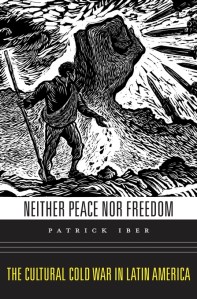
 Patrick Iber’s Neither Peace nor Freedom: The Cultural Cold War in Latin America (Harvard Press, 2015) is a very much-welcomed piece of historiographical investigation on Hemispheric Cold War in the Americas, and I think it is not just circumscribed within conventional historiography, since it also speaks to us as Latinamercanists, that is, some of us not precisely invested in writing history of Latin America. Its publication coincides with other recent books that reexamine the “culture battles” during the Latin American Cold War, such as Jean Franco’s Cruel Modernity (Duke, 2014) Mabel Moraña’s Arguedas/Vargas Llosa (Iberoamericana, 2014), or Rafael Rojas’ Fighting over Fidel (Princeton, 2015). Neither Peace nor Freedom studies the Cold War structuration in the region as a long durè process– spanning from the late twenties (take the assassination of Julio Antonio Mella in Mexico) to Sandinismo and the Marea Rosada or Leftist progressive governments that began with Hugo Chavez’s 1999 election. The Cold War took place in a climate of political and cultural conflictivity that the historian is not hesitant to call a “civil war”: “…the work of political and intellectual currents whose existence predate the Cold War, and whose sources lay in what might be described as the international Left’s civil war. The arrival of the Cold War meant that the Left’s internal conflicts would be inscribed onto superpower competition, and thus that struggles for justice around the world would be refracted through imperial interests of the United States and the USSR. In Latin America, that would leave the Left with almost no viable options for pursuing its aims without compromising them” (3).
The event of the Cold War in Latin America was in this sense a long and costly civil war overdetermined by a dual structuration. However, as Patrick Iber’s studies moves on to argue, this structuration didn’t always lead to political or cultural closure on either side. This duality had multiple replications throughout the book: there was the World Peace Council (WPC) and the Congress for Cultural Freedom (CCF), Casa de las Americas and Mundo Nuevo, along with the principles of “peace” (promoted by the geopolitical interests of the Soviet Union) and that of “freedom” (promoted by anti-communist and largely financed by the CIA). Of course, every reader could input their favorite artist, intellectual, or country for either side. It might be superfluous to say that Neither Peace nor Freedom maps a heterogeneous and conflicting history of the Cold War in the Americas (as opposed to being a “Latin American narrative” that only “happened to them” so engrained in the common position of anti-imperialist mapping. Some of us, not all, associate this second with John Beverley’s work and in particular with his Latinamericanism after 9/11).
But perhaps less obvious is the fact that Iber’s commitment to historical writing has abandoned a model of political militancy to generate an otherwise relation with the cultural Cold War archive. I want to expand on this point. At the center of Iber’s argument is that this dual structuration – whether you were anti-communist or anti-anti-communist – encompassed both a technology of liberation and a position in favor of occasional oppression (149). If this is in fact what ‘contained’ the logic of the Cold War, then one can see that Iber’s own position as a historian is consistent with not being on the side of ‘liberation’ or of ‘oppression’. To affirm this, either side would have to hold on to some principle of imperialism. These are the stakes in Patrick’s own book, and I am bringing up this point as to allow for a reexamination of the “dual structure” of the Cold War epoch in light of our present. I think there is something to this. If Patrick is neither on the side of “peace” or “freedom”, ‘liberation’ or ‘oppression’, ‘Latin American anti-imperialism’ or ‘neo-conservative domination’, what is his ground? Where is he standing?
I think there is commitment in Neither Peace nor Freedom, but only in so far as it uncovers another space beyond ideology. This dislocation is the excess of the cold war duopoly. One of the places in which one could start discussing this space, is where Iber argues the following, which can be found at the very end of the introduction of his book:
“Each camp would accuse the others of corruption and operating in the service of foreign empire. But it was not so much an issue of corruption as of the inscription of intellectuals’ preexisting campaigns onto Cold War. The evidence from Latin America suggests that the Cultural Cold War is best understood within a framework of “ironic gramscianism” – the pursuit of cultural hegemony through a combination of coercion and consent, incorporating many agendas. But the consequences were so varied that cultural fronts produced nearly as many ironies as they did movement in the direction that their patrons hoped…And the experience of Lain America’s Left during the Cold War was less a betrayal of democracy than a true paucity of options” (18).
This notion of “ironic gramscianism” – that also makes an important come back at the very end of the book- remains an underdeveloped quasi-concept making it even more suggestive for understanding the endgame of the cultural Cold War [1]. To finish, I want just to elaborate on two aspects that seem latent in this fragment of Iber’s text, and I take them to be hyperbolic of some of the strong claims laid out. First, “ironic gramscianism” seem to be understood by Iber as the contamination by way of the effects of hegemony. Hegemony here is taken as producing not just ‘other effects’ than those desired or intended, but more importantly, perverse effects. As I understand it – not just explicitly in this fragment, but more implicitly in Iber’s study cases– ironic gramscianism breaks the very closure and suture logic of hegemonic articulation, opening itself to an excess that it cannot contain ideologically. That explains why there were “many ironies counter to the direction that the patrons hoped”.
Iber seriously puts hegemony theory in crisis. As we know, hegemony theory is not just a theory, but also inevitably the principial political theory of and about modern Latin America State form. I do not know to what extent hegemony theory can come back unscathed as a viable political option (another example: to what extent the valence of Estado Integral as Estado Aparente in Álvaro Garcia Linera not an ‘irony’ in a deep sense?) [2]. If gramscianism is always ironic, this means that gramscianism does the work in the negative (the “cunning of imperialist reason”), and this negative is the limit of what is no longer “tolerable” in history (think dictatorship, or forms of oppression) (244). If Gramsci (consent and coercion) is always a machine that generates other effects, then it cannot but be ironic. A fundamental consequence here is that hegemony theory does not produce democracy (it cannot do this labor). It is my impression that it is not just a matter of perception, but that gramscianism (hegemony) is irony tout court. Is the ‘irony’ constitutive of hegemony not the very excess and ruin of itself as shown consistently through the Cold War disjunction?
Secondly, I want to raise the question of democracy that lies at the heart of Iber’s intervention. Fundamentally, the question about the Cold War is also a genitive question about democracy in the region: why has there always been a demise and impossibility of democracy? Why the condemnation, the open repudiation across intellectual groups and politico-cultural ideologies? I don’t think that this is something that Iber takes up in his book, nor should we demand an answer from it. In my view, Patrick Iber makes a modest plea: democracy (or let’s call it republicanist democracy) was impossible because there were no options that allowed for such a drift. It is here where I want to open another question for Patrick – as well as for our debate more generally– and this is: what about populism in the Cold War? The national popular State (Peronism, Cardenismo, Varguismo) with all its limitations and authoritarian drives has been the closest to true democratic experiment in the region. Early castrismo, for instance, is in a sense-liquidated populism [3]. Perhaps populism is what the negative does not let be in time. My point is not that populism is something like a “Latin American destiny”. What I wonder is if populism is not what could allow for a republicanist drift (as I suggested recently reading Jose Luis Villacañas’ Populismo) as to establish long lasting democratic institutionalization, perhaps for the first time in the region’s history since the independences of 1810.
I realize that this a highly speculative question, since with the demise of what some of us are calling the “exhaustion of the Latin America political progressive cycle”, populism is not even a viable option. What is worse, the neo-populisms from the Right are neither desirable nor consistent with a democratic opening. The Marea Rosada was a fundamental moment of the Latin American Leftist democratic desire, but not for the reasons proposed by Beverley (geopolitical inversion or State-subaltern alliance), but rather because of the implementation of a certain “fiesta del consumo” that expanded the borders of democratization. Now, to keep insisting on ‘gramscianism’ – and its categories, such as the Integral State, hegemony theory, “identity”, “correlation of forces”, albeit the admiration for Garcia Linera’s thinking, whose work is the most systematic effort to re-inscribe Gramsci in the present – is more of the same, and in an ‘ironic’ way, an option that is highly consistent with neoliberal machination and de-hiarchization (Hatfield 2015).
The end of the Latin American progressive cycle puts to the test the populist democratic articulation that conditions the national popular state form. As we know, this past Sunday, Evo’s MAS lost the referendum in two of its most important political bastions (Potosí and El Alto). If las nuevas derechas are able to keep the level of consumption on the side of large underprivileged popular sectors, then this would mark the final collapse of Latin American populism as a potential democratizing force, obliging us (scholars, and students) to rethink the nature of the political anew.
Notes
- Patrick Iber. Neither Peace nor Freedom: The Cultural Cold War in Latin America. Harvard University Press, 2015. In the conclusion, Iber writes: “The history of the MLN is another reminder that prodemocracy movements in Latin America, whether of the anti-Communist or anti-anti-Communist variety, used languages of liberation that were implicated in support for empire somewhere on the globe. Perhaps there was no other way” (149). Also see (195) his emphasis on “truncated Leninism” as the modernizing drive of the anti-communist intelligentsia.
- For this conceptual translation in Garcia Linera, see Gareth Williams’s excellent “Social Disjointedness and State-Form in Álvaro García Linera”. Culture, Theory, and Critique, 2015.
- On the Cuban Revolution as hegemony, see El Viejo traje de la Revolución: identidad colectiva, mito, y hegemonía política en Cuba (Universidad de Valencia, 2007) by Sergio López Rivero.
*Introductory remarks for Patrick Iber’s book worskshop at Priceton University, February 23, 2016.
 Infrapolitical Deconstruction (and Other Issues Related and Unrelated.)