
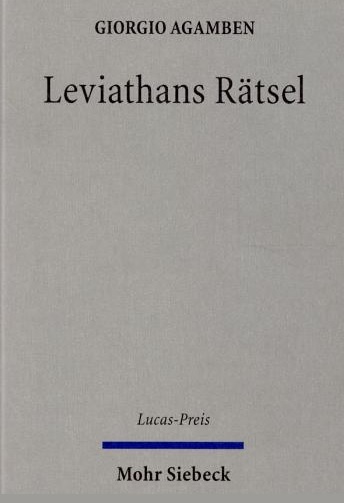
Leviatán sin pueblo: sobre Leviathans Ratsel, de Giorgio Agamben. Por Gerardo Muñoz.

Leviathans Ratsel Agamben 2014En la nota que sigue quiero detenerme en una reciente lectura de Giorgio Agamben sobre el Leviathan (1651) de Thomas Hobbes y elucidar algunas de sus tesis. Leída como ponencia en el marco de la ceremonia Dr. Leopold Lucas-Prieses 2013 en Tübingen, y publicada ahora bajo en edición bilingüe como Leviathans Ratsel (Mohr Siebeck, 2014), el filósofo italiano ofrece lo que pudiéramos llamar, de forma preliminar, una lectura sintomática de la escatología, cuyo propósito es nada más ni nada menos que la deconstrucción interna del pensamiento sobre el Estado Moderno que ha dominado la teoría política durante los últimos tres siglos. Si el Leviatán ha gravitado como figura categorial fundamental en el pensamiento clásico sobre el Estado – de Carl Schmitt a Quentin Skinner, de Leo Strauss a Eric Nelson – la tarea consiste, nos dice Agamben, de poner a examen de una vez por todas a la figura del “gran dios mortal” a la luz de su propia escatología esotérica.

En buena medida esta conferencia radicaliza el argumento del Carl Schmitt de El Leviatán en la teoría del Estado de Thomas Hobbes (1938) quien sostenía, revisando su propia teoría en torno a la soberanía en Teología Política, que la crisis de legitimidad de la modernidad y su caída hacia la nihilización del mundo ya se encontraba en la disposición maquinista del Estado hobbesiano. En otras palabras, la posterior desintegración estatal tenía sus fisuras en la debilidad apotropaica de un viejo símbolo. A diferencia del autor de Romanticismo Político, Agamben no busca rehabilitar al Leviatán como forma katechonica de la gran política estatal, sino más bien insinuar su estatuto extenuado, cuya aporía solo es posible de captar en la medida en que podamos comprender el misterio que Hobbes inscribió en ese emblema marítimo. El gesto de lectura de Agamben también busca distanciarse de las teorías del contrato social, desde las cuales Leviatán es convencionalmente desarmado como el representante del “Pueblo” o la Commonwealth en un proceso invariante entre el poder constituido y el poder constituyente.

La clave la encontramos, en primer lugar, en el plano pictórico. Se trata de entender la lógica óptica que organiza espacialmente el conocido grabado que Abraham Bosse hiciera para la portada del libro de Hobbes, y que muestra al gigante Leviatán compuesto de pequeños hombrecillos mientras se asoma detrás de una montaña de un pueblo inhóspito. El Soberano flota en el mar (por su propia condición anfibia), mientras que el espacio de la ciudad se encuentra despojado de ciudadanos. Esta sería, en primer lugar, el momento aporético de la soberanía: el devenir del Soberano aparece situado en el espacio anómico (donde la tierra termina) cuyo cuerpo ahora encarna un “Pueblo” que ha dejado de ser multitud.

Y desde una lectura de De Cive, Agamben explica que el concepto fundamental de “cuerpo político” solo puede entenderse en la medida en que la multitud nunca coincide con el soberano, y es precisamente por esto que la multitud es capaz de sobrevivir como remanente existencial (tal vez como “forma-de-vida”) una vez que el “Pueblo” se inscribe el no-lugar de la “persona artificial”  del Soberano. Como argumenta Agamben:

“Es un lugar común decir que en Hobbes la multitud no tiene ningún sentido político y tiene que desaparecer para que el Estado pueda comenzar a existir. Pero si nuestra lectura de esta paradoja es correcta, y el pueblo se constituye de una multitud desunida, entonces la multitud no solo antecede al soberano, sino que en forma de multitud dispersa continua existiendo posteriormente. Lo que desaparece es el pueblo que ha migrado a la persona soberana, y si bien gobierna la ciudad, le es imposible morar en ella. La multitud no tiene ningún sentido político, sino que es el elemento impolítico cuya exclusión funda la ciudad solo para que la multitud habite un mundo en ausencia de pueblo que se ha desaparecido para integrar el cuerpo del soberano (Agamben 32) [1].

Así, la multitud signa la inoperancia de la concreción teológica-política del Soberano en tanto pueblo. Incluso, podríamos decir que a diferencia de Antonio Negri y Jon Beasley-Murray, la multitud que aparece en Hobbes no es propiamente la de un poder constituyente como agente transformador de la historia en vías de constitución, sino como remanente sin Pueblo y sin principio. Esto es, como esa katargesis, concepto que Agamben estudia en la epístola a romanos de San Pablo, incapaz de coincidir con el Pueblo ni restituirse como principio nómico [2].

La multitud solo recoge en su existencia un habitar permanente de mundo vacío, sin pueblo y sin arche. Emerge aquí un Hobbes emparentado con el Maquiavelo del comienzo aleatorio y sin origen avanzado por Althusser. Por lo que toda condición de democracia – y esta sería una formulación de la lección hobbesiana que nos refiere la lectura de Agamben y que se abre en el interior de nuestra discusión – se sitúa en una zona de indeterminación del “sin principios”, o bien en perpetua ademy que signa el fin categórico del pueblo, y por lo tanto de toda articulación hegemónica.

Pero volvamos a la figura mítica del Leviatán. Lo que para Schmitt representaba (dentro de su invariable visión antisemita de la Historia) el despedazamiento final entre Leviatán y Behemot al cual los judíos solo contemplaban a distancia, para Agamben desoculta una óptica escatológica que irrumpe todo principio estatal como garante katechontico de la historia. Lo que introduce Hobbes con Leviatán es la potencia misma de una política profana, a saber, una política sin fundamento o condición de restitución del acontecimiento transcendental de la Historia.

Su única promesa es la destitución del espacio de la excepcionalidad como regulación efectiva del derecho soberano. Si para Schmitt la anomia estaba irremediablemente asociada con la figura del Anticristo tal y como se concibe en la Epístola de Juan, con el escatón se abre otro espacio impolítico que ha sido olvidado completamente por la arquitectónica de la Iglesia y del Estado, si bien estas dos figuras de la contención política occidental pueden inscribir su huella.

Lo que sugiero es que del mismo modo en que el tratado El misterio del mal: Benedicto XVI y el fin de los tiempos anuncia una temporalidad escatológica desintegradora de la historicidad katechonica para la Iglesia; en Leviathans Ratsel Agamben lleva a cabo una destrucción de la temporalidad restrictiva de la política estatal hacia la apertura de una impolítica profana. Ambos gestos llevan la suma total de la teología-política a su ruina conceptual y al fin de su productividad epistémica. Pero habría que matizar, sin olvidar el final del ensayo que retoma al Benjamin del “Fragmento Teológico-Político”, que el eskhaton no busca poner al katechon de cabeza frente a la historicidad, sino que indica el éxodo a un espacio infinitesimal como naturaleza del fragmento en el devenir de una impolítica de la destitución (Agamben, 58) [3].

La propuesta de Agamben es, en este sentido, una invitación para releer a Hobbes a contrapelo, incluso contra el propio pensamiento que recorre el proyecto de homo sacer. Si en Il potere sovrano e la nuda vita (1995) aparece el Hobbes de la mutación del cuerpo hacia la muerte como parte de la invención contractual ‘protección a cambio de obediencia’, en esta nueva lectura el excedente de la fuerza inherente a la forma Estado hace que el “momento hobbesiano” recoja internamente su propia desintegración hacia una forma destituyente y profana, cuyo signo escatológico solo puede afirmar una opción no-nihilista del habitar sin Historia. En cambio, si en Lo abierto un manuscrito hebreo de la Biblioteca Ambrosiana ilustraba el banquete mesiánico donde el rostro de lo humano se ha vuelto indistinguible del animal, el cefálico Leviatán se prepara para el momento en donde el Reino solo puede volver irreducible la relación entre cuerpo y representación, entre vida y anomia en un panteísmo inmanente que solo Spinoza pudo conceptualizar hacia los comienzos de la Modernidad.

Si la arquitectónica política de la Modernidad yace en ruinas en nuestro tiempo, la propuesta que parece querer avanzar Agamben agiliza la investigación de la forma Estado que, lejos de operar como katechon y como representación del Pueblo, busca reconciliarse con su marca escatológica en la fractura que marca el tiempo del fin.

Notas

  1. Giorgio Agamben. Leviathans Ratsel. Mohr Siebeck, 2014. La traducción al castellano es mía.
  2. Jon Beasley-Murray. Posthegemony: Political Theory and Latin America. University of Minessota Press, 2010. p.XII-XV.
  3. Giorgio Agamben. “What is destituent power?” (Society & Space, 2014). Pienso en especifico en el momento en que Agamben posiciona su propuesta de la teoría destituyente frente a varios de los programas críticos de la política en la segunda mitad del siglo veinte: “It is this destituent potentiality that both the anarchist tradition and 20th century thought sought to define without actually ever succeeding. The destruction of tradition by Heidegger, the deconstruction of the archē, and the fracturing of the hegemonies by Schurmann, and what, on the trail of Foucault, I have called “philosophical archeology” – they are all pertinent, but insufficient, attempts to return to an historical a priori to destitute it…(….). The destitution of power and its works is an arduous task, because is first of all and only in a form-of-life that it can be carried out”.

Althusser’s Machiavelli, 2. (Alberto Moreiras)

First of all, do take a look at Jon Beasley-Murray’s previous blog on Althusser’s Machiavelli: http://posthegemony.wordpress.com/2013/02/13/machiavelli-and-us/.  What follows, and what antecedes in my previous post, are just an elaboration of it.

In “La récurrence du vide chez Louis Althusser,” another essay published as an appendix to the book edition in French of Machiavel et nous, Francois Matheron quotes a private communication from Althusser to some of his friends: “It so happens we have a certain number of definite means that we are the only ones to have. It just happens that, as a function of this transitory privilege, we are the only ones that can occupy, and that occupy, an empty space: the space of Marxist-Leninist theory, and more particularly the place of Marxist-Leninist philosophy” (224-25).   It is an intriguing text, where Althusser is saying “we are here, we might as well use it.”   Or even: “we are here. We must use it. If not us, then who?” Which means that the space Althusser and his friends occupy is the mere occasion to launch the possibility of a beginning, of a political beginning.   The occasion binds the political agent to the very extent that the political agent is only an agent seeking an occasion. It is a structural place, in the sense that it is a particular site within the general structure, but it is more than anything a conjunctural place.   From which to make a leap, were it the case that Fortune helped.   In the meantime, one is not in politics, but preparing for politics. Preparing the necessary virtue. Thinking under the conjuncture. Waiting in active waiting.

This means, a political objective must be in place, which we need to understand under the figure of “determinate absence” (Machiavel 137).   It is not there, or rather, it is there but under the form of a void that must be filled.   And it will only be filled if an encounter were to happen that cannot be anticipated, only desired.   A political act is always an absolute beginning because its event is aleatory.

Althusser and his friends are therefore preparing themselves to take on the role of the New Prince, which they understand can only happen from within the Party.   The Party is seen as a necessary part of the conjuncture, as a necessary part of political virtue, but also as a necessary part of historical Fortune. In the name of a political objective, which is no longer, for Althusser and his friends, the constitution of a lasting national State, but rather the constitution of the state of communism. This complicates the notion of “determinate absence.” For Machiavelli, the determinate absence could only be filled by the absolute solitude of the New Prince.   But the absolute solitude of the Prince can hardly be translated to the solitude of the Party.   There is no solitude to the Party, witness Althusser’s own words to his friends.

Althusser has of course denied that Machiavelli must be understood as a democratic republican, and even more so that he has any secret or esoteric intentions.   Everything is out in the open if one cares to understand The Prince in the context of the Discourses.   What is at stake is the creation of a new political space, a lasting national Italian space, without tyranny, with laws that can protect the people. Against whom? Not just against foreign agents, but particularly against the grossi, the dominant class.   The dominant class is characterized by its desire to command, by its desire to oppress. The small people, the people as such, only care about their own safety. Freedom is for them freedom from oppression.   If the Prince must on occasion act as a scoundrel, well, it can be forgiven if it is done for the sake of a lasting national constitution without tyranny.   But it won’t be forgiven if it results in tyranny.

The solitude of the Prince is then compensated, at a second or later moment, by the Prince becoming the people.   This is the politics of the day-after, in other words, not the politics of the act of political irruption, not the politics of the aleatory encounter that might enable a change in the coordinates of the situation, even an impossible change (a change that only becomes possible after it happens, but could not have been predicted).   One supposes the Party must follow a similar course, since the Party is the new Prince. The Party must become the people, even if only after power has been taken, that is, starting the day after. This might be the task prospectively self-assigned to Marxist-Leninist philosophy and his agents, Althusser and his friends.  Discussing this, still allegorically, still in the name of an exegesis of Machiavelli´s work, is presumably the object of the last extant chapter in Machiavel et nous (which we know was left unfinished).

It has to do with the development of the Marxist State apparatus, and Althusser’s first interest is then showing the similarity between Machiavelli’s take and the Marxist one. For Althusser, Machiavelli would already be signaling in the direction of Gramsci’s definition of the state, “une hégémonie (consentement) bardée de coercition (force)” (147). Beasley-Murray is right, in his blog entry mentioned above, that what follows is a fundamental endorsement of hegemony theory through the analysis of the Machiavellian popular army, the function of base ideologies (religion) and secondary ideologies, and particularly of the Prince as state individual.

And it is in the analysis of the latter that a curious contradiction comes up. The Prince must “become the people,” but it turns out to be a fake becoming.   The Prince is before all, through his or her very virtue, a master of what Kant would have called radical evil, that is, a master at making political appearances look like righteous behavior. It is always a matter of fooling the people, then, either with the truth, that is, by conforming to the ideology that supports the state (religion, laws), or with a falsity meant to appear as a truth. That is, even the Prince’s righteous behavior appears as a form of deceit, once it is accepted that the capability of becoming evil is also proper to the Prince. Because the people, il volgo, want to be content, the Prince must do everything he or she can to keep them ideologically content—and this is of course the limit of the hegemonic model Althusser establishes Machiavelli proposes, and Althusser seems to sanction.   “Parmi tous les tromperies possibles, il en est une qui intéresse le Prince: la tromperie par excellence, celle qui présente aux hommes l’apparence mëme en laquelle ils croient, qu’ils se reconnaissent, oú ils se reconnaissent, disons oú leur idéologies se reconnaït en eux, celle des lois morales et religieuses” (169).

The fakely-becoming-people of the Prince is never addressed as such except as a political necessity.   But it marks a gap, or a “vide,” to use one of Althusser’s favorite words, in the very conception of politics proposed. Politics takes absolute priority, for the sake of its end, true (Althusser has argued earlier that the prevalence of the end makes Machiavelli´s theory anything but a form of pragmatism: “only results count, but it is only the end that judges the results that count” [161]), except that the end, politically speaking, is the necessary becoming people of the Prince, which is barred through the essential falsity of the Prince’s political action. When we transpose this situation to the actions of the Party, either before or after it takes power, we can see how unsatisfactory the theory becomes.   Just as unsatisfactory as the history we know.   If, as Althusser puts it, the Prince looks, not for the love, but for the “friendship” of the people (172), even as State individual, then the friendship gained in the political game remains a function not just of consent and coercion, but of duped concern sustained in the violence of the constant ruse (in addition to coercion based on force).   Bad friendship, which may be all hegemony can offer at best. Althusser calls it “ideological politics” (173).

It is clear that Althusser’s text does not manage to resolve the tension between politics as aleatory encounter, as the virtuous ability to seize the unforeseeable conjuncture and to keep itself within the rigor of the unforeseeable, and the hegemonic politics of the day-after, which are no longer aleatory politics, but a politics determined to gain and accumulate at the cost of perfectly foreseeable and presumably systematically organized state duping.   Critics have become accustomed to accepting something like two Althussers that can find no common ground. Beasley-Murray associates posthegemony to the Althusser of the encounter, to the extent that the notion of the aleatory encounter as master trope of political action excludes and must even denounce hegemonic procedures of constitution.

But does infrapolitics figure here?  Clearly, Althusser’s intent, whether it is the first or the other Althusser, is to theorize the political as such.   That it is an insufficient and broken theorization (and I do recommend Francois Matheron’s “’Des problèmes qu’il faudra bien appeler d’un autre nom et peut-ëtre politique’”), that politics ends up offering a disappointing result, may point the way towards the need for infrapolitical reflection.   So far we can only see it in the definition of il volgo as those who do not have the desire to command and opress but would rather be left alone in their everyday life, would rather reject the false friendship of the Prince who prides herself or himself in her or his capability for evil and ruses.

If we may understand infrapolitics as the region of historical facticity, the factical opening of historical space, that is, of spatial temporality for a life, for any life, infrapolitical reflection is first of all a destruction of political inconsistency, which ceaselessly hijacks both time and space (it is not only that, as Marx puts it in the Grundrisse, all economy is an economy of time, but all politics are equally a politics of time). It is as a destroyer of political inconsistency, which may be politics’ only consistency, that Althusser’s essay on Machiavelli may be claimed to be part of the infrapolitical archive.   When it comes to infrapolitics, perhaps the people will decide that they have better things to do than to prepare for politics, than to wait in active waiting for an event of beginning.   Perhaps, after all, thinking under the conjuncture may enable us to dismiss the conjuncture, and to look for something else.

Galli’s Lo sguardo di Giano: Passing Beyond Schmitt. By Alberto Moreiras.

The title words in Carlo Galli`s book, soon to be published in English, are a reference to the passage between form and the formless, chaos and order, war and peace. Carl Schmitt´s thought is said to carry a tremendous capacity to account for the radical reversibility of the political realm—ultimately, from form to crisis and from crisis to form. If the ability to experience both sides of the political, to see both, and to dwell in the ambivalence of political time is important for a thinker, then Carl Schmitt, who has that capacity to an eminent degree, is himself required passage for “whoever wants to think politics radically.”   Schmitt is a modern classic, and one of the last classics of modernity, through what Galli calls the tragic drift of his thought (based on the experience of the ultimate indetermination of political order, that is, of violence as the immanent destiny of the political).   But even Schmitt’s radical reach cannot reach beyond the historical limits of the modern as such. Today, that is, Schmitt’s thought needs to be abandoned, needs to be crossed through and left behind, in order to find cognitive access to new political spaces beyond the modern. We must pass beyond Schmitt’s theory of the passage: this is the core of Galli’s proposal in this book, which takes up and elaborates aspects of Schmittian thought that Galli’s previous Genealogia della politica. Carl Schmitt e la crisi del pensiero politico moderno had not covered.

And of course one cannot cross the thought of a thinker without experiencing it first in as intimate a proximity as possible. Lo sguardo di Giano is composed of five chapters where Galli discusses Schmitt’s relationship to State theory, to political theology, to the so-called global age, and to Machiavelli, Strauss, and Spinoza.   They are all masterpieces of critical exegesis.

The chapter on the State takes up the notion that Schmitt, without considering that the State is the core of the political, thinks of the State as the principal aspect of political modernity precisely as the very symptom of the inherent gap between form and reality, which at the same time the State attempts to mediate.   That the State can be or is at the same time the symptom and the cure is only paradoxical if one does not realize that the order of the State is never fixed, never static, but rather tragic, unpacified, transitory, mobile. The study of the perpetual mobility of the State can therefore only be undertaken through a simultaneously theoretical, historical, and utterly political, that is, local gaze. If in this analysis the history of the State is constantly undergoing an unstable passage from the God-State to the Machine-State, in the same way that the God of metaphysics comes to be substituted in modernity by technology as the referential center of reality, the liberal phase of the State starts to appear as a depoliticized State-form: in the liberal State politics are disavowed into a technical de-politicization that of course cannot survive its own neutrality. The rise of potentially catastrophic political myths is never far from that terminal point, after which, through conceptual necessity, a new world space opens up, post-state and post-modern, for which we do not yet have a concept.  [Infrapolitics, while itself not politics, is of course the name we are pushing as a precondition for a possible reinvention of the political in the post-Schmittian age.]

The chapter on political theology continues the previous story by pointing out how it is precisely the liberal pretension of a radical neutralization of political theology that must be subjected to deconstruction by Schmitt as a way of finding his own path into the epistemic and practical state of the political.   The modern neutralization of political theology is nihilism as such, to which we cannot oppose a reinvention of the Divine, but rather simply a radical objection to its efficacy: that neutralization is in every case a disavowal of forces nevertheless profoundly powerful can only be forgotten at one’s own risk. And the theory of the exception is the place where Schmitt sustains the possibility of an understanding of the political between abyss and reason, between arbitrariness and necessity. After all, a proper understanding of authority as factically decisionistic, and not based on rational mediation, not based on legal self-foundation, is the best protection against political blindness, hence disaster. But blindness acts today for the most part through the very automatism of neutralization, through the de-politicization that disavows any principle of political transcendence in the ostensible triumph of politics as technics.  And this goes not just for neoliberal or rightwing practices, but also for whatever it is the conventional left–today the pro-hegemony, populist left, in general terms–has come to understand it should do.  The end of political theology is also the end of any concrete stability for the modern State, hence the end of the modern State; and the beginning of something else for which the categorical apparatus deployed by Schmitt can only show its insufficiency.  We need to push further.

The chapters that follow, on Machiavelli, and then on Spinoza as mediated by the figure of Leo Strauss, are tours de force of intellectual history where the presuppositions of Schmittian thought are brought to bear on the work of two other seminal thinkers of modern political thought. Galli concludes that Machiavelli is not in fact a significant segment in Schmitt’s intellectual genealogy, but in the process a highly useful explanation of the difference between a theory of the State as virtue or force and a theory of the State as the friend/enemy stasis emerges (or, as Galli puts it, the difference between the State as immediacy versus the State as negated mediation).   In the same way Spinoza comes through as outside the purview of Schmitt’s understanding of what is central to modern political theory.   But can Spinoza really help today?  It is an open question.

The last chapter on Schmitt and the global age brings the antecedent to an intricate discussion of the specific status Schmitt holds in contemporary thought: as a deconstructor of political modernity, as one of the 20th century thinkers whose depth, in all its conflicts and tensions, and in his great, unforgivable errors, gives us more to understand about politics as such, and politics in the overall history of the West, and as someone endowed with the kind of intellectual power that can become conscious of its own limitations–hence make others conscious of their limitations as well.   Schmitt represents an “extreme deconstruction” of modern political thought as “architectonic nihilism.” As such, Schmitt illuminates or reveals the radical aporias of modern political thought, and brings us to the end of a history that we must now discard, as the “new destiny of the world,” which is that of the “global age,” can no longer be accounted for through modern categories.   A new nomos has taken root, but that means in the first place that we must bring ourselves to a position from which we can interpret it. Galli presents here some of his ideas on globalization as global mobilization, but suspends the answer as to whether global mobilization can eventually reveal itself as order-bearing.   For the time being, Galli sustains, global war is a form of conflictuality without a restrainer. This is no longer a Schmittian horizon, which means that non-Schmittian political categories must be developed. Our best tool is still the understanding of the end of the political categories of modernity accessible to us as the very reverse or the other side of Schmittian thought. Schmitt still works as a deconstructor, to such an extent that one needs to read Schmitt to get rid of Schmitt—which is the same as saying that an opening to the imperatives of contemporary political thought requires a successful passage through the Schmittian passage itself.   Now, to where?

Cabezas’ A-Positional Freedom. By Alberto Moreiras

“No infrapolitics without exploitation; no exploitation without infrapolitics.”   The Introduction to Oscar Cabezas’ Postsoberanía: Literatura, política y trabajo begins by stating that post-sovereignty would be the condition of capital’s “absolute sovereignty,” that is, a capitalism without restrainer.   The hypothesis, or thesis, is that such is the regime of rule today, in virtue of which there is no limitation to the slavery imposed by capital. Post-sovereignty would describe the political terrain of globality, understood as the political terrain of exploitation.

But in the first chapter we read that there is no formal or real imposition of sovereignty, as the history of modernity shows, without the simultaneous production of a “judaizing remainder” (22), the organizer of the marrano figure, or register, as a radical exception to the sovereign community.   The marrano exception is an error or errancy as such, and marks or provides the “enigmatic experience” of something that, interpellated and informed by the law, is never quite subordinate to the unity of command” (23): an overflowing or desbordamiento “before the law.”

If the “community,” certainly in its modern form as national community, but presumably beyond that, is always an invention of power, even of inquisitional power (in the same way that the marrano is a figure within the law that exceeds the law itself, its counterpart, the Inquisition, or inquisitional logic, is “a power within the state superior to the state itself,” in Henry Charles Lea’s definition), then the marrano marks a decommunitarian option or position that, towards the end of the chapter, Cabezas will indicate as an a-positional position, an exodus from position (81).

Cabezas corrects Heidegger’s Parmenides by insisting that it is not the Germans, precisely, who could mark the very possibility of a non-Roman, non-imperial understanding of the political, but rather the marrano, as inquisitional excess.   He links this to Derrida’s messianism without the Messiah, hinting at, without fully developing, the idea that Derrida was the first to thematize political de-capitalization for a properly counterimperial, non-Roman thinking of the political.

But I wonder whether, within the confines of this chapter at least, Cabezas’ move is really towards counterimperial politics and not rather towards infrapolitical decapitalization.   Perhaps the most moving pages in the chapter are the central ones, the section entitled “Sovereign T-error, Exile’s Truth.” In them Cabezas pursues notions such as “subjectivity without subjection,” “apátrida thought,” “erratic language,” and “sovereignty without sovereignty” in order to affirm that it is only in them that a possible “relation to freedom” opens up in modernity and beyond modernity (43).   The radical sadness of exile, of ex-communication, of de-communitarization, is a condition of freedom under every regime of sovereignty, which the marrano abhors.

But can a radical opposition to sovereignty be identified as a political position? The language of the marrano is always a losing language, a language of loss or in loss (51). “Only a language of unity turned sovereignty can fulfill the function of union” (51). There can be no union under a marrano register, only separation.   But this then means, “the marrano condition of language” (61) is never political, and can only be infrapolitical. Cabezas says “clandestine,” “subterranean,” “invisible,” that is, it never rises, because it can never do, to heliotropic regions.

Marrano a-positionality is always already infrapolitical, which is its condition of freedom.   Freedom is never defined, only invoked.   So this chapter powerfully raises a question that it is not easy to come to terms with: the answer would be, there is no political freedom, in the same way there is no good community in community. But there is something like infrapolitical freedom, invoked, never defined.

Cabezas concludes: “Exile unbinds freedom doubly, as an experience in the open, but also as the impossibility for it to take place in the name of any modern genealogy of sovereignty or its criollo variations. Freedom is the experience of exile, and the whisper of a marrano who blows into your ear the destruction of the images of idols” (91).

Non-Catastrophic Practice of Non-Knowledge. By Alberto Moreiras.

If there exists something we should call infrapolitics beyond the critical text, in other words, if infrapolitics belongs in the real and is not merely a hermeneutic notion, simply a way in which we have imagined we could refer to certain phenomena that cannot be captured by any proper ethico-political understanding, we might want to assume that it invests a region of experience that must more or less overlap with the political region.   Infrapolitics would be below politics, or beyond politics, it would have consequences for politics, but it would be a bit, perhaps, like a double of politics, like politics´s shadow.   In a similar way, it would determine or inhabit habit itself, the original ethos, and it would be co-presential with ethics, while being ethics’ other side, ethics’s double, or the shadow of ethics.   And all of this is possible, and possibly productive: infrapolitical thought aims at investigating the obverse of the ethico-political relation, what the ethico-political relation leaves behind in every case.   We could remember Heidegger’s mention of the “invisible shadow” that falls upon everything once the human can only be considered a subject and the world can only be perceived in the mode of image.   Infrapolitics can only be the region of the invisible shadow. And infrapolitical thought would then be a theoretical practice in and of the shadow, a thinking of the withdrawal or in the withdrawal of the ethico-political relation.

But this very difference between infrapolitics as region and infrapolitics as theoretical practice raises many questions that may complicate the mapping. If infrapolitics obtains in the wake of the withdrawal of the ethico-political relation, we could ask whether the ethico-political relation is not in the first place an imaginary imposition on the immense and intractable real whose withdrawal opens up a region of experience that vastly exceeds mere obversity; if it is an “other side” it would be like the other side of the iceberg; if it is what the shadow guards or protects, and first of all from language, it could be an unimaginable and unprocessable monster.

So, infrapolitical practice would run the risk of dwelling on a nothingness, of setting its sights on a region that must by definition be excluded from capture, from any capture, also, therefore, from capture by the infrapolitical gaze.   Infrapolitical practice would have become a nice promise, thank you very much, but an unfulfillable one. Or only to be fulfilled in the form of catastrophe.

This is like Nietzsche’s Grenzpunkte: one can gaze into the abyss, but one would not like to fall into it.

So, why would one want to run that risk? First of all, because it is there, and because notice has been received of a facticity that cannot be merely wished away by the beautiful soul’s emphasis on handling only that which can be securely handled. If the totality of our language means to express, with a moderate degree of difficulty, only those phenomena that can be linked to the ethico-political relation, and if that is what our tradition calls knowledge, well then, there is a certain amount of hard-headedness, even of idiocy, in insisting that non-knowledge also beckons, and that it is not just interpreting the world but also transforming it that is at stake in the bid to move beyond more or less secure knowledge.

Who would want to do it?   Who is the subject of infrapolitical practice?   Perhaps a specific libidinal cathexis is required here.   It is not a practice for those whose secure essence precedes them. It is a practice of existence, a form of excess beyond discourse, an ongoing demetaphorization of existence for the sake of something that might always elude.   But how can it elude if it is at the same time always already there?

A Thesis on Culture/Politics. By Alberto Moreiras.

It is no doubt not only arrogant but also silly to state that culture does not exist, or that politics are useless, even if or particularly if we provide a suitable and encompassing definition of what it is we want to do without, which is not easy of course.  Culture and politics are master concepts, whether we like it or not, and one cannot leave them behind without giving up on language and history both.  However, I have insisted and will continue to insist on the fact that without a critical destruction (a destructive critique?) of both concepts, after which we’ll have to see what might be left over, the project of infrapolitics, or even of its associated term, posthegemony, will not take off, will be hampered at the very basic level of articulation.   A few years ago I called this predicament the “cultural-political closure”–as the horizon of thought, which is as ideological as any other horizon of thought, and there is nothing natural about it.  No doubt my thinking was as insufficient and incoherent then as it is today.  But I’d like, nevertheless, in a tentative and risky way, to put forth the idea that the cultural-political closure is as pernicious yet constitutive for our world as political theology was for the 19th century.

Link

“Infrapolitical Action: The Truth of Democracy at the End of General Equivalence”

I. Extroduction

Jean-Luc Nancy refers to general equivalence, in his short book La communauté affrontée (2001), a bit counterintuitively: “What arrives to us is an exhaustion of the thought of the One and of a unique destination of the world: it exhausts itself in a unique absence of destination, in an unlimited expansion of the principle of general equivalence, or rather, by counterblow, in the violent convulsions that reaffirm the all-powerfulness and all-presentiality of a One that has become, or has again become, its own monstrosity” (12). Only a few pages later he speaks about the increasing “inequality of the world to itself,” which produces a growing impossibility for it to endow itself with “sense, value, or truth.” The world thus precipitously drops into “a general equivalence that progressively becomes civilization as a work of death;” “And there is no other form in the horizon, either new or old” (15). If the loss of value organizes general equivalence, it is the general equivalence of the nothing. Nancy is talking about nihilism in a way that resonates with the end of Martin Heidegger’s essay “The Age of the World Picture,” where Heidegger discusses “the gigantic” as the culmination of modern civilization in order to say that quantitative-representational technology can also produce its own form of greatness. It is at the extreme point of the gigantic that general calculability, or general equivalence, projects an “invisible shadow” of incalculability (“This incalculability becomes the invisible shadow cast over all things when man has become the subiectum and world has become picture” [Heidegger 72)]). Heidegger’s invisible shadow could be compared with Nancy’s hint of “an obscure sense, not a darkened sense but a sense whose element is the obscure” (20). Let me risk the thought that this obscure sense, as the invisible shadow of an undestined world, is for Nancy the wager of a radical abandonment of the neoliberal world-image, a notion that has become commonplace in political discourse today. But we do not know towards what yet—the invisible shadow within nihilism that projects an obscure sense out of nihilism is a political alogon whose function remains subversive, but whose sense remains elusive.

In The Truth of Democracy (2008) Nancy says that, in 1968, “something in history was about to overcome, overflow, or derail” the principal course of the political struggles of the period (15). This statement is probably not meant to be understood as springing from any kind of empirical analysis. Rather, the book makes clear that “something in history” is precisely the truth of history, understood as the epochal truth of history along classically Heideggerian lines (“Metaphysics grounds an age in that, through a particular interpretation of beings and through a particular comprehension of truth, it provides that age with the ground of its essential shape. This ground comprehensively governs all decisions distinctive of the age” [Heidegger, “Age” 57). There was a truth that the Europeans, for instance, could only obscurely perceive under the veil of a “deception,” and such a truth is, for Nancy, the truth of democracy that titles his book. My contention is that Nancy’s insistence on that truth of history, or truth of democracy, preserves a Hegelian-Kojèvian position that Nancy proceeds to overdetermine from a critique of nihilism. In other words, for Nancy, a truth of history was about to overcome and derail the main course of political struggles from the left in 1968, and it was the event of true democracy, only accessible on the basis of an opening to an epochal mutation of thought whose necessary condition would have been, would be, the renunciation of the principle of the general equivalence of things, infrastructurally represented by the Marxian Gemeinwesen, money, as the unity of value and as generic unity of valuation. The truth withdrawn under the veil of disappointment is the possibility of overcoming the nihilism of equivalence. Such is the modification Nancy imposes on the Kojévian thematics of the end of history, which now becomes understandable as the history of nihilism. Against it Nancy wants to offer a new metaphysics of democracy. Nancy’s understanding of democracy coincides with his “obscure sense” of the incalculable. In this essay, I will try to explain it, first, and then raise a question at the end.

Read more… (.pdf file)