
Podemos, ¿en nombre de qué? Transversalidad y Democracia. (Gerardo Muñoz)

En el artículo “Una patada en la mesa”, publicado el pasado 17 de Mayo, el pensador David Soto Carrasco pone sobre la mesa dos estrategias fundamentales para acercarnos sobre lo que viene acechando a la política española (aunque para los que estamos interesados en pensar la política más allá de un caso nacional, España es solamente un paradigma de la tarea central para el pensamiento político). Primero, Soto señala, contra los críticos convencionales tanto de la derecha como de la izquierda, que el nuevo acuerdo entre Podemos-Izquierda Unida no es una radicalización ultraizquierdista de la nueva fuerza política de Pablo Iglesias. Y segundo, sugiere que el nuevo acuerdo tampoco es un “acto de resistencia” en el sentido de una mera filiación para mantenerse a flote en la escena de la política nacional.

Soto Carrasco nos dice que se trata de un acto político de madurez que convoca a la ciudadanía española a través de una táctica de transversalidad. La alianza con Izquierda Unida, de esta manera, no estaría implicada en arribismo hegemónico, sino en nuevas posibilidades para “dibujar líneas de campo” y enunciar otras posiciones por fuera del belicismo gramsciano (guerra de posiciones). Soto Carrasco le llama a esto “sentido común”, pero le pudiéramos llamar democracia radical, o bien lo que en otra parte he llamado, siguiendo a José Luis Villacañas, deriva republicana. Conviene citar ese momento importante del artículo de Soto Carrasco:

“En política, la iniciativa depende fundamentalmente de la capacidad de enunciar tu posición, la posición del adversario pero también de definir el terreno de juego. Si se quiere ganar el partido, no solo basta con jugar bien, sino que hay que dibujar las líneas del campo. Dicho con otras palabras si se quiere ganar el cambio hay que recuperar la capacidad de nombrar las cosas y redefinir las prioridades. Generalmente esto lo hacemos a través de lo que llamamos sentido común. Para ello, la izquierda (como significante) ya no es determinante” [1].

El hecho que los partidos políticos y sus particiones ideológicas tradicionales estén de capa caída hacia el abismo que habitamos, es algo que no se le escapa ni al más desorientado viviente. Contra el abismo, el sentido común supone colocar al centro del quehacer de la política las exigencias de una nueva mayoría. Pero esa gran mayoría, en la medida en que es una exigencia, no puede constituirse como identidad, ni como pueblo, ni como representación constituida. La gran política no puede radicarse exclusivamente como restitución de la ficción popular bajo el principio de hegemonía.

En los últimos días he vuelto sobre uno de los ensayos de Il fuoco e il racconto (Nottetempo 2014) de Giorgio Agamben, donde el pensador italiano argumenta que justamente de lo que carecemos hoy es de “hablar en nombre de algo” en cuanto habla sin identidad y sin lugar [2]. La política (o el populismo) habla hoy en nombre de la hegemonía; como el neoliberalismo lo hace en nombre de la técnica y de las ganancias del mercado, o la universidad en nombre de la productividad y los saberes de “campos”. Hablar desde el mercado, la universidad, o el gobierno no son sino un mismo dispositivo de dominación, pero eso aun no es hablar en nombre de algo. Agamben piensa, en cambio, en un habla abierta a la impotencia del otro, de un resto que no se subjetiviza, de un pueblo que no se expone, y de una lengua que no llegaremos a entender. El mayor error de la teoría de la hegemonía es abastecer el enunciado del ‘nombre’ con fueros que buscan armonizar (en el mejor de los casos) y administrar el tiempo de la vida en política.

Por eso tiene razón José Luis Villacañas cuando dice que el populismo es política para idiotas (Agamben dice lo mismo, sin variar mucho la fórmula, que hoy solo los imbéciles pueden hablar con propiedad). Podríamos entender – y esta sería una de las preguntas que se derivan del artículo de Soto Carrasco – el dar nombre, ¿desde ya como función política que abandona la hegemonía, y que contiene en su interior el rastro poshegemónico? ¿No es ese “sentido común” siempre ya “sentido común” de la democracia en tanto toma distancia de la hegemonía como producción de ademia? Si la democracia es hoy ilegítima es porque sigue dirigiendo las fuerzas de acción propositiva hacia la clausura del significante “Pueblo” en nombre de un “poder constituido”.

En este sentido estoy de acuerdo con Moreiras cuando dice que la poshegemonía “nombra” la posibilidad de cualquier posible invención política en nuestro tiempo [3]. Es una brecha del pensamiento. Lo que siempre “nombramos” nunca habita en la palabra, en el concepto, o en prefijo, sino en la posibilidad entre nosotros y la potencia de imaginación para construir algo nuevo. Y eso es lo que pareciera constituir el olvido de los que permanecen enchufados a la política de la hegemonía, o la hegemonía como siempre reducible de una manera u otra a la política.

Soto Carrasco propone una transversalidad entendida como “principio político y nueva cultura política”. Y esto, nos dice, es lo decisivo para un nuevo rumbo y renovación de la política. La transversalidad es momento y estrategia de invención de las propias condiciones de la política real, y por eso necesariamente se escapa al orden de la hegemonía o del doblez en “Pueblo”. ¿Qué tipo de transversalidad? ¿Y cómo hacerlo sin volver a dibujar un mapa de alianzas políticas y sus digramacionoes de poder, siempre en detrimento del orden institucional y de la división de poderes? Fue esto lo que en buena medida limitó y finalmente llevó a la ruina y agotamiento la capacidad de ascenso del progresismo en América Latina durante este último ciclo histórico de luchas más reciente [4]. La transversalidad no puede ser alianza meramente con fines electoralistas o populistas de un lado u otro péndulo del poder.

A la transversalidad habría que superponerla con su suplemento: una segmentariedad inconmensurable, poshegemónica, y anti-carismática. Como lo ha notado recientemente José Luis Villacañas, quizás varíen las formas en que aparezca el lenguaje: “Es posible que lo que yo llamo republicanismo no sea sino la mirada de un senior de aquello que para alguien jóvenes es populismo…” [5]. Pero si las palabras y los términos fluctúan (siempre son otros para los otros), lo único que queda es la pregunta: ¿en nombre de qué?

Más allá de la palabra o el concepto, la política que viene tendría que estar en condición de hablar-se en nombre del fin de la hegemonía y la identidad. Solo así sus nombres del presente podrían ser democracia poshegemónica, populismo, comunismo del hombre solo, transversalidad, institucionalismo republicano, o división de poderes…


Notas

  1. David Soto Carrasco. “Una patada al tablero”. http://www.eldiario.es/murcia/murcia_y_aparte/patada-tablero_6_516958335.html
  1. Giorgio Agamben. Il fuoco e il racconto. Nottetempo, 2014.
  1. Alberto Moreiras. “Comentario a ‘una patada al tablero’, de David Soto Carrasco. https://infrapolitica.wordpress.com/2016/05/18/comentario-a-una-patada-al-tablero-de-david-soto-carrasco-por-alberto-moreiras/
  1. Ver, “Dossier: The End of the Progressive Cycle in Latin America” (ed. Gerardo Muñoz, Alternautas Journal, n.13, 2016). Ver en particular la contribución de Salvador Schavelzon sobre las alianzas en Brazil, “The end of the progressive narrative in Latin America”. http://www.alternautas.net/blog?tag=Dossier
  1. José Luis Villacañas. “En La Morada”: “Es posible que lo que yo llamo republicanismo no sea sino la mirada propia de un senior de aquello que para alguien más joven es populismo. La res publica también provoca afectos, como el pueblo, aunque puede que los míos sean ya más tibios por viejos. Su gusto por las masas es contrario a mi gusto por la soledad. Yo hablo en términos de legitimidad y ellos de hegemonía; yo de construcción social de la singularidad de sujeto, y ellos de construcción comunitaria; yo de reforma constitucional, y ellos de conquistas irreversibles; yo de carisma antiautoritario, y ellos de intelectual orgánico. En suma, yo hablo de Weber y ellos de Gramsci, dos gigantes europeos. Es posible que una misma praxis política permita más de una descripción. Es posible que todavía tengamos que seguir debatiendo cuestiones como la de la fortaleza del poder ejecutivo, algo central hacia el final del debate. En realidad yo no soy partidario de debilitarlo, sino que sólo veo un ejecutivo fuerte en el seno de una división de poderes fuerte.” http://www.levante-emv.com/opinion/2016/05/17/morada/1418686.html
Can the poem be thought? on Marco Dorfsman’s Heterogeneity of Being. (Gerardo Muñoz)

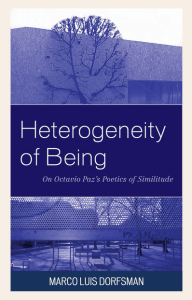
Dorfsman Heterogeneity of Being_2016In the last chapter of Heterogeneity of Being: On Octavio Paz’s Poetics of Similitude (UPA, 2015), Marco Dorfsman tells of how he once encountered a urinal in the middle of a library hallway. It was a urinal possibly waiting to be replaced or already re-moved from a public bathroom. The details did not matter as it recalled the origin of the work of art, and of course Duchamp’s famous readymade, originally lost only to be replicated for galleries and mass spectatorship consumption. Duchamp’s urinal, or for that matter any manufactured ‘displaced thing’ reveals the essence of technology, at the same time that it profanes its use well beyond appropriation and instrumentalization. I recall this late anecdote in the book, since Dorfsman’s strategy in taking up Octavio Paz’s poetics is analogous to the dis-placing of a urinal. In Heterogeneity of Being, Paz is de-grounded from the regional and linguistic archive, dis-located from the heritage and duty of national politics, and transported to a preliminary field where the aporetic relation between thought and poem co-belong without restituting the order of the Latianermicanist reason.
Heterogeneity of Being is Dorfsman’s leap (a versuch that gathers also the innate ability for failure in the Nietzschean sense) to cross the abyss of the poetic identity; fleeing from the national-popular frame, as well as from the pitiable origins that enable every ground of transcultural articulation. Against the good intended “–abilities” to “speak on the name of” and in the “place of” the other, Dorfsman offers an exercise in thought. The initial hypothesis is how to assimilate, or render thinkable, an ontology of Pazian poetics in the way of a ‘stimmung’ facilitating the endeavor for thought (12). Heterogeneity of being is nothing more than this, but it happens to be also a stroll around Paz’s poetical constellation– not without accidental turns, missed encounters with transient signatures, interrupted articulations and rhythms – as an attempt to arrest the fold between thinking and the poematic. The poematic is understood here as a strange habitation of sorts; a stanza for the (im)possibilities of thought.

Indeed, the poematic is that which allows a tropology that exceeds the compartmental and sheltered demands of the political, subjective, and ethical drives. Against the temptation of disciplinary binds (which are, after all, signs of university semblance), Dorfsman calls for an incomplete Paz that cannot be an objectified signatory authority, but rather as what unveils the temporality of being (11).

Pazian poetics co-belong with the existential time, since it is a now time (the time of a life), which appears at the gates, without entry, of the culturalist and conventional literary methodologies responsible for the organization of poesis legistlation. Dorfsman is not interested in what we could call a “signatory local scene” of the poetic (“Paz in Mexico” or “Mexico un Paz” – the usual postal-service that is always the currency of exchange) as if the “poem”, as the poet’s standing reserve, could supplement what remains on the side of the unthought or the repressed. (Say an ancient cosmogony, a non-Western mantra, or a temporality that derails the homogeneous or messianic time of the modern). Rather, “Paz” is depository of a heterogeneity of inheritance that fails to assume the form of an identity, a destinial time, and therefore is always “anachronistic and it involves a ghost, a specter” (Dorfsman 18-19).

Laberinto de la Soledad, Postdata, or ¿Águila o sol? attentively read in the initial chapters of the book are displaced from the topical discussion of ‘Mexican identity’ to one of difference and inheritance, or as Dorfsman’s conceptualizes it, of “dif-herencia”, following Derrida’s elaboration of spectrality and heritage in Hamlet-Marx. The temporalization of the poematic allows Dorfsman to unveil in Paz’s thought as a language of dif-herencia that: “is not a concept or a metaphor; it is more like a simile or a pun. It thrives on its ambiguity and imprecision” (23).

Dif-herencia brings to halt the logic of identity and difference, while attending to the exposure of a wound (herida) internal to the process of deappropriation and splitting. Thus, more than drift towards a criollo fictive ethnicity, Paz is reservoir of specters that punctuate through a politico-ethical relation that bring forth responsibility and the practice of witnessing emptying identity formations. Pazian poetic time, suggests Dorfsman, does not inaugurate something like a “national I” or a “principial Mexican inheritance of the letter”, but a dwelling that opens a singular existence and disavows every nomic allowance. Pazian poematicity is an atopic temporal relation with a groundless tradition.

But the heterogeneity of the singular also resists – although “resistance” or “stasis” are not the appropriate words – a negativity that feeds the labor of dialectics. Here Dorfsman deploys along with his concept ‘dif-herencia’ that of ‘similitude’, which could be conceived as nocturnal knowledge or the failure of every effort into constructing a people, an ‘alternative subject’. In his strong reading of Laberinto de la Soledad, contaminated by Heidegger’s expository understanding of the essence of technology, the Mexican essence-problem is turned inside-out as one of masking and simulation. Following Italian philosopher Emanuele Coccia, we could say that in every expository relation one always remains strange or improper [1]. De-attaching the codifications of masks from Christian morality (shame, guilt, or purity), Dorfsman reads a poetical-speak of similitude, where appropriation (of meaning) is de-appropriated in the name of an echo-plurality that is always-already unappropriable threshold for a “modality of truth” (45). In a substantial passage from the third chapter, Dorfsman writes:

“…the revolution, perhaps the most authentic because it set up a confrontation with the interior nothingness of being, only managed to produce a new mask, an institutional mask, the PRI, whose transfigurations and unmasking continue to this day. The chain of identities, Spanish, Indian, Mestizo, Catholic, liberal,….etc, can all be inherited and disavowed, they are all interchangeable and all empty” (47-48).

The poematic in Paz is in the order of the profane, although not because it dwells in the radical historicity of the singular seeking to ‘represent’ or ‘donate’ the real world with measured political action, but because it has no desire in instantiating a historical event (or a new politics). The profanity of the mask vis-à-vis the logic of similitude is a space of potential use that trans-figures the other for becoming. It is a style that is both singular and disjointed. In Dorfsman’s propositional hermeneutics, Paz’s discussion of identity is only preparatory for a de-identification of a singular-plural that destitutes every politics of location, and in fact, all politics of being within history.

Pazian culturalism is dissolved not only in similitude / simulation, but also in the poetic temporality of language. Here, similitude coincides with the event of language itself, making the poetic the very singularity of profanation. In Piedra de sol, Dorfsman reads the verse “unánime presencia en oleaje” in light of Heidegger’s poetological exegesis of Parmenides poem and the poetic universe of Georg Trakl (94-96). But Dorfsman goes further, since for him the Pazian poematic bear witness to the rhythm of singular life (I would also argue of the ‘immanent cause’, although this is not explicitly in the analysis) where the way of language builds its own path or “camino”.

Hence, it is no longer a subject that enacts or wills, but the time of being which against the order of signification, stems from the stasis of language (“en el seno del lenguaje hay una guerra civil sin cuartel”) (97). Crossing tracks with Heidegger and Trakl, Dorfsman’s disobeys the exegetical command of the Pazian archive, only to re-direct it to the spiral of errancy of language. This is the proper region of the poetic temporality or the silence or the simulation in the poem.

The temporality of the poem becomes for Dorfsman the possibility of speaking in language, in the tongue of the other. This is why the end of Heterogeneity of Being should be read as poetic desistence, as the call for a practical exodus from every determination of the poetic arrival in meaning or History for a ‘peal of language’ [102] [2]. The poem, in its exigent silence and means of desistance, opens in this way to thought:

“To say no the world is to flee, to escape, perhaps towards an elsewhere: poetry. At least towards a certain kind of poetry, the kind of hermetic, escapist aestheticism which Paz seems to be attacking but which, paradoxically, he was himself accused of writing. But no, what the poem here says is not no or yes; it a refusal of both. Is it a negation, then? Rather, it is the recognizing of the aporetic status of the world, to which affirmation and negation are irrelevant. The poet hears a call to either affirm or deny, but he cannot place the call.” (109).

It is here, however, where the poematic becomes a problem for thought, as well as an impersonal exigency. This is why it is odd that Dorfsman vacillates in calling Paz’s poetics “mysticism” as temporalizing of language, since it is the mystic reverse what allows for the tracking of silence, for the breathing in of a permanent wound that is its second voice. This is the silent voice that dwells in the event of the calling of thinking, which turns (and the turn here is not just in passing, but indicative of the taking place of language) any iteration of everything unsaid in the event of language [3].

The exodus of the poematic does not lead to the desert but to the nocturnal and illegible knowledge of the pyramid. The pyramid knowledge knows no disclosure. This is where Duchamp’s readymade crosses path with Heidegger’s thought on the essence of technology. This very encounter is pyramidal (or at least triangular: Duchamp-Heidegger-Thing), even if Dorfsman does not attempt the elaboration and keeps it secret. But Dorfsman’s suggests that Duchamp’s painting as philosophy is what speaks (in silence) to the unveiling of modern technology.

The duchampian injunction poses another tactical movement: it radically suspends the modern closure on aesthetics (aisthesis), which entails the ruin of the technology of “critique” (Thayer) for the production of ‘visibility’, of the ‘made visible’. It is only in Duchamp where the Heideggerian maxim “the painting spoke”, earns something like a covert instance of life; or in Dorfsman’s terminology, a poetic similitude. The notion of the poem itself becomes profane simulation of every distance relative between language and world. It through this transfiguration of the power of the dichtung (still a revelatory substitution in the later Heidegger) to the readymade, that a heterogeneity of being ceases to be supplementary to the order of history and of epochal destiny.

And it is at this instant where the poematic touches and falls into the strange welcoming site “where literature, paintings, shoes, and urinals may speak, but their secretions may be otherwise than meaning” (124). This is no longer a region for aesthetics or production, but desistance in language. Perhaps at this point one could say that the poem has conducted an exodus from itself into the inner sense of silence.


 Notes

  1. Emanuele Coccia. Sensible Life: a micro-ontology of the image. Fordham University Press, 2016.
  2. For a take on desistance in the specific context of the Chilean Avant-Garde and the readymade, see Villalobos-Ruminott’s “Modernismo y desistencia. Formas de leer la neo-vanguardia. Archivos de Filosofia, N.6-7, 2011-2012.
  3. Giorgio Agamben. “Il silenzio del linguaggio”. Arsenale Editrice, 1983.

More thoughts on infrapolitics. (Steve Buttes)

schendel-05

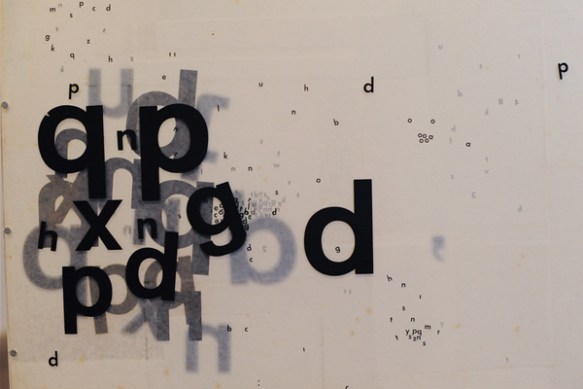
I want to respond and reframe some of my initial questions given the ways in which the dialogue has approached them thus far. Moreiras notes that “there is a differend between us at the level of presuppositions, and that it is very difficult to look both for agreements or disagreements if the differend is not recognized as such.” Using the metaphor of the “pine trees” we discussed earlier, he goes on to say that “this is not the same as saying that you, for instance, insist on focusing on the pine trees whereas infrapolitics looks for everything else as well.

Rather, the very perception of the “everything else” already goes through the recognition of the differend. At that level, I would say that “your” pine trees, from this side of the divide, are not the same as the pine trees we can see and deal with.” And then this is compared with “lust [which] has different connotations for different ethical positions: a puritan sees lust where a libertine sees only desire, etc.”

What I understand as at stake here is the difference between translation and belief. In the former, we might think of the possibility of translating libertinism into a puritan language, of acknowledging the presuppositions of puritanism but nevertheless finding room to see from within those terms desire rather than lust. Approaching puritanism and libertinism as different languages, we might find points of conversation. But, then, if you are a puritan and encounter the translation of desire into your language, what do you do with the earlier form of puritanism in which you understood desire as lust? If it’s a good translation, you’d stop using the earlier version, or maybe you’d strategically (or cynically) use one or the other in given circumstances.

If it’s a bad translation, you might say, “nice try, but it makes no sense: I’m not buying it” or “that’s blasphemous.” But what marks the difference between good and bad here is whether or not you find it convincing and adopt it as your own. In other words, it’s not really a translation at all but rather an argument, one that you either believe to be correct or incorrect. The same goes for the pine trees. If I believe every kind of tree is a type of pine tree and you believe that all trees are individual and beyond categorization, we disagree rather than just differ. This takes the argument onto the ground others have already argued: Di Stefano, Sauri, Hatfield, Michaels and others. Indeed, as Michaels notes in The Shape of the Signifier critiquing the conversing “moral vocabularies” that Richard Rorty advocates and explaining the strangeness of the translation model, “Hebrew and German do not contradict each other, and insofar as Saint Paul’s and Freud’s moral vocabularies are like Hebrew and German, they don’t contradict each other either . . . . if Paul says that Jesus is God and Freud says he isn’t, they aren’t disagreeing, they’re just speaking different languages” (46).

While I believe these issues are important to discuss, I believe the scholars I mention can speak to their own arguments if they wish. I don’t want to move in that direction in my own comments because it takes us away from the intention of my initial post, which was not to interrogate the totality of systems of thought (e.g. infrapolitics as a whole) or make claims about entire philosophical traditions that are at odds with each other. Rather, my intervention emerged from my own plodding, piecemeal way of working, which is to mark concrete points of contact between my thinking and interests and those I see in others—in my case the Neobaroque, trompe l’oeil and the punctum—and to ask questions from there.

In this vein, let me reframe the initial reflection above in which I attempted to address the metaphors Moreiras evokes in his previous post. Rather than puritanism and libertinism, I want to imagine the strangeness of this demand for translation over argument in a Latin American context. More specifically, I want to draw attention to an episode from the colonial period that appears in Mariano Picón-Salas’ work and which I encountered in Marco Dorfsman’s recent Heterogeneity of Being (2015). Here Dorfsman discusses the “very Baroque example” (72) of the transliteration of the Pater Noster (Lord’s Prayer) into hieroglyphic Indian writing:

“The text begins with the word pantli (in Nahuatl a banner or flag of sorts) followed by the glyph for nochtli (in Nahuatl the cactus fruit or tuna) and so it continues on in this manner. The idea is that the Indian is supposed to read pantli nochtli phonetically, and not to see the images of the hieroglyph. A proper reading of the pictographic writing would, of course, produce pure gibberish, while the phonetic reading produces a distorted Latin. It is worth recalling that the majority of the Indians, even those who would have been able to ‘read’ and recite the Pantli Nochtli, would have not been able to understand Latin in any case. However, it is precisely the fact that this new hybrid is incomprehensible that gives it both its sacred and poetic power . . . . In the transliteration, Latin is being put to uses that are only ecclesiastical or scholastic on the surface. Within, ‘a beautiful harmony’ (or struggle) rages. What we have here is the true fusion of opposites [the coincidentia oppositorum of the Baroque]: the beginning of a literary production that leads, almost naturally, towards that other Latin American [Lautréamont] who in France joined together an umbrella and a sewing machine upon an operating table” (72-73).

Here, though I’m not certain that this is a main point of his argument, Dorfsman signals the strangeness of the translation model. As Dorfsman frames it, “Tuna Flag” either makes no sense at all (is “pure gibberish”) or is a way of joining the faith community in saying “Our Father” (in a “distorted Latin”). In the tension between these, Dorfsman sees a “poetic power,” but it is a power that emerges, of course, from a pedagogical power. The “Tuna Flag” scene is taken from the section of Picón-Salas’ book entitled “The Pedagogy of Proselyting:” “images and metaphors were sought in the circumscribed world of the native to bring religious ideas nearer to his mentality” (Picón Salas 56). While, as Dorfsman points out, this pedagogy is somewhat pointless in the sense that “a proper reading of the pictographic writing would, of course, produce pure gibberish,” rather than an understanding of the complexities of a belief system, it is possible to find in the gap between the saying (the distorted Pater Noster) and the said (the incomprehensible Pantli Nochtli)—in the failure to produce a successful translation—a proto-surrealist poetic form: the “true fusion of opposites” that is the “beginning of a [Neobaroque?] literary production” (73).

It is here that I see the task of the infrapolitical thinker manifesting itself as Moreiras describes: deciding what kind of object the failure that is the Pantli Nochtli is. Neither the Franciscans who instructed the indigenous artisans to create the images of the Pantli Nochtli nor the indigenous painters themselves would have recognized what Dorfsman does, which is to see what existing modes of calculation could not. In the gap between the utopian pedagogical practice of the Franciscans and the everyday intonation of gibberish in Nahuatl, the infrapolitical thinker sees the emergence of a nascent (Neobaroque?) literary form. But it is for this reason that I claim in my initial post that infrapolitics (in my partial, fragmented approach to it) “remain[s] squarely within Baroque modes of trompe l’oeil thought, requiring . . . unbelieving beholders.” Indeed, here we see a key example of trompe l’oeil literature: out of raw materials (“pure gibberish”) the appearance of the ecclesia emerges (“distorted Latin”).

But the infrapolitical thinker, as what I call a “miner of life’s raw material,” appeals to the potentiality of life itself by seeing the invisible qualities of that “gibberish.” That is, by seeing in the the incongruous encounter a potentiality that is not visible from the two poles mandated by the encounter, in demanding the failure of realizing the utopian promise (which is accompanied by the violent and creative modes Picón-Salas describes), we see the invisible emergence of the possibility of integrating the Pantli Nochtli into an absent whole by seeing it as the first in a series of variations that will produce an alternative tradition: a poetic form that begins with the Franciscans and develops into the incongruous images created by Lautréamont, the surrealists and Octavio Paz.

It matters little here that the Pantli Nochtli is meant as a mnemonic device to enter the ecclesia. What matters instead is the emergence in the everyday intonation of the Pantli Nochtli of the failure of utopia, which the infrapolitical thinker recognizes as poetic form, a form that is invisible to those who made the work. This infrapolitical account of poetic form escapes the belief systems of the colonial encounter, it does not escape a belief system outright but rather produces one of its own that displaces current understandings by integrating the Pantli Nochtli into the avant-garde tradition (if we agree with the reading) or doesn’t (if we disagree). Does the infrapolitical see a role for artistic visibilizations, or must these always be broken down for parts? Is the failed artwork central to infrapolitics? Are the terms “neobaroque” and “infrapolitical” synonyms for each other?

It is from here—in the infrapolitical approach’s ability to see what is not there when reading from existing modes of calculation—that I can return to the question of the punctum. In reading Moreiras’ work on poverty and infrapolitics in Línea de sombra, I saw parallels with his earlier work on Borges and Cortázar in Tercer espacio. I then heard the opening remarks made by Gerardo Muñoz and Sergio Villalobos-Ruminott at the ACLA seminar in which they marked a connection between Línea de sombra and Tercer espacio: “The drift to suspend the categorial structure of the Latinamericanist reflection was already underway in Tercer espacio and [The] Exhaustion [of Difference]” (“A Response”).

It is in this context that I felt justified in asking the question of whether there was continuity between the infrapolitical that motivates Moreiras’ work now (and underscores the work of the Collective) and his earlier claims about the punctum made in Tercer espacio. Moreiras hints at the possibility of this continuity: “The punctum is . . . a crucial concept for me, as precisely the site of desire, redefined by infrapolitics as the crossing of the ontological difference in every case. I should use this precise point in your paper to warn you that when I wrote Tercer espacio, or even Exhaustion of Difference, I was not yet thinking of infrapolitics. So for me the inferences are very interesting, but I am not ready to endorse them without going over them with a very fine comb” (“A Response”). But as he notes in the continuation of our discussion, where he explains that his account of infrapolitics as “always already a response to exploitation,” what is crucial is that the response occurs in “the gap between lives exploited and infrapolitical lives, the punctum in that gap–the site of Borges’ “ancient innocence”” (“More on responding”).

In this line from Borges’ poem “Alguien” [“Someone”], these confluences are clear: a sudden feeling of happiness that emerges not in hope for the future (an eschatology of change) or from the demands of daily life but rather from the pang of an “ancient innocence.” This “ancient innocence” enables one to see in the partial moments (“an unexpected etymology,” “the taste of water”) of a daily life controlled by structures that are not our own the forgotten joys of the past (which could presumably be the joys of the future). The “ancient innocence” that underscores the infrapolitical minor adjustment has a clear connection with the punctum: it cannot be planned but must rather occur “de pronto” [“all of a sudden”].

And this demand leads me to the follow up question of whether the infrapolitical account of the punctum—the hidden minor adjustment that could not come into being were it planned as part of an anti-exploitation or antipoverty project—has something to do with the antitheatrical reading of the punctum produced recently by Michael Fried. As Fried notes, Barthes demands that the punctum not be put there for us, not be part of the photograph’s studium (or mode of calculation), and it is this demand that marks the punctum as part of the antitheatrical tradition and secures for photography its aesthetic form.

If the punctum (what the photographer cannot put there for the viewer) is a radicalized form of absorption (the refusal to perform for the viewer), it is also what secures for Barthes a successful photograph, or at least one that he finds compelling. This creates a tension, then, between the failed translation above and the successful photo here. If every success is a potential failure (mode of exploitation) and every failure a potential success (mode of escape), these are often invisible to existing modes of calculation, that is, remain in the shadows until revealed by the minor adjustment that breaks down (deconstructs?) those modes.

Does the infrapolitical demand a failed (non-unified) work, or does the infrapolitical (with its emphasis on desires that remain in the shadows, on what is not there for us) dialogue with the antitheatrical reading of the punctum developed by Fried and Michaels? I will end for now but will continue to engage in the dialogue as it/if it continues to develop.


Works Cited
Borges, Jorge Luis. “Alguien.” El otro, el mismo. Obras completas. Emecé, 2007.

Di Stefano, Eugenio and Emilio Sauri. “Making it Visible: Latin Americanist Criticism, Literature, and the Question of Exploitation Today.” http://nonsite.org/article/making-it-visible

Dorfsman, Marco Luis. Heterogeneity of Being: On Octavio Paz’s Poetics of Similitude. Lanham, MD: UP America, 2015.

Fried, Michael. Why Photography Matters as Art as Never Before. Yale UP, 2008.
Hatfield, Charles. The Limits of Identity: Politics and Poetics in Latin America. U Texas P, 2015.

Michaels, Walter Benn. The Shape of the Signifier: 1967 to the End of History. Princeton UP, 2004.

___. The Beauty of a Social Problem: Photography, Autonomy, Form. U Chicago P, 2015.

Muñoz, Gerardo and Sergio Villalobos-Ruminott. “Línea de sombra Ten Years Later: Introductory Remarks”. https://infrapolitica.wordpress.com/2016/03/17/linea-de-sombra-ten-years-after-introductory-remarks-acla-2016-harvard-university-gerardo-munoz-sergio-villalobos-ruminott/

Picón-Salas, Mariano. A Cultural History of Spanish America, from Conquest to Independence. Trans. Irving A. Leonard. U California P, 1962.

*Image: Mira Schendel. Untitled. 1973.

Into the common blue: on Federico Galende’s Comunismo del hombre solo. (Gerardo Muñoz)

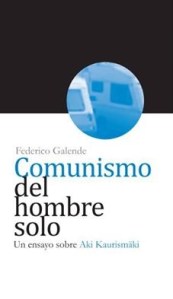
Galende Comunismo hombre soloFederico Galende’s new book Comunismo del hombre solo (Catálogo, 2016) cannot be read as just an essay, but rather as a gesture that point to a common hue of humanity. This hue is the intensity of blue – instead of the zealous red, the morning yellow, or the weary white – the intensity that withdraws to an ethereal plane of the common. In a recent book on Picasso, T.J. Clark reminds us that the palate blue of the Spanish artist’s early period paved the way for the entry into the temporality of the modern, while demolishing the bourgeois interior and its delicate intimacy of lives that thereafter became possessed by work and display [1].

Galende’s blue dwells on an angular bend of a color without signification. He is not interested in re-signifying blue as topologically reducible to the new oikos of being. Rather, it is the blue of Aki Kaurismäki’s films what inscribes a distance or metaxy of what is improperly common to a humanity thrown into a world beyond measure (11-12). For Galende, Kaurismäki’s work is an excuse for thought, in the same way that the paintings of Yves Klein or Andrew Wyeth would have been been deployed to un-veil a distant sky that opened to the world of the living in a radically different temporality that is neither that of progress or work, nor that of alienation and consumption.

Blue communism, or rather a communism of blues brings forth unity where there is separation, because ‘class’ far from constituting an identity, is a praxis that “les brinda a ser habitantes inocentes de una actividad que se despliegue bajo un mismo cielo” (36). Hence, there is no ‘idea of communism’, but only an unfulfilled image of potentiality (this is what at stake in Kaurismäki’s cinema, but also in Bresson and Bela Tarr, briefly sketched out in the essay by Galende) of a “tiempo inútil” or an inoperative time. It is a time of life against empty homogenous time of historical appropriation or abandonment. This is also the time that exceeds the threshold between life and work, cinema and the worker’s ailment, the solitary proletarian and the lumpen as always immanent to the capitalist conditions of labor. This inoperative time is what gives form (gestalt) to a negative community of the senses that re-attaches, as in multiple patchwork, what is real and what must remain fiction (78).

Galende sees implicitly this inscription of the inoperative time in Marx’s figure of the lumpenproletariat, and more subtlety, in bits and pieces of Marx’s own life as is autographically reconstructed from the days when the “18th Brumaire of Louis Bonaparte” (1852) was written. It is only in Blanqui and later Benjamin, where communism is imagined as the improper existence of singulars under a common sky. Galende’s injunction for communism is an astro-communism that is neither regulated by subjectivity or will, political parties or the language of the transcendental nor is it a historical benchmark for hegemony and order. Against every regimen of subjective onto-theology, astro-communism is an experimental and impersonal practice of being exposed in the other, with the other. In a crucial moment of his essay, Galende writes:

“Introducir la práctica de los otros no es sin embargo una facultad exclusive del arte. Es la manera que tienen cualquiera de deshacer la identidad a la que ha sido confinado por el otro…Esto significa que no hay nada que interpretar ni nada que comprender, como diría Deleuze, ningún imperativo que asimilar: lo que la experimentación destruye es el transcendental que el catastrofista o el adelantado inyectan en el movimiento de la experiencia con el único fin de inmovilizarla. Ahora estamos al tato de que ese trascendental no era más que la máscara que cubra la vida vacía del sacerdote que frustra las potencias que se actualizan en su despliegue. […] Probar ser otro: la experimentación es una extensión en lo impropio” (81-83).

Astro-communism is conditioned by a metaxy that exceeds every anthropological remainder and its restitution. This explains why in the later part of the essay, Galende turns his attention to the animalia of both Kaurismäki and Bresson’s films: stray dogs, Balthassar the donkey, talking monkeys, rats or giant insects in Kafka. Curiously enough there is no mention of wolves in the essay (the wolf being the only animal that resists the circus or domestication, that is, that resists theory proper). Under the sway of animality, what Galende captures is not a substance or an intensity of the animal as to delimit the caesura between man and animal, but an openness that retain metaxy of every singular animal with the world.

For Galende, the animal’s sight abolishes any ‘central organization of perception’, which is condition for the appearance and consequently for being-singular in common (103-104). The metaxy of animal-world is (intentionally?) underdeveloped in Comunismo del hombre solo, but one could well speculate that this imagistic tactic here is to cross over the ontological difference into a region what the event of the human proper loses its privilege into an unearthly landscape where things and animals are assumed as a form devoid of epochal destiny. Astro-communism renders inoperative all epochality, since it conceives itself as lacking a ‘center, axis, or an organization of the visible that are merely instantiated in the quotidian [2].

This improper communism of the singular man delivers no political program. Of course, Galende makes no effort in restituting a politics in the time of the ruins of the political; at a moment when critique as such has been subsumed into a universitarian operation (125-126). Galende’s point of departure (not of arrival) is thus infrapolitical. His gesture in this sense cannot be said to produce a critical register aim at “re-orienting the present struggles” and re-integrate lumpen-living into the “stable working class”. This second option is already to abandon the promise of astro-communism in the name of an anthro-productivism that feeds off from the fictive arrangement of mechanical and labor arrangement against the singular experience.

Comunismo del hombre solo imagines and thinks what is always-already in the excess of production, that is, on the side of the lumpen, which is the form of life of astro-temporality of being. The blue man of communism can’t never be subsumed by work, since he is first a style of existence that is closer to the work of art. This is why the experience of communism, as Groys understands it, was a destructive plenary where social space became an all-encompassing museum. But that experiment failed, and only comes back to us as spectral trace. This is the promise in Kaurismäki’s oeuvre. What returns is what is un-common of the inoperative man – for instance, the particle ‘mu’ of communism [3] – not only as what makes possible and concrete every existence of life, but as a natural flux of a reverie that carries the fractured back of a laboring humanity.


Notes.

  1. T. J. Clark. Picasso and Truth: From Cubism to Guernica. New Jersey: Princeton University Press, 2013.
  1. Federico Galende writes: “…en este comunismo no hay centro, no hay eje, no hay una organización de lo visible ni a partir del contracampo del protagonista en el que el paisaje se condensa ni a partir de una mirada dirigida….fuera de toda imposición, en formas de co-existencia que asoman solo cuando se las requiere para solucionar un traspié inmediato o cotidiano”. 117-118
  1. Wu Ming. “The Mu particle in communism”. Make Everything New: a project on communism. London: Book Works, 2006.

Is communitarianism a substitute for State-University discourse? (Gerardo Muñoz)

Julian Velez Bolivia 2015

As we witness the exhaustion of the Latin American progressive cycle, it is obvious that new demands emerge for thought. What began more than ten years ago in Venezuela, Ecuador, and a little later in Argentina and Bolivia, has now come to a full close. Concretely, this signifies a halt in the processes of democratization in the region. It also entails the need to think new categories, demand imagination to other possible configurations, and abandon principles that have been subsumed into the ‘duopoly’ of market-State formulation [1].

If the last decade was characterized by democratization through consumption, this could well mean that the Latin American plebs will now consume less, will party only part-time under surveillance, and will have to reimagine themselves otherwise (even if it is around a Coca-Cola late at night in the villa). The runfla lives (the lives of the marginalized, of the popular sectors, the villeros, etc.) will have to regain the time of life, which is the time of the commons in consumption.

Out of the many concepts that circulated in the ‘Universidad Posible’ Conference (generously organized by Willy Thayer & Raul Rodriguez Freire) that took place in Santiago (April 18-21) it was that of ‘the commons’ which had intellectual political purchase to ‘invert’ and transform the waning of progressive political structuration, now in the hands of right-wing administrative governmentality. But the idea or concept of ‘commons’ was in itself ambivalent: on one hand, the ‘idea of the commons’  (it is always an idealistic affirmation) thrives on the general horizon of resistance from below, but on the other, it necessarily feeds off the crystallization of the crisis of hegemonic articulation.

This resonated in the phrase that Eduardo Rinesi repeated throughout the four days of the conference: ‘let us not forget that something has happened all these years in Latin America’ (“recordemos que algo ha venido pasando en América Latina”). On one hand, this introduced the experience of someone implicated in a progressive State apparatus, but on the other, this was also an implicit response to those who called for radical suspension of university epochality [2].

But what is that that has happened (in Latin America)? In any case, what happened must remained silenced, and merely evoked. The event cannot be given its proper weight, its semantic density, and its full hermeneutic dis-closure. Perhaps, because what has happened is democratization, but also (now) the crisis of democratization. In other words: in the time of the ruin of hegemony proper, there is a decline and trans-formation into its other, the shadow of post-hegemony as translated and incorporated against the time of democracy. Hegemony flows back as time past to avoid its spectral present.

More importantly, that ‘that which has happened’ provides for political verisimilitude that guarantees specificity of location, which is also a guarantee of the political. But in its closure, it also unveils a temporality of the past. A past that cannot assume the present, and when it tries to do so, it renders a telic result of what has already taken place. In this variation of university discourse, thought is incorporated into the prison of consequential necessity of time. It has happened, but it must remain outside of the now. If according to a maxim of the Russian poet Joseph Brodsky, the prison is maximum time with minimum space; university discourse is maximum past with minimum present. In the carceral reflection on the university in time of crisis, thought itself enters prison with no possibility for parol.

It is at this point where the communitarian option emerges from below as co-substantial with the crisis of democracy. In fact, its demand appears as its supplement that affirms time present of horizontal an-institutionalization with the ‘something has happened’ of partial (interrupted) democratic life. Communitarism becomes a safety-vowel to recast hegemony form from below in the crisis of hegemony form. Thus, communitarianism is a necessary supplement of hegemony to keep its ground intact.

It is in this double movement – between hegemony of the effectual past and the localization of the movement in the present – where something like a crisis of university discourse could be located in the Latin American intellectual reflection when confronted with the inevitable sinking progressive cycle in the region. This movement is full stasis in a double sense: it provides balance and form to principal (intellectual) reflection, and it also guards the conflict between fracture of institutional hegemony and immanentization of hegemony translated into community.

Can the Latin American crisis assume the form of a political plebeization to save itself? What is the time for a plebeization of the university? This was the question posed by Oscar A. Cabezas against reflexive modalities of political closure or the substantialization of the political (as stasis) into thinking the present [2]. Plebeization becomes a possible horizon when it demands the integration of the unity of conflict. But the turn to a communitarian unity of intellect must first posit political struggle as a primary antagonism of the friend-enemy divide, as Luis Tapia forcefully argues [3]. In fact, this is the argumentative core in Tapia’s Universidad y Pluriverso (2014), an inverse but affirmative schmittianism.

Plebeization (a term that interestingly Tapia himself does not deploy) organizes the time of the ‘future’ as a way to govern the present, in the name of forgetting the singular. Or is plebeiazation an invisible remainder of what is always taking place? Or is it a dirty eschatology for post-katechontic times? In both cases, the ‘something has happened’ and the ‘immanentization of the ultimate struggle’ amount to a dual machine of a particular historical fabric that, in the face of the fissures the political, is unable to see the open.


Notes

*Image: Popular procesion after Tiwanaku, by Maria Alejandra Escalante & Julian Velez, 2015. (Do not reproduce without their permission).

.

  1. The duopoly of State and market was thematized by Gareth Williams following Brett Levinson’s Market and Thought: Meditations on the Political and Biopolitical (Fordham, 2004).
  2. Moreiras referred the a-positional ‘ex-universitatis’, Villalobos-Ruminott a suspension of the principle of equivalence, whereas I called for a ‘postunivesity form beyond community’. Rodrigo Karmy’s averroism against ‘epistemic personhood’ was also consistent with these positions. These were all rehearsals for an infra-university, as Williams called it.
  3. Oscar A. Cabezas. “Los intelectuales y la universidad norteamericana”. (Paper read at Universidad Posible Conference, 2016).
  4. Luis Tapia’s Universidad y Pluriverso (2014). The reference to Schmitt’s concept of the political is thematized explicitly in Tapia’s essay.

A note on ‘class’. By Gerardo Muñoz.

I think that a discussion on class and exploitation brings important points for a fundamental disagreement. In so far as thought solicits perpetual interlocution, this exchange seems necessary and timely. Since I alluded in passing to Daniel Zamora’s article on exploitation in a previous note, I would like to recall the way in which he brings to bear the analytical stakes in pursuing the question of ‘exploitation’ against that of ‘inequality’. (Let’s leave for a moment the oppositional form of the debate, that is, between inequality and/or exploitation, which I do not think exhausts the discussion of work in any sense). Zamora writes at the very end of his article:

“Today, more than ever, the success or failure of the struggles to come depend on the capacity of political and class organization (e.g: unions) to draw attention to the socioeconomic stakes represented by the “surplus population”, and to convince the so-called “stable” working class that their fates are intertwined. Indeed, at the very dawn of the industrial era, Marx had already posited that a decisive stage in the development of the class struggle would be the moment when workers “discover that the degree of intensity of the competition among themselves depends wholly on the pressure of the relative surplus population” and thus on their being able to “organize a regular co-peration between employed and unemployed in order to destroy or to weaken the ruinous effects of this natural law of capitalist production on their class” [1].

I do not intend to gloss Zamora’s article, rather I want to use it to introduce at least two intertwined elements of analysis. First, I would agree with Zamora that exploitation has not disappeared from our contemporary world. On the contrary, everything is labour and everyone is exploited insofar as we are in the post-epochal stage dominated by the principle of general equivalence. What disappears is the semblance and unity of the very category of class as articulated in Marx’s thought. In the 1990s, this aporia underlying the “theory of the working class” was posed with immense clarity by the Chilean philosopher Willy Thayer as follows:

“Escasa la teoria porque esta ha caido en el territorio de la fenomenolidad. Lo que equivale a decir que el conflicto o la divison del trabajo entre teoria y fenomenolidad ya no rigen estrictamente mas. La efectividad ha subsumido esa posibilidad” [2].

So, the end of work does not mean the end of exploitation as such, but a turbulence between the categorial sphere and the phenomenal sphere. As Willy Thayer observed, the totalization of real subsumption of capital leaves only capitalism and gets rid off the potential for revolution (Thayer 139). So, if we only account for labor in the way that Zamora (or even Hatfield at the end of his book) seems to do, then, how can the role of finance, derivative models, the phenomenon of debt, and the pure means of speculative capital where nothing is produced except value itself be thought? It is general knowledge that for Marxism the model solicits a necessary mediation between money, commodity, and surplus value. However, in the ‘financial turn’, as Joseph Vogl discusses at length in his Specter of capital (Stanford 2013), work is reduced to mere re-production of value for value’s sake. For Vogl this is linked to bad faith and guilt. Today, it seems that the attractiveness of the category of class in the new the sociological revival of Marxism is solely discursive, since it cannot say anything about these transformations.

More important is the fact that, by retaining the category of class, the sociological critic secures his place as a vanguard of his time, leaving untouched the constitutive productionism at the heart of Marxian critique of capitalist labour. This is, after all, the philosophy of history working both against existence (wanting to “convince” specific subjects, whether in motley or unified social determination), while voicing a messianic promise for an emancipation to come. Of course, this does not mean that the idea of class could not be reworked as to grasp something else beyond Marx, as Andrea Cavalletti has demonstrated [3]. But the positive horizon that posits class against inequality does not do the work as an analytical tool to understand the global predicament. In fact, it seems to restitute as a sort of violence implicit in political drives.

When Zamora speaks of the “intention to convince the stable working class”, he reveals an old desire of the Left. (And it should not come as surprise that his book on Foucault and Neoliberalism comes endorsed by the Marxist sociologist Vivek Chibber). However, this is a legitimate political position, which actually exited last century under the name of guerrilla warfare. What is the guerrilla if not a process of subjectivization that pushes to link or “convince” the unemployed or the lumpen (whoever inhabits the outside of the “stable working class”) with class, or vice versa (those outside with the stable proletariat)?

It is very interesting that those who stand for full fleshed theory of such a strict political action do not push (at least explicitly) for guerrilla warfare. But it is the guerrilla form what seems to haunt the very horizon of thought that demands revolutionary alliance. Guerrilla is the unsaid of ‘obligatory’ class as a sort of universal military conscription or duty. Against voluntarism or this kind of brute force, the task is to imagine other ways of thinking labor as an exigency for our times. Infrapolitical exodus – exemplified by the sabbath (see Kelso 2016) – seems to me a space beyond this productionism and the recurring promise of emancipation of life through work.

.
Notes

1, Daniel Zamora. “When inequality replaces exploitation: the condition of surplus-populition under neoliberalism “. Non-site, Issue 10, September 2013.

2, Willy Thayer. “Tercer Espacio e ilimitacion capitalista” (1999). But also see his “Fin del trabajo intelectual”, in Fragmento repetido (ediciones/metales pesados, 2006)

3, Andrea Cavalletti. Clase: el despertar de la multitud. Buenos Aires: Adriana Hidalgo, 2013.

A reply to Steve Buttes on infrapolitics. (Gerardo Muñoz)

Chillida 1970

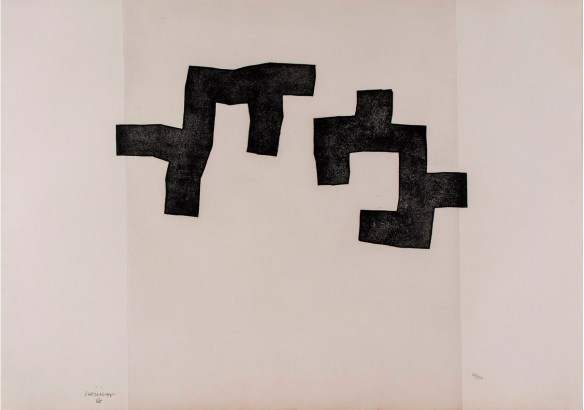
Steve Buttes’ “Some questions for infrapolitics” is an intelligent and generous effort that engages with several key problems at the heart of the ongoing collective project of ‘Infrapolitical Deconstruction’. Although, it begs to say that Moreiras’ works – from the early Interpretación y Diferencia (1991) to Línea de sombra (2006), have been central to thinking de-narrativization and the critique of metaphoricity, bringing these problems into new light from different registers (the literary, the cultural, and the political), I think it would be incorrect to frame the particular project of infrapolitics as a culmination of Moreiras’ own thought and itinerary. In this light, what I find of importance in Buttes’ intervention is the fact that he does not just hinge on a particular problem, but is able to juggle and render visible a series of common elements of the project that merge with his own research (1).

Indeed, it was unfortunate to have missed Prof. Buttes at the last formal meeting during the Harvard ACLA 2016 conference, but we could only hope that there will be another timely encounter for discussion. For what it is worth, I want to lay down a few commentaries on some issues raised by Buttes. My aim is not to correct or even less defend a programmatic way of infrapolitics, but perhaps to think about his recent inquiry as parallel with some of the problems that have been pertinent to my own intellectual reflection over the last two or so years. I hope this will serve as a reparatory outline for future discussions to come.

In a precise moment of his commentary, Buttes writes: “That which escapes regulation, visibilization through the metaphors chosen to organize the world—the unthought thought, that which “what was never [on the] radar” (“Some comments”), freedoms that remain beyond writing (Williams, The Mexican Exception), the unfinished manuscript (Cometa, “Non-finito”), averroist intellect (Muñoz “Esse extraneum”) and so on—always remains invisible, and as a consequence always emerges as something that looks like the thing it is: real life beyond calculation, beyond visibilization, beyond metaphoric capture. In other words, it is the image, as Dove has called it. This image, of course, is characterized by its invisibility, by its ability to be sensed but not seen, experienced but not known, used but not valued”.

I am entirely in disagreement that infrapolitics could be thought as invisibility in opposition to visibility, since that opposition itself remains caught in calculation that renders the operation of unconcealment and the existential analytic obsolete. The very idea of the averroist intellectual has nothing to do specifically with the image as such, but with metaxy (or metaxu as rendered by Weil’s anti-personalist Platonism). This is why life as pure means constitutes itself impersonally from the outside. Hence, to reduce the question of the image to a division of the senses (sight) or to the disciplinary arrangement made possible by modern art historical discourse (Fried et al) is interesting, but not relevant, at least not for averroism. It is true, however, that averroism is crucial for infrapolitics. To some extent averroism, like the existential analytic or marranismo, is an important referent for infrapolitical existence and posthegemonic democracy.

א In her important research on the saturated image, Camila Moreiras Vilaros has emphasized the transformative nature of images from a regime of the society of control to one of saturation and exposure. If the first still has a mode of coercion over bodies and subjects, the second one is hyperbolically without subject, substance, and extension. Exposure coincides fully with the image of the world in positionality. In this sense, infrapolitics fundamentally thinks not the invisible, but the invisible as already fully visible. To be marrano in the open means to dwell in the event of total exposure.

Weil, Esposito, Coccia, Agamben, or Moreiras are thinkers of this outside as metaxy, although do not particularly wish to install an “invisible iconology”, or “an icon of potentiality over actuality”. I am convinced that the question of iconology features centrally in Prof. Buttes’ research, but from my own understanding, infrapolitics cannot be separated from an actuality granted by a form of life or the second division of existence that renders inoperative the very distinction of actuality and potentiality. In fact, in recent months some of us have understood the importance of undertaking Heidegger’s influential seminar Aristotle Metaphysics 1-3: the actuality over force, as to cautiously rethink the difficulty of the Aristotelian category (actuality) that is at stake here. In terms of the icon, in my own research project I have thought of another relation with pictorial space that is not possessed by iconicity, which allows possible oikonomical arrangement and sacrament institution [2]. I would say that, indeed, landscape is important for infrapolitics, but far from rendering a dichotomy between the visible and the invisible, the expropriated and the appropriated, it seeks to think distance and dwelling.

א It was something like this that was at stake for Heidegger in one of his rare essays written as a general reflection on art, but specifically meant as a commentary on a Spanish sculptor that he very much admired: Eduardo Chillida. In Die Kunst und der Raum (1969), Heidegger writes: “Solange wir das Eigentümliche des Raumes nicht erfahren, bleibt auch die Rede von einem kunst-lyrischen raum dunkel. Die weise, wie der Raum das Kunstwerk durchwaltet, hangt vorerst im Un-bestimmten.” Before the pictorial space there is the question of space. How to account for the peculiarity of space? That was Heidegger’s question, since spacing meant to ‘erbringt’ (don) freedom and the life (wohnen) for da-sein.

The word “value” appears in different ways about seven or eight times in Buttes’ piece. I am not sure I can take up the different ways in which it appears, at times in opposition to use. However, it is clear that infrapolitics does not seek to value any ontic or ontological position, since it departs necessarily from a critique of the principle of general equivalence as the contemporary determination of nihilism (an argument made forcefully, I think, by Moreiras, Villalobos-Ruminott, & J. L. Nancy). Thus, it is inconsistent with infrapolitics to argue that “infrapolitics, creates […] a fetish—“a form of thinking the political that fetishizes the undoing of power as a value in itself”. Undoing power arrives at the non-subject or post-hegemony as democratic condition for social existence. But how is this “value” or instrumentalized for “value itself”? In some cases, Buttes seems to take value for ‘preference’. Infrapolitics does not make that decision for preference’s sake, but for understanding the non-correspondence between life and politics in thought.

א The question of value tied to the problem of ‘poverty’ and ‘exploitation’ is a register that infrapolitics does not take for granted. However, I am convinced that the pursuit of a new jargon of exploitation today is always in detriment of the possibility of understanding the existence of man otherwise. It is a very strange turn that some today on the Left– take Daniel Zamora, who fundamentally misinterprets Foucault’s work – keep insisting on the question about the necessity to reintroduce proletarian identity as determinate subject against diversity. It makes no sense to do this in a time like ours, where work and labor have completely disappeared. I prefer to discuss inclusive consumption (Valeriano) and uneven pattern of accumulation (Williams), not labor and exploitation.

In one of his footnotes, Buttes claims that “infrapolitics spans writers from Javier Marías, to Borges, to Lezama Lima to Cormac McCarthy to, as I note below, Ben Lener, and also, plausibly, Sergio Chejfec or Alberto Fuguet, then infrapolitics is the canon, it is the archive itself”. It is a surprising remark, but I understand that I might not fully understand its implications. Does it entail that infrapolitics is an archive of a particular style, or that it coincides merely with a work-for-the-archive? I agree with Moreiras that infrapolitics is a type of relation with the archive, and in fact, at the moment the collective is currently thinking through the archive in relation to the general historiography of the imperial Hispanist tradition [3]. Does this mean that infrapolitics is merely a relation with Hispanism and the Spanish letters? I am not convinced. I do think that there is intricate relation between writing and infrapolitics, but it could be extended and explored in other forms of art (painting, music, cinema, or even dance). Most of us work on writers such as Roa Bastos or Raul Ruiz, Lezama Lima or Oscar Martinez, Juan Rulfo or Roberto Bolaño; but these proper names are far from constituting an infrapolitical archive. There can never be an archival infrapolitics.

א In a recent intervention on the subject of infrapolitics, Michele Cometa suggested that infrapolitics was indeed the place to use literature as a thing for thought [4]. The modern invention of university disciplines and faculties, archives and practices such as “literary criticism” is a perversion of an an-archic space of unity where there is no differentiation between literature and thought, the image and life. One has to break away from the modernist fantasy that there is a ‘proper location’ for an object of studies. There are only relations of force constituted by tradition. This is why Dante at the dawn of Modernity, and later Leopardi during the bourgeoisie revolution, could see themselves as poets, thinkers, political theorists, and lovers. There was no separation.


Notes

*Image: Eduardo Chillida, drawing, 1970.

1. Buttes, Steve. “Some questions for infrapolitics”. https://infrapolitica.wordpress.com/2016/04/10/some-questions-for-infrapolitics-by-stephen-buttes/

2. Mondzain’s research is fundamental here, since her work on early Byzantine Church’s articulation of hegemony is intimately tied to the operation of iconology. See, Image, Icon, Economy: The Byzantine Origins of the Contemporary Imaginary. Stanford University Press, 2004.

3. Alberto Moreiras. “A response to Steve Buttes”. https://infrapolitica.wordpress.com/2016/04/11/a-response-to-steve-buttes-by-alberto-moreiras/

4. https://www.youtube.com/watch?v=U6ddjE_sL5w

Esse extraneum: on Emanuele Coccia’s Sensible life: a micro-ontology of the image. by Gerardo Muñoz

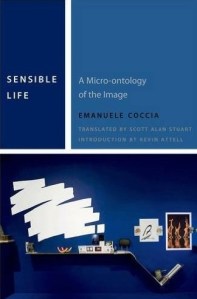
coccia sensible lifeLa vita sensibile (2011) is Emanuele Coccia’s first book to be translated into English. Rendered as Sensible Life: a micro-ontology of the image (Fordham U Press, 2016), it comes with an insightful prologue by Kevin Attell, and it belongs to the excellent “Commonalities” series edited by Timothy Campbell. We hope that this is not the last of the translations of what already is Coccia’s prominent production that includes, although it is not limited to La trasparenza delle immagini: Averroè e l’averroismo (Mondadori, 2005), Angeli: ebraismo, cristianesitimo, Islam (co-ed with G. Agamben, 2011), and most recently Il bene nelle cose: la pubblicità come discorso morale (2014). One should take note that in Latin America – particularly in Chile and Argentina – Coccia’s books have been translated for quite a while, and have been part of a lively debate on contemporary thought. We hope that a similar fate is destined in the United States. For some of some of us working within the confines of the Latinamericanist reflection, an encounter with Coccia has grown out of our continuous exchange with friends like Rodrigo Karmy, Gonzalo Diaz Letelier, and Manuel Moyano. It would be superfluous to say that Coccia’s work is nested in the so called contemporary ‘Italian Philosophy’ (pensiero vivente, in Roberto Esposito’s jargon), although one would be committing a certain violence to reduce it to another ‘theory wave’ so rapidly instrumentalized in the so called ‘critical management’ within the North American university.

Coccia’s tropology (not entirely a set of fixed “categories” or “concepts” for a philosophical program), such as imagination, the sensible, and the averroist intellect are signatory relays for a potential history of thought against the grain of grand conventional histories and historiographies of Western philosophy, or even more so, against the reaffirmation of a principle of philosophy of history in the wake of nihilism and biopolitics. It is most certainty true that Coccia’s investigations share a horizon that we can call the “form of life” – some of us also call it “infrapolitical existence”, which for Coccia himself has translated as the vita sensibile – although both his approach and condensation of thought always presuppose an efficient interrogation of the singular indifferent to “influences” or “schools of thought” (even when Coccia moves deep into scholastic and medieval philosophy). Perhaps no less important of a metacritical index is the unreserved service for a reconsideration of the philosophical tradition – and more importantly, the transmission and disposition of a thinking that remains unwritten – beyond the history of metaphysics and political theology.

Sensible Life is not a book about the ontology of the image in the pictorial or phenomenological sense, but an investigation into the metaxy of existence and being in the world. As Coccia argues early on in the book, ‘the sensible life is a world given to us, and only as sensible life are we in the world’ (2). Against biopolitical or vitalist (neo-positivist) remnants of understanding as fated in the subject (or the persona), Coccia prepares the ground for a physics of the sensible that affects, without really transforming, the human as subject, although it does seek to exhaust itself in subjectivity. Coccia argues, as if implicitly taking up Simone Weil’s suggestion, that the form of sensation is always a modal relation with the outside, an improper distance (metaxu) of the ‘in between’, necessary for any schematization of concrete existence [1]. Hence, perception or sensing is only possible because there is metaxy, and not because there is a subject as the producer and commander of capacities and substances. Against distributive ontologies that design complex arrangement and division of ‘life’, Coccia’s sensibly maps out a region that has always already been there, and that turns to another relation with ontology and language.

In a large part, Sensible Life is vastly informed by his prior study on Averroes and the averroist tradition Averroè e l’averroismo (Mondadori, 2005), where Coccia studied the ways in which conventional Christian history of philosophy convicted the twelve century Iberian philosopher for the madness of positing a common and universal unity of the intellect. What Coccia thematizes in that study, but also in Sensible life with greater speculative freedom, is the extent to which reason depends on the potentiality of the intellect understood as the capacity for imagination. What is common and at the same time ‘improper’ to all beings is the potentiality of imagination that remains outside of life, never constituting a principle of sufficient reason nor the ground for dogmatic belief. The ‘scandal of averroism’, as Rodrigo Karmy has called it, was followed by the Scholastic ban on teaching averroism and removing averroists from the university. It is no surprise that this coincided with the development of the category of the person as a secondary reserve of Christian political theology and Roman Catholic ratio [2].

This is what lays bare in Coccia’s explicit condemnation of the Cartesian cogito, and his affirmation of the sensible as a de-metaphorized image without proper location, since it only dwells ‘where one no longer lives and where one no longer thinks’ (17). This impersonal drift of the sensible is what allows for an extreme de-localization in multiplicity of reproduction of images that serve to dislocate the very inside and outside of the constitution of the subject, but also of any constitution of life itself (31-32). Indeed, the first part of the book is said to write a physics of the impersonal and immaterial ‘third space’ (sic) – what in Aristotle’s vocabulary is the relation with the ‘externals’ [tōn exōthen], and in medieval scholasticism is the esse extraneum – that like marrano existence, it dwells on a dual exteriority. In a key moment of the development of Sensible life, Coccia writes:

“How, then, can we define an image? In his work on perspective John Peckham held that an image is “merely the appearance of an object outside its place (extra locum suum) because the being appears not only in its own place but also outside its own place”…Our image is nothing but the existence of our form beyond what makes up, the substance that permits this form to exist in an entirely extraneous matter to that in which one exists and mixes with. Every form is born from this separation of the form of a thing from the place of its existence: where the form is out of place, an image will have a place [ha luogo]. […] Thus, an image is defined by a dual exteriority: the exteriority from bodies and the exteriority from souls – because images exist prior to meeting the eye of the subject who observes a mirror” (19).

The reproductive machine of the sensible image does not ground itself unto the subject or the purely sensorial; a movement which would have produced yet another schism between mind and body, senses and reason, the visible and the invisible. Against the categorial arrangement of the persona (and its attributes, genus, and divisions), Coccia pushes forth a general theory of productions of forms that could account for the natural life of images (31). What is really at stake here is a medial process (provided by the medieval intentio) of multiplicity beyond being and substance, property and the proper of ontological assertion. Instead, Coccia affirms a cosmological understanding of the One. In fact, one could stress this a little bit further and argue that the averroist potential intellect is a singularization of the henological neo-platonic substance into one of pure externality beyond metaphysical structuration. But the question of henology and the overcoming of metaphysics is one that we cannot raise in the space of this commentary.

For Coccia the medial extension of the image (and the imagination) leads to a metaxy of coming together (simpatizzano, which is Italian ‘third person’ indicative for sharing, is the word he choses) that conspire to form a sort of clinamen effect of singularities. Not long ago Fabián Ludueña thematized this negative community in his important La comunidad de los espectros (Miño & Dávila, 2010) as a ghostly disfiguration that, vis-à-vis the nature of mediality, enters into relation with what is always unhomely and foreign (extraneum). That is the only possible form of the communitas in the sensible life.

The second part of the book made up of seventeen scholion unveil the way in which the sensible immaterial metaxy also provide for the man’s body that accounts for a mundane relation that exceeds and subceeds the psychological and the culturalist materialisms. By reassessing vita activa and mediality, dreams and the ‘intra-body’ (Ortega y Gasset), clothing and cosmetics, Coccia situates the sensible incarnation on the very surface of the body as momentary dwelling (52). As a general anthropology of the sensible, Coccia recoils back to the ‘subject’ and even ‘identity’, but only insofar as one recognizes in this an intention that he calls an ‘ontological indifference’ that allows for an outside projection of an “infra- or hypersychic consistency – a consistency that is almost hyperobjective. Here, “the intentional sphere does not coincide with the sphere of the mind even it includes the mind; it is, rather, the state of existence of all forms when they keep themselves beyond objects and on this side of subjects, or vice versa” (55). This “infra-subjective” solicits a concrete intentional relation of dwelling in the world.

Although the space of the political is not elaborated explicitly – and perhaps for Coccia there is no need for embarking on such a task – one could say that this region is consistent with the infrapolitical relation of the non-subject vis-à-vis the ontological difference. In fact, the marrano whose existence is necessarily infrapolitical in nature is consistent with the multiplied imposture that clothes every identity and every oikos an un-homely as being-in-the-world (91). In fact, Coccia is correct in taking this cue to the limit: “only those can make up and disguise themselves can truly say “I” (86). Marrano life is also the life of the outside, a borrowed life. It is in fashion understood as a tropological site of existence, where according to Coccia a style of the multiple is given its proper place, precisely because it lack costumes, essence, or meaning. On the contrary, fashion brings to bear that only modal relations can constitute forms of life (habits). Fashion has freed life to the sensible, through a suspension of all meditation with the metaphor as its end. Indeed, it is style and not metaphorization what provides for the sensible life.

The dwelling of the sensible is also incarnated multiplicity: it is the improper relation between man and animal, between living and dying. The sensible life as pure immersion, as Coccia has argued in another place, is a flow where movement and detention, action and contemplation become inseparable [3]. It comes as no surprise that Sensible life closes with a meditation on images for life and with a general economy of natality. Here perhaps one could raise the question about averroism as philosophical transmission, but also regarding its staging of ‘living with images’. Coccia argues that life is, above all, ‘what can be transmitted, the very being of tradition” (98). But to transmit is to re-enact a style that never took place: it is a becoming of singularity. In this sense, continues Coccia, ‘Life never stops producing and reproducing, and multiplying’. However, can there be ‘inheritance’ or even ‘legacy’ of that which lacks proper place, and that is always alocational? Is not the becoming of the reproduction of the sensible the very end of transmission, the very form of dis-inheritance from any nomic determination?

It is in this aporia where Coccia’s account of the sensible life (perhaps as a flight from the form of life) touches on the question of natality as a central problem for thought, which is fundamentally a question for the history of thinking. This is also the problem that Reiner Schürmann contemplated in his posthumous Des hégémonies brisées (1996) without really unrevealing its major consequences (except in the problem of finitude posed by the tragic denial). Coccia’s invitation is for us to reimagine imagination (la vita sensibile) outside of its proactive and transcendental saturation into a region that co-belongs with thought. To this end, the vita sensible cannot amount to another anthropology, since its taskless work is to render a life that is no longer one for labor and action, but affected by the immanence of what can be imagined.


Notes

  1. Simone Weil. “Metaxu”. Grace and Gravity. New York: Rutledge, 1999.
  1. Rodrigo Karmy. “La potencia de Averroes: para una genealogía del pensamiento de lo común en la Modernidad”. Revista Plèyade, N.12, 2013.
  1. Emanuele Coccia. “Speaking Breathing”. New Observation, N.130, 2015.

Línea de sombra ten years after: introductory remarks | ACLA 2016 Harvard University. (Gerardo Muñoz & Sergio Villalobos-Ruminott)

linea de sombra

Ten years have passed since the publication of Línea de sombra: el no-sujeto de lo político (Palinodia, 2006). It seems that this seminar received neither the most appropriate of titles, nor the most desirable one. At the end of the day, others are the ones that live by anniversaries, ephemerides, and revivals. In a way, to commemorate is a convoluted and dangerous move that recaps the jacobinist principle ‘down with the King, long live the principle!’

Something radically other is at stake here, or so we wish to propose. To the extent that something is ‘actual’ is so because it allows conditions for thinking and thought; that is, conditions of doing in thought. Then, of course, there are activities and activities. As Lyotard observed, there are some activities that do not really transform anything, since ‘to do’ is no a simple operation (Lyotard 111). So much is needed for this encounter to happen – and the purpose of this encounter with many friends here is Línea de sombra ten years after. This was Alberto’s fourth major book – after Interpretacion y diferencia (1992), Tercer espacio (1999), and The Exhaustion of Difference (2001), and that is without counting his early La escritura política de José Hierro (1987). Línea, we should not forget it, was published in Chile in 2006, under turbulent circumstances. We are referring here of course to Alberto’s exodus to Aberdeen, and in a way his “exile” from the enterprise of Latinamericanism. The drift to suspend the categorial structure of the Latinamericanist reflection was already underway in Tercer espacio and Exhaustion, books that radically altered the total sum of reflections on and about Latin America, in the literary and the cultural levels, and whose consequences were felt, though we are not too sure that they have been fully pursued and taken to its outermost transgressive limits. As Alberto has repeated often, the issues on the end of the 1990s and the beginning of the 2000s are still among us, but we have yet been able to deal with them radically, which means, to deal with them without just reproducing the constitutive limited structures and categorical systems that have informed Latinamericanism and Hispanism at large through the twentieth-century.

In this sense, Línea de sombra is an unfinished intervention. In part because it did not produce many interlocutors and readers when published, or perhaps because it was taken (and it is understood as such still today) as a book that transgressed the ‘Latinamericanist reason’, opening itself to a region of thought that was in itself undisciplined, savage, and for the same reason, considered an outlaw intervention (and we should keep in mind this tension between thinking and law). It does not matter. But what really does matter is that we consider the silences around Alberto’s intervention not as a personal affair, but as a particular effect of a certain disposition of hierarchies and prestige within the contemporary university. As if Línea (and the other books) were dammed from the beginning due to the constitutive limitation of Hispanism and due to the lack of interest in theoretical approaches coming form Latinamericanism, a field that was usually identified with the exoticism of political conundrums and the curiosities coming out of Third World countries.

Of course, the reverse side of this underprivileged condition of Spanish language for intellectual reflection is that it (re)produces reactive effects. For example, the decolonial option demands a constant revision of the privilege that Spanish has had in the process of representing Latin American realities. However, the paradox arises when this decolonial turn limits itself to the glorification of native languages as if they carry with them a more authentic access to the real, without questioning the self-limitation that both, Latinoamericanist criollo scholars and decolonial ones, show in restricting themselves to the same ethnographic task, avoiding not an explicit politics of identification, but avoiding the most urgent and radical politics of thinking. This politics of thinking doesn’t belong to disciplines and doesn’t follow University structruration. This is what we call infrapolitics.

In fact, we recently called this self-imposed limitation in Latinamericanism ‘late criollismo’ in relation to the last manifestations (political practices and historical forms of imagination) of a particular tradition of thought that, reactively, is confronting the dark side of modernity and globalization with a dubious re-territorialization of affects, practices and politics: from neo-indigenism to neo-communitarianism to literary New Rights, from neo-progressism to neo-developmentalism and neo-extractivism.

On the other hand, we should not forget it, Spanish was an imperial language, and the current (rhetoric of) privilege for ‘Spanish’ is also at the heart of the neoliberal university. In fact, it is what allows the expansion of the language programs, and by consequence, the expansion of ‘adjunct professors’ and ‘part-time post-PhD students’ that carry departmental duties. An exponential process of subalternization that professors that defend far-away subalterns always seem to forget. One might say, the psychotic decolonial affect is possible by the foreclosure of a minimal distance in favor of the maximization of their subjective drive, in a process of identification that is also a process of libidinal investment and insemination.

Línea de sombra appeared in this context, but we do not think it wants to take part on either the side of defending the underdog or assuming a counter-hegemonic capitulation of Spanish as the master language or even the variations of Spanish as a sort of a new pluralism against Iberian hegemony. Línea renounces what Derrida calls in an essay of Rogues the ‘presbeia kai dunamei’, which is roughly translated as ‘majesty and power’, but it also renounces to the privilege of the predecessor or forbear, the one that commands, the archē (Derrida 138). Alberto’s text is a call for releasement of such a demand as principle of reason into a different relation with thought – now we think it is fair to say that that relation is always an infrapolitical relation – positing the archē of the political parallel to the category of the subject. In the introduction Alberto lays the question:

“El subjetivismo en política es siempre excluyente, siempre particularista, incluso allí donde el sujeto se postula como sujeto comunitario, e incluso ahí donde el sujeto se autopostula como representante de lo universal…el límite de la universalidad en política es siempre lo inhumano. ¿Y el no sujeto? ¿Es inhumano? Pero el no-sujeto no amenaza: solo está, y no excepcionalmente, sino siempre y por todas partes, no como el inconsciente sino como sombra del inconsciente, como, por lo tanto, lo más cercano, y por ello, en cuanto que más cercano, al mismo tiempo como lo ineludible y como lo que más elude” (Moreiras 12-13).

So, el no sujeto is an excess of the political subject, an incalculable and unmanageable rest, since the non-subject of the political just is, without a why. Just like the counter-communitarianism cannot constitute a principial determination, the non-subject does not wish to do so either. Indeed, Línea de sombra unfolds a complex instantiation against every nomic determination that guarantees the truth of the idea or the concept. But the non-subject haunts its violence, its transgression. Following our recent encounter with Schürmann’s work, we can say it confronts the latent forgetting of the tragic condition of being.

Indeed, the political has rarely been thought against the grain of its nomic and decionist principles, and Línea de sombra was (and still is) an invitation to do so. Our impression is that it is a book that does not want to teach or master anything, but thematizes something that has always been already there, even if some prefer to sublimate it into the principle of satisfaction. The price to be paid for that is quite high. Hence the desire to move thought elsewhere: indifferent to legacy, proper name, inheritance, masters, and subjects.

We propose, then, to think collectively these days around the promise, the offer, and the gift of this book, but not necessarily to place it in a central canonical position. Rather we intend to open its questions to interrogate our own historical occasion.


Notes

Alberto Moreiras. Línea de sombra: el no-sujeto de lo político. Santiago de Chile: Palinodia, 2006.

Jacques Derrida. Rogues: two essays on reason. Stanford University Press, 2005.

Jean François Lyotard. Why Philosophize? Polity, 2013.

*Image by Camila Moreiras, 2016.

Movement and Sacrifice: On Samuel Steinberg’s Photopoetics at Tlatelolco, Afterimages of Mexico 1968. (Gerardo Muñoz)

Photopoetics SamSamuel Steinberg’s Photopoetics at Tlatelolco, Afterimages of Mexico 68 (U Texas Press, 2016) is a timely contribution to the field of Mexican Studies. It posits itself as a sort of culmination of that field, and we would not exaggerate to say by saying that it is an archive of an archive that thrives to undo ‘Mexicanist ideology’ towards a different opening. Steinberg powerfully states at the end Photopoetics: “Mexicanism, in turn, is the name of the ideology that regulated the dutiful carrying-out of the relation between art and the people that the Mexican state organized until Tlatelolco…According to this procedure, one can constantly make art speak the name of Mexico as its truth, as the discontinuous thought, the spirit that haunts and must be revealed by thought” (182). This is a strong and devastating assertion that should also be strategically posited in whatever remains of ‘area studies’ structuration as institutional inertia as well as against its dominance over knowledge production of Latin America within the contemporary university. Photopoetics’ boldness lays precisely in this intersection within archive and reflection, between cultural inscription and disciplinary containment in the wake of the Tlatelolco massacre during the Mexican 68. This ‘event’ is symptomatic of the hegemonic haunting of principial Mexicanist reflection and of its multivalance inscription that continuously translates and archives itself as ‘defeat’ (37).

But Photopoetics is more than a book about the co-belonging between photography and literature, the image and life. Rather this very relation, and the limits thereof, is what is tested and taken to the edge in the different folding case studies that make up the book – from Monsivais to Poniawtoska, from Paz and Volpi to contemporary artist Francis Alÿs. The name of that operation depends largely on ‘photography’ as a medium but is not entirely reducible to it. Indeed, photopoetics is the term that establishes a transversal relation with the archival 68 without necessarily being a master trope that seeks to subordinate the archive to “photographic studies” or the “visual culture” discipline (in the W.J. T. Mitchell line or otherwise). The ‘photopoetic’ is not even a concept, but rather a dispositif that varies according to the object in question, allowing for a phenomenology of the onto-photographic effect on the Real and process of encrypting the event as event, as well as the indexical repetition of the archive (25-28).  

This has potent consequences for an analytical comprehension of the political, which fundamentally entails the displacement of hegemonic structuration (not only for ‘Mexicanism’ or the ‘global 68’). Indeed, for Steinberg, hegemony is the consignation of an archive, if by the latter we understand the reduction and principial limitation of the political to calculation (27). It is thus not surprisingly that Steinberg situates his own reflection within a post-hegemonic horizon primarily defined as the destruction of the differend between theory and practice (and throughout the book there is critical engagement with Moreiras, Williams, Yúdice, and Beasley-Murray) (8). This is the unsaid ‘althusserianist’ wager in Steinberg’s book, which is, at the same time, consistent with a politics beyond the subject and a defiant a-principial thought. There are two major and unexpected figures that support this general horizon: José Revueltas and Francis Alÿs. In fact, the book opens with Revueltas and closes with Alÿs; a double movement that although not fully developed, is preparatory for an atopic ground in relation to a post-Mexicanist horizon of reflection, a new form of thought, and a democratic (and communist?) promise.

The first two chapters – “Archive and Event” and “Postponed Images” – situate the general economy of the book, that is, the relation between archive and event and archive as the hegemonic force proper to the 68. The hegemonic phantasm is that of situating the 68 as a sacrificial horizon of history against what should be read as the contingent and democratic student movement that remains encrypted or translated into a reiterated and diversified figures of closure (victims, heroes, the people, or melodrama). Understood in a rancierean key, Steinberg’s post-hegemonic articulation rests principally on the contingent heteronomy of the movement:

“…What we call 1968: “an unforeseeable coming of the other, of a heteronomy; “the event of what or who comes” as incalculable exposure to that other and to the event that is other. […]. No: it is “the event of what or who comes”, that change encounter in which ‘students are confused with workers”, and in which the peasants are also present – absent from where they properly should be. Unconditionally”. (44).

It is not just that the archival event orders them into a grammar of visibility, but also the fact that it translates it (them: the students, or what is to come) into a principle. This is what in “Postponed images” Steinberg sees in Monsivais’ popular melodrama and “national unity” that reinserts “mexicanidad” within the general analytical economy. In a similar way, although folded, this is what is analyzed in the chapter on testimonio (“Testimonio and the future without excision”) taking Elena Poniatowska’s famous La noche de Tlatelolco as interchangeably positing the sacrificial structuration of history vis-à-vis civil society. La noche de Tlatelolco tames the democratic dis-order of the movement into one of the “People” within a broad ‘collective memory’ of the nation (112). We are not too far here from a ‘fictive ethnicity’ grounded in testimonio and its politics of truth. Again, an indexical photopoeticology is what guarantees – in Monsivais’ melodrama as well in Poniatowska’s civil society deposition – the encryption of 68 and its ‘afterlife’.

“Exorcinema” and “Literary restorations” are secondary moments of the 68 archival fantasies and unusual atopics for carrying out the lasting effect of this event. “Exorcinema” takes up films, such as Fons’ Rojo Amanecer and Raygadas’ Silent Light as resurrections of the photopoetic act, but it also has strong declinations that spill over Chris Marker monumental Grim without a cat (1967-77), as well as other figures of Mexican cinema. In “Literary Restoration”, the transition is folded from the ‘spirit of revolutionary sixties’ to the ‘neoliberal age of restoration’. Restoration here is not deployed lightly. Following Badiou, the staging of restoration announces an impasse in the face of historical nihilism, but also makes evident the fascination with the ‘past’ as melancholic repetition and restitution. In this sense, the work of Jorge Volpi centrally figures itself as the symptom of neoliberal restoration, and more specifically his pedagogic novel El fin de la locura (Seix Barral, 2003) sketches something like a narratological aleph of the sixties, revolving around “French theory”, Fidel Castro, psychoanalysis, the “Padilla Case”, and revolutionary ethos. This is an ‘after the fact’ historical novel that condenses – meant for a middlebrow public – major events of the leftist politization and heroic drives. Against Volpi’s own authorial intentions, however, Steinberg concludes that Volpi’s narrative halts at complete politization (hegemony) making possible an infrapolitical register. This is not to say that Volpi is an infrapolitical writer himself. There is no doubt that Volpi’s literary program – the Crack Manifesto, his novels, also his journalism – amount to literary nihilism in the wake of Mexico’s turn towards neoliberalism after NAFTA trilateral economic adjustments. Steinberg pushes for what I would call an infrapolitical interruption in Volpi as a secondary effect of what hegemony and counter-hegemonic literary depolitization cannot hold itself up to.

The last chapter, “An-archaeologies of 1968”, is the fleeing territory from the Mexican archive, and it does so with the help of contemporary artist Francis Alÿs. In this chapter, there are at least two major problems at stake for Steinberg: on one hand is the question of the de-territorialization of the Mexicanist disciplinary (and disciplined) boundaries of knowledge formation, and on the other, the possibility of rendering inoperative any ideal of emancipation (and resistance) based on history, subject, and work (192-93). The relational aesthetics piece “When faith moves mountains” is taken as a precarious negative community that exceeds national borders, as well as any possibility of subjectivation for the Mexican being. Alÿs is resistant to the resistance of Mexicanism. While this is true, perhaps some readers are left desiring further confrontation but this time not against the Mexican archive, but on the grounds of what I would call the transnational circuit of global contemporary art. Bourriaud and Claire Bishop’s theories on relational aesthetics make an entry into the discussion, but I am tempted to say that both of these critics, in different ways, are fully committed to hegemony theory, or at least to hegemony for contemporary art relations to the political, whether in consensual or antagonistic terms [1].

I am not arguing here that Steinberg endorses either Bourriaud’s or Bishop’s assessments or “contemporary art”, but that the an-archeology releasement opens to a critical assessment of the very machinistic operation of contemporary art in its very economical precocity, autonomous circulation, and so called “democratic inclusion” of extended practices and subjects. In this sense the problem of “faith” (189-91), is also about “the faith” of contemporary art: the “pistis” (credit) that in the aura of participation and immateriality ends up repeatedly bounded within a logic of exchange value through the practice of documentation.

Photopoetics at Tlatelolco inaugurates a post-sacrificial reflection on Mexican culture and its conditions of possibility. Making no concessions to ideological or locational authorities, Steinberg calls for a post-hegemonic desire that affirms the real movement of thought that is the concrete potentiality of politics beyond principles and idle chatter.


Notes

  1. I am thinking here of Nicolas Bourriaud’s Relational Aesthetics (Les Presses du Réel, 1998) on the side of consensual political practice, and the article “Antagonism and Relational Aesthetics “ (October, Fall 2004), by Claire Bishop on the side of antagonism.