Good riddance! Apuntes sobre Marranismo e Inscripción. (Sara Nadal-Melsió)

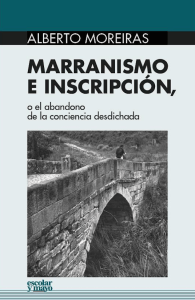
Marranismo e Inscripción (Escolar y Mayo, 2016) traza un itinerario en tres estadios, cada uno marcado por efectos narrativos de sujeto que se descomponen en cada uno de sus tramos, como huellas borradas: la autobiografía/autografía intelectual, la entrevista-conversación, el ensayo teórico, la lectura interesada. En su centro aparece un dispositivo y un cálculo en los que el pensamiento se narra como huida para terminar convertido, en su tránsito por la escritura, en causa y razón, en militancia incluso. La autografía, la escritura como inscripción, permite a Moreiras, permutar la narrativa de un sujeto académico plenamente interpelado por la institución por una práctica de lo propio desde su afuera. Su propuesta se nos presenta como una táctica de apropiación de lo que se mantiene externo a la institución: la existencia y su facticidad, lo absolutamente singular en su contingencia.

Así la escritura de propio, el autografismo del marrano, se externaliza para convertirse en herramienta de transmisión no circunscrita ya ni a la enseñanza ni al saber; enfrentada a la producción de consenso a la que tiende el aparato académico y a su reducción de la transmisión a enseñanza, saber y disciplina. La institución no puede interpelar a lo propio, en tanto lo propio es un ejercicio de singularidad que no pertenece a la narrativa de sujeto. Lo propio funciona en el texto como un enigma estructurante. Moreiras es el enigma y el no-sujeto que se escribe frente a nuestros ojos mientras se descose como académico, como miembro de la institución y acatador de sus leyes.

Lo que transmite aquí Moreiras es la fidelidad a una idea impersonal que excede al sujeto. Se trata de un cálculo que está ahí desde el principio como intuición y que sólo puede vivirse como error o falta. Diría incluso que esa impersonalidad está en el centro de la tragedia académica a la que se alude como trauma del sujeto. La academia solo acepta y produce sujetos plenamente interpelados, todo lo demás simplemente no existe. En ese sentido es una estructura schmittiana de gobierno, no solo de amigo/enemigo, sino de sujeto y no-sujeto. El no-sujeto de lo impersonal no tiene cabida en su seno pero es también justamente el exceso impersonal lo que sobrevive a su tragedia, a la pérdida del cobijo académico y su producción de identidades.

Esta impersonalidad, anclada en el centro de un texto personalísimo, reclama un más allá de la voz que nos habla, nos cuenta y reflexiona sobre su insomnio, su desenganche del sujeto académico y de su falso cobijo. Maurice Blanchot tenía muy claro que escribir equivale a pasar de la primera a la tercera persona. Y esa tercera persona es también el lugar que Roberto Esposito describe como “la vela alucinada del insomnio” en Tercera persona: política de la vida y filosofía de lo impersonal. Cito:

“…no el yo que vela en la noche, sino la noche que vela dentro del yo despojándose de su rol de sujeto, de su identidad de persona, de su capacidad de imputación. Un acontecimiento, llegado desde afuera y dirigido hacia fuera, que se sitúa en un nivel completamente exterior respecto a la esfera personal de la conciencia.” (Esposito, 187).

El insomnio que acecha el subtítulo de Marranismo e inscripción: ‘Más allá de la conciencia desdichada’ alude a una escena originaria en la que la pérdida es aún solo eso. La lucha agónica y especular entre la primera y la segunda persona de “Mi vida en Z”, su tragedia, queda a lo largo del texto definitivamente desplazada en favor de una tercera persona que es a la vez singular y plural, ya que se relaciona con el mundo a través de su diferencia y nunca de su identidad interpelada. La solución está no solo en asumir la pérdida sino en celebrarla. El proceso no es reversible porque la lógica ternaria es irreducible ya a la binaria. No hay vuelta atrás: adiós a la conciencia desdichada. Good riddance!

El dispositivo teórico de Marranismo e inscripción demanda una estructura triple, liberada finalmente del agonismo trágico del diálogo a dos bandas (la lucha a muerte entre el tú y el yo que la institución demanda). A mi personalmente este dispositivo me recuerda un poco a la passe lacaniana, que es también la inscripción de la voz de la tercera persona, un salto de la tragedia a la política de la comedia, a su picaresca, a su ‘make-do’ con lo dado. Así, la relación central del texto, la relación entre vida y pensamiento, bios y logos, deja también de ser binaria una vez aceptamos que ni la una ni la otra coinciden con la subjetividad y sus trampas. La vida pensante que ejerce el “moralismo salvaje” propuesto por Moreiras solo puede ser impersonal, cómplice con la facticidad del mundo y su exterioridad.

En la textualidad misma de Marranismo e inscripción se produce otra no coincidencia, esta vez entre la letra y la voz, la aporía en la que texto se instala. El desborde producido por la voz propia amenaza con descoser la continuidad de la letra y su capacidad de construir una opción de lenguaje subjetiva. La singularidad de la voz es un índice de su exterioridad: la voz es siempre otra. Y escuchar la voz en la letra es desdoblar su identidad y su identificación monológica. La voz es siempre marrana y la cuestión es cómo sostener esa tonalidad en el acto de la escritura. Es ahí donde la picaresca de la voz de Alberto actúa como soporte de su marranismo, como antídoto a la institucionalización de su escritura.

Asimismo, asumir el accidente del marranismo (el “no querer estar nunca allí donde lo ponen”, 49) es un acto de voluntad política y una entrada en un mundo más allá del yo que demanda la incorporación de lo ajeno como propio. Se trata pues de un acto retroactivo que señala la extraversión como momento de inflexión; inscripción que transmuta la necesidad en elección, lugar al que sólo se llega después de pasar por el desierto y verse de bruces enfrentada a lo que no es “ni inagotable ni subsumible” (Moreiras, 56): la existencia como resto y como supervivencia. Algo que convierte a la precariedad de la superviviente, que sabe bien de la fragilidad del sujeto como cobijo, en condición voluntaria desde la que iniciar un ergon propio. Una práctica de no-sujeto que ponga a trabajar el tiempo exterior de la existencia, su singular facticidad, la de una vida no intercambiable con ninguna otra.


*Position Paper read at book workshop “Los Malos Pasos” (on Alberto Moreiras’ Marranismo e Inscripción), held at the University of Pennsylvania, January 6, 2017.

Acts of Engagement: on Marranismo e Inscripción. (Djurdja Trajkovic)

What is the relation between negative engagement and deconstruction? Negative engagement is a singular engagement of separation that instead of proposing a binary problem/solution proper to contemporary thinking, offers new questions and the possibility of pushing thought further. It is negative since it does not look for empathy nor compassion, neither redemption nor recognition. It is an engagement that abandons the “state of things”, only to open up thought to the unthinkable, and to the difficult experience of freedom. It is engagement as a form of life, since what is at stake is a relation to existence outside of hegemony, identity, and quality; that is, at the margins of institution (if there is such a thing anymore).

In Moreiras’ anti-book, Marranismo e Inscripción (Escolar & Mayo, 2016), we bear witness to such a difficult intervention. It is a book made up of heterogeneous writings, some highly intimate, others profoundly distant, which overwhelms the reader with their arduous insistence and demand for thinking. It is as if Moreiras is repeating the Heideggerian conclusion that we have not even begun to think. And what is there to think about in “times of interregnum”?

Firstly, the crucial task that Alberto offers up for thought is what cannot be said: the crisis of the Humanities. Suggesting that we do not posses even the concepts or language with which we could start this process, Moreiras is suspicious of returns to national history and grand (canonical) literature. If this is a crisis of crisis, how do we think about the Humanities within the eye of the storm? What kind of crisis are we bearing witness to? It seems that the Humanities has become sort of a bad word: it is a space where a fundamental interrogation on the state of humanity could have been put into question once, and that today increasingly mirrors only the loss of academic jobs of academics and its contingency. Global capitalism turns a necessity, the cultivation of thought and the letter, into contingency by naturalizing the status quo and refusing to recognize the conflict.

Important as it may be to address the contingency of academic work, however, the crisis is profound since what is at its heart is the very crisis of thought and intellectuality. It seems that the brutal acceleration and instrumentalization of life itself has surpassed our capability to rethink it without falling into nostalgia and melancholia and other “solutions” that lead nowhere. I am not suggesting here embracing all too quickly a “happy” form of living without really dwelling into the question of globalization. But does anyone really need the Humanities anymore, if anyone ever really did? Is the university, as a space of hospitality without condition, possible today? Can the Humanities offer once again a thought of/for transformation? How is transformation to be enacted irreducibly to wishful thinking and pure dreaming? Critical thinking stutters here, as it fears its own disappearance.

There is no room for cynicism or nihilism, however. And even if there is, we must reject it. The situation is difficult, unbearable. Inviting us to abandon recognition, Moreiras underlines the acknowledgment of finitude; the very possibility of doubt and doubting of decolonial and communist impulses (you may want to revise this last phrase, as it is difficult to figure out what you mean). He is one of the rare thinkers who trace the problem of the temporality of thinking itself. For example, he asserts that our accustomed “tools” fail us today as the exhaustion of modern (political) concepts is beckoning us. Perhaps we are bearing witness to the death of modernity. And yet, Moreiras does not offer to salvage those concepts but instead proposes without proposition a further deconstruction of politics. One must ask then what is left of politics and the political after deconstruction? What is unthinkable after deconstruction? Is deconstruction in need of deconstruction? Is deconstruction possible in the eye of a mass depolitization that the failure of neoliberalism made visible?

Infrapolitics, as something that happens, offers itself as the radicalization of deconstruction. It is a labor of difficult passion, of possibilization of the impossible, and a constant search, a desire, for the outside. Moreiras himself is hesitant to affirm if and when such a possibility might open up. Certainly not today when the conditions of possibility of/for thinking in the university of equivalence have closed even the possibility of putting into question the university itself and division of labor. Not even to mention the anti-intellectuality and anti-theoretical turn haunting the Humanities. After all, all is said and done, right? And yet, at the same time, Moreiras does not want to abandon the possibility of a new historicity, a new writing of history irreducible to instrumentalization and to the capture of history for supposedly progressive goals.

How to exercise such a demand? I believe that the question is not anymore ‘what is to be done’ but how to think the end of doing and the beginning of thinking. At the heart of his intervention is a thinking of radical democracy, a demand for a freedom of life liberated from the identitarian and hegemonic drives, a demand for other thought and time irreducible to the techno-political machine which captures experience and knowledge into another fetish and concept to be applied. In Moreiras we are distant from destruction, and what is being offered is the very possibility of experiencing freedom anew.

How so? He suggests in his reading of Javier Cercas’ El impostor that thinking is inseparable from freedom, not inseparable from love as for Jean Luc Nancy, but freedom itself. Thinking is irreducible to philosophy and literature is the risk one must take if there is going to be freedom at all. Thinking is sick thought. And only patient attention to this sickness (how could it be otherwise after the violence of metaphysics?) through the cultivation of other thought and letter could bring about the “cure”. However, the cure is not restoration of health but precisely the opening, the region, where freedom could appear. Moreiras uses here a curious word, “appearing,”- which is not appearance but “appearing.” For example, freedom appears when and if, a (wo)man opens herself to letting it be, when the character is separated from destiny, and when we consider what we are not and what we have not been able to be. Also letting it be so that the unknown can appear. Not doing but being. Is this the attempt to write a history of what has not happened and could have been? It is certainly a demand irreducible to “restorative nostalgia.”

This is a similar suggestion to what Sergio Chejfec exercises in his Los incompletos. We are not speaking here of mourning, but of the possibility of confronting the real as unforeseeable, as imperfect and inconclusive past. When we understand that, as Javier Marias reminds us, grace without use is also “la suma de todas las posibilidades no realizadas en nuestras vidas no como destino fallido”. Perhaps only then we will be ready to let freedom appear in its inexhaustibility. This is the task and promise of brave negative engagement for any Hispanist.

Undigestible Hispanism: reflection on Marranismo e Inscripción. (Brett Levinson)

Marranismo e inscripción, henceforth MI, is both a performance and explanation of its own undigestibility, which is to say, the undigestibility of Moreiras within Hispanism as well as within, let us call them, the theoretical humanities. Undigestible is MI not because it is too hard to read or understand; it is too hard to take. In Ecce Homo, Nietzsche explains “Why I write such good books.” In MI, Moreiras explains “Why what I write produces such indigestion.”

As to those who find Moreiras undigestible—I cannot enter into a detailed analysis, which I think is nonetheless important to one day carry out, of the number of figures who can’t take Moreiras because they do not know he is available for the taking, or who do know, but choose not to partake. I am referring to those who do not read Moreiras at all, yet who occupy prominent places within the institution of theory. This non-reading is not the result of some accident in which we can say: “Well, nobody can read everyone or everything; that is the nature of knowledge; we are doomed to specialization. One chooses a discipline to a large degree by accident; accidental too, then, are the books one is obliged to read to “keep up,” as well as the texts that even come to one’s attention. Non-Hispanists cannot possibly sift through a tome that is only partially about theory, deconstruction, Marxism, neoliberalism, mourning, and unhappiness, that is, non-Hispanic matters, even if to conclude that it, MI, is undigestible.

It is just not in the interest of, for example, Derrideans and Heideggerians to do so, even if they can read Spanish (and many, though not enough, in fact can).” This sort of un-digestion—undigestion as as non-reading—is no accident because the entire institution in which we dwell is oriented in such as fashion that a Spaniard, writing in Spanish or English about theory–the entire hegemonic apparatus of the theoretical humanities is organized in such a manner that this kind of person, one such as Moreiras, is not of interest to, does not work in the interest of, any component of institutional knowledge. MI does not serve theorists proper; they do not have the time. Thus, while such folks may be very good theorists, they are completely complicit with the state of the humanities which they pretend to “deconstruct”; Moreiras is the symptom (which, like many symptoms, such as a twitch, appears to everyone but the body of he or she who has it) of that complicity, which symptom remains un-analyzed because many of those who could analyze it—well, it is not in their interest to do so.   In this situation, Moreiras proves undigestible not because potential consumers, namely, those who do not consume Moreiras, do not have the time but, in fact, because they cannot be bothered to make the time.

I will concentrate instead on the engagement with Latin Americanism and/or Hispanism as a field which MI addresses, and which includes the chapter on communism, in which a Hispanist and a Bolivian are featured.   Before doing so, though, I want first to thank Jacques Derrida for casting stupidity as a project of philosophy that philosophy cannot turn into a concept of philosophy, cannot appropriate.   For, in doing so, Derrida allows one to call discourses stupid without insulting their authors, presenting the stupid as a most profound marker of the finitude of knowledge to which thought ought to turn. Indeed, thanks to Derrida, you can now safely turn to a colleague and say: “you fucking bestial idiot—and I mean that in the best of senses of course!”

By bête or betisse, of course, Derrida means the automaticity of the human—which automaticity is not merely technical but also animal and spiritual, of the soul—which repeats itself and repeats itself without being able to humanize the repetitions, which is to say, without (the human is without) being able to contain them within a rational, responsive and responsible, hence human framework.   The human is not bête, to be sure. Man is not animal; he is not the only stupid one necessarily, the only one who can be stupid (the rest are innocent, like a dog who barks too much: what can you do, a dog is a dog)—this is Derrida’s point, in fact: the human is and is not the bête.   For, the experience, sense or intuition of sheer nonsense is impossible without a framework or concept. That each thing be digested as just another stupid thing and another stupid thing, indifferent from all other things, hence undefined, nonsensical, is impossible, since the very concept of bête, disavows the bête, rationalizes it, humanizes it, precisely by grabbing it with both hands, which hands make consumption, thus digestion, conceivable.

Stupidity is too stupid to be theorized, for example, to be deconstructed. Thus, we can say, that Derrida himself, like Lacan in the seminar on Joyce, illustrates that the great thinkers—and Derrida and Lacan, with precious exceptions, only address great thinkers—include and disavow a bit of stupidity. That is to say, there is a bit of the bête in every humanist intellectual operation, which therefore is and is not human, responsive and responsible. The bête is the trace of the human, and the means by which the last Derrida affirms stupidity as the name of the opening to thought, politics, activism, ethics, fiction, and so forth, even though stupidity itself is neither good nor bad. MI is the history of Moreiras as bête and as not bête.

But—and here comes the undigestible component of Moreiras—Moreiras, given his field, given that he is a Spaniard and a Hispanist, in addition to whatever else he is, does not get to address Hegel; he is not granted that right by the institution that MI addresses to show how brilliant Hegel is—to show that Hegel anticipated everything Marx, Nietzsche, Deleuze, Lacan would later say if you just know how to read right, but that he also contains a little bête there where Hegel did not think, the bête by means of which one can demonstrate—those who have the right to read Hegel right—that Hegel did not think everything right, that his thought is finite, and therefore, that absolute knowledge bears a mark of stupidity: a chocolate stain on the tablecloth, food for thought. The double gesture of affirmation and unraveling that deconstruction and/or psychoanalysis perform on Hegel, and on any number of wonderful thinkers and artists, whose perfection, whose magnificent totality, is tainted by imperfection, and whose taint calls forth thought today, for us—Moreiras and MI cannot make this their project their project.

In sum Moreiras, a Spanish whitish guyish individual writing about Spanish things or writing in Spanish about non-Spanish things, cannot subsist writing about Hegel, for that writing is not in anyone’s interest, including Moreiras’s. Thus, Moreiras has to write about scholars who are really stupid as if they were Hegel, as if they could be both critiqued and affirmed. Moreiras, that is, must say what he does not say but that I will say for him, to wit, that the Jameson that he cites and reads so generously, desde luego con todo respeto, the discourses of Jodi Dean, Bosteels, Mignolo, Beverley, and so many others within MI, are stupid—I am not saying the people are stupid; I do not know them well enough to say that: their discourses are stupid, this I do know—and they cannot be affirmed and rescued in any way except by casting them as better than they are, which is to say, as stupid as Hegel is. But you cannot do it, which Moreiras’s previous Exhaustion of Difference showed: you cannot cast the stupid that is in fact fact stupid as smart so as then to say that it is stupid. You cannot deconstruct stupidity. You only end saying the stupid is stupid, which is undigestible to the stupid, and also, fortunately, itself a bit stupid, for it is a tautology.

Which, that is, the stupid, MI shows, is stupid for a reason: because it takes all concepts–rhetoric, destruction or deconstruction, Europe, the West, ghost, desire, drive, deferral, death, Dasein as el no sujeto, philosophy, Marx, de Man, Badiou, and so on—and converts them into brands that it, the stupid, can then reject as brands, taking concepts along with it. Either that or it, the stupid, can take the conversion of concept into brand and then, as competitor, critique it. The competitor qua discourse of critique of the concept-turned-brand (turned, that is, by that competitor himself) poses as the alternative to of capitalism or colonialism (which the brand represents). Of course this competition with the concept turned brand that academic politics undertakes has only one name: branding.   Academic politics (perhaps politics as such, if politics had an as such; yet that is the point infrapolitics: politics as such is naught) emerges, not as a set of concepts or actions but a choice for this or that brand, as an opportunism, brand against brand. And within that discourse the turning to ideas, concepts, and language emerges as a choice, a “buying in”: the choice not to be political but philosophical, textual, literary, historical.   To address concepts or language is the choice, according to politics, to be apolitical, hence not stupid. MI is not stupid, or not stupid enough, and that is perhaps its most objectionable quality, at least for those who find it undigestible.

Moreiras tries to make these points politely, in a digestible fashion; he tries to deconstruct his objects. But deconstruction presupposes concepts, and concepts are not at work in the objects to which Moreiras, as a Spaniard writing in English or an American writing in Spanish, is bound. So he does not deconstruct, intentions notwithstanding. He discloses the stupid, which stupidity cannot take its being “called,” as one calls the other in poker.

Indigestible finally also is infrapolilitics. For the sake of time, I will illustrate with my own example, stupid like all examples, and not at all like the examples in MI itself. In the film “Fences,” which reproduces almost to the letter August Wilson’s early 1980s play, which takes place in 1957 Pittsburgh, the son says to the father—and both characters are of course black—a father bitter about a denied career in major league baseball, that things have changed: “Dad, the Pirates have this black Puerto Rican player named Clemente!” The father’s response, a father who is blind to himself, blind as all tragic characters are blind, can be heard as an case of identity politics, although identity politics is rarely as eloquent as August Wilson. However, the space of that politics, whatever one thinks about, is not defined or determined by politics. It is defined and determined by the word “black,” which is linguistic not political, for it is a trope. Indeed, no skin color is actually black. The field of the politics is determined by blackness, which blackness is not political but rhetorical. There you have the beginning of an understanding of infrapolitics.

First, there must be a claim on politics, a specific claim, like the father makes about the injustice black people face; the claims outlines, forms the boundary, of the domain of politics–politics in the particular, factical circumstance. But the claim itself is not grounded in politics, but in blackness, which is rhetorical, though it could also, in another analysis, be seen as ideological, philosophical, ethical, religious, historical—the point is that is it not political. The claim on politics is impossible without the non-political that grounds the claim. The limit, the boundary, the border, the definition of the space of politics is not given; it happens when you claim it. When you claim politics, and all Hispanism and all theory does for reasons I cannot explain here, you expose the non-politics of politics, the irreducibility of politics to itself, that which is indigestible to any political as such, precisely because it denies the political as such.

Now, the son’s comment, “the Pirates have a black Puerto Rican player named Clemente,” pronounced in either 1957 and the early 1980s (depending on how you look at it) is also pronounced in the film, by Denzel Washington, in 2017. And in 2017, Roberto Clemente, were he alive as, say, David Ortiz is alive, would not be a black ballplayer but a Hispanic one. For African-American, the displacement of a biological referent, a skin color, black (which again is not a skin color but a trope), with an historical/cultural definition of a race, a race of people that came to America from Africa as so many slaves, overcame slavery, then overcame incredible injustices through the civil rights movement, and now faces and combats new injustices—AfricanAmerican now overdetermines blackness, though black and AfricanAmerican are, today, equally proper.

Thus, only African Americans, in the discourse of baseball, which in “Fences” is the discourse of every discourse, and certainly the discourse of justice, are black, while the Dominicans and Cubans and Panamanians and Venezuelans and Puerto Ricans, and so on, who one might have once called black, as the son calls Clements black, are Hispanic.   So the identity politics of baseball regarding race is now defined, at least in part, by the African-American/Hispanic division. Of course, again, the essence of an African-American politics is the definition “African-American”—which, by the way, is not a signifier without signified, a word without definition a la Laclau but definition itself, the determiner of the political space—which is not political; it does not come from politics. The essence of an African-American politics, “African-American,” indeed, is not itself politics but infrapolitical, inscribed into the political as that which is irreducible to it. Now, it ought be clear that any politics concerning race that might emerge in the project of baseball, or any other project, would form at the limit of the political, which is there where African-American and Hispanic meet, which is no place; for there is no place where the division between the two can be grounded.

The Hispanic, as other than the African American and other than the white, Native-American, indigenous, is nowhere to be found.   Its territory emerges only through the sociologiziation of knowledge and culture: everything with a place in its place. Even if other places bleed into that place, as in mestizaje—that is ok—but, for the sociologization of the knowledge to win out, first there must be a rightful place, so that there can be rightful politics, which is the conquest of place, or property, or concepts turned brands.   Politicization is both the exposure and erasure of the infrapolitical, the non-place or non-ground of any definition, in MI, of the Hispanic or Hispanism. And if you start a discourse on Hispanism from a foundation that says that Hispanism is not a place and has no place—well, that is undigestible for Hispanism and non-Hispanism alike.


*Position Paper read at book workshop “Los Malos Pasos” (on Alberto Moreiras’ Marranismo e Inscripción), held at the University of Pennsylvania, January 6, 2017.

On Alberto Moreiras’ Marranismo e Inscripción. (Lacey Schauwecker)

In the preface to Marranismo e Inscripción, Moreiras warns readers of the book’s “carga afectiva,” a valence palpable throughout his rigorously critical, and yet also resolutely personal, chapters. It is “autografía,” which he describes as writing that “busca verdad y produce destitución” ( Moreiras 200). Autography inscribes both oneself and one’s unknowing, always oriented toward that which exceeds it, a surplus that itself produces.

I am inclined also to call this writing – this autography – literature, not as a fetish but as the desire to know that which remains necessarily unidentified ( Moreiras 27). As memoir, history, theory and fiction, Marranismo e Inscripción resists the reduction to a singular genre, or even discipline. In this sense, it performs its very call for radically interdisciplinary scholarship. What interests me most about this book, at least as a first impression, however, is its implications for teaching literature, and particularly Latin American literature. As a committed teacher and mentor, Moreiras makes various references to this aspect of his accomplished career. He is a professor who never had a passion for teaching survey courses, especially those which promote facile understandings of culture, politics, and geography. Additionally, he is a mentor who refuses to claim disciples — instead, he mentions interlocutors and friends with whom he resists hegemony of all types.

Describing himself as neither identitarian, nor a specialist in any one “discipline,” Moreiras likely would scoff at the idea of any systematic or curricular pedagogy (Moreiras 213). Even so, the question of how to create a community (an inoperative or unworked, desobrada, community) of counter-university scholars, both within and beyond the classroom, permeates his work and begs further consideration.

“Es un placer enseñar lo que uno sabe o cree saber a los más jóvenes,” he affirms, “pero es mucho más divertido aprender con otros, tomar riesgos, empujar lo permisible y exponerse” (Moreiras 16). This scholarship, he claims, no longer needs to place itself under labels such as Latinamericanism, which are only metaphors in need of deconstruction as demetaphorization: that is, a thorough consideration of what such metaphors exclude, betray, and foreclose. For Moreiras, the point is to take the field to its own limits. He does this naturally, driven by a question that he cannot yet name but nevertheless yields tentative answers, concepts that resist their own intellectual capture. I wonder if, and how, such uncompromising curiosity – which he also calls “goce” – can be taught: “…habrá quizás otras maneras de serlo en las que el goce que uno quiso buscar pueda todavía darse. Hoy ese goce, en la universidad, solo es ya posible contrauniversitariamente (Moreiras 16-17).

Within the context of Latin American literature, a deconstructive pedagogy requires liberating thought from the signifiers “Latin American,” “literature,” and “Latin American literature,” among others. This happens by researching and teaching from “otros horizontes y otros parámetros ya no regionalistas ni excepcionalistas” (Moreiras 132). Moreiras understands such horizons as beyond any prescribed geopolitical commitments, as well as beyond disciplinary norms and prescriptions, pointing to a theoretical and infrapolitical elsewhere. This “elsewhere” might be imagined through motifs of exteriority (exile, abandonment), but also—crucially and dangerously—as folds within such boundaries and norms: clandestine, secret, marrano. Marranismo e inscripción, dares us to take this risk together.


*Position Paper read at book workshop “Los Malos Pasos” (on Alberto Moreiras’ Marranismo e Inscripción), held at the University of Pennsylvania, January 6, 2017.

Ascesis universitatis: sobre Marranismo e Inscripción, de Alberto Moreiras. Por Gerardo Muñoz.

marranismo-inscripcion-moreirasMarranismo e Inscripción, o el abandono de la conciencia desdichada (Escolar & Mayo, 2016), el nuevo libro de Alberto Moreiras, es un compendio reflexivo sobre al estado teórico-político del campo latinoamericanista durante los últimos quince o veinte años. A lo largo de nueve capítulos, más una introducción y un epílogo, Moreiras traza en constelación una cartografía de numerosas posiciones de la teorización latinoamericana, sin dejar de inscribirse a sí mismo como actor dentro de una epocalidad que pudiéramos llamar ‘universitaria’, y cuyo último momento de reflujo fue el ‘subalternismo’. Además de bosquejar un mapa de posiciones académicas (postsubalternistas, neomarxistas, decoloniales, o deconstruccionistas), el libro también alienta una hermenéutica existencial que se hace cargo de lo que le acontece a la vida, y en su especificidad a la “vida académica”. Y los lectores podrán comprobar que lo que acontece no siempre es bueno. Marranismo e Inscripción explicita muy tempranamente en la introducción un tipo de denegación que configura el vórtice de este ejercicio autográfico: “…durante años pensé en mí mismo como alguien comprometido centralmente con el discurso universitario, como la institución universitaria. Hoy debo admitir que ya no – trato de hacer mi trabajo lo mejor posible, claro, pero algo ha cambiado. O seré yo el que cambió. Y entonces, para mí, ser un intelectual ha perdido ya su prestigio, el que una vez tuvo. Habrá quizás otras maneras de serlo en las que el goce que uno quiso buscar pueda todavía darse. Hoy ese goce, en la universidad, solo es ya posible contrauniversitariamente.” (Moreiras 16).
La tesis a la que invita Marranismo es la de abandonar la crítica universitaria (y la conciencia desdichada es un producto de la creencia en el prestigio de la labor crítica) en al menos dos formulaciones principales. Por un lado, la función de la crítica como apéndice tutelar del saber universitario entregado a su tecnicidad reproductiva. Y en segundo término, tal vez menos vulgar aunque no menos importante, el abandono de la crítica como operación efectiva y suplente de la crisis interna de la universidad. El ejercicio autográfico marcaría una modalidad de éxodo de la suma total de la razón universitaria hacia lo que se asume como una estrategia hermenéutica que implica necesariamente la indagación de una situación concreta que da el paso imposible ‘del sujeto al predicado’ [1]. Pero el paso imposible del marrano solo dice su verdad no como persuasión interesada de un sujeto, sino como hermenéutica inscrita en cada situación irreducible al tiempo del saber. En el ejercicio hermenéutico, el marrano deshace íntegramente la incorporación metafórica, sin ofrecer a cambio una paideia ejemplar, un relato alternativo, o recursos para el relevo generacional. Es cierto, hay un llamado a cuidarse ante un peligro que acecha, aunque esto es distinto a decir que el libro está escrito desde una situación de peligro. En realidad, el tono del libro es de serenidad.

En un momento del libro, Moreiras escribe: “…el próximo expatriado potencial que lea esto debe saber a qué atenerse, y protegerse en lo que pueda” (Moreiras 18). La pregunta que surge en el corazón de Marranismo es si acaso la universidad contemporánea está en condiciones de ofrecer un mínimo principio de autoconservación de la vida del pensamiento; o si por el contrario, la universidad es solo posible como pliegue contrauniversitario post-crítico, léase poshegemónico, para seguir pensando en tiempos intempestivos, atravesados por el ascenso de nuevos fascismos, y entregado a la indiferenciación técnica del saber en el seno de la institución. O dicho con Moreiras: ¿habrá posibilidad de ‘mantenerse en pie’ en los próximos años? Y si hay posibilidad de hacerlo, ¿no es una forma de contribuir a mantener en reserva el general intellect en función de una ecuación humanista? (ej.: más saber + más estudiantes = más progreso; pudiera ejemplificar lo que queremos decir). Todo esto en momentos, dicho y aparte, en donde la lingüística aplicada o la pedagogía derrotan en rendimiento a la ya poco digna tarea del pensar. Y si es así, la universidad contemporánea no estaría en condiciones de ofrecer más que humanismo compensatorio, donde el pensador solo puede disfrazarse de civil servant de la acumulación espiritual de la Humanidad. Desde luego que no hay curas ni bálsamos para dar con una salida a lo que Moreiras se refiere como un futuro “incierto e indecible abierto a cualquier coyuntura, incluyendo la de su terminación” (Moreiras 57). Pero tal vez hayan formas más felices que otras de entrar en relación con el nihilismo universitario en sus varias manifestaciones opresivas.

Por eso es que me gustaría invitar a leer Marranismo e Inscripción como una contestación a las formas sofísticas dentro y fuera del campo académico, exacerbadas en el momento actual del agotamiento de la universidad en el interregno. Y como sabemos, el interregno no es más que la imposibilidad de hacer legible el pensamiento en el momento del fundamentalismo económico. Pero es también la diferenciación cultural substituta como se ha demostrado con la hermandad entre multiculturalismo identitario y neoliberalismo. En el interregno el sofismo no solo crece y se alimenta, sino que dada la caída de toda legitimidad, la mentira solo puede asomarse como performance desnudo de la no verdad, puesto que ha agotado su efecto de persuasión posible, su validez efectiva, y cualquier ápice de razón. La tecnificación del pensamiento a través del marco equivalencial de la teoría supone la codificación del sofismo como valorización sin necesidad de apelar a la razón.

Por ejemplo, el éxito universitario de la decolonialidad, ¿no es la victoria de la irracionalidad como valor? A la decolonialidad no le hace falta ni le importa la razón – que para los llamados pensadores decoloniales es ya de antemano contaminación ‘eurocéntrica’ o ‘ego-política colonial’ – sino la afirmación nómica de un absolutismo cultural y propietario. La irracionalidad prometeica de las finanzas en el momento de la subvención real converge con un neomedievalismo crítico, y de este modo las piedades y doxologías retornan como figuras luminosas de un saber que parece haber saldado sus cuentas con la Historia. La anomia de la universidad contemporánea es principalmente una crisis de legitimidad, entendida como fin de su efecto de auto-convencimiento y ejercicio del pensar singular. Y así, no es sorprendente que la irracionalidad brille, triunfe, y cobre un peso irrefutable en las medidas tecnocráticas que regulan las Humanities.

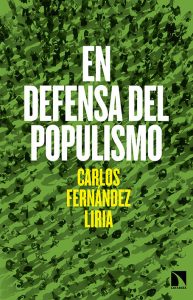
La irracionalidad comparece a la tecnificación donde todo se ventila de antemano. Pensemos, por ejemplo, en la jerigonzas concurridas como ‘¿cuál es tu marco teórico?’ o ‘¿desde donde hablas?’ ‘¿cuál es tu archivo?’. Estas indagaciones solo pueden entenderse como formas de una máquina inquisitorial que la universidad alberga como principio de autoridad ante la caída medular de su legitimidad. Sería coherente pensar, entonces, que si estamos ante una máquina confesional, solo la mentira puede ofrecer salvación o posibilidad de ‘mantenerse en pie’ sin tocar fondo, o sin que le vuelen a uno la cabeza. Justo es esto lo que esgrime en En defensa del populismo (2016) el filósofo español Carlos Fernández Liria, quien sugiere que ante la consumación de la mentira en el campo político contemporáneo, no hay verdad que esté condiciones de legibilidad, ni de escucha, ni de generar efecto alguno ante un macizo ideológico impenetrable. La única posibilidad es expresar una contramentira. ¿Pero es ésta la única forma de contestación? Podemos ‘testear’ esta pregunta en un momento decisivo del libro, y que aparece condensado en la forma de un chiste. Valdría la pena reproducir el pasaje:

“La sospecha de no ser lo suficientemente correctos en política, con todo el misterio terrorífico que esa determinación tiene en la academia norteamericana, pesó siempre sobre nuestras cabezas como una grave espada de Damocles, y todavía pesa, y no importa lo que digamos o hagamos, porque estas cosas, como todo el mundo sabe, se solucionan a nivel de sospecha y rumor y susurro malicioso. O incluso: es una cuestión de olor u honor, como el cristiano nuevo perfectamente devoto que no puede evitar caer en manos de la Cruz Verde porque todo el mundo sabe que su piel no reluce con la grasa prestada de la sobrasada. O, en palabras de algún fiscal federal asistente en la nueva serie de televisión Billions, «Si alguien dice que Charlie se folló a una cabra, aunque la cabra diga que no, Charlie se va a la tumba como Charlie el Follacabras» (225-26).

Lo que he llamado la forma sofística de la retórica contemporánea transforma a todos en Follacabras, en miembros potenciales de algún siniestro grupúsculo de Follacabras, y no importa la verdad que salga de la boca de la cabra (si es que la cabra habla), o del propio Charlie, puesto que una vez que la marca de Caín reluce sobre el pellejo de la frente, ya estamos automáticamente condenados a participar de una exposición que nos arroja al juego de cazadores y cazados. Este ha sido siempre el campo de batalla de la hegemonía, y que hoy se vuelve sistemático desde su inscripción en la equivalencialidad general. Esto es, no hay quien se escape a su lógica. Es más, no hay quien no sea, a la vez, una excepción sacrificable a esta lógica.

Pero habría otra opción: los Follacabras o los condenados pudieran también rechazar el sofismo y sus afligidas metáforas, aceptando la verdad como ascesis, esto es, como ejercicio en éxodo de todo juego hegemónico efectivo. Es lo que parece estar pidiendo Moreiras en Marranismo e Inscripción, y eso es ya bastante, y nos obliga a repensar la cacería como único juego posible. Y es el ascesis donde pensamiento y vida entran en una zona de indeterminación, y desde donde la verdad puede comparecer como alternativa al yoga acrobático que ofrece la universidad contemporánea, ya sea en su forma inquisitiva que obliga a la mentira, o en su produccionismo metabólico desplegado en el consenso, o en la politización, o en las buenas intenciones. Fue Iván Illich quien notó que el ascenso de la crítica académica monástica, y cuya secularización es la sospecha hermenéutica, coincidió con la declinación del ejercicio ascético del singular [2]. Y esto tiene sentido, puesto que la función crítica solo puede apelar a una radicalidad en expansión, siempre y cuando se retraiga de pensar la facticidad que supone la irreversibilidad del capitalismo. No es casual que Moreiras hacia el final del libro, y en réplica a una pregunta de Ángel O. Álvarez Solís, recurra al arcano del ascesis, como abandono del juego hegemónico de las mentira, y que dibujo los contornos de una vida sin principio:

“La palabra «ejercicio» puede servir si la entendemos etimológicamente, desde ex + arcare, desenterrar lo oculto, des-secretar. Digamos entonces, todo lo provisionalmente que quieras, que la infrapolítica es una forma de ejercicio en ese sentido –busca éxodo con respecto de la relación ético-política técnica, busca su destrucción desecretante, para liberar una práctica existencial otra. Yo no tendría inconveniente en usar para esto una expresión que he usado en algún otro lugar, la de «moralismo salvaje». La infrapolítica, en su condición reflexiva, es un ejercicio de moralismo salvaje, anti-político y anti-ético, porque quiere éxodo con respecto de la prisión subjetiva que constituye una relación ético-política impuesta ideológicamente sobre nosotros como consecuencia del humanismo metafísico. Sí, ese paso atrás salvaje con respecto de la relación ético-política es an-árquico, porque no se somete a principio.” (Moreiras 208).

La ascesis dice la verdad en la medida en que siempre atraviesa una hermenéutica existencial, y da un ‘paso atrás’ que renuncia a las determinaciones fundamentales de la subjetividad. El ejercicio tiene como objetivo el cuidado ante previsibilidad del síntoma. Si la ascesis es contrauniversitaria, lo es no en función anti-universitaria, sino por su instancia necesariamente atópica, ejercida como expatriación y desvinculación de todo sentido de propiedad y pertenencia comunitaria. Para el marrano no hay pasos aun por dar, sino solo un paso atrás, que es siempre el paso imposible al interior del tiempo de la morada. Esto supone abandonar el fantasma hegemónico del campo académico como avatar del pensamiento. Se piensa siempre en otro-lado. Es este también el sentido, de otra manera incomprensible, desde el cual podemos entender el intercambio epistolar entre Celan y Bachmann: “No recuerdo haber salido nunca de Egipto, sin embargo celebraré esta fiesta en Inglaterra” [3].

Ese paso atrás es el de la posibilidad imposible para seguir adelante desde un pensamiento que renuncia a la presbeia para ser radicalmente amonoteísta. ¿Podemos acaso imaginar una universidad en Egipto? Solo esta sería una universidad post-deconstructiva. Marranismo e Inscripción invita a este éxodo como única posibilidad de mantenernos en pie, y de echar adelante. Y hoy, ya no perdemos nada con intentarlo.

*Position Paper read at book workshop “Los Malos Pasos” (on Alberto Moreiras’ Marranismo e Inscripción), held at the University of Pennsylvania, January 6, 2017.

Notas

  1. Arturo Leyte. El paso imposible. Mexico D.F: Plaza y Valdés, 2013. p.24-53.
  2. Iván Illich. “Ascesis”. (Manuscript, dated 1989).
  3. Paul Celan & Ingeborg Bachmann. Tiempo del corazón: Correspondencia. Buenos Aires: Fondo de Cultura Economica, 2012.

El relato del bastón torcido: sobre En defensa del populismo de Carlos Fernández Liria. Por Gerardo Muñoz.

fernandez-liria-popEn defensa el populismo (Catarata, 2016), del pensador Carlos Fernández Liria, es un libro espinoso que busca instalarse con vehemencia al interior del debate en torno a la política española de los últimos años. Por supuesto, es también un libro abiertamente comprometido con el ascenso de Podemos, y su líder Pablo Iglesias, y sobra decir que su defensa de la ‘centralidad del tablero’ no se presta a equívocos. En efecto, en el prólogo del libro, Luis Alegre Zahonero celebra que Fernández Liria brinde su apoyo a la disputa por los nombres del enemigo, y que recupere para la izquierda nociones como democracia, ciudadano, derechos, o institución en línea con la obra elemental populista: la construcción de un pueblo. El punto de partida de Fernández Liria es volver sobre la textura del lenguaje, y desde ahí colonizar su gramática hasta efectuar un ‘nuevo sentido común’. Aunque Fernández Liria sitúa el problema en un arco de larga duración: al menos desde Platón y Sócrates, el lenguaje siempre ha obedecido al habla en el lenguaje del otro, léase del poderoso, y solo así ha sido capaz de generar escucha.
Según Liria ésta sería la lección decisiva de algunos diálogos socráticos, pero también de los sofistas, en la medida en que ambos discursos lo que se juega no es la verdad, sino su recursividad efectiva. Entonces, de la misma manera que Platón o los sofistas habrían derrumbado la verdad de los poetas, para Liria hoy no hacemos nada en decir verdades a orejas que no lograrían escucharla, puesto que son orejas que están blindadas a la verdad. Por lo tanto, es fundamental jugársela dentro de los límites impuestos por el falsum colectivo si es que se quiere llegar a un mínimo de veracidad. Pero, ¿qué nos dice esto del populismo? En una primera instancia que el discurso populista no depende de una aclamación de la verdad, y todo esfuerzo por desplegarlo en realidad terminaría atropellándose contra el blindaje que el ‘macizo ideológico’ (sic) de la mentira ha superpuesto en su economía general del sentido. El populismo tiene que entrar necesariamente a jugar el juego del sofismo. En un momento significativo para el argumento de Fernández Liria, éste recurre al relato leninista del bastón torcido que conviene citar íntegramente:

“Althusser recurría siempre a una cita de Lenin que hablaba de que para enderezar un bastón torcido no se podía sencillamente mojar la madera y atarla a una guía rectar, porque al soltar la guía el bastón quedaría menos torcido, pero seguiría torcido. Para enderezarlo, es preciso que la guía esté torcida en sentido contrario. Una idea falsa no se puede combatir sencillamente diciendo la verdad, hace falta otra idea falsa de signo contrario para que la verdad tenga alguna oportunidad. Una mentira se corrige diciendo la verdad. Pero en este mundo las ideas están impregnadas de una materialidad que pesa como el plomo, llevan adherido verdaderos sistemas de pasiones y afectos autorreferenciales y tautológicos…En esos casos, mover del sitio una mentira se parece a la tarea de intentar arrastrar un iceberg remando en una pirgua. Si hay que hacerlo es, por el contrario, para que verdad tenga alguna oportunidad en este mundo” (Fernández Liria 37-38).

Estaríamos ahora en condiciones de señalar la segunda dimensión del populismo que maneja Fernández Liria; a saber, que el populismo sería el mejor de los artificios posibles para el rendimiento de la política en un mundo de dilatada mitomanía. Y es esto lo único a lo que el populismo puede aspirar en su inserción social. Aunque según Liria es lo que debe aspirar toda política en tiempos de fin civilizatorio (sic) a causa del ascenso del principio general de equivalencia. No hay más fuera de esto (Fernández Liria 221). No se nos escapa en el fragmento citado anteriormente una cierta traslación leibniziana, donde el gesto de hipostasiar la imaginación política a una combinatoria lingüística es compensatorio de la crisis general de la política misma. Y tampoco es casual que Fernández Liria glose algunas fichas especulativas de Crítica de la Razón Política de Regis Debray, para dar cuenta cómo la maximización de la globalización, así como los experimentos por consolidar el socialismo real durante el pasado siglo, terminaron generando arcaísmos políticos y una perdurable proliferación de mitologías a contrapelo de la racionalidad moderna. De ahí que, si la política moderna de la secularización estuvo siempre caída hacia el nihilismo, entonces no queda otra opción que sostener cierta dosis de religiosidad edificante para retener cierta ‘calderilla antropológica’ (sic) contra el perpetuo ‘desnivel prometeico’ de la maquinación neoliberal. En estos trámites de compensación, la opción es solo una:

“Hace falta un populismo de izquierdas que, consiente de la necesidad de pertenencia tribal del ser humano, conocedor de que el mundo político tiene sus propios resortes y sabedor de que no se puede eliminar la superstición, sino, todo lo más, contribuir a su civilización, sea capaz de enderezar las energías populares a favor de instituciones republicanas” (Fernández Liria 159).

De esta manera, los capítulos “Razón y Cristianismo” y el epílogo “Progreso y Populismo”, apuestan a un registro mítico del populismo como interface o suplemento arcaico capaz de sostener lo mejor del Republicanismo, su ideal institucional, y estado de derecho. Estamos muy lejos, o casi en la posición contrapuesta a la invitación de José Luis Villacañas explicitada en Populismo (Huerta Grande, 2015), a la cual Liria alude, pero tan solo para subordinarla a su lógica principial de populismo. El sustento que alienta la teoría de Liria remite explícitamente a la lógica de hegemonía como vehículo monoestático para alcanzar y finalmente conquistar el llamado ‘sentido común’. Escribe Liria: “El mayor error que podría cometer un populismo de izquierdas sería renunciar a la defensa de esta objetividad republicana. Es más, esta defensa de la objetividad república es más bien lo único que puede convertir al populismo en un populismo de izquierdas” (Fernández Liria 109).

Si para Liria el populismo es más cercano a la Ilustración que al jacobinismo, no es porque tenga como referente último la legitimidad institucional y los derechos del hombre, sino porque el vaciamiento de estos principios hoy hace posible que el populismo les dispute el campo semántico a categorías de peso en la tradición. A diferencia de Villacañas, para quien el republicanismo pudiera aflorar como posibilidad poshegemónica y breakthrough del impasse del ‘momento populista’; en la defensa del populismo de Fernández Liria, el republicanismo y la institución son significantes y estructuras que permiten hipostasiar el pensamiento en nombre del sentido común en tanto hegemonía. En otras palabras, mientras que la deriva republicana de Villacañas busca pensar la política democrática para tiempos de interregno, el llamado ‘populismo-republicano’ de Liria funciona a la palestra de extender el presupuesto schmittiano de la enemistad. Este es, al fin y al cabo, la pieza última de la ‘defensa populista’, por la cual a pesar de todas las piruetas por distanciarse de Laclau – y que quizás implícitamente es uno de los flancos de un tipo de discursividad que ‘no convence’ en tiempos poshegemónica para Liria – reaparece acoplada sobre los mismos términos. De hecho, Liria no cambia nada de la matriz de la hegemonía entendida como reducción culturalista enchufada a la voluntad de poder. Veamos:

“…la hegemonía se ejerce, fundamentalmente, apropiándose de lo que solemos llamar el “sentido común”. Es allí, en el sentido común de la población, donde se produce la secreta mutación de los intereses particulares en intereses generales de la colectividad. Es por lo que los marxistas repitieron tanto eso de la ideología de una sociedad era siempre la ideología de la clase dominante…Es ahí donde se disputa lo que podríamos llamar “la ficción de una voluntad general”. Así pues, la lucha política es, ante todo, una lucha por la hegemonía, una lucha, por tanto, por instalarse en el sentido común de la población de manera que los propios intereses hagan pasar por los intereses de la voluntad general” (Fernández Liria 51-52).

El llamado a más hegemonía, a pesar de su apelación a la Ilustración o a la posibilidad republicana, desafortunadamente termina siendo una variante más del voluntarismo político propio del cierre onto-teológico, donde la estructuración del contrato social y la factura culturalista terminan por agotar las opciones de otra política. Y así, lo que solicita Fernández Liria, al igual que la que ha venido pidiendo Alan Badiou, es desde un principio una política para convencidos, o para militantes, o para quienes quieran creerse ‘el cuento’ [1]. Pero es también aquí donde el juego sofista entra en aprietos, puesto que, si la subsunción real del capital genera la más densa mitología del consumo y la publicidad, ¿qué puede hacer la hegemonía, sino fracasar ante ello, o bien ofrecer un contra-mito siempre limitado o insuficiente? O simplemente arribista, acotado a la ‘coyuntura’ sin más. Sin duda, la apuesta por un contra-mito tampoco es novedosa, y no habría muchas diferencias a la solución de Carl Schmitt en su conocido ensayo sobre la instrumentalización del mito en el nacional-socialismo contra la neutralización ejercida desde la ‘habladuría’ parlamentaria [2].

Pero estos fueron esfuerzos por una totalización de la política que se ha arruinado en nuestros tiempos, y sin embargo es la condición mínima para que Liria pueda echar a andar la fuerza apropiativa de la hegemonía como motor de conflicto, y de existencia en común durante tiempos de crisis. En cualquier caso, Liria no logra avanzar más allá del esquematismo constitutivo entre Ilustración y crisis que encuadra el gran relato de la soberanía popular desde la revolución francesa, y del cual la teoría de la hegemonía tendría que hacerse cargo de manera más delicada. De otra manera los sofismos antropológicos serán mellados por el tiempo efectivo del capital sin muchos reparos por las fantasías equivalenciales diagramadas sobre las lenguas comunicacionales.

Pero Liria no hace concesiones, y hacia el final del libro sentencia: “En todo caso, un auténtico cosmopolitismo no podrá jamás suprimir algo así como el Estado nación. Siempre seremos seres humanos y naceremos por ‘el coño de nuestra madre, aprenderemos a hablar en algo así como la familia y tendremos una identidad personal y tribal que tendrá que ser gestionada políticamente” (Fernández Liria 236). La pregunta que tendríamos que hacerle a la ‘defensa del populismo’ de Liria es si acaso, su ‘nuevo’ ‘populismo-republicano’ podría ser algo más que una tribulación antropológica entregada al pastoreo gubernamental, una contra-hegemonía de la dominación desde una metapolítica del pueblo. Y si así es, el relato del ‘bastón torcido’ es una teoría de ‘bandazos’, como le ha llamado recientemente Villacañas, ya que no puede convencer ni atraer a nadie en tiempos poshegemónicos [3]. Liria exige que mantengamos la vista fija sobre el listón de madera mientras el abismo que desfonda la política sigue su curso por debajo. El bastón, entonces, es principalmente un fetiche y la exigencia una plegaria.

¿Pero no sería hora de arrojar el bastón? Luego de la lectura de En defensa del populismo queda muy claro que hegemonía como suelo que agota la política es el principio ineludible del sentido común. Y es esa la razón por lo que Luis Alegre tilda de “pensadores perezosos o cobardes” a quienes se afanaban por inventar ‘cosas mejores’ (sic), esto es, cualquier cosa que no sea hegemonía (Fernández Liria 13). O bien pueda Liria exhibir a aquellos que, en lugar de ofrecer sus vidas a la teología de la liberación, “estaban intentado descifrar a Derrida o dándole vueltas y vueltas al insondable misterio que ellos llamaban el dilema del prisionero” (Fernández Liria 149). Aunque quizás la inventiva de ese hombre perezoso y poshistórico, tal y como lo pensaba Alexandre Kojeve, sea la que menos rebusque en los basureros intelectuales de la izquierda. Ese perezoso hombre poshegemónico, es cierto, no ofrece proezas salvíficas o descalificaciones altisonantes, pero tal vez remitiría a un tiempo de democracia más allá de fábulas antropológicas que hoy solo pueden sucumbir a la indiferencia generalizada, o bien a rechineos para espabilar solo a unos cuantos.


Notas

  1. Es lo que propone Badiou con su noción de “nueva gran ficción” en “Politics as a nonexpressive dialectics”, en Philosophy for Militants (Verso, 2012).
  2. Carl Schmitt. “La teoría política del mito” (1923). Carl Schmitt: Teólogo de la Política (Orestes Aguilar, ed., 2001).
  3. José Luis Villacañas. “Podemos, la hora decisiva”. http://www.levante-emv.com/opinion/2016/12/13/hora-decisiva/1503555.html

‘Chasing the hare with the ox, swimming against the swelling tide’: Towards a Posthegemonic Institutionality. (Gerardo Muñoz)

*(Paper read at the workshop “Left Behind: The Ends of Latin America’s Left Turns”, held at Simon Fraser University, December 5, 2016. Organized by Jon Beasley-Murray.)

In an important moment of Alberto Moreiras’ new book Marranismo e inscripción (2016) we read: “La sospecha de no ser lo suficiente correctos en política, con todo el misterio terrífico que esa determinación tiene en la academia [norteamericana], pesó siempre sobren nuestras cabezas como una grave espada de Damocles y todavía pesa…” (Moreiras 125). It might be a good ocassion to say upfront that the waning of the progressive cycle in Latin America will most likely revive old affective demands and well-known pieties that the Left never affords to give up. Someone will be blamed for the broken plates, and the burden of those “left behind”. But this moment should be seized to think not what ‘politics’ should or must do (in Latin America and beyond), but rather how to think politics in what already is taking place. Or to question if perhaps the political today amounts to nothing more than what Arnaut Daniel said of the poet: “[He] chases the hare with the ox, swims against the swelling tide”. Can the paralysis of politics be something other than hunting or resistance?

As this 2016 comes to a close, we have witnessed a series of drawbacks in the political landscape of Latin America: from the outcome of the referendum in Bolivia to the electoral victory of Mauricio Macri’s PRO in Argentina, not to speak of Dilma Rousseff parliamentary impeachment in Brazil. There has been other lesser-known events, although no less disturbing, such as Roxana Pey’s arbitrary dismissal as First President of Universidad de Aysén by the current Chilean Minister of Culture after proposing a debt free and non-corporate public education. The sense of ‘exhaustion’ is at the thicket of the progressive cycle and has only deepened in the last two years, although this prognosis is more than just a motto of ‘ultra-leftistism’. Recently, high profile figures of the so-called Pink Tide governments have also voiced a sense of political stagnation and defunct space to reignite the original rhythm that took place at the turn of the century.

Just about a week ago, in a conversation that took place at Columbia University between philosopher Étienne Balibar and Vice-President of Bolivia Alvaro Garcia Linera, the latter stated that we are now in turbulent times where no horizon is in clear sight. It might be true that the unsettling remark might have partly been influenced in the wake of Fidel Castro’s death as the symptom of Latin American Left’ symbolic orphanhood, although Castro died far from leaving a relevant political legacy. I think many will agree that the guerrilla warfare, the Partido Único, or the concept of ‘struggle’ plays no role in the future of the Latin American Lefts. Yet such announcement from the Vice-President of the Bolivian Plurinational State seems to put to a halt the deep political conviction for transformation that he himself theorized in a wide range of orienting categories such as ‘creative contradictions’, ‘planetary ayllu’, or ‘communist horizon’.

The deficiency of a visible political vista means that we are in times of interregnum; a time when the modern epochality is left behind and a new one that has yet to materialize. The interregnum describes an extraneous temporality that fissures the antinomies of architectonics of modern politics – autorictas and potestas, constituent and constituted power, legitimacy and legality – carrying the very economy between thought and action in a threshold of indeterminacy. At the closure of epochality we are obliged to rethink once again the limits of the Latinamericanist conditions of reflection in light of the contemporary transformation of the space or object of knowledge that we call Latin America. A few years ago, John Beverley made an attempt to propose a new paradigm in his Latinamericanism after 9/11 (2011) under the preliminary notion of post-subalternism, which he defined as an alliance between subaltern and the new progressive State:

“The question of Latinamericanism is, ultimately, a question of the identity of the Latin American state…I would like to suggest here an alternative that is post-subaltenrist, ‘post’ in the sense that it displaces the subaltenrist paradigm but is also a consequence of that paradigm in that it involves rethinking the nature of the state and of the national popular from the perspectives opened by subaltern studies. …This possibility has a double dimension: how can the state itself be radicalized and modified as a consequence of bringing into it demands, values, experiences from the popular subaltern sectors, and how, in turn, from the state, can society can be remade in a more redistributive, egalitarian, culturally diverse way (how hegemony might be constructed from the state, in other words). (Beverley 110-116)”.

The post-subalternist option largely depends on the temporalization of the State-people alliance, which leaves pressing questions relative to State form and patterns of accumulation untouched, or any excess that disrupts the culturalist consensus at the heart of every hegemonic articulation. The problem that arises from this specific conceptual design is that with the rise of the New Rights, which continue to operate on the basis of the expansion of social inclusion through consumption, the hegemony of a ‘non-State that acts as a State’ (another way through which Beverley defines postsubalternism), will be set to accomplish two simultaneous tasks: on the one hand, contain and polish the heterogeneity or savage dimension of ‘the people’ into the metaphoricity of national-popular representation; while on the other, reducing the State’s structures and institutions to the management of geopolitical processes and rent distribution. In a rather counterintuitive way, the post-sulbanternist option reenacts the decionism from the instrumentalization of the state as the exception to post-sovereign capital in the name of the people.

At the same time, facticity is now fully post-subalternist, but for the opposite reasons as those imagined by Beverley: hegemony’s de-hiearchization and economic administration convergences with the neoliberal general equivalent as real subsumption of capital renders hegemonic politics obsolete for substantial change. Ultimately, post-subalternist alliance curbs posthegemonic temporal intrusion, which forces a relentless displacement of its object of identification to disregard the constitutive tragic repetition of the fissure in its closure.

Post-subalternism is an attempt to reawake the specter of hegemony from the ruins of the political: from the inside it stands politics of subjectivization by the State, and from the outside, as a metapolitical form of order (katechon) to detain internal social explosion (Williams 61).

In recent years the post-subalternist paradigm has been somewhat displaced by what I have called elsewhere a ‘communal or communitarian turn’ (Muñoz 2016). Raquel Gutierrez Aguilar, a key thinker of communal horizontalism and also the author of the influential book Los ritmos de Pachakuti: Movilización y levantamiento indígena-popular en Bolivia (2008), at the end of last year conjured a radical turn towards the “communal” as the site for a new political program. In a more urgent tone, Huascar Salazar Lohman in Se han adueñado del proceso de lucha (2015) defines the position as following:

“Lo relevante es afirmar que la transformación heterogénea y multiforme que emerge de los entramados comunitarios implica la capacidad de dar forma a su reproducción de la vida social, trastocando, trans-formando o reformando la propia forma de la dominación…La manera en que los entramados comunitarios enfrentan al capital es a partir de vetos que permiten conservar, establecer, o restablecer relaciones sociales para reproducción la vida. En este sentido, el telos o el horizonte de deseo que media la lucha comunitaria es el despliegue de su propia forma de reproducir la vida, es decir, ampliar su capacidad de formación” (Salazar Lohman 35).

For both Gutierrez Aguilar and Salazar Lohman, the communitarian horizon requires breaking away from the dichotomy of civil society and State in order to relocate the temporal vitality of an autonomous re-production of life and the re-appropriation of that which the state has expropriated from communal property. However, if the communitarian form is not determined a priori by domination and capital, why is the emancipatory potential of the communitarianism emphasized solely on the basis of re-appropriation of what is valorized in the State? Salazar Huascar himself provides the answer to us when alluding to Bolivar Echevarria’s reconceptualization of the notion of use-value as yielding something like an inner exception within the logic of exchange. Communitarism, then, re-translates use-value as locational propriety.

Ironically, this is not very different from Álvaro Garcia Linera’s own attempt to “restore the communal (ayllu), against the logics of subsumption, through a re-functioning of culture and democracy and the recent juridical-political attempting to contain the ‘cunning of capital’ as it imposes its logics through its others…” (Kraniauskas 48). Although it seems the polar opposite of Huascar’s position, Garcia Linera’s instrumentalization of the communitarian through use-value mediates an indianization of the subject of social emancipation in the ‘community form’” (Kraniauskas 48). In fact, communitarianism ends up offering yet another exceptional particularism legitimized by the normative assumption of propriety and properness via-a-vis collective decision-making ( as ‘participacion directa y obligatoria’), and an alternative biopolitics of the ‘reproduction of life’ (reproducción de la vida). Communitarianism as a locational politics of resistance is already contained in the State’s shadow of community use-value, which is inverted on behalf of communitarian decisionism.

A similar paradox is at the heart of Diego Sztulwark and Veronica Gago’s essay that expands the temporality of the ‘end’ of the Latin American progressive cycle from below. On the one hand, they note that neoliberalism runs parallel to constituting a governmentality from above, and is also “inextricably linked to popular consumption, apparatuses of indebtness, and new forms of violence” as two dynamics that permute and sustain one another” from below (Gago & Sztulwark 610). While discerning the spectral dimension of contemporary flexible capital, they immediately move on to claim that it is on this plane where new counter-powers are transformed, modes of weaving together a resistance and a set of practical actions for political efficacy… (Gago & Sztulwark 612). However, counter-hegemonic subjective vitalism is already captured by the plasticity of financial subjectivization. Thus, this new vitalism framed solely as resistance only lifts political imagination to the domain of stasis or civil war already taking place in the territories, in which the struggle for subsistence takes the form of a neo-Francicanism eschatology (minimal relation to propriety) immanent to the financial subaltern bodies.

I would like to suggest that the two reflexive options sketched above, that of a post-subaltern state and the particular communitarian horizon, coincide in fashioning a politics of resistance after the closure of hegemonic principles. At the same time, the failure of hegemonic theory in the region is in this sense neither accidental nor limited to the temporalization of the so-called progressive cycle, since it also characteristic of the phenomenology of the originary fissure in the State form over the last two hundred years.

Hegemony or hegemon as an ultimate ontology of the political constitutes itself as a phantasm, which following Reiner Schürmann, denies the tragic dimension of the singular, translating norms and legislating laws in the name of its own sovereign principle. A phantasm is hegemonic when an entire culture relies on it as if it provided that in the name of which one speaks and acts. Such a chief-represented (hêgemôn) is at work upon the unspeakable singular classifying, inscribing, and distributing proper and commonality (Schürmann 22). In this sense, communitarianism and state hegemony are not just contending procedures of political decisionism, but more importantly, the two poles of a same structure waged on life as ultimate referent.

This is why, according to Schürmann, there is a “kind of joy of violent submission to it. Perhaps the intoxication they wish for us, or that we wish for ourselves through them” (Schürmann 29). To the extent that is waged on life, there has always been hegemony, although only as a phantasmatic economy to flatten and systematically erase the time of the tragic, whenever it appears to interrupt and ascend into the political principle. This is the time of the singular that is neither reducible to a subject in the eventfulness of history (a movement, a people or a multitude), nor a cultural schematization of identity and difference.

The challenge for thought is necessarily post-hegemonic, which I define as the potentiality for institutionalization of the tragic (singularity) in the anomic epoch of neoliberal administration. It is no coincide that both communitarian and hegemonic options define themselves against institutions, and they both respond to the moment of crisis of political epochality. A reformulation of an institutional form can mediate the ever-present pendulum movement that oscillates from neoliberal deregulation to the populist anti-institutionalism and back. But it so happens that populism does not posses a theory of institutionality, therefore is in no condition of providing a strategy to cope with the movement of the pendulum (Villacañas 2016). Since populism is always a decision on a concrete existential situation, it always remains attached to the perpetuity of the state of crisis as a decision made on and for life (understood in the Greek sense of krisis as judgment). As such, populism is the temporality of expropriation, and its process of abstractation into finite demands coincides with the money form (general equivalent) that structures the contemporary financial body of the living.

In the introduction to their edited volume Left Turns (2010), Beasley-Murray & Cameron & Herschberg noted that “if the Latin American states are to survive their current crisis of legitimacy they then need to be better funded, more efficient, and more reflexive of public preferences…the entire political class confronts the challenge of refunding the Latin American State” (Cameron & Herschberg 6). This was the promise and the stakes .Since then, the Latin American Progressive Cycle’s extreme presidencialism led to the withering of institutionalization making it easier for an accelerated restructuring of the State’s institutions by the New Rights technocrats. As the populist interpellation between friend and enemy evaporates in each political cycle, the price to be paid is life as thetic communitarian identity formation or as counter-hegemonic biopolitical vitalism. Constitutional scholar Bruce Ackerman alerts in his The Decline and Fall of the American Republic (2010) that the expansion of the powers of the ‘most dangerous branch’ (executive) effectively prepares the ground for an ominous neoliberal anti-institutionalization. This is what lurks in United States’ political future after the President-elect Donald Trump, and more generally, what haunts the spatial configuration of every western state’s void of legitimacy.

A posthegemonic institutionality for post-hegemonic times seeks the thinking of another relation with the political that is not reducible to the principle of a hegemonic phantasm as the oblivion of its own excess to equivalence. But perhaps more importantly here is how to think a posthegemonic institutional form that that would break away from the indeterminate concrescence of law as always already short-handed for internal exceptionality in order to redirect and put in motion the temporality of development. Thus, a posthegemonic institutionality will thrive to move beyond a notion of interruption or an insurrectionary moment dispensed in the phantasm of hegemony.

How can we imagine a form of life instituted not only in its irreducibility to the movement of vital ‘rhythm’, but in the arrival of the day after, when the last lights have gone off, after everyone has returned home, and mobilization gives way to demobilization? In his book on the Spartacist uprising, Furio Jesi says that the ‘decisive day of freedom’ is that which takes place the day after tomorrow, in which the time of living is not exhausted in life or death (Jesi 134). The crucial distinction here is a temporal one: living against life or death.

To institutionalize not life in the frame of biopolitics or communitarism, constituent power as passage to constituted power, but a destituent time of the living. The day after tomorrow is posthegemonic demobilization as distance from political ontology and its conversion into metapolitical community. Only by institutionalizing the temporality of an improper singularity could something like an inequivalent and ungraspable form of democracy and radical freedom could be conceived as the new truth in and beyond politics.

Bibliography

Ackerman, Bruce. The Decline and Fall of the American Republic. Boston: Harvard University Press, 2010.

Beverley, John. Latinamericanism after 9/11. Durham: Duke University Press, 2011.

Cameron, Maxwell & Herschberg, Eric. Latin America’s Left Turns: Politics, Policies, and Trajectories of Change. Boulder: Reinner Publishers, 2010.

Gago Verónica & Sztulwark Diego. “The Temporality of Social Struggle at the End of the “Progressive” Cycle” in Latin America”. SAQ, 115:3, July 2016.

Kraniauskas, John. “Universalizing the ayllu”. Radical Philosophy, 192, July-August, 2015.

Moreiras, Alberto. Marranismo e inscripción. Madrid: Escolar & Mayo, 2016.

Muñoz Gerardo (ed.). “The End of the Latin American Progressive Cycle” (dossier). Alternautas (3.1, July 2016). http://las.sites.olt.ubc.ca/files/2016/11/Alternautas_End-of-Progressive-Cycle-Dossier-2016.pdf

Salazar Lohman, Huascar. “Se Han adueñado del proceso de lucha”: horizonte comunitario-populares en tensión y la reconstitución de la dominación en la Bolivia del MAS. La Paz: autodeterminación, 2015.

Schürmann, Reiner. Broken Hegemonies. Bloomington: Indiana University Press, 2003.

Villacañas, José Luis. Populismo. Madrid: La Huerta Grande, 2015.

.
Williams, Gareth. “Los límites de la hegemonía”. Poshegemonía: el final de un paradigma de la filosofía política en América Latina (Castro Orellana, ed.). Madrid: Biblioteca Nueva, 2015.

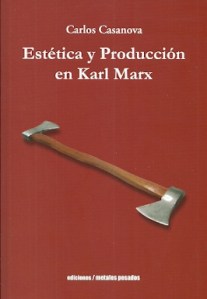
Inside the Industry of the Senses: on Carlos Casanova’s Estética y Producción en Karl Marx. (Gerardo Muñoz)

casanova-marxCarlos Casanova’s short book Estética y Producción en Karl Marx (ediciones metales pesados, 2016), a condensed version of his important and much longer doctoral thesis, advances a thorough examination of Marx’s thought, and unambiguously offers new ways for thinking the author of Das Kapital and beyond. Although the title could raise false expectations of yet another volume on ‘Marxism and Aesthetics’, or, more specifically, a hermeneutical reconstruction of a lost ‘aesthetics’ in Marx, these are neither the concerns nor aims of Casanova’s book. Instead, he does not hesitate to claim that there are no aesthetics in Marx’s thought derivative from German theories of romantic idealism, conceptions of the beautiful, or the faculty of judgment in the Kantian theory of the subject and critique.

Forcefully, Casanova situates his intervention apart from two well-known strands of thought: those that have sought to extract an aesthetics in Marx (of which Rose’s classic Marx’s lost aesthetic is perhaps a paradigmatic example), and those who have wanted to produce ‘a Marxist’ social theory for art (Lukacs and Eagleton, but also De Duve or Jameson). Casanova argues that Marx’s aesthetic can be located in a modality of thinking through an anthropological conception of man and the human (although, as we will see, perhaps ‘anthropogenic event’ is more accurate, than the claim for an anthropology). The anthropogenic event in the early Marx of the Manuscripts of 1844 is closely examined in light of the concept of praxis displacing the problem to the economy of potentiality and actuality inherited from the Aristotelean tradition. According to Casanova, this informs Marx’s concept of “exteriorization” understood as the capacity of use in the human. In Casanova’s conceptualization ‘use’ refers to potentiality, and not to a compensatory measurement of ‘value’, as it appears, for instance, in Bolivar Echevarria’s culturalist reading of the status of accumulation in Marxist theory. Challenging the Althusserian structuralism, which authorized the reduction of a heterogeneous corpus into two phases relative to the epistemological break; Casanova suggests that the early Marx inhabits the threshold of thinking the potentiality of Humanism as always producing the disruption of the apparatus of property and the person. What is at stake in Marx is an ‘industry of the senses’ in the constitution of the singular. Hence, Casanova writes early in the book:

“Vale decir: lo que hay en Marx es un pensamiento del limite, no del fin del humanismo, sino de un pensamiento de lo humano que consiste en un pasaje al límite del humanismo donde este se vera menos suprimido que suspenso, desfondo en su “raíz”. Digamos que, utilizan una expresión de Esposito y de Nancy, lo que hay en el pensamiento de Marx es más bien una “división/interrupción” del mito del humanismo” (Casanova 16).

Marx’s ‘aesthetic industry’ crashes the humanist onto-theological machine, which opens the inoperativity of man’s praxis as irreducible to the concrete and abstract extraction of value and production. This displacement pushes Marx away from the humanist machine of universality or particularity as the two poles of a locational dispute of the “subject”. Further, what follows from this claim, are two ways of liberating Marx from the constraints of the Marxist principial tradition and the opposition ‘structuralism vs. the subject’ towards a new use of man’s praxis. In the first part of the book, Casanova takes up the inoperativity of Marx’s humanism (“Humanismo del hombre sin obra”), and in the second section (“Tecnologías de la producción”), the analysis shifts towards a polemical scrutiny of the question of technê against the theorizations of telecratic instrumentality, but also from the phenomenological interpretations that have understood Marx’s thought as the consummation of the epochal technological enframing. Of course, Casanova’s book, and his own reflection on Marx, is situated in the wake of a reconsideration of the technology of the sensible, that allows him to read Marx beyond the humanist onto-theology as a messianic principle that propels the Hegelian philosophy of history as stasis for mastering the logic of revolution.

Casanova’s Marx is an-archic or aprincipial in Reiner Schürmann’s sense, as it avoids the substantialization of a ‘marxist politics’ to assert a stable ground for action over thinking. The Marx endowed in Estética y Producción is also an-anarchic in yet another sense: it offers no productive horizon of philosophical knowability as a new vanguard of intelligence, a technology of critique, or even a practice of restitution. Casanova makes no concessions to epochal nihilism, and there is no attempt in crafting Marx as an archē for militant hegemony or the invariant procedure of truth. His intervention is situated at the crossroads between Agamben’s archeology of potentiality, J.L. Nancy’s deconstruction, and more esoterically, a Chilean critical constellation, which includes, although is not limited to Pablo Oyarzun’s Anestética del ready-made (2000), Miguel Valderrama’s La aparición paulatina de la desaparición del arte (2008), Federico Galende’s Modos de Producción (2011), and Willy Thayer’s Tecnologías de la crítica (2010). This list could go on, and although none of these names are directly confronted, it would be interesting to read his intervention as a radical conceptual abandonment of the “aesthetic” in this specific cultural field.

In the first section “Humanismo del hombre sin obra”, Casanova complicates the early Marx of the Manuscripts by suggesting that the notion of the “generic being” takes place in a double-bind as part of the historicity of the human’s sensible organs that are both conditions and products of a “sensible activity” of the exteriorization of abilities. If both idealism and alienation are the forgetting of the material forms of production, Casanova is quick to underline that it is not just a mere extraction and division from a point of view of ‘functional socialization’, in terms of Alfred Sohn Rethel (although this is not explicitly thematized in the book), but an activity that is the very ‘mediality’ of life as the potentiality in which man can exercise a direct and unmediated relation with nature. In a crucial passage, Casanova writes:

“Los órganos humanos son las capacidades desarrolladas, esto es, el poder ser actual de los individuos al igual que los medios o instrumentos a través de los cuales esas mismas facultades se ejercen. Al mismo tiempo, ellos son los productos, el mundo objetivo del trabajo de toda una historia pasada: son los sentidos de una actividad productiva, entendida como “la relación historia real de la naturaleza (el “mundo sensible”) con el hombre. Son, en suma, los órganos de la industria del hombre” (Casanova 31).

What capitalism stages in the figure of the proletariat, as a result, is a series of divisions that obfuscate the taking place of a praxis constitutive of the industry of man; that is, of the life of the generic without work. In this intersection, Casanova is very much dependent on the Aristotelian’s definition of man’s essence as an-argos, or without work [1]. Hence, Marx’s “real humanism” entails necessary praxis of the industry of the senses, which capitalist humanism divides and codifies in terms of exploitation, alienation, rule of law, and private property. However, and more importantly for Casanova, is the privatization of the sensible transformed into an aesthetic apparatus that governs over life (Casanova 44-45).

The modes of production are in this way already a semblance and reduction of the overflowing of the senses in the praxis of man, which necessarily posits poesis as what cannot amount to work through the unlimited process of accumulation. The labor of the proletarian, understood as the industry of the generic being, enacts an undefined potentiality, in which action and thought, singularity and commonality, sensing and reason, collapse in a heterochronic plane of immanence with no remainder.

The becoming of man corresponds to the becoming of the world beyond the principle of equivalence as the structural circuit through which global spatialization of capital replaces the possibility of ‘earth’. Marx’s humanism without work is situated against this ruinous and fallen world confined to the logic of exchange and appropriation. The proletariat stands here less than a subject for and in history, as the site where an excess to productivity and equivalence is latent as a multiplicity of singular potentialities: “Ya no hay nada que apropiar mas que lo inapropiable – el libro uso de común de las fuerzas de producción – de una apropiación no capitalizable, es decir, excesiva respecto del marco económico politico de productividad, por ende no mensurable de acuerdo a la medida del valor, es decir, no gobernable bajo el principio o ley universal de la equivalencialidad” (Casanova 53).

To appropriate the inappropriable is the stamp of Marx’s industry of the forms of life as the turn towards what is an excess to equivalence. But Casanova’s Marx as the thinker of the inappropriable cannot escape the function of appropriation in the event of a modality of work, which constitutes, perhaps to the very end, the aporia’s of Marx’s thinking [2]. The function of positive appropriation of force in Marx is still tied to “esta producción multiforme del globo entero” (Schöpfungen der Menschen)” (Casanova 52).

Casanova forces Marx to say that a relation always implies the production with its own potentiality. But is not appropriation of production haunted by the unproductivity that is deposed in every praxis? That is, only because praxis is use, there is no longer an appropriation of wealth, which remains on the side of vitalism as a productive entelechy disposable for work. However, Casanova affirms that Marx’s communism was perhaps the first (sic) in taking into account how labor and property are economic categories of policing and subjecting the organization of life. In fact, all subjectivization is already a movement capture of immanence as a regime of equivalence in both the apparatus of modern sovereignty and in the capitalist form of exchange of the commodity. Marx’s communism is thus not a movement that trends towards the transformation of the actual state of things, but a deposition of a self-relation of one’s potentiality.

The mediality exposed in humanism without work is juxtaposed and analytically enlarged in the second part of the book when thinking the question of technology as originary technê, which Casanova also calls ‘co-constitutive’ of the generic being. Challenging Kostas Axelos’ standard reading of Marx as an epochal product of the complete exposure of the age of technology, he polemically advances a production of technology that is never reduced to instrumentalization, nor to the clarity of the concept in philosophy as a secondary tier of appropriation. Following Nancy, Marx’s thought is registered as one of finitude, as it opens to the mundane and profane dimension of the material conditions of sensibility:

“Un pensamiento de las condiciones denominadas “materiales” de existe es un pensamiento que necesariamente vincula, como cuestión ineludible la deconstrucción de la metafísica de la presencia con la pregunta por la condición material, económica, y social de los hombres. Un pensamiento así es, por otra parte, un pensamiento que se piensa en “la ausencia de presencia como imposibilidad de clausura del sentido o de acabada presentación de un sentido en verdad” (Casanova, 79).
Marx’s critique of political economy appears as a translation of his critique of religion as the deconstruction of the onto-theology of capital and the subject as coterminous with the principle of general equivalence. Equivalence is what renders abstract the industry of sense, capturing every singularity in a regimen of equality in exchange value and the commodity form. As such, the technology of capital equivalence is what separates and articulates for “work” the co-constitutive modal ontology of originary technê. More importantly, the originary technê allows for the emergence of politics in Marx that Casanova does not shy away to call “politics of presence” (política de la presencia) as the force that un-works the labour apparatus of labour. But, even in its appropriative force, is not production what thrusts the ‘absolute movement’ towards non-work?

Casanova is aware of this aporia when at the very end of his book he asks: “¿Continúan siendo las fuerzas en este movimiento metamórfico, fuerzas dispuestas dentro del marco de la productividad? ¿Siguen siendo las fuerzas del hombre fuerza de trabajo, o más bien, se transforman en fuerzas humanas en cuanto tales…” (Casanova, 118)? Could the limit of Marx’s thought be inscribed in the way in which concrete industriousness in the essence of man, only dispenses what is proper and productive in the anthropogenic event? Why is the status of “force” in the becoming of the sensible of the singular?

At the very end of the seminar Heidegger: The Question of Being and History (U Chicago, 2016), Jacques Derrida posits the existential analytic as what precedes anthropogenic event based on labor and its force of the negative [3]. But this is only the Hegelian telling of the ‘story’. Casanova grapples to make Marx a thinker of the originary technê in a metamorphic movement that brings to a zone of indistinction thought and action, whose appropriation is always that of the excess of the proper. Could this entail that communism in Marx rejects the notion of “equipementality” (verlässlichkeit) for a program of emancipation in the movement of appropriation of work? If so, then the labor of stasis at the heart of the sensible industry fails at being formalized into a ‘politics of presence’.

What opens up is an infra-political relation, a necessary fissure within any articulation of the common in the event of appropriation. In repositioning Marx to the improper site of desouvrament and the ungovernable, Casanova stops short of offering a Marxist ‘politics’. But perhaps no such thing is needed: the task of freedom is to abandon any metaphoricity as a new nomos of the senses. Bresson captured this freedom in a remark on Cezanne: “Equality of all things. Cezanne painted with the same eye, a fruit dish, his son, and Mt. Sainte-Victoroire” [4]. The ‘grandeur of Marx’ resides in that the sensible machine is never ontology of art; in the same way that hegemony never constitutes a phenomenology of the political. At the heart of Marx’s industry there lays, always and necessarily, a life without “work”, something other than politics.


Notes

1. This pertains to the passage from Aristotle’s Nicomachean Ethics (1098 a7) in which the philosopher argues that the musician has a particular function that defines his work, but the human to the extent that he is human, is born without work.

2. This is what Agamben detects in Use of Bodies (Stanford University, 2016), as the insufficiency of Marx’s oeuvre in terms of the fixity to the modes of production: “One-sidedly focused on the analysis of forms of production, Marx neglected the analysis of the forms of inoperativity, and this lack is certainly at the bottom of some of the aporias of his thought, in particular as concerns the definition of human activity in the classless society. From this perspective, a phenomenology of forms of life and of inoperativity that proceeded in step with an analysis of the corresponding forms of production would be essential. In inoperativity, the classless society is already present in capitalist society, just as, according to Benjamin, shards of messianic time are present in history in possibly infamous and risible forms.” 94.

3. Jacques Derrida. Heidegger: The Question of Being & History (U Chicago, 2016), p.194-96.

4. Robert Bresson. Notes On The Cinematographer. New York: NYRB, 2016.

Katargein: notes on Giorgio Agamben’s L’uso dei corpi. By Gerardo Muñoz

Luso dei corpi 2015

1. L’uso dei corpi (Neri Pozza, 2014) is the culmination of Agamben’s Homo Sacer project after a little more than a decade. The thinker has warned that the volume should not be taken as the end of the project, but as the last installment before its abandonment. To this effect, it is for future thinkers and scholars to continue carrying forth an investigation that polemically proposes an archeological destruction of politics in the West. L’uso is a book written with a backward gaze on what has been elaborated in other volumes, while thematizing instances of the unsaid in them. A novelty in L’uso dei corpi is the constant iteration of anecdotal impressions that enact as emblems of the indeterminate threshold between thought and life.

None of these details are meant to add flare to the content. Rather, they allude to one’s impossible strategy of sketching or bearing witness to life. It is precisely that alocation which already introduces the idea of form of life. It is worthwhile to note that in this bravado, there is little meditation on Agamben’s own life, which remains silently opaque and perhaps on the side of “ette clandestinité de la vie privée sur laquelle on ne possède jamais que des documents dérisoires”. The writing of a life is only potential or a habitual relation of the singular with itself, foreign to conventional literary genres or works of memory and identity. The form of life coincides here with a writing that never anticipates its own becoming; it seeks for an inclination or a “gusto” (as opposed to an ‘aesthetic’ form) [1]. Hence, if according to Benjamin Heidegger’s thinking is angular; one is tempted to say that Agamben’s style is scaly as in the skin of a fish, only visible when exposed to light, generating multiple intensities and shifting canopies.

2. As the culmination of Homo Sacer, L’uso dei corpi is in equal measure the writing of the end of the ontological metaphysical tradition and the opening of the question of life or existence. This is not accomplished, like in Heidegger or Schürmann, solely as an extraction of the history of metaphysics given primacy to philosophical discourse. Rather the methodological wager here is archeology, which allows not for a process of “destruction” (although in a certain sense it is consistent with a deconstructive practice), but for one of rendering inoperative the machine(s) that capture negativity into life and politics, or the political as always an impolitical foundation or archē of life:

L’identificazione della nuda vita come referente primo e pota in gioco della politica e stato perciò il primo atto della ricerca. La struttura originario della politica occidentale consiste in una ex-ceptio, in una esclusione inclusive della vita umana nella forma della nuda vita. Si rifletta sulla particolarità di questa operazione: la vita non e in se stessa politica – per questo essa deve essere esclusa dalla citta – e, tuttavia, e propio l’exceptio, l’esclusione-inclusione di questo Impolitico che fonda lo spazio della politica” (Agamben 333).

[“The identification of bare life as the prime referent and ultimate stakes of politics was therefore the first act of the study. The originary structure of Western politics consists in an ex-ceptio, in an inclusive exclusion of human life in the form of bare life. Let us reflect on the peculiarity of this operation: life is not in itself political – for this reason it must be excluded from the city – and yet it is precisely this exceptio, the exclusion-inclusion of this Impolitical, that founds the space of politics” (Agamben 263)].

This position allows Agamben to simultaneously bring the relation between biopolitics and sovereignty to a maximum proximity, while taking critical distance from the so-called Italian Theory, in the variants of Cacciari, Esposito, or Tronti. Like these three, politics cannot be rethought without the wrench of the theological register, but unlike them, Agamben is not interested in take part in the construction of a nomic difference posited as an exclusive modality of “Italian difference”.

His critique is situated against the political as a transversal in Western rationality and ontology vis-a-vis the unfolding of paradigms. In Agamben’s view there is no need for epochal structuration, and not even for a history of metaphysics proper. Rather, the ‘history of metaphysics’ is the history of its apparatuses; and that is why the critique of these apparatuses is not fulfilled at the domain of epochal presencing, but rather within an array of fields of tension and relays – from metaphysics proper to the classics, from theology to modern literature, from philology to jurisprudence and political philosophy – in which power articulates and divides the constitution of life.

In this way, Agamben is neither a philosopher nor a critical theorist (in the Foucaltian or Kantian sense), since for him the history of Western philosophical tradition cannot consecrate itself in two or more moment, since the narrative of the history of philosophy is far from being the place where the question of “life” is waged. (As opposed to Foucault’s position in Lectures at Dartmouth College would could still argue: “Maybe also we can say that there are two great philosophical moments: the pre-Socratic moments and the Aufklärung”). Archeology and the paradigm are not historical moments or epochs, but singular signaturas in which the amphibology between potentiality and actuality, the political and its impolitical are dispensed as ensembles of legibility.

3. Unlike conventional philosophical histories or historico-intellectual reconstruction of ideas, the archeology of paradigms has no intention of restituting something like an uncontaminated or esoteric tradition. Averroism, just to take one example, has been casted erroneously in such a light. There is no such thing as an alternative non-metaphysical history of Western metaphysics and ontology, and the form of life as the part construens does not amount to an alternative history, but rather to the unthought of metaphysics, secluded between the public and the private (in the sphere of life), the norm and the exception. What is then given is not a second history, but something like the history of intimacy of thought at the instance of contact, a region that dwells in an improper de-relation (itself-with-itself). How Agamben reads the notion of “intimacy” could also be displaced to his rewriting of the philosophical and political stakes of his work:

אSolo a solo” e un’espressione dell’intimità. Siamo insieme e vicinissime, ma non c’è fra noi un’articolazione o una relazione che ci unisca, siamo uniti l’uno all’altro nella forma del nostro essere soli. Ciò che di solito costruisse la sfera della privatezza diventa qui pubblico e comune. Pero questo gli amanti si mostrano nudi l’uno all’altro: io mi mostro a te come quando sono solo con me stesso, ciò che condividiamo non e che il nostro esoterismo, la nostra inappropriabile zona di non-conoscenza. Questo Inappropriabile e l’impensabile, che la nostra cultura deve ogni volta escludere e presupporre, per farne il fondamene negative della politica” (Agamben 302).

[“א Alone by oneself” is an expression of intimacy. We are together and very close, but between us there is not an articulation or a relation or a relation that unites us. We are united to one another in the form of our being alone. What customarily constitutes the sphere of privacy here becomes public and common. For this reason, lovers show themselves nude to one another: I show myself to you as when I am alone with myself; what we share is only our esoterism, our inappropriable zone of non-knowledge. This Inappropriable is the unthinkable; it is what our culture must always exclude and presuppose in order to make in the negative foundation of politics” (Agamben 237-238)]

The critique raised against negativity as a disjointed form stages the necessary condition for division and distribution of ontology as political. It would not be too grandiloquent to say that negativity for Agamben is always machination and positionality. The life of intimacy or the intimate life is consistent with an infrapolitical region that is at once “superpolitical and apolitical” (hypsipolis apolis): separated in the ban from the city, it nevertheless becomes intimate and inseparable from itself, in a non-relation that has the form of an “exile of one alone to one alone” (Agamben 236). An affirmation of the regime of exodus inscribes the life of beatitude that always dwells in an absolute politicity (to the extent that the exception is de-captured and suspended), opening to a new politics of exile. It is a unity, not separation, from the political. But calling for the politization of the absolute state of exodus is already recasting the political as something other than what it has been in the Western tradition, as tied to the duopoly of polis-oikos, of inclusion-exclusion, or one of doxology and sovereignty.

Agamben moves on to argue that there have signatures in the history of thought where this politics of exile could be recasted: first, Neo-Platonism vis-à-vis Plotinus and Marius Victorinus; and secondly, in Averroism as the signature of the noetic common intellect that evades the figure of the person. But these two traditions do not exhaust the form of life (eidos zoes) that Agamben wants to pursue. The task of the coming philosophy is to imagine and provide for such thought through traditions that function as paradigms for the potentialities of thought against the historical unfolding proper of metaphysics.

4. The project does not limit itself to an archive of philosophers, but necessarily poses problems for theology. This is the case, for instance, of the early Christian rhetor Marius Victorinus. Victorinus’ apothegm from his treatise on the Trinitarian polemic (Adversus Arium) functions as a sort of chant of the form of life: “quasi quaedma forma vel status viviendo progenitus” [“life is a habit of living, and a kind of form generated by living”] (Agamben 221). Victorinus displaces and renders inoperative the ontological ground of the post-Aristotelian Hellenistic School to a co-substantialism between Father and Son, existence and essence that already prefigures the modal ontology of the late Leibniz-Des Bosses epistolary exchange, but also the Spinozian singular substance of Nature. This is symmetrical to the Averroist intellect, since ‘life’ does not take the character of a declination between attributes, properties, and differences, but is a mode instantiated by its living. The way of living becomes the threshold of indistinction, and as such, an incalculable life that is always already singular and, by the same token, a common life. But what is not clear in Agamben’s glossing of Victorinus is his place within the debate of Trinitarian thought. In Regno e Gloria, the Trinitarian machine functioned as a dual-power that was able to divide sovereign power from administrative or oikonomical power, a regime of attribute causation to one of collateral effects, one of necessity into the site where the instrumentalization of contingency takes place [2].

The Trinitarian machine allowed for the emergence of governance and administration beyond the facticity of sovereignty in a perpetual form of the stasis of humanity. By placing Victorinus as a thinker of the eidos zoes (form of life) is a risky one, Agamben might be suggesting that another turn within the theological machine is potentiality within the Trinitarian machine [3]. And this would solidify Malabou and Esposito’s recent positions, against Agamben, that political theology cannot be deconstructed. But if stasis is always a conflict in representation of the political, what Marius Victorinus posits for thought is a reconsideration of conflict that cannot assume the form of a stasis against democracy. Perhaps at stake is a democracy that never one with the People or predicated upon legitimacy. Rather, a democracy without kratos that is generated in its living body that cannot take the shape of a bare body of life or the mystical body of the political already positioned for a governance in spite of the absent People, such as in Thomas Hobbes’ Leviathan.

5. Agamben’s exodus is not from the political, but rather a return to an absolute politicity. But what is the proper sphere of policity here? Are all aspects of Life subordinated to the political? What is the political for Agamben? Here the recoil is to Plotinus for whom the political is the happy life is the coincidental principle of “living well” (eu zen). Agamben condemns the Heideggerian “letting-be” (galassenheit), as yet another gesture already determinate to produce necessary exception (a ban) to the political [4]. This is why happy life is always extreme and minimal politicity that incorporates life in its form as always already taking place and as a form of beatitude. In the section “A life inseparable from its form”, Agamben writes:

Il mistero dell’uomo non e quello, metafisica, della congiunzione fra il vivente e il linguaggio (o la ragione, o l’anima (, ma quello, pratico e politico, della loro separazione. Se il pensiero, le arti, la poesia e, in generale, le prassi umane hanno qualche interesse, ciò e perché essi fanno girare archeologicamente a vuoto la macchina e le opera della vita, della lingua, dell’economia e della società per riportarle all’evento antropogenico, perché in esse il diventar umano, non cessi mai di avvenire. La politico nomina il luogo di questo evento, in qualunque ambito esso si produca” (Agamben 265-66).

[“The mystery of the human being is not the metaphysical one of the conjunction between the living being and language (or reason or the soul) but the practical and political one their separation. If thought, the arts, poetry, and human practices generally have any interests, it’s because they bring about an archeological idling of the machine and the works of life, language, economy, and society, in order to carry them back to the anthropogenetic event, I order that in them the becoming human of the human being will never be achieved once and for all, will never cease to happen. Politics names the place of this event, in whatever sphere it is produced” (Agamben 208)].

Politics here coincides fully with inoperativity, its katargein (the suspension and accomplishment of Law according his reading of Paul in The Times that Remains), a singular strategy of profanation that turns each action into its improper destitution. This is what constitutes use (chresis) in Agamben’s early part of the book, and it is also a general methodology for thought that coincides with politics. Since politics is not a sphere of life, or of an administrative partition of what life is (ontology), politics is a general strategy that renders life into an event for whatever (qualunque) use [5]. Strategic politics does not posit a principle of action; it is rather what does not solicit calculation, submersing into thought and distance of the non-relation. A handy example comes by way of chess, as explicitly thematized in the drift on Wittgenstein’s form of life in language, since gaming itself results in strategy in which rules are co-substantial and infinite in the state of things (the game). Hence, in every sphere of human activity, thought exceeds the productionism of calculation normatively captured.

But the qualunque – as we also learned from Agamben’s The Coming Community – is what reimagines another possibility of a community of singulars and homonyms vis-à-vis praxis and use as the kernel of pure means. This ‘politics’ de-appropriates the form in life that has remained caught in the schism of every biopolitics. Here Agamben differentiates himself from understanding the political as a public presencing in Schürmann’s anarchistic destruction of principal thought [6]. Figures such as the landscape, the intimate exposition, style, or the inclination to animality, are metonymic tropes for a politics of use and of the contemplative region of a life that is co-substantial with its form. On the other end, whatever divides and administers singularity is always production of bare life, which is why evil is first and foremost a consequence of biopolitical machination.

6. The major volumes of Homo Sacer always revolved around a series of polemical signatures: Carl Schmitt in State of Exception, Erik Peterson in Kingdom and the Glory, Kojeve in The Open, or Kant in Opus Dei. It is fair to say that in L’uso dei Corpi we are confronted with two names: Michel Foucault and Martin Heidegger. Unlike Schmitt and Peterson, these two names are not presented as archenemies, but rather as the thresholds where the possibility of new thought is contested and waged. Whereas Foucault’s limit is the hidden question of pleasure as use (chresis) still co-related with a care of the subject; Heidegger appears as the highest aporia of Western thought in thinking the ontological difference in the limit of the animal. It is fair to say that Agamben situates his thought at the crossroads of the existential analytic on one side, and the intimacy constitutive of the “care of oneself” as a work of art on the other [7].

If Heidegger lays down a destruction of ontology in Western metaphysics, Foucault’s genealogy of contemporary subjection, avoids precisely that problematization. The confrontation is not longer given between negativity and existence, but rather on the question of life and the strategies (aporetic, which for Agamben entail entrapment in the theological machine) of making thinkable an inoperative zone of the form of life. There is a third figure, Guy Debord, who accomplishes perhaps two interrelated strategies in the vortex of the book: first, it plugs thought to strategy (Debord invited a game of war, a sort of alteration of chess); and second, out points to the impossibility of narrativizing life. Debord’s Panegyric is form of life precisely because it fails to assume an autobiographical testamentary form as documentation. Of course, Agamben appears here not a thinker of semiology and traces, but of gestures and signatures. The coming philosophy of the form of life is precisely that mobility of signatures inclined towards a region that coincides with the event of thought.

7. L’uso dei corpi is also an attempt to thematize the place of singularity. ‘Singularity’ is a term that is never mentioned as such, but instead it takes the name of the form-of-life, the Ungovernable, or the Inappropriable. Similarly, there are three places where the singular is investigated at different moments of the book: a first ontological exegesis of the Aristotelian ti en einai, vis-à-vis Curt Arpe’s work on the Aristotelian grammar in a 1937 essay (Das Ti en einai bei Aristoteles). Secondly, a recast of Leibniz’s correspondence with theologian Des Bosses on the “substantial vinculum” as to inform the question of hexis. Thirdly, the figure of the form of life as happy life in the Neo-Platonic tradition, departing from Plotinus, and making its way to Marius Victorinus and Averroes. Spinoza comes to the forefront as the thinker of the passive immanent cause, only insofar as he accompanies other strategies, such as Guillaume’s operational time or Arpe’s grammatological exegesis in Aristotelian writings. The singularity is the life of thought as occurring, which opens itself to a conceptualization of the inoperativity of man: “We call thought the connection that constitutes forms of life into an inseparable context, into form of life…Thought is, in this sense, always use of oneself, always entails the affection that one received insofar as one is in contact wit a determinate body” (Agamben 210).

8. L’uso dei corpi picks up where Altisima Poverta left off; that is, on the question of the relation between life and law (regula), which for the Franciscans overdetermined the thinking through a relation instantiated in propriety. Against the nexus of the proper and rule of law, Agamben radicalizes the archeology of form of life with the notion of use (chresis) against biopolitical subsumption of life that attempts at making form of life of divisible and instrumentalized in ontology. The passage towards a form of life that is always already in use, seeks to inaugurate, on one hand, an ethics that is no longer predicated on subjective metaphysics concepts of will and duty, and that on the other, free the anthropogenic event of the human vis-à-vis its inoperativity [8]. In political terms this is not entirely solved in Agamben, and at the very end of the book, the gesture for a translation of praxis seems to retort, against all ‘negrism’ and counter-hegemonic rehearsals, as a process of institutionalizing the deposition maneuver of the destituent potential.

What is central is to think the anthropogenic form of life coincide with a new institutionalization of every singularity beyond a procedure of administration (oikonomia), but also the fiction of sovereignty (exceptio). Contra-Schürmann, Agamben admits that staging another principle of an-archy is a false exit, since power is always anarchic, but more importantly because economy remains on the shadowy side of the political. As Agamben argued in Regno e Gloria, oikonomia is the apparatus in which the West has organized the contingency and inoperativity of the anthropogenic event. Thus, the procedure of destituent power is fundamentally anti-an-archic, if the latter is to be understood as principally tangled as an ‘economy’.

What emerges for the allowance of the form of life is a strategy of the Pauline ‘as if not’ (hos me). Agamben understands this modality as a turning of the state of things without voluntarism, and beyond the creation of a ‘new identity’. In tune with Simone Weil’s decreation, the hos me does not instantiate a messianic escathon, sacrificially putting life before the transcendental or in the community (as in Taubes). Rather, the messianic hos me detonate a klesis in life that is no longer grounded in action or in communitarian terms. The Pauline ‘katargein’ deactivates the apparatus of criminalization of sin (which for Illich represents the machine of modern subjection), as well as the historical horizon of the philosophy of History as accomplishment of the law [9]. What Agamben is after, and still remains unresolved in the case of Paul, is a new de-relation with law in which the singular could face law without passing thorough property (Franciscanism) or the rule of law (anomie).

The coming politics is a politics of impotential actions, which is necessarily post-hegemonic politics, to the extent that it displaces the centrality of active domination in the polis to another region that takes ‘distance’ with politics [10]. The Pauline hos me becomes the true state of exception. In this sense, it is not an impersonal power immanent in every articulation of law, and which is why the inoperativity of law also takes distance from Esposito’s deconstruction of the politico-theological machine. Whereas law is always necessarily impersonal, the katargein is not on the reverse side of the person contained in generic equivalence of jurisdiction, but the deposition of every law in the irreducible life of the singular.

Albeit the critique of folding duality of the principial One into the person-subject, Esposito’s impersonal remains bounded to the limit of law that haunts the coming of modern biopolitics. Thus, the destitution of political theology has less to do with the deployment of certain terms whose provenance is the theological sphere, than the necessity of facing the question of law beyond the community and anthropologic productiveness of the subject. The Pauline ‘as if not’ is an effort to render thinkable a form of law no longer effective (‘actual’), but studied (impotential). Far from constituting a telic historical time, the messianic points to the potentiality of freeing the ethics immanent in every form of life, that is, decapturing the beatitude of humanity, which is the promise of Justice [11].

But how could a law of pure mediality be institutionalized? How can one open the way for law in line with the form of life not as constituting an impersonal relation, but an anarchical regulated game like the one that all infants play? After all, playing, like studying, is what denotes the force of Justice in the time of the living.


Notes

*Giorgio Agamben. L’uso dei corpi. Rome: Neri Pozza, 2014.

*Giorgio Agamben. Use Of Bodies. (Trans. Adam Kotsko). Stanford University Press, 2016.

  1. This has been recently published in another essay, Gusto (Quidlobet, 2015), although originally written in the 1970s.
  1. Agamben makes this distinction between sovereignty and the machine of oikonomia dominated by contingency in The Kingdom and The Glory: “In other words, two different concepts of the government of men confront each other: the first is still dominated by the old model off territorial sovereignty, which reduces the double articulation of the governmental machine to a purely formal moment; the second is closer to the new economico-providential paradigm, in which the two elements maintain their identity, in spite of their correlation and the contingency of the acts of government corresponds to the freed of the sovereign decision” (108).
  1. Marius Victorinus conception of absolute substantialization of the Trinity in his Treatise reads as follows in a crucial moment when introducing the ‘living life’: “Indeed, life is a habit of living, and it is a kind of form or state be- gotten by living, containing in itself “to live” itself and that “to be” which is life, so that both are one substance. For they are not truly one in the other, but they are one redoubled in its own simplicity, one, in itself because it is from itself, and one that is from itself because the first simplicity has a certain act within itself. For repose begets nothing; but movement and the exercise of acting forms for itself from itself that which it is or rather that it is of a certain mode. For “to live” is “to be”; but to be life is a certain modes of being, that is, the form of the living produced by the very one for which it is form. But the producer, “to live,” never having a beginning-for that which lives from itself has no beginning since it lives always-it follows that life also has no beginning. Indeed as long as the producer has no beginning, that which is produced has not a beginning. As both are together, they are also consubstantial. […] Therefore, from life comes understanding, and life itself comes from living, that is, from the Father comes the Son, and from the Son, the Holy Spirit. For he added this: “All things that the Father has are mine”; “I said that all that the Father has is mine, because all the Father has is the Son’s, “to be,” “to live,” “to understand.” These same realities the Holy Spirit possesses. All are therefore homoousia (consubstantial). [“Against Arius IV”, 277, from Theological Treatises on the Trinity, 1978.
  2.  Agamben writes: “And if being is only the being “under the ban” – which is to say, abandoned to itself – of beings, then categories like “letting-be”, by which Heidegger sough to escape from the ontological difference, also remain within the relation of the ban” (Agamben 268).
  1. Agamben retells this anecdote on his essay “Metropolis”: “Many years ago I was having a conversation with Guy (Debord) which I believed to be about political philosophy, until at some point Guy interrupted me and said: ‘Look, I am not a philosopher, I am a strategist’. This statement struck me because I used to see him as a philosopher as I saw myself as one, but I think that what he meant to say was that every thought, however ‘pure’, general or abstract it tries to be, is always marked by historical and temporal signs and thus captured and somehow engaged in a strategy and urgency. I say this because my reflections will clearly be general and I won’t enter into the specific theme of conflicts but I hope that they will bear the marks of a strategy”.
  1. Agamben’s moment of maximum proximity to Schürmann is also the one of his greatest remoteness. At the end of the last part of L’uso dei corpi he writes: “The limit of Schürmann’s interpretation clearly appears in the very (willfully paradoxical) syntagma that furnishes the book’s title: the “principle of anarchy”. It is not sufficient to separate origin and command, principium and princeps: as we have shown in The Kingdom and the Glory, a kind who rules does not govern is only one of the two poles of the governmental apparatus and playing off one pole against he other is not sufficient to halt their functioning” (Agamben 276).
  1. At the end of the Intermezzo on Foucault, Agamben takes this aporia of the subject to the end: “Certainly the subject, the self of which eh speaks, cannot be inscribed into the tradition of the Aristotelian hypokeimenon and yet Foucault – likely for good reasons – constantly avoided the direct confrontation with the history of ontology that Heidegger had laid out as a preliminary task. What Foucault does not seem to see, despite the fact that antiquity would seem to offer an example in some way, is the possibility of a relation with thyself and of a form of life that never assumes the figure of a free subject – which is to say, a if power relations necessarily refer to a subject, of a zone of ethics entirely substrate form strategic relation of an Ungovernable that is situated beyond states of domination and power relations.” (108).
  1. Andrea Cavalletti. “http://ilmanifesto.info/agamben-la-vita-e-forma-e-si-genera-vivendo/
  1. Agamben literally repeats the elaboration of inoperativity of the Law from the book on St. Paul: “An example of a destituent strategy that is neither destructive nor constituent is that of Paul in the face of the law. Paul expresses the relationship between the messiah and the law with the verb katargein, which means, “render inoperative” (argos), “deactivate”. Thus, Paul can write that the messiah “will render inoperative (katargese) every power, every authority, and every potential (Cor 15:26) and at the same time that the messiah is the telos of the law” (Romans 10:4): here inoperativity and fulfillment perfectly coincide”. (Agamben 273).
  1. The notion of ‘distance’ as a region of relation in the polis that precedes the equivalence grounded in administrative politics is thematized by Spanish philosopher Felipe Martinez Marzoa in his El concepto de lo civil (Ediciones Metales Pesados, 2008). Alberto Moreiras has recently treated this cuasi-concept as an infra-political register in his “Nearness against Community”: https://infrapolitica.wordpress.com/2016/03/12/nearness-against-community-the-eye-too-many-by-alberto-moreiras/
  1. Carlo Salzani has listed a typology of “messianic figures” (the messianic that in Agamben has little to do with a philosophy of History). These are also figures of the hos me such as dancing, the party, gesture, play, poetry, landscape, or thought. Introduzione a Giorgio Agamben (Il Melangolo, 2013). But at stake here is also the question of Justice. In the chapter “The Inappropriable”, Agamben recalls a fragment written by W. Benjamin entitled “notes towards a Wok on the Category of Justice” (1916): “no order of possession, however articulated, can therefore lad to justice. Rather, this lines in the condition of a good that cannot be a possession. This alone is the good through which goods becomes possessions…Virtue can be demanded [exigency]; justice in the final analysis can only be as a state of the world or as a state of God” (81). It is a strange fragment mainly because exigency of virtue (arête) is isolated from a notion of “Justice” as a state of the World. But was not exigency as demand what happens without ever being demanded? On the opposite side, the ‘state of the world’ should not be equipped with the Heideggerian notion of ‘letting be’, but rather as a politics of exile of the singular or as Agamben says “to experience is absolutely inappropriable” (81). This is connected also with a later essay that Benjamin writes on the tenth anniversary of Kafka, in which he famously writes: “…legal scholar Bucephalus remains true to his origins, except that he does not seem to be practicing law – and this is probably something new, in Kafka’s sense, for both Bucephalus and the bar. The law, which is studied and not practiced any longer, is the gate to justice. The gate to justice is learning”. Benjamin quickly notes that there is a distinction between learning and studying; the first case being on the side of that which can be mastered. Playing or studying the law is in every case the praxis of Justice and nothing more.

Interregnum and worldliness: on Sergio Villalobos-Ruminott’s Heterografías de la violencia. (Gerardo Muñoz)

Heterografias de la violencia 2016Sergio Villalobos-Ruminott’s Heterografías de la violencia: historia nihilismo destrucción (La Cebra, 2016) is, at first sight, an assorted compilation of fifteen programmatic essays. Mostly written during the last decade or so, these texts attend to a wide range of theoretical specificities, such as the baroque and performative violence, imperial reason and contemporary literature, sovereign-exception law and flexible capitalist accumulation. It is to Villalobos’ merit that none of these issues are restituted to academic knowledge production or leveled out as a selection of “hot topics” within the neoliberal marketplace. As in his prior Soberanías en suspenso: imaginación y violencia en América Latina (La Cebra, 2013), what is at stake, far from erecting the edifice of a ‘critical theory’ aspiring to fix the limits of reflection – as postulated in “sovereignty” “nihilism” or “destruction” – is the composition of a constellation that circumnavigates the vortex of the general horizon of the philosophy of history and the university machine.

In some way, Heterografías is auxiliary to Soberanías en suspenso, but not in the parasitical sense of amending or filling previous generalities. This new collection pushes thought beyond the specificity of the insular ‘Chilean scene’, providing for the indeterminacy of the logic of sovereignty as the arcanum of both interruption and continuity of the philosophy of the history of capital in Latin America. This is not to say that in Soberanías en suspenso the ‘local Chilean scene’ operated self-referentially as the archive for the reassertion of a cultural investigation. In the prior book, the Chilean scene is understood as a paradigm, in the sense of a singular relation to the singular, which Heterografías converts into a topical ensemble that interrogates the displacements, variations, and narratives of principial Latinamericanist reason from both nomic and anomic spatial formations.

Heterografías resists positing a new metaphorization of history, as well as yet another ‘political theory’ for what Latinamericanists identify as the object of “Latin America”. Although Villalobos does not thematize it as such, his book is full-fleshed post-Latinamericanist, and the reason is not just because it moves and weaves through the Schmitt-Kojeve debate on geopolitics and colonialism to the politics of the baroque and Catholic imperial katechon; from Latin American literature (Borges, Lamborghini, Perlongher) to debates on memory and indexing (Richard, Didi-Huberman, Segato). It is post-latinamericanist because it challenges the university praxis that administers, organizes, and provides for a linguistic transculturation to a post-katechontic ground that is today insufficient except as onto-theology and reproduction of cliché.

On the other hand, one also appreciates Villalobos’ minimal gesture of displacement of Latinamericanism not as a mere abandonment of the Latinamericanist object – which amounts to another exception, another distance with the object of desire, or its mere dis-placement – but as an otherwise relation that is not regulated by what Moreiras has called the ‘pleasure principle’ at the heart of hegemonic investment of the Latinamericanist intellectual [1]. A post-Latinamericanism, thus is necessarily posthegemonic to the extent that:

“…no se trata de elaborar una ‘mejor crítica’ de lo real ni de desenmascarar el carácter ideológico de un programa en competencia, sino de debilitar la misma lógica “fundamental” que estructura el discurso moderno universitario…. desistir del nihilismo en nombre de un pensamiento que no puede ser reducido a un principio hegemónico de producción de verdad y de saber. La post-hegemonía de la que estamos hablando, no es solo una teoría regional destinada a evidenciar los presupuestos de la teoría política contemporánea, sino también la posibilidad de establecer una relación no hegemónica entre pensamiento y realidad. Ubicarnos en esa posibilidad es abandonar el discurso de la crítica de la denuncia y particular de una práctica de pensamiento advertida de las fisuras y trizaduras que arruinan a la hegemonía como principio articulador del sentido y del mundo” (Villalobos 36).

What is offered to radical “destruction” is the principle of sovereignty that, as Villalobos painstakingly labors to display, is always already an-archic and indetermined. If according to Reiner Schürmann, the principle (archē) is what structures and accounts for the ground of presencing in any given epochality; Villalobos bears witness to the an-archic instance of every form of apparatus (literature, geopolitics, the national-popular, ethnicity, war, neoliberalism, etc.) that seeks to ground itself through principial formation, as both origin and commandment. In this way, the ‘history of metaphysics’ is not taken here as a teleo-phenomenological compression reducible to the very hyperbolic presencing of mere principles, but as a folding process that transforms the critique of metaphysics to that of its apparatuses. This has radically consequences, since it is no longer a debate about the university regime of knowledge production, or about the co-belonging between the destruction of metaphysics and the metaphysics of destruction, but rather: “…como concebir el carácter moderna y prosaico de las prácticas históricas, ya no investidas con un secreto transcendental, sino que constituidas como aperiódica radical de de-sujeción” (Villalobos 136).

The gesture does not wish to open a second order of exteriority to thought (whether geopolitically or subject-oriented), but a practice of the “non-subject” within the interregnum that lends itself to the radical historicity beyond the historicism of its apparatuses. The interregnum highlights the radical dislocation between philosophy and history, disinhibiting the categorial determinations that attest to its in-determinacy (Villalobos 145). By putting emphasis on the indeterminate character of violence, Villalobos is also indicating the flexibility and modality of effective law in every specific historical instance [2]. Thus, to amend the anomic status of the interregnum is always already to fall a step forward into nihilism and its epochal structuration of the given conditions. This is the instinct of all hegemonic principial incorporation as a pastoral or geopolitical formation. Heterografías consistently points to the folds that open to a potential constellation of singulars as an otherwise of experience de-contained from the duopoly philosophy-history and the cunning of capital (Kraniauskas).

As such, Heterografías advances the destruction of three transversal lines that feed the apparatuses of the philosophy of the history of capital in the interregnum: sovereignty, war, and accumulation. It is not the case that these lines have their own autonomy, historical foundation, or even ‘substance’. Rather, these folds that act as an assemble that partition and make up what I am willing to call the Latinamericanist exception in its metamorphosized transformations that aggregate knowledge, practices, and discourses. To dwell otherwise on the interregnum entails precisely to ‘free the lines’, as Deleuze & Guattari’s proposed in A Thousand Plateaus, crisscrossing the modalities of war (in times of peace or what Villalobos calls pax Americana); sovereignty (as still rendered in the katechontic determination of the State and fictive ethnicity); and accumulation (as an always ‘ongoing appropriation and expropriation’ from modernization processes to neoliberalist dispossession).

The scene of the interregnum as traversed by the flexible pattern of accumulation (Williams 2002) is a baroque scene. Not so much ‘baroque’ in the literary or even pragmatic sense that seeks to provide agency to subaltern informal workers in the Latin-American peripheries, but as a modal process that counteract the dynamic of sovereignty while re-inseminating a heterogeneous (heterographic) processes of violence at the heart of the common political experience [3]. The baroque also dramatizes the fissure of finitude that could put a halt to the sovereign exception. To this end, the critical gesture during times of interregnum is to abandon first principle of action, whether as purely conservationist katechon, or as immanentization of the eschatology. Villalobos calls for a third option, which is infrapolitical relation with the worldliness and the mundane freed from exclusion-inclusion logic. In an important moment in his essay on Kojeve and the geopolitical philosophy of history, Villalobos writes:

“Faltaría pensar la no-relación entre el ni-amigo-ni-enemigo, lo neutro blanchotiano, que se des-inscribe del horizonte sacrificial de la tradición política occidental, esto es, de una cierta tradición política asociada con el principio de razón, con la comunidad y la amistad, como decía Derrida, o del sujeto, como dice Alberto Moreiras, apuntando a una dimisión no afiliativa ni fraternal, no principial ni fundacional, sino infrapolítica” (Villalobos 92).

Infrapolitical relation is given as a promise that retains freedom of life during the time of the interregnum against all apparatuses of capture and conversion (it is no by accident that the marrano figure appears a few times through the book in decisive ways). How can one participate in conflict without necessarily open to war? How could one instantiate exchange without reproducing the principle of equivalence? How could there be a relation between literature and politics beyond representation and the productionist aesthetic institution and the literary canon? The potential to render thought otherwise, profanes every articulation of the apparatus allowing for a political exigency in the interregnum: an infra-political relation with the political, which brings back democracy to its post-hegemonic site. It is in this sense that Heterografías it is not a book disconnected from the “political practices” or what the althusserians call the material “conjuncture”. On the contrary, the task is achieved through a reflexive gesture that attends to every singular determination of the ‘ongoing accumulation’ that exceed the libidinal and memorialist investments in Marxian locational archives [4].

The purpose is to avoid a calculable relation with the conjuncture as always already shorthanded for hegemony, will to power, ‘movement of movements’, subjection, etc.; as to de-capture the radical historicity no longer ingrained in History’s metaphoricity. This is why Borges, the a-metaphorical thinker, disseminates Heterografías at various key moments juxtaposing politics and imagination and undoing the master-theory for political movements that always speak in the name of ’emancipation’. (The fall of Brodie in Borges’ short-story is the absolute comic negation of the Pauline’s militant conversion at Antioch).

As already specified in Soberanías, the threshold of imagination becomes the task for intra-epochal (interregnum) experience. Imagination, of course, does not point to an anthropological faculty of humanity, the prevalence of a sensible component over reason as in Kant, or a new intellect that as post-universitarian is able to secure a new site for prestige. Imagination is a preparatory relay for a turbulent de-formation of the apparatuses in to a common universality of singulars. Villalobos does not deliver a general theory of imagination, since imagination is already what we do as a form of dwelling, in the course of every form of life. I would like to un-translate Heterografías in these terms not because imagination remains the unsaid in every practice of destitution as what always escapes identity, equivalency, or the friend-enemy relation. But then, is imagination the outside of nihilism?

Imagination accounts for the heterographic processes that are flattened out by the master concepts that capture and dispense principial thought. In this sense, imagination is not reducible to the institution of literature or culture, but inscribes a singular relation with language; the possibility of speaking in the name of that which lacks its proper name [5]. The fact that today everyone speaks in the name of something it is the most visible asymptotic of the fall into technical nihilism. On the contrary, imagination is always the potentiality to speak for a minor people that interfere with the grammar of grand politics. In the last chapter “Crítica de la accumulation”, the site of imagination is the necessary metaxy for an otherwise politics of contemporary Latin America:

“En última instancia, se trata de pensar los límites históricos de la imaginación política latinoamericana, misma que necesita trascender la nostálgica identificación con una política reivindicativa y radicalizar su vocación popular en una suerte de populismo salvaje, que no se orienta heliotrópicamente a la conquista del poder del Estado, para una vez allí, disciplinar a las masas. Un populismo sin Pueblo, pero con muchos pueblos, heterogéneos y contradictorios, con una énfasis insobornable en los antagonismos y no en las alianzas, en las figuraciones catacréticas y disyuntivas…En suma, un populismo post-hegemonico…” (Villalobos 228).

The political mediation insofar as it is post-hegemonic ceases to dominate in the principial totality where life and the social, as based on fictive identity, coincide or collapse unto each other. This post-hegemonic populism cannot be said to be one at odds with institutions, or merely just cultural or charismatic supplement. Villalobos seems to be opening here the question of a distinctive form of law that would require imagination, not heterographic violence; attentiveness to singularity, and not another politics of the subject. How could one think a law that exceeds the citizen and the exception? Is it not isonomy – as the principle of the integral movement towards citizenship – what hinders and captures political life over its heterographic excess? Could one imagine a law that is consistent with democracy as the self-rule of a minor people, of a people without history, a savage people, inhabiting the true state of exception?

The answers to these questions are not to be found in Heterografías de la violencia. Villalobos-Ruminott has made a striking effort to sketch a set of common objectives, tasks, nuances, exigencies, and considerations for the possibility of critical thought (in the deleuzian sense) against the grain of interregnum’s anomie. The task is immense, even when its transparent language is deceiving: to open a fissure of worldliness (mundanidad) in preparation for a savage democracy to come; enabling the conditions for a way of thinking that is not oblivious to the production of violence within the ongoing accumulation that unfolds and whitewashes the present.


Notes

  1. Alberto Moreiras. “Poshegemonía, o más allá del principio del placer“. Poshegemonía: el final de un paradigma de la filosofía política en América Latina. Madrid: Biblioteca Nueva, 2015.
  1. It is in the quasi-concept ‘effective operation of law’, where Villalobos comes nearest  to Yan Thomas’ studies on the juridical flexibility of law. See his Les opérations du droit (EHESS, 2011).
  1. I am thinking here of Veronica Gago’s recent book La razón neoliberal: economías barrocas y pragmatica popular (Tinta Limón, 2015) which seeks to render a micropolitical form of neoliberalism from below deploying the concept of ‘baroque’ to ‘express’ its emancipatory and empowering dynamic in the informal sector. For Villalobos, on the contrary, informal economy is not an exception to the visible form of accumulation, but its flexible difference in the age of an-archic capital. The baroque is not a given instance for “emancipation” or “subjective agency”, but where sovereignty becomes dramatized in its most extreme degree: “Es decir, necesitamos pensar el barroco como una problematización de la filosofia de la historia del capital, con una interrupción que trastoca la especialización del atemporalidad propia de la metafísica moderna y más específicamente, de su correlato, política, la versión liberal-contractualista del orden y del progreso social” (78).
  1. “Diría que hay, al menos, dos formas de confrontar este problema; por un lado, la posibilidad de repensar el marxismo, Marx y sus diversas apropiaciones, según su historia, sus filologías y tradiciones, para determinar la “verdadera” imagen de Marx, hacerle justicia a su corpus, exonerarlo de los excesos de la tradición y traerlo al presente según una nueva actualidad. Por otro lado, sin renunciar a un horizonte materialista y aleatorio, la posibilidad de elaborar una crítica de la acumulación….” (215).
  1. Giorgio Agamben. “In nome di che?” Il fuoco e il racconto. Rome: nottetempo, 2014.