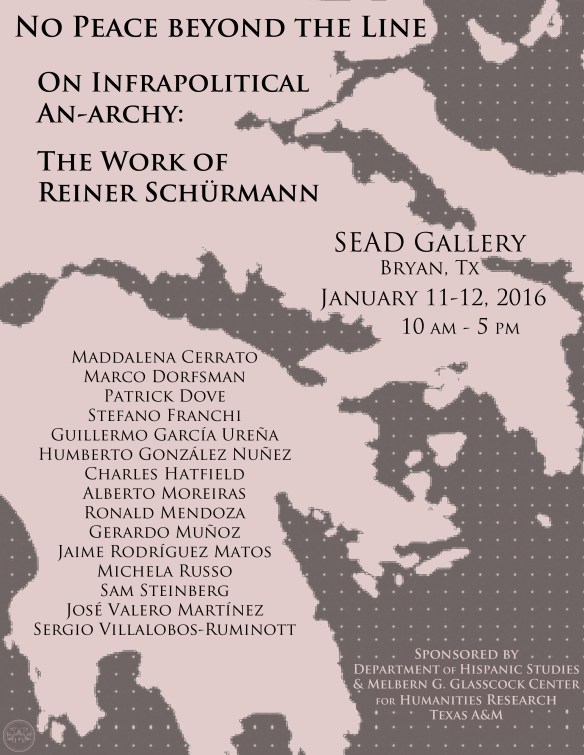
Five hypotheses on Reiner Schürmann’s anarchy. (Gerardo Muñoz)

It was pitch black at Bryan’s Revolution Café and Bar, a smoky fire behind us, when Sergio Villalobos claimed that more vital than becoming “experts”, what really mattered was to produce an encounter that permitted us to leave our “skins behind”. In a similar vein, I added, that lizards too lose their skin in the desert. Lizards in the desert: that seems to be the right image to describe what was indeed a productive and worthwhile, and much needed conference on Reiner Schürmann’s oeuvre.

The purpose of the workshop, if any at all, was far from wanting to establish a consensual theoretical frame on “Schürmann” as yet another proper name within the marketplace of ideas. Rather, it seems to me that at the center of our debates, to paraphrase Schürmann himself, was a “nocturnal knowledge” of sorts, a constellation that produced moments of encounter and releasement; a thinking on the basis of the epochal structuration of the history of being and the exhaustion of principial thought.

What remains of interest in Schürmann’s thought is the potential to make thinkable the relation between hegemonic phantasmatic maximization, principial articulation, and the question of finitude (what he calls the tragic denial in his monumental and posthumous Broken Hegemonies). If anything, Schürmann contributes, as noted by Alberto Moreiras’ introductory remarks, to the archive of infrapolitical thought in a line of reflection folded within the contemporary university discourse and the consummated politicity of globalized machination [1]. To be sure, to “become lizards” is very different from “becoming Schürmanians”. The first thrives for releasement of tragic denial, and posit in the singularization to come in what it can no longer be reduced to the will, which is also the predicament at stake in thinking by and through principles. The second is the professional philosopher committed to the accumulation of knowledge, and by consequence, to the denial of the singular in the name of the duties of imposed on life. There is no normative judgment in making this distinction, but rather it is a matter of a tonality, and of establishing differences. One needs not “sacrifice” the epistemological grounds that demand the first in appropriative gestures of the second.

“Nocturnal knowledge” signals a drift of thought that is not longer bounded by the location drawn by heritage, proper name, archive, expertise, or even ethical relation. Yet all of these remain of importance, even if not exhausting the possibility of thinking otherwise beyond the masters and the articulation of “being in debt” as a structural position or intellectual commitment. It is futile to reconstruct a debate whose consequences and “effects” are always beyond our reach. What I would like to do in the remainder of this note, is to sketch out a hasty catalogue of “five hypothesis” – by no means the only hypotheses discussed during the rich two days of discussions at Texas A&M – that will inscribe, at least for me, a path of further investigation and writing to come in line with the project of infrapolitics.

  1. The “epochal” hypothesis. Schürmann’s breakthrough philosophical project is without question the monumental Broken Hegemonies. Surpassing a telic drive of Heidegger: Being and acting, BH installs the topology of the history of being as a heterochronic montage that, as powerfully argued by Stefano Franchi, “rewinds” or unwrites to a certain extent Hegel’s Phenomenology of Spirit. Deremption against the synthetic offers parameters to think the differend of naturality and mortality in a strictly non-dialectical movement, but still a politically significant one. For my purposes, what is at stake here, besides the ruin of any philosophy of history, is the translation of the legitimacy-legality differend that opens another way of thinking the legal and legitimate grounding of the categories of modern political thought. Epochality and epochs establish a reversal of the metaphoricity of history, contributing to the historicity of being that radically retreats from the “poem” of development. The nexus between epochality and the end of principial thought (or anarchy in the face of globalization) is a daunting question that remained open in much of our own reflection on Schürmann. Villalobos-Ruminott picked up the subtle but open Schürmann critique of the “deconstructive text” at the beginning of BH as to go into the “thicket of the text” (BH, 15). But if this is a crucial task, is not the task of deconstruction precisely the drifting beyond the “hegemonic maximization” towards those spaces that remain contaminated by the labor of minimization and transgression? The very legislative differend Derrida-Schürmann remains a fertile space for problematization. In other words: how can we think the postulate of the post-hegemonic ultimate from BH last pages with the deconstructive differànce?
  1. The Democracy hypothesis. It is not obvious in any case how Schürmann himself situates the problem of “Democracy” at the intersection between the end of principial thought and the maximization of legislative-transgressive norms. If infrapolitical reflection is also a question about the potential of democracy, then it remains to be thought how Schürmann’s work contribute to this task beyond the limitations of the political that structure Arendt’s work (which seems to be the modern thinker that best informs Schürmann’s thought on democracy). Guillermo Ureña’s transversal take on Schürmann and Marzoa’s Concepto de lo civil, indicates a point of departure in light of singularization to come as it faces its tragic destiny. The question of democracy gains space of its own if it could radically differentiate itself from the maximization of community, which binds the maximum phantasm of hegemonic politics in light of natality and the denial of the tragic. If we take Arendt to be a thinker that establishes an antinomy between the oikos and the polis, it is easy to sidestep the question of stasis or civil war as always already fantasmatic constitutive of any demos articulated between these two poles, as well as any promise of “democracy” regulated by the category of the citizen [2]. In light of our current “global war”, however we understand it, is difficult to affirm democracy without taking into consideration the facticity of neoliberalism. This was the relevant point made by both Charles Hatfield and Patrick Dove on the “life without why” as replicating or even coinciding with the nihilist condition of transnational accumulation at the “end of history” ideologies.
  1. The “life” hypothesis. Alberto Moreiras and Stefano Franchi’s noted in contrasting ways how BH necessarily opened to the question of “life”. The radical opening towards the tragic denial recoils back to this problem where another relation of experience (passion) must be thought. If for Franchi the tragic opens back to natality and even to the comic; in Moreiras’ grammar it is a matter of affirming the existential analytic where something like an “infrapolitical breakthrough” could possibly take place [3]. Let’s call this instance infrapolitical dwelling or breakthrough. In terms of the “possible”, and what is meant by the possibility of that which remains impossible, Ronald Mendoza reminded us that it is a task to be pursued on the threshold of Heidegger’s rendition of possibility in Being and Time. This is no mere exegetical task, since what is at stake here is nothing other than the confrontation with the economies of reading and thinking through Aristotle’s Metaphysics, reconsidering the relation between dunamis and energeia. It is in this direction or turning towards the possibility where something other than a biopolitical closure. Releasement towards the tragic destiny is only evoked to reopen the question of life beyond the antinomies that organized logics of causation and distributive ontologies that, in the words of Agamben in Lo aperto, have only fueled the anthropological machine of the West that divides the animal and the human.
  1. The “text” hypothesis. It would be unfair to treat Schürmann’s architectonics of the topology of being as sidestepping the question of narrativity and the literary text in general. What are myths if not a textual machine, as understood by Jesi, which plays on the organization as well as excesses of each economic phantasm? Nevertheless, much work needs to be done to wrench Schürmann’s topological arrangement of the history of being in relation to the function of literature. It is at this intersection where Dorfsman’s meditation on the poetics dwelled, as well as perhaps the figure of the marrano strategically analyzed by Humberto Nuñez. Literature has all to do with a textual economy that is the excess of hegemonic maximization, and that for this reason is difficult to locate on a single plane of ordering and commandment of language. But what becomes clear is that through Schürmann a tropology opens with fundamental consequences for grapping with “life”: this is the “fool” as suggested by Franchi, Don Quixote’s wandering joy through La Mancha alluded by Teresa Vilarós, or Moreiras’ pícaro. I would also suggest Dante’s Divina Comedia, where mundane life seem to mark the passage from the hegemonic Latin phantasm of natura to the sovereignty of the modern passive epochality [2].
  1. The Luther hypothesis. It seems to me that the only major figure that throws off a shadow at the grand epochs of the topology of being is that of Martin Luther. It is a risk that Schürmann takes, but that allows him to read the modern tradition of the subject against the grain of Descartes’ cogito, Kant’s autonomous subject, or Spinoza’s Deus sive natura. Luther stands out in BH as an outsider that fundamentally returns to inflict the totality of the modern structuration. It is through Luther that we are confronted negatively with a possibility of the de-basement of the subject, emptying the signifier of “God” that connects with the releasement and play in his analysis of Eckhart’s sermons. Jaime Rodriguez Matos rightfully noted that the arguments on the existence of God, far from being the central problem, function as a pretext for an underlying problem consistent with the ruination of the subject. And what has been modern politicity if not hyperbolic to the condition of subjectivity? The figure of Luther for Schürmann signals passive transcendentalism and the opening towards heteronomy, which must be understood in light of the subject of command through duty and debt. It is here where Sam Steinberg’s reflection on the Mexican modern politicity as a history of debt resonates with the modernizing paradigm in Luther. The militant figure of Worms offers another paradigm to understand the epochality of secularization, and reassess Schmitt’s well-known “occasional decisionism” (Löwith) in differential positioning with the passivity of the vocation. It is also through Luther that Hegelianism becomes an epochal possibility (impossible?) for the narrativization of the history of the West. Luther also signals the problem of returns not only in the modern epoch, but also as Jose Valero argued in his own terms, in relation to the arche of metaphysics and repetition. How does tradition gets transmitted and repeated? In slightly different terms, Michela Russo’s problematization of heritage also speaks beyond the metanarrative task imposed by Schürmann’s “archive”, situating the archive as command and origin of a form of doing history of philosophy; even if it is aprincipial history that questions the very antinomy of progression / containment.

As Hispanists or Latinamericanists working in the contemporary university, one must renounce the burden that implies carrying forth or reproducing Schürmann’s legacy as a question of fidelity, preservation, or even detachment. The history of the topology of being, argued Moreiras, seems at moments even more complex than the one offered by Heidegger himself. This much is needed. Metaphysics will neither be abolished nor put to a standstill with Schürmann’s injunction in the theoretical scene. For my purposes, a possible turning would always be a-locational, and for that very same nature, incalculable. In lesser words, this would imply the suspension of the very ground that feeds into our beliefs.


Notes

  1. Alberto Moreiras. “Preliminary remarks on Infrapolitical anarchy: the work of Reiner Schürmann. https://infrapolitica.wordpress.com/2016/01/05/preliminary-remarks-for-no-peace-beyond-the-line-on-infrapolitical-an-archy-the-work-of-reiner-schurmann-a-workshop-january-11-12-2016-texas-am-by-alberto-moreiras/
  1. Giorgio Agamben. Stasis: civil war as a political paradigm. Stanford University Press, 2015.
  1. Eric Auerbach. Dante: poet of the secular world. University of Chicago Press, 1961.
Nirenberg, David. Anti-Judaism. Reflections from an Infrapolitical Perspective

David Nirenberg’s Anti-Judaism is an outstanding piece of scholarship in the history of ideas. The book’s title announces itself as presenting the reader with a history of “anti-Judaism,” but it is perhaps better described as the tracing of a ghostly signature — that of the Judaic and the Judaizing — where the latter is understood to be the an insignia of a structurally constituted exclusion which can be traced throughout the intellectual history of the West, including early Islamic thought. Nirenberg’s history begins with the treatment of Jewish communities in the political imaginary of Ancient Egypt as it attempts to deal with the collapse of its social and political order, faced with the threat of Persian, Greek and Roman invasions, passing through the the early emergence of Christianity and the teachings of the Church and the rise of Islam and, eventually, analyzing attitudes towards Judaism through the Spanish Inquisition, William Shakespeare and Baruch Spinoza, before moving onto modern treatments of Jewishness in the French Enlightenment and German Idealism, as well as in the writings of Marx, Goebbels, and Jewish philosophers such as Arendt. All of it is excellently researched in the finest detail, with keen nuances to language, in a practice of philological and hermeneutic readings that do not cease to impress, drawing on primary sources in a number of modern and ancient languages which is vast enough to make even the most polyglot scholar feel inadequate.

One of the most striking features of this history as Nirenberg presents it, to my eyes, is the importance of linguistic interpretation, and perhaps even of a certain sovereign claim over language, for constructing senses of self and otherness in which anti-Judaic thought structurally functions as a means of constituting orthodoxy and community by figuring as a constitutive alterity. Though Nirenberg provides many examples of anti-Judaic thought throughout his study, what they appear to share in common is a concern for the proper reading and interpretation of language (the proper reading of scripture, for example, but also, in more recent history, a proper interpretation of the essence of man and of the national being) in which the figure of Judaism always somehow stands in for that which threatens and makes unstable this stability of language. Nirenberg shows that, throughout the writers that he explores, the figure of Judaism is constantly reinscribed as part of a constituted other in the respective political theologies that he studies (we should not assume — and Nirenberg hints at this, albeit only briefly — that the Jewish communities themselves were not always already engaged in these similar struggles over the ‘proper’ interpretation of scripture and of history, but of course this is not what is important for Nirenberg’s history, which is, in his own words, concerned with a ‘rear-view mirror’ perspective on history, only looking on history in terms of its eventual outcomes and not of its other ‘what ifs’). It would be impossible to summarize the many facets that Nirenberg shows this anti-Judaism to adopt in the long history that he expertly describes, but certain themes, at times contradictory among themselves, appear once and again: Judaism and Judaizing as a concern for the letter, an all-too-literal adherence to the law, as being concerned with the material, and, more and more as time goes on, with mercantilism, banking and capitalism, and also, in a seemingly reverse move, with an all-too-abstract spiritualism and with an intellectualism that is poisonous to man’s relationship with nature (there is an interesting passage later in the book with regards to this concerning the young Martin Heidegger, which would be interesting to put into communication with Peter Tawny’s insights into the Heidegger of the Black Notebooks). What Nirenberg shows, however, is that more often than not this concern is not a reflection of what ‘actually existing Jews’ are doing, but rather with debates that are at the core of deciding what it means to belong to the Christian community, for example, or to the German nation; ultimately, at the core of the hermeneutic struggles over which the shape of various political theologies are decided.

What I would like to focus on — because it would be an impossible task to try to resume this monumental work and because it is what appears to be most interesting for my own purposes in the context of reconsidering the marrano history from the perspective of infrapolitics — is this hermeneutic question, or this question of the correct interpretation of language, and of a certain sovereign claim to language that is therein implied. In his discussion of the early years of Islamic history, and the place of the Judaic within it — which, Nirenberg shows, is not only continuous with the early history of Christianity, but actually in a sense part of that history, despite its own eventual claim to be a separation and break from it (another example of the struggle for a sovereign claim over the meaning of language, then, where Islamic thought attempts to constitute both Judaism and Christianity as its other) — Nirenberg discusses the importance of language and the interpretation of scripture to early Islam’s political claims. In what follows I will cite one of the passages of this chapter at length. What is important to note, however, and what Nirenberg makes clear, is that the figure of the Judaic in these struggles over the meaning of scripture did not have to do with ‘real living Jews,’ and the accusation of Judaizing could be, as we know all too well from the marrano case, aimed at any of those whose own practices threatened the orthodoxy of the community. Indeed, the Judaic simply became the figure of all that could be misguided or erroneous in the interpretation of the prophetic texts. Here is the passage:

“Like Jewish and Christian scripture, the Qu’ran contains the awareness that the problem is one of language. ‘He … revealed unto you the Scripture in which there are verses of clear meaning [muhkamat] …, and others which are ambiguous [mutashabihat]. But those in whose hearts is perversity pursue the ambiguous, looking for discord [fitna] and seeking to interpret it” (Q 3:7). Interpretation, the human desire to make sense of communication, is the wellspring of discord. Like so many Qu’ranic passages about the sowing of scriptural confusion, this one referred to the Jew’s inability to read correctly. The Jew’s ‘reading disability’ was paradigmatic, so strong that at times God gave up on their literacy altogether and turned them into apes. But the same risks applied to non-Jewish readers: ‘Lo, the worst of beasts with God are the deaf and the dumb who do not understand’ (Q 8:22). Tradition relates that Muhammad meant here ‘the hypocrites, whom I have forbidden you to imitate.’ But if hypocrisy means falling like an animal into the trap of language — recall Jesus’s warning to his disciples about the ‘yeast of the Pharisees”’ — then no human except perhaps the Prophet himself is exempt” (174).

It is clear that the fear of Jews and Judaizing that Nirenberg identifies does not correspond to an actual threat, or even the presence of actually existing Jews (many of the writers that he studies, it appears, were not themselves familiar with any such Jewish communities, though they certainly felt very legitimate in writing about them). Jewishness was itself an invention of the various discourses he studies, a kind of internal enemy to its own instability — explicitly a hermeneutic instability — that threatened to contaminate the purity of the community of the faithful. This had the surprising effect — as Nirenberg shows although does not go into great detail about, it is outside of the scope of what interests him but it of course fundamental for us in this working group — of producing a community of Judaizers (this would be compatible with B. Netanyahu’s earlier study of the Spanish marranos, where he shows that the Spanish fear of conversos did not correspond to a real Jewish threat and, in fact, the community of marranos ironically appeared and flourished in the immediate aftermath of the social terror that was the Inquisition). The marrano subject, therefore, which of course corresponds to a fact which interests us enormously, in historical terms, does not refer to a Jewish community which attempts to reinstate its own political theology in the face of the Catholic-Spanish threat but, rather, a community that flourishes as a subject position which refuses or, perhaps, cannot somehow, because of certain experiences or choices, be inscribed within this “correct” hermeneutic reading of the scripture which is demanded by theological orthodoxy. Marranismo may well be considered, in this context, as the experience of this outsideness or exile with respect to orthodoxy itself.

However, before the Spanish Inquisition, it is important I think to note, though Nirenberg himself does not explicitly make this point, that even if we are speaking of institutional practices, they have not yet reached the point of claiming to have a hold on all aspects of social life, nor do they seek to entirely exorcise all of these Judaizing elements from society. Nirenberg does seem to suggest, though he does not use these words, that the Jewish may have been given a textual position within this intellectual history analogous to what Giorgio Agamben would call “bare life” from a very early historical moment (think, for example, about the story concerning Muhammad’s allowance of the Jewish community to use the lands which then now belonged to the Islamic empire. where Muhhamad permits this use only insofar as he does not choose take that right away, which he ultimately retains the right to do: “[he] reserved for himself, in other words, the power of exile over the Jews” [163] — Muhhamad retains a legal right to do what he simply does not choose to execute). The power is there in potentia, in other words, though of course in reality such a right could always be contested by those same Jewish communities, and only a fight to the death or surrender on one of their parts could resolve it. Nevertheless, Nirenberg detects a shift in anti-Judaic practices with regards to the Edict of 1492, and, in the run up to it, to the Laws of Toledo, the ideology and practice of pureza de sangre, the expansion of the Inquisition and various other practices that were part of a general need to ‘cleanse’ the community of the faithful from the Judaizing influence. Nirenberg shows there to have definitely been a change in intensity and in the nature of anti-Judaizing practices at this historical juncture, though I am left only with curiosity regarding their significance, knowing that many scholars have identified, in the practices of the Inquisition in particular, early patterns of what would later typify modern totalitarian regimes. Nirenberg does not seem to entertain this kind of genealogical debate, though it may be important for those of us who want to consider the importance of the marrano legacy in the the age of the consummation of the onto-theological structuration of history and in the spirit of infrapolitical reflection.

Curiously, what Nirenberg does identify as being a particularly important feature of the changes that take place in Spain in the late 14th and 15th centuries is a certain difficulty to distinguish between the friend and the enemy, that is, the gentile and the Jew, as it is established by the anti-Jewish discourse that he shows once and again to be structural to Christian theology. Citing one of the ideologues of the rebels of Toledo, “bachelor Marcos,” Nirenberg writes the following: “What was new about the bachelor’s arguments, what was new more generally about the Judaizing creativity of mid-fifteenth-century Spanish politics, was its context. As we will see, mass conversion had shrunk the distance between Judaism and Christianity, and the mass assimilation of those converts had created, probably for the first (but not the last) time in the history of Catholic Europe, the possibility for extensive doubts about who really was or was not a Jew” (214). It seems that Nirenberg would suggest that this “possibility for extensive doubts” provided the key historical difference that saw a new phase of anti-Jewish practices. If there had indeed been before generalized beliefs about the figure of the Jew as a constitutive outsider to orthodoxy (a belief that, if it often resulted in violence against Jewish communities, was not part of a centralized and institutionalized effort by a sovereign power to rid themselves of these communities), then under the Catholic Monarchy of imperial Spain this would soon turn into into a phantasmatic and hidden presence that threatened the very core and stability of the community and that had to be rooted out from the body politic through institutionalized practices.

{It is worth opening a parenthesis at this point in the discussion of what I see as some of Nirenberg’s most pertinent points (again, only from the perspective of my own future work on marranismo), to ask a question about his methodology and the possible connection between this ambiguity between who really is and is not Jewish and the institutionalized practices of anti-Judaism, about which he is about to embark upon in the following chapter. Nirenberg himself, and to his great merit, I think, quite often discusses his own methodology, in what appears to be at times a metacritical standpoint which questions what the objective for writing such a history might be, why one should treat the writing of history in such a critical way, and why the history of ideas specifically should be the focus of scholarly attention (in some way anticipating, no doubt, the accusation that he remains at an all too abstract and intellectual level of analysis). In the epilogue to the book, this problem comes to the fore when he discusses, very briefly, Adorno and Horkheimer’s Dialectic of the Enlightenment. According to Nirenberg, Adorno and Horkheimer seek to explain anti-Semitism by arguing that it provides the people who participate in its ideology with a comforting fantasy, the “fantasy that the gap between our understanding of the cosmos and its fearful complexity does not exist” (466). He then goes on: “Clearly we do not want our decisions about the world to be made in the grips of fantasy or pathology. But how can we tell whether we are being adequately reflective in our “projective behavior,” that is, in our deployment of our concepts into and onto the world, in order to make sense of it? The decision is all the more difficult the more such claims are made in terms consonant with our own understandings of reality. In such cases we need a point from which we can reflect on our own habits of thought. The difficulty lies, of course, in finding such a platform for perspective” (ibid.). Yet these methodological questions, when read in conjunction with the analysis that Nirenberg provides above, begs the question: is this what Nirenberg sees as the root of a transmutation in the form of dealing with Judaic and Judaizing elements in Spain? Was the problem, in other words, that the myth that allowed medieval Europeans to sustain “the fantasy that the gap between our understanding of the cosmos and its fear of complexity does not exist” suddenly became that much less available, as each and every one of one’s neighbours — and even oneself — became potentially the enemy, the spirit of that “evil” that orthodoxy had thought it had exorcised from the community? It is worth at least putting the question forward, and its particular relevance for the contemporary moment, one which we have elsewhere identified or associated with ‘terror,’ would need exploring in more detail. With these remarks I close this parenthesis and continue with this very partial review of Nirenberg’s book.}

Nirenberg shows that, throughout this historical period, the transmutation in the type and intensity of anti-Jewish practices actually worked to intensify the categorical collapse of the distinction between ‘Jewish’ and ‘non-Jewish’, whereby these new practical truth-procedures that were designed to exorcise the Judaizing specter from the community were such that they constantly made sure to create what they were looking to find (Idelver Avelar’s chapter on truth and interrogation from Letters of Violence and Erin Graff Zivin’s treatment of the Inquisitive logic in Figurative Inquisitions immediately come to mind here as compatible with this historical view). Nirenberg states that:

“In their inquiry into how modernity could produce mass murder, two German-Jewish philosophers we will meet in the epilogue, Horkheimer and Adorno, proposed a metaphor for how accusations of Judaism work: “[To] call someone a Jew amounts to an instigation to work him over until he resembles the image.” In Spain, at least, the extent of this “working over” had been tightly circumscribed before the mid-fifteenth century. Theologians and poets might call each other “Jews,” but the label was not meant to extend much beyond a specific interpretation or practice of reading. These limits collapsed under the tactics advocated by the rebels of Toledo, and in the context of a society in which mass conversion and widespread intermarriage had blurred many of the differences, including those of lineage, between gentile and Jew. Accusations of Judaism now became instigations to prove through genealogy and interrogation that their objects really were Jews in flesh and faith” (240).

This shift from a hermeneutic practice confined to religious and poetic debates to a new intensity of violence against the Jewish communities in the Toledo rebellions of 1449 and its ideology, which were then to be institutionalized as practices of the Inquisition — practices which Nirenberg analyzes briefly but shows to include the accumulation of family trees and genealogy in the obsession for pureza de sangre — all of this would need further exploration, but it suggests a mutation in the connection between textual interpretation and institutionalized practices that would be highly relevant to the study of the marrano from an infrapolitical perspective, it seems to me. Alas, this is where Nirenberg leaves the historical context of Catholic Spain to explore the figure of the Jew in Martin Luther’s theology, before moving steadily onwards through the work of Shakespeare, Hobbes, Spinoza, Voltaire, Montesquieu, Burke, Kant, Fichte, Hegel, Heine, Marx, Weber, Heidegger and Goebbels. For all their differences, Nirenberg shows that these thinkers continued to employ a trope of Judaism that played on the expectations of their reading public, where this Judaism held a specific place and specific connotations in the social imaginary. He makes it clear that his genealogy does not assume any kind of historical inevitability or destiny, as if the Ancient Egyptians had laid the seed for the Holocaust, but rather that a study of the history of anti-Jewish thought shows there to have been, throughout history, common ideas about what it meant to be Jewish (with, we can say at the very least, an extremely complex relationship to ‘actually existing Jews’) that could be employed in the service of struggles over the correct reading of scripture or of history, the correct basis for a political community, or for the future direction of society. Here is a passage from one of the final paragraphs of the last chapter:

“In pointing to this common history, I do not mean to intervene in what German historians call the “Sonderweg” debate — that is, the question of whether the structural “Peculiarities of German history” condemned it to a unique attitude toward fascism and anti-Semitism. My point is only that the long history of thought I have described was broadly shared. It shaped the worldview of many people, both among those who came with more or less willingness under Hitler’s rule and among those who successfully opposed and defeated him. Perhaps the commonality can help to explain why the Germans found so many willing collaborators for their projects of extermination in many of the lands they occupied. Perhaps it explains as well why even some of the nations that most firmly resisted the German armies (the United Kingdom, the United States, and immediately after the war, the Soviet Union) nevertheless adopted important anti-Semitic measures of their own, such as closing their borders to Jews seeking to escape their executioners” (458).

Reflections which may serve, in some sense, as an opening to Timothy Snyder’s book Black Earth, which is next on my list.

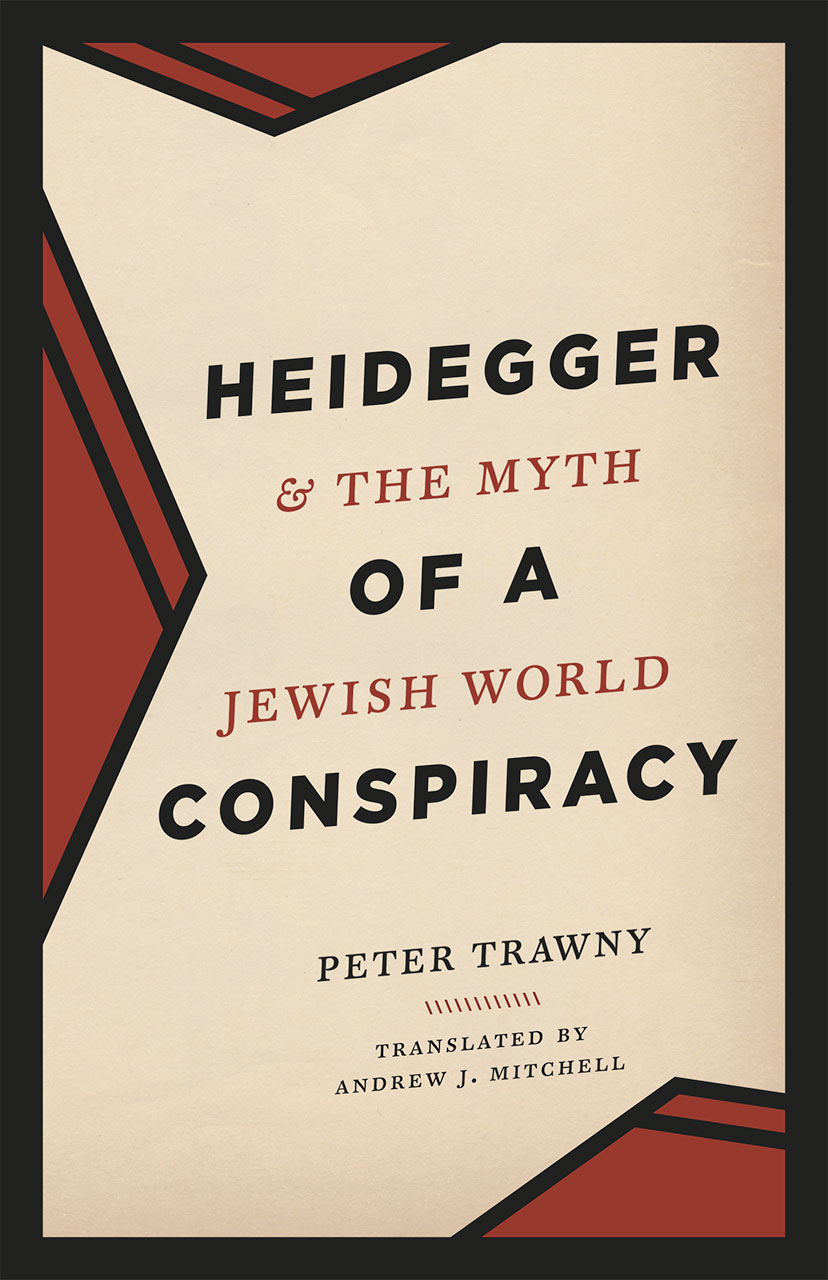
Against American gigantism: on Peter Trawny’s Heidegger & the myth of a Jewish World Conspiracy. (Gerardo Muñoz)

Trawny Heidegger Jewish 2016

One of Peter Trawny’s main theses in his new book Martin Heidegger & the myth of a Jewish world conspiracy (University of Chicago Press, 2016), if not the central one, is that the expansion of machination at world scale was identified by Heidegger not only as the invisible power in the hands of a “dangerous band of Jews” (as Jaspers writes in his Philosophical autobiography), but also as “North America”, understood as the hyperbolic location for the fulfillment of wordlessness calculation. “Americanism” was tacitly interpreted by Heidegger as completion of nihilism, due to a “gigantism” that surpassed even the English overseas imperial trade. America lacked a proper destiny.

Against the idea of Empire built on the thriving commercial rationality, Heidegger counter-posed a non-biological conception of race ingrained in the possibility for a German turning vis-à-vis the poetic, the gods, and “the encounter in which each learn through what is respectively foreign” (Trawny 2016, 52). Whereas the “other beginning” for Germans was marked by the event of being-historical, continues Trawny, “Americanism is simply incapable of a beginning because it does not know the “origin”, because it is the offspring of an English that pursues its “gigantic business” (Trawny 2016, 37).

Taking distance from American machination also implied an open anti-Semitism within the history-of-being, conditioned by a fear due to loss of ground and a-locational fissure of dwelling. If this is Heidegger’s position in the recently published Black Notebooks, one could read here a paradoxical conjunction between Trawny’s first book Freedom to fail: Heidegger’s anarchy (Polity, 2015)- where errancy signaled not just momentary slippages of thought, but constitutive phases of his philosophy – and now errancy as privation of historical destiny. It seems as if between Trawny’s first and second book on Heidegger’s Black notebooks, what we get are really two types of errancy: the first that has to do with the site of the philosopher’s thought in opening of the Ereignis and second phase, where errancy is externalized and deeply connected to the anti-semitic a-locational dwelling in America.

It is here where one could partially inscribe a distance against Heidegger’s anti-Americanism, and establish an alternative anti-anti-Americanism, which would neither affirm the dismissal of America as the site of nihilism in the name of “Destiny” or lack thereof, nor uphold a populist or American imperialism in the name of modern mass consumerism and historical exceptionalism. Rather, it is precisely the a-locational errancy which one could affirm as a third space of an American experience of freedom. This will be the Marrano freedom, both at the level of politics as well at the level of the work within the university (knowledge).

What is crucial here to understand seems to be that Heidegger’s dismissal of America as gigantism went beyond the well-known aristocratic resentment against modern industrial society, exemplified by poets such as Stefan George or R.M. Rilke; or reactionary conservatives such as Erik Peterson, Carl Schmitt, or Julius Evola. What differentiates Heidegger’s anti-Americanism revolves around the fear of errancy and foreignness that is predicated on “race” (Judaic domination and reproduction). As Trawny quotes Heidegger:

“World Judaism spurred on by the emigrants let out of Germany, is everywhere elusive. In all the unfurling of its power, it need nowhere engage in military actions, whereas it remains for us to sacrifice the best blood of the best of our people” (Trawny 2016, 30).

It would be wrong to infer from this annotation that Heidegger is making a plea for a sacrificial substance within the German history-of-being. In fact, as Trawny reminds us, Heidegger’s anti-Americanism is accompanied by a deep regret against Germans who, instead of following the path of poets and thinkers (the conference on Holderlin’s Ister was given during the war), were deceived by the “rootless foreignness” who reckoned unto German ground in Jünger’s total mobilization (Trawny 2016, 53). What fundamentally perturbed Heidegger, however, was not the errancy of the German destiny, but the fact that American machination had turned the “rootless foreign” in all directions and spaces. Returning invisibly to the very German ground.

Why was the radical thinker of finitude unable to comprehend the horizon of democracy as consistent with the tragic condition of thought? This seems to be the limit of Heidegger’s intra-war politicity. A limit that Reiner Schürmann and Hannah Arendt’s problematize in their respective endorsements of aprincipial democracy. Against an easy dismissal of Heidegger’s thought, Schürmann’s Broken Hegemonies could well be said to affirm the a-locational errancy of democracy through the development of two of his master concepts: singularization to come and the releasement of tragic denial effectuated in hegemonic order. Beyond Heidegger’s another beginning based on Parmenides, Schürmann’s destitution of henology is reworked precisely in the name of a tragic democracy.

It is interesting that both Schürmann and Arendt were thinkers committed to different projects of post-heideggerianism in United States and that neither affirmed an Anti-Americanism of North-American gigantism, nor assumed the conventional anti-imperialist anti-Americanism sentiment of so many Cold War Lefts. It would be naïve to say that Arendt or Schürmann “fixed” Heidegger’s anti-Semitic anti-Americanism, but both definitely rework the nexus between the democratic stature and the place of thinking against the grain of onto-theology. Trawny’s book do not take up these issues, but allow us to commence to discuss them.

Our task leaves us with the necessity of affirming Heidegger’s dismissal of a-locational foreignness as a space of freedom of thought, if we are to remain committed to what in recent times Alberto Moreiras and Miguel Abensour have called savage democracy. America could well be said to be the name of that inheritance that is no longer in need of affirming a destiny or “a people”.

Preliminary Remarks for “No Peace Beyond the Line. On Infrapolitical An-archy: The Work of Reiner Schürmann.” A Workshop. January 11-12 2016, Texas A&M. By Alberto Moreiras

Workshop. Infrapolitical anarchy“Only a wrenching of thinking allows one to pass from the “time” that is concerned with epochal thinking to originary time, which is Ereignis—to agonistic, polemical freeings. So, it is not as an a priori that temporal discordance fissures the referential positings around which epochs have built their hegemonic concordances” (Schürmann, Broken Hegemonies 598)

Preliminary Remarks for “No Peace Beyond the Line. On Infrapolitical An-archy: The Work of Reiner Schürmann.” A Workshop. January 11-12 2016, Texas A&M.

For a little less than two years now we have been pursuing or unfolding or developing or whatever it is one does with these things a research or thinking project based on our professional histories and orientations as mostly Latinamericanist or Hispanist literary and cultural scholars but not limited to them. The project revolves for the moment around two master terms, namely, “infrapolitics” and “posthegemony.”   Those are terms that come from a reflection dating back to the late 1990’s and early 2000’s in our professional field, but which were neglected after 2003 or so for reasons that there would be no need to explain at the moment but that have to do with a certain collapse of the spirit for collective work, which became pervasive at least in the sector of the professional field interested in theoretical work beyond merely so-called political commitment.

We named the project in its new instantiation Infrapolitical Deconstruction, where by “deconstruction” we ought to understand not just Derrideanism but also the Heideggerian deconstruction (Abbau) of the history of thought in the West, whose practice and continuation have come to characterize the so-called Heideggerian left. Infrapolitics names a space of thought and existence that subtends political life while not being alien to it, or, if you want, subtends social life while not being reducible to it.   Posthegemony, the absent third term, refers—politically, insofar as it is an explicitly political term—to the Machiavellian dictum according to which “the rich like to dominate, the poor do not like to be dominated,” and takes a position against both sides of the Machiavellian phrase (posthegemony is not only a refusal of domination—it is also a recognition that domination happens in myriad ways and that political conflict is primary and unavoidable.)

We named the resulting group the Infrapolitical Deconstruction Collective. We conduct most of our activity through the web, in social networks, with occasional meetings such as this one, sometimes taking advantage of large professional gatherings such as LASA or ACLA, sometimes simply using whatever resources are available to us in the diminished scenario of the contemporary university.   The group also meets with others, for instance through the Seminario Crítico Político Transnacional summer meetings in Spain.   We were initially small, about fifteen people or so. Over the last year and a half, a little more, the group grew to a membership of about ninety, but the core of it is still small and will conceivably continue to remain small. Some of the core members are here today, and I greatly appreciate that and thank them for it. This is an important event in the little history of our group, and let me take this moment as an opportunity to thank all the participants and also the Hispanic Studies Department at Texas A&M and the Glasscock Center for Humanities Research for sponsoring the meeting.

Reiner Schürmann was a German Dominican priest born in 1941 in Amsterdam, during the occupation, who decided to hang his monkish attire and think and teach philosophy in the US (most of the time at the New School for Social Research in New York) until he died, prematurely and all too early, of AIDS, in 1993, at fifty two years of age.   During his lifetime he published, in addition to a number of essays in journals, two important books, translated into English as Wandering Joy. Meister Eckhart’s Mystical Philosophy (1972, translation 2001), and Heidegger on Being and Acting: From Principles to Anarchy (1982, translation 1987).   Although those books were certainly discussed through the 1980’s (my own dissertation, written in 1986-87, deals with Schürmann’s book on Heidegger), it is probably fair to say that Schürmann’s greatness as a thinker was definitively established with the posthumous publication of Broken Hegemonies (1996, translation 2003), although it took a few years for this very difficult masterwork to make it into relative public awareness—one can conceivably say the issue is still in progress, so this workshop is also a contribution to it.   Schürmann’s work is, generally speaking, an “Auseinanderdersetzung” with Heidegger, whom Schürmann considered to be the most decisive thinker of the 20th century.   He combines his own brand of Heideggerian deconstruction of the history of Western thought and a certain sustained take on politics and political life after the exhaustion of the political categories of modernity, where Schürmann joins from his own original perspective other thinkers that are also of interest to us, such as Simone Weil and Hannah Arendt, María Zambrano, Derrida, Luce Irigaray, Jean-Luc Nancy, Massimo Cacciari, Giorgio Agamben, Carlo Galli, and Roberto Esposito among others.   We thought that thematizing his work, forcing us all to establish a direct relationship with it, would help us establish bridges between the German, French, Italian, and North American moments of reflection and proceed on our own course, connected of course to the Spanish archive, through a sustained critical meditation on historical metaphysics, which we hold essential for our own endeavors regarding both infrapolitics and posthegemony.   But, since Schürmann’s “retrospective” Heideggerianism bridges Continental traditions of thought and North American reflection at the height of the theory moment in the US universities in the late 1980’s and early 1990’s, I suppose the question is fair as to what it is that should take a group of mostly Latinamericanist literary scholars by academic adscription to have chosen to focus on Schürmann’s work. The reason of course is honorable: some of us think he can help us think through both what is instituting and new and also what is ancient and continuous in both posthegemony and infrapolitics.   We are under no illusions that we are saying or would like to say the same things Schürmann did say, but we think it is imperative for us to take his thought on board.   In that sense, Schürmann is one more powerful element of our archive, and we learn from him.

There is of course by now a solid tradition of both Heideggerianism and Derrideanism in the United States going back in the first case perhaps to William J. Richardson’s classic work, Heidegger: From Phenomenology to Thought (1974), and in the second case to the aftermath of the 1966 Johns Hopkins Conference where Derrida presented his essay on “The Ends of Man.”   I think it is safe and proper to say that most of us are friendly towards but at the same time quite alien to those communities of thought, whose fundamental questions are not necessarily ours, and which have offered us no interlocution so far.   We are celebrating this workshop in English, to a certain extent against our better instincts, and aim to publish results in English as well, as a way of intervening in those discussions, no matter how modestly. That is not because we aim to intervene in some other discussions, so that we cannot be bothered with the North American one. Actually, what is at stake here is something else, probably a bit unusual, a bit weird perhaps, looking at it from the outside and from a perspective that ignores the real dynamics of life in the US university, perhaps even unclassifiable: we want to wake up from our own dogmatic slumber and to push thought to whatever extremes we can muster given our resources, in all modesty but also with a certain confidence and a certain resoluteness which we will no longer give up.   We aim to be as free and uncompromising in our attempt at reflection as possible, and we will not allow the professional field, the pressures, said and unsaid, from the civil servants of the institution, the endemic hostility to unpredetermined thought that structurally pervades the disciplinary and unequal configuration of the contemporary university, to circumscribe our thinking and make it conform to ready-made boxes.   I can say, speaking for myself now, that I did not start my career thinking those thoughts, but I do now. In one of his essays Schürmann analyses, in a fairly devastating manner, the US philosophical establishment up to the 1980’s. We could do a similar analysis, which would have to be equally devastating, concerning the fields of theoretical reflection in the humanities in the 2000’s and the 2010’s. The object of such an analysis would necessarily be, not to prepare an exodus, rather to determine its deeper necessity for the sake of institutionally-unrestrained thought. Thinking is hard enough from internal obstacles even to whatever can be attained in terms of personal freedom.   This is the time to give up, to the extent we can, on external obstacles as well. To that precise measure we claim that the university also belongs to us.

If infrapolitical deconstruction can be wagered upon as a project with properly instituting potential—something that will require a few years to unfold and establish, if we are persistent enough–, our intention is not to do the instituting within the framework of the current disciplinary distribution of knowledge in the university. Schürmann joked that in the philosophical field of the 1980’s one could only say whatever one’s colleagues would allow him or her to say. Well, as already stated, we are not interested in letting ourselves be constrained by the good will of our well-intentioned field colleagues (“oh, whatever you write is just too difficult,” “oh, whatever you write is just so presumptuous,” “oh, whatever you write has nothing to do with our field,” “oh, whatever you write is an imitation,” “oh, whatever you write should be illegal”) in their roles, not necessarily secundary, as discourse police and upholders of the laws of language.   Even if, as a result of that fateful positioning, against the grain, we end up saying nothing and falling into silence, as many of us have already done at several points in our careers, that decision—which is not supplementary, it is not an add-on, but is rather essential to the posthegemonic and infrapolitical aspects of the project, one must do what one thinks—is both founding and irreducible, as well as the direct consequence of a state of affairs which we know is not directly challengeable, or not directly challengeable by us. So we go along to get along, but we claim an exception, and it is called Infrapolitical Deconstruction. As a wager for and an attempt at free thinking, free from as many constraints as possible, it simply claims its own space, nothing else. It wishes to infringe upon no one’s terrritory, as if it were theirs, and it makes no claims on anybody else’s desire, as if it were not always already the other’s desire. This is not necessarily easy, as we all know or must learn. There is a certain risk, there is a certain adventurous danger attached to this journey that we will not deny all the while preferring to avoid its disagreable character and consequences. We will see, as we are not blind.   But we are not in the business of properly disciplined work in the conventional sense. Which makes us all, structurally, in the university, our home, marrano thinkers: our procedure is marrano, our reception is that accorded to marranos, our thematics are marrano thematics as well. It is no wonder, then, that projects on the marrano difference and a multi-volume collection of essays on literary marranismo in the Hispanic archive are on our immediate agenda for the next few years.

What we are doing now is still preparatory, inchoate, a beginning. We are patiently establishing an archive of theoretical references, and we thought Schürmann’s work deserves to be one of them. Hence the importance of this meeting for us, perhaps a merely private or semisecret importance, a marrano importance, which at the same time takes advantage of and attempts to cover over an institutional void, a hole at the center of the contemporary university, of humanities discourse in the university, the experience of which may have become our generational (this time, it does not matter that there are several generations of scholars in the group: the time for reflection is now, not tomorrow, not yesterday) destiny as Latinamericanist thinkers working in the United States outside mainstream parameters—which today means, on the positive side, political parameters very narrowly conceived, and on the negative side not even that.

We have planned this meeting not as a final discussion of Schürmann’s work, rather as a first discussion.   All of us have been reading his work in the past few weeks or months, and I can tell you, speaking for myself, I am already missing a second reading of Broken Hegemonies, which seems to me an inexhaustible book that immediately calls for a rereading of all of its texts under study.   We will present position papers meant to propose some ideas for discussion, and it on the basis of the discussion, I imagine, that we will then go back home and start writing in earnest.   We will also take this opportunity to make a series of short interviews on infrapolitics with our outside guests, since we have them here.

Since I have counted myself out of reading my own position paper, as I did not want to take up too much time, let me finish these preliminary remarks by suggesting, through a quick succession of bullet points, what it is that Schürmann provokes and challenges us to continue to think in connection with infrapolitics and posthegemony.

  1. The notion of hegemonic fantasm, to which he opposes, in the last pages of Broken Hegemonies, the notion of “posthegemonic ultimates.”
  2. The notion of anarchy as a political position at the end of principial politics, which would for me stand in need of reformulation as infrapolitical anarchy.
  3. The general schematics of his understanding of the relation between time and history, event and clearing.   Schürmann seems at times to move forward to the claim of a certain extrahistoricality of being, in order to avoid the accusation or the categorization of his thought as “historicist.”   But I think we should re-evaluate that, through the renunciation of the radical transcendentality of what gives.   To that extent, I would argue that infrapolitics, as infrapolitics, holds on to the priority of the existential analytic, expanded and revised, reformulated vis-à-vis the relevant sections of Heidegger’s Being and Time, but still a thought anchored in singular existence, not on the priority of radical heteronomy.
  4. In his book on Eckhart, and throughout the rest of his work, Schürmann upholds the notion of an “imperative mode of thinking,” as opposed to an “indicative mode.”   What commands in thought is not a principle, rather the very need for singularization, which cannot be thought outside the parallel instance of “natality.”   The conjunction of natality and mortality cannot however avoid a certain priority of the “singularization to come,” similar to the sway of the Heideggrian No (and against the double Derridean Yes).   If infrapolitics accepts its own status as a thought of the singularization to come, and if it is true that infrapolitics results “from the dissociation from any figure of the commons” and commits us to the acceptance of the “tragic condition,” “the fateful fissuring of being,” then infrapolitics must search for a tonality of inscription of life in thought and thought in life. Infrapolitics is the search for an imperative style that commands no one but submits to its own command, which is the heterononous command of freedom.Workshop. Infrapolitical anarchy.jpg

I invite discussion. As always, I do not presume I speak in anybody’s name but mine, if that.


No Peace Beyond the Line. On a Footnote by Schürmann. By Alberto Moreiras

thThe complicated conjunction between “principle” and “anarchy” is motivated on the alleged or suspected fact that the so-called “hypothesis of metaphysical closure,” and the consequent loss of any recourse to principles or principial thought, do not immediately condemn us to an a-principial world, since, on the “transitional” line, at the line but not beyond the line, we can only think, our language can only offer us to think, the lack of a recourse to principles through the painful enunciation of the principle of anarchy, the principle of non-principles. This is not a trivial affair. If, as Reiner Schürmann establishes at the end of Broken Hegemonies, a hybristic insistence on the maintenance of principles as constant presence equals something like (non-ethical, non-moral, but nevertheless overwhelming) evil, the principle of anarchy might also be considered historial evil—is it not after all a reluctant recourse to principles in the last instance? A desperate clinging to the principle—an irremediable and yet bogus extension of its presence—under the ruse of anarchy?   How are we to negotiate the ultimate catastrophe assailing the hypothesis of closure?

I do not mean to answer that question. Let me only point out a curious circumstance. Emmanuel Lévinas, whose work could be considered committed to the awakening of goodness in his sense, published Autrement qu’Ëtre in 1974. His Chapter 4 opens with a section on “Principle and Anarchy” (Otherwise Than Being, 99-102). It could be expected that any posterior attempt at dealing with the “and” in Lévinas´ phrase would refer back to that work and those pages. And yet Schürmann’s Le principe de l’anarchie. Heidegger et la question de l’agir (1982) devotes only one footnote to Lévinas (in the English translation, page 346, on the difference between originary and original Parmenidism), and, let us say, half of another one, whose main thrust is a sharp critique of Derrida: “Among the company of writers, notably in France, who today herald the Nietzschean discovery that the origin as one was a fiction, there are those who espouse the multiple origin with jubilation, and this is apparently the case with Deleuze. There are others who barely conceal their regret over the loss of the One, and this may indeed be the case with Derrida. It suffices to listen to him express his debt to Lévinas: ‘I relate this concept of trace to what is at the center of the latest work of Emmanuel Lévinas,’ Jacques Derrida, Of Grammatology, p. 70. The article by Emmanuel Lévinas to which he refers announces in its very title—‘La trace de l’autre,’ the Other’s trace—how far Derrida has traveled from his mentor. For Derrida, the discovery that the ‘trace’ does not refer back to an Other whose trace it would be, is like a bad awakening: ‘arch-violence, loss of the proper, of absolute proximity, of self-presence, in truth the loss of what has never taken place, of a self-presence which has never been given but only dreamed of,’ ibid., p. 112” (Schürmann, Heidegger on Being and Acting, n. 44, 321-22). As you have just seen, there is no mention of Lévinas’s take on “principle” “and” “anarchy.”   Unless we take the implied, indirect critique to Lévinas’ notion of the trace as referring to an Other understood as neighbor, always already nostalgic of the pure presence of the One, as a terminal disagreement at the level of conceptualization.   But the footnote does not really warrant it.   So we can only hypothesize.

For Lévinas “consciousness” does not exhaust the horizon of being and should not be, against modernity, considered the being of beings. Or perhaps it can, but then the positing of a me-ontological region, beyond being, certainly beyond consciousness, becomes obligatory.   Within that structure, “principle” is very much on the side of consciousness: in fact, subjectivity is the principle. “Being a theme, being intelligible or open, possessing oneself, losing itself and finding itself out of an ideal principle, an arché, in its thematic exposition, being thus carries on its affair of being. The detour of ideality [Lévinas has just said that ‘even an empirical, individual being is broached across the ideality of logos,’ 99] leads to coinciding with oneself, that is, to certainty, which remains the guide and guarantee of the whole spiritual adventure of being. But this is why this adventure is no adventure. It is never dangerous: it is self-possession, sovereignty, arché” (99). If there were to be an “spirituality” beyond “the philosophical tradition of the West,” it would have to be found beyond consciousness, that is, beyond always already archic being.   It would be the place of “anarchy.” Of a dangerous and adventurous anarchy.

Anarchy is a persecution and an obsession. “The subject is affected without the source of the affection becoming a theme of representation” (101); “Anarchy is persecution. Obsession is a persecution where the persecution does not make up the content of a consciousness gone mad; it designates the form in which the ego is affected, a form which is a defecting from consciousness. This inversion of consciousness is no doubt a passivity—but it is a passivity beneath all passivity” (101).   Far from being a hypertrophy of consciousness, it hits us as irremediable and always unwelcome trouble. It comes from outside. It is not domesticable, tamable, it admits of no reduction to arché. It is an absolute passion: “This passion is absolute in that it takes hold without any a priori” (102). Do we want it? But the question is only a question posited to consciousness, to the archic.   Beyond consciousness we cannot resist it.

What is it? Lévinas calls it “a relationship with a singularity” (100).   It therefore irrupts from a “proximity” we cannot organize or measure, and it is a proximity beneath all distances (“it cannot be reduced to any modality of distance or geometrical contiguity,” 100-01). It is the “trace:” “This way of passing, disturbing the present without allowing itself to be invested by the arché of consciousness, striating with its furrows the clarity of the ostensible, is what we have called a trace” (100).

Is this commensurate to Schürmann’s thought of the principle of anarchy?   Does it come under the indirect critique of his footnote? Yes, without a doubt, it is “arch-violence, loss of the proper, of absolute proximity, of self-presence, in truth the loss of what has never taken place, of a self-presence which has never been given but only dreamed of.” Schürmann’s critique may hint at the notion that any surprise in this regard would be always naïve or feigned. It is true that Lévinas makes it dependent on the encounter with the other as neighbor (“What concretely corresponds to this description is my relationship with my neighbor,” 100).   This is what Derrida is said to depart from, and what Schürmann seems to take for granted as correct. The irruption of anarchy should not for him, any more than for Derrida, be reduced to an encounter with human otherness, even if the encounter with human otherness could trigger it every time, or some times, also as a persecution and also as an obsession. In Lévinas the persecutory obsession of relational anarchy does not seem to be triggered by unspecified being—it is always a relationship with a singularity that does it. But, leaving Lévinas’ ultimate position aside, there is something else in Schürmann’s gesture of (non)citation that should be questioned.

Schürmann seems to naturalize the persecutory aspect of me-ontological anarchy by positing (displeased) surprise at Derrida’s feigned surprise and celebrating Deleuze’s jubilation in the face of it.   As if there were nothing particularly painful in being thrown over to an anarchic relation.   As if, therefore, the resources of subjectivity—the subjectivity of the thinker—were or could be enough to keep the dangerous adventure of anarchy at bay, under control. But, if so, the principle of anarchy emerges, plainly, as principle, and principle of consciousness.   Anarchy runs the risk of becoming yet another form of mastery.   At the transitional time, posited as such by the hypothesis of metaphysical closure, metaphysics still runs the show as consolation and consolidation.   But this may not be good enough.   It is not exposure but counterexposure.