Ultima linea rerum. (Sobre la última sección de “Ousia et grammé.” [Jacques Derrida, Marges de la philosophie, París: De Minuit, 1972, 31-78.]) Por Alberto Moreiras.

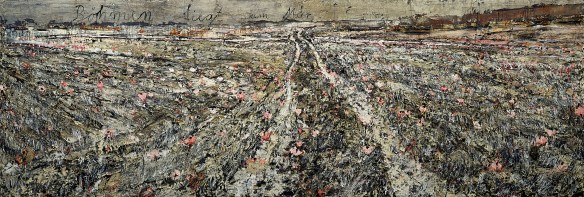
kiefer

¿No es este el pro-grama infrapolítico?: “Une telle différance nous donnerait déjà, encore, à penser une écriture sans présence et sans absence, sans histoire, sans cause, sans archie, sans télos, dérangeant absolument toute dialectique, toute théologie, tout téléologie, toute ontologie. Une écriture excédant tout ce que l’histoire de la métaphysique a compris dans la forme de la grammé aristotélicienne, dans son point, dans sa ligne, dans son cercle, dans son temps et dans son espace.”

A veces conviene recordar la radicalidad del proyecto.

Las primeras palabras de “La clöture du gramme et la trace de la différence”advierten que todo lo precedente se hizo como preparación a lo que viene. Derrida ha establecido ya, en páginas admirables, que el tiempo en general pertenece a la conceptualidad metafísica–en realidad, que ningún concepto alternativo de tiempo podría desarrollarse que no llevara necesariamente a “otros predicados metafísicos u ontoteológicos.” De ahí que, para Derrida, el juego de Heidegger en Ser y tiempo todavía pertenece también a esa conceptualidad. Igual que no puede oponerse un concepto vulgar de tiempo (de Aristóteles a Hegel) a otro auténtico (el querido y fallado por Heidegger, que abandona el proyecto de Ser y tiempo como consecuencia), de la misma manera la diferencia entre lo auténtico y lo inauténtico (temporalidad originaria y temporalidad caída) no traspasa ninguna frontera. La misma noción de caída, explica, pertenece ya al concepto vulgar (esto es, metafísico) de tiempo–puesto que la caída tendría que darse en el tiempo, como derivación temporal. El horizonte del ser, esto es, la diferencia óntico-ontológica, no puede esclarecerse a partir de esa distinción que permanece intrametafísica: lo originario y lo caído. Nota que en esta conceptualidad lo originario es siempre árquico.

Derrida entiende que este es el problema que llevó a Heidegger a suspender el proyecto de Ser y tiempo–ninguna reconceptualización del tiempo podría ofrecer un horizonte apropiado a la diferencia ontológica. Derrida ofrece el pensamiento de que la noción posterior de epocalidad del ser busca otro horizonte desde el que pensar la diferencia entre ser y entes.

Siguen unas referencias a “La palabra de Anaximandro,” del 46. Este ensayo es importante porque en él Heidegger intensifica su meditación sobre la presencia–iniciada en Ser y tiempo o antes, y vinculada a los muchos análisis heideggerianos en referencia al sujeto como presente-a-la-mano, ante-los-ojos, cuya destrucción es el principio motivador mismo de Ser y tiempo–como horizonte fundamental de la metafísica desde los griegos. Derrida detecta una vacilación esencial en Heidegger–por un lado, Heidegger piensa modalidades de la presencia, por otro lado busca llamar a tales modalidades de presencia en su conjunto “la clausura (misma) greco-occidental-filosófica.” Y aquí es donde Derrida, en mi opinión, demuestra y declara su cercanía fundamental a Heidegger. Derrida dice que todas las arduas meditaciones fundamentales de Heidegger sobre la presencia, incluida la meditación sobre Anaximandro, son intrametafísica, pero dice también que Heidegger sabe eso, y prepara o cuida siempre otro gesto, “le plus difficile, le plus inouï, le plus questionnant, celui pour lequel nous sommes le moins préparés.” Tal gesto “se laisse seulement esquisser, s’annonce dans certaines fissures calculées du texte métaphysique.”

La contribución fundamental de Derrida empieza ahora. como elaboración directa de la problemática heideggeriana, es decir, como intento por dilucidar lo que Heidegger mismo quiso dilucidar y se esforzó extremadamente por dilucidar. Es obvio que ese gesto difícil no puede darse a leer bajo forma de presencia–su signo debe pues exceder toda producción o toda desproducción de ente alguno, no puede darse a través de la cópula, del esti, y tampoco a través del me on o del ouk esti, que refieren a modalidades negativas de presencia. Gesto an-árquico, pues, pues, dice Derrida sin elaborarlo mucho aquí, pero es obvio que hay resonancias de esto con la anarquía schurmanniana y con la infrapolítica, “seule la présence se maïtrise.”

Es ahora, en la última página y media, donde se ofrece el concepto o el cuasiconcepto de traza. Ese gesto difícil que busca Heidegger corresponde a la traza, “la trace n’est ni perceptible ni imperceptible.” Ni presente ni ausente.

¿Es sólo un gesto heideggeriano? No, la traza pertenece también a toda la tradición de escritura metafísica. Pero es la traza en cuanto borrada, la traza en cuanto olvidada. La diferencia entre ser y entes, la diferencia ontológica, se pierde como traza, se olvida en cuanto traza. Si la diferencia es ya sólo traza, entonces el olvido de la diferencia es traza de traza–el olvido es traza de segundo orden.

Pero esto abre una posibilidad inaudita–y al tiempo siempre ensayada: en la metafísica misma, la diferencia se percibe como traza, y la traza es en la metafísica el horizonte del ser. Hacer aparecer la traza propiamente, “en cuanto tal,” es cagarla. Y ese es el gesto crítico derridiano fundamental–la traza “en cuanto tal” es siempre en cada caso el nuevo nombre del ser de los entes, intrametafísico. La traza “en cuanto tal” establece en cada caso el nuevo plano de figuralidad principial.

Por lo tanto, traza de traza de traza: “il y aurait une différence plus impensée encore que la différence entre l’ëtre et l’étant . . . Au-delá de l’ëtre et de l’étant, cette différence (se) différant sans cesse, (se) tracerait (elle-mëme), cette différance . . . ”

La noción de “différance” es pues la propuesta derrideana para salir de la conceptualidad intrametafísica, para aludir a ese gesto difícil que permita abandonar el horizonte presencial, sin el cual no hay éxodo de la metafísica. Tal différance sería por lo tanto “plus vieille que l’ëtre lui-mëme,” en la medida precisa en que el ser mismo es siempre necesariamente (concebible sólo como) arché originario.

Para mí, la pregunta crucial en relación con Derrida es si tal différance, en la que se continua de otra manera el proyecto heideggeriano, está circunscrita a y por la lengua; si el gesto “más difícil, más inaudito, más cuestionante” no será también y antes que otro un gesto silencioso al que llamamos infrapolítico.

El párrafo que colgué al principio viene inmediatamente a continuación de la mención de la palabra “différance.” En cuanto a la problemática de la diferencia ontológica, creo que la relevancia de este ensayo es clara. En cuanto a lo de no-sujeto y autenticidad, la cosa es mucho más complicada–la autenticidad permanece sin embargo encriptada en el análisis derrideano, mutada, pues ya no es cuestión de oponer lo originario a lo caído, lo propio a lo menos que propio o impropio–es cuestión de ese otro gesto inaudito, la relación con la traza, con la estela. Sin cuya posibilidad no habría deconstrucción, me parece, de la misma forma que no habría infrapolítica.


Some comments on the ACLA-2016 discussions. By Alberto Moreiras.


kiefer2. pgAt the American Comparative Literature Association meeting that just ended (Harvard University, March 17-20, 2016) we had a series of three panels, very kindly organized by Maddalena Cerrato, Sergio Villalobos and Gerardo Muñoz, and with the additional participation of Ana Carrasco-Conde, Michela Russo, Marco Dorfsman, Pablo Domínguez Galbraith, and Derek Beaudry, which were designed as an engagement with a book I published in Santiago de Chile (Palinodia) in 2006 (“Beyond the Subject and Heritage: Línea de sombra Ten Years After”). I am very grateful to the organizers, the presenters, and the audience for the personal honor the seminar represents. Many interesting and provocative things were said about the book, but, for I hope obvious reasons, I will not comment on them with any specificity.   What I want to do here is briefly to register several of the issues that came up rather forcefully in the conversations of the last three days and that seem to me of particular relevance to the infrapolitical project at its present state of self-understanding. Those issues are: the provenance of infrapolitics from subaltern studies; the politics of infrapolitics; marrano infrapolitics; and the connection between infrapolitics and university discourse.  Of course I make my own comments, and do not claim to speak in any name but my own.

We discussed, in those panels, many other things beyond those four, and several other members of the collective also presented papers in different seminars, and I was able to attend some but not all of them, so I may be missing any number of crucial developments. In any case, this note does not claim any kind of exhaustivity, indeed it will only mention those specific issues, and it certainly may be supplemented by others in the comments below, or through the posting of other notes that may want to account for other discussions and for other themes.   The occasion was important enough, as it brought up new reflections, new thematics, and a certain number of advancements in conceptualization. So let me try to offer a kind of short-hand summary of those four for future reference.

(This seems to me important in general, leaving aside my possible deficiencies in terms of getting things right, or in terms of focusing on the most significant, because infrapolitics is still at a very early stage of development and because, even at this early stage, it is already meeting with some obscure antagonism from certain quarters of the professional fields involved, which of course affects us and exposes us to the self-weakening of our own ideas. But, really, we have no fear—we stay calm and carry on. In the meantime, keeping a register of discussions is useful to us, and we are doing it, even if it only comes up occasionally on this blog, even if we end up misregistering things, misplacing them, mistaking them—further archive troubles for people whose relationship to the archive is problematic to start with.)

Inevitably, the discussions on Línea de sombra that followed the paper presentations quickly moved to the present state of the project on infrapolitics. The book is, by the way, very happy, it just told me, to be considered merely a part of the genealogy of the present project.   It was published at a time when my own engagement with university discourse on Latin America was waning, or undergoing a kind of crisis, or a period of disorientation.   No doubt the different essays that compose the book were themselves an attempt to continue to deal theoretically with the aftermath of the collapse of Latin American Subaltern Studies.   The term infrapolitics is used in the book partially to mark a sense of the facticity of subaltern life—it was clear, it still is, that subaltern lives are subaltern precisely out of some exclusion from the political. And yet even the more theoretically minded Indian scholars in the South Asian Subaltern Studies project probably never broke away from straightforwardly political reflection, as if the problem of subalternity were only available to political analysis, as if it did not exist outside of politics.   But that is not the case, eminently not the case, and it was obvious to some of us as early as the late 1990’s that a different kind of reflection was necessary that would deal not only with subaltern lives, but with all infrapolitical lives, that is, with all lives to the extent politics does not and constitutively cannot exhaust them.   From that perspective, so-called political thought in our field, and not only in our field, had become a straitjacket that repressed both thought and politics, that reduced both to reciprocal imitation, and that was intent on disavowing the increasingly potent and undeniable realization that the political categories inherited from modernity were becoming woefully inadequate to account for what they meant to account, and even more inadequate in terms of accounting for what was never in their radar in the first place.   The situation is even more blatant today, when political thought has taken on increasingly managerial airs, when it has come mostly to bore not just the people it is allegedly meant for, but even their very authors, as everybody knows (it is enough to read them, one is sorry to say).   We need a new kind of political imagination, and infrapolitics is a modest attempt to initiate it—at least it has the virtue of looking at the contemporary exhaustion of political thought squarely in the eye, and of telling it also plainly that it is, more than ever, simply incapable of accounting not just for the totality of existence, but particularly for many things that matter the most for any given singular existence, and particularly for subaltern or subalternized existence.

This is also to say that the colleagues who, without even bothering to listen to us, pretend to be full of reason when they accuse the infrapolitical project of not being political enough are sorely mistaken and altogether miss the mark.   Infrapolitics indeed proposes, in every case, nothing but concrete analyses of concrete situations. It just does so from alternative questions, it thematizes a different register, it is in no hurry to reach the properly political site, which in any case is seen by us from the perspective of a demotic republicanism that we have sometimes called marrano democracy or posthegemonic democracy.   Indeed, if we take into account the ongoing Taylor-Fordization of the professional classes and the ongoing and relentless production of the reserve army of the unemployed and the underemployed, which makes all of us subaltern or potentially subaltern in ways that would have been unimaginable only a generation or two ago, we could say that the cluster of issues associated with infrapolitics and posthegemony, with marrano democracy, with lives that are not yet political or can never have access to political life as such, it would not be beyond reason to call infrapolitical reflection a site of the class struggle in theory.   Certainly much more so than many other ostensibly political options of thought or critical reflection, which increasingly, in the managerial university, unthinkingly become themselves little more than managerial criticism, perfectly attuned to the system they claim to abhor.   (Could it be that even deconstruction has become managerial today?  But infrapolitics is not simply a fold internal to deconstruction.)

The right to use the term “marrano” or “marranismo” to refer to our project—in the specific sense of, for instance, “marrano infrapolitics,” namely, a propositive practice that internalizes the marrano condition and makes it a point of departure for existential exercise—could be questioned, it was hypothetically suggested, from an identitarian perspective: we would not be marranos, since the marranos expired with the Inquisitorial society that produced them in the first place, which then means: we would be illegitimately misappropriating a term that does not belong to us, that cannot form our identity.   But we do not use marranismo in any identitarian sense: indeed, there was never a marrano identity claimed as such, since the marranos were historically only those accused of being so, the accusation performatively turning them into subjects (or rather, objects) of a double exclusion where everything was at stake.   Marranismo is for us a historically trans-figuring term that appeals to the very loss of the identitarian archive, to the loss of ground, to the loss of legacies of belonging through the monumental expropriation that constitutes the kernel of contemporary infrapolitical life, where all and any politics ultimately play themselves out. Far from constituting the inception of a new, sorry-assed philosophy of history, our use of the term marrano, or marranismo, points to the very ruin of all philosophies of history, to the abandonment of the archives that make them possible, to the exodus from any kind of originary or eschatological (i. e., teleological) belonging.   There is only marranismo at the infrapolitical level, we are all marranos, and when we are that no longer we are already into deluding politics. For better or for worse.  This is one of the reasons why marrano infrapolitics refuses metaphorizations in principle, is suspicious of them, and would rather engage in a non-administrative relation with the time of singular life.   There is of course nothing non-political about it, even if we call it infrapolitics.

It was showed in one of the talks that, in the same way disciplinary society gave way to the society of control, in Foucault and Deleuze’s theorization, the society of control is giving way to surveillance or expository society.   If that were indeed the case, the university would not be safe from it.   An expository or surveillance university is a university that targets us and puts a price on our heads. We all become subject to machinic operational images that regulate our thought and set limits to our imagination.   For instance, to refer to something that concerns all of us, we are not even talking about the fact that, contrary to the golden rule of some years ago, hirings at the university are no longer done primarily or centrally on the basis of quality of work, but are increasingly organized on the basis of perceived affinities whose generalized function in expository and exclusionary surveillance is obvious. This, which would have been called straight corruption just some decades ago, is today a widely extended practice, and it includes the best universities as well, or indeed them in the first place. That this spells the end of the university in the classical sense goes without saying.   In the meantime those of us who have reasons to suspect our maladjustment to the new conditions must hide in plain sight, the same talk claimed.   Infrapolitical reflection is perhaps such an attempt, risky as such, exposed as such, even as it attempts counterexposure, or even nonexposure.   But there is no ivory tower. The university is no more than a symptomal torsion of the wider society.   Which is why infrapolitics must abandon its original roots in university discourse, exit disciplinary configurations, and break away from any attempt to surrender at the capture of thought through increasingly domesticated, indexed, regulated, venued, and analytically-ranked self-insertion. This is one of the reasons why infrapolitics claims a savage terrain of engagement, beyond fields: because it understands that battles internal to university politics are always already rigged, always already lost battles.   Hence infrapolitics prefers to hide in the plain sight of the world at large, and reflect away from any regulated archive: the real struggle is out there, particularly if we manage to escape from the boredom that threatens us from the rear, and from the sides. Boredom is, after all, the fundamental academic passion, is it not? Hence also our most powerful enemy.


Línea de sombra ten years after: introductory remarks | ACLA 2016 Harvard University. (Gerardo Muñoz & Sergio Villalobos-Ruminott)

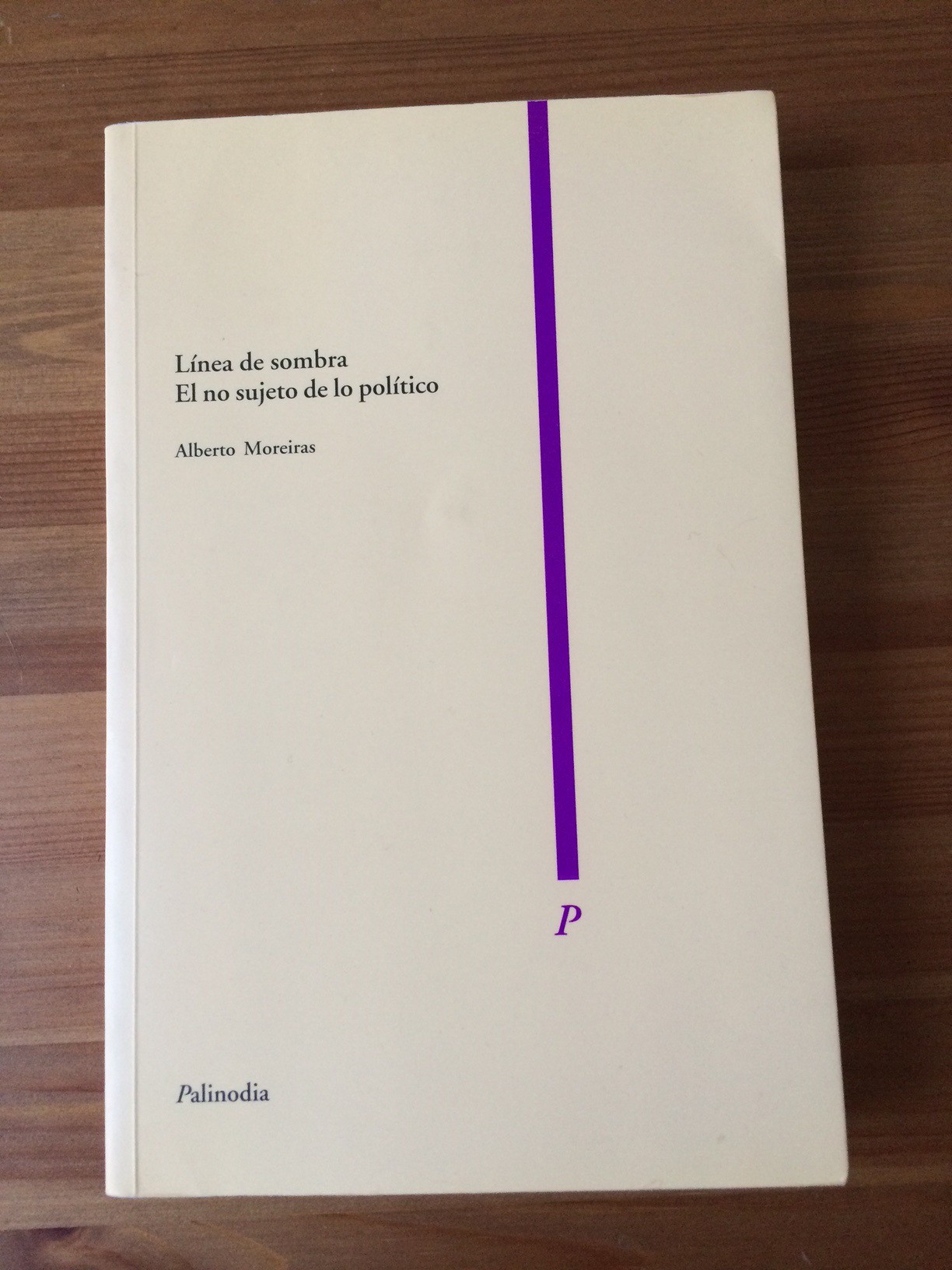
linea de sombra

Ten years have passed since the publication of Línea de sombra: el no-sujeto de lo político (Palinodia, 2006). It seems that this seminar received neither the most appropriate of titles, nor the most desirable one. At the end of the day, others are the ones that live by anniversaries, ephemerides, and revivals. In a way, to commemorate is a convoluted and dangerous move that recaps the jacobinist principle ‘down with the King, long live the principle!’

Something radically other is at stake here, or so we wish to propose. To the extent that something is ‘actual’ is so because it allows conditions for thinking and thought; that is, conditions of doing in thought. Then, of course, there are activities and activities. As Lyotard observed, there are some activities that do not really transform anything, since ‘to do’ is no a simple operation (Lyotard 111). So much is needed for this encounter to happen – and the purpose of this encounter with many friends here is Línea de sombra ten years after. This was Alberto’s fourth major book – after Interpretacion y diferencia (1992), Tercer espacio (1999), and The Exhaustion of Difference (2001), and that is without counting his early La escritura política de José Hierro (1987). Línea, we should not forget it, was published in Chile in 2006, under turbulent circumstances. We are referring here of course to Alberto’s exodus to Aberdeen, and in a way his “exile” from the enterprise of Latinamericanism. The drift to suspend the categorial structure of the Latinamericanist reflection was already underway in Tercer espacio and Exhaustion, books that radically altered the total sum of reflections on and about Latin America, in the literary and the cultural levels, and whose consequences were felt, though we are not too sure that they have been fully pursued and taken to its outermost transgressive limits. As Alberto has repeated often, the issues on the end of the 1990s and the beginning of the 2000s are still among us, but we have yet been able to deal with them radically, which means, to deal with them without just reproducing the constitutive limited structures and categorical systems that have informed Latinamericanism and Hispanism at large through the twentieth-century.

In this sense, Línea de sombra is an unfinished intervention. In part because it did not produce many interlocutors and readers when published, or perhaps because it was taken (and it is understood as such still today) as a book that transgressed the ‘Latinamericanist reason’, opening itself to a region of thought that was in itself undisciplined, savage, and for the same reason, considered an outlaw intervention (and we should keep in mind this tension between thinking and law). It does not matter. But what really does matter is that we consider the silences around Alberto’s intervention not as a personal affair, but as a particular effect of a certain disposition of hierarchies and prestige within the contemporary university. As if Línea (and the other books) were dammed from the beginning due to the constitutive limitation of Hispanism and due to the lack of interest in theoretical approaches coming form Latinamericanism, a field that was usually identified with the exoticism of political conundrums and the curiosities coming out of Third World countries.

Of course, the reverse side of this underprivileged condition of Spanish language for intellectual reflection is that it (re)produces reactive effects. For example, the decolonial option demands a constant revision of the privilege that Spanish has had in the process of representing Latin American realities. However, the paradox arises when this decolonial turn limits itself to the glorification of native languages as if they carry with them a more authentic access to the real, without questioning the self-limitation that both, Latinoamericanist criollo scholars and decolonial ones, show in restricting themselves to the same ethnographic task, avoiding not an explicit politics of identification, but avoiding the most urgent and radical politics of thinking. This politics of thinking doesn’t belong to disciplines and doesn’t follow University structruration. This is what we call infrapolitics.

In fact, we recently called this self-imposed limitation in Latinamericanism ‘late criollismo’ in relation to the last manifestations (political practices and historical forms of imagination) of a particular tradition of thought that, reactively, is confronting the dark side of modernity and globalization with a dubious re-territorialization of affects, practices and politics: from neo-indigenism to neo-communitarianism to literary New Rights, from neo-progressism to neo-developmentalism and neo-extractivism.

On the other hand, we should not forget it, Spanish was an imperial language, and the current (rhetoric of) privilege for ‘Spanish’ is also at the heart of the neoliberal university. In fact, it is what allows the expansion of the language programs, and by consequence, the expansion of ‘adjunct professors’ and ‘part-time post-PhD students’ that carry departmental duties. An exponential process of subalternization that professors that defend far-away subalterns always seem to forget. One might say, the psychotic decolonial affect is possible by the foreclosure of a minimal distance in favor of the maximization of their subjective drive, in a process of identification that is also a process of libidinal investment and insemination.

Línea de sombra appeared in this context, but we do not think it wants to take part on either the side of defending the underdog or assuming a counter-hegemonic capitulation of Spanish as the master language or even the variations of Spanish as a sort of a new pluralism against Iberian hegemony. Línea renounces what Derrida calls in an essay of Rogues the ‘presbeia kai dunamei’, which is roughly translated as ‘majesty and power’, but it also renounces to the privilege of the predecessor or forbear, the one that commands, the archē (Derrida 138). Alberto’s text is a call for releasement of such a demand as principle of reason into a different relation with thought – now we think it is fair to say that that relation is always an infrapolitical relation – positing the archē of the political parallel to the category of the subject. In the introduction Alberto lays the question:

“El subjetivismo en política es siempre excluyente, siempre particularista, incluso allí donde el sujeto se postula como sujeto comunitario, e incluso ahí donde el sujeto se autopostula como representante de lo universal…el límite de la universalidad en política es siempre lo inhumano. ¿Y el no sujeto? ¿Es inhumano? Pero el no-sujeto no amenaza: solo está, y no excepcionalmente, sino siempre y por todas partes, no como el inconsciente sino como sombra del inconsciente, como, por lo tanto, lo más cercano, y por ello, en cuanto que más cercano, al mismo tiempo como lo ineludible y como lo que más elude” (Moreiras 12-13).

So, el no sujeto is an excess of the political subject, an incalculable and unmanageable rest, since the non-subject of the political just is, without a why. Just like the counter-communitarianism cannot constitute a principial determination, the non-subject does not wish to do so either. Indeed, Línea de sombra unfolds a complex instantiation against every nomic determination that guarantees the truth of the idea or the concept. But the non-subject haunts its violence, its transgression. Following our recent encounter with Schürmann’s work, we can say it confronts the latent forgetting of the tragic condition of being.

Indeed, the political has rarely been thought against the grain of its nomic and decionist principles, and Línea de sombra was (and still is) an invitation to do so. Our impression is that it is a book that does not want to teach or master anything, but thematizes something that has always been already there, even if some prefer to sublimate it into the principle of satisfaction. The price to be paid for that is quite high. Hence the desire to move thought elsewhere: indifferent to legacy, proper name, inheritance, masters, and subjects.

We propose, then, to think collectively these days around the promise, the offer, and the gift of this book, but not necessarily to place it in a central canonical position. Rather we intend to open its questions to interrogate our own historical occasion.


Notes

Alberto Moreiras. Línea de sombra: el no-sujeto de lo político. Santiago de Chile: Palinodia, 2006.

Jacques Derrida. Rogues: two essays on reason. Stanford University Press, 2005.

Jean François Lyotard. Why Philosophize? Polity, 2013.

*Image by Camila Moreiras, 2016.

Homage to Catalonia I: An Infrapolitical Civil War?

These are some first thoughts towards something I’ll be teaching later on in the summer, as part of a course on the Spanish Civil War. Crossposted .

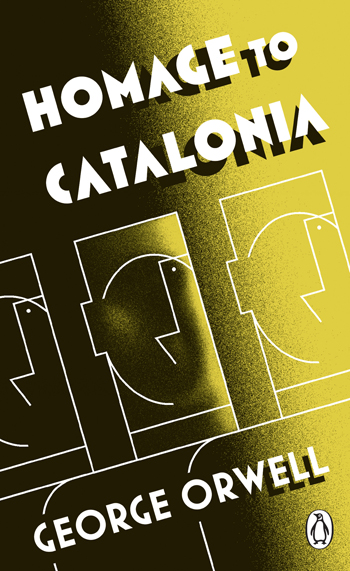
Homage to Catalonia cover

George Orwell is probably the most famous English political writer of the twentieth century. As such, it is surprising, in Homage to Catalonia, to read him telling us that, at the front of the Spanish Civil War, “the political side of the war bored” him (208). He says of his initial impressions of Catalonia that

the revolutionary atmosphere of Barcelona had attracted me deeply, but I had made no attempt to understand it. As for the kaleidoscope of political parties and trade unions, with their tiresome names–PSUC, POUM, FAI, CNT, UGT, JCI, JSU, AIT–they merely exasperated me. It looked at first sight as though Spain were suffering from a plague of initials. (197)

This book, then, part memoir and part political analysis, documents a change in Orwell’s perspective, a form of politicization. For, in his words, “everyone, however unwillingly, took sides sooner or later” (198). Homage to Catalonia is, as much as anything, an account of how and why Orwell took side, and began to view the array of political acronyms as more than just some alphabet soup. For it turns out that the war had everything to do with politics–“it was above all things a political war” (197)–and so boredom or disinterest are no longer viable options. It is in the name of politics that a certain–largely fictitious–narrative of the conflict had been propagated, and it is likely that it is in the name of politics that the Republic would be lost.

Yet, if this is the message of the book, Orwell remains strangely ambivalent about it. He tells us, at the start of his first extended disquisition on the internal struggles between Anarchists and Communists, that “if you are not interested in the horrors of party politics, please skip.” As he notes, he separates out the analysis from the memoir “to keep the political parts of this narrative in separate chapters” precisely so that the disinterested reader can pass over them and continue following Orwell’s personal journey unperturbed. In other words, in this conflict in which “everyone” has to take sides, the reader is carefully shielded from this responsibility. In fact, in later editions of the book the “political” chapters are relegated to appendices, pushed even more to the margins of the main narrative. But does this not allow precisely the depolititicization, or refusal to engage in politics, against which Orwell’s book is otherwise written? Orwell wants both to protect us against the “horrors of party politics” and (if we are curious to read through the appendices that contain them) to tell us that they are essential to any understanding of the situation in Spain–and indeed, Europe as a whole. At one and the same time, the book both directs us to the centrality of political disagreement and aspires to shield us from it.

It may then be better to think of this as an infrapolitical book, in the sense that it is about what is simultaneously a necessary link and an absolute breach between war and politics. The Spanish Civil War is at the same time a thoroughly political war and absolutely non-political at the same time. The “horrors” of politics are both inevitable and to be avoided if at all possible. Orwell has both to show the connections between the “common decency” for which he came to fight (197) and the political machinations that make it both possible and impossible, and at the same point to keep them utterly separate. This is, of course, an impossible task, which is why in some sense this is an impossible book, fractured and somewhat absurd. But it is in that fracture that we see the struggle between politicization (taking sides) and commonality (common decency) played out, which are the stakes of the war itself, which ultimately can only be understood in these infrapolitical terms.

Nearness Against Community: The Eye Too Many. By Alberto Moreiras.

(Lecture presented at the Abstraction Conference, Department of Comparative Literature, University of California-Irvine, March 11-12, 2016)1914589_998121010280661_3891660453838990569_n
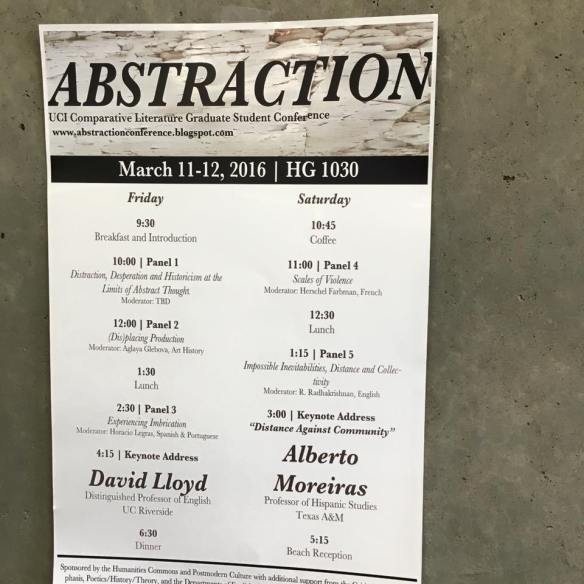
My intention is to present to you a precise definition of what I call marrano infrapolitics, a definition that I can sum up in the phrase “becoming homely in the unhomely,” in the context of the epochal ruin of politics, the end of community, the vanquishing of the principle of general equivalence, and the abandonment of nihilism.   All of it goes through an acknowledgment of the tragic condition of the human, but also through an immense task of architectonic destruction.   I hope you bear with me.  As I was listening to so many great papers yesterday I could not help but think what I have thought also at other times: that something like a new frame for thought was becoming increasingly necessary. I do not know if you would find that fact all that surprising at this point.  For better or for worse, I hope not in any kind of arrogant or presumptuous way, marrano infrapolitics does wish to provide it, and wishes to do it through the establishment of a difference between the polis and the political that may orient an existential position today. Call it the infrapolitical difference, and let us see what you think. Yes, it is an attempt to bring everything back from abstraction into the most concrete thing you have: your life. What I will read is about half of a text that I finished only last week.   I hope the drastic cuts still make things understandable enough.   I can send the complete paper to those of you who might become interested.

Some of you at least will have seen the first season of the Better Call Saul television series, or the serial documentary Making a Murderer. I think a claim can be made that both texts enact a certain marranismo, infrapolitical in nature, although they do it of course in very different ways.   At the end of the season, Jimmy, the protagonist of Better Call Saul, decides that “doing what is right” is no longer going to hold him. He seems to make that decision on the basis of the betrayal by his brother, Chuck, a character defined by Jimmy’s friend as “a stuck-up douchebag.” Chuck does not consider his brother a good enough person to become a lawyer in the firm he is a partner in. So Jimmy, dejected, perhaps having lost his last mooring, gives up on his sustained attempt to become an upstanding citizen within the law. In the talk to the bingo crowd, in the last episode, when Jimmy makes his decision to go rogue, he emphasizes his brother’s betrayal.   He had stopped being “slippin’ Jimmy” and spent ten years as a mailroom clerk in his brother’s firm and getting an online law degree from the University of American Samoa. He passed the bar exam for the State of New Mexico at his third attempt. His brother ought to be proud, since Jimmy did that for himself, certainly, but also to (re)gain his brother’s trust. To no avail, since Chuck still considers Jimmy a villain, slippin’ Jimmy indeed, and refuses to let the firm hire him. On that basis Jimmy makes his decision.   His heroic subjectivity goes out the window in the very decision to break away from the law.

Now, there is a problem in Jimmy’s story. I can understand how a betrayal by “the system” may drive somebody into piracy, not even out of a need for revenge, only out of a need for freedom: you cannot make it within the system because the system is rigged and corrupt, so you abandon the pretense, and from then on it is only a matter of getting away with whatever you do for your own advantage.   But can a betrayal by a member of your family trigger the same effect? Is it not the case then that you in fact continue to subordinate your life to the little family drama that perhaps caused you to become slippin’ Jimmy in the first place? This is an Oedipal drama that will keep you in the bounds of unfreedom: you want to succeed outside the law only to confirm your brother’s ideas about you and show him what can be done with them.   We need to keep in mind that collapsing the family into the system and the system into the family, although a tradition in rightwing thought, has a price: a symbolic break with the law that happens through a thorough absorption of the Oedipal triangle is perhaps merely an inversion of the relation to the law.   Jimmy’s decision may not be infrapolitical enough. It will not lead him home.

I myself have only seen three episodes of the terrorizing, deeply uncanny documentary Making a Murderer, partly because it scares me, partly because I live out in the country and my internet connection is through satellite, and I do not have enough gigabytes to watch everything I want in a given month.   But the documentary tells the story of Steve Avery, a poor devil from Wisconsin that was falsely accused and convicted of a crime he had not committed, and condemned to thirty-four years in jail.   The first episode—things get much more complicated later—explains that he was released from jail after eighteen years, when new DNA-analysis techniques exonerated him and showed his innocence. His lawyers’ appeals had by then been exhausted, the Wisconsin Supreme Court had confirmed the ruling against him, and Avery could have gotten out of jail on parole much earlier if only he had declared his guilt: he had nothing to lose, or almost nothing. He only had to say “yes, I did the deed,” and he could have been out resuming his life. But he did not want to do it, preferred not to. Why? He thought he would not say “yes, I did it,” because he had not done it. He faced the most terrifying—a life in jail—because his truth was his only possession, his only possibility of not losing himself forever.

Both Jimmy and Avery are uncanny creatures, in the sense that they opt for the uncanny, they assume a radical unhomeliness, they embrace the unfamiliar out of a sense of home. And, in a sense, they opt out of politics altogether. Jimmy himself makes everything depend on his brother’s approval, but perhaps it is Mike, another character in the series, who metonymically emphasizes whatever is homely in the most unhomely decision: While a detective in Chicago, Mike had to kill the cops who had killed his son. He flees to New Mexico to be near his daughter-in-law and his granddaughter. There he works as a parking attendant, reads the newspapers, does the crossword puzzles, and waits for a phone call from the remains of his family. Yes, in the meantime he does odd jobs and passes no judgment, he does what he is paid to do, but what matters to him is the return home, what remains of it.   And Avery makes his truth the only home he has, his agalma, his treasure.

One thinks of Sophocles’ Antigone. And of marrano fates.   Take the historical marranos: they were never a social class, only a group without group of individuals accused of being marranos, that is, accused of judaizing in a society where such an accusation meant imprisonment, ruin, torture, even death. To be a marrano then was a factical condition one could not survive.   Direct repression by the state (or by “the power in the State superior to the State itself,” the Inquisition) made it not just a social but also a political condition. What we can call marranismo today is of course a tropology, a metaphoric extrapolation, and refers to an infrapolitical condition. It is a not directly political condition of existential displacement from hegemonic social conditions at the very point of their hegemonic articulation (a criminal is also displaced as such, but the condition of the criminal is not strictly comparable to the marrano condition: they are mutually heterogeneous).   Marranismo, as an infrapolitical condition in the present, is intellectual dissidence and existential internalization of such a dissidence. At the limit, it can be referred to Antigone, whose act, misunderstood by Creon as political, is a marrano act in the sense that it expresses a radical difference from political conditions.   Antigone was not looking for inscription, rather for de-inscription. She is the person, as her first conversation in the play with her sister Ismene reveals, who does and is going to do what she has got to do, regardless of the consequences. Why? Because it is due; but due to whom or to what? That remains concealed. What is due, perhaps, is due to a destiny, or to a character, to the way things are. Creon cannot tolerate it. Antigone’s persistence turns her into what the play calls dein[a], terrible, uncanny, unhomely, unheimlich.   But she becomes unheimlich out of a need not to be left thoroughly homeless, radically destitute.   We can see here, in the background, in the difference between the two senses of home that Antigone or any marrano factically appeal to, what Martin Heidegger in Introduction to Metaphysics was still calling the “ontological difference,” of which he said: “The originary division, whose intensity and originary disjunction sustains history, is the distinction between Being and beings” (218-19). (By the way this is a good moment to say that David Lloyd proposed to us yesterday, with great elegance and flair, what he called a “red republicanism” through a number of supplementations to Hegelianism; and that what I am trying to do is to propose the conditions for what I call a marrano republicanism, very much dependent on the possibility of retrieval of the ontological difference as an essential matter for thought.)

If Being is home, what is at stake for Antigone or marranismo is the deep existential contestation of nihilism in the Nietzschean sense. For Nietzsche nihilism was “the most unheimlich of all guests,” and marranismo apotropaically incorporates the most unheimlich position for the sake of a counterturning: the marrano, not the one accused of being such, but the one who has internalized and assumed his condition in the rejection of a fallen home, of the social home, of the political home, in the rejection of compromise, the law, or hegemony, invokes a secret truth, another home that opens the ontological difference within singular history. In his commentary to Hölderlin’s “Homecoming/To Kindred Ones,” Heidegger says that “homecoming is the return to the nearness to the origin. Only he can return home who previously, and perhaps for a long time, has wandered as a traveler and borne upon himself the burden of the journey . . . the essence of nearness appears to be that it brings near that which is near, yet keeping it at a distance. This nearness to the origin is a mystery” (Elucidations 42).   The mystery remains such, neither Antigone nor the marrano claims to unveil it.   Which is why ontic namings will not do the trick. It is not a matter of religion, it is not a matter of ethics, certainly not of politics, and it is not a matter of following any alternative principle.   Heidegger also says: “What is most characteristic of the homeland, what is best in it, consists solely in its being this nearness to the origin—and nothing else besides this” (42).   We do not have to appeal to any fatherland or ideology.   We can discount all the rhetoric: what Heidegger is saying is that in the only sense that matters home or the hearth are the relation to Being understood as the essence of Dasein: the human is human in and through an originary relation to something that escapes ontic nominations but which, for the human, can only happen historically. There is an originary relation that marranismo claims, which is the absolute limit of the place where politics can be narrativized. I call it infrapolitics, and risk the thought that it has everything to do with the difference between the polis and the political.

Let me offer you a thesis, as clearly as I can do it at this point, so that you may agree or disagree with it. The marrano must, and existentially has no choice but, to invoke a nearness to something without which life would be unlivable. That something is not politics, it is precisely not politics. That is also Antigone’s need, which is not to say that Antigone is a marrana: rather that marranismo is necessarily antigonic in that sense. I think the thought of the ontological difference—the difference between beings, in the usual sense, and Being, which establishes the horizon of appearance and presencing—opens itself essentially as the appeal to that something. That is of course the role of the ontological difference in infrapolitics. And this seems consistent to me with the Heideggerian interpretation of Antigone, in its second manifestation, in the 1942 text we will talk about, as “becoming homely in the unhomely.” “To assume a distance” is an empty gesture, and doubly terrible if that assumption is not already looking for something other than the distance itself. We assume a distance for the sake of a nearness. And the nearness matters the most.

If it is true that the history of thought in the West is a history of the progressive voiding out of Being until, with Hegel, which brings to an end the inception of philosophy started by the Greeks, Being is substance and substance is the subject, and Being becomes the most abstract and general of words, substantial exhaustion turns into a final point of abstraction, and abstraction, having reached a point of no exit, an end, having become aporos, turns into distraction. We live in distracted times, in aporetic times. Reiner Schürmann begins his monumental text, Broken Hegemonies, in reference to Oedipus’ nocturnal knowledge. “The tragic condition” is the specific infrapolitical condition of our aporetic time: “To think is to linger on the conditions in which one is living, to linger on the site where we live. Thus to think is a privilege of that epoch which is ours, provided that the essential fragility of the sovereign referents becomes evident to it” (Schürmann 4, 3). The “singularizing withdrawal” that opened the tragic in pre-metaphysical times through its conflict with “the universalizing impulse” of “political” or historical principles is again with us. Both instances cannot be reconciled through any appeal to higher principles. This “kenosis” of the principle opens a new time of tragic an-archy (4). Founding speech gives way to “insurmountable silence” (17).   Ours is a “pathetic site” that once again reveals, against all abstraction, “the tragic condition” of being (532).   Infrapolitical marranismo understands and assumes such a condition, dwells in it, as Jimmy or Avery sufficiently show.

In the astonishing pages of Hölderlin’s Hymn ‘The Ister” (1942) where Heidegger reframes, in what I will considerately call an anti- or non-Nazi sense, the interpretation of the first choral ode of Antigone he had offered in Introduction to Metaphysics (1935), he speaks about the polis as the site of a turning-counterturning that organizes the historical existence of the human being: “Perhaps the polis is that realm and locale around which everything question-worthy and uncanny turns in an exceptional sense. The polis is polos, that is, the pole, the swirl [Wirbel] in which and around which everything turns.” (Hölderlin 81). For Heidegger the polis, as “the site of being homely in the midst of beings as a whole” (82), is also the site of a counterturning: “what properly characterizes the unhomely is a counterturning that belongs intrinsically to its essence” (84). The polis: the homely-unhomely site, the originary site, the founding site of any and all historical appropriation, and by the same token of any and all historical disappropriation. But this means that “the polis is and remains what is properly worthy of question in the strict sense of the word, that is, not simply something questionable for any question whatsoever, but that with which meditation proper, the highest and most extensive, is concerned” (85).

It is here that Heidegger pronounces some fateful words we have not yet thought through. There is no politics without the polis, and yet the essence of the polis is not political.   There is a difference, uncanny in nature, between the polis and the political, and yet that difference is also a logical one. This is the logic: “if ‘the political’ is that which belongs to the polis, and therefore is essentially dependent upon the polis, then the essence of the polis can never be determined in terms of the political, just as the ground can never be explained or derived from the consequence” (85). What determines the essence of the polis? Politics cannot explain the polis, even if the polis determines the political.   The political may have always already started, but the polis finds its beginning, its origin, in a realm that cannot be reduced to the political. This region, this site prior to any site, this chora, is the originary site of the nearness, hence also the possibility itself of any distance whatsoever.

I understand Spanish philosopher Felipe Martínez Marzoa’s own meditation on the polis in this context—and let me suggest that Marzoa’s work is perhaps entirely contained in such an effort.   He says, for instance: “We call polis [the site] where the game that is already being played aspires to become relevant as such, that is not a doctrine on the polis but precisely the polis itself; we could refer to the fact that such a relevance means at the same time the loss [of the polis] by pointing out that the polis dies not through the attack of the barbarians, rather precisely because it stands” (Marzoa, Heidegger 28, my translation). The loss of community, through politics, is a direct result of the self-recognition of the community. As a “community” the polis binds the homely, but as a “community” that explicitates its own game it opens itself to the unhomely.   This is the first historical inception, a thematization of the game of common life as a game of binding loss that opens, as such, the space of the political.   But we can also bring the history of the polis to our own times. “Distance” is for Marzoa “the distance or reserve that irretrievably remains at the root of the modern project itself, the irretrievable secondariness of the modern, irremediable in the sense that recognizing it is in no way going back to the primary, rather only attempting to understand what is secondary as secondary” (111).   The political is a thematization of secondariness in respect of the very question-worthiness of the polis itself. But the political is also a secondary, always belated reflection on the loss of the turning-counterturning relation to being that first makes the polis historical as such. For Marzoa only distance can bring up, minimally, the very difference between the primary and the secondary that organizes the very possibility of a step-back from contemporary politics. Such a distance is infrapolitical distance.

If marrano history, as the history of the marranos, can testify to a situation of double exclusion—the marranos are simultaneously excluded from their originary provenance, Jewish, and from their secondary provenance, Catholic—, a metonymic projection makes of the marrano a figure of displacement and homelessness. A marrano inscription is countercommunitarian and singular, cats on a roof, but also besieged and precarious, cats chased by dogs. A marrano position is never immune to politics, but it relates to politics para- or posthegemonically: hegemony kills it. It prefers not to be killed. It dwells infrapolitically, as a survivor, in its secret, which it inhabits as one inhabits an ethos, knowing there will be no protection except chance. Chance is its tragic condition. If, as Michel Foucault says, “one is ‘in the true’ only if one obeys the rules of some discursive police” [Foucault, Archeology 224], then the marrano’s untruth stands aside, in a disobedience that makes it a perpetual target. From it, it dreams of a relationship to history that will not be Hegelian or Nietzschean. Can that relationship be established? Or is marrano infrapolitics structurally an opting out of history, an abandonment of history’s script for the sake of an untimeliness beyond measure?   Let us once again remember Antigone, or Jimmy, or Steve Avery.

In Introduction to Metaphysics, a 1935 text, pertaining therefore still to the years of commitment to some kind of hypernazism, Heidegger attempts to establish what he calls the essence of the human in its first inception or beginning in the history of the West in reference to Oedipus, in powerful words that I find hard to deal with. Those words are:

Oedipus goes to unveil what is concealed. In doing so, he must, step by step, place himself into an unconcealment that in the end he can endure only by gouging out his own eyes—that is, by placing himself outside all light, letting the veil of night fall around him—and then by crying out, as a blind man, for all doors to be flung open so that such a man may become revealed to the people as the man who he is.

But we should not see Oedipus only as the human being who meets his downfall; in Oedipus we must grasp that form of Greek Dasein in which this Dasein’s fundamental passion ventures into what is wildest and most far-flung: the passion for the unveiling of Being—that is, the struggle over Being itself. Hölderlin, in the poem “In lieblicher Bläue blühet . . . ,” speaks this seer’s word: “King Oedipus has perhaps one eye too many.” This eye too many is the fundamental condition for all great questioning and knowing as well as their sole metaphysical ground. (112-13)

I wonder if the eye too many Oedipus grows and was made to grow is also our own eye today. The eye too many that Oedipus has enables him to distinguish seeming from being, but does not spare him from errancy.   Errancy, defined as “the space . . . that opens itself up in the interlocking of Being, unconcealment, and seeming” (115), is a state of being that includes the fight against errancy. This fight against errancy seems to define whatever remains in the Heidegger of 1935 of the notion of authenticity exposed in Being and Time (1927).   It is a tragic fight that will eventually lead Heidegger into a meditation on the possible end of errancy, into a meditation on Bodenständigkeit, “earthiness” or “rootedness,” into a meditation on a form of dwelling not or no longer dependent on gouging out one’s own eyes or other people’s eyes, into a form of historical life no longer sacrificial. This is poetic dwelling, developed through his readings of Hölderlin through a process and a number of years that take Heidegger from a clear commitment to violence and to political violence into something else—this something else is or would become eventually Heidegger’s abandonment of Nazism, and with it of the region of politics, of the very idea of politics, as the site of historical salvation.

For Heidegger, referring to Hölderlin, poetic thought, as opposed to technical, violent thought, refers to something that abides and endures. The something that abides and endures is home or the hearth, only retrievable in shy remembrance: “This shyness . . . is more decisive than all violence” (153).

A slow path towards a nearness to the origin, a homecoming that is more decisive than all violence: this is the eye too many through which Oedipus, and all dwellers in the tragic condition, must attune to the experience of a homeliness “more decisive than all violence.”   I think it is fair to say the beginnings of such a meditation can be found, still in a preliminary form, in the analysis of the first choral ode in Sophocles’ Antigone that Heidegger works out in the 1935 text. But he would come back to it and establish a fundamental correction a few years later. Even later, towards the end of his life, other corrections would ensue.

The first choral ode of Antigone says “polla ta deina kouden anthropou deinóteron pélei,” “manifold is the uncanny, yet nothing uncannier than man rises beyond him” (quoted in translation in Heidegger, Introduction 156, translation modified).   If nothing is uncannier than the human being, then the human being is the uncanniest. For Heidegger, “the saying ‘the human being is the uncanniest’ provides the authentic Greek definition of humanity.” (161).   Oedipus, we recognize, was also uncanniest, as the struggle against seeming undid him, and by undoing him turned him into the man he was.   This is the tragic condition of the human in the Greek way.

There are three passages in the ode that merit special attention from Heidegger: verses 360, pantoporos aporos ep’ouden erchetai, 370, hupsipolis apolis; and 372-73, met’ emoi parestios genoito met’ ison phronon.   Pantoporos aporos is translated by Heidegger as “everywhere trying out, underway; untried, with no way out he comes to nothing.” Hupsipolis apolis is translated by Heidegger as “rising high over the site, losing the site is he for whom what is not is always for the sake of daring.” And verses 372-73 are rendered as “let him not become a companion at my hearth, nor let my knowing share the delusions of the one who works such deeds” (158). Pantoporos aporos and hupsipolis apolis are presented by Heidegger as interpretations of the uncanniest in the human (deinótaton) (162).   As such, they are characterizations of the human in the context of the explicitation of the originarity unity and disjunction of being and thinking.   If thinking means apprehending (noein as Vernehmen), apprehension is, Heidegger says, “a happening (Geschehen) in which humanity itself happens” (150).   How does it happen? Thinking is a relation to being that is channeled, at the time of the inception, as reciprocal violent appropriation. If the human can dispose of the sea and the earth, of animals, of language and passion, it is because it is disposed to them and by them, through the violent prevailing of Being.   And so humans ultimately look at their own perdition in various ways: they are aporos and apolis because “they stand in the no-exit of death” (169) as essential, constant limitation—a limitation that rules over the fact that human techné clashes against diké. This confrontation, technédiké, which he finds clearly expressed in Antigone’s first choral ode, is also at the same time what, at the end of his book, Heidegger would claim constitutes the “inner truth and greatness of National Socialism,” the historical confrontation at the end of metaphysics that could restitute the possibility of a resolutive “encounter between global technology and modern humanity” (Introduction 213).   This is 1935 (although the phrase about the encounter was added later, in 1953).

Perdition (Verderb) is the possibility that ensues from the oppositional relation of the two forms of the deinon, techné and diké. Perdition is the uncanniest. It does not come at the end of any failing activity, it “holds sway and lies in wait fundamentally” (173). Oedipus faces disaster because disaster faces Oedipus.   If Heidegger also pays attention to the conclusion of the choral ode, which exclude the uncanny human from hearth and counsel, it is to say that “one who is in this way [namely, as the uncanniest] should be excluded from hearth and counsel . . . Insofar as the chorus turns against the uncanniest, it says that this manner of Being is not the everyday one . . . In their defensive attitude they are the direct and complete confirmation of the uncanniness of the human essence” (175-76).   The determination of Greek humanity assumes its tragic condition in uncanny errancy and the necessary loss of the hearth and of the sharing of collective counsel, of communal thought.   For Heidegger this is the first inception of the West as history, or of history in the West.

The uncanny, which translates into English the Greek deinon, is in German the Unheimliche, the unhomely.   Heidegger says that the reciprocal relation of diké and techné is the same thing as the reciprocal relation of being (einai) and thinking (noein) (176).   The relation is a violent relation.   It makes uncanniness happen, that is, it makes homelessness appear. “The assault of techné against diké is the happening through which human beings become homeless” (178).   Homelessness results, originarily, in the first historical inception, from the mutually appropriating relation of being and thinking.   That the chorus will exclude the human from hearth and counsel confirms the unhomely but, at the same time, makes the home first disclose itself as such (178).

The question for a marrano infrapolitics has to do with whether the second inception, the other beginning, presumably to occur in the present, would stand in a similar relation to the unhomely.   Heidegger frames his entire discussion of the choral ode in the context of an overwhelming confrontation between diké and techné whose outcome is violent and necessary perdition. Is homelessness a condition of marrano infrapolitics that discloses as if for the first time the need for a home?   Or would marrano infrapolitics assume the uncanny, even the uncanniest, as its necessary constancy and prevailing?   Are marrano infrapolitics a resignation to necessary, tragic violence? Are marrano infrapolitics an infrapolitics of perdition? We could, again, ask Jimmy, or Steve Avery. In terms of Heidegger, some scholars have noted an allegedly unrecognized difference in his treatment of the first choral ode of Antigone in Introduction to Metaphysics and in the 1942 lecture series entitled Hölderlin’s Hymn “The Ister”.   That difference is for me an essential difference, and it sets Heidegger on the way to an infrapolitical project, out of and away from politics at the end of metaphysics.

An other beginning is presented as an overcoming of nihilism.   This was so in the 1935 text and it will be so in the 1942 text on Hölderlin, which includes a central chapter in which Heidegger returns to the choral ode of Antigone.   Some years mediate, a thorough engagement with Hölderlin has also occupied Heidegger in those years.   The interpretation of the choral ode is the same, yet fundamentally different. Where is the difference?   The difference is in the frame. Heidegger no longer emphasizes the historical confrontation between techné and diké. What interests him now is the relationship between the homely and the unhomely understood not in terms of the heroic and the violent, rather in terms of the hearth, and phronein.   Once again, Heidegger focuses his commentary of the choral ode in an elucidation of the same verses Introduction to Metaphysics concerned itself with. But the interpretation now takes its departure from what is attributed to Hölderlin: “For Hölderlin, that essence [of history] is concealed in human beings’ becoming homely, a becoming homely that is a passage through and encounter with the foreign” (Hölderlin 54). Accordingly, for Sophocles too “human beings are, in a singular sense, not homely, and . . . their care is to become homely” (71). This is the difference: it is now caring to become homely rather than accepting the destinal character of uncanny violence that describes the essence of the human.

But the decisive moment in Heidegger’s reframing of his reading of Antigone must be found in the discussion of the first dialogue between Antigone and Ismene, which was absent in Introduction to Metaphysics. Heidegger focuses on Antigone’s words to her sister, announcing to her that she is willing pathein to deinón touto, in Heidegger’s translation “to take up into my own essence the uncanny that here and now appears” (103).   To suffer the terrible, to bear the unhomely: Antigone takes it up, she does not flee from it: “within the most uncanny, Antigone is the supreme uncanny” (104).   And then Heidegger asks: “What if that which were most intrinsically unhomely, thus most remote from all that is homely, were that which in itself simultaneously preserved the most intimate belonging to the homely?” (104).

Everything depends on the interpretation, within the context of the tragedy, of the last few verses of the choral ode, where the chorus affirms its rejection of the uncanny ones: “met’ emoin parestios genoito met’ ison phronon hos tad’ erdoi,” which Heidegger renders as “such shall not be entrusted to my hearth, nor share their delusion with my knowing, who put such things to work” (92). Are we to think that the chorus rejects Antigone, the rebellious, who will not conform to the laws of the city? If so, the choral ode would have become, in these last verses, “a song in praise of mediocrity, and a song of hatred towards the exception” (97).   The tragedy does not support that. Heidegger returns to the thought that a difference is being sustained through those very words between the polis and the political, of which he adds “for the Greeks, the polis is that which is altogether worthy of question. For modern consciousness, the ‘political’ is that which is necessarily and unconditionally without question” (94-95). The interpretation according to which the chorus rejects Antigone, expels her from the hearth, can only be the interpretation of modern consciousness. But there is an alternative reading even for us.

Antigone’s willingness to bear the burden of the heart, to suffer any suffering in her commitment to honor the dead, must be understood otherwise.   There is a stupid unhomeliness, which consists in “a forgetting and blindness” (109) of the hearth, but it is not Antigone’s—it is, rather, Creon’s.   Antigone’s unhomeliness is of an entirely different kind, since it consists in a radical affirmation of the hearth: “The hearth, the homestead of the homely, is being itself, in whose light and radiance, glow and warmth, all beings have in each case already gathered. Parestios is the one who, tarrying in the sphere of the hearth, belongs to those who are entrusted with the hearth, so that everyone who belongs to the hearth is someone entrusted, whether they are ‘living’ or dead” (114-15).   Antigone is able, that is her supreme action, to assume the passage through unhomeliness and death for the sake of taking up unhomeliness into her own essence. Antigone, says Heidegger, “becomes homely within being” (117).   She is exempt from the rejection of the chorus because she herself founds the very sense of hearth the chorus enacts.   “Becoming homely in being unhomely” (121) is Antigone herself, her essence. Heidegger calls this the “poetic:” “The unhomely being homely of human beings upon the earth is ‘poetic’” (120). Deprived of the simple recourse to homeliness among beings, Antigone’s decision appeals to the higher homeliness of being, which founds the polis as it founds any and every other possibility of historical dwelling for the human.

I prefer to call Heidegger’s “poetic” infrapolitical. The wrenching shift from an everyday engagement with things to a radical engagement with the darkness of the originary home, never to be reached, but approachable through nearness, could perhaps be described poetically, but becoming homely through the unhomely remains an infrapolitical task.   The infrapolitical task is not a minor one: it has to do with establishing an existential attunement to the fact that everywhere today politics is nothing more than venturing forth with no way out, a siteless undertaking. Politics is today the uncanniest were it not the most ridiculous.   Politics is Creon’s doing, the headless and errant assertion of unhomely power lost in non-being, lost in the nothingness of administrative claims.   Is that the injustice of the world imagined by Zur Linde in Borges’s story?   Or should we keep awaiting a new historical dawn, Hegelian or otherwise?

I also want to translate the notion that the polis is the most question-worthy, in its very difference from the political, into the notion that it is infrapolitics that is question-worthy when there are no longer any extant questions for politics: politics is technology today, in a context where diké is no longer overwhelming, because it has been thoroughly absorbed into political techné in the form of social administration under the principle of general equivalence.   There is no longer a polis—it only remains as a ghost from the tradition. Its spectrality subsists in the form of infrapolitics as a dark memory of the origin; as a reminder of the fact that we too were historically appropriated once.   But no more. We have all been unmoored as potential marranos, which is not without its promise.

Reflecting on the polis, Martínez Marzoa notes: “either the community itself does not make itself relevant in any way, remains opaque as such, and then to a certain extent it can be said that there is no community, it does not take place, since it never becomes manifest . . . or else the community is not in a position to rest content with its own opacity, and the links, that is, the countersettings, always already taken for granted, are forced into becoming said, becoming relevant, and then the community certainly takes place, it certainly exists, but then it is to be seen whether what happens is not that the community explodes” (“Estado y polis” 106).   Once the distance of the game becomes not just relevant, but obvious, once the distance has been naturalized and has assumed a patency, has become primary, then distance is all there is, but empty distance, distance that rules over a space that is no longer the space of community, but an indifferentiated and continuous space, an unlimited space where only arbitrary cuts are not just possible but customary. The consequences reach modernity in the following way: the “political problem” in modernity is that “consensus is limited to one thing only, which is not to seek any consensus; there is to be agreement only in creating and maintaining conditions so that it is possible to live without any agreement at all, not communing with anything” (“Estado y legitimidad” 88).   This is the “democratic republic” or just “democracy” (“Estado y polis” 113). But the other side of this coin concerning the dissolution of consensus and communions in modernity is “what happens when those dissolutions and delinkings begin to be (partially) real and the State begins to find itself not even opposed to those things, but alone with itself; it would need to be seen whether there is some reason then for the State to feel panic before itself and to hurry and look for new reconciliations and syntheses with those other things” (89).   The thorough emptiness of the political determination, its modern-democratic formulation, anchored in the principle of equivalence according to which every thing is exchangeable for everything else, and there is nothing outside the system of circulation, means there are no substantial, only formal, links, there is no possibility of a political home or a nearness to any kind of origin.   But this also means: “that structure or formation that projects as its concept of legitimacy the absence of links, to the point where it cannot function otherwise, at the same time fails to function without constantly making up some or other supposedly given links, in the name of which, sooner or later, the set of conditions that the concept of legitimacy acknowledges is violated . . . Nihilism must above all avoid recognizing itself, it must always fabricate something to hold on to, and this is because precisely the recognition of nihilism would be the only non-nihilist thing” (100). But this is nihilism with a bite. In the state’s reaction to its own empty formalism, oppression ensues.

And yet it was Schürmann himself who said: “Only a wrenching of thinking allows one to pass from the ‘time’ that is concerned with epochal thinking to originary time, which is Ereignis—to agonistic, polemical freeings. So, it is not as an a priori that temporal discordance fissures the referential positings around which epochs have built their hegemonic concordances” (Schürmann, Broken 598).   This wrenching of thinking—do we need to refer to it as capable of a new determination of the essence of the human being, a new determination of history, a new historical dispensation?   The answer would have to be negative, particularly since those intended “agonistic, polemical freeings” would not coalesce into any new hegemonic concordance. Marrano infrapolitics is the mere possibility of the wrenching of thinking towards the nearest.

The originary logos of the West, the logos of the first inception, evolved through Platonic and later times into today’s cybernetics and logistics following a process of abstraction that has turned Being into the most general, hence empty, of concepts.   I have made an effort to give some concreteness to Being by associating it to the home of infrapolitics. In a late lecture entitled “On the Question Concerning the Determination of the Matter for Thinking” old Heidegger maintained that the change from the dominance of the principles of modern subjectivity into the dominance of cybernetics, which stands for the total orderability of the world, consummates the final avatar of the history of presence, and it is no longer possible to go past it. In that impossibility, which is the confirmation of the hypothesis of metaphysical closure, the question of presencing in a verbal form, still a part of the Greek experience of life but covered over and forgotten, comes up once again as a hint for those able to understand today’s impasse. The total orderability of the world, which the present age and its politics will continue to bring on in an ever increasing manner, constitutes the final principle of metaphysics. Total orderability is general equivalence.   But general equivalence as total orderability is also the end of politics—not its factical end, since there will be politics, but rather the end of politics as historical mediation.   What is essential today is orderability as such, which cannot be fought politically. Orderability can only be fought infrapolitically, by developing a relationship to existence that dwells on and questions the other of orderability, which, as mere trace, is the remnant of the free historical being of the first inception. This is marrano infrapolitics: as another, even later Heideggerian essay puts it, the attempt to dwell in what “sustains and determines and lets us grow in the core of our existence” (Heidegger, “Messkirch” XX) against every imposition of conformity.   If we are still truly capable of it.

Alberto Moreiras

Texas A&M University

Top of Form

Bottom of Form



Movement and Sacrifice: On Samuel Steinberg’s Photopoetics at Tlatelolco, Afterimages of Mexico 1968. (Gerardo Muñoz)

Photopoetics SamSamuel Steinberg’s Photopoetics at Tlatelolco, Afterimages of Mexico 68 (U Texas Press, 2016) is a timely contribution to the field of Mexican Studies. It posits itself as a sort of culmination of that field, and we would not exaggerate to say by saying that it is an archive of an archive that thrives to undo ‘Mexicanist ideology’ towards a different opening. Steinberg powerfully states at the end Photopoetics: “Mexicanism, in turn, is the name of the ideology that regulated the dutiful carrying-out of the relation between art and the people that the Mexican state organized until Tlatelolco…According to this procedure, one can constantly make art speak the name of Mexico as its truth, as the discontinuous thought, the spirit that haunts and must be revealed by thought” (182). This is a strong and devastating assertion that should also be strategically posited in whatever remains of ‘area studies’ structuration as institutional inertia as well as against its dominance over knowledge production of Latin America within the contemporary university. Photopoetics’ boldness lays precisely in this intersection within archive and reflection, between cultural inscription and disciplinary containment in the wake of the Tlatelolco massacre during the Mexican 68. This ‘event’ is symptomatic of the hegemonic haunting of principial Mexicanist reflection and of its multivalance inscription that continuously translates and archives itself as ‘defeat’ (37).

But Photopoetics is more than a book about the co-belonging between photography and literature, the image and life. Rather this very relation, and the limits thereof, is what is tested and taken to the edge in the different folding case studies that make up the book – from Monsivais to Poniawtoska, from Paz and Volpi to contemporary artist Francis Alÿs. The name of that operation depends largely on ‘photography’ as a medium but is not entirely reducible to it. Indeed, photopoetics is the term that establishes a transversal relation with the archival 68 without necessarily being a master trope that seeks to subordinate the archive to “photographic studies” or the “visual culture” discipline (in the W.J. T. Mitchell line or otherwise). The ‘photopoetic’ is not even a concept, but rather a dispositif that varies according to the object in question, allowing for a phenomenology of the onto-photographic effect on the Real and process of encrypting the event as event, as well as the indexical repetition of the archive (25-28).  

This has potent consequences for an analytical comprehension of the political, which fundamentally entails the displacement of hegemonic structuration (not only for ‘Mexicanism’ or the ‘global 68’). Indeed, for Steinberg, hegemony is the consignation of an archive, if by the latter we understand the reduction and principial limitation of the political to calculation (27). It is thus not surprisingly that Steinberg situates his own reflection within a post-hegemonic horizon primarily defined as the destruction of the differend between theory and practice (and throughout the book there is critical engagement with Moreiras, Williams, Yúdice, and Beasley-Murray) (8). This is the unsaid ‘althusserianist’ wager in Steinberg’s book, which is, at the same time, consistent with a politics beyond the subject and a defiant a-principial thought. There are two major and unexpected figures that support this general horizon: José Revueltas and Francis Alÿs. In fact, the book opens with Revueltas and closes with Alÿs; a double movement that although not fully developed, is preparatory for an atopic ground in relation to a post-Mexicanist horizon of reflection, a new form of thought, and a democratic (and communist?) promise.

The first two chapters – “Archive and Event” and “Postponed Images” – situate the general economy of the book, that is, the relation between archive and event and archive as the hegemonic force proper to the 68. The hegemonic phantasm is that of situating the 68 as a sacrificial horizon of history against what should be read as the contingent and democratic student movement that remains encrypted or translated into a reiterated and diversified figures of closure (victims, heroes, the people, or melodrama). Understood in a rancierean key, Steinberg’s post-hegemonic articulation rests principally on the contingent heteronomy of the movement:

“…What we call 1968: “an unforeseeable coming of the other, of a heteronomy; “the event of what or who comes” as incalculable exposure to that other and to the event that is other. […]. No: it is “the event of what or who comes”, that change encounter in which ‘students are confused with workers”, and in which the peasants are also present – absent from where they properly should be. Unconditionally”. (44).

It is not just that the archival event orders them into a grammar of visibility, but also the fact that it translates it (them: the students, or what is to come) into a principle. This is what in “Postponed images” Steinberg sees in Monsivais’ popular melodrama and “national unity” that reinserts “mexicanidad” within the general analytical economy. In a similar way, although folded, this is what is analyzed in the chapter on testimonio (“Testimonio and the future without excision”) taking Elena Poniatowska’s famous La noche de Tlatelolco as interchangeably positing the sacrificial structuration of history vis-à-vis civil society. La noche de Tlatelolco tames the democratic dis-order of the movement into one of the “People” within a broad ‘collective memory’ of the nation (112). We are not too far here from a ‘fictive ethnicity’ grounded in testimonio and its politics of truth. Again, an indexical photopoeticology is what guarantees – in Monsivais’ melodrama as well in Poniatowska’s civil society deposition – the encryption of 68 and its ‘afterlife’.

“Exorcinema” and “Literary restorations” are secondary moments of the 68 archival fantasies and unusual atopics for carrying out the lasting effect of this event. “Exorcinema” takes up films, such as Fons’ Rojo Amanecer and Raygadas’ Silent Light as resurrections of the photopoetic act, but it also has strong declinations that spill over Chris Marker monumental Grim without a cat (1967-77), as well as other figures of Mexican cinema. In “Literary Restoration”, the transition is folded from the ‘spirit of revolutionary sixties’ to the ‘neoliberal age of restoration’. Restoration here is not deployed lightly. Following Badiou, the staging of restoration announces an impasse in the face of historical nihilism, but also makes evident the fascination with the ‘past’ as melancholic repetition and restitution. In this sense, the work of Jorge Volpi centrally figures itself as the symptom of neoliberal restoration, and more specifically his pedagogic novel El fin de la locura (Seix Barral, 2003) sketches something like a narratological aleph of the sixties, revolving around “French theory”, Fidel Castro, psychoanalysis, the “Padilla Case”, and revolutionary ethos. This is an ‘after the fact’ historical novel that condenses – meant for a middlebrow public – major events of the leftist politization and heroic drives. Against Volpi’s own authorial intentions, however, Steinberg concludes that Volpi’s narrative halts at complete politization (hegemony) making possible an infrapolitical register. This is not to say that Volpi is an infrapolitical writer himself. There is no doubt that Volpi’s literary program – the Crack Manifesto, his novels, also his journalism – amount to literary nihilism in the wake of Mexico’s turn towards neoliberalism after NAFTA trilateral economic adjustments. Steinberg pushes for what I would call an infrapolitical interruption in Volpi as a secondary effect of what hegemony and counter-hegemonic literary depolitization cannot hold itself up to.

The last chapter, “An-archaeologies of 1968”, is the fleeing territory from the Mexican archive, and it does so with the help of contemporary artist Francis Alÿs. In this chapter, there are at least two major problems at stake for Steinberg: on one hand is the question of the de-territorialization of the Mexicanist disciplinary (and disciplined) boundaries of knowledge formation, and on the other, the possibility of rendering inoperative any ideal of emancipation (and resistance) based on history, subject, and work (192-93). The relational aesthetics piece “When faith moves mountains” is taken as a precarious negative community that exceeds national borders, as well as any possibility of subjectivation for the Mexican being. Alÿs is resistant to the resistance of Mexicanism. While this is true, perhaps some readers are left desiring further confrontation but this time not against the Mexican archive, but on the grounds of what I would call the transnational circuit of global contemporary art. Bourriaud and Claire Bishop’s theories on relational aesthetics make an entry into the discussion, but I am tempted to say that both of these critics, in different ways, are fully committed to hegemony theory, or at least to hegemony for contemporary art relations to the political, whether in consensual or antagonistic terms [1].

I am not arguing here that Steinberg endorses either Bourriaud’s or Bishop’s assessments or “contemporary art”, but that the an-archeology releasement opens to a critical assessment of the very machinistic operation of contemporary art in its very economical precocity, autonomous circulation, and so called “democratic inclusion” of extended practices and subjects. In this sense the problem of “faith” (189-91), is also about “the faith” of contemporary art: the “pistis” (credit) that in the aura of participation and immateriality ends up repeatedly bounded within a logic of exchange value through the practice of documentation.

Photopoetics at Tlatelolco inaugurates a post-sacrificial reflection on Mexican culture and its conditions of possibility. Making no concessions to ideological or locational authorities, Steinberg calls for a post-hegemonic desire that affirms the real movement of thought that is the concrete potentiality of politics beyond principles and idle chatter.


Notes

  1. I am thinking here of Nicolas Bourriaud’s Relational Aesthetics (Les Presses du Réel, 1998) on the side of consensual political practice, and the article “Antagonism and Relational Aesthetics “ (October, Fall 2004), by Claire Bishop on the side of antagonism.

Ironic gramscianism: on Patrick Iber’s Neither Peace nor Freedom: the Cultural Cold War in Latin America. (Gerardo Muñoz)


Iber Peace Freedom 2015Patrick Iber’s Neither Peace nor Freedom: The Cultural Cold War in Latin America (Harvard Press, 2015) is a very much-welcomed piece of historiographical investigation on Hemispheric Cold War in the Americas, and I think it is not just circumscribed within conventional historiography, since it also speaks to us as Latinamercanists, that is, some of us not precisely invested in writing history of Latin America. Its publication coincides with other recent books that reexamine the “culture battles” during the Latin American Cold War, such as Jean Franco’s Cruel Modernity (Duke, 2014) Mabel Moraña’s Arguedas/Vargas Llosa (Iberoamericana, 2014), or Rafael Rojas’ Fighting over Fidel (Princeton, 2015). Neither Peace nor Freedom studies the Cold War structuration in the region as a long durè process– spanning from the late twenties (take the assassination of Julio Antonio Mella in Mexico) to Sandinismo and the Marea Rosada or Leftist progressive governments that began with Hugo Chavez’s 1999 election. The Cold War took place in a climate of political and cultural conflictivity that the historian is not hesitant to call a “civil war”: “…the work of political and intellectual currents whose existence predate the Cold War, and whose sources lay in what might be described as the international Left’s civil war. The arrival of the Cold War meant that the Left’s internal conflicts would be inscribed onto superpower competition, and thus that struggles for justice around the world would be refracted through imperial interests of the United States and the USSR. In Latin America, that would leave the Left with almost no viable options for pursuing its aims without compromising them” (3).
The event of the Cold War in Latin America was in this sense a long and costly civil war overdetermined by a dual structuration. However, as Patrick Iber’s studies moves on to argue, this structuration didn’t always lead to political or cultural closure on either side. This duality had multiple replications throughout the book: there was the World Peace Council (WPC) and the Congress for Cultural Freedom (CCF), Casa de las Americas and Mundo Nuevo, along with the principles of “peace” (promoted by the geopolitical interests of the Soviet Union) and that of “freedom” (promoted by anti-communist and largely financed by the CIA). Of course, every reader could input their favorite artist, intellectual, or country for either side. It might be superfluous to say that Neither Peace nor Freedom maps a heterogeneous and conflicting history of the Cold War in the Americas (as opposed to being a “Latin American narrative” that only “happened to them” so engrained in the common position of anti-imperialist mapping. Some of us, not all, associate this second with John Beverley’s work and in particular with his Latinamericanism after 9/11).

But perhaps less obvious is the fact that Iber’s commitment to historical writing has abandoned a model of political militancy to generate an otherwise relation with the cultural Cold War archive. I want to expand on this point. At the center of Iber’s argument is that this dual structuration – whether you were anti-communist or anti-anti-communist – encompassed both a technology of liberation and a position in favor of occasional oppression (149). If this is in fact what ‘contained’ the logic of the Cold War, then one can see that Iber’s own position as a historian is consistent with not being on the side of ‘liberation’ or of ‘oppression’. To affirm this, either side would have to hold on to some principle of imperialism. These are the stakes in Patrick’s own book, and I am bringing up this point as to allow for a reexamination of the “dual structure” of the Cold War epoch in light of our present. I think there is something to this. If Patrick is neither on the side of “peace” or “freedom”, ‘liberation’ or ‘oppression’, ‘Latin American anti-imperialism’ or ‘neo-conservative domination’, what is his ground? Where is he standing?

I think there is commitment in Neither Peace nor Freedom, but only in so far as it uncovers another space beyond ideology. This dislocation is the excess of the cold war duopoly. One of the places in which one could start discussing this space, is where Iber argues the following, which can be found at the very end of the introduction of his book:

“Each camp would accuse the others of corruption and operating in the service of foreign empire. But it was not so much an issue of corruption as of the inscription of intellectuals’ preexisting campaigns onto Cold War. The evidence from Latin America suggests that the Cultural Cold War is best understood within a framework of “ironic gramscianism” – the pursuit of cultural hegemony through a combination of coercion and consent, incorporating many agendas. But the consequences were so varied that cultural fronts produced nearly as many ironies as they did movement in the direction that their patrons hoped…And the experience of Lain America’s Left during the Cold War was less a betrayal of democracy than a true paucity of options” (18).

This notion of “ironic gramscianism” – that also makes an important come back at the very end of the book- remains an underdeveloped quasi-concept making it even more suggestive for understanding the endgame of the cultural Cold War [1]. To finish, I want just to elaborate on two aspects that seem latent in this fragment of Iber’s text, and I take them to be hyperbolic of some of the strong claims laid out. First, “ironic gramscianism” seem to be understood by Iber as the contamination by way of the effects of hegemony. Hegemony here is taken as producing not just ‘other effects’ than those desired or intended, but more importantly, perverse effects. As I understand it – not just explicitly in this fragment, but more implicitly in Iber’s study cases– ironic gramscianism breaks the very closure and suture logic of hegemonic articulation, opening itself to an excess that it cannot contain ideologically. That explains why there were “many ironies counter to the direction that the patrons hoped”.

Iber seriously puts hegemony theory in crisis. As we know, hegemony theory is not just a theory, but also inevitably the principial political theory of and about modern Latin America State form. I do not know to what extent hegemony theory can come back unscathed as a viable political option (another example: to what extent the valence of Estado Integral as Estado Aparente in Álvaro Garcia Linera not an ‘irony’ in a deep sense?) [2]. If gramscianism is always ironic, this means that gramscianism does the work in the negative (the “cunning of imperialist reason”), and this negative is the limit of what is no longer “tolerable” in history (think dictatorship, or forms of oppression) (244). If Gramsci (consent and coercion) is always a machine that generates other effects, then it cannot but be ironic. A fundamental consequence here is that hegemony theory does not produce democracy (it cannot do this labor). It is my impression that it is not just a matter of perception, but that gramscianism (hegemony) is irony tout court. Is the ‘irony’ constitutive of hegemony not the very excess and ruin of itself as shown consistently through the Cold War disjunction?

Secondly, I want to raise the question of democracy that lies at the heart of Iber’s intervention. Fundamentally, the question about the Cold War is also a genitive question about democracy in the region: why has there always been a demise and impossibility of democracy? Why the condemnation, the open repudiation across intellectual groups and politico-cultural ideologies? I don’t think that this is something that Iber takes up in his book, nor should we demand an answer from it. In my view, Patrick Iber makes a modest plea: democracy (or let’s call it republicanist democracy) was impossible because there were no options that allowed for such a drift. It is here where I want to open another question for Patrick – as well as for our debate more generally– and this is: what about populism in the Cold War? The national popular State (Peronism, Cardenismo, Varguismo) with all its limitations and authoritarian drives has been the closest to true democratic experiment in the region. Early castrismo, for instance, is in a sense-liquidated populism [3]. Perhaps populism is what the negative does not let be in time. My point is not that populism is something like a “Latin American destiny”. What I wonder is if populism is not what could allow for a republicanist drift (as I suggested recently reading Jose Luis Villacañas’ Populismo) as to establish long lasting democratic institutionalization, perhaps for the first time in the region’s history since the independences of 1810.

I realize that this a highly speculative question, since with the demise of what some of us are calling the “exhaustion of the Latin America political progressive cycle”, populism is not even a viable option. What is worse, the neo-populisms from the Right are neither desirable nor consistent with a democratic opening. The Marea Rosada was a fundamental moment of the Latin American Leftist democratic desire, but not for the reasons proposed by Beverley (geopolitical inversion or State-subaltern alliance), but rather because of the implementation of a certain “fiesta del consumo” that expanded the borders of democratization. Now, to keep insisting on ‘gramscianism’ – and its categories, such as the Integral State, hegemony theory, “identity”, “correlation of forces”, albeit the admiration for Garcia Linera’s thinking, whose work is the most systematic effort to re-inscribe Gramsci in the present – is more of the same, and in an ‘ironic’ way, an option that is highly consistent with neoliberal machination and de-hiarchization (Hatfield 2015).

The end of the Latin American progressive cycle puts to the test the populist democratic articulation that conditions the national popular state form. As we know, this past Sunday, Evo’s MAS lost the referendum in two of its most important political bastions (Potosí and El Alto). If las nuevas derechas are able to keep the level of consumption on the side of large underprivileged popular sectors, then this would mark the final collapse of Latin American populism as a potential democratizing force, obliging us (scholars, and students) to rethink the nature of the political anew.


Notes

  1. Patrick Iber. Neither Peace nor Freedom: The Cultural Cold War in Latin America. Harvard University Press, 2015. In the conclusion, Iber writes: “The history of the MLN is another reminder that prodemocracy movements in Latin America, whether of the anti-Communist or anti-anti-Communist variety, used languages of liberation that were implicated in support for empire somewhere on the globe. Perhaps there was no other way” (149). Also see (195) his emphasis on “truncated Leninism” as the modernizing drive of the anti-communist intelligentsia.
  1. For this conceptual translation in Garcia Linera, see Gareth Williams’s excellent “Social Disjointedness and State-Form in Álvaro García Linera”. Culture, Theory, and Critique, 2015.
  1. On the Cuban Revolution as hegemony, see El Viejo traje de la Revolución: identidad colectiva, mito, y hegemonía política en Cuba (Universidad de Valencia, 2007) by Sergio López Rivero.

*Introductory remarks for Patrick Iber’s book worskshop at Priceton University, February 23, 2016.

Thwarted Universalisms and Latin American Identity: on Charles Hatfield’s The Limits of Identity. (Gerardo Muñoz)

hatfield limitsMy review of Charles Hatfield’s recent Limits of identity: politics and poetics in Latin America (U Texas Press, 2015) was published today at Berfrois. It is an admirable book, which I hope will promote  important discussions both within and beyond the professional field.

“In spite of its simplicity and methodical pragmatism, Charles Hatfield’s The Limits of Identity: Politics and Poetics in Latin America (University of Texas Press, 2015) is an ambitious and systematic effort to dismantle some of the predominant variations of identarianism that feed the discursive apparatus of Latinamericanism in a period that spans over a century, from José Martí’s “Nuestra América” (1891) to John Beverley’s Latinamericanism after 9/11 (Pittsburgh Press, 2011) [1]. The organization of this book, however, is not chronological nor is it structured around case studies based on regions or authors”…[to continue reading].

Sobre Populismo, de José Luis Villacañas (Madrid: La Huerta Grande, 2015). Por Alberto Moreiras.


Me alegra seguir el ejemplo de Gerardo Muñoz y escribir unas palabras de reconocimiento al importante libro de José Luis Villacañas sobre populismo.   Como Gerardo ya ha hecho (ver más abajo en el blog) un análisis temático del libro, eso me permite a mí aprovecharme de su trabajo y concentrarme sólo en algunos puntos especiales.   Debo decir de entrada, para preparar mi propia reflexión, que, a pesar de que la elegancia intelectual y personal de José Luis le lleva en las primeras páginas a resaltar la complejidad práctico-teórica del populismo, y así su dignidad intelectual, como opción política para el presente, su ensayo es, a mi juicio, una demolición sistemática y total del fenómeno, sin concesiones de ninguna clase. Cada uno tiene sus preferencias personales, pero hay que notar que es difícil, tras la lectura, sustraerse a la idea de que el populismo es política para idiotas.   Y todavía más difícil encontrar formas de articular un desacuerdo con tan severo dictamen.

Villacañas escribe su libro en un momento especialmente grave de la política española, cruzada, como él mismo expone, por un desgaste de carácter fundamental en tres niveles—crisis económica, crisis institucional y crisis de representación política—que amenaza con convertirse en crisis orgánica (“Un paso en falso, solo uno, y desde luego los éxitos históricos de la España contemporánea pueden verse comprometidos” [122]). No hace falta ser un lince para entender que el libro no se postula sólo como un acto académico ni meramente reflexivo, sino que tiene una intencionalidad política de primer orden, y quizá dominante. Pero el libro lo escribe no un cascarrabias del 78 sino alguien que ha apoyado en los últimos tiempos frecuente, grande y entusiastamente la posible renovación política española representada por Podemos.   Muchos se rascarán el cácumen con perplejidad: ¿cómo este hombre se permite tan fieros denuestos contra el populismo si sus simpatías políticas están con el partido de Pablo Iglesias?   ¿No es cierto acaso que la mayor parte de los defensores académicos de la línea política de Podemos lo hacen precisamente desde el populismo, desde posiciones pro-populistas, desde posiciones que apoyan sin renuencia alguna a los máximos teóricos del populismo, en el mejor de los casos a los buenos, como Ernesto Laclau y Chantal Mouffe, y a su escuela, y en otros casos también a los mediocres, que son los tantos citados y recitados en los artículos que uno va leyendo sobre la llamada “latinoamericanización” de la Europa del Sur (¡pero no es eso!), las decolonialidades pendientes en España (tampoco), los poderes duales, y las virtudes infinitas del comunitarismo universal, para no hablar de los identitarismos endémicos que son como el cola-cao de la joven izquierda descerebrada (y descerebrada históricamente, no vayan a pensar que este es un insulto caprichoso y trivial, por razones que Villacañas expone y analiza persuasivamente en su libro)?

Pero, cabalmente, esa es la intencionalidad política real de su libro: a favor de una renovación radical de la política española, a favor de una sucesión política efectiva, y sin embargo en guardia contra lo que en esa renovación y sucesión puede convertirse en catastrófico, puesto que no hay garantía de que no vaya a ser así. Hay que leer, por ejemplo, con cuidado el siguiente párrafo: “Las demandas de las mareas sociales en defensa de la educación, de la sanidad, de las mujeres, de los homosexuales, de los ecologistas, de los dependientes, de los desahuciados, de los afectados por la hepatitis, todas eran demandas sectoriales. No fueron equivalenciales. Tenían detrás colectivos de profesionales, intereses parciales, no reclamos populistas. Es verdad que había un denominador común: los unía un gobierno que se empeñaba en una agenda torpe e inviable, que desconocía la realidad social de un país que deseaba ofrecer a minorías instaladas en estilos e ideas muy atrasadas respecto a las clases medias españolas. Pero todas esas demandas no forjaron un reclamo populista. Todavía estaban guiadas por una aspiración moderna de dotarse de instituciones eficaces, públicas, funcionales, solidarias. Se veía todo el esquema neoliberal más bien como una regresión que conectaba con los profundos estados carenciales de las instituciones predemocráticas españolas” (118).

El uso dominante del imperfecto en la cita, sin duda escogido e intencionado, comunica implícitamente el temor de que ya no sea así, de que las demandas sectoriales del 15-M hayan evolucionado hoy, en manos del partido que se autodenomina su consecuencia política crucial, y de su máximo líder, hacia demandas equivalenciales características de un populismo en construcción, dedicado a la formación hegemónica y dedicado a la toma del poder por la vía más rápida posible.   Si, como dice Bécquer Seguín en “Podemos and Its Critics” (Radical Philosophy 193 [2015]), Podemos es hoy un partido cuyo horizonte ideológico está repartido entre un neo-gramscianismo y un neo-leninismo, pero ambos vaciados de su sentido marxista y renovados en el sentido de una retorización dominantemente populista, la preocupación transparente en Villacañas es la de reforzar, dentro de tal partido, las tendencias abiertamente ni neo-gramscianas ni neo-leninistas.   La opción favorecida por Villacañas es en realidad una opción presente en Podemos, en alguno de sus máximos dirigentes, y es todavía incierta su materialización efectiva: el republicanismo democrático, él mismo de vieja raigambre y que incluye desde luego a Karl Marx si no precisamente al marxismo histórico entre sus defensores.

Me permito un ejemplo entre tantos que, en su ambigüedad, justifica la alarma y la crítica. En el artículo publicado ayer por Pablo Iglesias en El País, que conviene entender como un esfuerzo mediático por deshacer cierta torpeza retórica cometida en el faux pas de su primera propuesta de un gobierno de coalición a Pedro Sánchez, “El gobierno del cambio” (26 de enero, 2016), dice Iglesias: “Sabemos . . . que la mejor vacuna contra la traición, las filtraciones falsas y el doble juego es hacer a los ciudadanos testigos de lo que se dice y se hace. Por eso hemos invitado a Sánchez a un diálogo público y abierto a la ciudadanía, sin perjuicio de las reuniones que deban tenerse. En las reuniones se fija el texto de los acuerdos que después deben hacerse públicos, pero en los diálogos públicos se contrastan propuestas y argumentos.” Así que las conversaciones políticas ya no son, según Iglesias, conversaciones, sino que asumen más bien la forma de gritos en el mercado, y esos gritos son los que salvan al lenguaje de caer arteramente bajo la traición y el doble juego. No creo que haya que darle a estas frases un papel demasiado ejemplar, en la misma medida en que son frases defensivas, pero tampoco hay que desoírlas: la espectacularización de la política, y del lenguaje político, es un rasgo tan ampliamente populista como abiertamente antirrepublicano.   Estamos, en principio, servidos.  “Nadie está en condiciones de saber cuáles serán los frutos de las políticas educativas, culturales, familiares y económicas que se han impulsado en los cuarenta primeros años de nuestra práctica democrática española ni los retos que podrá encarar la sociedad que el régimen democrático nacional-liberal español ha configurado. Pero ya es una mala señal que no tengamos garantía alguna de que un correcto republicanismo cívico pueda ganar la partida al cortocircuito de alianzas que el neoliberalismo teje con el populismo” (114). ¿Cómo es esto último?

Como el liberalismo, el populismo no reconoce contenidos vinculantes y es por lo tanto abiertamente contracomunitario. El populismo ha asumido desde ya su punto de partida nihilista, o nihílico en la palabra de Felipe Martínez Marzoa. El populismo no parte de contenidos sustanciales ni afirma la esencialidad de ningún pueblo.   El populismo, más bien, se esfuerza permanentemente por construir un pueblo, por construir una noción de comunidad, y por rechazar por lo tanto la herencia nihílica a favor de su conjuración afectiva.   Así, desde una situación de partida que comparte con el liberalismo, el populismo se ofrece como su precisa o imprecisa alternativa. El libro se concentra en definir apretadamente los rasgos fundamentales de la posición populista desde su mejor formulación teórica, que es la elaborada por Ernesto Laclau en La razón populista. Los rasgos mínimos que detecta Villacañas, y que permiten por lo tanto una definición inicialmente apropiada de populismo, pueden resumirse en la siguiente cita: “el pueblo es una comunidad construida mediante una operación hegemónica basada en el conflicto, que diferencia en el seno de una unidad nacional o estatal entre amigos/enemigos como salida a la anomia política y fundación de un nuevo orden” (22). Los rasgos fundamentales son pues no sólo los definidos por Yannis Stavrakakis y su grupo de Salónica: la creación de un antagonismo y la invocación tendencialmente inclusiva de un “nosotros;” sino que en Villacañas incluyen un tercer rasgo, a saber, la intención de construcción comunitaria en recurso hegemónico fundacional: “esto significa que el populismo trata de transformar la sociedad de masas en comunidad políticamente operativa. Su problema es cómo hacerlo” (36).

La voluntad de creación comunitaria, en recurso hegemónico por lo demás, significa que el populismo se articula como movilización permanente. “Es un proceso en movimiento,” dice Villacañas. El populismo es movilización, y en cuanto movilización es también movilización post-crisis: una vez arruinadas las bases operativas de algún sistema social, el populismo se instala en el vacío, como respuesta a él, y moviliza lo social a favor de una invención retórica: Villacañas cita a Laclau, “La construcción política del pueblo es esencialmente catacrética” (43), se instala en el lugar de un vacío. “Se trata de crear instituciones nuevas mediante un poder constituyente nuevo” (64).   Para ello, el populismo necesita de otra función estructural que es para Villacañas sine qua non: la función del líder carismático, soporte afectivo de los procesos de identificación libidinal sin los cuales no podría consolidarse construcción retórica alguna. El líder es el representante sustancial, es decir, la encarnación simbólica de las demandas equivalenciales. Pero es un líder peculiar, pues su función consiste sólo en representar, y no en cumplir, tales demandas.   Villacañas es rotundo: “El líder populista no atiende demandas insatisfechas, lo que Weber llamaba ‘intereses materiales de las masas.’   Eso haría del líder populista un constructor institucional, lo que llevaría a una disolución de la formación populista” (73-74).   Con ello, el fin político del populismo lo predispone (o lo apresta) a una movilización permanente, incesante, ajena a cualquier normalización. Y esta es en el fondo la condena a mi parecer más dañina de la efectividad política del populismo en Villacañas: “lo decisivo es que el populismo asume como principal objetivo el mantener las condiciones de posibilidad de las que brotó” (79); “En lugar de usar el poder para superar la crisis y recomponer la atención a demandas parciales, usa el poder para perpetuar la crisis institucional, generando en la formación del pueblo el muro de contención del desorden que él mismo ayuda a mantener” (83).   Pero esto significa que la desmovilización populista es necesariamente traición, y así en rigor que no puede darse la desmovilización populista. El populismo es un movimiento que no aspira a su cumplimiento, o más bien un movimiento cuyo cumplimiento es su misma permanencia efectiva como movimiento.   Y es esto lo que lo hace política para idiotas (agitados).

No necesariamente de idiotas, claro, sino para idiotas. El papel del líder—por lo tanto, también de aquellos que amparan al líder en cuanto líder, la intelligentsia del partido que es en todo populismo soberana–es entender demasiado bien que no hay ya diferenciación institucional posible, que no hay por lo tanto complejidades sectoriales que abastecer. El papel del líder es buscar, en todo momento, la reducción y simplificación de la política a mecanismos de identificación imaginaria, que sostengan el deseo comunitario: “Todo lo que el populismo dice de la trama equivalencial tiene como supuesto el abandono de la tarea de singularización que suponemos prometida por la existencia de la inteligencia en nosotros” (94). ¿Cómo habríamos llegado a tal cosa, y llamarlo renovación?   Villacañas dedica algunas de sus mejores páginas a explicitar por qué el populismo es consecuencia directa de la devastación orgánica a la que el neoliberalismo somete lo social: “Cuanto más triunfe el neoliberalismo como régimen social, más probabilidades tiene el populismo de triunfar como régimen político” (99).   Si ambos son espejos mutuos, el populismo se convierte en una amenaza perpetua, de carácter siempre reactivo, a la sociedad neoliberal que facilita su alza.

La esperanza de que el republicanismo democrático se imponga en España contra la tentación populista—ya algo más que tentación en Cataluña—no queda enunciada más que como esperanza en este libro.   No es este un libro optimista, aunque los que conocen la labor periodística de Villacañas no habrán dejado de percibir un optimismo real en sus artículos. Aquí, sin embargo, la denuncia del populismo, como posibilidad no ya implícita en el curso de los tiempos, sino semiconsumada o en ciernes de hacerlo (no hay que pensar sólo en el todavía indeciso Podemos, sino en tantos otros de los fenómenos criptopopulistas que se desatan todos los días en las periferias y márgenes de la política real en casi todos los ámbitos de la contestación política en España) encuentra su colofón en la siguiente frase: “Si bien la crisis española no es todavía orgánica, podría serlo. Y el populismo tiene puesta su mirada en este horizonte” (119). El populismo emerge en este libro como una maldición contingente, pero se trata de una contingencia frente a la que no es dado hacer mucho en el corto plazo.   Sólo esperar que no se cumpla del todo, o, en todo caso, y esa puede ser la tarea política real de la generación presente, luchar por su desmovilización efectiva.   Me pregunto si el republicanismo en España no capitalizará su verdadera promesa en el “día después” de alguna pesadilla populista generalizada de la que quizá sea ya demasiado tarde para librarse.


The republicanist drift: on José Luis Villacañas’ Populismo. (Gerardo Muñoz)

Villacañas populismoThere is little doubt that populism has profoundly upset the debates on thinking politics in recent times. Indeed, Jose Luis Villacañas’ motto in his recent essay Populismo (La Huerta Grande, 2015) correctly captures this anxiety: “el populismo acecha”. In this brief and intelligent essay – this must be underscored, since unlike other monumental studies of his, this text is meant for a widely informed public, hence the lack of footnotes and historical reconstructions – populism is weighted with the much needed urgency that it deserves against its superficial dismissal by liberal thinkers or conventional political pundits that understand it as irrationalism or Catholicism in politics.

Villacañas’ starting point is twofold. On one hand, he affirms the confusion that structures today’s international political scene; the multiple uncertainties, and unclear directions. The fact that the Democratic and Republican parties have opposing national and international agendas, attest to this indecision even within imperial reason. The reemergence of populism departs from this current predicament. On the other, Villacañas confronts Loris Zanatta’s liberal reconstruction of populism, as one that profoundly derives its consequences as a confrontation between modernization and the survival of its archaic remnants. In Zanatta’s conceptualization, populism is the outcome of an ancestral community predicated on the mystic body of Catholic representation, a formulation that seems to repeat early Schmittian theory without too many nuances. But the problem with this overarching thesis is that, although there are analogic mediations between the Pauline figure of the katechon and populist structuration, it dismisses all too easily the populist experiences in Protestant national communities, such as that of Nazi Germany or the North American democratic ‘We the people’ that runs from Abraham Lincoln to F.D. Roosevelt.

Nonetheless, it is not a matter of disagreeing with Zanatta’s conceptual limitations in El Populismo (Katz, 2015). What is crucial is that this assessment allows Villacañas to clear a space of for his own intervention that neither affirms a hyperbolic thesis of secularization (populism as a sort of plebeian Catholicism), nor discards the recent debates on the Left regarding the specificity of populism. Against Zanatta, Villacañas defines the point of departure of populism in the contingent articulation of a “people”:

.
“…nosotros hemos dicho que el pueblo es una comunidad construida mediante una operación hegemónica basada en el conflicto, que diferencia en el seno de una unidad nacional o estatal entre amigos/enemigos como salida a la anomia política y fundación de un nuevo orden” (Villacañas 2015, 28).

The author of ¿Qué imperio? admits that he does not seek to sketch an “ideal type” of populism, if there ever was one. Instead, he offers a rough guide to interrogate more complex associations that the concept generates. In the subsequent chapters the discussion is displaced over a mapping of Ernesto Laclau’s important architectonics of populism through the reformulation of the categories of the people, the equivalence of social demands, the role of affect, the friend-enemy antinomy, the elaboration (and distortion) of Gramsci’s concept of hegemony and the intertwinement with charismatic leadership. It is important to note that Villacañas is not interested in a recapitulation of Laclau’s political trajectory, to the extent that Laclau’s On populist reason (Verso, 2006) is the culmination of a long political and militant itinerary that commences in the argentine syndicalist experience and comes to a close in the British school of cultural studies, so well studied by John Kraniauskas (2014). Opting for a different path, Villacañas situates Laclau as the symptomatic figure that condenses a series of problems in the history of the modern categories of the political since Hobbes; showing how, far from irrationality or even anti-liberalism, the author of Hegemony and Socialist Strategy is a quintessential modern political thinker at its core.

There are analytical limits to Villacañas’ Laclau, which serve to ground the arguments of his essay. For example, throughout the book, there is an insistence in reading the argentine thinker in confrontation with the neoliberal epochality, as if Laclau’s theory of equivalence of demands or the catachrestic national popular springs as a response to the so-called ‘big-bang’ of global neoliberalism. A second imposed limit is the role of affect and power, which implicitly (it is not developed to its outermost consequences in the essay) has much to do with the debate on post-hegemony, which connects not only to Jon Beasley-Murray’s well known contribution of the same time, but also to the most recently published volume Poshegemonía: el final de un paradigma de la filosofía política en América Latina (ed. Castro-Orellana, Biblioteca Nueva 2015). A central gesture in Villacañas’ essay is to move away from a reductionist opposition between the “populism and post-hegemony” debate, while simultaneously drifting toward a discussion of populism beyond the concept of hegemony as identitarian production embedded in the principle of equivalence.

To this end, “el populismo acecha” is not a matter of competing master tropes or schools of thought in the contemporary university where intellectual battles sometimes seem to be placed. Villacañas’ wager is that thinking populism allows for clearing the political opacity and anti-institutionalism promoted by neoliberalist machination. It in this conjuncture that populism, for Villacañas, is situated in a permanent double-bind, that is, populism is the effective response to “neoliberalism’s stealth revolution”, as Wendy Brown recently has called it; and inversely, it also coincides with neoliberalism’s drift for anti-institutionalization that fuels the anarchic principle of economic valorization at all levels of the social life.

This double bind is a secondary contradiction, since Villacañas rightfully notes that populist anti-institutionalism also rests on a minimal institutional differentiation and a maximum expansion of equivalent demands. This entails that with no institutionalization; populism cannot consecrate a principle of equivalent conversion. However, with full institutionalization there is no longer any possibility for populism, since this would result in the fulfillment of all social demands withdrawing the need for charismatic personalism. Carlos de la Torre’s informative analysis of Ecuadorian Rafael Correa’s technocratic populism confirms Villacañas conceptual reflection on the convergence of populism and neoliberalism in relation to the question of institutionalization (De la Torre 2013).

At the risk of an evermore-latent alliance between neoliberalism as the reactive form of government and populism as the proactive response to the crisis, we are limiting the political to nihilist circularity. Nihilism should not be understood lightly here. The question of time is implicitly located in Villacañas’ essay as what anti-institutionalization cannot account neither from the side of populism, nor from destructive hyperneoliberalism. The more we push for second one, the more the populist dessert grows. In fact, according to Villacañas, this seems to be a necessary consequence that neoliberal and liberal administrators should seriously accept. More important than the fact that the populist option does merely plays the game with neoliberalism, it obfuscates the necessity of a “third” option that would allow for a change beyond this circular temporality.

What, then? For Villacañas this third option is the republicanist drift. This republicanism is not limited to the Republican governmental form of State but rather to a contingent democratic form (opened to the extension of social demands and antagonism of singulars) based on the guarantee of institutional stability. In a few words, it is the time of justice:

“Pero la justicia es un empeño positive que surge de lo más propio que ofrece el republicanismo: una percepción de confianza y seguridad que abre el tiempo del futuro sostenido por estabilidad institucional. Si no se atiende con una voluntad específica, la justicia no se producirá de modo natural. Abandonar toda idea de justifica facilita la agenda populista de configurar una nueva…Donde el republicanismo no ejerce su función estabilizadora a través de instituciones, el tiempo del la sociedad se reviste de esos tonos inseguros que el populismo tiene como premisa”. (Villacañas 114)

The Republicanist drift affirms a post-hegemonic form of democratic politics against the neoliberal structuration of the world. It radicalizes the “minimal republicanism” that populism trims through anti-institutional time of “grand politics” (Villacañas 117). This republicanism is not manufactured on the question of personal freedoms – which is still the limit of Liberal political theory from Rawls to Nussbaum – but grounded on firm redistributive policies that, unlike populism, could transform the time of life. In this light, Villacañas understands the eruption of participatory politics in the Spanish scene (the so called “Mareas”) not as an anti-institutional equivalence of demands, but as a republicanist affirmation of deepening democratic and public institutionalization (Villacañas 124-25).

This republicanist turn, unlike liberalism’s promise of redistribution, centers political life, as Hannah Arendt and Simone Weil understood so well, in the polis or citè as radical desistance from principial (State) order. Positing the polis as the minimal unit of political community, Villacañas retains the popular demand along with the always impossible pursuit of the singular. The extent to which this republicanist drift can account for the generic production of the subject is not clearly outlined in Villacañas’ essay. But Populismo (La Huerta Grande, 2015) does open productive ways for future probing and interrogations.


Notes

Carlos de la Torre. “El tecnopopulismo de Rafael Correa: ¿es compatible el carisma con la tecnocracia? LARR, Vol.48 No.1 Spring 2013, pp. 24-43.

John Kraniauskas. “Rhetorics of populism”. Radical Philosophy, July/August 2014.

José Luis Villacañas. Populismo. Madrid: La Huerta Grande, 2015.